Dan Flavin at David Zwirner

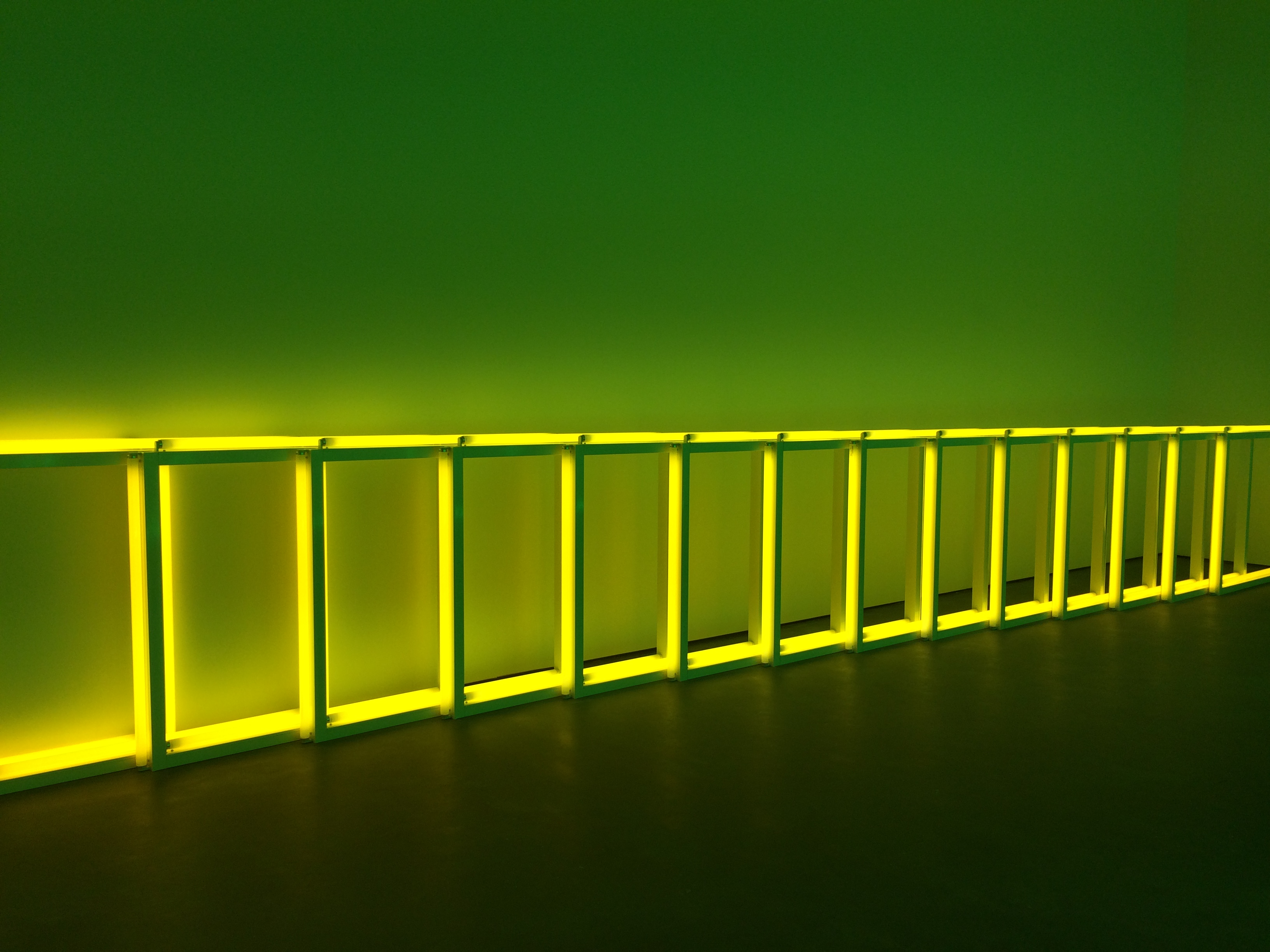
David Zwirner is presenting the exhibition “Corners, Barriers and Corridors” at the 20th street gallery. This show presents the work of Dan Flavin from the late 1960’s into the 1970’s. The artist is famous for his use of fluorescent light constructions to define geometry within a space.

15-39-1

“Untitled (to Sonja)”, 1969

Much of Flavin’s work involved the use of straight lines and grids. I was particularly happy to see a work that was all about circles.

15-39-2

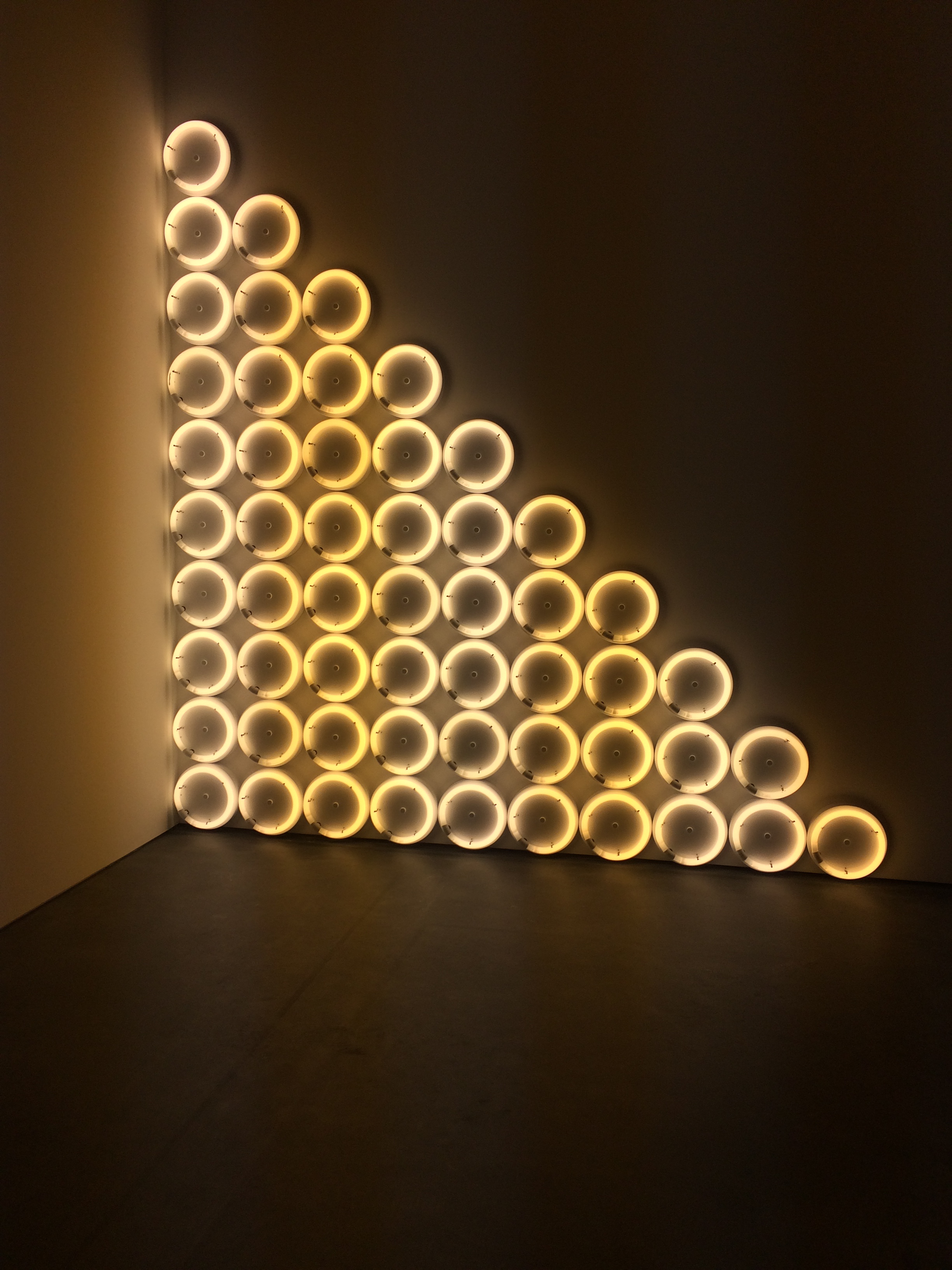
“Untitled (to a man,George McGovern) 2” ,1972

Situated in the corner of the room “Untitled (to a man, George McGovern) 2” from 1972 is made up of a series of columns of circles of light. They descend in order from a height of ten circles to a single circle. The juxtaposition of the curves of the circles with the straight edges of the corner space and the placement of the circles with in a grid creates an interesting tension. The 45 degree angle produced by the descending columns gives the illusion that the circles are rolling down the construction. Dan Flavin is known as a minimalist and this work uses only the most basic elements, circles within an environment of straight lines, but the impact is impressive.

Susan Happersett

Topologist’s Pool Toy

We have been having a hot and humid week in NYC so it was probably not the most well advised plan to go traipsing around the Lower East Side. I was thinking to myself what am I doing here in the midday sun walking from gallery to gallery and then… I saw this amazing sculpture that just seemed to scream Mathematics in the Summer time.

15-30-1
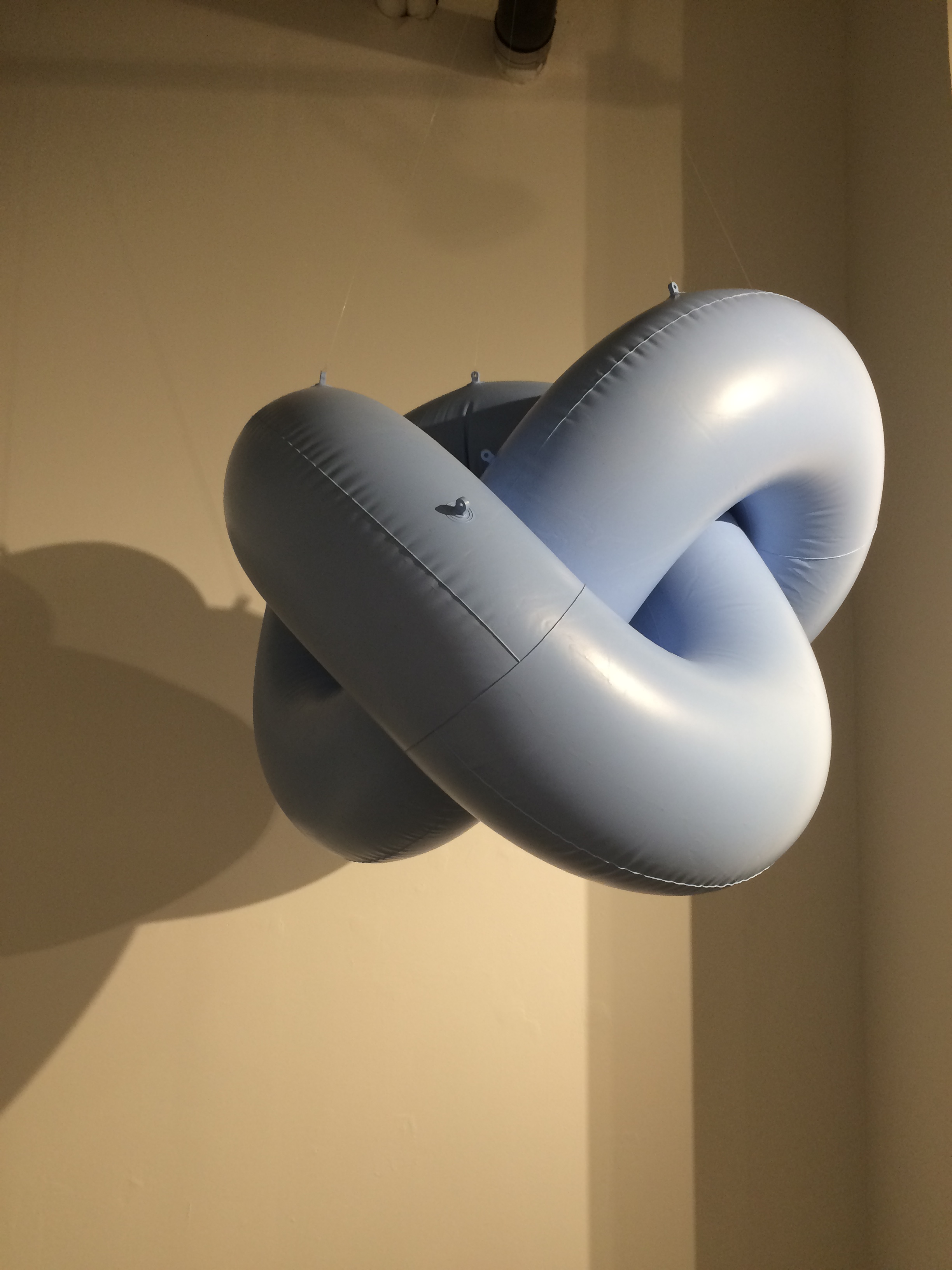
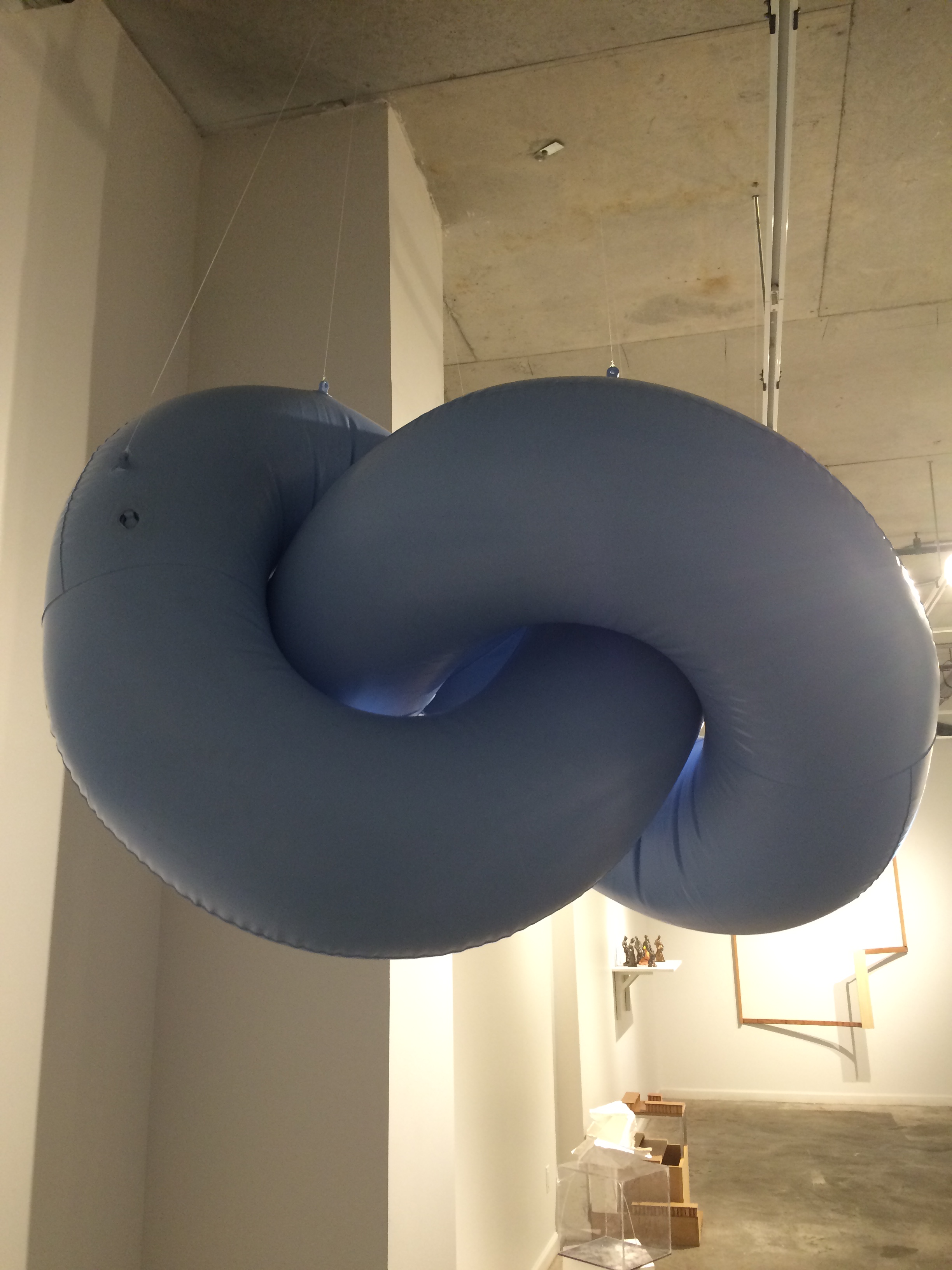
This inflated vinyl hanging form”Squirm” is the work of Doreen McCarthy and is part of the group show titled “Object’hood” at the Lesley Heller Workspace. This sculpture has the materiality of a classic tube used for floating around in a pool on a steamy afternoon. Topologically we think of the traditional pool toy as being a donut-like torus, but this baby blue version is a knot instead. It is a 3D interpretation of a trefoil knot, Which is a basic overhand knot with the ends joined together. I found “Squirm” to be a refreshing topographical Summer treat.
15-30-2Susan Happersett

Rotational Printing by Dikko Faust at Purgatory Pie Press

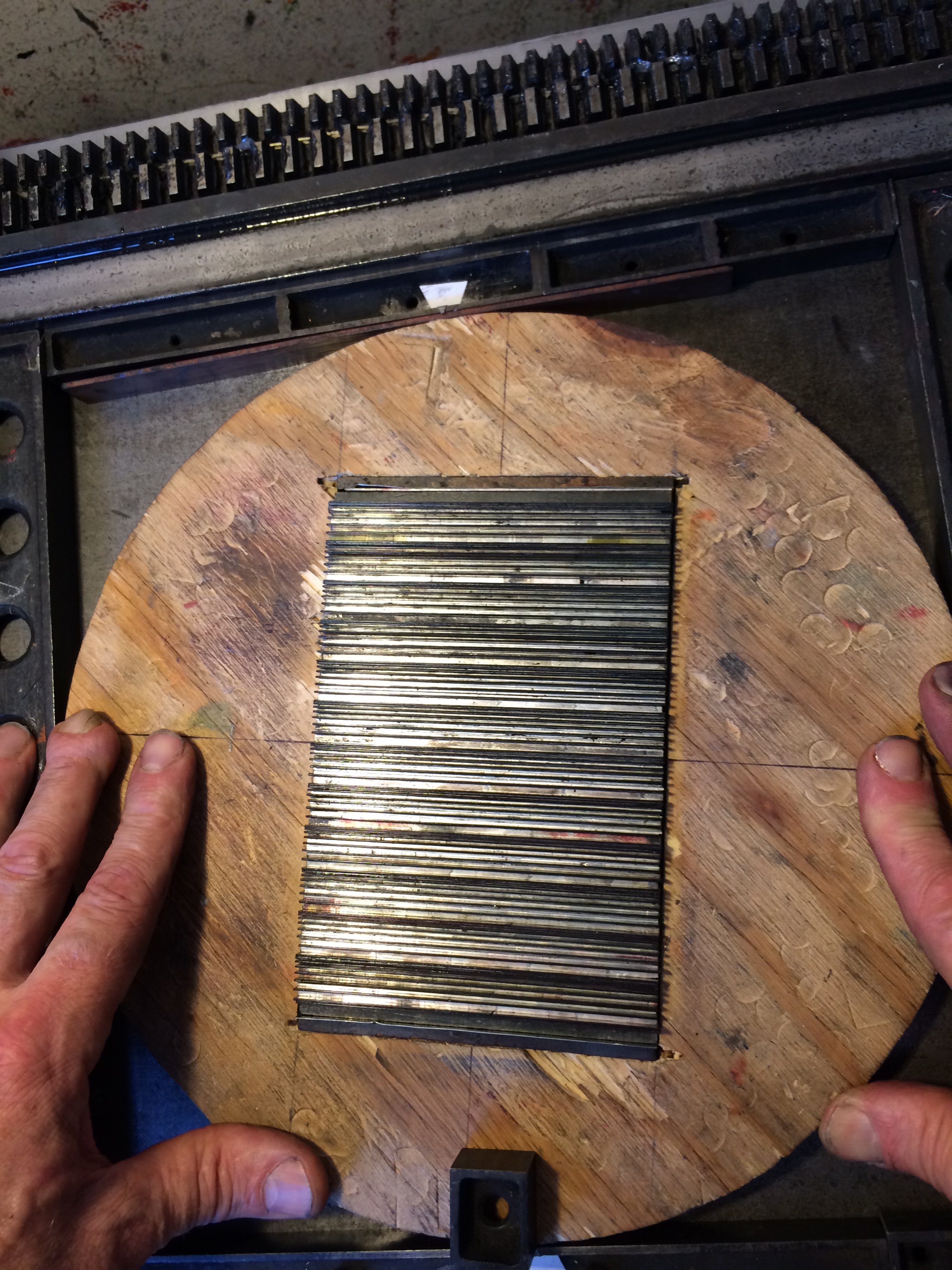
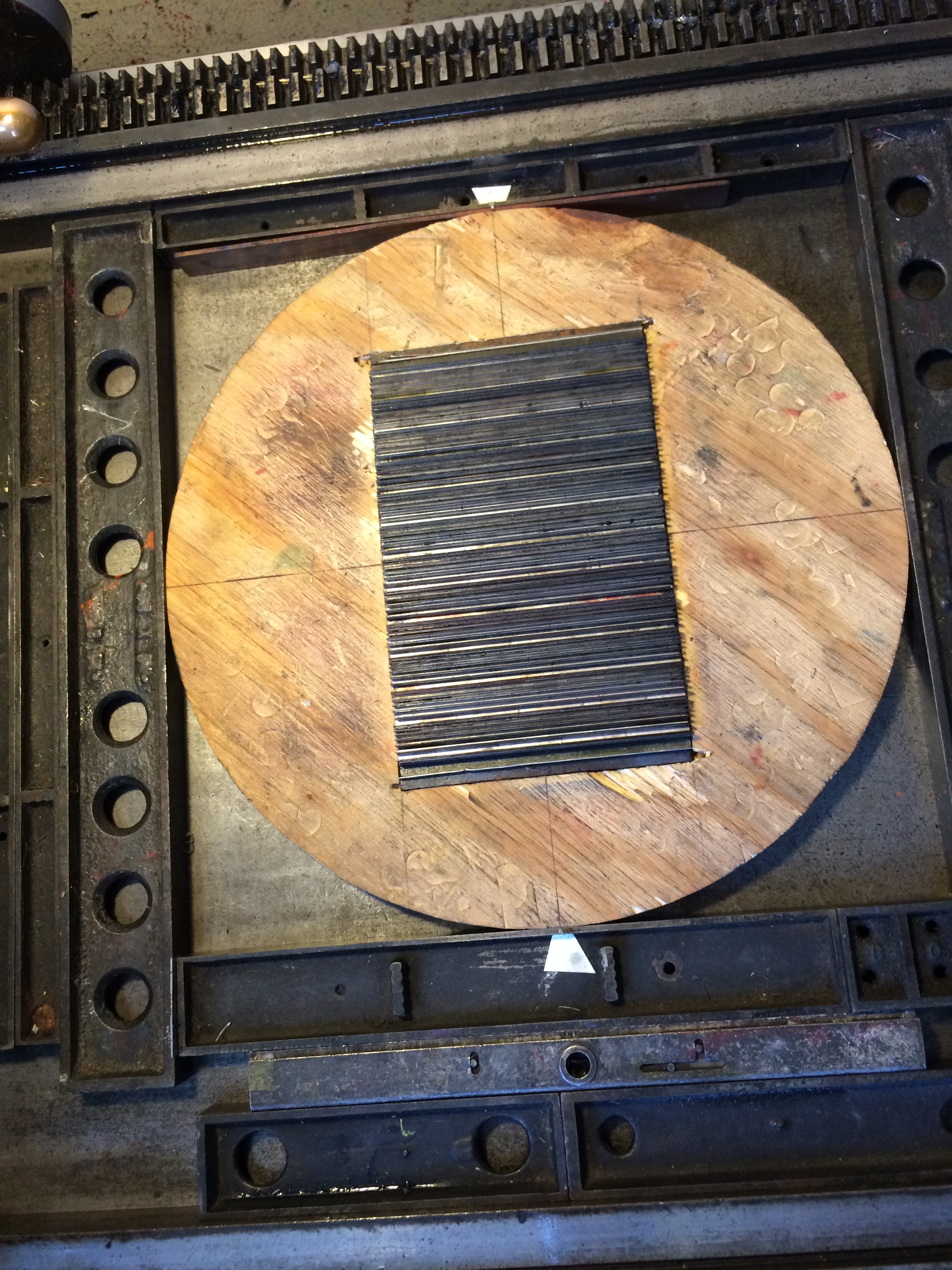
Dikko Faust has been making prints using rectangular sections of grids and other geometric line patterns. By shifting the grids across the plane he has created a series of overlapping prints. Recently he has added a new twist to his process. Faust has invented a new printing tool that allows him to rotate the rectangle around a central axis point.

15-28-01

(A quick note about printers’ measurements: In the print studio distances are measured in picas and points. One inch is equivalent to 6 picas and 1 pica is equivalent to 12 points.)

To measure the rotation of the rectangle, Faust uses a straight edge to form a line from the bottom corner of the rectangle that is perpendicular to the horizontal  bottom edge of his press, and then measures how far from the center point to the horizontal line. The initial measurement for a straight up and down rectangle would be 12 picas from the center (the rectangle is 4″x 6″ or 24 by 36 pica).
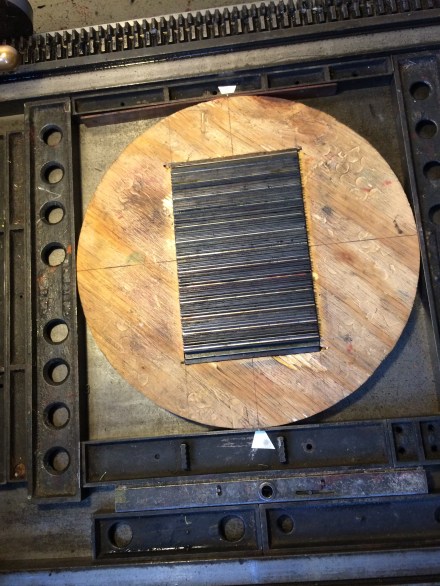
15-28-02

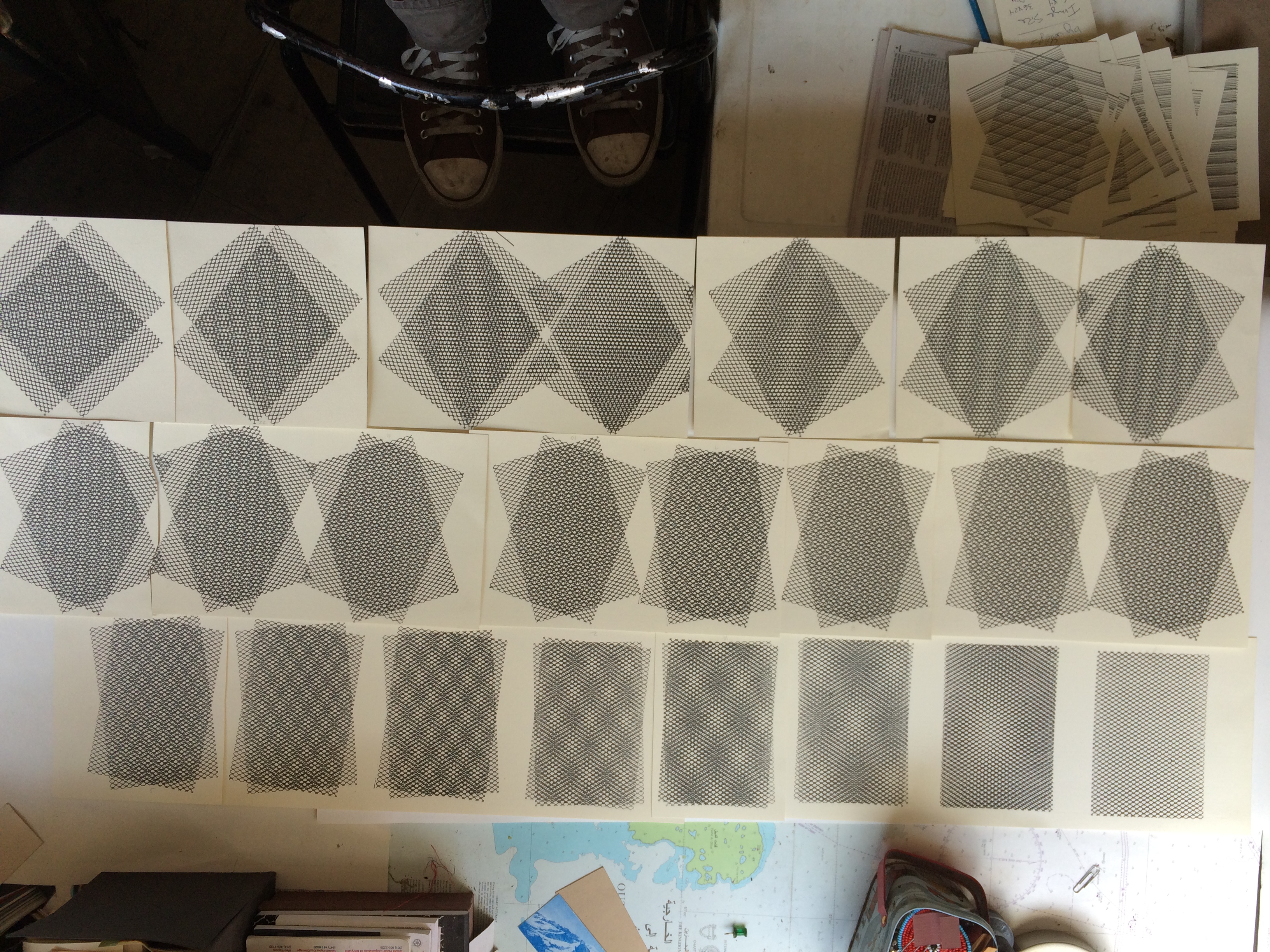
Faust has been experimenting with what happens to different patterns throughout  the rotation process
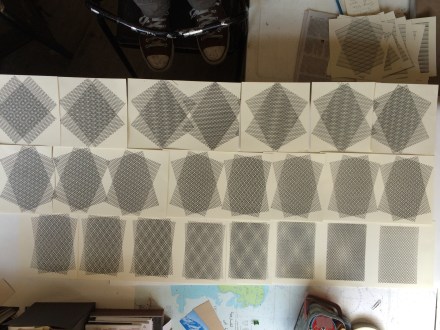
15-28-03

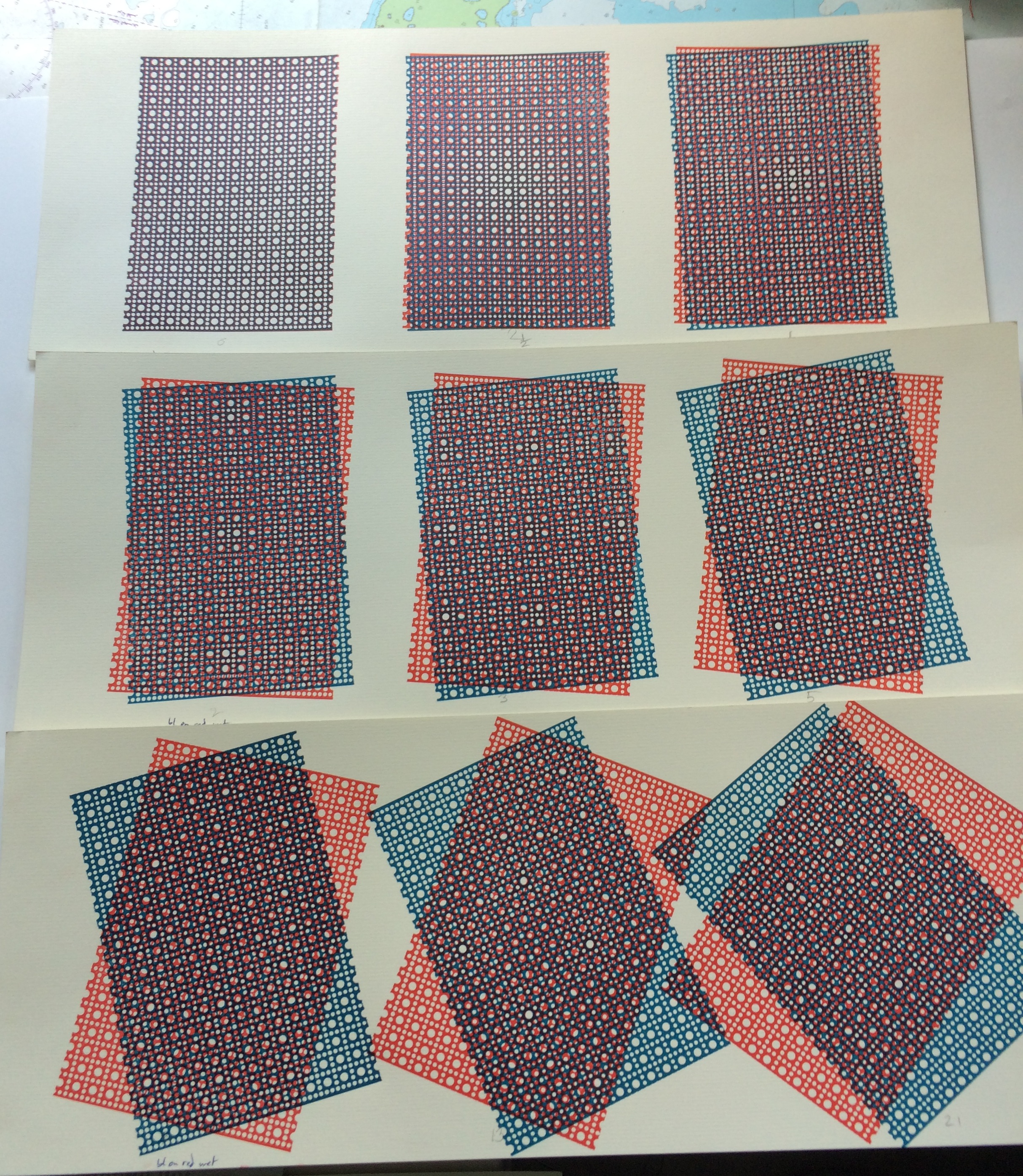
To better explore the relationship between the grids,Faust has made series of two-color prints. He has selected only the prints that are the most visually interesting. Making consecutive prints with the number of ratio of pica differences to correlate with the Fibonacci Sequence is one technique.
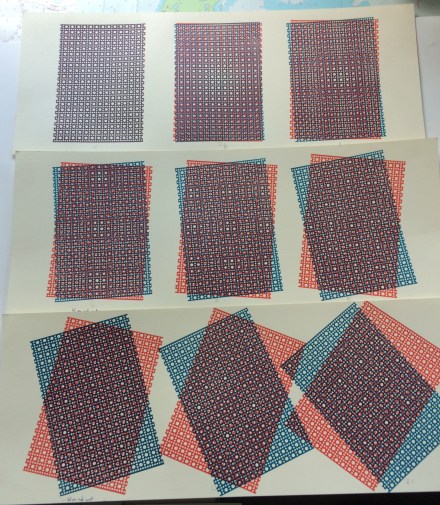
15-28-04

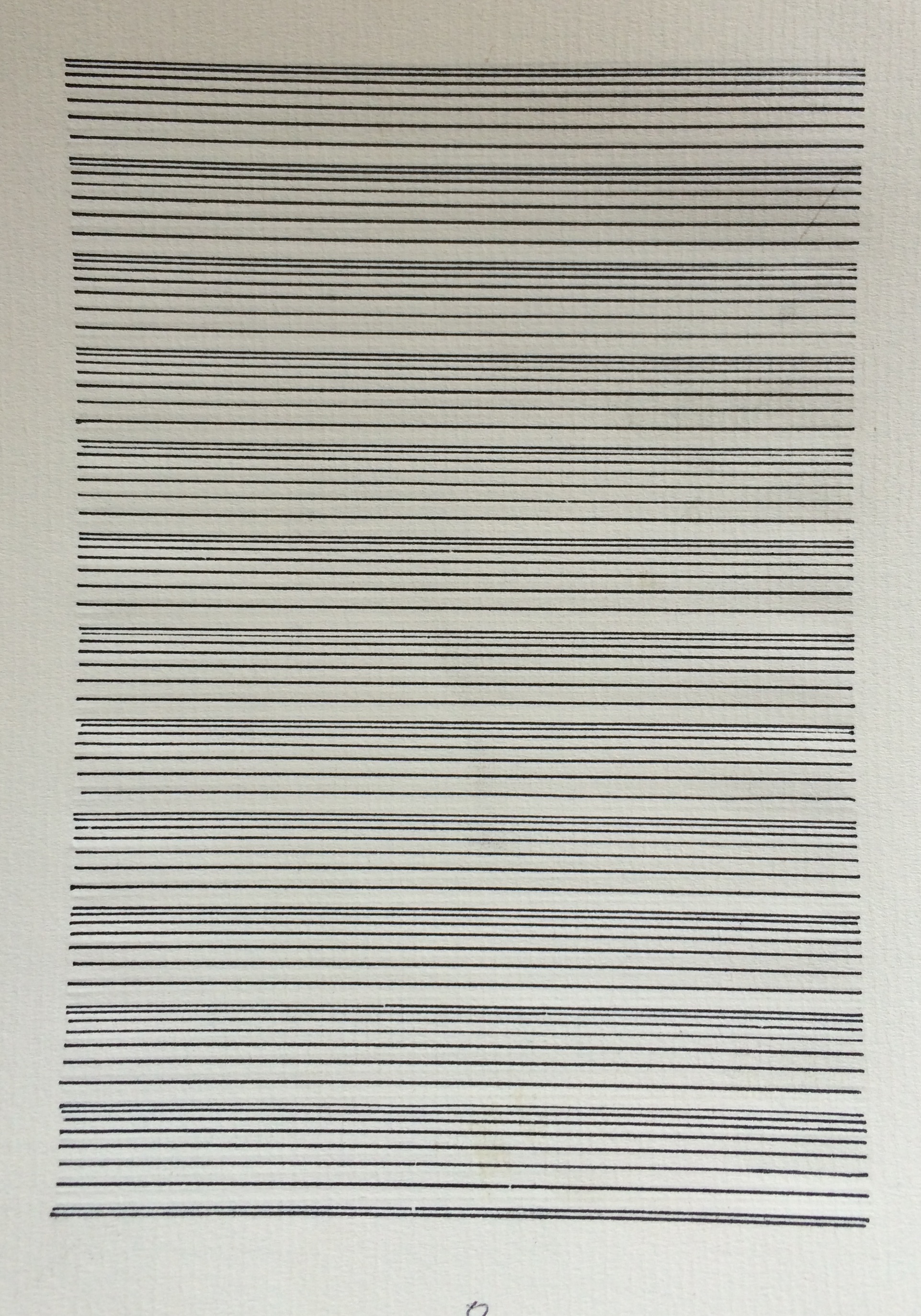
The day I was in the studio, Dikko was working with a pattern he had created using airline (1/2 point) rules. He used parallel lines: there is 1 point of space between the first two lines, 2 points between the 2nd and 3rd line, then 3 points between the 3rd and 4th….. up to 6 points of space between the 6th and 7th line. Then the whole pattern repeats 12 times.
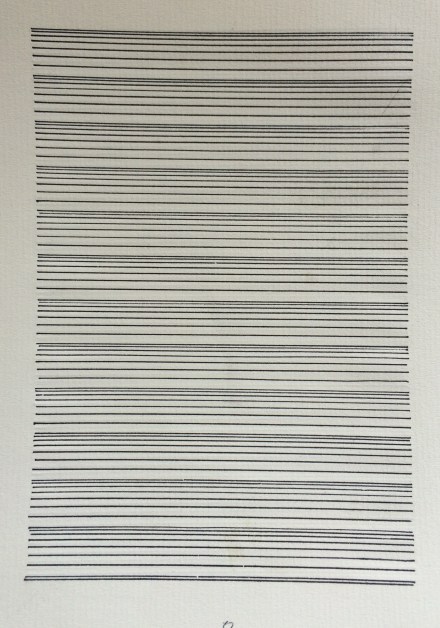
15-28-05

While I was at the printing studio Faust was making a single print with multiple rotational images. I took pictures throughout the process.

15-28-06

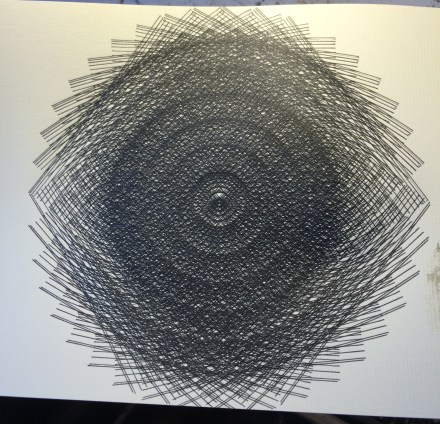
This is an early stage of the process: it has the original line print plus a 5 pt and 10 pt rotation clockwise and a 5pt and a 10pt rotation counter clockwise.
15-28-07

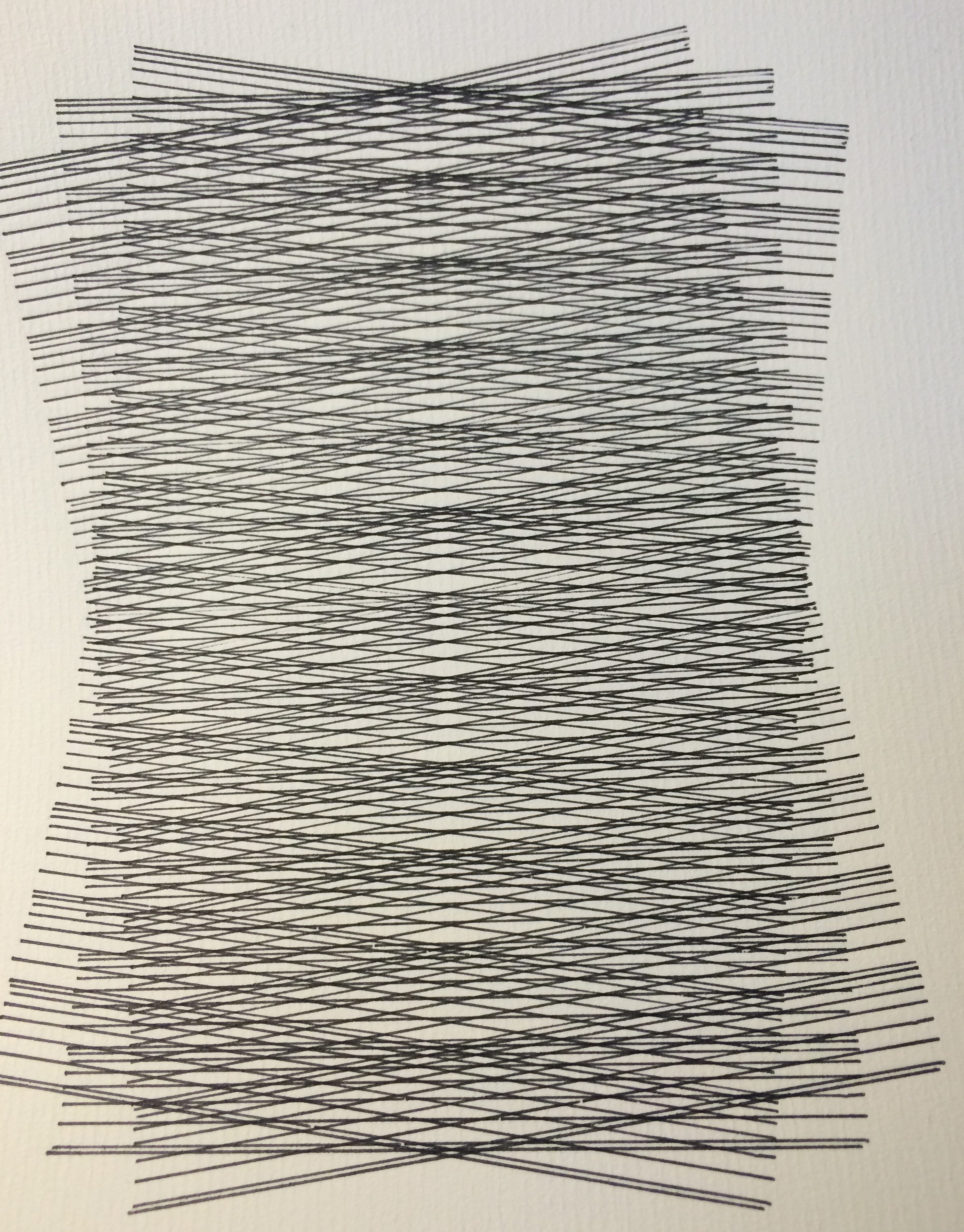
This is the finished print. There are 5pt, 10 pt, 15 pt, 20 pt, and 25 pt rotations in both the clockwise and counter clockwise directions. The process that Faust has developed to create these new prints is very algorithmic. It requires a commitment to experimentation trying different patterns and rotations. The outcomes are then judged on their aesthetic merit determining which prints are to be  completed works of art.

Susan Happersett
 

Eureka at Pace Gallery

The current exhibition at Pace Gallery takes its name from the Edgar Allan Poe poem from 1848.  The press release contains a quote from the poem: “I design to speak of the Physical, Metaphysical and Mathematical-of the Material and Spiritual Universe: of its Essence, its Origin, its Creation, its Present Condition and its Destiny…….”

This group show features work form the 1840’s to 2010 that builds a links between science and Mathematics and the artistic spirit. In one of the first galleries there is a copy of Edwin Abbot’s 1884 book “Flatland: A Romance of Many Dimensions”. In this novel Abbott creates a two dimensional society and introduces a three dimensional character with interesting results and exciting prospects about further dimensional expansion. Abbott’s art allows his readers to imagine the possibility of a fourth dimension, a Mathematical idea that was very new at the time.

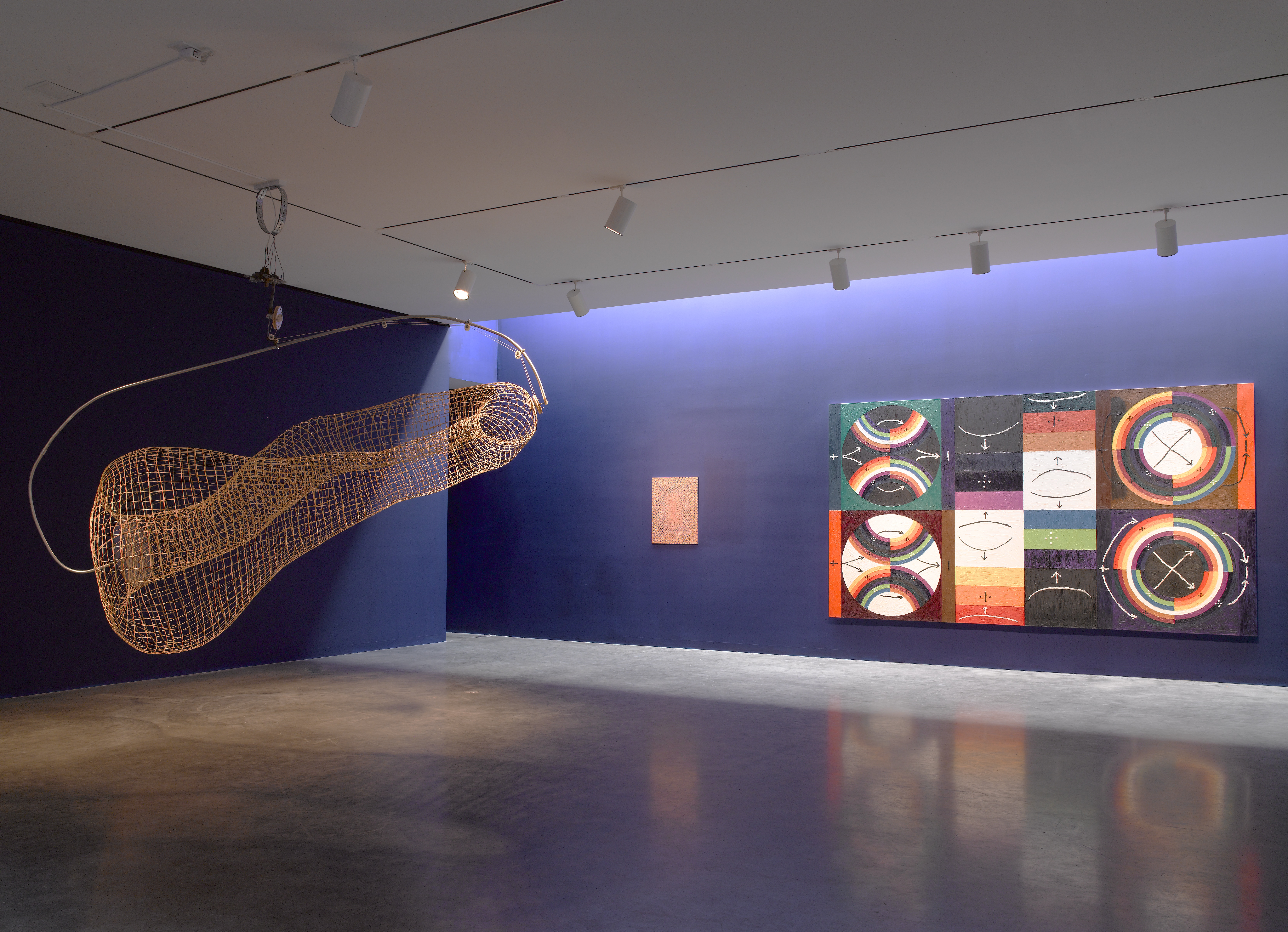
Installed in the largest room of the gallery is Tim Hawkinson’s large rotating sculpture “Gimbled Klein Basket” a wonderful homage to the “Klein Bottle”. A Klein Bottle is an impossible form first introduced by mathematician Felix Klein in 1882. Like a Moebius strip it has only one side, but a Klein Bottle has no boundaries, whereas  a moebius strip has boundaries at its edges. Compare to, for instance,  a sphere, which has no boundaries either.

Video

The basket structure of Hawkinson’s “Gimbled Klein Basket” creates an interesting grid pattern on the shape, adding another visual element to the form. The hand crafted quality of the object makes it seem as if this shape is actually possible in 3-D. By rotating the sculpture the viewer has  a chance to examine the form from all angles.

15-24-2

Installation view of the exhibition, Eureka, Pace Gallery, 508 West 25th Street, New York, May 2–June 27, 2015. From left: Hawkinson, Gimbled Klein Basket, 2007; Siena, Battery, 1997; Jenson, Physical Optics, 1975. Photograph by Tom Barratt, courtesy Pace Gallery.


Mark Knoerzer at Bertrand Delacroix Gallery

Picture courtesy of the gallery and the artist

Susan Happersett

Phil Wagner at UNTITLED Gallery

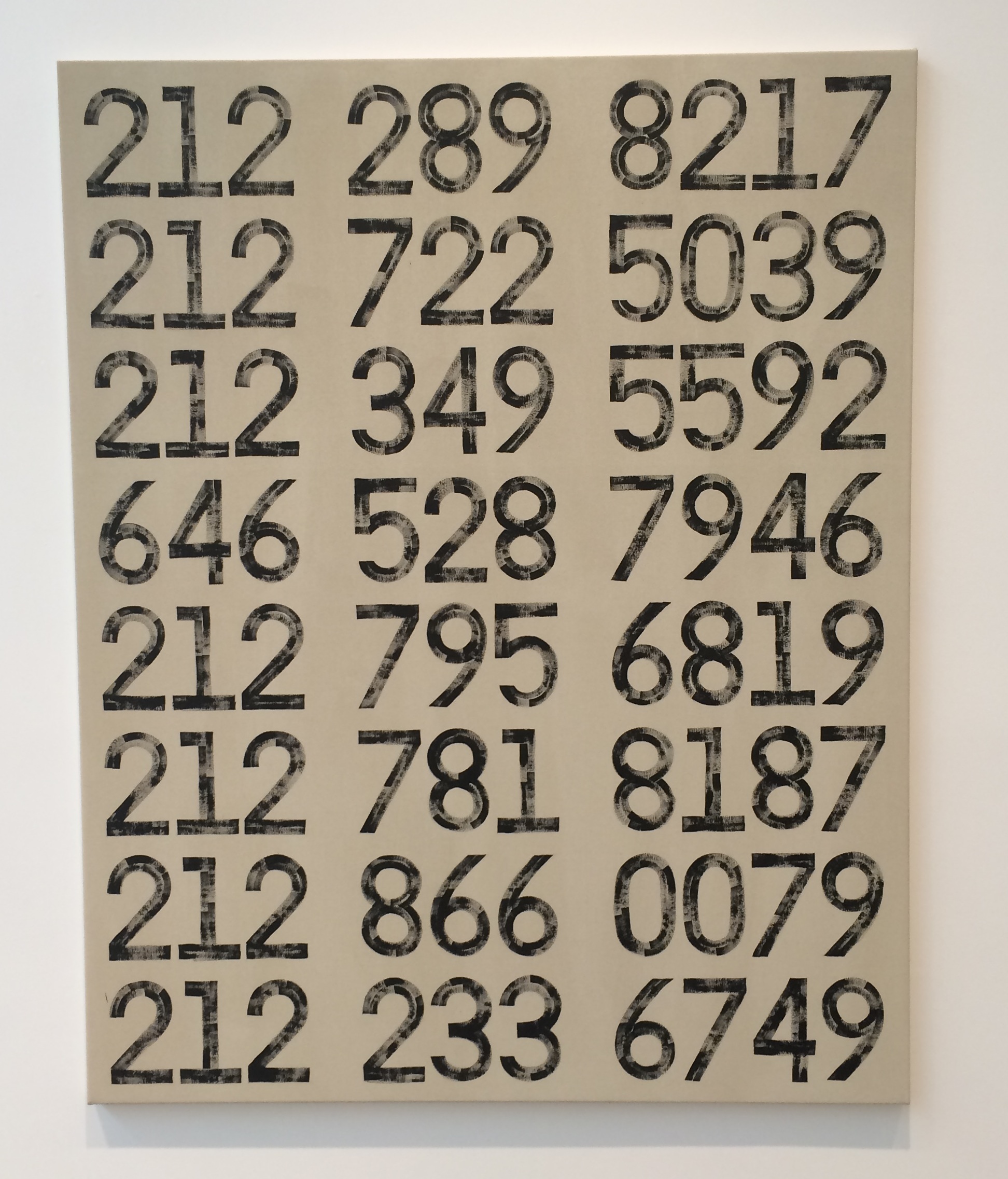
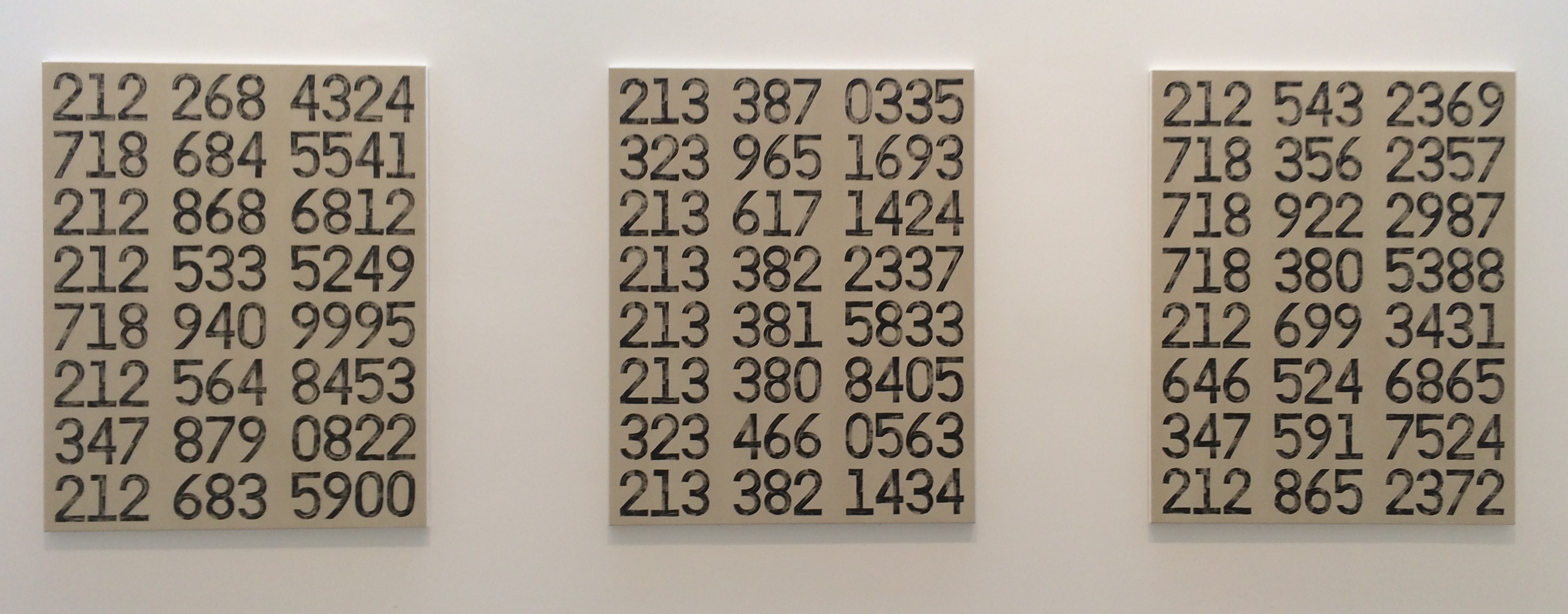
The exhibition “It’s Been Too Long” at the UNTITLED Gallery on Orchard Street features a recent (2015) series of paintings based on telephone numbers. Wagner has randomly selected telephone numbers from the NYC and LA white pages. He paints columns of the enlarged numbers.

15-18-1
The numbers have been painted with uneven brush strokes so that the resulting numerals look as if they have been stamped with an old fashioned rubber stamp and ink pad onto the parchment-colored background. These paintings are an exploration into society’s association with numbers. The rows and columns of numerals become abstract geometric patterns. Removed from the initial source they lose their meaning and purpose. The whole concept of a paper telephone directory is becoming obsolete. In this digital age the once important pages are becoming visual artifacts.

15-18-2
The gallery installation fills an entire room with these canvases, creating an environment of numerals. As some one who likes to work with numbers, I found it quite soothing, almost meditative. It makes me think of all of the other places we see numbers: train cars, mileage signs along the road, credit card numbers, etc… and never stop to think about the aesthetics. Numbers are an important part of our lives but quite often we tend to only use them for practical applications, never stopping to appreciate their visual qualities.

Susan Happersett
Karen Schiff at BravinLee Programs

At their Chelsea gallery, BravinLee has a vitrine dedicated to the display of Book Arts. Works that address the topics of typography and linguistics are considered part of the Book Arts genre. Currently on display are recent prints by Karen Schiff. These works are created using alphabetic and numeric rubber stamps. The artist prints on various types of commercial stamp album graph paper in a very small scale grid.

15-13-1

Karen Schiff – “oOo” 2015 Ink graphite, and watercolor on stamp album paper
Picture courtesy of the artist and the gallery

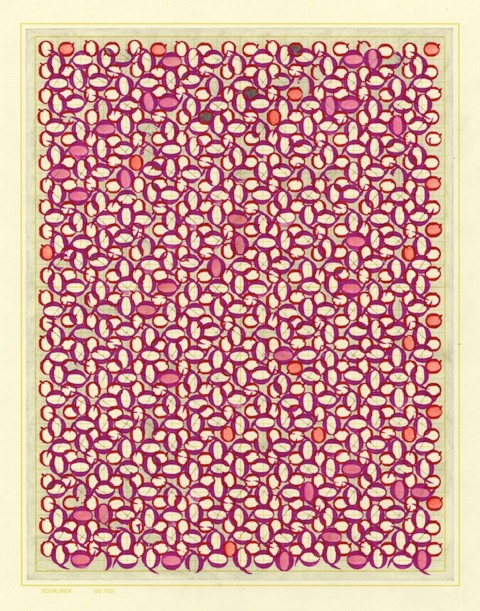
“oOo” from 2015 is a type of tiling constructed out of zeros and capital letter O’s. The artist takes advantage of the two-fold rotational symmetry of these forms. By rotating the figures 90 degrees and overlapping the edges, Schiff has filled the rectangular plane with ellipses. This print is an exploration of the geometry of these two typographic elements.

15-13-2

Karen Schiff – “mmm…” 2014 Ink, graphite, and gouache on stamp album paper
Picture courtesy of the artist and the gallery

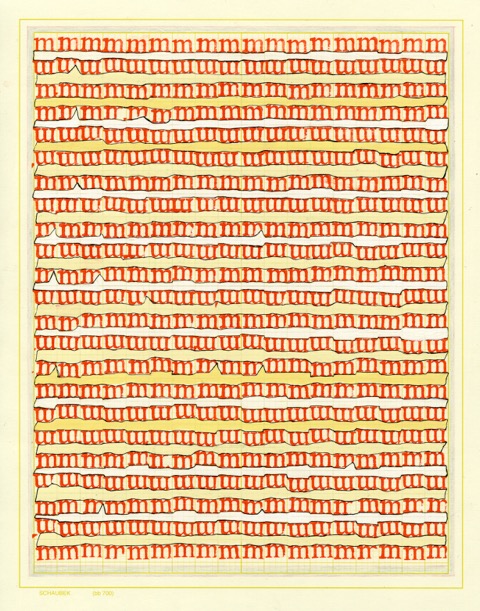
“mmm…” made in 2014 is composed using only one type of rummer stamp, the lower case “m”. At first glance, the image appears to be a horizontal rows of vertical marks, but upon closer inspection you see the top curves of the m’s. What makes these rows of m’s interesting is the fact that the letters have no symmetry, but lined up appear to create a consistent pattern.

Schiff hand stamps each of these letters individually to form detailed images. The imperfections of the printing process create slight discrepancies in the patterns. This is an important part of Schiffs artistic process. By removing the letters and numbers from a traditional text format of works or calculations they lose their direct linguistic and numeric connotations, becoming abstract forms. This allows the viewer to explore the abstract shapes geometrically. We look at numbers and letters all day with out thinking mathematically about their shapes. In this his new series of prints Schiff has invited us to look at numbers and letters in a different way.

Susan Happersett
Geometry at the Armory Show

For one week each March New York City becomes the epicenter of the contemporary international art world. There are at least 6 art fairs all running pretty much simultaneously. The largest is the Armory Show. It is too huge to fit in the Armory so it takes place on two huge piers on the Hudson river. Over one hundred gallerists form all over  the planet set up exhibitions rooms to showcase the their inventory. The opening night is a very noisy, crowded and rather intimidating event. I saw quite a bit of art with Mathematical subject matter. For this blog entry I have decided to focus on three works that are about Geometry.

15-12-1

Gabriel de la Mora at Sicardi Gallery

Sicardi Gallery from Houston Texas featured this amazing construction by Gabriel de la Mora at the entrance to their booth. This work is a nod to minimalist paintings from the 1960’s and 70’s but with a twist. It is composed of match boxes.The red brick shaped rectangles that make up this work are actually the red phosphorous paper you find on the striker of a match box. This unexpected choice of material makes us look at the repetitive nature of the geometry with a more emotionally charged reference point. Adding the element of fire changes the theme of the work, but the geometry stays true to the Minimalist roots.  La Mora’s background as an architect is apparent in the precision involved in the creating the parallel lines to form the concentric rectangles. This work also has both a horizontal as well as a vertical line of symmetry.

15-12-2

Julio Le Parc Galeria Nara Roesler

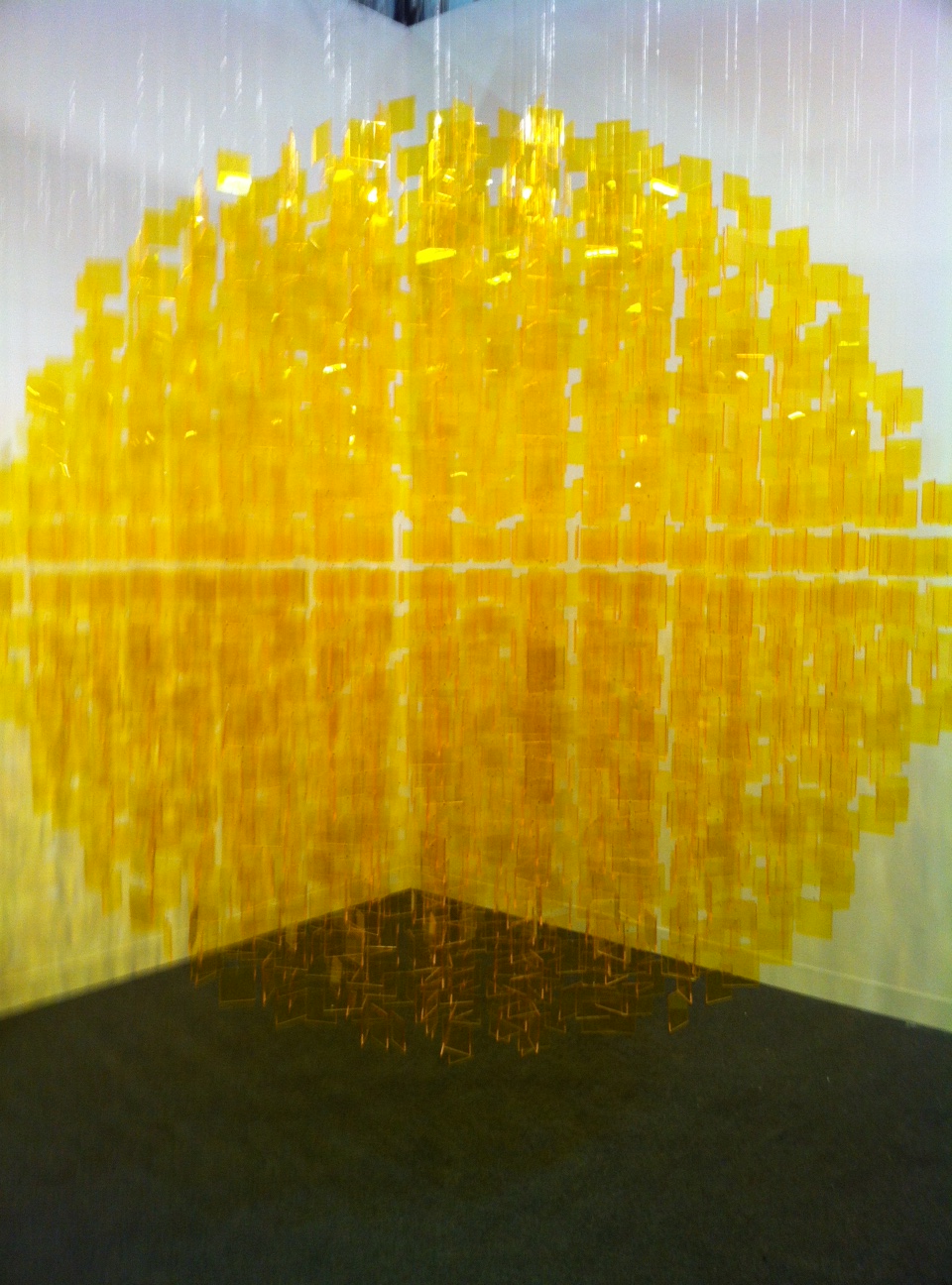
The large mobile installation by the famous Argentinian artist Julio Le Parc at the Galeria Nara Roesler (Sao Paulo) is a sphere composed of small flat rectangular acrylic shapes. There is a great sense of movement in this sculpture, and the semi-transparent yellow pieces of acrylic play with the light. It almost seems like magic that a grid of rectangles can render such a lively sphere.

15-12-3

Claudia Wieser at Sies+Hoke Galerie

Claudia Wieser’s ceramic wall installation takes center stage at Sies +Hoke Galerie from Düsseldorf, Germany. The images of this work feature a right triangle, an isosceles triangle, as well as two circles. It seems to pay homage to a geometry text book. What I find visually interesting in this piece is the use of tiles, which creates a secondary underlying square grid. This grid is instrumental in the coloring of the large circle.

I have been attending the Armory Show for years. In past shows there were times when there was very little presence of Mathematics in the art work presented, but this year I was quite pleased to find  a number of interesting examples.

Susan

David Scanavino at the Aldrich Contemporary Art Museum

The Aldrich Contemporary Art Museum in Ridgefield, Connecticut is celebrating its 50th Anniversary. Since its inception Aldrich has been committed to the collection and display of modern art, including some of the most important work in the areas of Minimalism, Conceptual, and Geometric art. The founder Larry Aldrich acquired the work of Eva Hess, Ellsworth Kelly, Agnes Martin, and many others. For the 50th anniversary a two part exhibition has been installed in the galleries over the past year. The curators have created a connection between the historical artwork from the early years of  the museum to contemporary art. Artists were asked to respond to the work from the 1960’s and 1970’s.
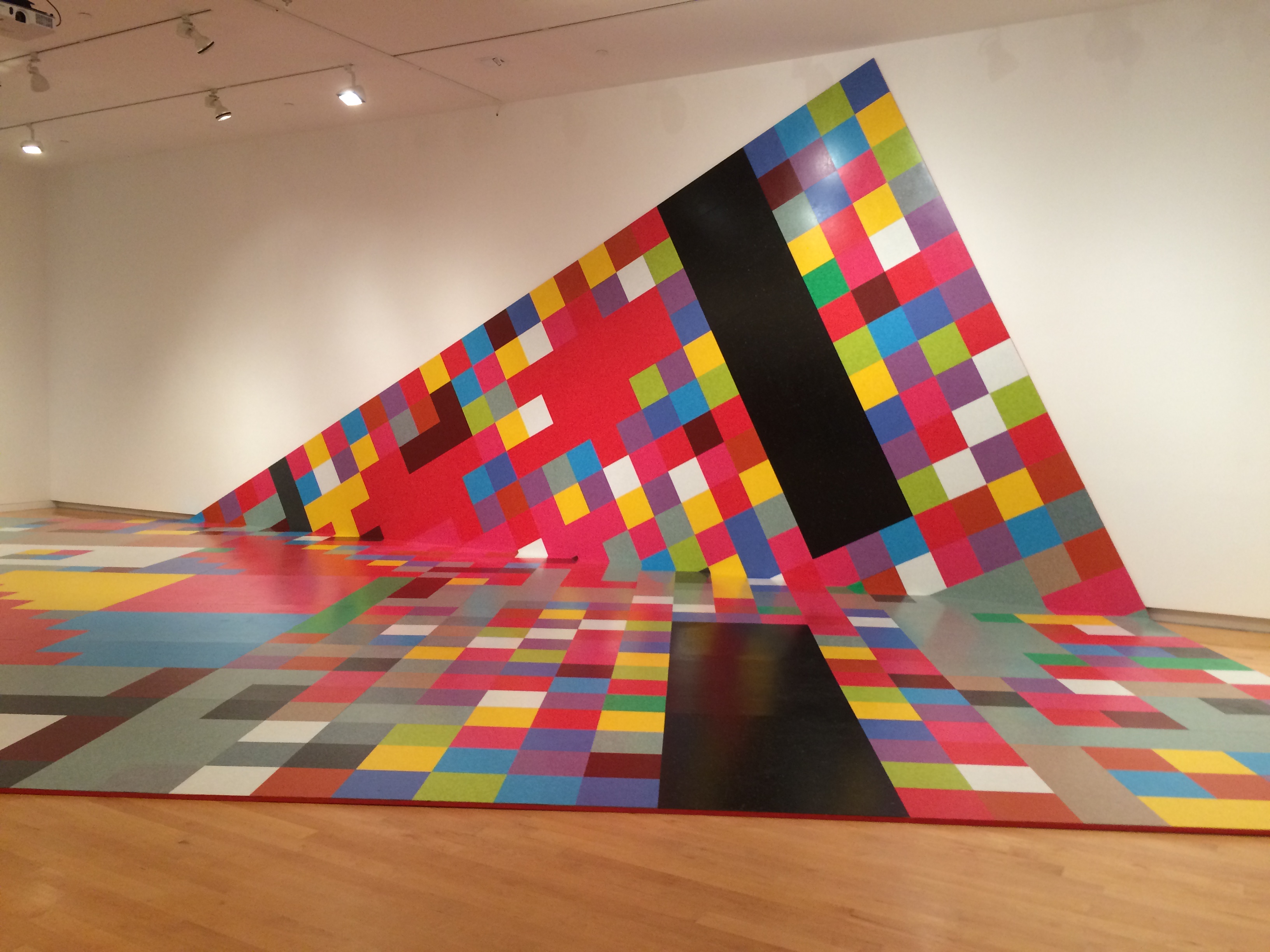
David Scanavino’s site-specific  room-sized installation “Imperial Texture” is the artist’s dialog with the work of Richard Artschwager. Artschwager is well known for his use of formica to make geometric forms that have the same shape as everyday items but can not actually be used as such. His sculpture “Pyramid Object” from 1967 was displayed near Scanavino’s installation.

15-9-1

“Imperial Texture” 2014
Courtesy of the artist and the museum

“Imperial Texture” consists of a grid of 1 by 1 foot square linoleum tiles that have been installed into the gallery at an angle so that they come off the floor and climb the walls. The tiling pattern was developed using computer software to make a digital model. This fact alone would make this a mathematically interesting piece. But what I find mathematically inspirational about this environment is the impact of a 2-D grid being retrofit into the  3-D rectangular box. The  traditional gallery space has a multicolored seemingly random patterned floor, that has been shifted leaving part of the floor uncovered. Scanavino’s decision to place the grid at an angle has created series of right triangles with their hypotenuses running along the lines where the walls meet the floors. “Imperial Texture” gives the museum visitor an altered sense of space. The linoleum floor we are accustomed to seeing on the floors of schools, stores and other industrial and institutional settings has shifted out of it’s practical floor covering purpose.

Susan Happersett

Audrey Stone at Umbrella Arts

The Umbrella Arts Gallery in the East Village is presenting a show titled “Off the Grid”, which features work that is created using a grid formation, or is displayed in a grid presentation.  Audrey Stone works with thread to produce  fine line patterns. Her work in this exhibition offers elegant representations of squares and grids.
18-8-3
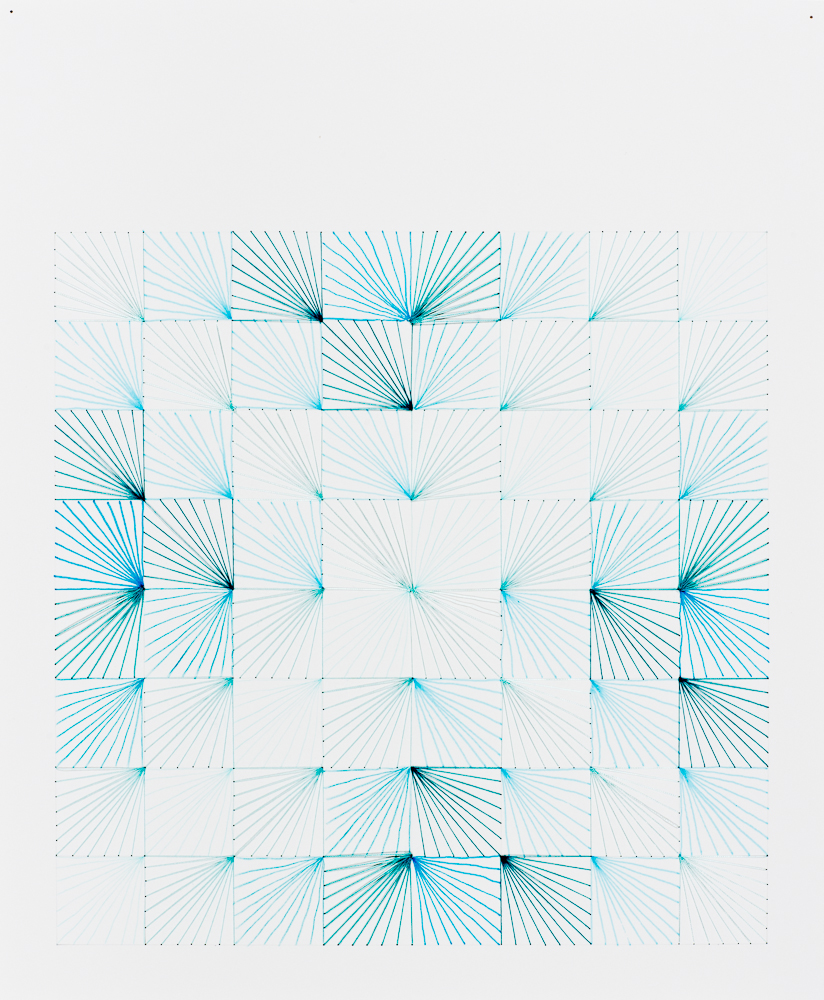
The thread drawing on paper “blue X” comprises of an 8 by 8 square grid. Each square has thirteen line segments radiating from one of its corners to points on the opposite sides of the square. The drawing has four-fold rotational symmetry. To achieve this symmetry, the artist has chosen from which corner of each grid square the line segments radiate. In the squares located in the upper left quarter of the drawing, the lower right corner is the point of where all thirteen line segments meet. In the upper right quarter of the work the lower left corner of each grid square is the radiating point. The lower left quarter of the drawing has the line segments all go to the upper right corner. And finally in the lower right quarter, the line segments radiate from the upper left corner.

18-8-4

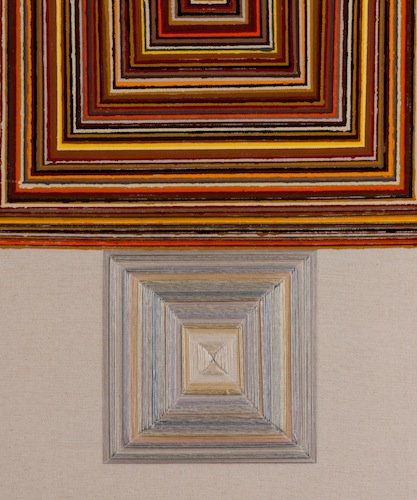
“The Lion and the Lamb” is a sewn painting, created with thread and paint on stretched linen. This work is more directly related to squares and the parallel lines of concentric squares. The top half of the piece shows half of a series of cencentric sqaures and uses paint. The form at the bottom of the canvas shows a series of complete concentric squares and is is sewn with thread onto the canvas.

Stone’s use of thread to create the lines in her drawings relates to traditional women’s needle work, but her subject matter is based in mathematical geometry.

“Off the grid” is on display at Umbrella Arts, 317 east 9th St until February 28. It is definitely worth a trip to the East Village.

Susan