Mathematical Art
It may seem unlikely to find Mathematical Art at a Folk Art Museum. The current exhibition at the American Folk Art Museum in NY features the work of what is often referred to as “outsider artists”. This term is controversial because it is very subjective what and who is inside or outside the standard “Art World”. It often means artists who have no official art training and are self taught or artists with medical or psychological or social situations that creates a position of isolation. There were two artists included in this exhibition who possessed an intense interest in mathematics.
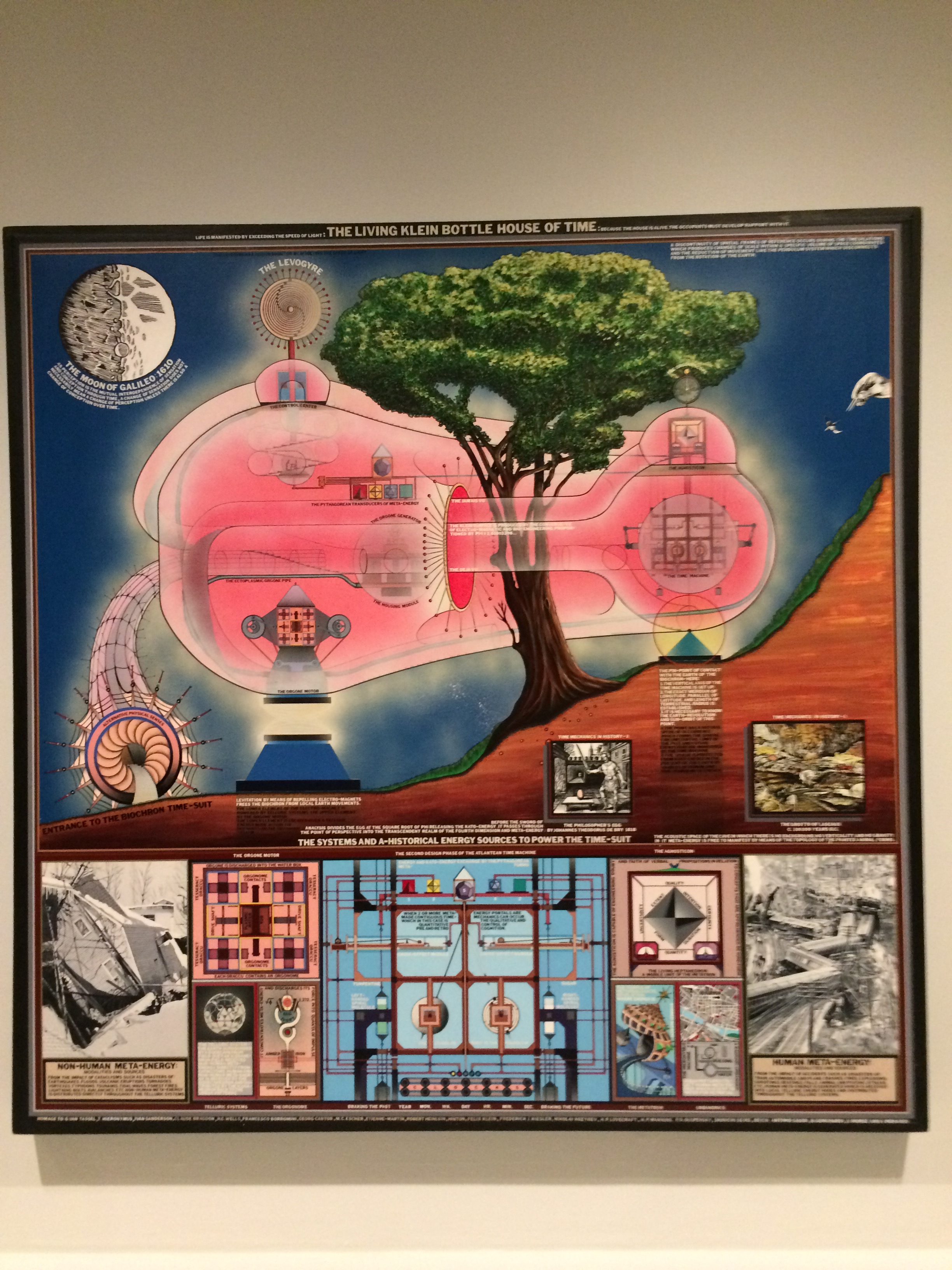
Paul Laffoley’s large painting “The Living Klein Bottle House of Time” from 1978 presents a fantastic schematic for life inside a Klein Bottle, complete with schematic diagrams. This painting offers us a unique perspective on Mathematics and society.
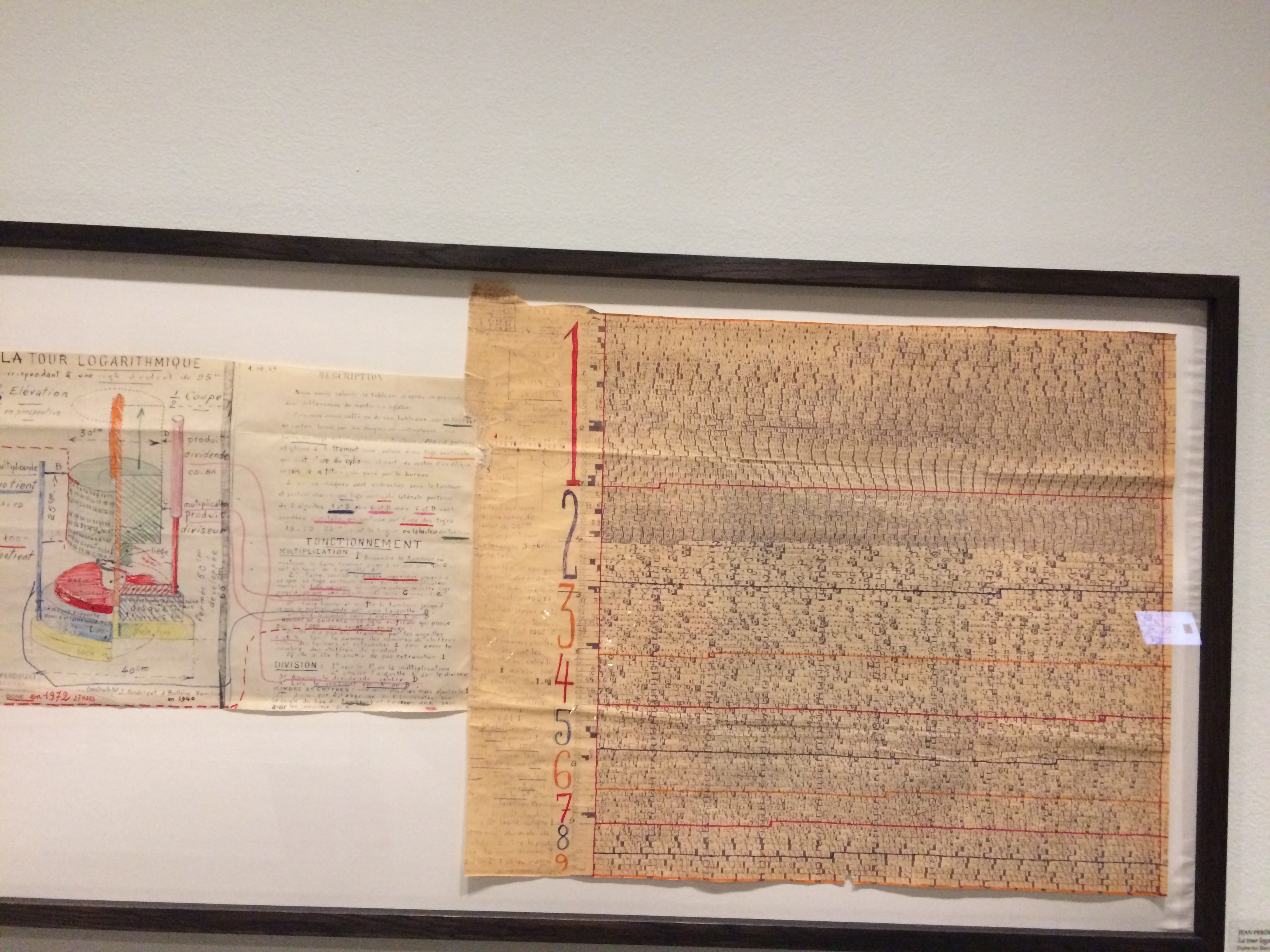
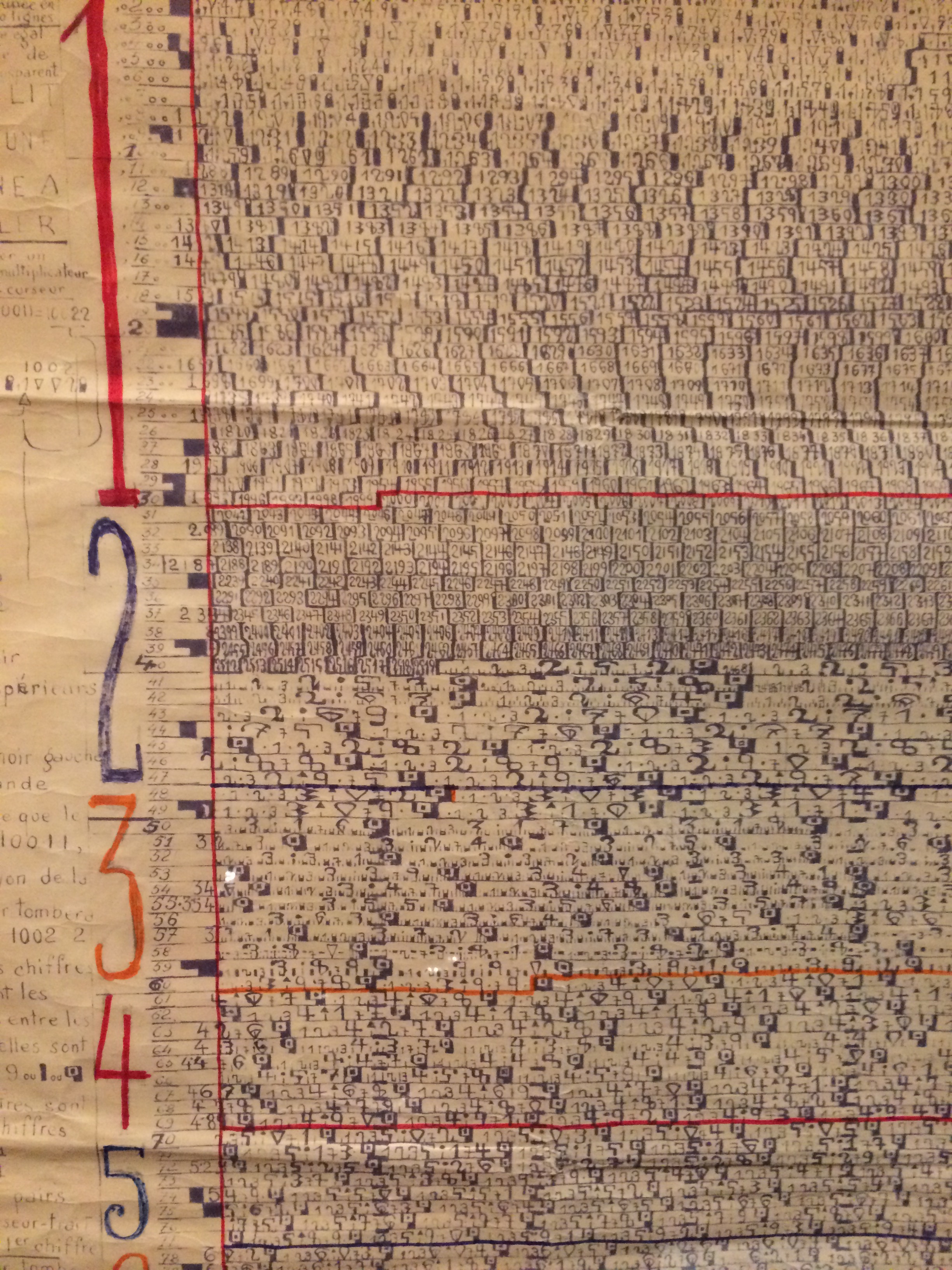
Jean Perdrizet’s series of diagrams for “La tour logarithmique (The logarithmic tower)” show the artist’s desire to create a object to solve mathematical logarithmic problems. The intense drawing and numbering reveal the emotional urgency of Perdrizet’s mission.
I have been writing this blog for a few years now and one of the things that I have learned is to look for art with Mathematical themes everywhere. I was so happy to discover these two amazing works, I feel they have a lot to reveal about how different people relate to Mathematics regardless if the artists are inside or outside the standard norms of Math or Art.
Susan Happersett
Richard Anuszkiewicz at Loretta Howard Gallery
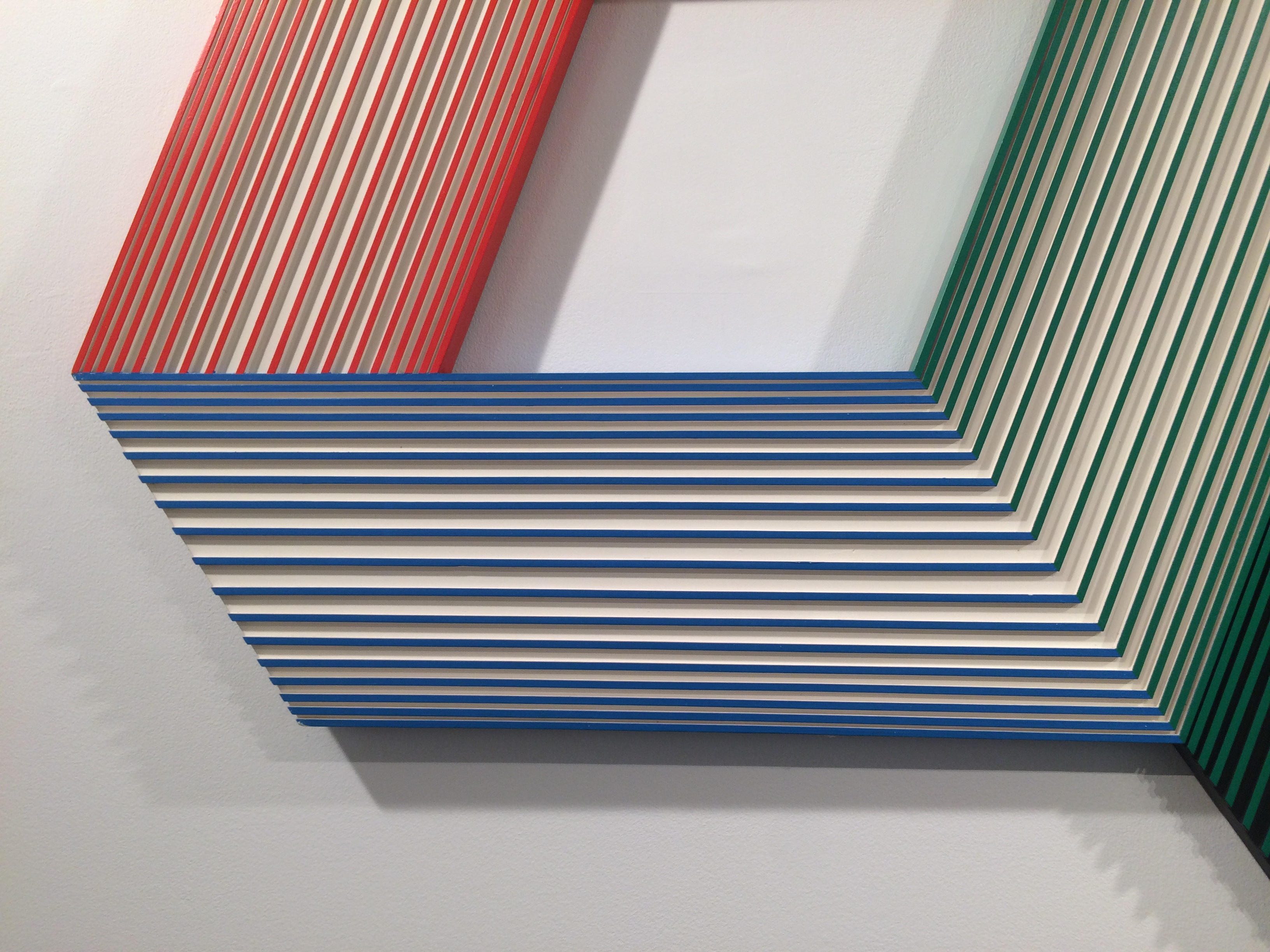
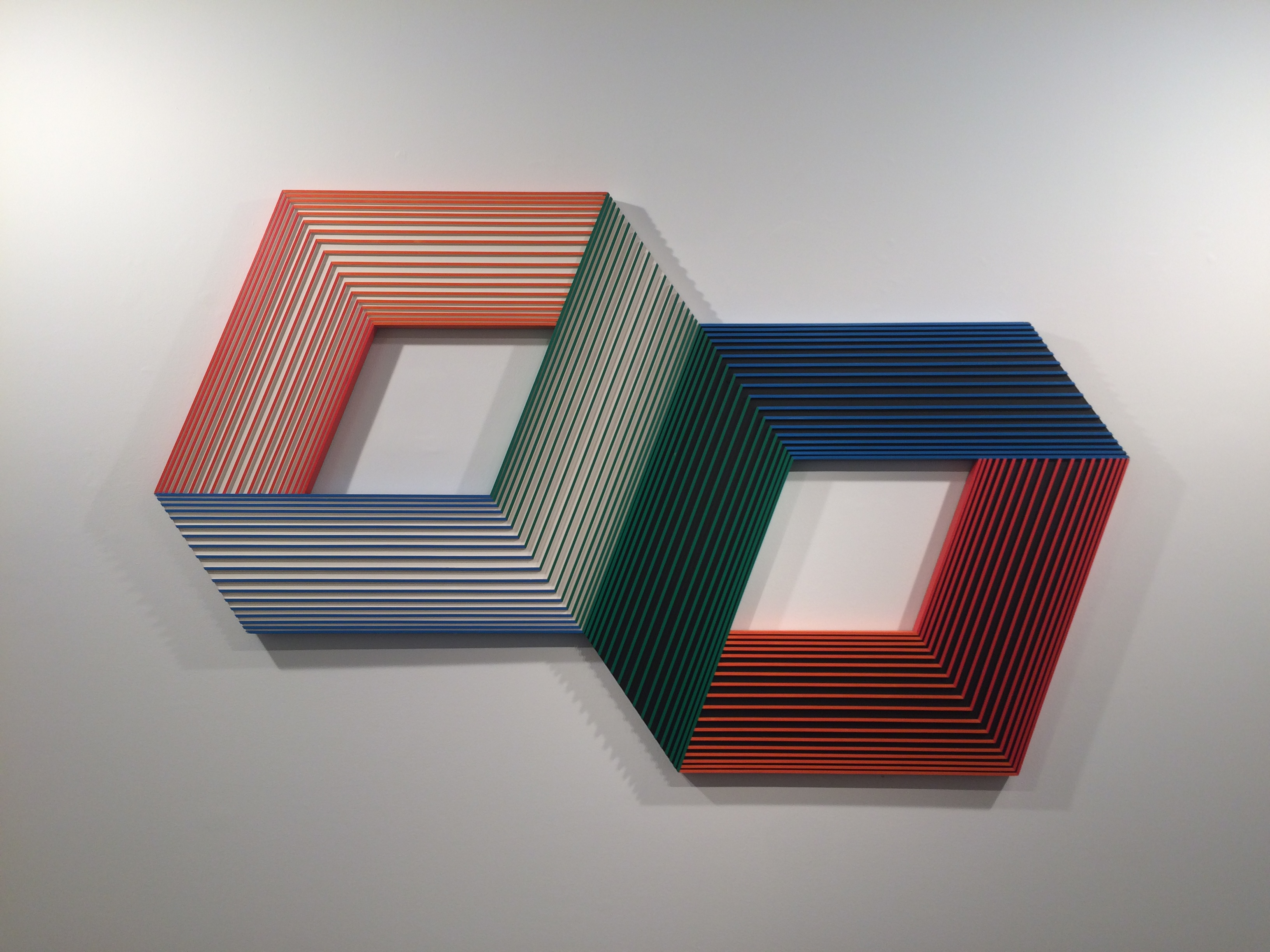
Richard Anuszkiewicz’s sculptural wooden wall constructions are currently on display in the exhibition “Translumina Series 1989-1993” at the Loretta Howard Gallery. These geometric forms present the illusion of three dimensionality but, except for low relief line carving the sculptures are flat.
“Orange Light- Day and Night” from 1990 resembles two open boxes with the openings angled in opposite directions. The left hand box opens upper wards towards the left and the right hand box opens down wards to the right. The use of parallel lines plays a important role in creation a sense of dimensionality.
The carved away white lines are thinner near the edges and thicker towards the center of each of the quadrilateral elements. This process has created the effect of shadows.
“Translumina- Marriage of Silver and Gold” from 1992 also features two open square boxes. In this sculpture the two geometric shapes appear to be entwined, creating a more complex representation of foreground and background. Anuszkiewicz’s geometric paintings offer the viewer contrasting perspectives on space. Low profile wood carving gives the work an objectness, actually coming slightly off gallery wall, but the work seems to be much more dimensional.
Susan Happersett
The Beautiful Brain: The drawings of Santiago Ramón y Cajal
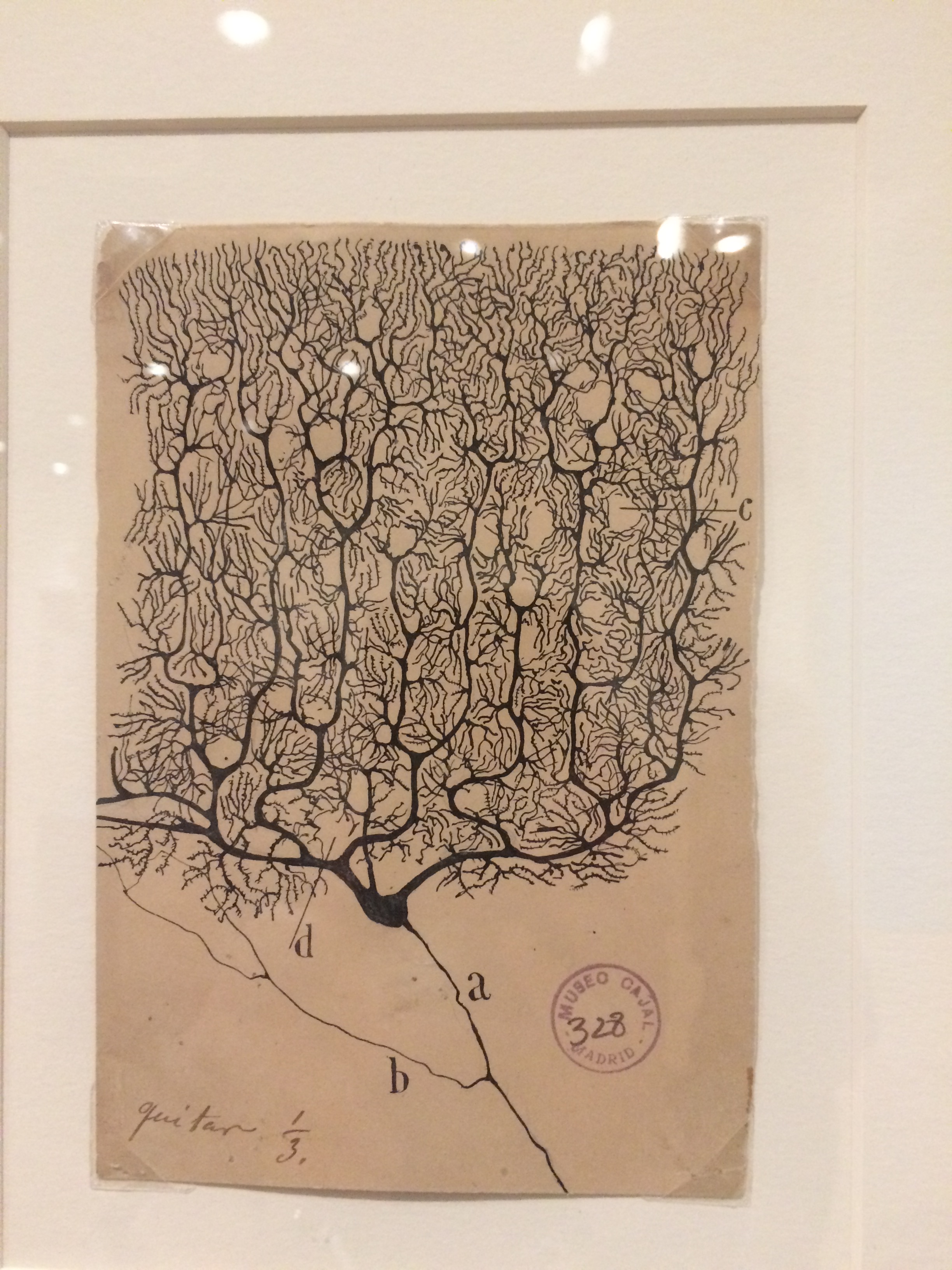
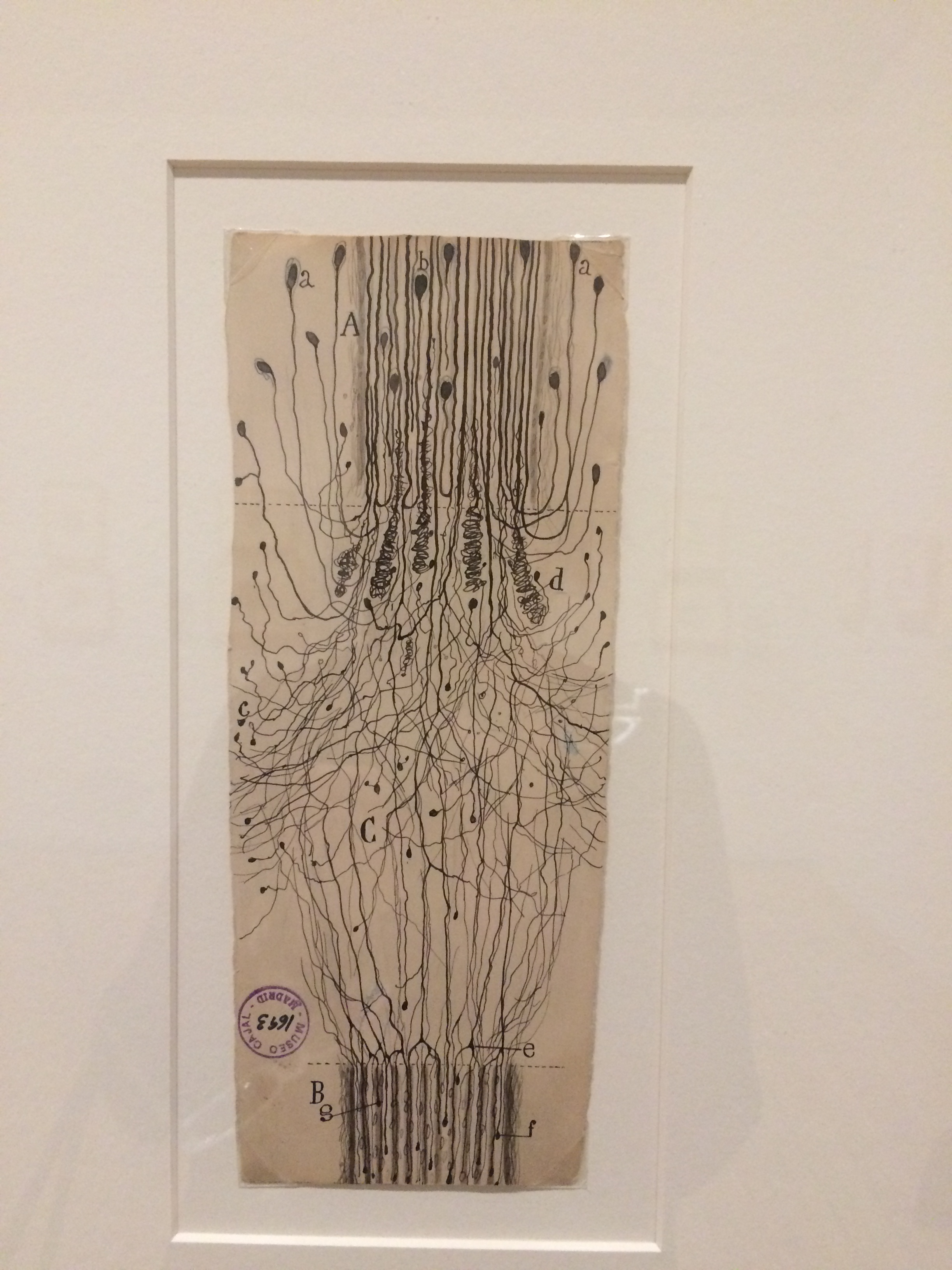
The Grey Art Gallery at NYU is currently presenting the scientific drawings of Spanish neuro-scientist Santiago Ramón y Cajal. Created at the end of the 19th century into the beginning of the 20th century the accuracy of these drawings are unsurpassed . These images are still used for scientific purposes.
This example is a pen and ink drawing of a Purkinje neuron from the human cerebellum from 1899 shows the scientist’s skills as a draftsman. These works were all done freehand looking through a microscope there is a more to these pieces than just research. Ramón y Cajal had an artistic sense of line and pattern.
This next drawing depicts a cut nerve outside the spinal cord from 1913. I think this work is a excellent representation of the contrast between an ordered system and chaos. The lines used to show axons in the center take on an almost lyrical sense of disorder.
This exhibition could be seen more as a Science/Art show then a Math/Art show. I feel however that the neurological systems examined in Santiago Ramón y Cajal’s work possess mathematical themes, including set theory. It is an exquisite exhibition and one of the best examples I have seen of scientific research in which the final product is Art that can be appreciated on it’s own merits. Special Thanks to Elizabeth Whiteley who sent me the info. If you can not see the show in NYC it will be on display at MIT in May
Susan Happersett
Mark Reynolds at Pierogi Gallery
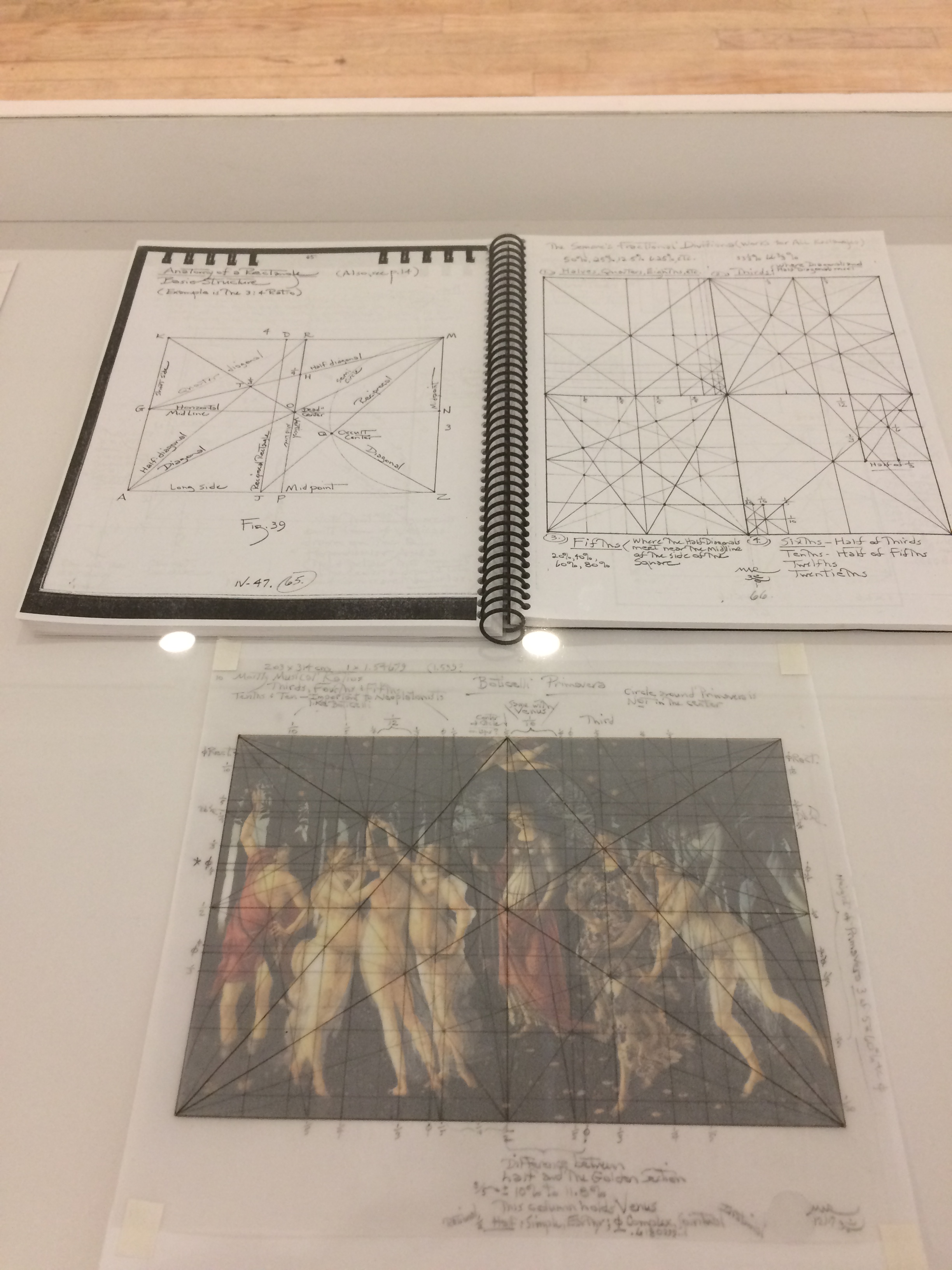
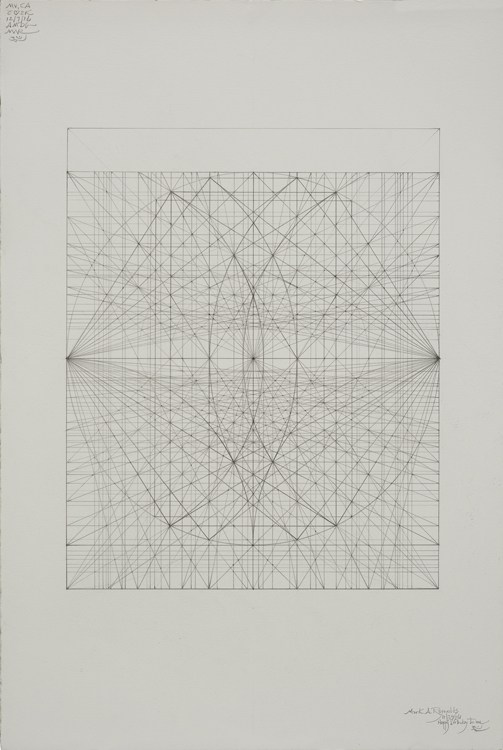
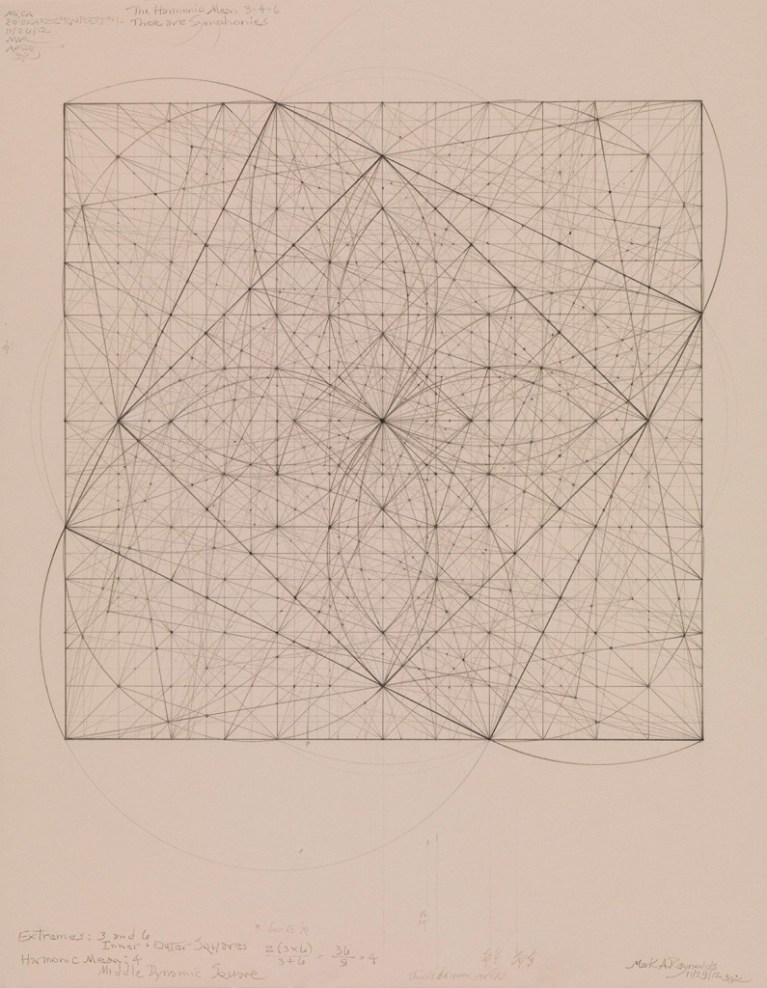
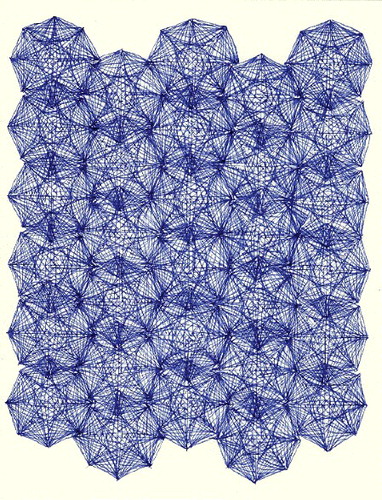
Mark Reynolds creates complex drawings of intense networks of geometric grids. The exhibition provides the public with some some sketches and studies to reveal some of the artist’s processes.
There are two different ways Reynold’s starts his patterns. One of the techniques utilizes historic images. This vitrine contained a small reproduction of a Botticelli painting with a sheet of tracing paper on which a series of guide lines have been drafted. There is also a notebook with a studies for the drawings that are based completely on Mathematical phenomena.
The drawing “Double Phi Series, Ideal Mathematical Space 23,11,16”, from 2016 employs both linear and curvilinear grids to fill the plane. This particular piece is more orderly then some of the other drawings at first glance it seems as though there might be two axises of reflective symmetry, but on closer inspection the two points on either side from which a series of rays emanates are not in the center of the side. There is only a vertical line of mirror symmetry.
“Square Series: Generation of the Harmonic Mean, 3-4-6, 11-29-12, from 2012 presents two opposing ideas. The sequence of rotating squares provides well ordered geometric shapes while the underlying cacophony of line work gives the feeling of disorder.
The detailed and precise complexity of the many layers of grids within Mark Reynold’s work unveil the order within chaotic patterning.
Susan Happersett
Cristina Camacho at Praxis
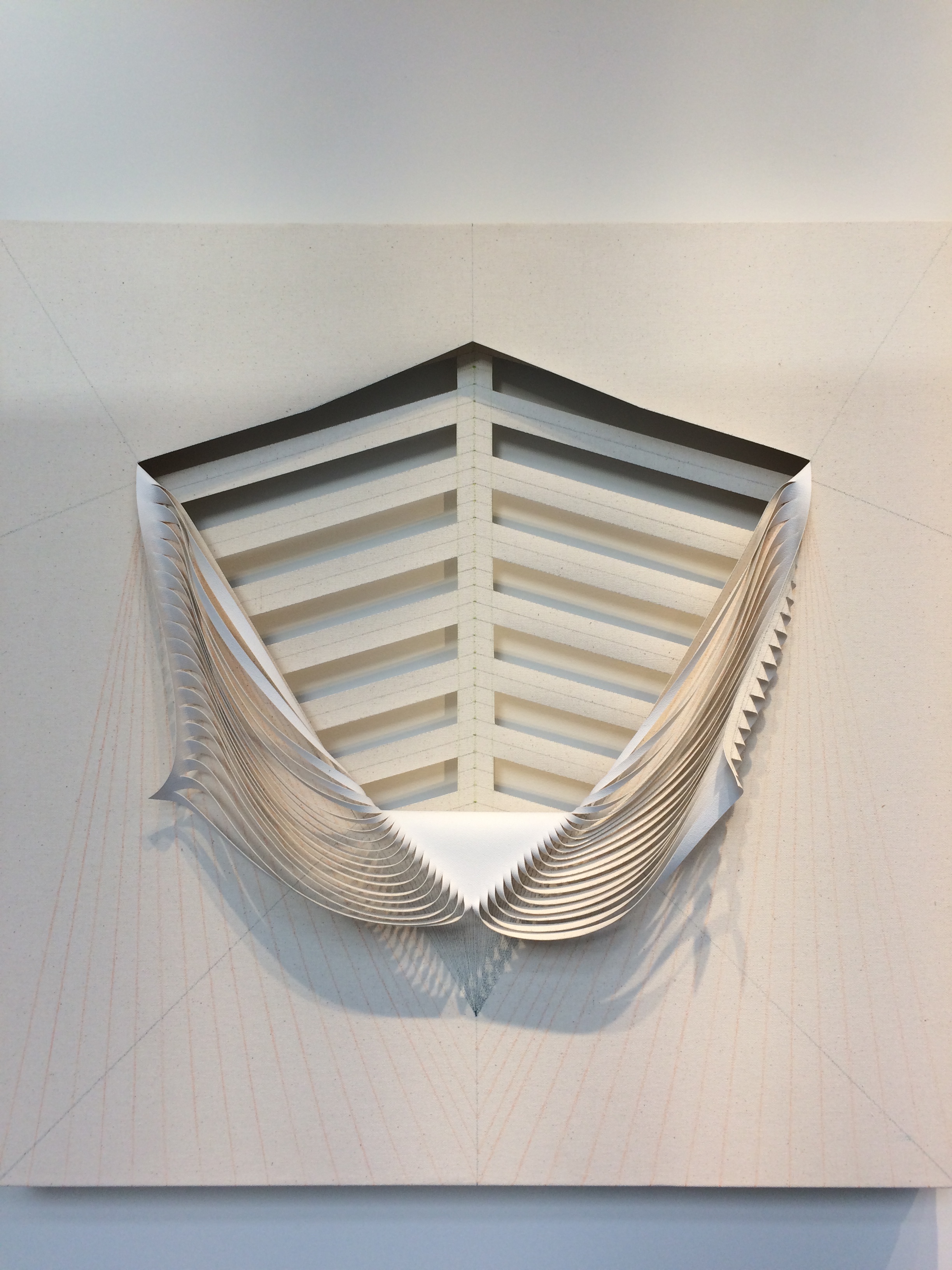
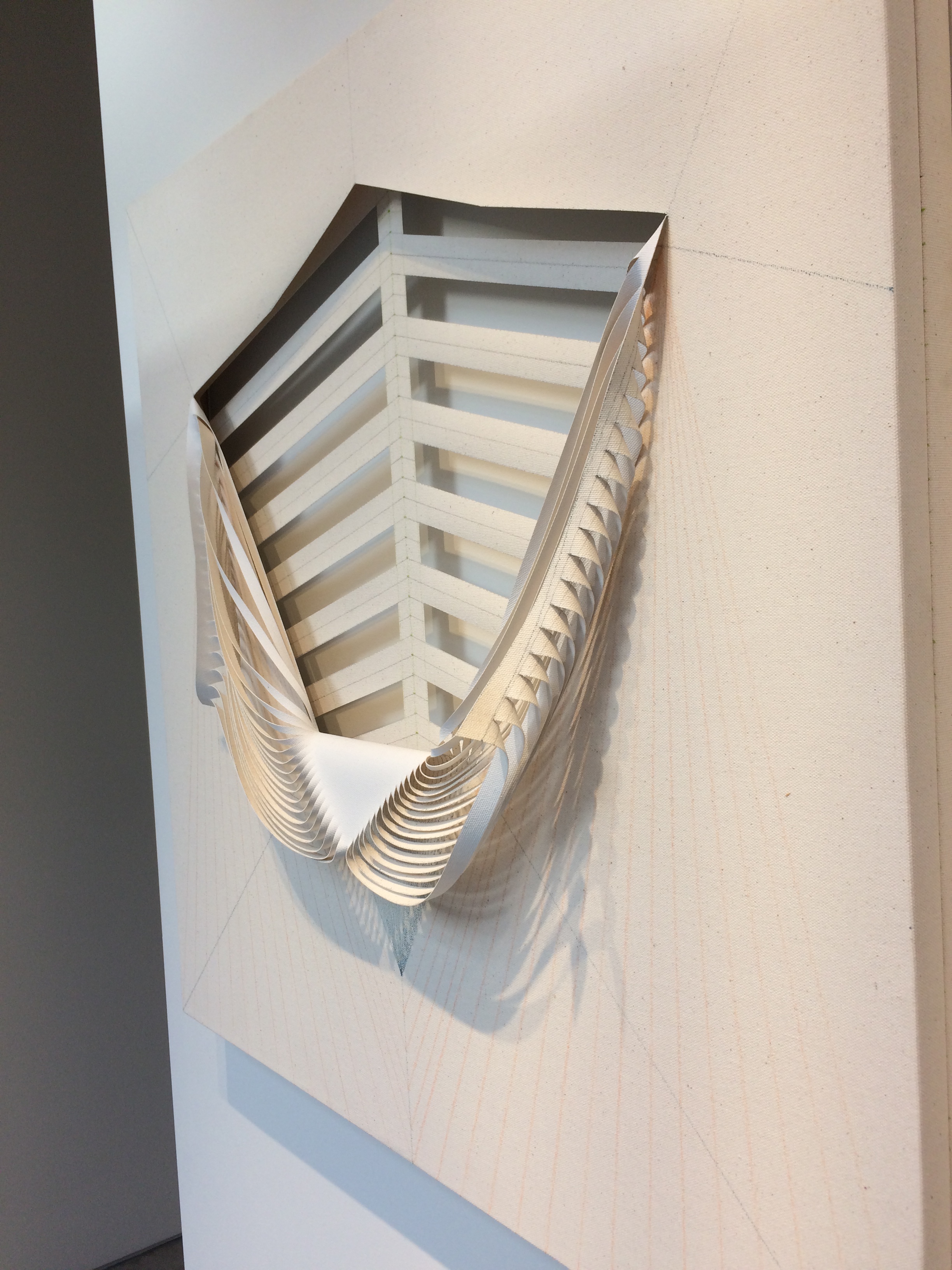
Using a process of making precise cuts through canvas Cristina Camacho creates a very unique type of dimensionality to straight edge drawing.
This example is based on a line drawing of an irregular pentagon with a vertical line of reflective symmetry. A series of lines have been drawn emanating from the two upper corners of the form featuring the same reflective symmetry. The top layer of canvas has been sliced in parallel line segments allowing the fabric to hang and drape off the 2-D plane.
The underlining canvas has a series of bars parallel to the top two sides of the pentagon cut completely away. This creates both positive and negative space as well as a shadow box effect.
What I find so interesting about this work is the way the shadows and especially the hanging drape of canvas make us look at a flat geometric figure in a very different way. The sculptural quality has been augmented by the obvious presence of light and gravity which play an important role in the transition from 2 to 3 dimensions.
Susan Happersett
Kantha Recycled and Embroidered Textiles at the Mingei International Museum
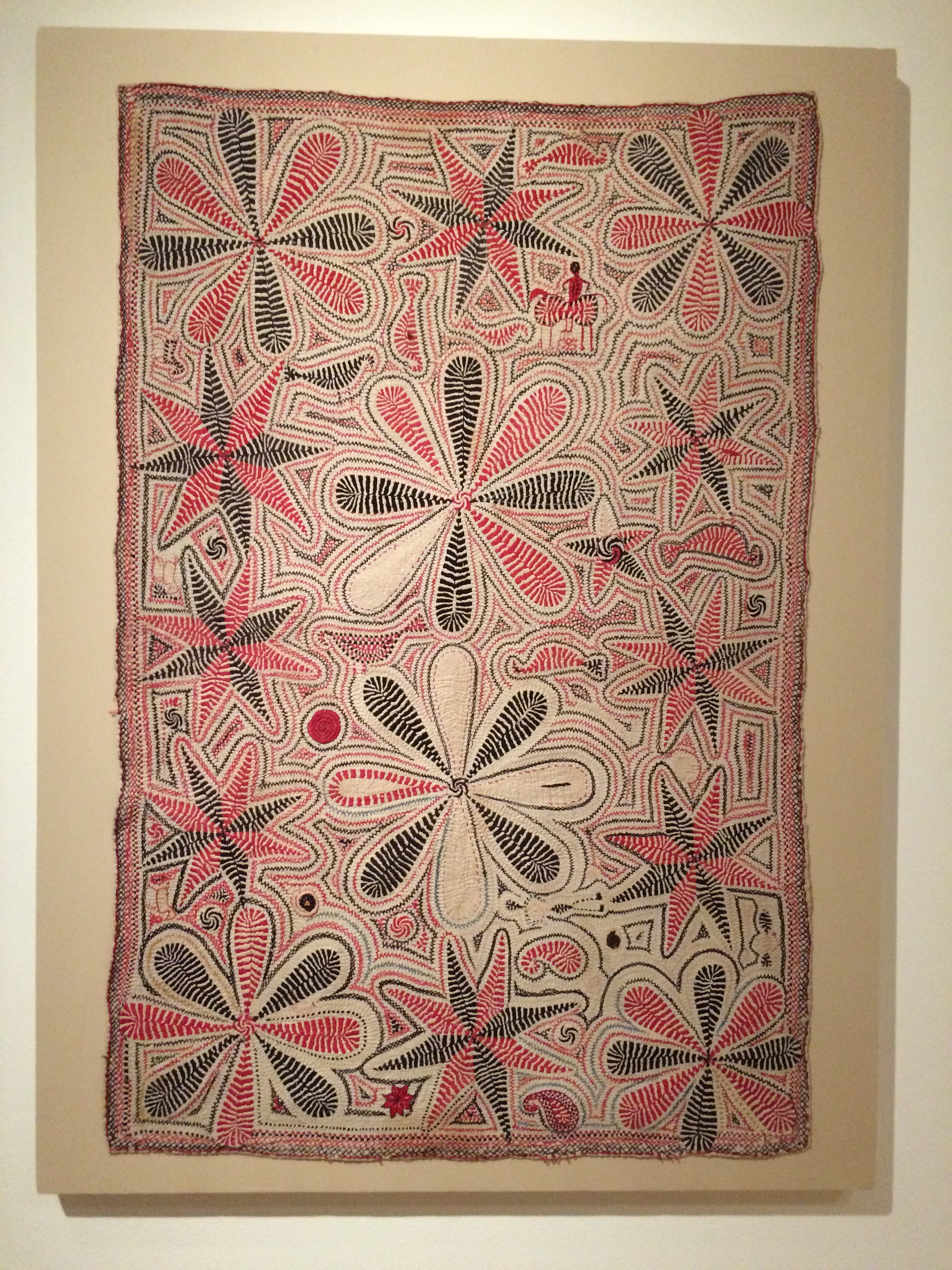
While I was in San Diego for JMM, I went to Balboa Park to visit the Mingei Museum. The museum is currently presenting a beautiful exhibit of vintage kantha, embroidered textiles from Bengal.
I was taken by the interesting uses of symmetry in some of the work.
This particular Baytan Kantha is from the late 19th or early 20th century. It features lotus flower and star patterns. All of these from possess order-8 rotational symmetry if you disregard coloring. The corner lotuses and the stars have order-4 rotational symmetry when color is taken into account. Although lotuses and stars are very traditional forms of patterning, to me this textile has a very modern abstract quality.
Susan Happersett
JMM 2018 San Diego – Art Exhibit
Happy New Year!
It is Januar and that means it is time for the Joint Mathematics Meeting. This year the conference was held at the San Diego convention center and had an attendance of over 5000 participants. The JMM Art Exhibition is always a great way for me to start of the year. There is always a very diverse selection of art on display, featuring many different themes, techniques, and materials. I was not disappointed this year. I will only be able to mention a sampling of the of the great work…but here are a few of my favorites.
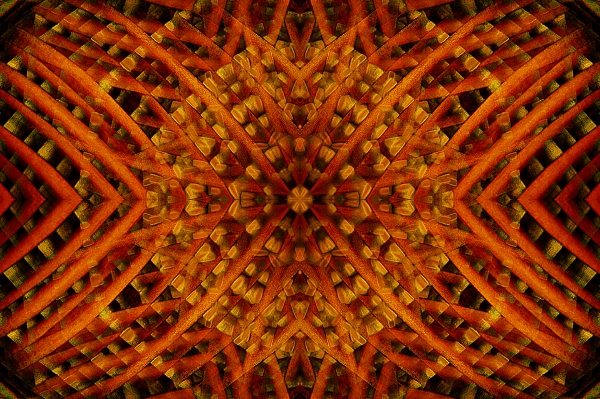
Photographer James Stasiak’s print “into the sun” transforms an original photograph into a mandala type abstraction through the use mathematical manipulation. Photo editing software allows Stasiak to carry out his prescribed sequence of rotations and reflections to create symmetrical properties. The result is a dense web of color that draw the viewers eye into the center of the print.
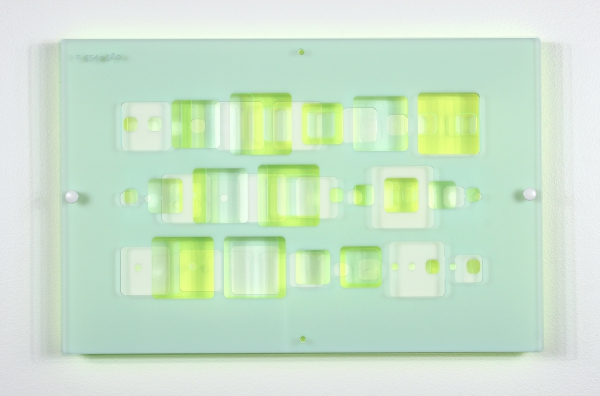
Yvette Kaiser Smith has created a language of shapes to represent digits and then laser-cuts these shapes into colored transparent acrylic sheets. The sequence of these shapes is based on the sequence of particular sets of digits found within the irrational numbers e and pi. Irrational numbers are numbers that cannot be written as a fraction and have never ending, non repeating decimal representation. The work in the exhibit “Excerpts from pi (187-210) (554-580) (685-711)” features three panels The top panel shows the 187th to the 210th digit in the number pi. By layering the panels of different colors with space between them Smith has created a complex arrangement of shape light and color. The irrational numbers and especially pi have a type of mysterious reputation and a history of human fascination. This sculpture examines the number at it’s most finite level and then through technique and material expresses the beauty within.
Susan Happersett
My Artist’s Statement in the Journal of Mathematics and the Arts
The current (December 2017) issue of the Journal of Mathematics and the Arts (JMA) is introducing a new feature, highlighting individual artists through their statements. The fist artist covered is yours truly.
Publisher Taylor & Francis is making the article available to everyone. You can read it here. The accompanying picture is also on the cover of JMA this issue.
Happy Holidays!
Kelsey Brookes at the Jacob Lewis Gallery
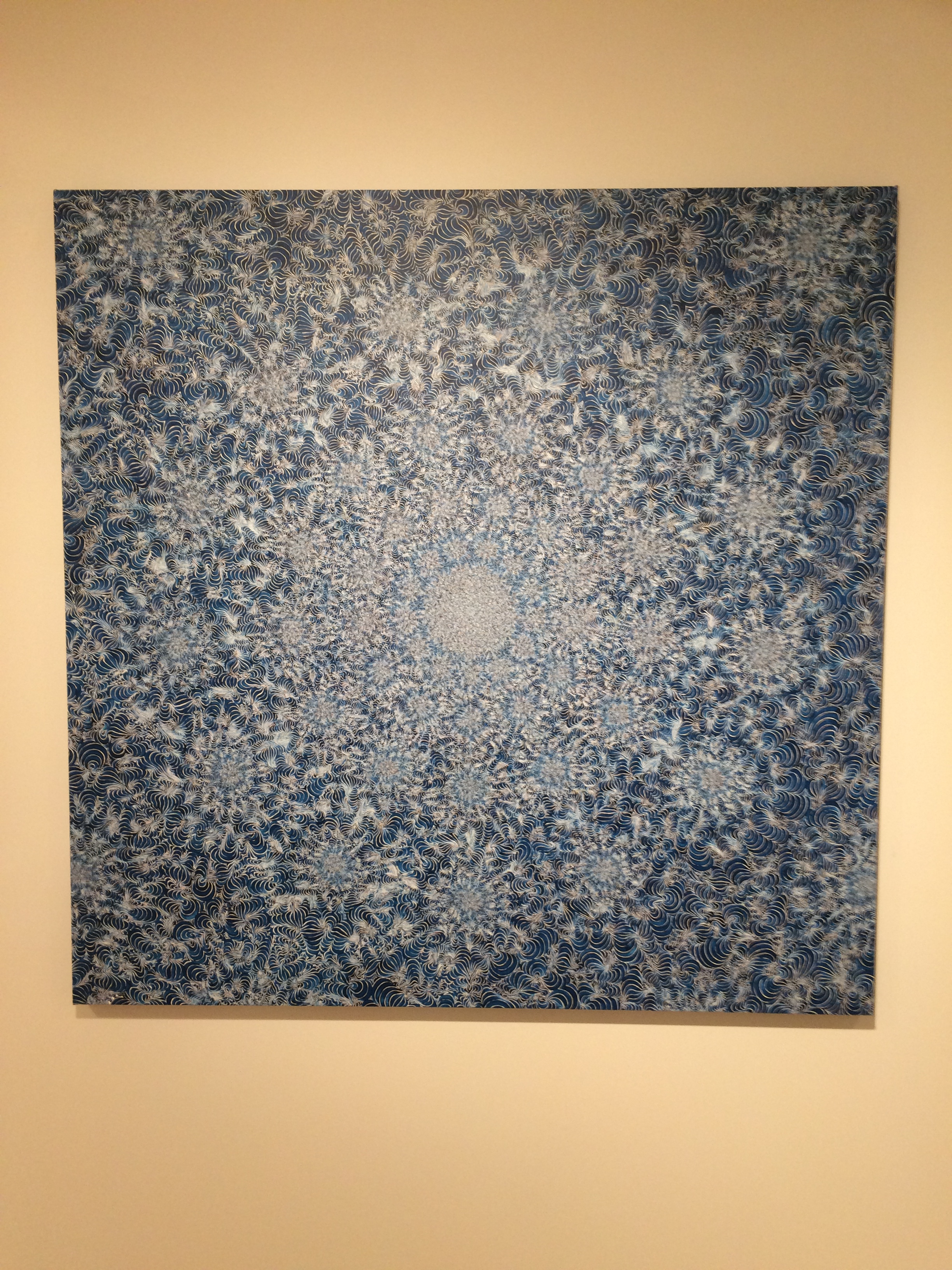
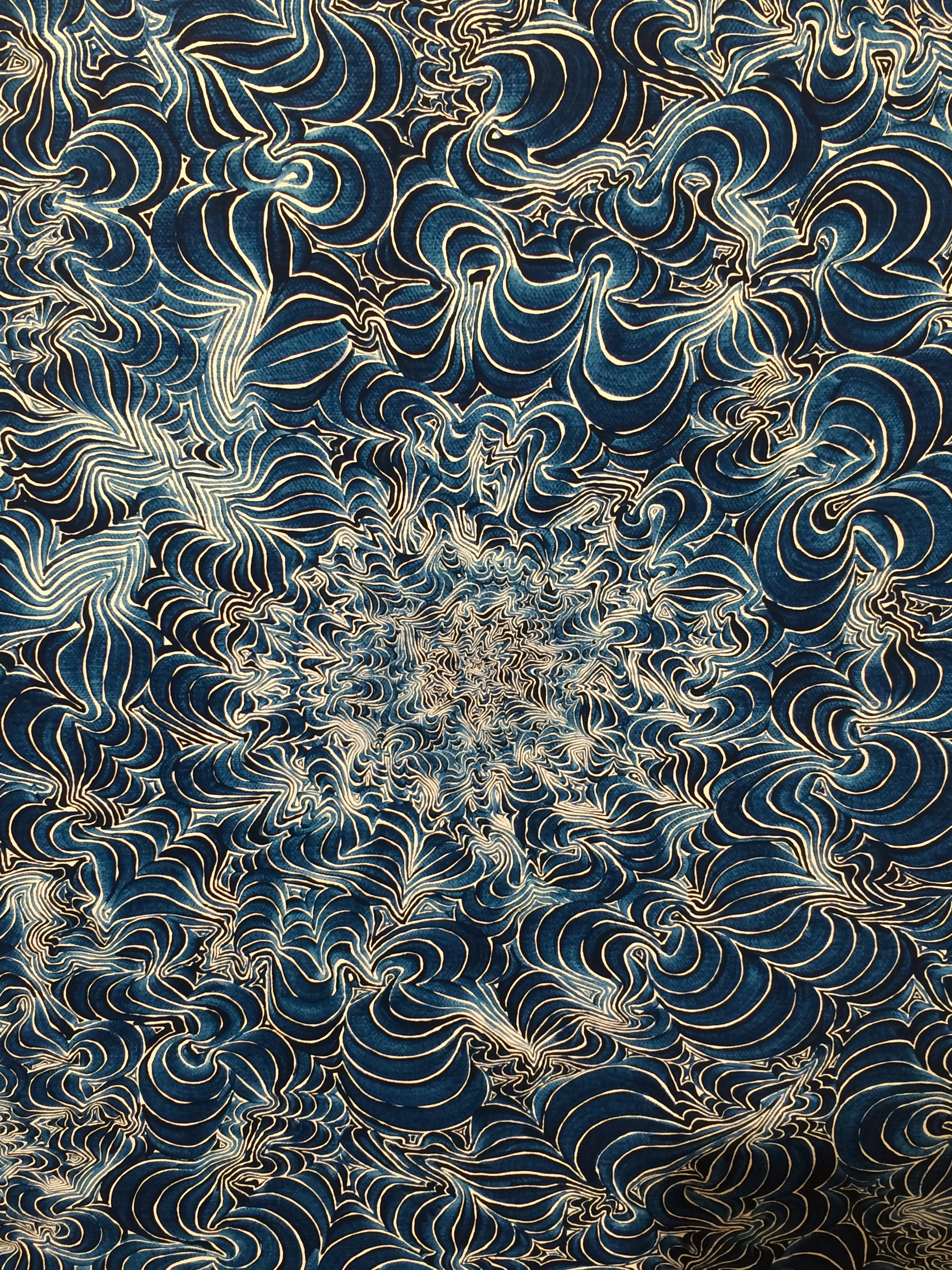
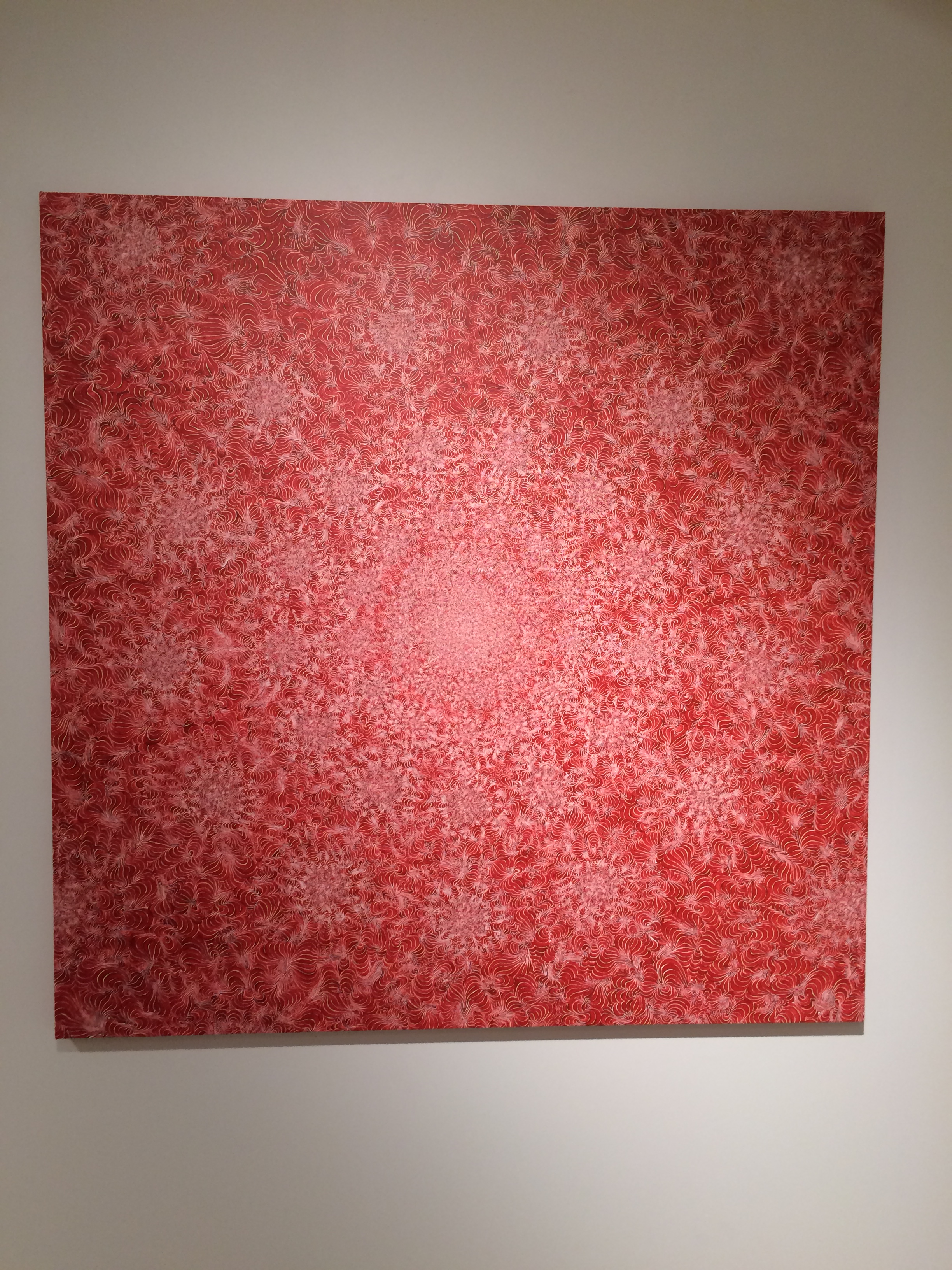
Kelsey Brookes current solo exhibition at the Jacob Lewis gallery is titled ” The Mathematics Underlying Art”. I was so happy to see that the Fibonacci Sequence is a major theme for these large scale paintings. Each square canvas is divided into thirteen (13 is a Fibonacci Number) wedges radiating from the center point. Then dots are made along each dividing line at intervals that correspond to the Fibonacci Sequence.
An intricate concentric pattern is painted around each dot, filling the surface. The waves and undulations in this detailed work allude to the fact that Brookes is also microbiologist.
There are two sets of systems at work in this series. There is the overall predetermined structure, which features order 13 rotational symmetry and the uses the Fibonacci Sequence and the Golden Ratio to place each circle. Within this architecture,when you look more closely at the paintings you see the freer, expressive style . The mathematical structure creates a sense of order to contain the movement of the patterns.
Susan Happersett
Rita McBride at Dia:Chelsea
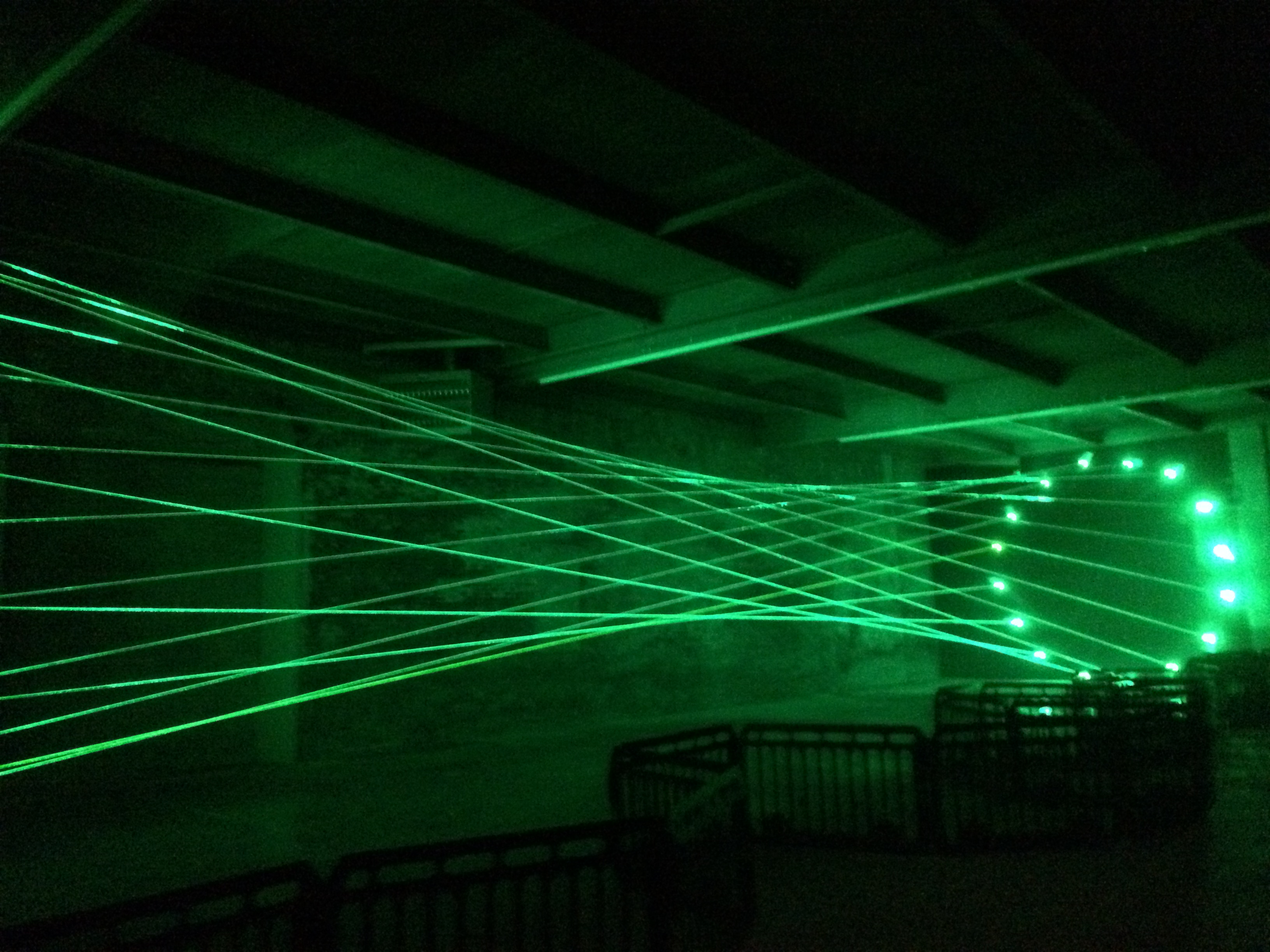
“Particulates” is Rita MacBride’s new site-specific installation commissioned by Dia for their Chelsea location. McBride has used industrial high-intensity light to define the space formed by a hyperbola rotated around an axis.
The bright green laser beams create the lines for this 3-D drawing. The atmospheric properties of the airflow in the gallery create a sense of motion. Dust and other particulates are caught in the blast of lasers and become dancing reflections of light. This results in an otherworldly experience for the viewer.
Susan Happersett