Playing with Design, Game Boards, Art and Culture

The American Folk Art Museum in Manhattan is currently presenting an exhibit titled “Playing with Design, Gameboards, Art and Culture”. These mid to late 19th century hand painted game boards feature geometric patterns that seem to be a precursor to 20th century hard edge abstraction.
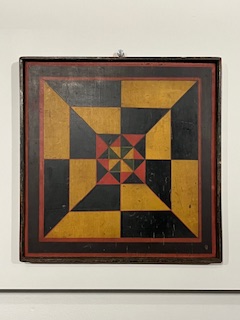
This “ Nine men’s Morris” board not only possesses 4 -old rotational symmetry it features an interesting composition based on squares. The board is divided into four squares. The interior square is again divided in four squares. Process continues through two more interactions to achieve this striking pattern.
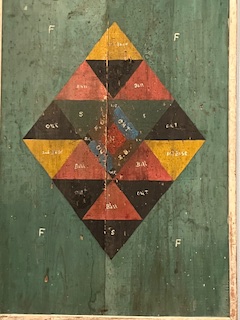
This painting is on a rougher wood with a wider color pallet. The use of equilateral triangles form  a diamond rhomboid pattern.

This exhibition reminds us that use of geometric forms in art and design has been part of our visual language throughout history. The makers of these game boards have incorporated sophisticated mathematical patterning into objects for everyday use and enjoyment.

Susan Happersett
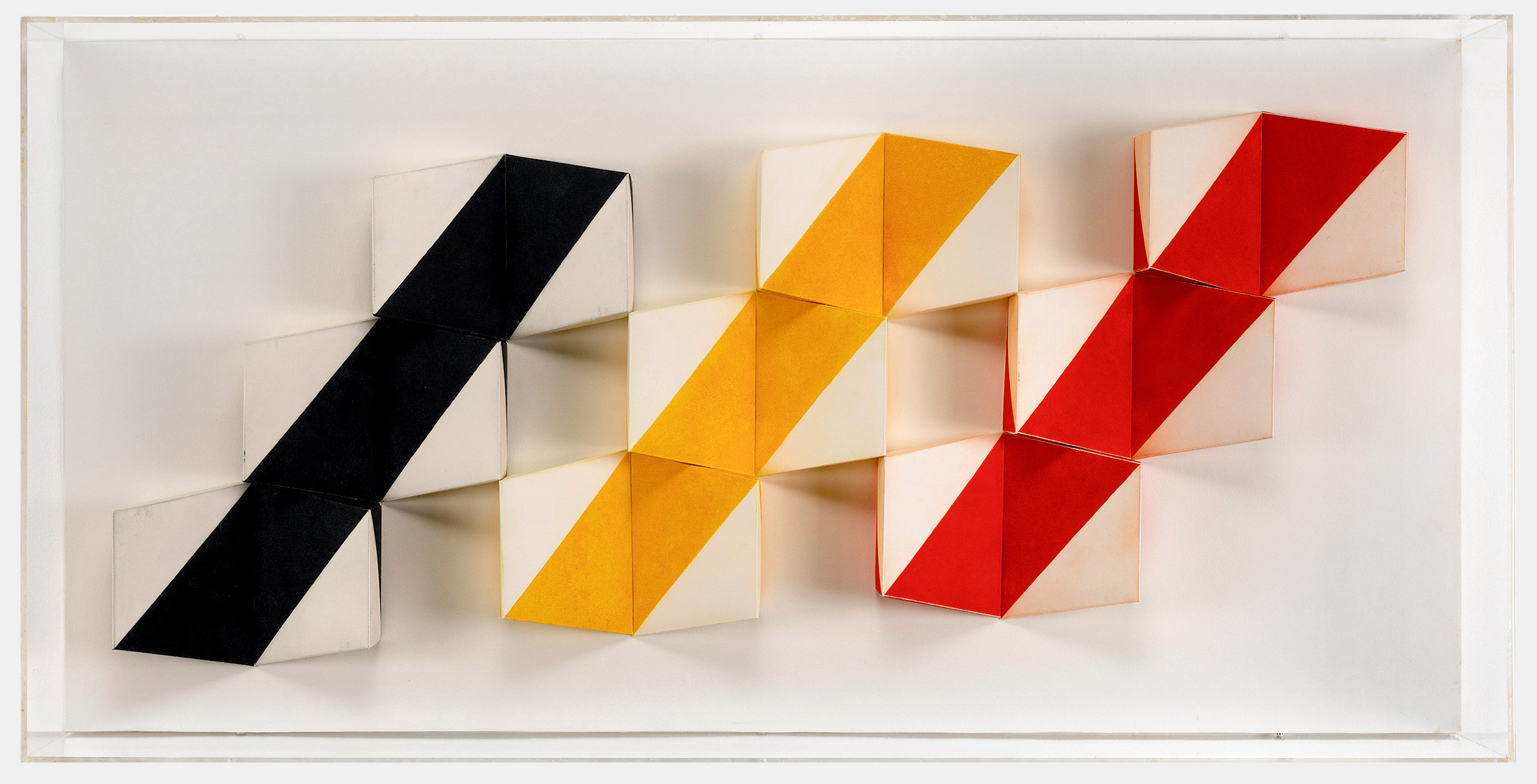
Benigna Chilla Folded Print Constructions 1970’s at Sapar Contemporary 

Benigna Chilla has had a long and impressive career. After studying with Bauhaus professors in Germany she immigrated to the USA in 1969. Her perceptions regarding planar geometry are highlighted in this current exhibition at Sapar Contemporary gallery in Tribeca. From early on her work has expressed her exploration of the connections between Mathematics and Art.
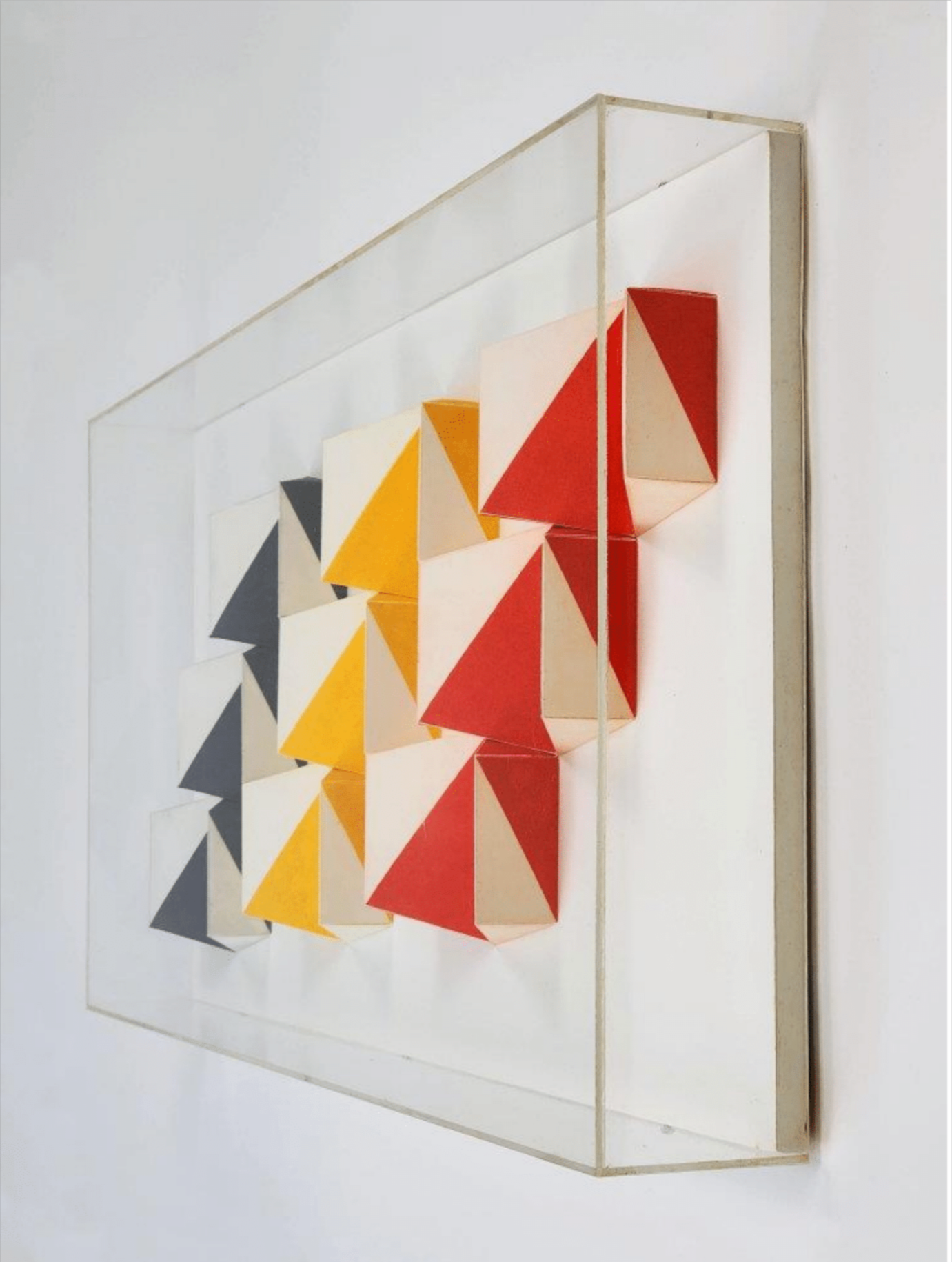
The 3-D constructions in this exhibition were built from prints that involve a minimalist sensibility. By cutting and folding the paper Chilla has created new visual geometries.


“Ascending” from 1972 features a system of accordion folded triangles. When positioned directly in the front the work, the viewer sees bold printing creates 3 diagonal stripes. 

But that is only hint of the complexity of the structure. A side view of the construction offers another perspective.

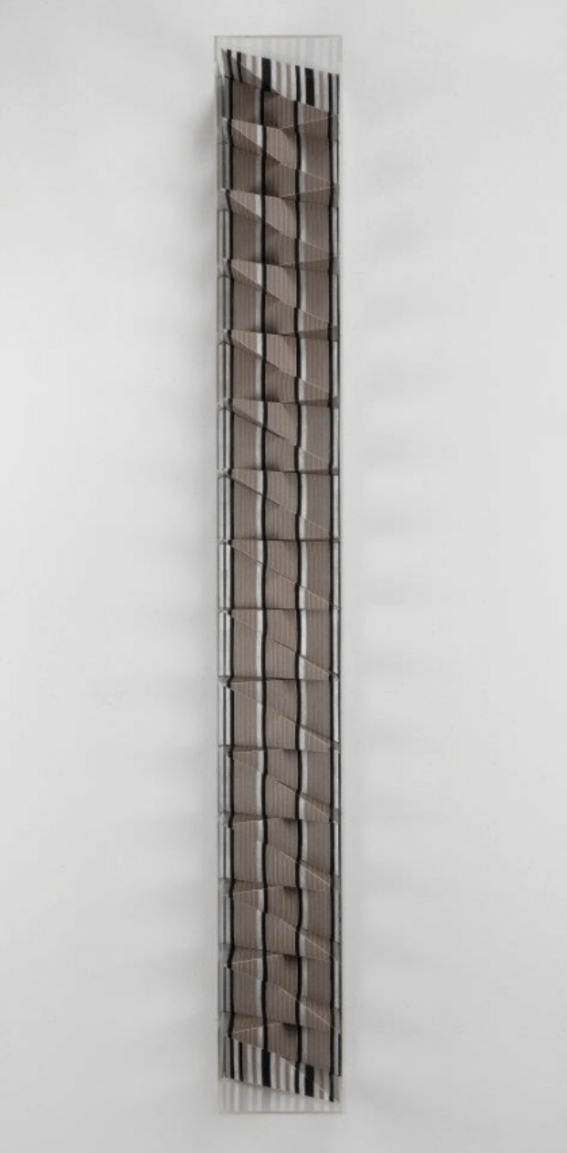
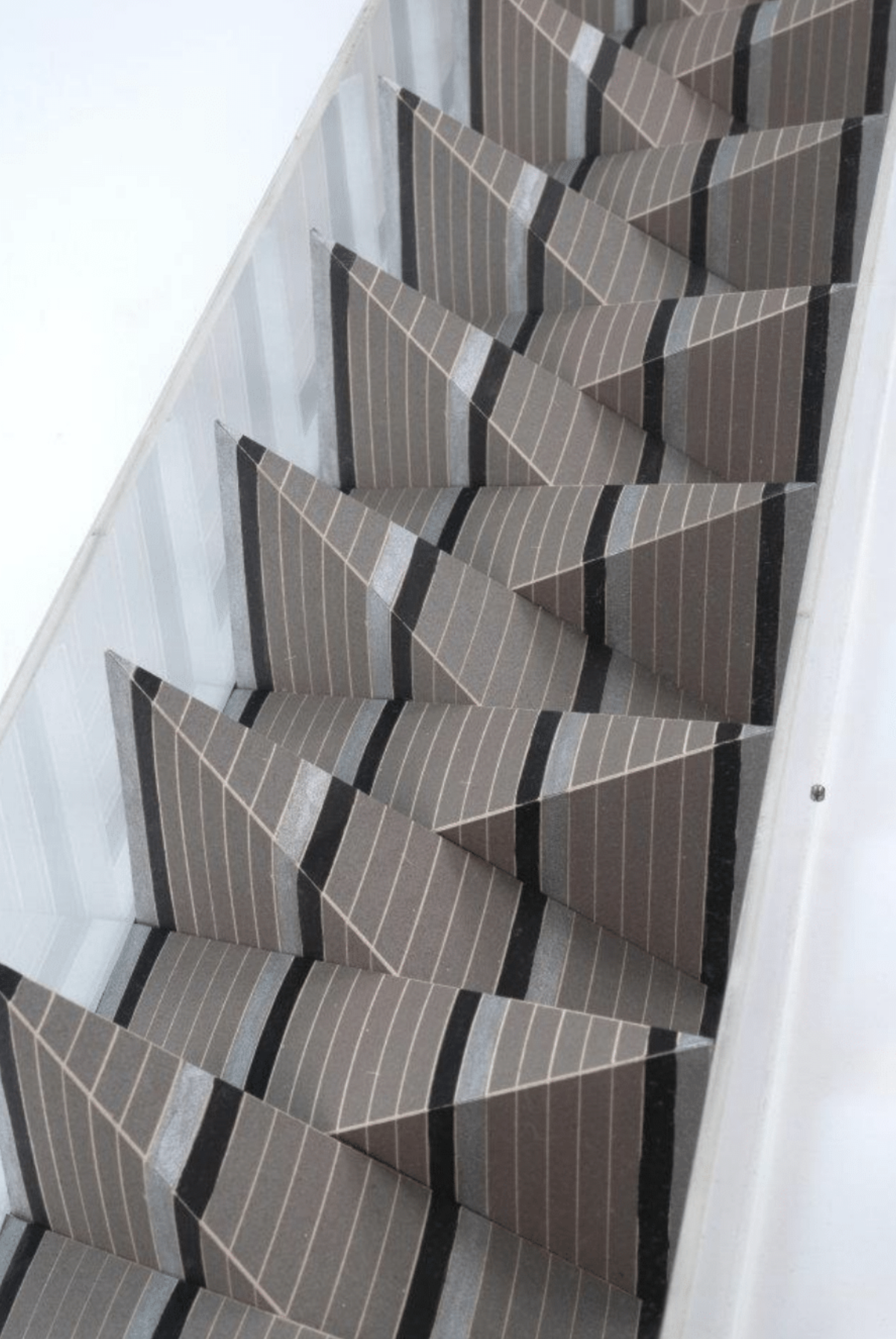
The prints incorporated in the construction “Untitled (Column)” from 1976 are long paper strips with delicate vertical parallel lines.


Looking from another direction. These lines go over and around the angles of Chilla’s angular folding pattern. 

What I find so fascinating about the work in this show is how the look of each piece changes when viewed from from different angles in the gallery. Chilla is able to present numerous mathematical ideas in each construction.

Susan Happersett
Armory Fair 2024 – New York City

The Armory Fair at the Jacob Javitz convention center is the largest of the NYC art shows. Galleries from all over the world exhibit at this venue. I chose two galleries with Mathematical work in their booth.

The Rodolphe Janssen galley from Brussels was presenting the work of Brooklin A. Soumahora.

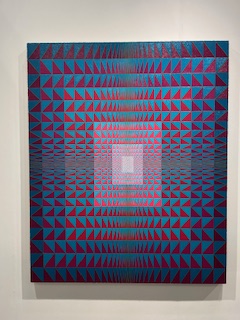
Window Pnk/Ble (2024)

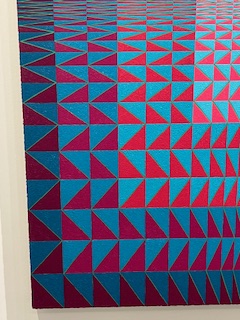
The painting “Window Pnk/Ble” from 2024 consists of a grid of  diagonally bisected rectangles, forming right triangles in contrasting colors. The proportions of the rectangles transition from corner squares to narrow vertical rectangles in the center of the work. This technique creates an interesting illusion of compressed space.

Window Pnk/Ble (2024) – detail

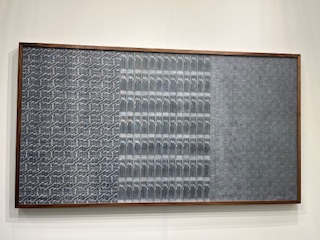
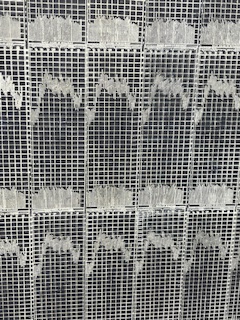
The Blue Velvet Gallery from Zurich was presenting the work of CHRYSSA from the 1960’s. For these  large scale works the artists used a technique of printing onto the painted canvas using images directly taken from printed media. “Magic Carpet (Newspaper )” includes repetitive clippings of grids from the stock market  reports. This mathematical data becomes part of an abstract composition.

“Magic Carpet (Newspaper )”
“Magic Carpet (Newspaper )” – detail

More art soon.

Susan Happersett

Art on Paper

The Fall Art season has started in NYC. The Art on Paper Fair on Pier 36 had a number of booths featuring mathematical art.

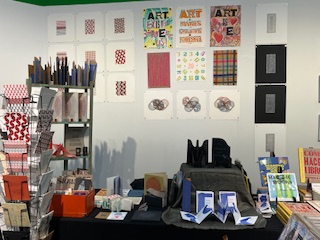
Purgatory Pie Press presented some of my Mathematical prints and books.

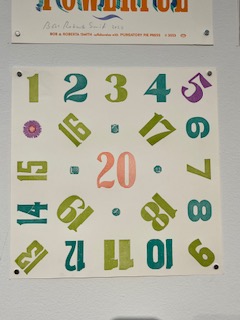
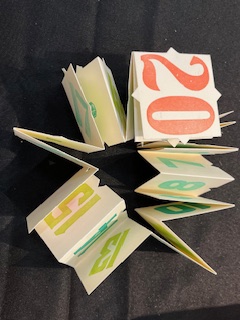
The press’ newest print and book “Twenty” by Dikko Faust and Esther K Smith is a counting spiral pattern.

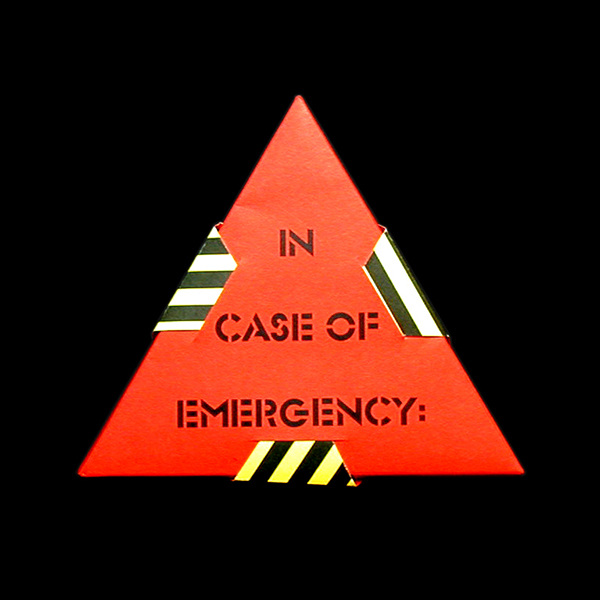
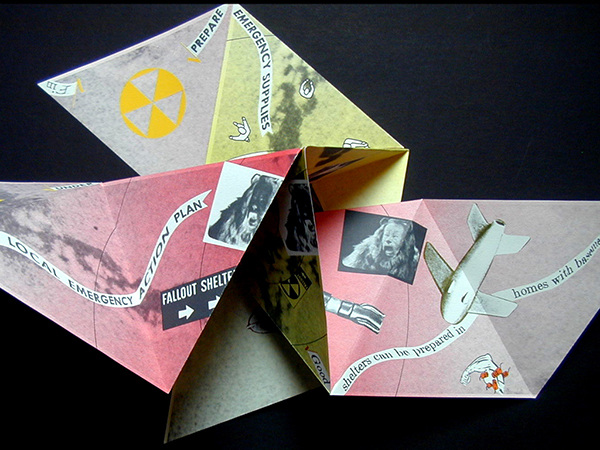
There were a number of galleries and artists showing work with Mathematics implications. Scott McCarney exhibited his triangle format book “In Case of Emergency”.


AC Latin Art exhibited the intricate geometric drawings of Hal Trager. Diamond-shaped grids are the building blocks for the drawing  “The Crossroads”. Diamonds become 3  triangles. A base of three equilateral triangles with an isosceles triangle perched on top.


There are quite a few art fairs in NYC this week. Next, I will visit the Armory Fair.

Susan Happersett

Joan Jonas at MoMA

The MoMA in Manhattan is presenting a retrospective of the Joan Jonas. Known for videos and installations that address political and environmental issues, Jonas incorporates blackboard drawings. Many of these white on black drawings incorporate mathematical images.

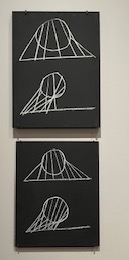
“Black Board Drawings III and IV” from 1971 features different vantage points of looking at a geometric shape, like an architectural diagram.

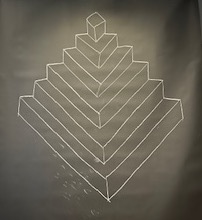
This drawing is part of an installation from 2002 titled “Lines in the Sand”. The step like pyramid form is related to both counting and geometry. Although these types of drawings were only a part of the total installation or video I feel it is important to point out the mathematical features of Jonas’ work.

Susan Happersett
Irene Rousseau at Sotheby’s Art & Home Gallery in Morristown NJ

Sotheby’s Art & Home Gallery in Morristown, NJ is currently presenting a solo exhibition of Irene Rousseau’s impressive mathematically-inspired mosaics and paintings under the title “Patterns in Nature”.

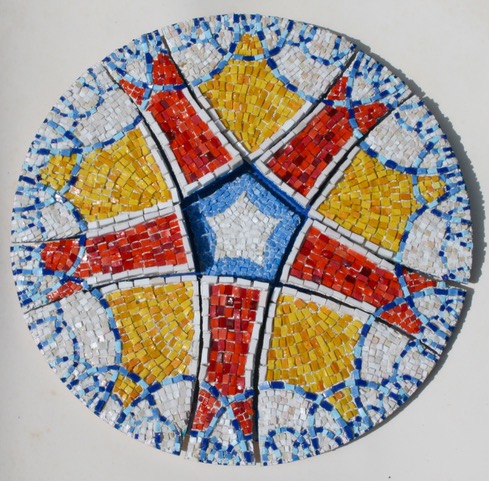
This mosaic, titled “Infinite Smallness”, is based on the concepts of hyperbolic geometry. Although the work is primarily 2-dimensional, Rousseau has incorporated non-Euclidean geometry in her exploration of negative curvature and exponential growth.

Rousseau also uses oil paint to build tessellated patterns. The painting “Layered Space” shows the dichotomy between the intricate patterning and the fractures within the pattern, caused by spaces between each individual painted “tile” . 
Through these mathematical tilings Rousseau expresses and expounds on very abstract and complex topics. Her use of shape and color makes the beauty of the Mathematics accessible to everyone.

Irene Rousseau’s work will be on display at Irene Rousseau at Sotheby’s Art & Home Gallery until July 15.

Susan Happersett
“Gesture & Form – Women in Abstraction” at Almine Rech Gallery 

The Almine Rech gallery on the Upper East Side of Manhattan is currently presenting a breathtaking group show of female artists who create abstract work. The the art in the exhibition spans decades and includes some very famous artists like Elaine De Kooning and Helen Frankenthaler.

There was one work in the show that was particularly mathematical. Minjung Kim’s mixed media “Insight” from 2017 featured a collection of identical circles positioned in horizontal rows.


In each of the rows, the circles got closer and closer as the viewers eyes travel across from left to right, at first only overlapping slightly, until finally completely layering one onto the other. This painstaking process rendered an almost ghost like march across the plane

Susan Happersett

Verena Loewensberg at Hauser & Wirth

Hauser & Wirth are presenting the exhibition Verena Loewensberg “Kind of Blue” at their Upper East Side gallery. This is the first solo exhibition in the United States for this important artist. Loewensberg was the only female member of the Zurich school of concrete artists. Using precise geometry and vivid colors the artist’s work spans decades. 

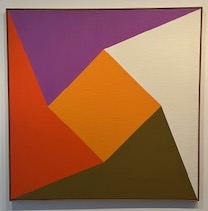
This Untitled canvas from 1964- 1965 features a central square that is positioned to have its diagonals parallel to the sides of the canvas. Enveloping the square are four concave quadrilaterals. Instead of using the expected triangles around the square the element of concavity creates a the sense that quadrilaterals coming from the corners of three canvas are hugging the square. This work has 4-fold rotational symmetry.

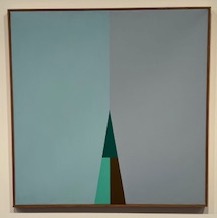
This Untitled canvas from 1963 features an isosceles triangle with its base along the bottom edge of the painting. This central figure has been divided into three sections creating a smaller similar triangle at the top and two quadrilaterals with a mirror symmetry between them.

Loewensberg work has a playful color pallet, I felt very happy walking through the gallery space surrounded by her work.

Loewensburg was also loved sound was influenced by Jazz. She owned a record store. The exhibition had a separate room displaying albums and playing Jazz. The title of the show “Kind of Blue” is from the the 1959 Miles Davis album.

Susan Happersett

Miguel Abreu Gallery, Lower East Side, NYC

The Miguel Abreu gallery is currently presenting the exhibition “Waclaw Szpakowski in Continuity with Paul Pagk”.


I find the Szpakowski’s drawings on tracing paper from the 1920’s fascinating. These are geometric and continuous line drawings on tracing paper, all using straight lines and right angles to create wonderful patterns.

The drawing “F13” from 1926 has endpoints near the upper right and the lower left corners . The line travels an  intricate route filling most of the plane.


“A00000” from 1927 has a more open feel with endpoints at the upper corners . The line follows a more straightforward path creating three stepped mountains.

Although these were drawn almost 100 years ago, they seem quite fresh and contemporary. Not only did the artist limit each work to a single continuous line the path of the line was ruled by right angles hinting at the concept of minimalism and geometric  grids.

Susan Happersett

Signs and Symbols Gallery, LES, NYC

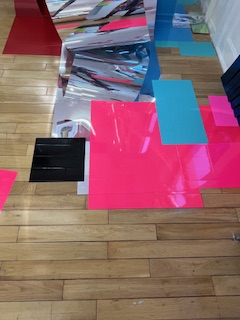
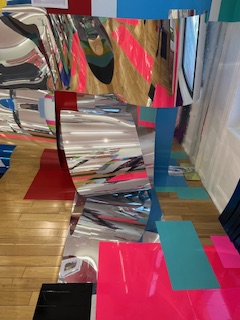
The Signs and Symbols gallery on the Lower East Side is currently presenting Sharon Louden’s solo exhibition “Barriers to Entry”. 

This mixed medium installation makes use of both the floor and the walls of the space. The floors are covered with colorful linear geometric shapes. Sculptural curved mirrored surfaces are propped against the walls.

The straight geometric shapes are reflected into the mirrors and the lines are  morphed into organic waves and curvilinear shapes. As you walk through the room your vantage point changes. The images in the reflection surfaces become kinetic.

Susan Happersett