More Chelsea Galleries – February

Robert Morris at Sonnabend Gallery

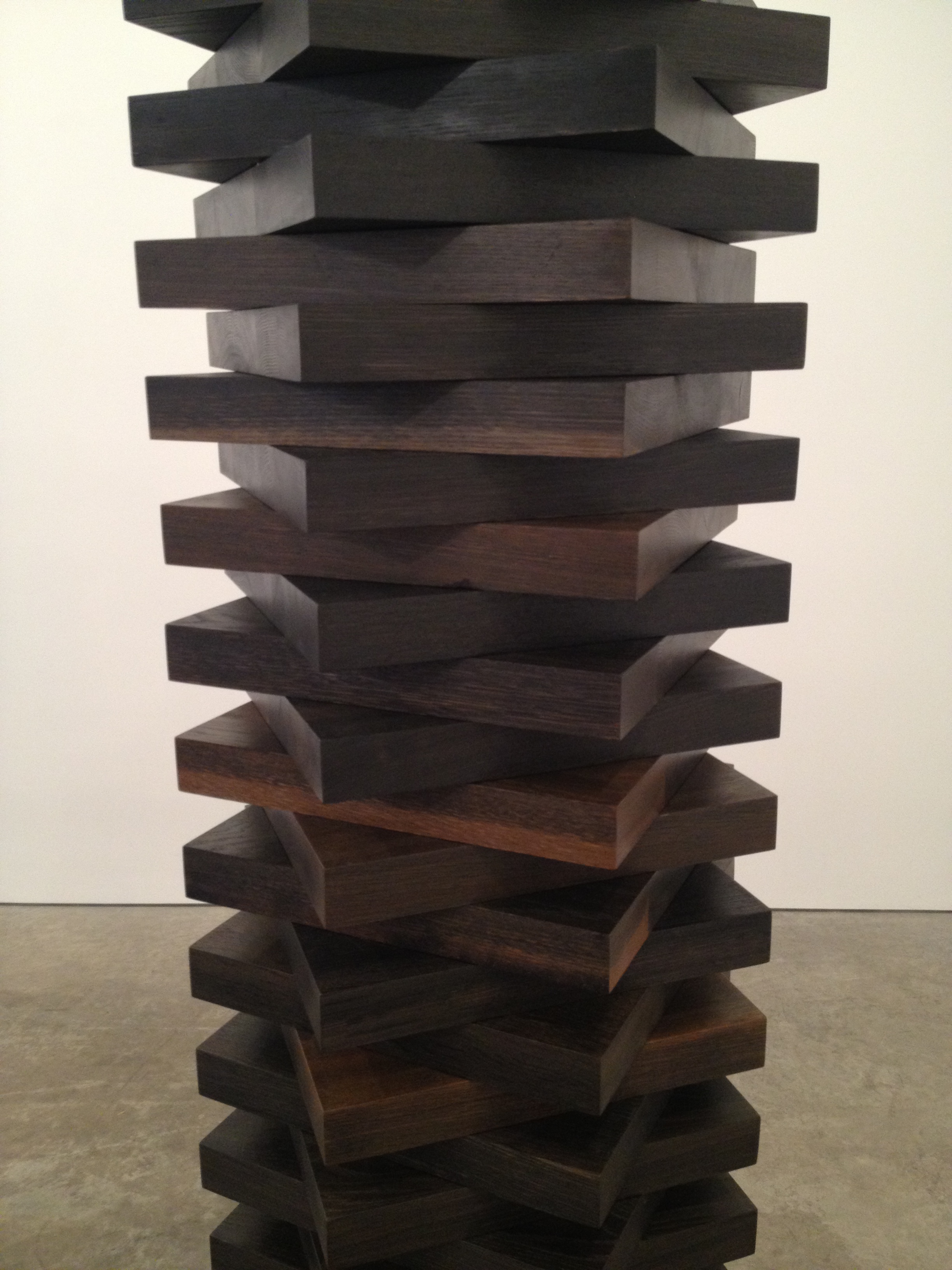
Sonnabend Gallery is exhibiting large wooden sculptures by Robert Morris. Morris is one of the most important American artists and preeminent practitioner of Minimalism. The twelve sculptures in this show are from his “Hardwood Series” and they are all recent reinterpretations of plywood constructions from the 1960’s. Craftsman Josh Finn facilitated the actual production of the work. I was particularly drawn to three totem-like sculptures that were each stacked columns of square planks. In “Serrated Column” (2012) each consecutive plank is rotated 90 degrees. Each square has diagonals that are parallel to the sides of the squares above and below.
photo

Morris – Serrated Column – 2012 – Wood

“Twisted Column” (2012) is a stack of  40 squares that rotate a total of 90 degrees. Each square is only rotated 2.25 degrees. This subtle rotation gives the illusion that it is a smooth surface instead of separate square planks.
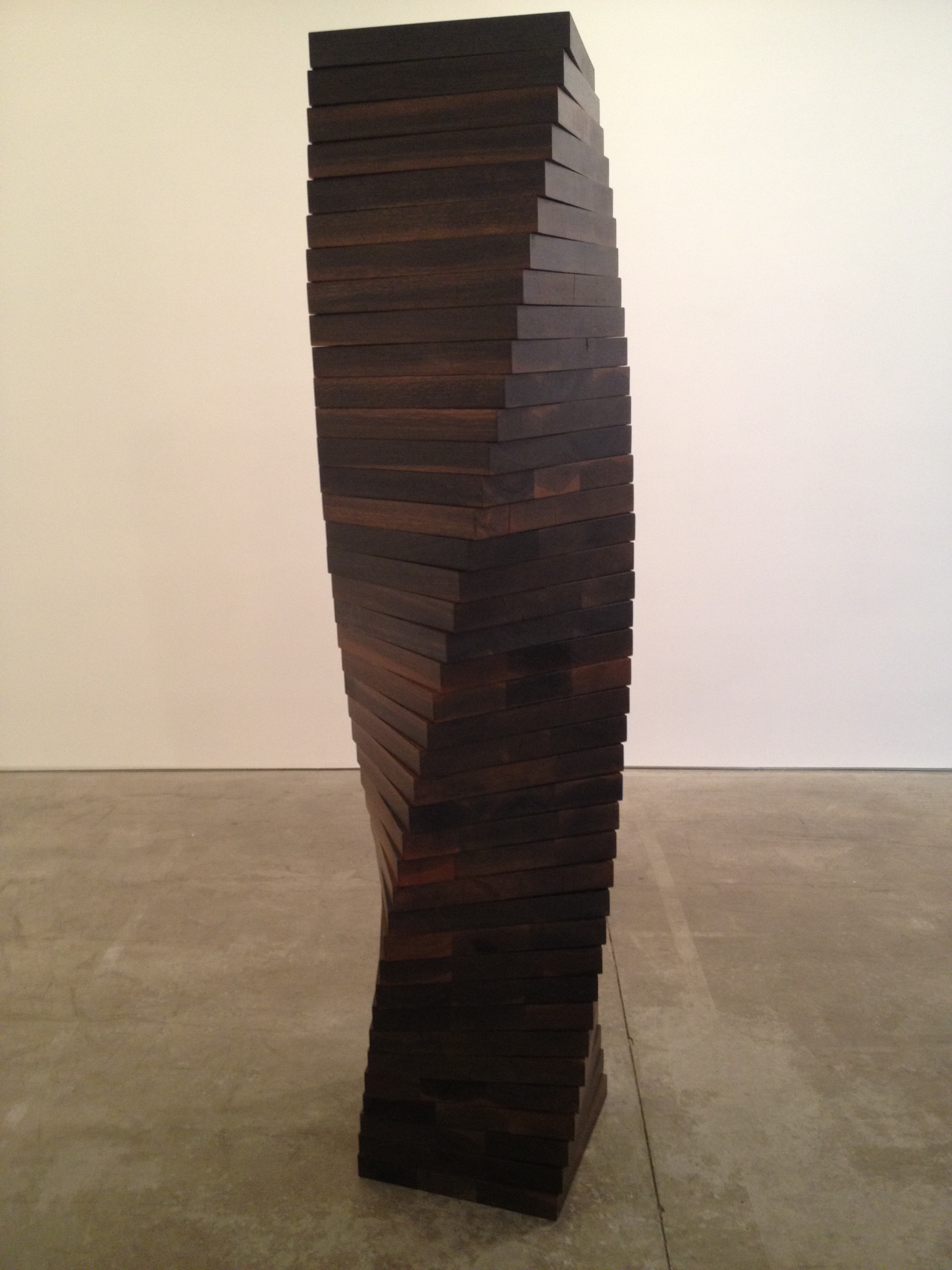
Morris - Twisted Column - 2012 - Wood

Morris – Twisted Column – 2012 – Wood

In “Spiral Column” (2013) the squares are rotated around a corner instead of the center. One full turn of the spiral is formed by planks. This work is an engineering marvel. Standing in front of this sculpture in the gallery it seems like magic that it does not tip over. Morriss’ column sculptures illustrate the many visual possibilities that can be explored using the repetition of a single geometric element.

Morris - Spiral Column - 2012 - Wood

Morris – Spiral Column – 2012 – Wood

Beth Campbell at the Project Room at Josee Bienvenue Gallery

In the Project Room at Josee Bienvenu Gallery, Beth Campbell is exhibiting her drawings and mobiles in an exhibition titled “My Potential Futures”. The works on paper are handwritten text-based diagrammatic drawings. The wire mobiles are a 3-D extension of the drawings. The structure of the mobiles create a binary fractal pattern. Each mobile is attached to the ceiling by a single wire that then divides into two wires, then each of those wires split again into two wires each. The 4 wires split into two wires each (now 8 wires). This continues through 7 iterations. Start at the top and then there is a choice of two possible routes, a yes or no question or ones and zeros if you are thinking in binary code.

Campbell - Mobile

Campbell – Mobile

Chelsea Galleries – February

Paul Glablicki at Kim Foster Gallery

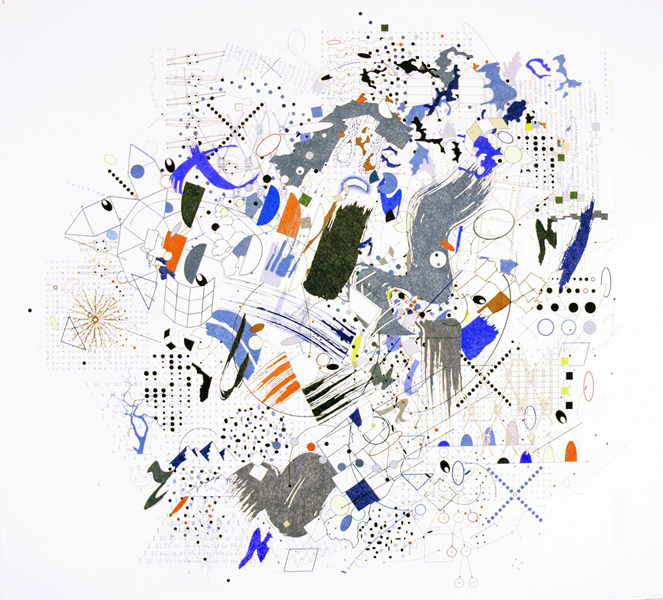
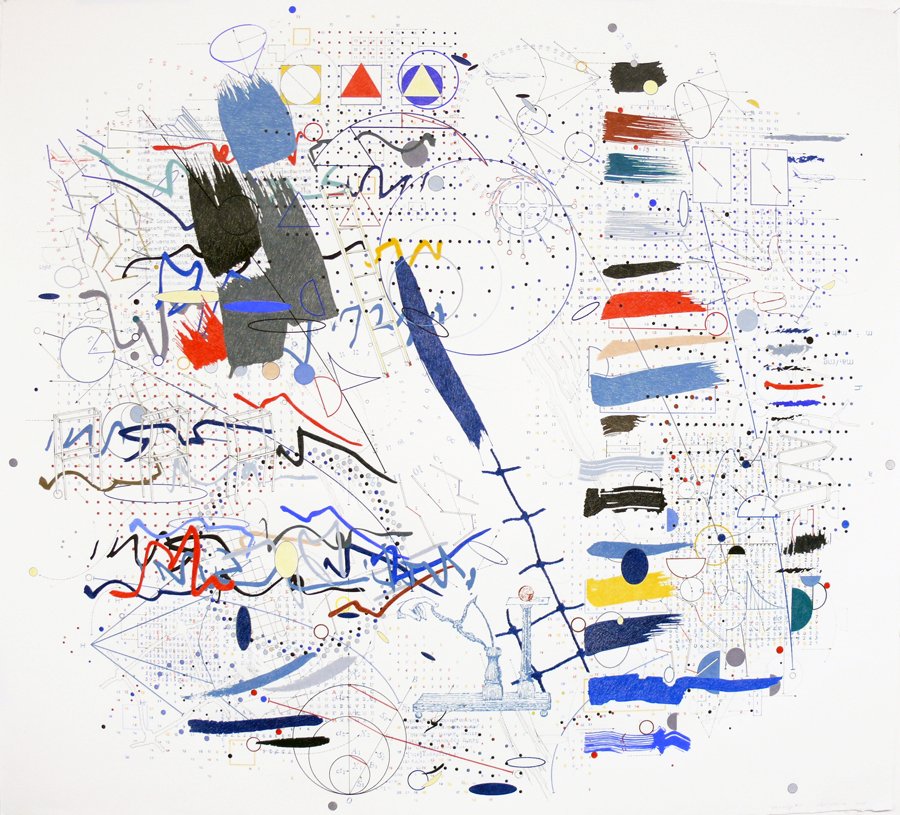
On my recent visit to the Chelsea gallery district in Manhattan I noticed a number of exhibitions featuring art with Mathematical influences. At the Kim Foster Gallery there is a show of exquisite drawings by Paul Glabicki based on Einstein’s Theory of Relativity. These works have layers of scientific data, charts, and mathematical formulae. In drawing RELATIVITY #8 Glabicki has drawn a series of Pascal’s Triangles in the mix of images.

Glabicki- RELATIVITY #3email

Glabicki- RELATIVITY #8

A Pascal’s Triangle is a triangular array made up of numbers. The number of terms in each row corresponds to the sequence number of the row. For example, the first row has one number (1) , the second row has two numbers (1,1), the third row has three (1,2,1). In Pascal’s Triangle, the first and last term of each row is 1. The middle terms are calculated by adding the two numbers directly above. Here is an example of a small Pascal’s Triangle.

              1
          1      1
      1       2     1
    1     3      3    1
  1     4     6     4   1
 1    5   10    10   5    1

In RELATIVITY #3 Glabicki has drawn Geometric studies of internally tangent circles. These circles share only one point and the smaller is inside the larger.

Glabicki-RELATIVITY #8email

Glabicki – RELATIVITY #3

What I think is fascinating about these drawings is the way the mathematical and scientific elements are used as small pieces of the total work. They are transposed from abstract ideas into aesthetic elements of a much larger complex picture:  the artist’s expression of the Theory of Relativity exploring the physics of time and space, through the arduous process of  intense layering of images. Paul Glabicki is well known for his experimental animated films that use hand drawings.They have appeared at many film festivals and exhibits, including at the Whitney Biennial and the Venice Biennale.

Austin Thomas at the Hansel and Gretel Picture Garden

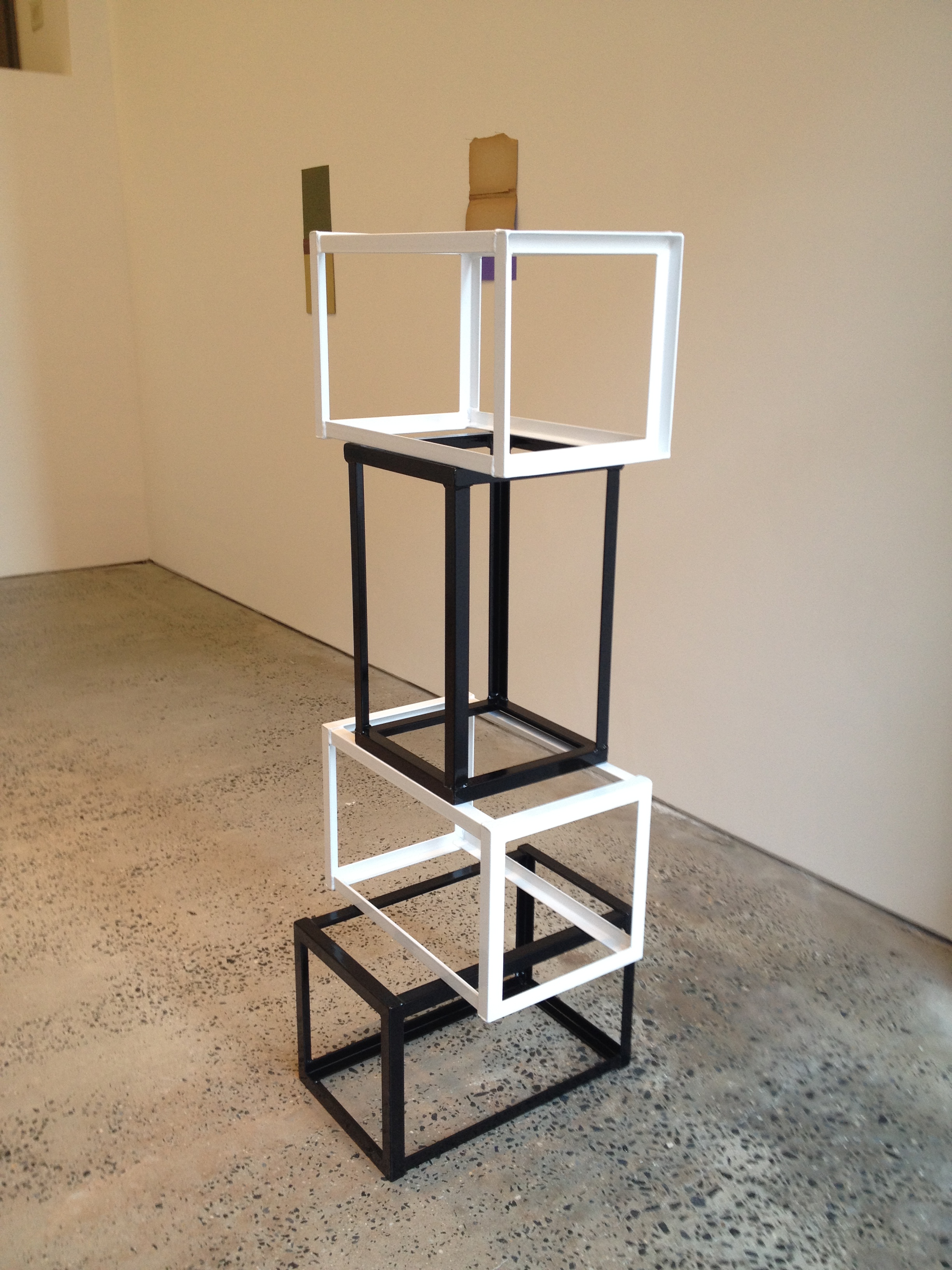
At the Hansel and Gretel Picture Garden there is a show of work by Austin Thomas. Exhibited are twelve drawings on paper, all of which have interesting proportions and geometric elements. The work that seems to really express mathematical principles is a sculpture the artist refers to as a “steel drawing”, made of two black and two white rectangular prisms. These are 3-D line drawings and by stacking them in this perpendicular fashion Thomas presents a nice study on squares and rectangles. Viewing the work from different angles and positions throughout the gallery offers many possible relationships between shapes, as well as the positive and negative spaces created by the open structures. Although it does not move, this is not a static sculpture. The prisms can be stacked in other ways offering Thomas a multitude of permutations to explore.

photo

Thomas – Steel Drawing