Pius Fox at Pablo’s Birthday Gallery

The German artist Pius Fox is having his first solo exhibition in New York City at Pablo’s Birthday Gallery. The title of the show is “We expected something better than before” and features  wonderful abstract paintings, whose geometries are based on interior architectural elements. I have chosen two works that seem to me to have the most mathematical significance.

Pius Fox - Zeitland Schaft - Oil on Canvas - 2014Picture courtesy of the artist and the gallery

Pius Fox – Zeitland Schaft – Oil on Canvas – 2014
Picture courtesy of the artist and the gallery

The first painting is “Zeitland Schaft”,  an oil painting from 2014. This work features four rectangles. Each is bisected diagonally to form eight right triangles. What I find interesting about this work is how it relates to the work of Piet Mondrian and Kazimir Malevich. Malevich used the geometric forms as his subject matter: the paintings were traditional in the fact that, even though he was depicting  abstract themes, they were still  pictures  of shapes within a background. In Mondrian’s square canvases the square itself becomes both the format and the subject. There is no longer a delineation between subject and artwork. I feel that in some ways Fox’s work is taking this use of geometric forms a step further. In this painting rectangles and triangles might – at first glance – seem to be the subject of this work, but in fact it is much deeper. The geometric shapes are a vehicle for Fox’s use of layers of color and his lush painting technique. The symmetrical properties of the painting – for example the glide reflections in the placement of the pink and yellow triangles – enhance the relationships of colors, making them seem to glow.
19-2

Pius Fox – Untitled (PF 1403-41) – Oil on canvas – 2014
Picture courtesy of the artist and the gallery

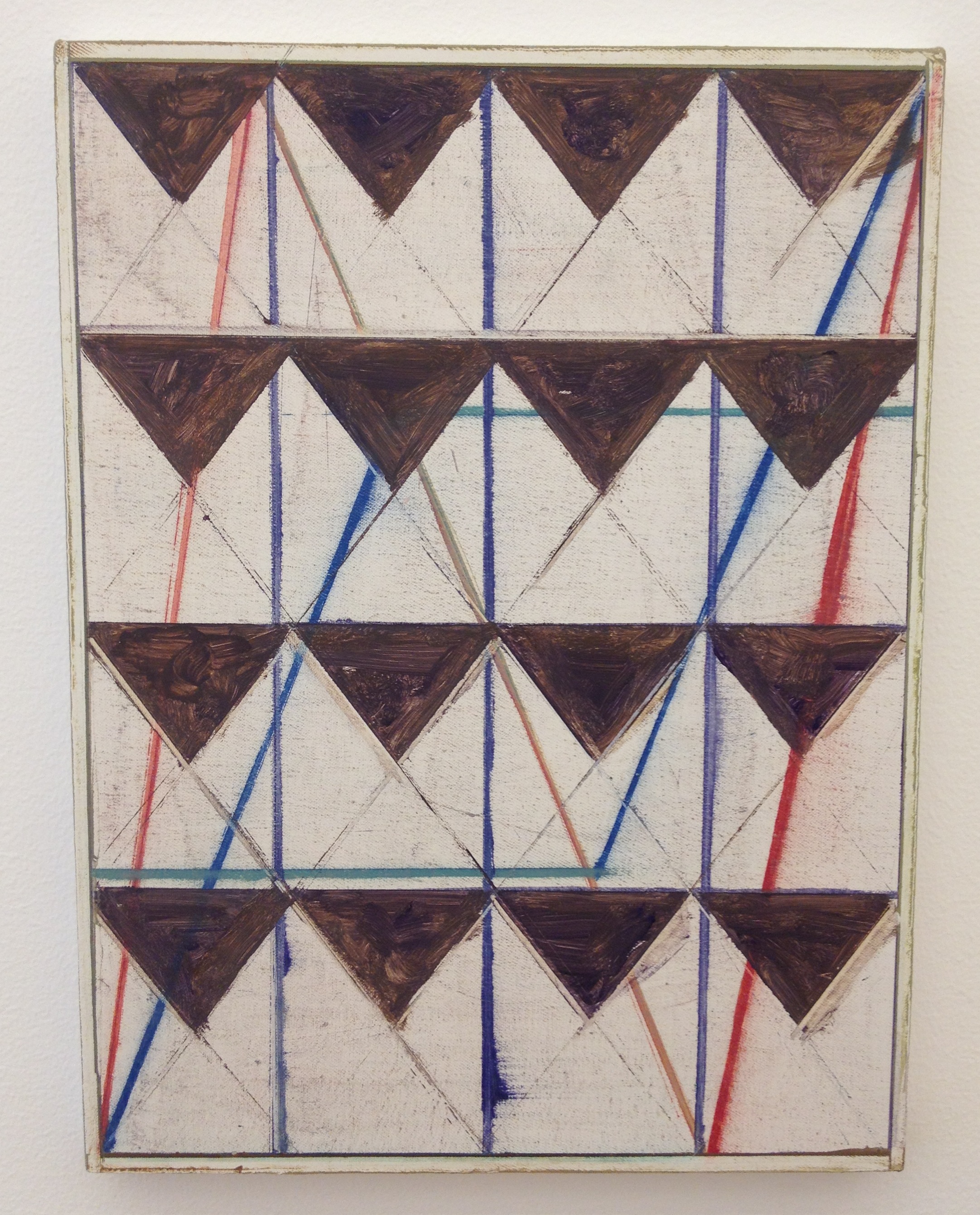
The next painting I would like to discuss is an untitled oil on canvas also from 2014. I Particularly like the use of both line and solid shapes this painting. Dividing the rectangular canvas into four columns and four rows, Fox has set up an interesting grid to draw lines connecting the points of intersection on the grid. Lightly drawing in both diagonals of each rectangular grid cell, he fills in a dark isosceles triangle in the top half of each. This creates a strong pattern that superimposes the other lines of the painting. Behind the triangles there is a 180 degree rotational symmetry to the red blue and gold lines. Looking at this  painting the viewer gets the feeling that it is about more than just the geometry. Again,the shapes are the language that Fox is using to convey a sense of place.

— Susan Happersett
MathArt in Chelsea Galleries – late February

Imi Hwangbo at Pavel Zoubok Gallery

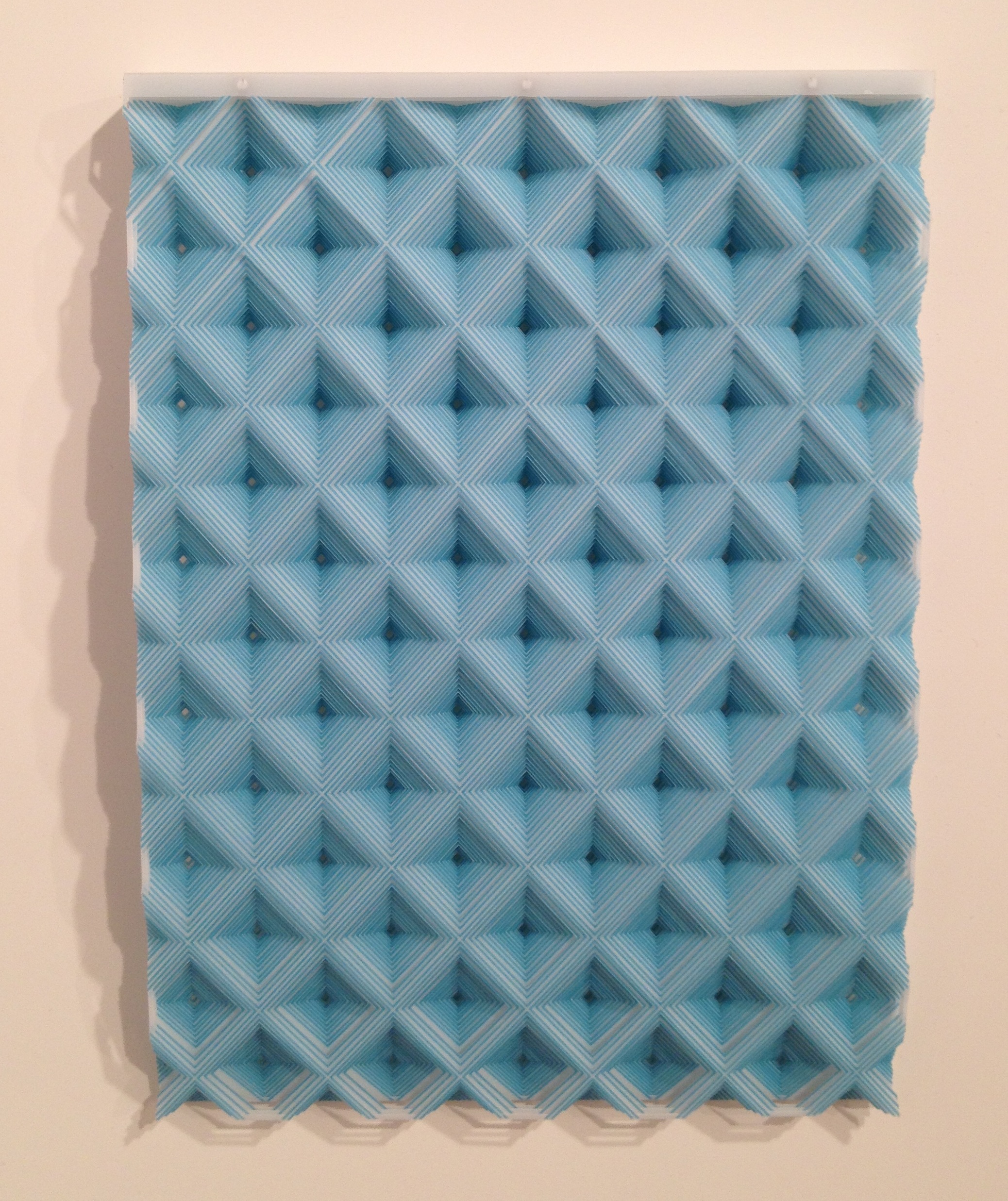
Pavel Zoubok Gallery is exhibiting the hand and laser cut mylar 3-D drawings of Imi Hwangbo. Using layers of colored mylar sheets, Hwangbo creates intricate geometric reliefs that have both depth and line. In the piece “Azure Seer” (2004), a grid of squares is meticulously cut from each sheet of mylar.  Sheets with larger squares are at the front. With each sheet the squares get ever so slightly smaller until the farthest sheet has no cutout. This method creates a grid of inverted pyramids. It is very common for Math enthusiasts to cut and fold paper to make 3-D geometric solids. Hwangbo’s process of cutting into the layers to make geometric voids is a fresh approach.

11-1

Imi Hwangbo – Azure Seer (2004)
Courtesy of the artist and Pavel Zoubok Gallery

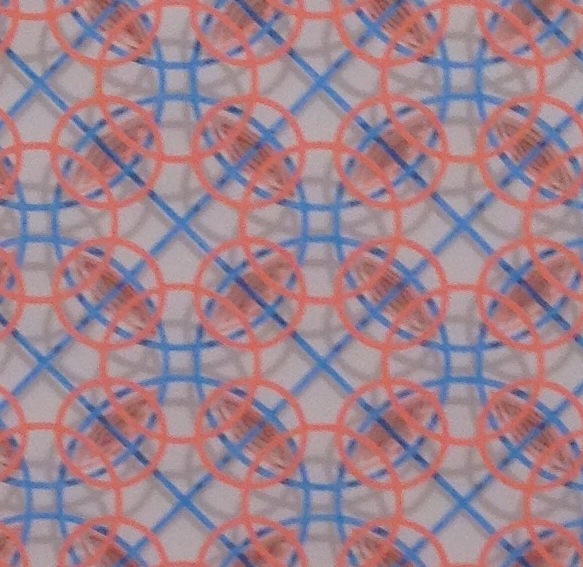
In a more recent work named  “Lens 2” (2013) Hwangbo has layered a series of net-like webs of patterns in hand-colored red and blue sheets. In the pattern there are intersecting blue circles with perpendicular diameters. These diameters run diagonally across the work creating a diamond grid. Then, in red layers there are two different sizes of smaller circles. Looking at a small section you can see the order 4 rotational symmetry around the center of each blue circle.

11-2 2

Imi Hwangbo – Lens 2 (2013) – DETAIL
Courtesy of the artist and Pavel Zoubok Gallery

Hwangbo has been influenced by ornamentation from religious and spiritual architecture. This inspiration enables her work to transcend the flatness of the mylar and create environments of space, light, and pattern.

Richard Kalina at Lennon Weinberg Inc.

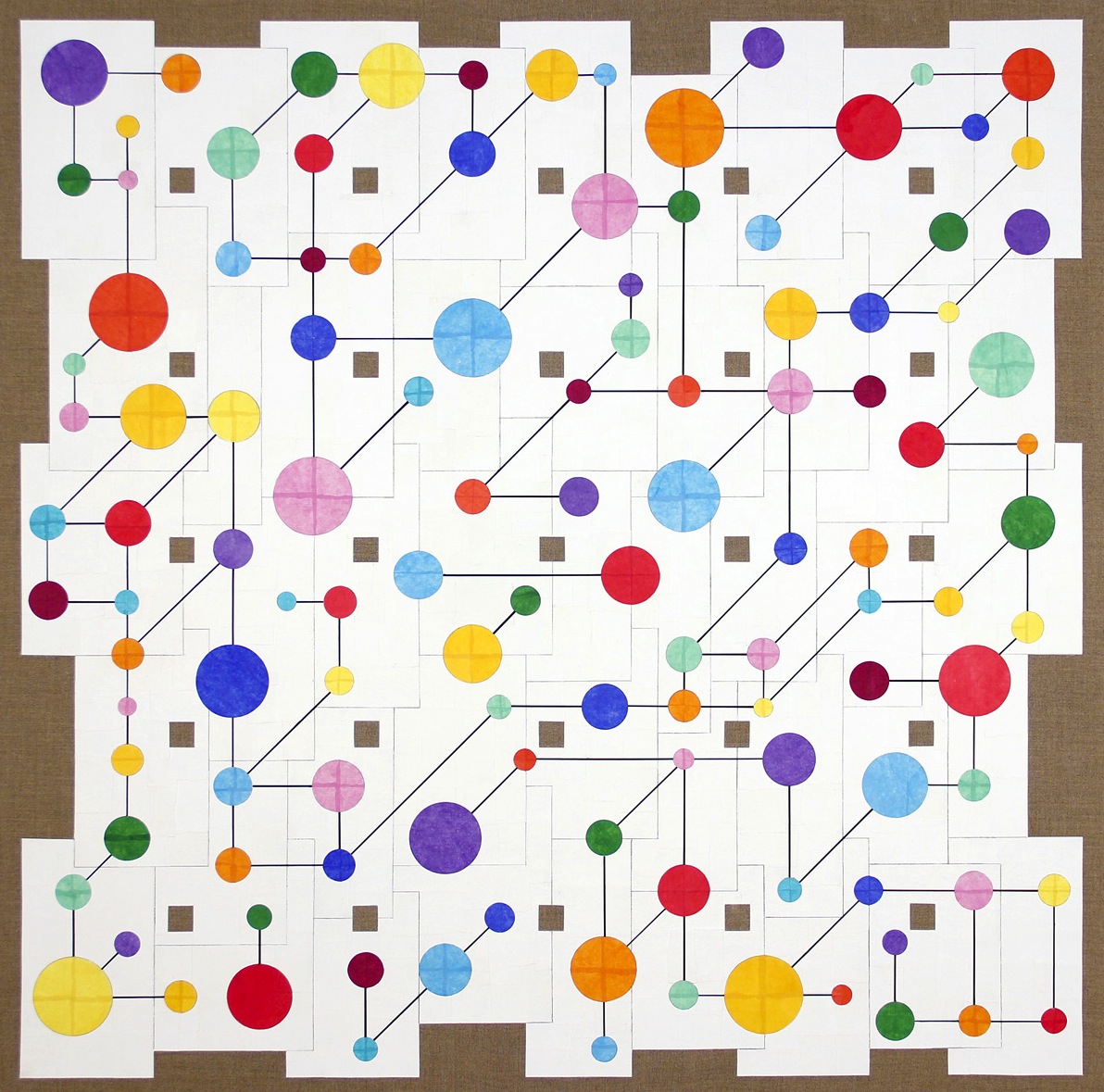
My fascination with MathArt goes beyond art whose direct theme is Mathematics. I am also intrigued by work that is inspired by, or is a reaction to, the systems in Mathematics. Richard Kalina‘s new work falls in this category. Lennon Weinberg Inc  is currently exhibiting his works on paper, as well as collages on linen. Using a  background grid consisting of overlapping rectangles of white paper in  “Nominal Space” (2012) Kalina paints a collection of brightly colored circles. These circles interact through a network of black straight lines that connect them. The lines have one of three possible directions: vertical, horizontal or diagonal, from lower left corner up to upper right corner. Each circle can have one, two, or three connecting lines radiating out from it, creating angles of 45 degrees. 90 degrees, 135 degrees, or 180 degrees. The patterns of connections seem like an homage to the molecular and  geometric models we made in high school.

e_9310_Nominal_Space

Richard Kalina – Nominal Space (2012)
Courtesy of the artist and Lennon Weinberg Inc.

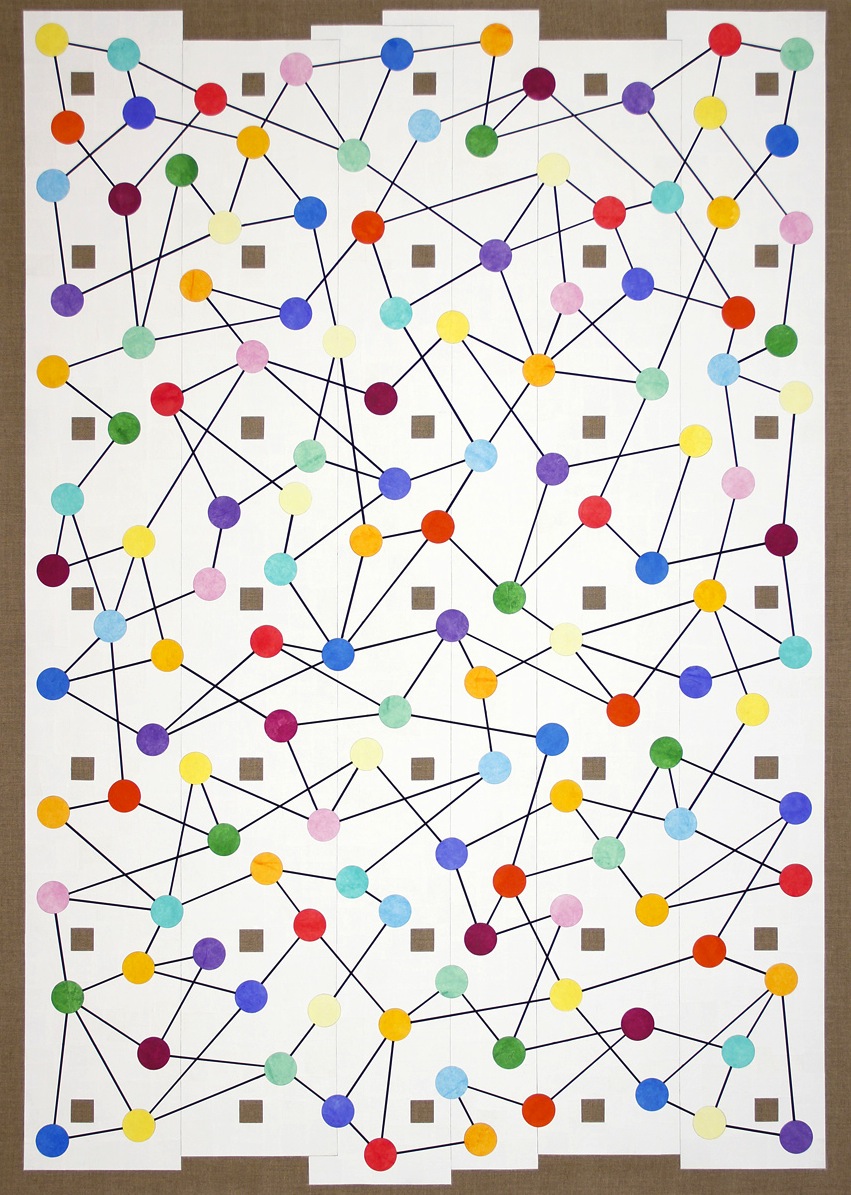
For the collage on linen “Neochrome” (2013) Kalina changed the rules with regard to the angles of the connecting lines. There are many more possible angle structures and the circles can have up to six connections. “Neochrome” has the energy of a complex flow chart with many possible routes to connect different elements within the network. Richard Kalina has had a long and esteemed career in the Arts. His work is included in many museum collections including the National Museum of American Art, the Fogg Museum, and the Wadsworth Atheneum. Kalina has also served as a contributing editor for Art in America magazine.

e_9307_Neochrome

Richard Kalina – Neochrome (2013)
Courtesy of the artist and Lennon Weinberg Inc.

More from the JMM exhibition

A few days ago, I discussed a few of the artists exhibiting at the art show that was part of the Joint Mathematics Meeting in Baltimore. Here are my other favorites from that show.

Robert Fathauer

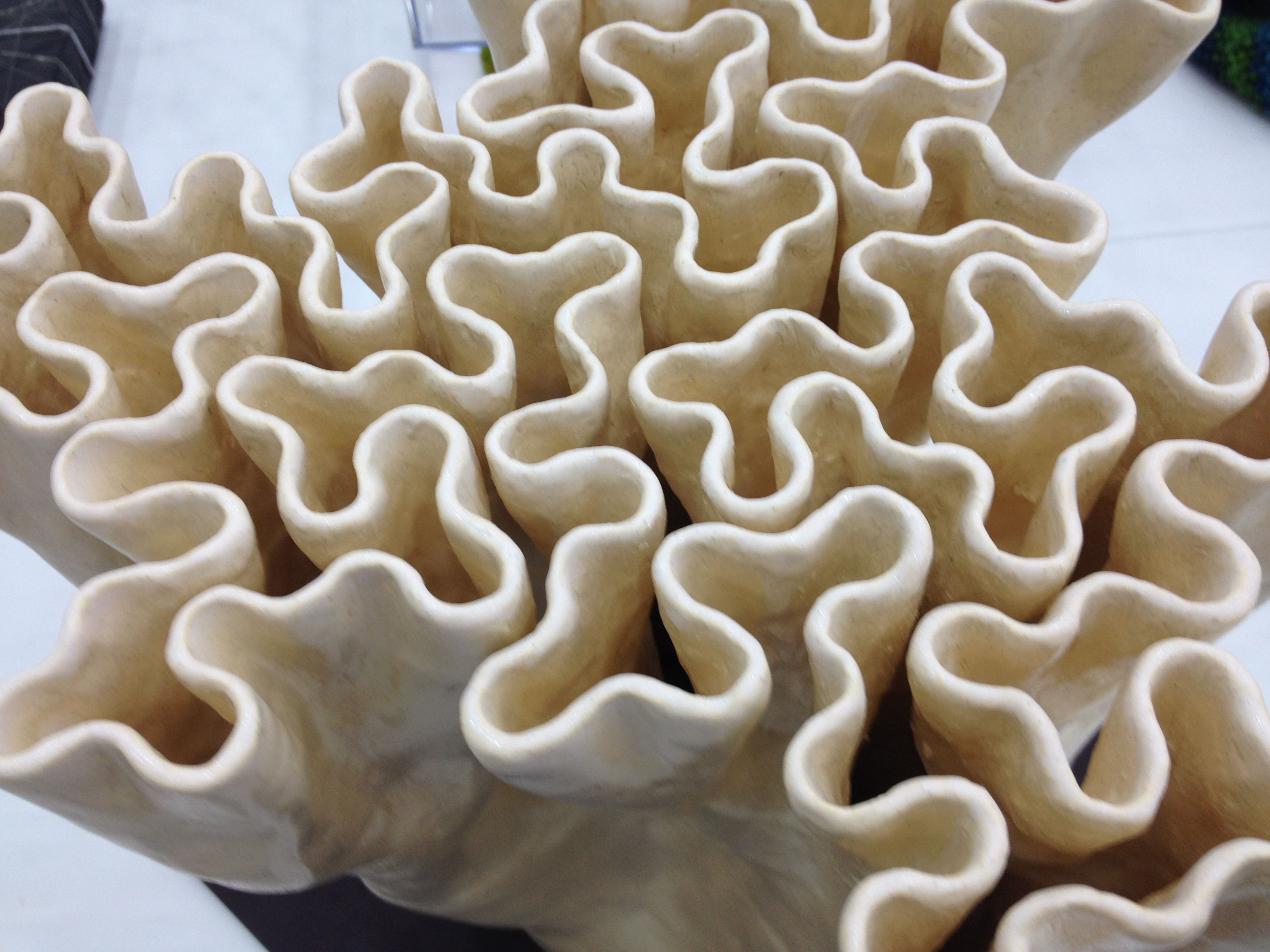
I have been a fan of Robert Fathauer‘s sculptures for years, but I feel Three-Fold Development is one of his best works. This ceramic vessel has a top lip sculpted to depict the development of a fractal curve through five iterations. Starting with a circle, then a three-lobed curve, then a nine-lobed curve. In each subsequent iteration the number of lobes triples.The sculpture has a wonderful organic quality, while still maintaining an elegant complexity. Fathauer has skillfully kept the spacing quite even between the ribbons of clay creating a graceful relationship between the positive and negative space.

Image

Fathauer – Three-Fold Development – Ceramic

Margaret Kepner

Mathematics enthusiasts have been fascinated with Magic Squares for centuries. Magic Squares are grids. Each grid square contains a number. The grids are constructed so that the sum of the numbers in each column, row and diagonal of the square are equal. Margaret Kepner‘s Archival Inkjet print “Magic Square 8 Study: A Breeze over Gwalior” is a an intriguing representation of a Gwalior Square: an 8 by 8 magic square which contains the numbers 0 to 63. The sums of the rows, columns and diagonals all  add up to 252. Kepner has translated each of the numbers 0 to 63 into graphic patterns using her own system, and formatting the numbers in either base 2 or base 4. The resulting print has a great optical effect of patterned color block grids that are both horizontal, vertical and across the diagonal. It reminds me of a Modernist quilt or a contemporary twist on some of Al Jensen’s paintings that resemble game boards. Kemper refers to her artistic process as “visual expression of systems”. I think that this print goes beyond merely expressing the Gwalior Square it celebrates the Mathematics in a bold field of shape and color.

photo-1

Kepner – Magic Square 8 Study: A Breeze over Gwalior – Inkjet print

Petronio Bendito

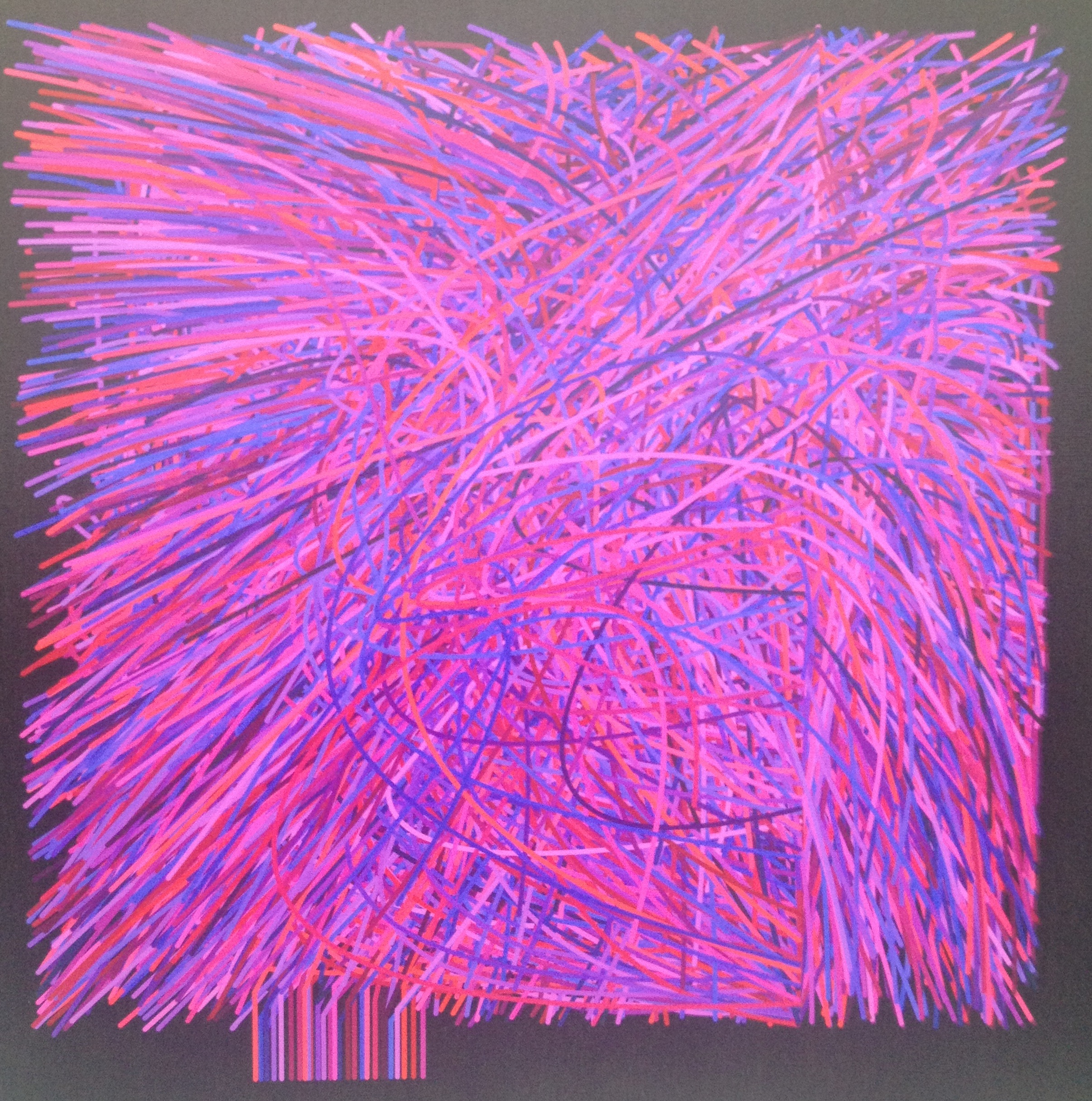
At the Art Exhibition at the JMM conference quite a bit of the art was digital printing on paper. Petronio Bendito – in contrast – prints his work on canvas, giving the prints more of a painterly feel. Bendito has developed algorithms to define his color palette, but there is also an element artistic expression in establishing the final images.”Color Code, Algorithmic lines n.0078″ is so vibrant that it beckoned me from across the room. Bendiito’s use of color and line creates  a cacophony of bright straight and curved thin ribbons of paint. The use of  the black background makes the exuberant frenzy of color jump out to the viewer.

photo

Bendito – Color Code, Algorithmic lines n.0078 – Digital print on canvas

Lilian Boloney

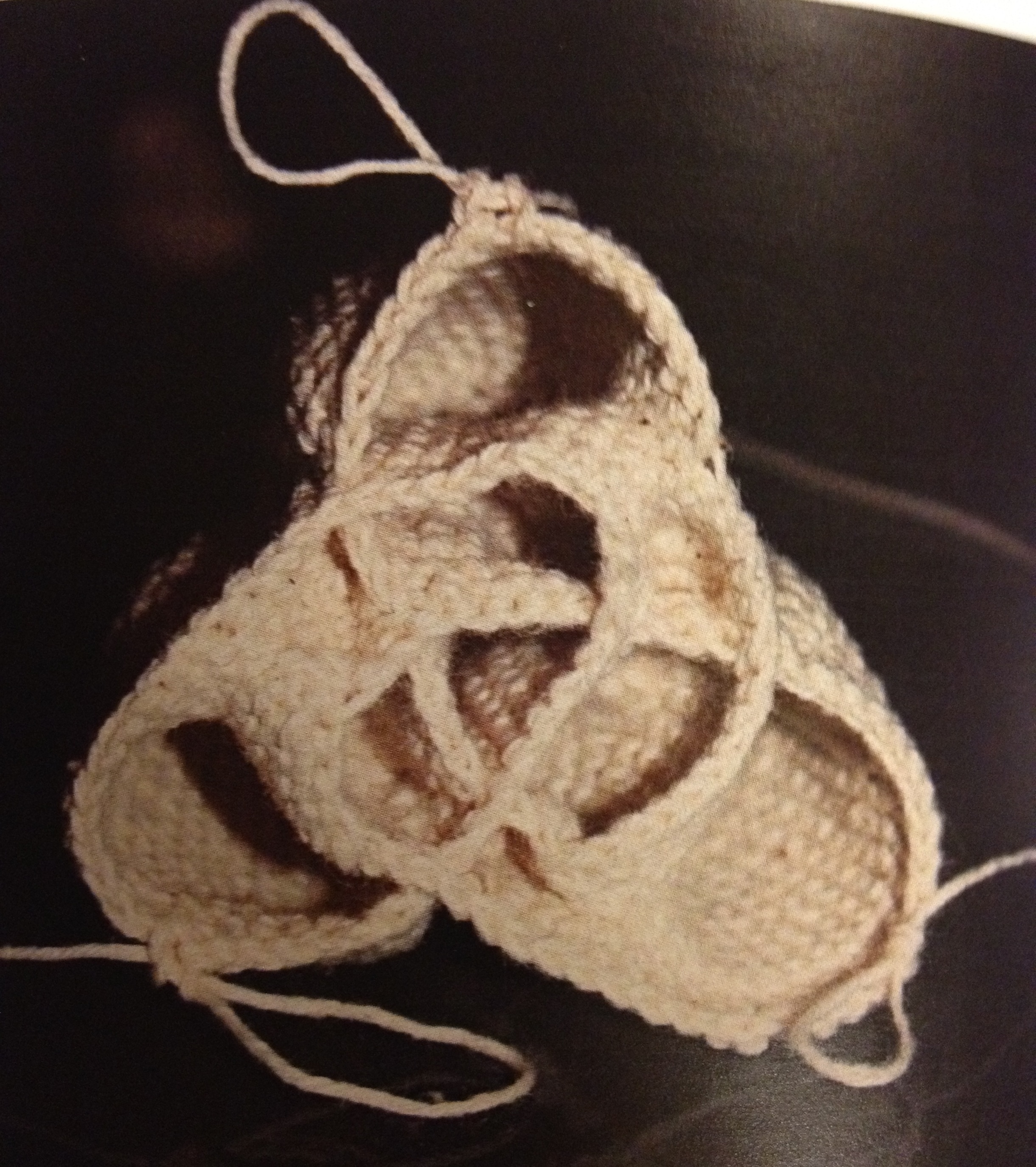
Lilian Boloney is a textile artist who uses crocheting to explore the geometry of hyperbolic figures.There is an elegant simplicity to the off-white cotton thread she used to crochet the sculpture “Boy’s surface”. This allows the viewer to explore the complex topology of the figure with out the distraction of patterns or color. Boloney not only has a clear understanding of her Mathematical subject, but she transposes their beauty into graceful objects. Instead of models of Hyperbolic figures I see them crocheted portraits.

photo

Boloney – Boy’s surface – Crocheted cotton

I hope you enjoyed the samples of work from the JMM exhibition as much as I did. The Art Exhibition at the JMM conference was organized by the Bridges Organization, an international organization that promotes the relationship between Art and Mathematics. Each year they have a conference where Mathematicians, Artists and educators meet to discuss, explore and learn about Math Art.

This year’s Bridges 2014 conference will take place in August in Seoul, South Korea. This is the first Bridges conference to take place in Asia. It is a wonderful opportunity. I encourage all artists who are interested in Mathematics to attend and participate at this conference. The deadlines for paper and art submissions are fast approaching all info is on the Bridges website.

-FibonacciSusan

Mathematical Art

In this blog, I will be sharing my observations on Mathematical Art that I see in galleries museums exhibitions and art fairs. What is Mathematical Art? I will choose work that meets at least one of the following three criteria: The art

  1. is based on a Mathematical phenomenon, or
  2. it is generated by a Mathematical process, or
  3. it is a personal response to Mathematics by the artist.

JMM – Baltimore 2014

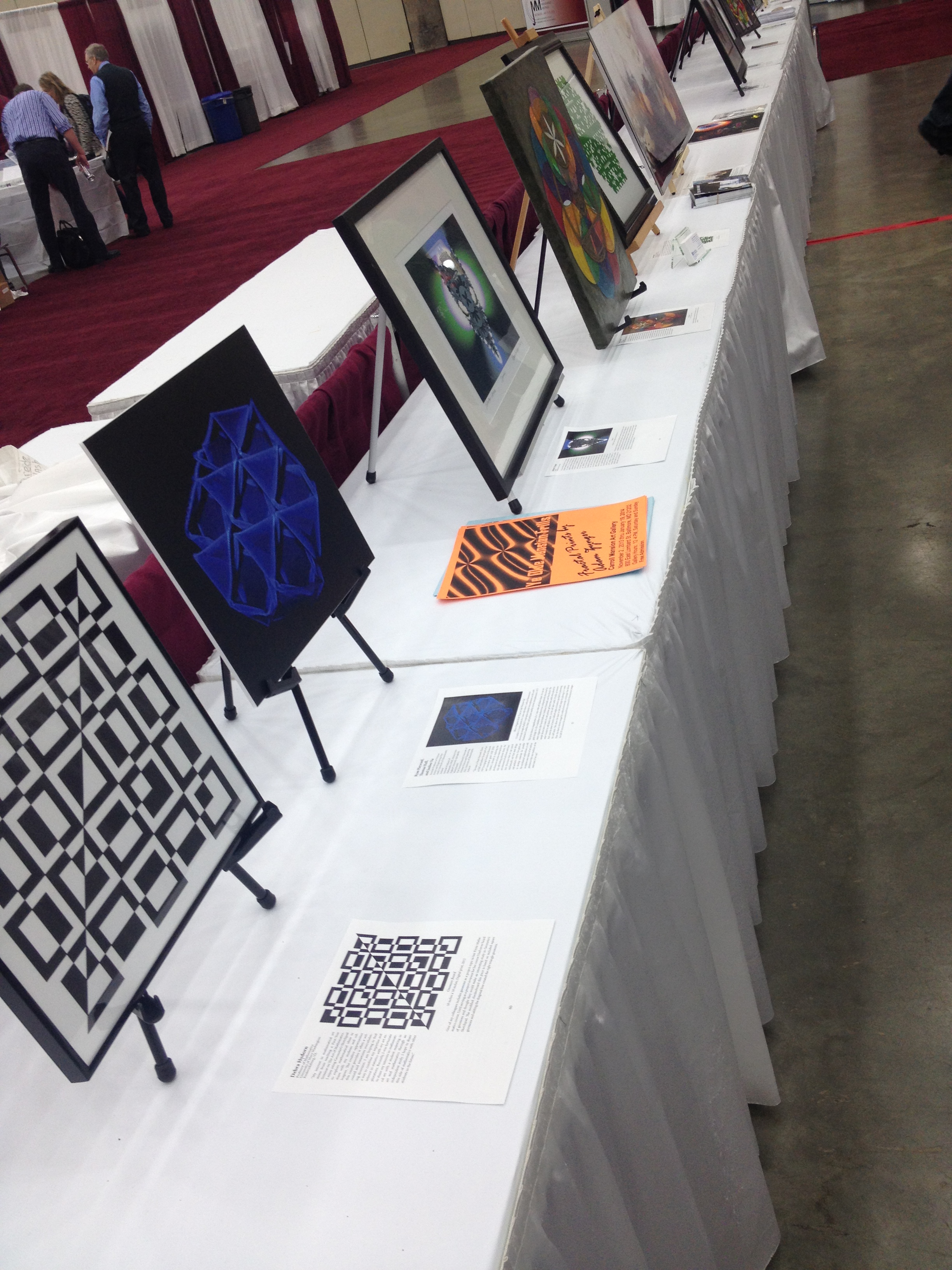
Each year in January, thousands of Mathematicians gather at the Joint Mathematics Meeting (JMM) to discuss current issues in their field.  For the past 11 years, an exhibition of Mathematical Art has been part of the event. This year the Joint Meeting was held in Baltimore at the convention center. The art exhibition was held at one side of the general exhibition hall.

Image

Joint Mathematical Meeting – 2014 Art Exhibition

I have participated in the exhibition five times in the past six years and over that time the exhibition has matured, both in the range of work exhibited, and in the quantity of interesting – or even exciting – work.

Exhibitions like this are really a mixed bag of prints, drawings, paintings and sculpture of all types. You can find full catalogs of the shows online. here I will discuss just a few of my favorites from this year’s show.

Shanti Chadrasekar

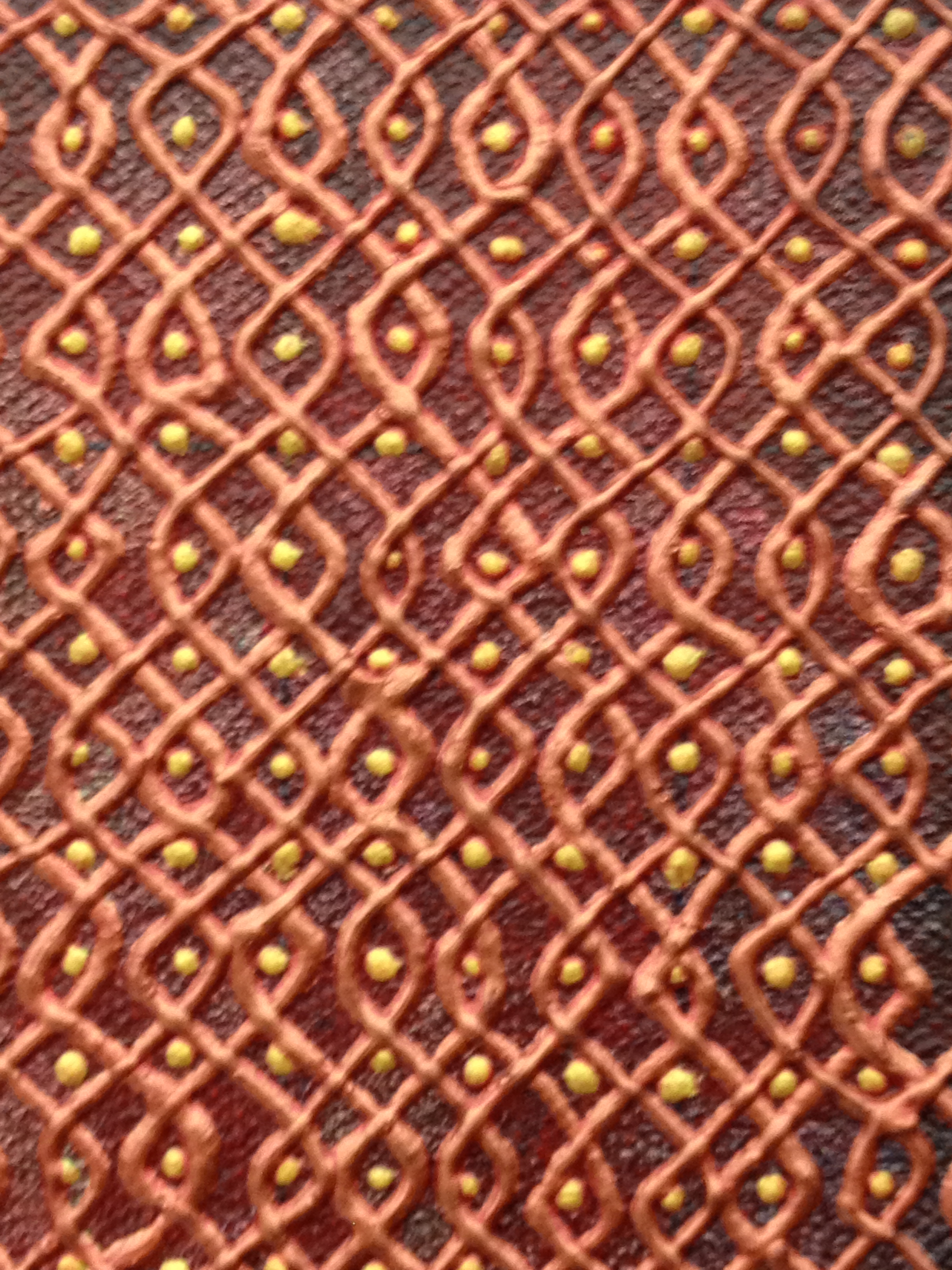
Kolam-93X93 is a painting on canvas based on the fractal patterns of Kolam drawings. Shanthi Chadrasekar has incorporated the rules of Indian Kolam drawings into her artistic practice. Kolam drawings are traditionally drawn by women, each day, at the entrance of their homes. In this painting, Chandrasekar has created an elaborate 93 by 93 dot grid with a single thread-like line that gracefully winds around each dot, completely enclosing the dots in a web. I find the intricacy of this painting mesmerizing. Spending a few moments with this work, the viewer feels as though they too could be encircled by this unbroken thread. The patterning on this painting is so dense that a small image of the entire piece will not do justice to the work so I am providing just a close up of a small section.

Chandrasekar - Kolan 93X93 - Paint on Canvas - 24" x 24" (detail)

Chandrasekar – Kolan 93X93 – Paint on Canvas – 24″ x 24″ (detail)

Karl Kattchee

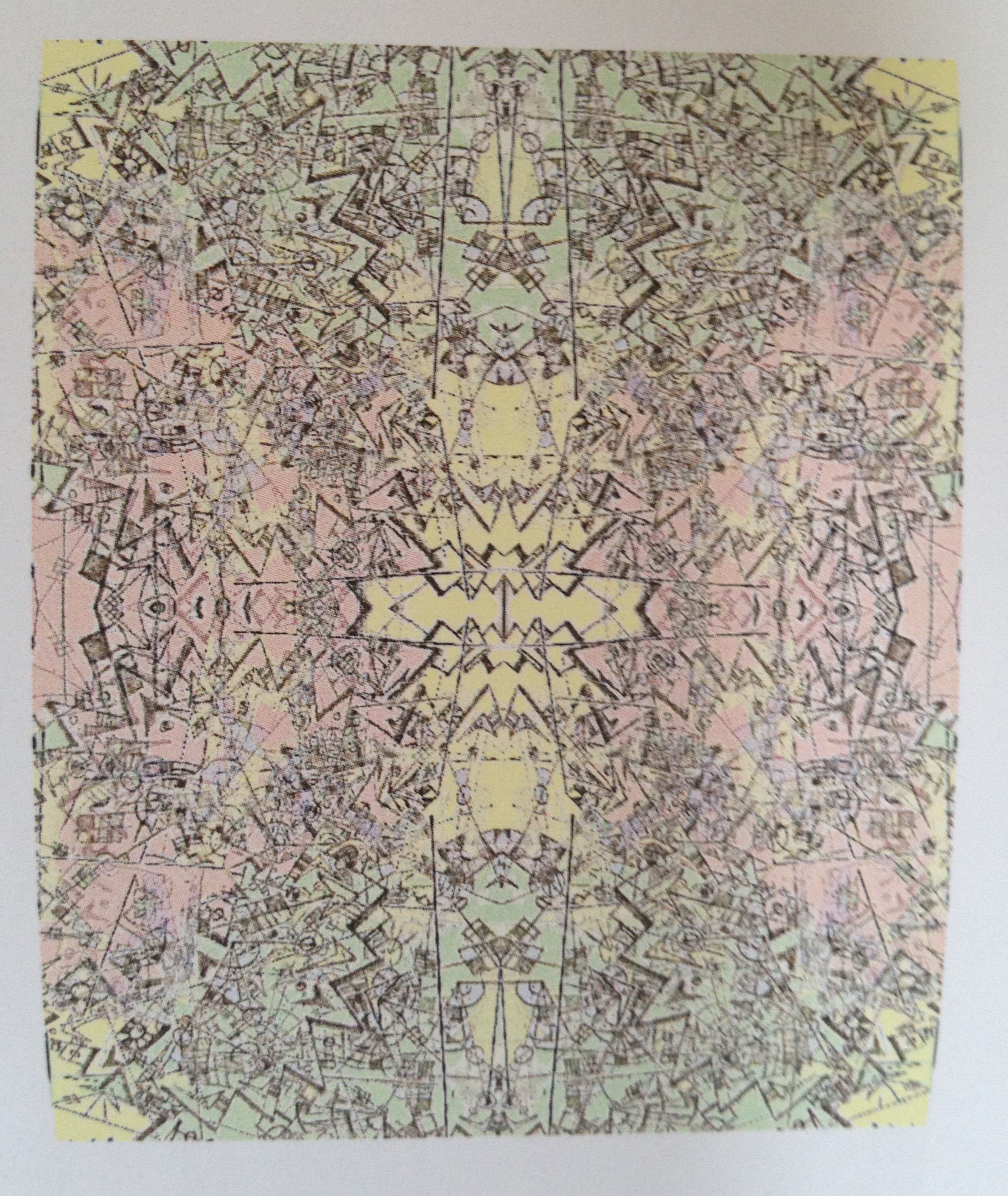
Karl Kattchee has developed a unique process to use Mathematics to create his digital prints. His work starts with hand drawn abstract drawings that are then multiplied and manipulated using  a camera, a computer and a printer. He creates reflections, translations, etc. until the image appears to have fallen into chaos. Kattchee then builds patterns using these chaotic elements. What I find very interesting about these prints is that the whole process begins with what  Kattchee refers to as” abstract automatic drawings”. The freedom of this stream-of-consciousness type of drawing lends a whimsical quality to the initial pictures. After they have been subjected to all of the technical process, they retain a playful quality: the drawings dance across the page.

photo32

Karl Kattchee

More about the art exhibition at JMM in Baltimore next time.

– FibonacciSusan