Picture courtesy of the gallery and the artist
Author: Susan Happersett
Phil Wagner at UNTITLED Gallery
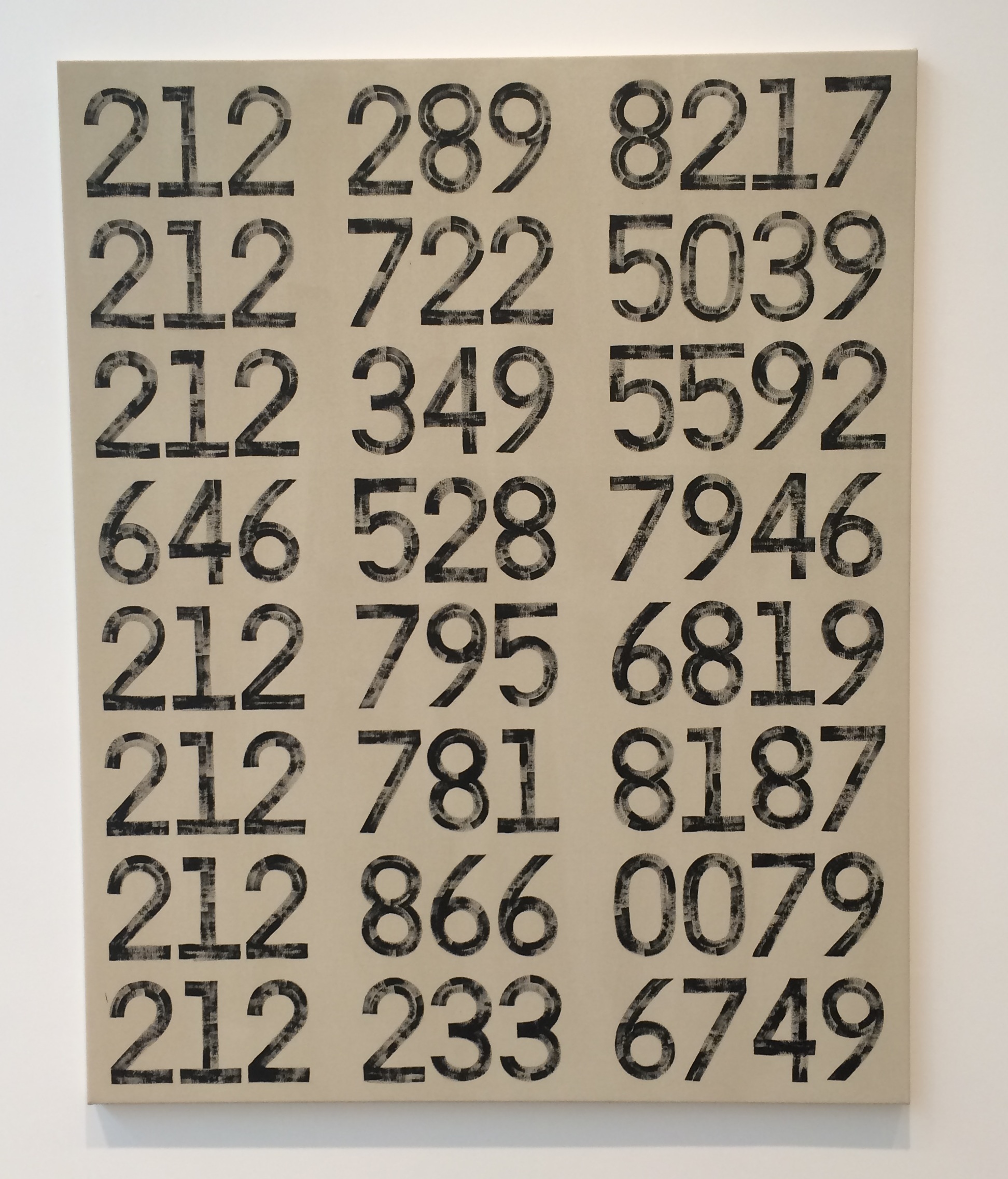
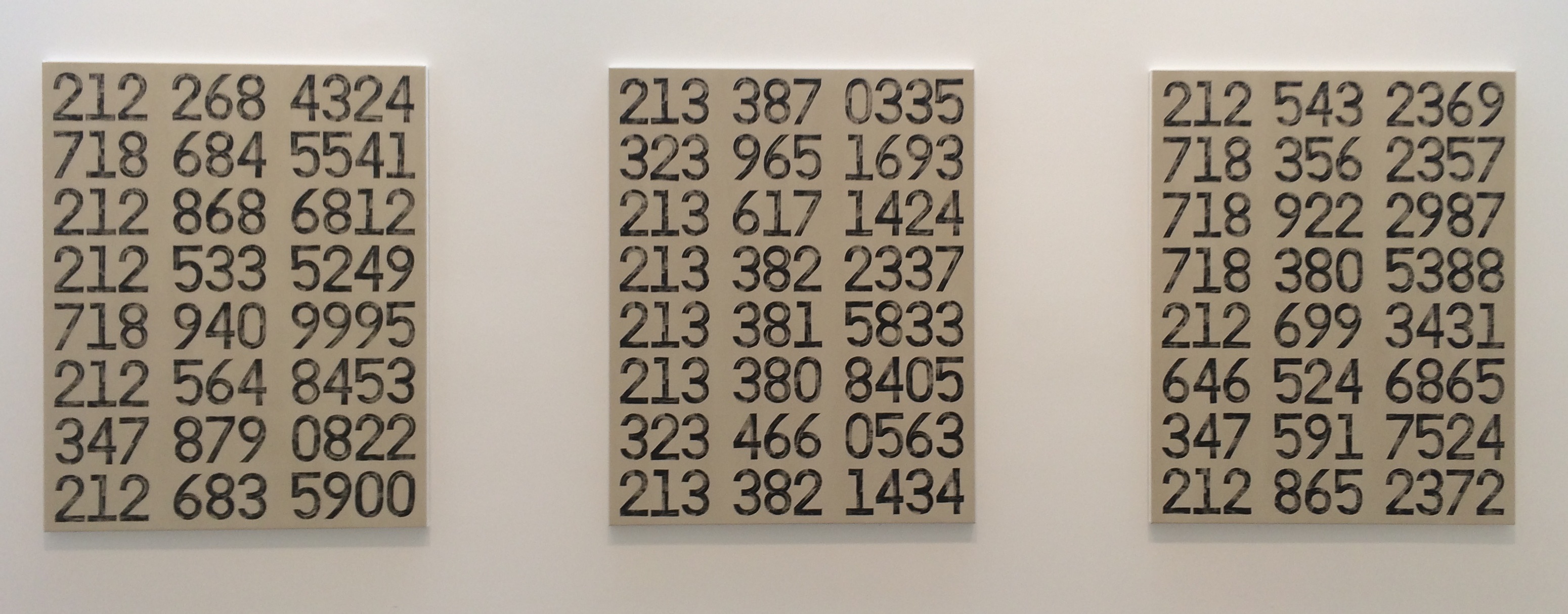
The exhibition “It’s Been Too Long” at the UNTITLED Gallery on Orchard Street features a recent (2015) series of paintings based on telephone numbers. Wagner has randomly selected telephone numbers from the NYC and LA white pages. He paints columns of the enlarged numbers.

The numbers have been painted with uneven brush strokes so that the resulting numerals look as if they have been stamped with an old fashioned rubber stamp and ink pad onto the parchment-colored background. These paintings are an exploration into society’s association with numbers. The rows and columns of numerals become abstract geometric patterns. Removed from the initial source they lose their meaning and purpose. The whole concept of a paper telephone directory is becoming obsolete. In this digital age the once important pages are becoming visual artifacts.

The gallery installation fills an entire room with these canvases, creating an environment of numerals. As some one who likes to work with numbers, I found it quite soothing, almost meditative. It makes me think of all of the other places we see numbers: train cars, mileage signs along the road, credit card numbers, etc… and never stop to think about the aesthetics. Numbers are an important part of our lives but quite often we tend to only use them for practical applications, never stopping to appreciate their visual qualities.
Susan Happersett
James Siena “New Sculpture” at Pace Gallery
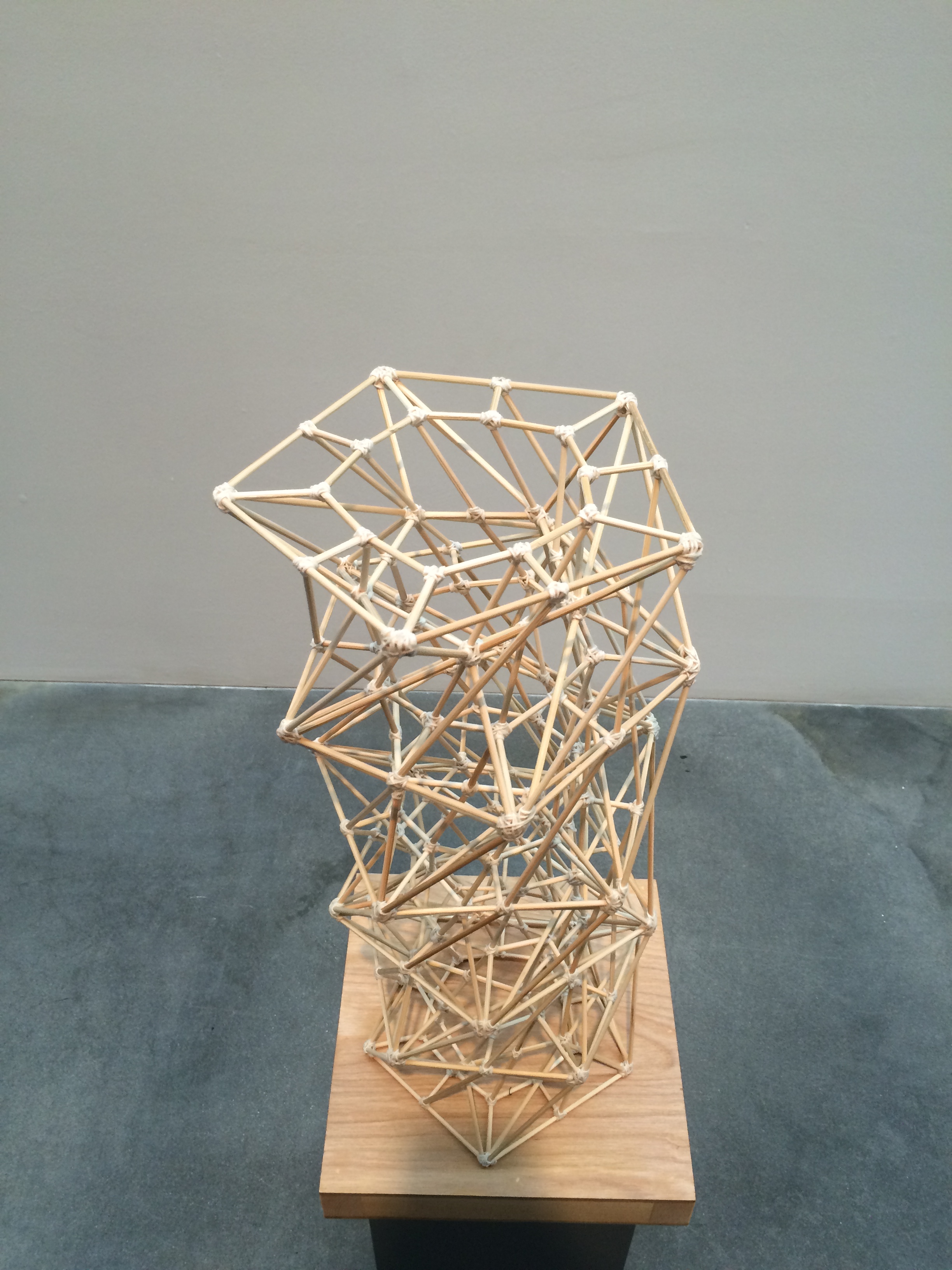
Pace Gallery on 25th street in Chelsea is currently presenting the geometric sculptures of James Siena. Well known for his algorithmic paintings, Siena has been making sculptures throughout his career. At first working with tooth picks, and now new work using bamboo skewers, as well as bronze casts of previous pieces. Some of the work has very clear geometric patterns and others seem more chaotic. I have chosen two of the bamboo sculptures that are about a particular mathematical geometric phenomenon.
“Richard Feynman” from 2014 is a great illustration of self-similarity in three dimensions. Named after the famous 20th century Theoretical Physicist, this work is a cube within a cube within a cube. Each cube structure is composed of 4 by 4 by 4 cubes. Four of smallest cubes make up one cube in the medium cube structure and four of the medium cubes make up one of the large cubes on the large cube structure. Using the bamboo skewers as lines in the 3-D space the artist has created grids on three different scales.
“Morthanveld: Inspiral, Coalescence, Rungdown” from 2014-2015 is complex tower created using 6 regular pentagons. Instead of stacking them at the same angle, Siena has twisted each consecutive pentagon 36 degrees. The finished sculpture is a spiraling geometric column. Siena uses a building technique of wrapping string around the vertices to to attach the bamboo skewers both in the interior and the exterior shapes. This requires a a very hands on process adding a human element to the Mathematical subject matter.
Pictures courtesy of the gallery and the artist.
Susan
Holly Laws “Cage Crinolines” at Muriel Guépin Gallery
The exhibition “No Woman, No Cry” at Muriel Guépin Gallery features the work by three women whose subject matter is the female identity in society. They reference both the tradition of feminine crafts, as well cultural expectations.
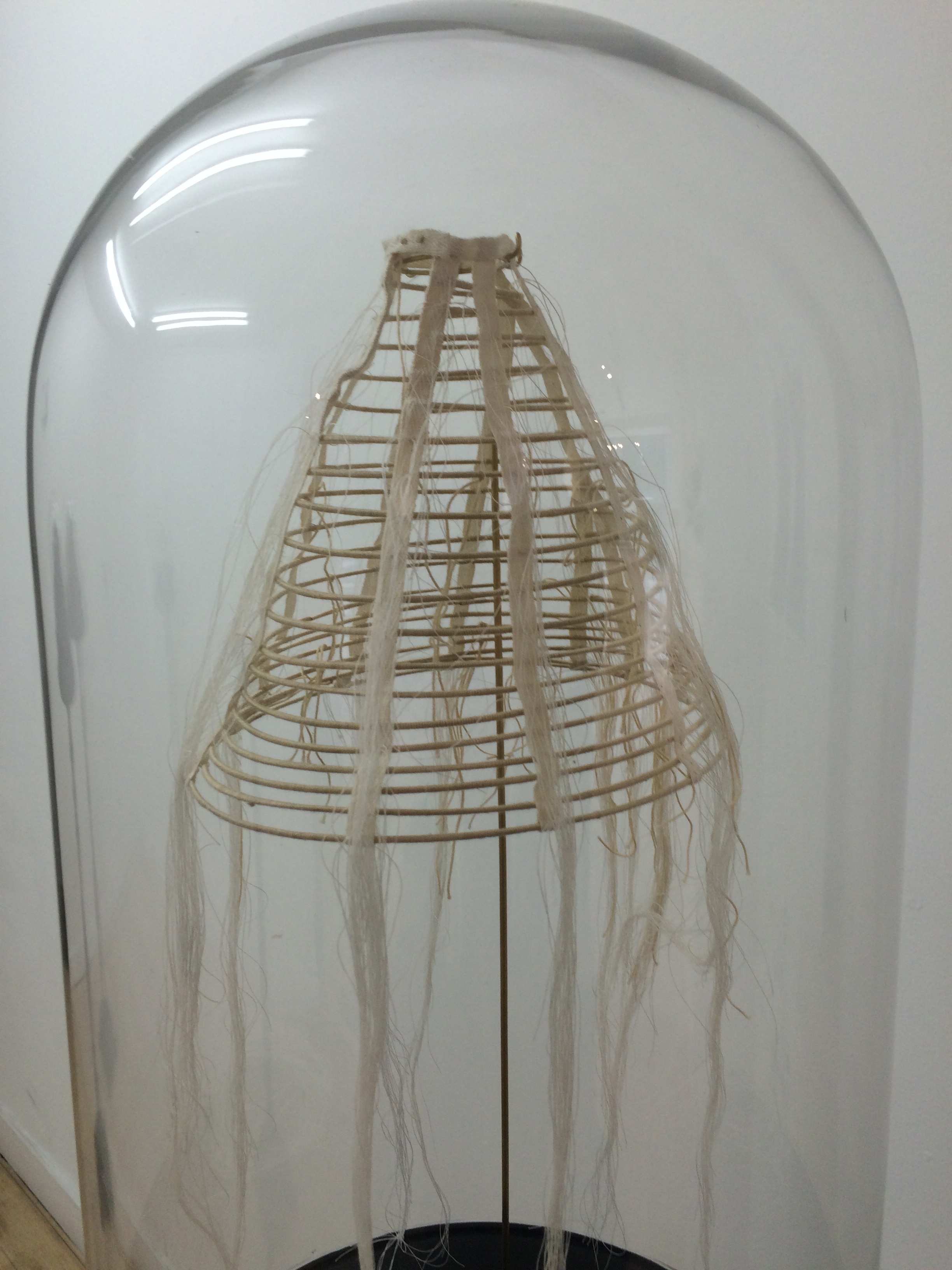
Holly Laws has created a series of small, detailed, handmade models of historic garments. Her intricate “Cage Crinoline” sculptures show the mathematics involved in the design of these 19th century hoop skirt figure enhancers. They are on display under glass domes, hinting at the Victorian practice of preserving and displaying things like a tiny skeleton in a cabinet of curiosities.
The structure for “Cage Crinoline 1864” consists of a series of concentric ellipses. They have been used to create a vertical column with two perpendicular reflection planes of symmetry. With the utmost precision Laws has built a 3-dimensional expression of the aesthetic qualities of ellipses. This complex geometry has been used in a miniaturization of an undergarment that if it were an actual garment would not even be seen in public. The mathematics would be hidden under a showy display of skirt fabric. I was really drawn to this “Crinoline Cage” because it reminds me to look beneath the surface and in unexpected place to find the beauty in Mathematics.
Susan
Math at the Cooper Hewitt
The Cooper Hewitt, Smithsonian Design Museum in Manhattan was closed for renovation for three years before it reopened at the end of 2013. The current exhibition features an overview sample of their vast collection. I was very happy to discover that they have chosen to display quite a bit of work with direct Mathematical links. The debate over the critical delineations between Fine Art and Design is a hot button issue I am not going to address in this blog post. I have selected two pieces that have specific Mathematical themes.
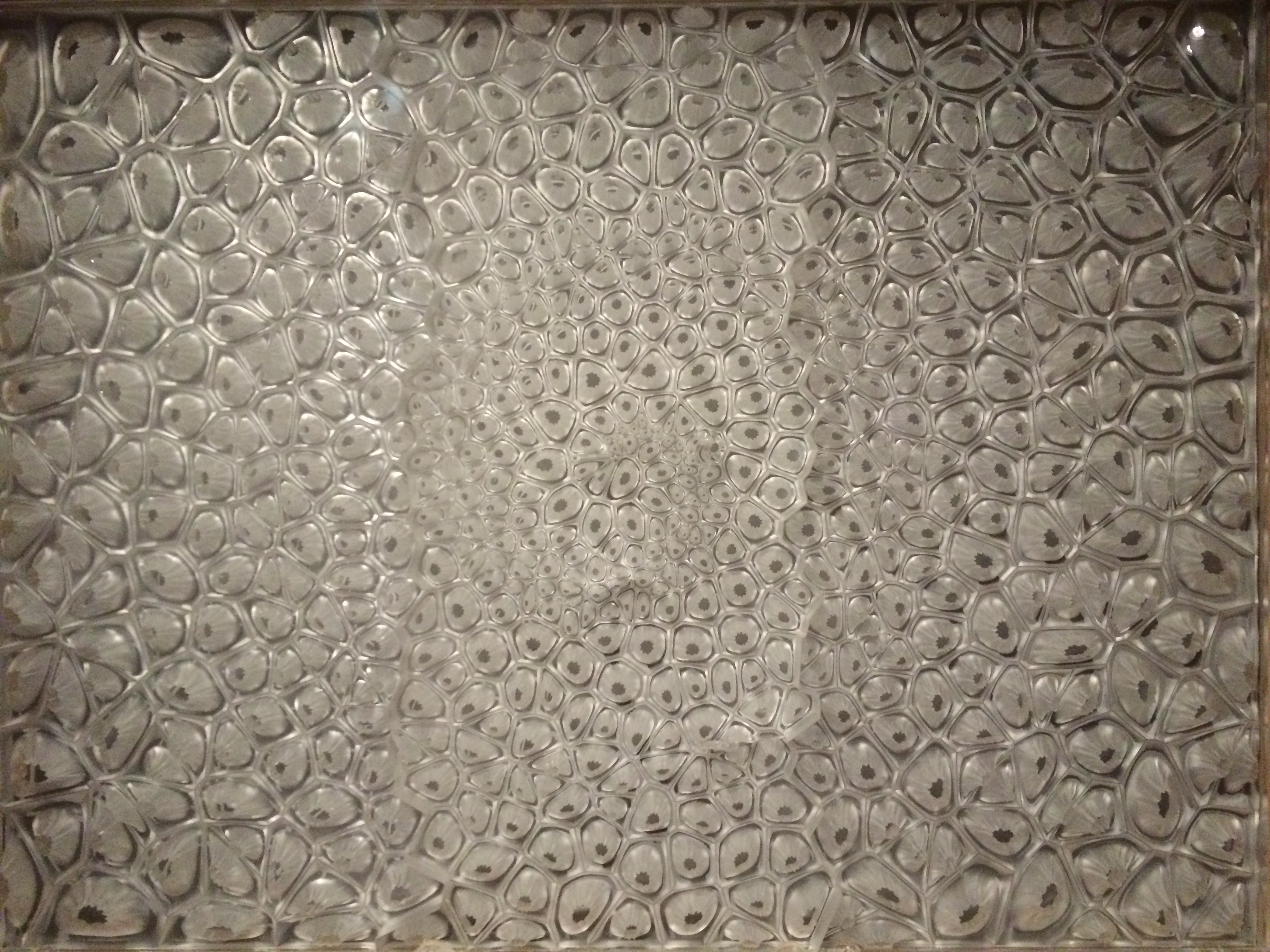
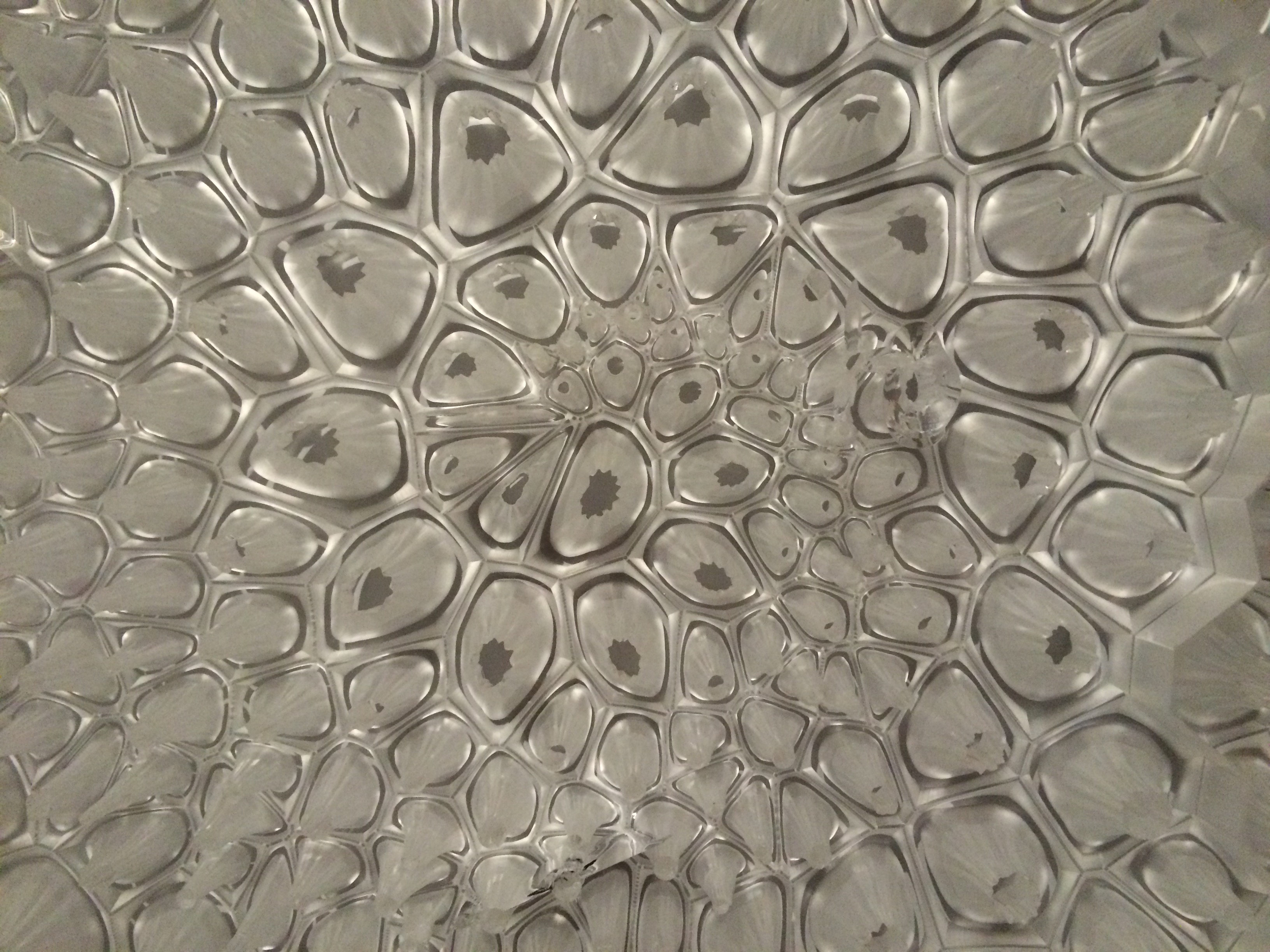
“Prototype for an Environmental Screen, Fibonacci’s Mashrabiya”, 2009 is an architectural element designed by Neri Oxman at MIT Media Lab with Professor W. Craig Carter. It is was created using algorithms and digital processes but is based on traditional screens found in historic middle Eastern design.
The recursive Fibonacci Sequence was used to create the spiral pattern. Here is a detail of the center of the spiral.
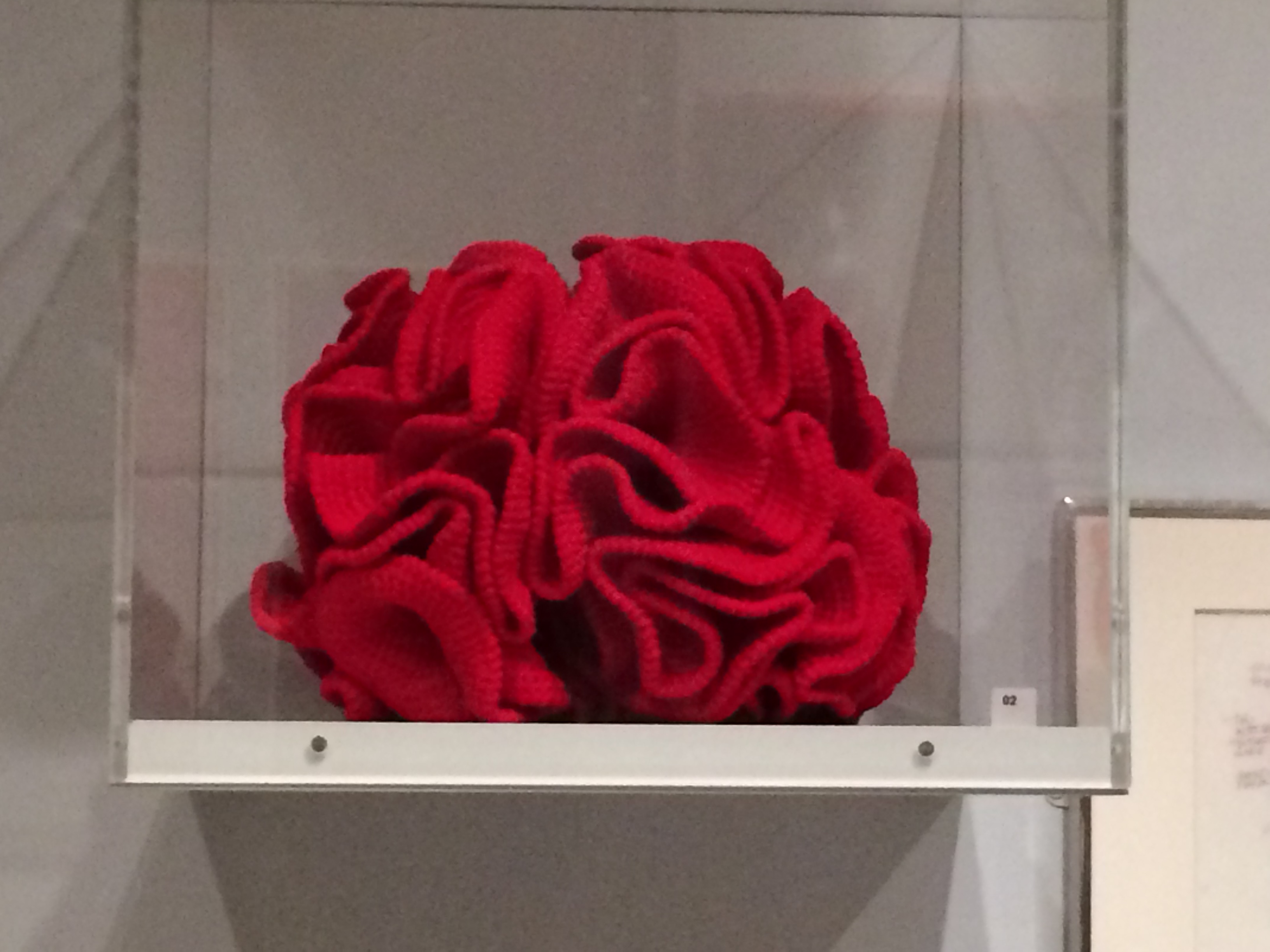
Mathematician and artist Daina Taimina has been quite well known for her crocheted sculptures of Hyperbolic Geometry.

“Model of a Hyperbolic Space” 2011, is crocheted out of wool yarn. Working on these sculptures since 1997, Taimina has made major breakthrough on the modelling of figures in Hyperbolic space. Hyperbolic Geometry is a Non-Euclidean Geometry discovered by Janos Bolyai and Nicholay Lobatchevsky in the first half of the 19th century. In Hyperbolic Geometry each point has negative curvature and seems to curve away from itself.
At the Cooper Hewitt there were many more items that featured Mathematics as a design element. There was a very direct indication of the importance Mathematics plays in the field of both decorative and industrial design.
Susan
Yuichi Higashionna at Marianne Boesky Gallery
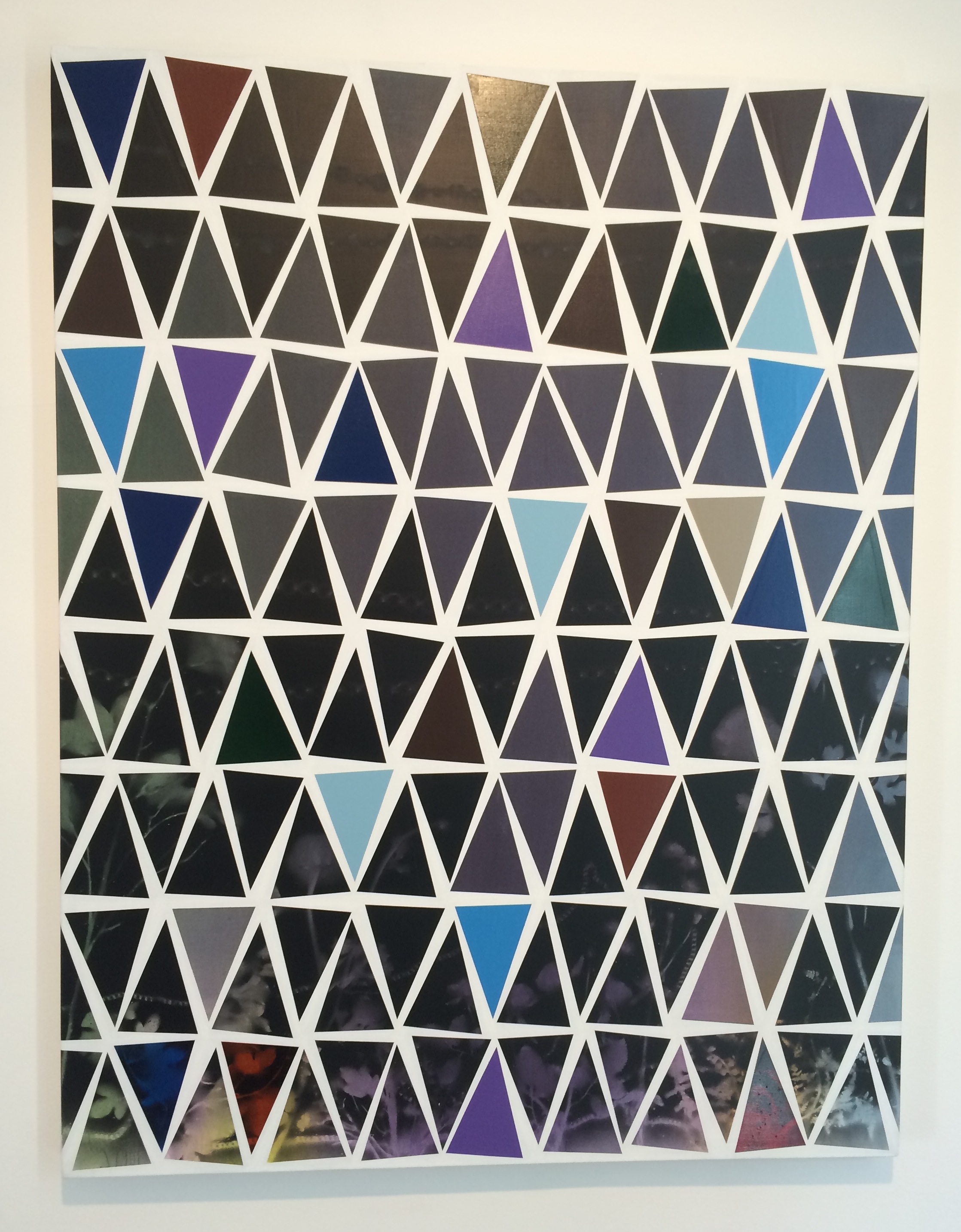
Marianne Boesky’s Upper East Side gallery is currently presenting the exhibition “let’s get dizzy”, featuring new work by Yuichi Higashionna. This Tokyo artist’s work is a reaction to Japanese Art and design of the 1970’s and questions the connection between luxury and aesthetics. His use of abstraction incorporates geometry. In this 2014 Untitled spray paint on canvas Higashionna uses an underlying grid of isosceles triangle.
This tiling is composed of rows of isosceles triangles. Alternating the direction of each triangle, first base at the bottom, then the next rotated 180 degrees, so its base is at the top. Within each of these grid triangles there is a smaller spray painted isosceles triangle that is slightly twisted off-center. The outcome of these shifts is a bit disconcerting and jarring, giving the painting a pulsing sense of movement. The idea of an underlying grid or tiling pattern is still clear but by placing the hard-edge painted triangles at slightly disjointed angles Higashionna changes the entire feel of the painting.
Susan
Karen Schiff at BravinLee Programs
At their Chelsea gallery, BravinLee has a vitrine dedicated to the display of Book Arts. Works that address the topics of typography and linguistics are considered part of the Book Arts genre. Currently on display are recent prints by Karen Schiff. These works are created using alphabetic and numeric rubber stamps. The artist prints on various types of commercial stamp album graph paper in a very small scale grid.

Karen Schiff – “oOo” 2015 Ink graphite, and watercolor on stamp album paper
Picture courtesy of the artist and the gallery
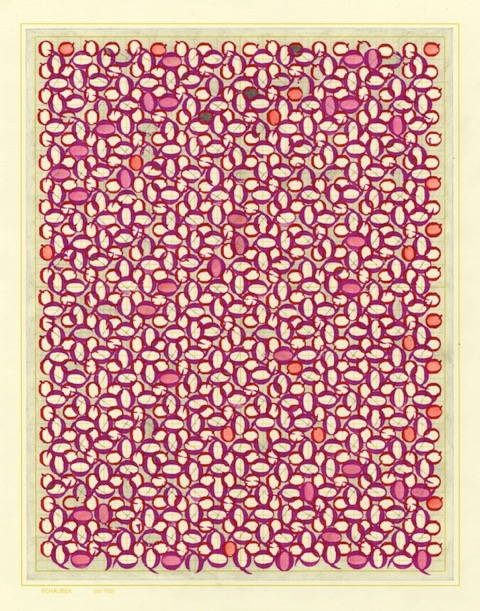
“oOo” from 2015 is a type of tiling constructed out of zeros and capital letter O’s. The artist takes advantage of the two-fold rotational symmetry of these forms. By rotating the figures 90 degrees and overlapping the edges, Schiff has filled the rectangular plane with ellipses. This print is an exploration of the geometry of these two typographic elements.

Karen Schiff – “mmm…” 2014 Ink, graphite, and gouache on stamp album paper
Picture courtesy of the artist and the gallery
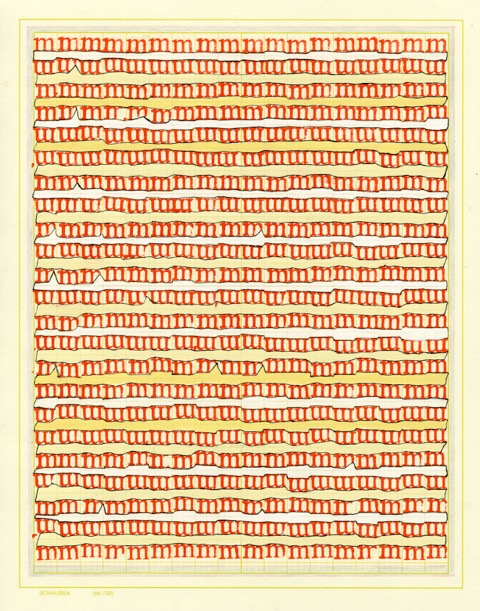
“mmm…” made in 2014 is composed using only one type of rummer stamp, the lower case “m”. At first glance, the image appears to be a horizontal rows of vertical marks, but upon closer inspection you see the top curves of the m’s. What makes these rows of m’s interesting is the fact that the letters have no symmetry, but lined up appear to create a consistent pattern.
Schiff hand stamps each of these letters individually to form detailed images. The imperfections of the printing process create slight discrepancies in the patterns. This is an important part of Schiffs artistic process. By removing the letters and numbers from a traditional text format of works or calculations they lose their direct linguistic and numeric connotations, becoming abstract forms. This allows the viewer to explore the abstract shapes geometrically. We look at numbers and letters all day with out thinking mathematically about their shapes. In this his new series of prints Schiff has invited us to look at numbers and letters in a different way.
Susan Happersett
Geometry at the Armory Show
For one week each March New York City becomes the epicenter of the contemporary international art world. There are at least 6 art fairs all running pretty much simultaneously. The largest is the Armory Show. It is too huge to fit in the Armory so it takes place on two huge piers on the Hudson river. Over one hundred gallerists form all over the planet set up exhibitions rooms to showcase the their inventory. The opening night is a very noisy, crowded and rather intimidating event. I saw quite a bit of art with Mathematical subject matter. For this blog entry I have decided to focus on three works that are about Geometry.
Sicardi Gallery from Houston Texas featured this amazing construction by Gabriel de la Mora at the entrance to their booth. This work is a nod to minimalist paintings from the 1960’s and 70’s but with a twist. It is composed of match boxes.The red brick shaped rectangles that make up this work are actually the red phosphorous paper you find on the striker of a match box. This unexpected choice of material makes us look at the repetitive nature of the geometry with a more emotionally charged reference point. Adding the element of fire changes the theme of the work, but the geometry stays true to the Minimalist roots. La Mora’s background as an architect is apparent in the precision involved in the creating the parallel lines to form the concentric rectangles. This work also has both a horizontal as well as a vertical line of symmetry.
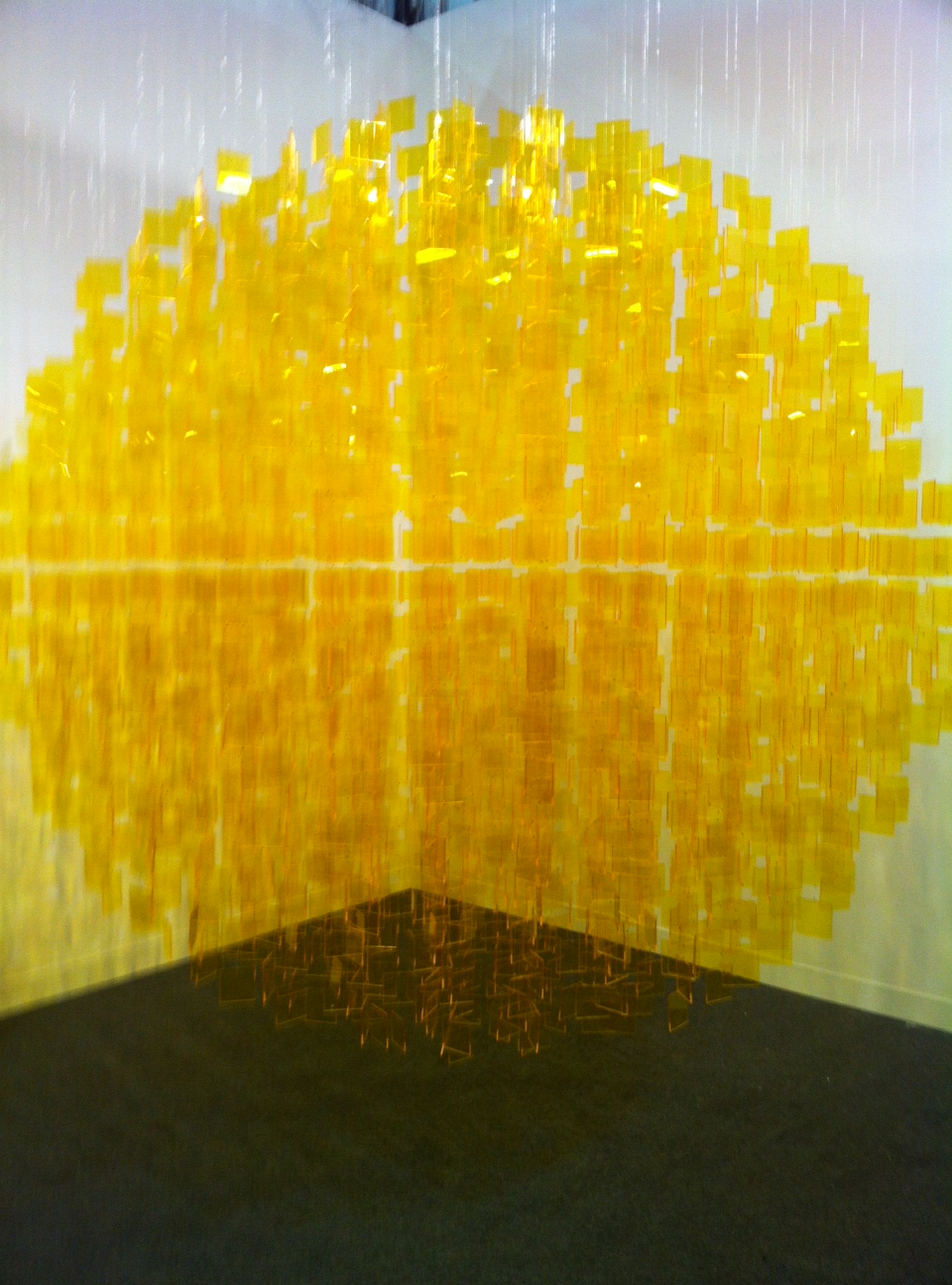
The large mobile installation by the famous Argentinian artist Julio Le Parc at the Galeria Nara Roesler (Sao Paulo) is a sphere composed of small flat rectangular acrylic shapes. There is a great sense of movement in this sculpture, and the semi-transparent yellow pieces of acrylic play with the light. It almost seems like magic that a grid of rectangles can render such a lively sphere.
Claudia Wieser’s ceramic wall installation takes center stage at Sies +Hoke Galerie from Düsseldorf, Germany. The images of this work feature a right triangle, an isosceles triangle, as well as two circles. It seems to pay homage to a geometry text book. What I find visually interesting in this piece is the use of tiles, which creates a secondary underlying square grid. This grid is instrumental in the coloring of the large circle.
I have been attending the Armory Show for years. In past shows there were times when there was very little presence of Mathematics in the art work presented, but this year I was quite pleased to find a number of interesting examples.
Susan
Sarah Stengle – Inspirational Conics
I look at a lot of art and I find quite a bit of work with Mathematical elements, but when I find new art inspired by a book of Mathematical proofs and figures I get really excited. Stengle’s new and ongoing series of drawings is based on Apollonius of Perga’s book “Conic Books I-IV”. Apolonius of Perga (262BC-109BC) was an ancient Greek geometrist who is famous for his innovated work in the mathematical field of conics. He explored the properties of conic sections and furthered our understanding of ellipses, parabolas, and hyperbolas.
Stengle has been collecting vintage postcards for a year. These postcards serve as the background image for her drawings. The choice of postcards is very important, as the artist looks for older non-glossy cards that can be drawn on. The subject matter on the card must also be fairly uninteresting visually so they can support but not over power Stengle’s mathematical imagery.
Each drawing is based on a proposition from “Conics Books I-IV”. There are three types of cards in this series. Some of the cards feature an accurate figure from a proposition in the book. In this case the book and proposition are written on the back of the card. Some of the other drawings have deviations from the figures in the book, but the aesthetics are interesting. Here the artist uses the work, and states the proposition and the fact there is a error on the back of the card. Finally, there are drawings that are imaginary propositions inspired by a particular figure.
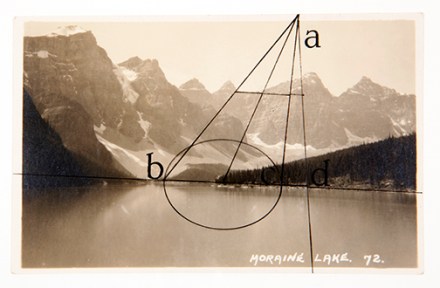
The card “Perga Moraine Lake 72” is the third type of card: it features an imaginary proposition. The artist had started to draw an Apolonius of Perga proof, but stopped at a point when the drawing reached a point of aesthetic completion. From the tip of the cone to its elliptical base, the mathematical figure leads the viewer’s eye from the mountain peaks in the landscape behind the lake to the shoreline.
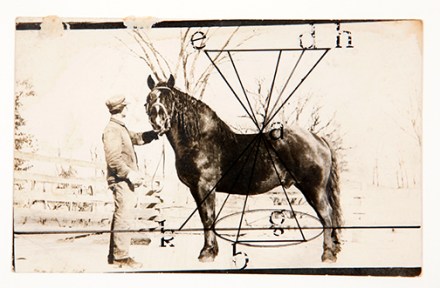
This second Post card from Perga, “Book 1, Proposition 2 Third Image” shows the third of the four figures in the proposition. The background card is an overexposed photo card of a horse . The uneven quality of the card could be due to the fact it was probably made to promote the sale of the horse. This card features a figure drawn directly from the text with no changes. The axis of symmetry of the mathematical figure goes through the center of the animal.
“Lilac Conics, Book 1 proposition 4” is also an accurate representation of the proposition in Apollonius of Perga’s book. The four conics are lined up along a beach mimicking the points of the masts of the fishermen’s boats.
Using carefully selected appropriated images as the backdrop for her geometric figures, Stengle has created a link between her mathematical subject matter and the world around us. The basis of the Perga post cards is an ancient text and the actual cards are vintage. When combined these elements lead to a sort of suspension of time. This series of work is a wonderful expression of the timeless aesthetics of Apollonius of Perga’s conic geometry.
Susan Happersett
David Scanavino at the Aldrich Contemporary Art Museum
The Aldrich Contemporary Art Museum in Ridgefield, Connecticut is celebrating its 50th Anniversary. Since its inception Aldrich has been committed to the collection and display of modern art, including some of the most important work in the areas of Minimalism, Conceptual, and Geometric art. The founder Larry Aldrich acquired the work of Eva Hess, Ellsworth Kelly, Agnes Martin, and many others. For the 50th anniversary a two part exhibition has been installed in the galleries over the past year. The curators have created a connection between the historical artwork from the early years of the museum to contemporary art. Artists were asked to respond to the work from the 1960’s and 1970’s.
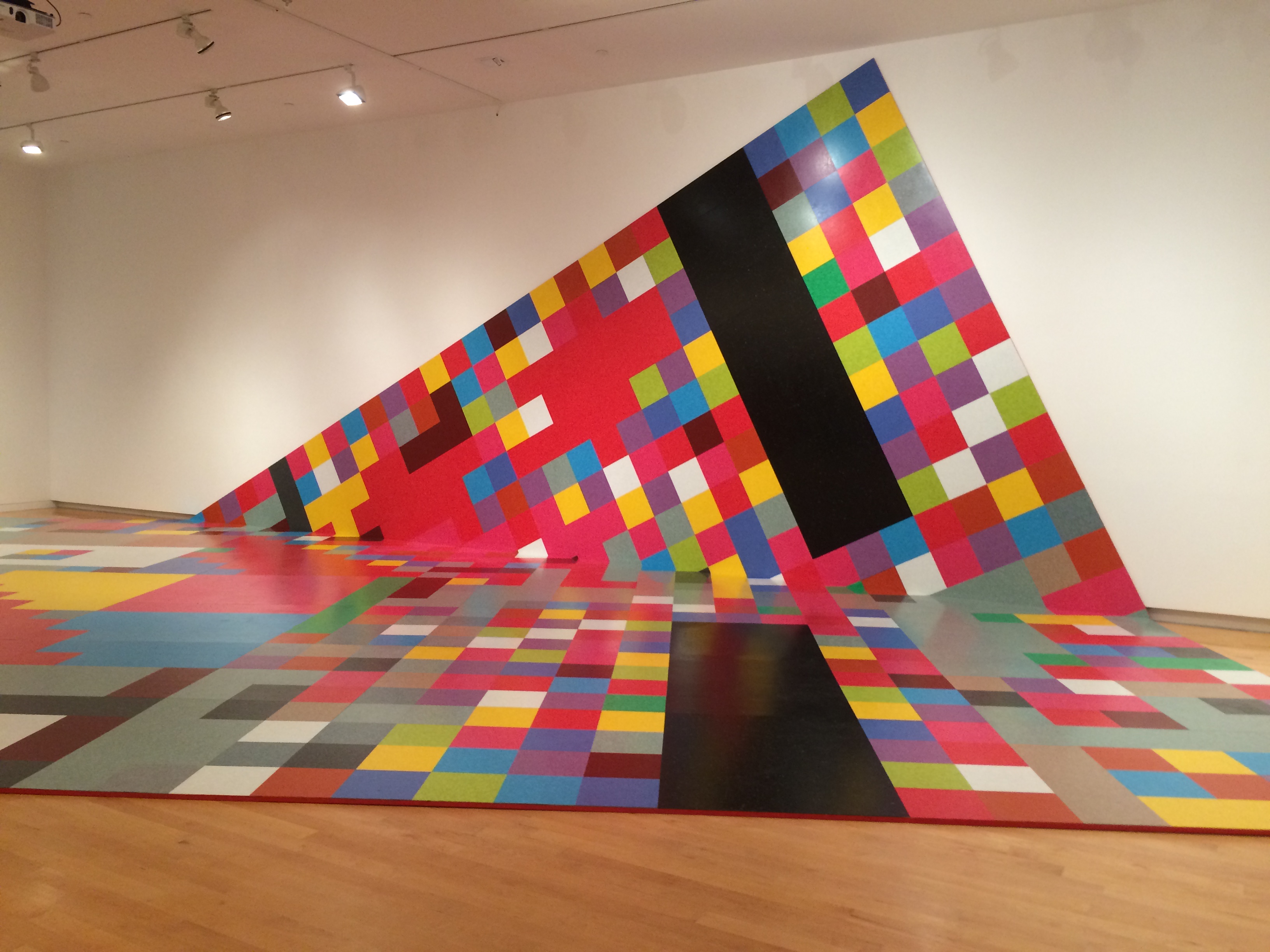
David Scanavino’s site-specific room-sized installation “Imperial Texture” is the artist’s dialog with the work of Richard Artschwager. Artschwager is well known for his use of formica to make geometric forms that have the same shape as everyday items but can not actually be used as such. His sculpture “Pyramid Object” from 1967 was displayed near Scanavino’s installation.
“Imperial Texture” consists of a grid of 1 by 1 foot square linoleum tiles that have been installed into the gallery at an angle so that they come off the floor and climb the walls. The tiling pattern was developed using computer software to make a digital model. This fact alone would make this a mathematically interesting piece. But what I find mathematically inspirational about this environment is the impact of a 2-D grid being retrofit into the 3-D rectangular box. The traditional gallery space has a multicolored seemingly random patterned floor, that has been shifted leaving part of the floor uncovered. Scanavino’s decision to place the grid at an angle has created series of right triangles with their hypotenuses running along the lines where the walls meet the floors. “Imperial Texture” gives the museum visitor an altered sense of space. The linoleum floor we are accustomed to seeing on the floors of schools, stores and other industrial and institutional settings has shifted out of it’s practical floor covering purpose.
Susan Happersett