
This is another big week for Art Fairs in New York. I will be at the Select Fair in Chelsea, New York with Purgatory Pie Press. It will run from Wednesday night through Sunday. If you are in the area stop by for a visit and see some new work. I will be showing some of my Mathematical Marking Drawings, Fibonacci Flowers, Spirals and Trees. Dikko Faust’s Tessellation prints will be on display, as well as his newest work (the ink is still wet) with Mathematical Moiré patterns. This is an exciting new process Faust has developed using rotating grids. It should be an exciting week!
Math Art
James Siena “New Sculpture” at Pace Gallery
Pace Gallery on 25th street in Chelsea is currently presenting the geometric sculptures of James Siena. Well known for his algorithmic paintings, Siena has been making sculptures throughout his career. At first working with tooth picks, and now new work using bamboo skewers, as well as bronze casts of previous pieces. Some of the work has very clear geometric patterns and others seem more chaotic. I have chosen two of the bamboo sculptures that are about a particular mathematical geometric phenomenon.

“Richard Feynman” , 2014
“Richard Feynman” from 2014 is a great illustration of self-similarity in three dimensions. Named after the famous 20th century Theoretical Physicist, this work is a cube within a cube within a cube. Each cube structure is composed of 4 by 4 by 4 cubes. Four of smallest cubes make up one cube in the medium cube structure and four of the medium cubes make up one of the large cubes on the large cube structure. Using the bamboo skewers as lines in the 3-D space the artist has created grids on three different scales.
“Morthanveld: Inspiral, Coalescence, Rungdown” 2014, 2015
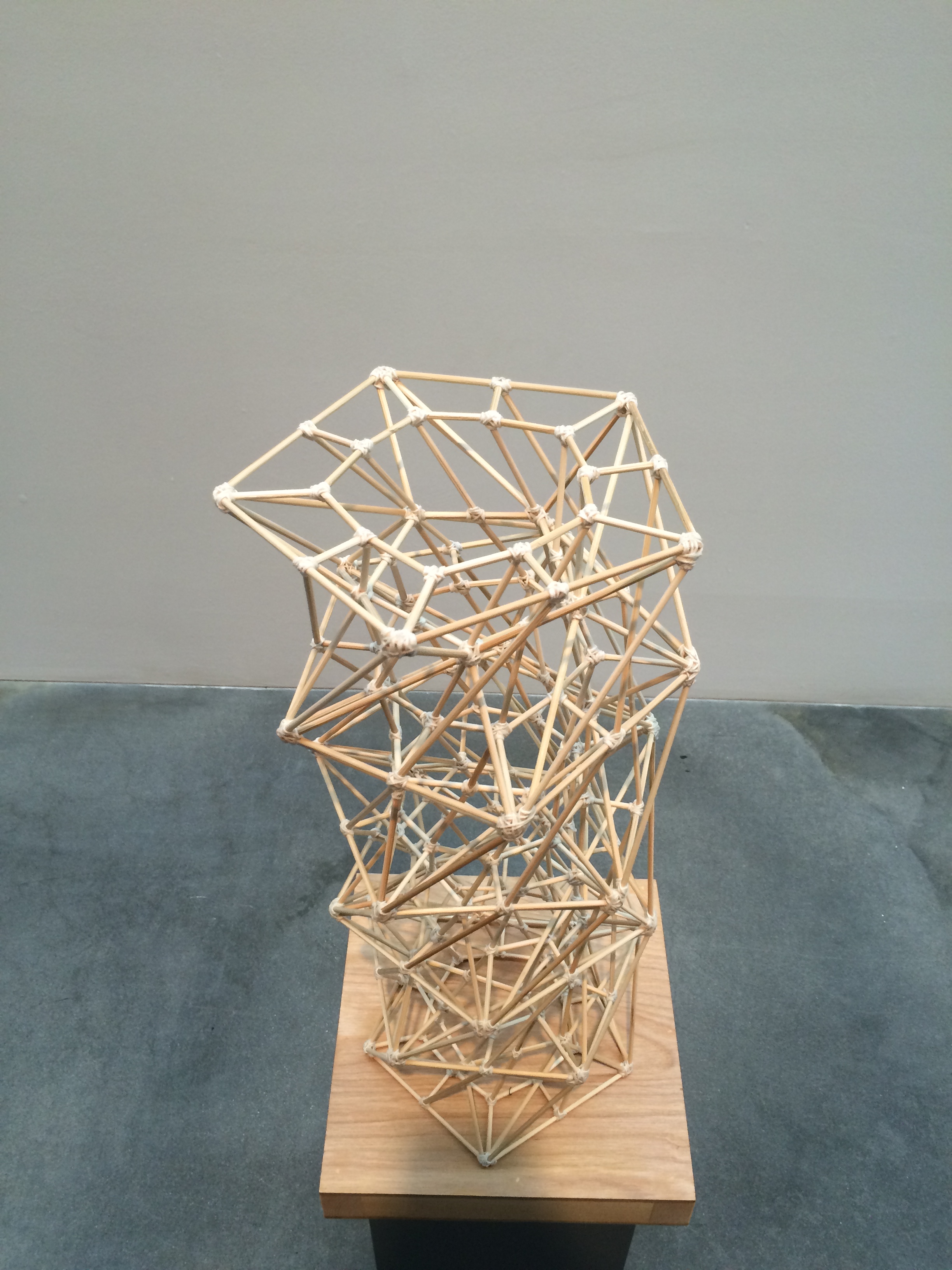
“Morthanveld: Inspiral, Coalescence, Rungdown” from 2014-2015 is complex tower created using 6 regular pentagons. Instead of stacking them at the same angle, Siena has twisted each consecutive pentagon 36 degrees. The finished sculpture is a spiraling geometric column. Siena uses a building technique of wrapping string around the vertices to to attach the bamboo skewers both in the interior and the exterior shapes. This requires a a very hands on process adding a human element to the Mathematical subject matter.
Pictures courtesy of the gallery and the artist.
Susan
Holly Laws “Cage Crinolines” at Muriel Guépin Gallery
The exhibition “No Woman, No Cry” at Muriel Guépin Gallery features the work by three women whose subject matter is the female identity in society. They reference both the tradition of feminine crafts, as well cultural expectations.
Holly Laws has created a series of small, detailed, handmade models of historic garments. Her intricate “Cage Crinoline” sculptures show the mathematics involved in the design of these 19th century hoop skirt figure enhancers. They are on display under glass domes, hinting at the Victorian practice of preserving and displaying things like a tiny skeleton in a cabinet of curiosities.
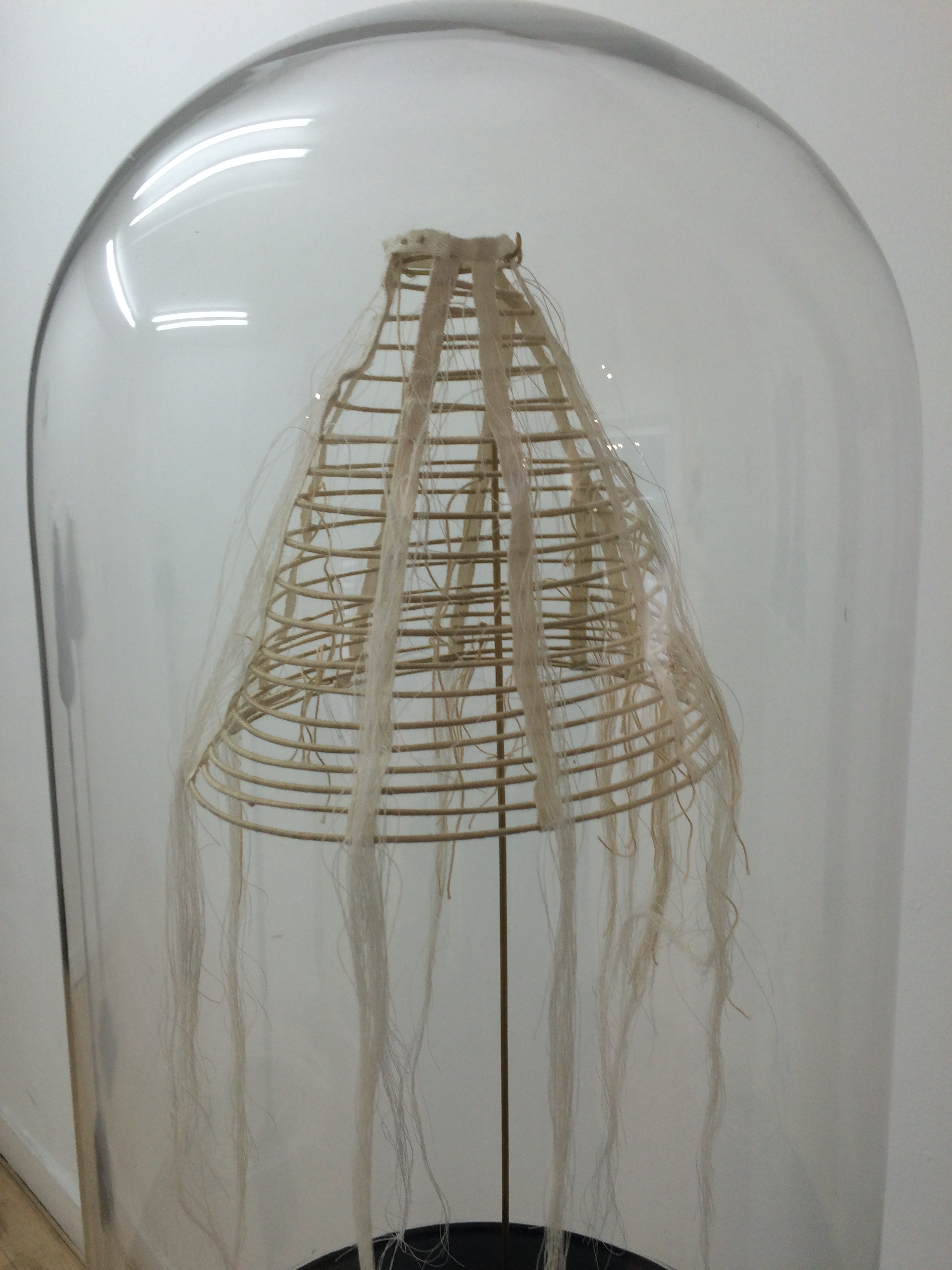
Holly Laws – “Cage Crinoline 1864” – 2015
Picture courtesy of the artist and the gallery
The structure for “Cage Crinoline 1864” consists of a series of concentric ellipses. They have been used to create a vertical column with two perpendicular reflection planes of symmetry. With the utmost precision Laws has built a 3-dimensional expression of the aesthetic qualities of ellipses. This complex geometry has been used in a miniaturization of an undergarment that if it were an actual garment would not even be seen in public. The mathematics would be hidden under a showy display of skirt fabric. I was really drawn to this “Crinoline Cage” because it reminds me to look beneath the surface and in unexpected place to find the beauty in Mathematics.
Susan
Math at the Cooper Hewitt
The Cooper Hewitt, Smithsonian Design Museum in Manhattan was closed for renovation for three years before it reopened at the end of 2013. The current exhibition features an overview sample of their vast collection. I was very happy to discover that they have chosen to display quite a bit of work with direct Mathematical links. The debate over the critical delineations between Fine Art and Design is a hot button issue I am not going to address in this blog post. I have selected two pieces that have specific Mathematical themes.
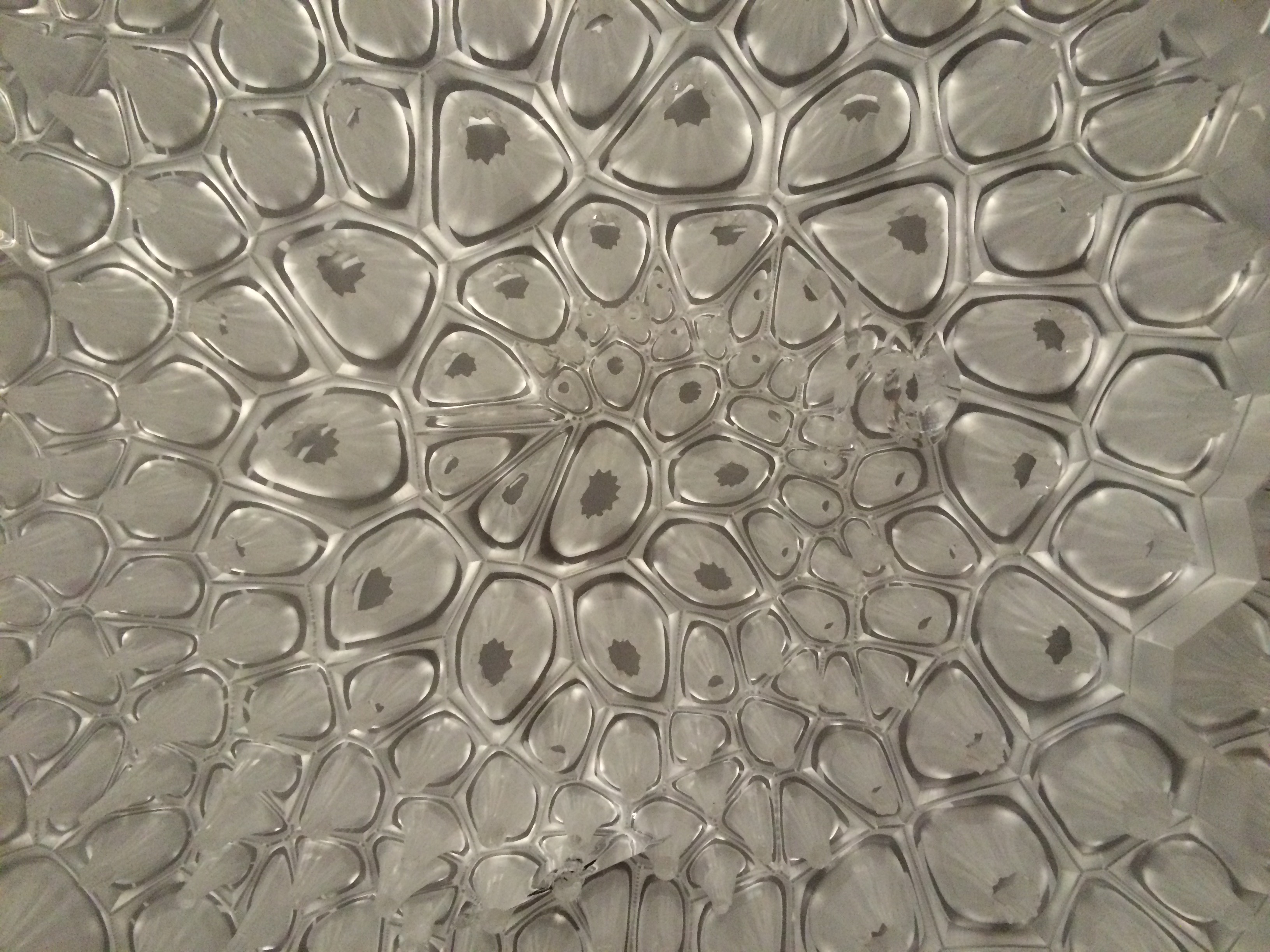
“Prototype for an Environmental Screen, Fibonacci’s Mashrabiya”, 2009 is an architectural element designed by Neri Oxman at MIT Media Lab with Professor W. Craig Carter. It is was created using algorithms and digital processes but is based on traditional screens found in historic middle Eastern design.
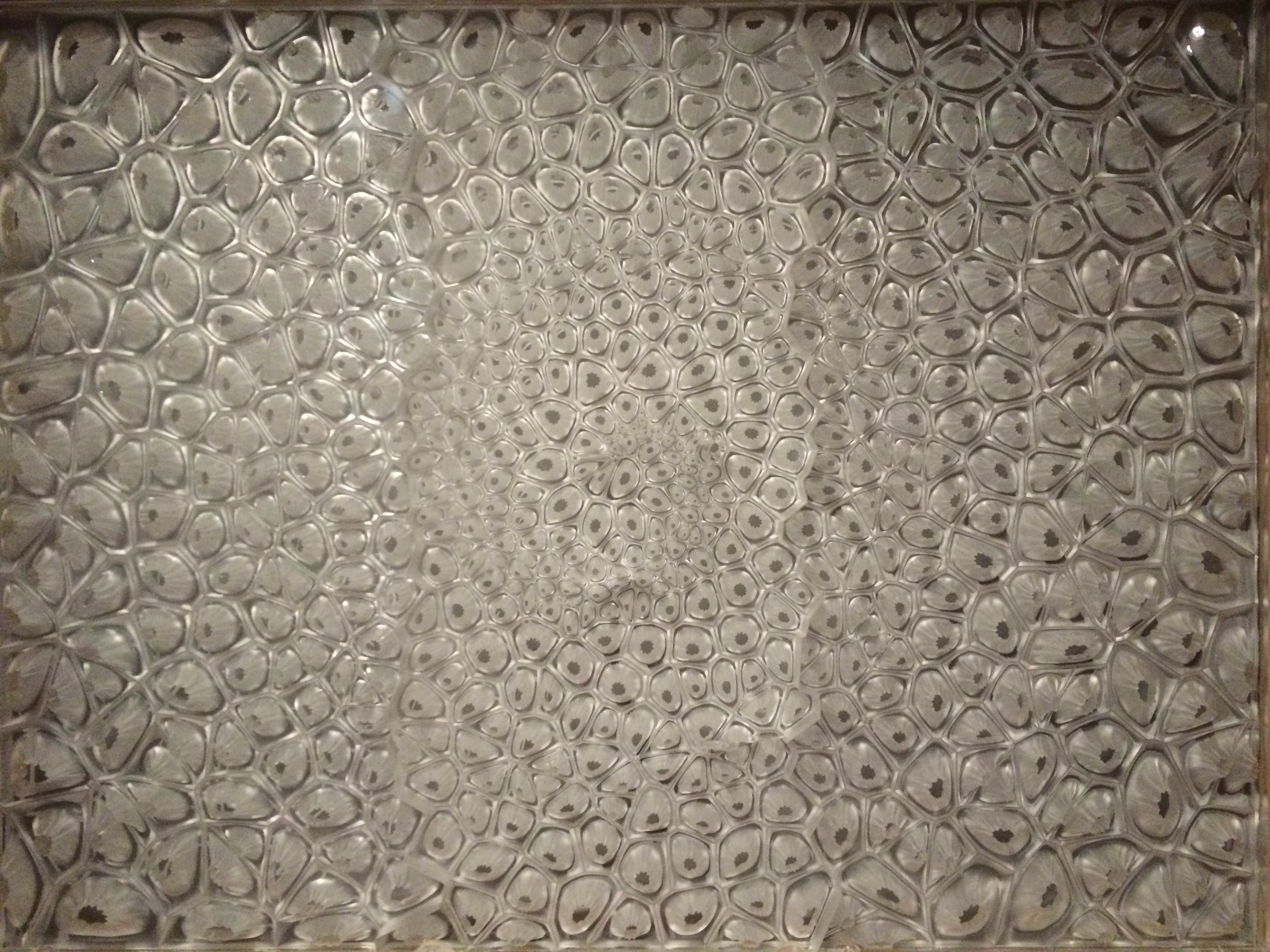
The recursive Fibonacci Sequence was used to create the spiral pattern. Here is a detail of the center of the spiral.
Mathematician and artist Daina Taimina has been quite well known for her crocheted sculptures of Hyperbolic Geometry.
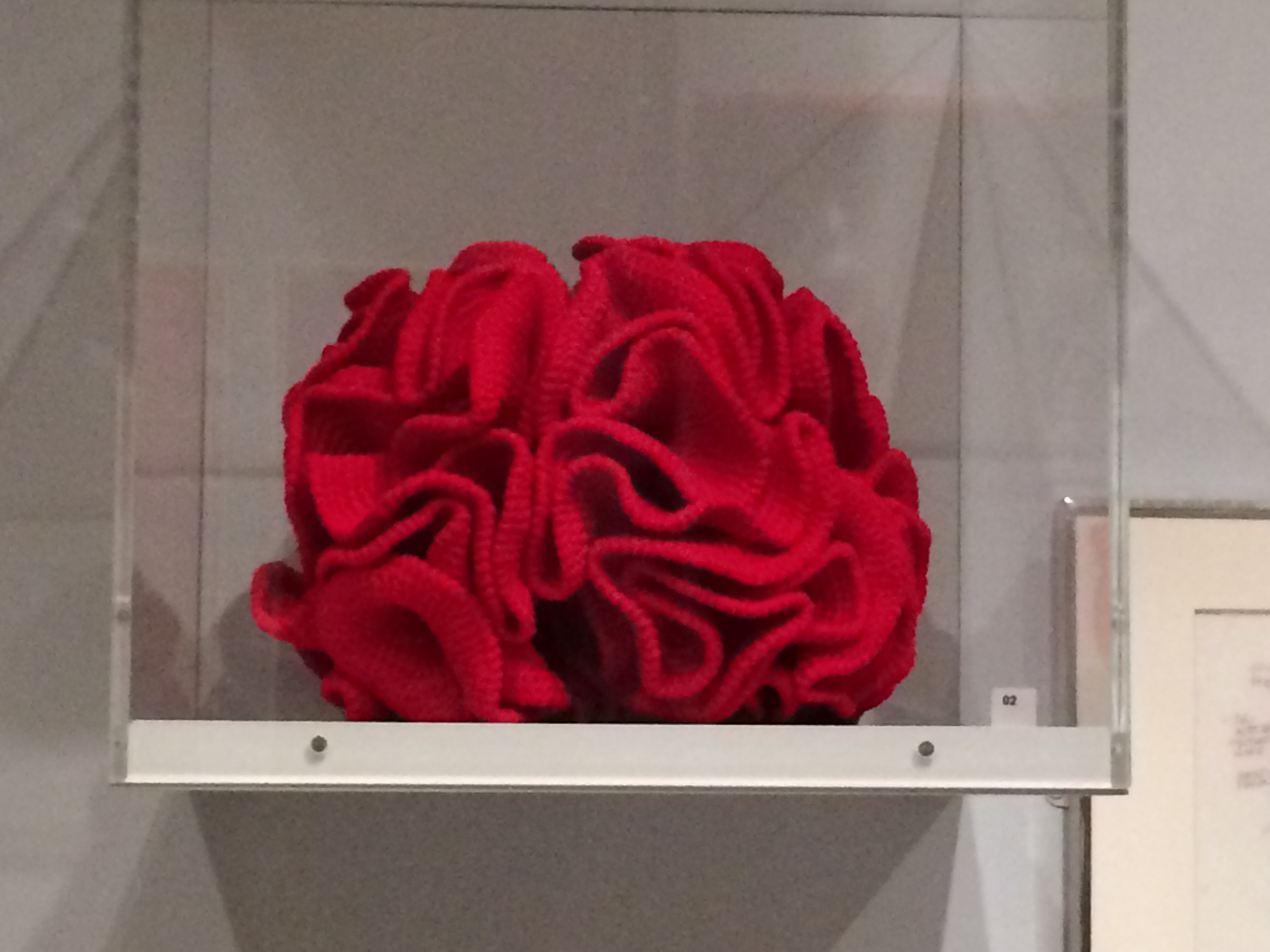
“Model of a Hyperbolic Space” 2011, is crocheted out of wool yarn. Working on these sculptures since 1997, Taimina has made major breakthrough on the modelling of figures in Hyperbolic space. Hyperbolic Geometry is a Non-Euclidean Geometry discovered by Janos Bolyai and Nicholay Lobatchevsky in the first half of the 19th century. In Hyperbolic Geometry each point has negative curvature and seems to curve away from itself.
At the Cooper Hewitt there were many more items that featured Mathematics as a design element. There was a very direct indication of the importance Mathematics plays in the field of both decorative and industrial design.
Susan
Yuichi Higashionna at Marianne Boesky Gallery
Marianne Boesky’s Upper East Side gallery is currently presenting the exhibition “let’s get dizzy”, featuring new work by Yuichi Higashionna. This Tokyo artist’s work is a reaction to Japanese Art and design of the 1970’s and questions the connection between luxury and aesthetics. His use of abstraction incorporates geometry. In this 2014 Untitled spray paint on canvas Higashionna uses an underlying grid of isosceles triangle.
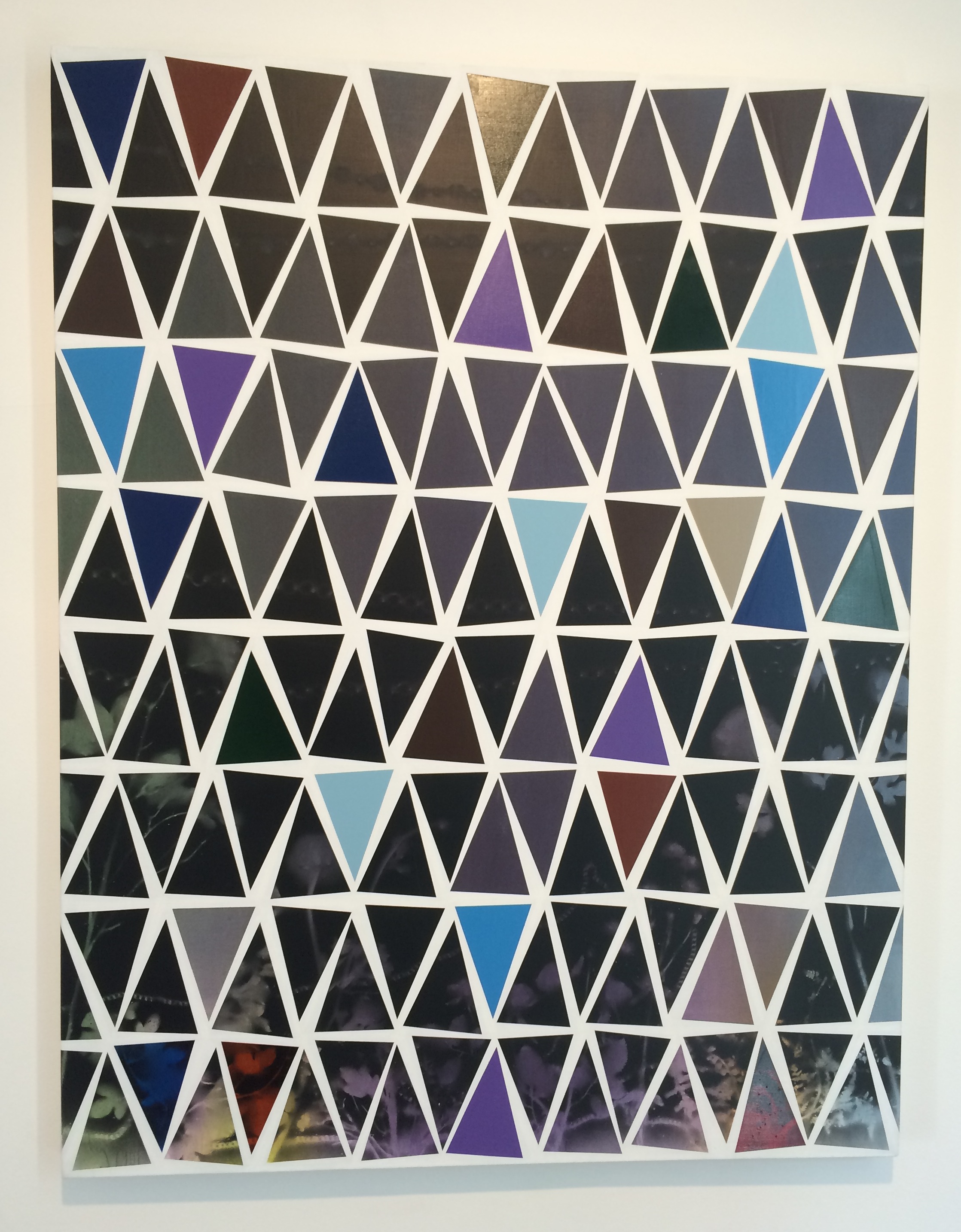
Untitled 2014 Spray Paint on canvas
This tiling is composed of rows of isosceles triangles. Alternating the direction of each triangle, first base at the bottom, then the next rotated 180 degrees, so its base is at the top. Within each of these grid triangles there is a smaller spray painted isosceles triangle that is slightly twisted off-center. The outcome of these shifts is a bit disconcerting and jarring, giving the painting a pulsing sense of movement. The idea of an underlying grid or tiling pattern is still clear but by placing the hard-edge painted triangles at slightly disjointed angles Higashionna changes the entire feel of the painting.
Susan
Sarah Stengle – Inspirational Conics
I look at a lot of art and I find quite a bit of work with Mathematical elements, but when I find new art inspired by a book of Mathematical proofs and figures I get really excited. Stengle’s new and ongoing series of drawings is based on Apollonius of Perga’s book “Conic Books I-IV”. Apolonius of Perga (262BC-109BC) was an ancient Greek geometrist who is famous for his innovated work in the mathematical field of conics. He explored the properties of conic sections and furthered our understanding of ellipses, parabolas, and hyperbolas.
Stengle has been collecting vintage postcards for a year. These postcards serve as the background image for her drawings. The choice of postcards is very important, as the artist looks for older non-glossy cards that can be drawn on. The subject matter on the card must also be fairly uninteresting visually so they can support but not over power Stengle’s mathematical imagery.
Each drawing is based on a proposition from “Conics Books I-IV”. There are three types of cards in this series. Some of the cards feature an accurate figure from a proposition in the book. In this case the book and proposition are written on the back of the card. Some of the other drawings have deviations from the figures in the book, but the aesthetics are interesting. Here the artist uses the work, and states the proposition and the fact there is a error on the back of the card. Finally, there are drawings that are imaginary propositions inspired by a particular figure.

“Perga Moraine Lake 72”
The card “Perga Moraine Lake 72” is the third type of card: it features an imaginary proposition. The artist had started to draw an Apolonius of Perga proof, but stopped at a point when the drawing reached a point of aesthetic completion. From the tip of the cone to its elliptical base, the mathematical figure leads the viewer’s eye from the mountain peaks in the landscape behind the lake to the shoreline.

“Post Card from Perga, Book 1, Proposition 2 Third Image”
This second Post card from Perga, “Book 1, Proposition 2 Third Image” shows the third of the four figures in the proposition. The background card is an overexposed photo card of a horse . The uneven quality of the card could be due to the fact it was probably made to promote the sale of the horse. This card features a figure drawn directly from the text with no changes. The axis of symmetry of the mathematical figure goes through the center of the animal.

“Lilac Conics Book 1 Proposition 4”
“Lilac Conics, Book 1 proposition 4” is also an accurate representation of the proposition in Apollonius of Perga’s book. The four conics are lined up along a beach mimicking the points of the masts of the fishermen’s boats.
Using carefully selected appropriated images as the backdrop for her geometric figures, Stengle has created a link between her mathematical subject matter and the world around us. The basis of the Perga post cards is an ancient text and the actual cards are vintage. When combined these elements lead to a sort of suspension of time. This series of work is a wonderful expression of the timeless aesthetics of Apollonius of Perga’s conic geometry.
Susan Happersett
Metro Curates
Every January there are a whole host of Art and Antique Fairs in NYC. One of my favorites is the Metro Curates Show. This event features dealers that together present a broad eclectic selection: Ethnographic Art, 20th century Modernist abstract paintings, folk art, as well as new work by contemporary artists.
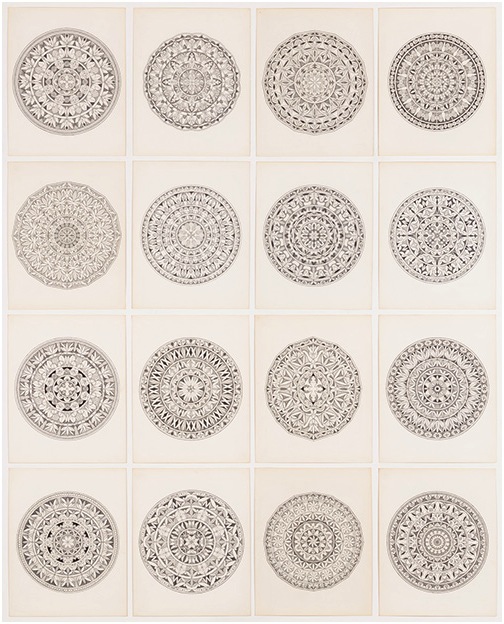
Constantine Karron, Untitled, 1940’s
ink on paper, 16 x 13 in.
Picture courtesy of Ricco Maresca Gallery
In the Ricco Maresca Gallery booth I found this amazing grid of drawings made in the 1940’s by Constantine Karron. These intricate works were all handmade using basic drafting tools. All but one of the 16 drawings are circles or regular polygons. The elaborate decorations feature rotational symmetries of varying degrees up to 16-fold. The precision and detail in these drawings is amazing. The only work that does not feature a circle or a regular polygon and has only 2-fold rotational symmetry is the drawing in the third column from the left, and is the third down from the top of the grid. This is a drawing of an irregular 16-sided polygon (hexadecagon) that has both horizontal and vertical lines of reflection symmetry. Ricco Maresca Gallery is displaying and selling these works as a group. Although each of the drawings is very interesting on its own, together they have an even more powerful visual impact.
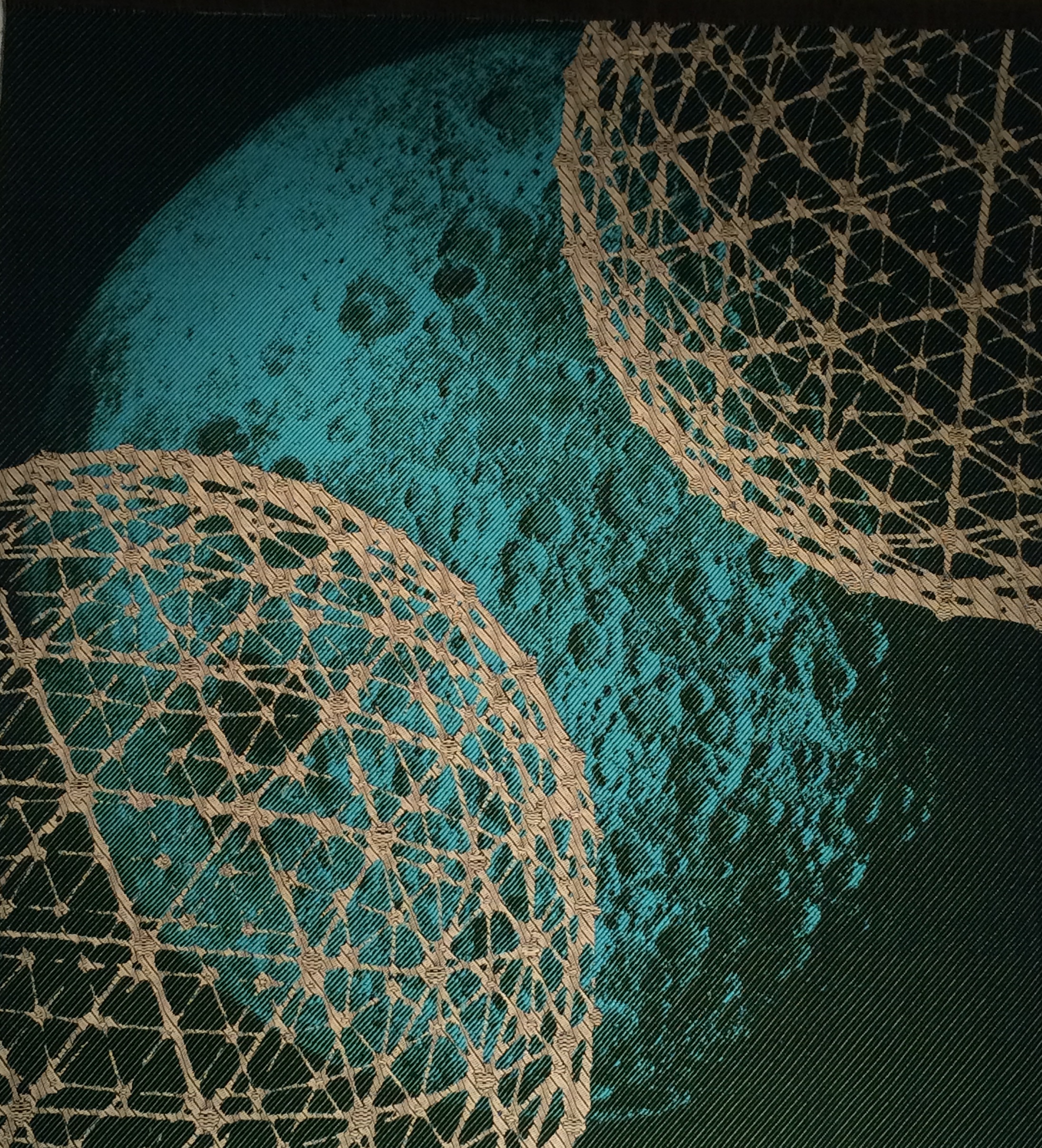
Annette Cords, “Combined Operations”, 2012
handwoven jacquard tapestry
Picture courtesy of Umbrella Arts
Annette Cords’ handwoven jacquard tapestry “Combined Operations” from 2012 was on display at the Umbrella Arts booth. I was immediately drawn into their space when I saw the geodesic spheres woven into this work. Cords also creates paintings and installations all dealing with systems of information and physics. The geometry of the spheres are quite clear but the jacquard weaving technique gives the lines a nice sketch quality. The lunar background gives the work an ethereal presence.
I spoke with Umbrella Arts gallerist and curator Margaret Bodell about my interest in Art and Mathematics and she gave me a preview of some of the amazing work that will be featured in the next show at their gallery in lower Manhattan. The exhibition is titled “Off the Grid” and it will take place from February 5th to February 28th. I will definitely be heading downtown to see and review the show. I know already there will be art with interesting Mathematical connections.
Susan
Jan Schoonhoven at David Zwirner
The David Zwirner Gallery’s 20th Street branch in Chelsea is presenting a large show of the work by one of the most influential Dutch artists of the last half of the twentieth century, Jan Schoonhoven. A member of the Nul Groep in Holland, Schoonhoven was connected to the international art movement “ZERO Group”. The artist members of these groups worked to develop a type of art that was more objective then the more emotionally expressive art created after WWII. Schoonhoven established techniques to create monochromatic wall sculptures that relied on clean geometric lines to explore form,light, and shadows.

Jan Schoonhoven – “R70-28” – 1970
The rectangular grids like the ones seen in “R70-28” from 1970 are probably the types of structures that became most famous. A square relief sculpture with 5 columns with ten rows each. The white walls are the grid lines, creating rectangles with a 1:2 ratio of height to width. The exhibition at David Zwirner is quite inclusive and includes works on paper, earlier geometric work, as well as work featuring more complex geometry.
Schoonhoven used latex paint, paper, cardboard and wood to assemble these sculptures. The hand of the artist has given these 3-D spaces an ageless quality. Although the geometry is all straight edges there is a softness to the lines of these shadow boxes.

Jan Schoonhoven – “R69-33”
The work “R69-33” from 1969 has a rather complex pattern made up of trapezoidal surfaces. They are positioned into rows with horizontal axes of symmetry. The longer side of each trapezoid is closest to the viewer. This work offers a dramatic example of Schoonhoven’s use of shadows.
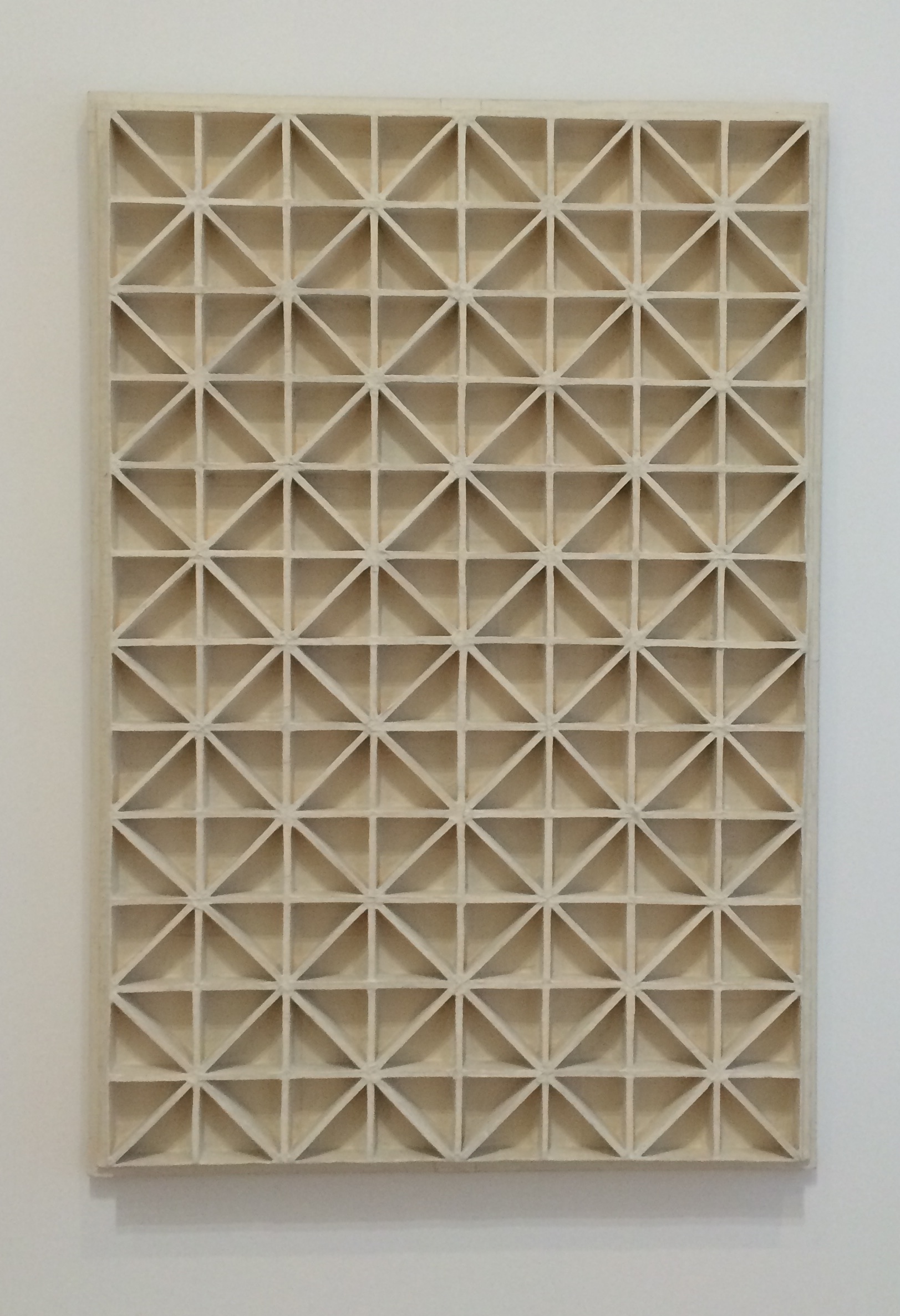
Jan SChoonhoven – “Diagonalen” – 1967
“Diagonalen” from 1967 is one of my favorite pieces in the show. The grid format is intact but by bisecting each grid square on alternating diagonals the artist has created a lattice of right triangles. One of the most exciting elements of Schoonhoven’s wall sculptures is that they change depending on the angle from which you see the art. As the viewer moves around the gallery the shadows are changing.
All pictures courtesy of the gallery.
Susan Happersett
Warren Isensee at Danese Corey Gallery
The Danese Corey Gallery is currently exhibiting the abstract geometric paintings of Warren Isensee. The artist uses a playful vocabulary of color to achieve an exciting sense of light. The straight edges are all hand painted without the aid of taping and Isensee uses adjacent colors that create enough tension that the work pulses with energy.

“Dark Heart”, 2014
The large square canvas “Dark Heart” provides an interesting perspective on the grid. Floating in a field of steel blue, the yellow black and red figure is made up of solid and striped squares. Alternating from horizontal to vertical of striped squares, the patterning draws the viewer’s eye to the two central horizontal bands. This work features both horizontal an vertical axises of symmetry through its center .
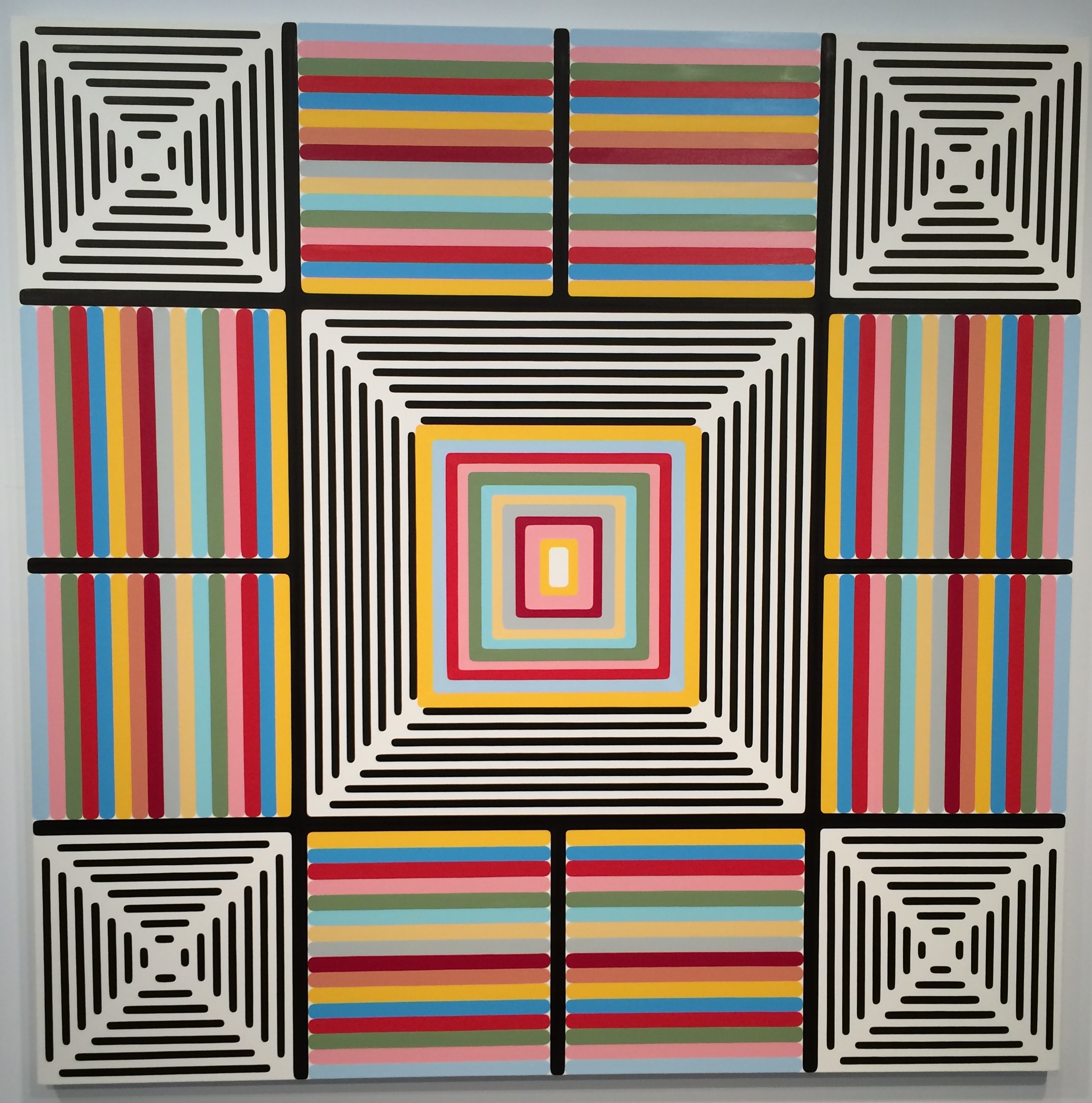
“Surface Noise”
“Surface Noise” offers the viewer an optical trick. At first glance it appears to have a nice neat four-fold rotational symmetry. The artist has painstaking created detailed elements of the composition that possess four-fold rotational symmetrical patterns. Only after close inspection you realize that the small center form is a rectangle and not a square. This painting has horizontal and vertical axises of symmetry, but it is not four-fold rotational symmetry. I think the slight deviation makes “Surface Noise” more interesting. It becomes a commentary on the visual expectations of symmetry.
Pictures courtesy of the gallery and the artist.
More math art next time
Susan
Dianna Molzan at MOMA
The Museum of of Modern Art is currently hosting an exhibition of the work of 17 diverse artists entitled “The Forever Now, Contemporary Painting in an Atemporal World”. The work is all made in the 21st Century, and the general theme of the show is that this work does not have defining elements that would indicate when the work was produced. The term “atemporal” refers to timelessness, as well as the way the art incorporates ideas from the past. The internet offers contemporary artists access to massive amounts of images and texts about previous generations of artists and their work. This knowledge is then incorporated into this new 21st century art.
Dianna Molzan has two works in the show that relate to the traditional rectangular dimensions of a stretched canvas paintings. The first, “Untitled 2010”, features a set of wooden stretcher bars with canvas attached on the two vertical sides. the painted canvas has been slashed with a series of horizontal cuts that creates ribbons of canvas that drape down in curve.

The second painting, “Untitled 2011”, is also based on a rectangle, but instead of having all four sides made out of wood, the left side of the frame and the bottom edge have been replaced with a stuffed and painted canvas tube. This has created a slack curved line.
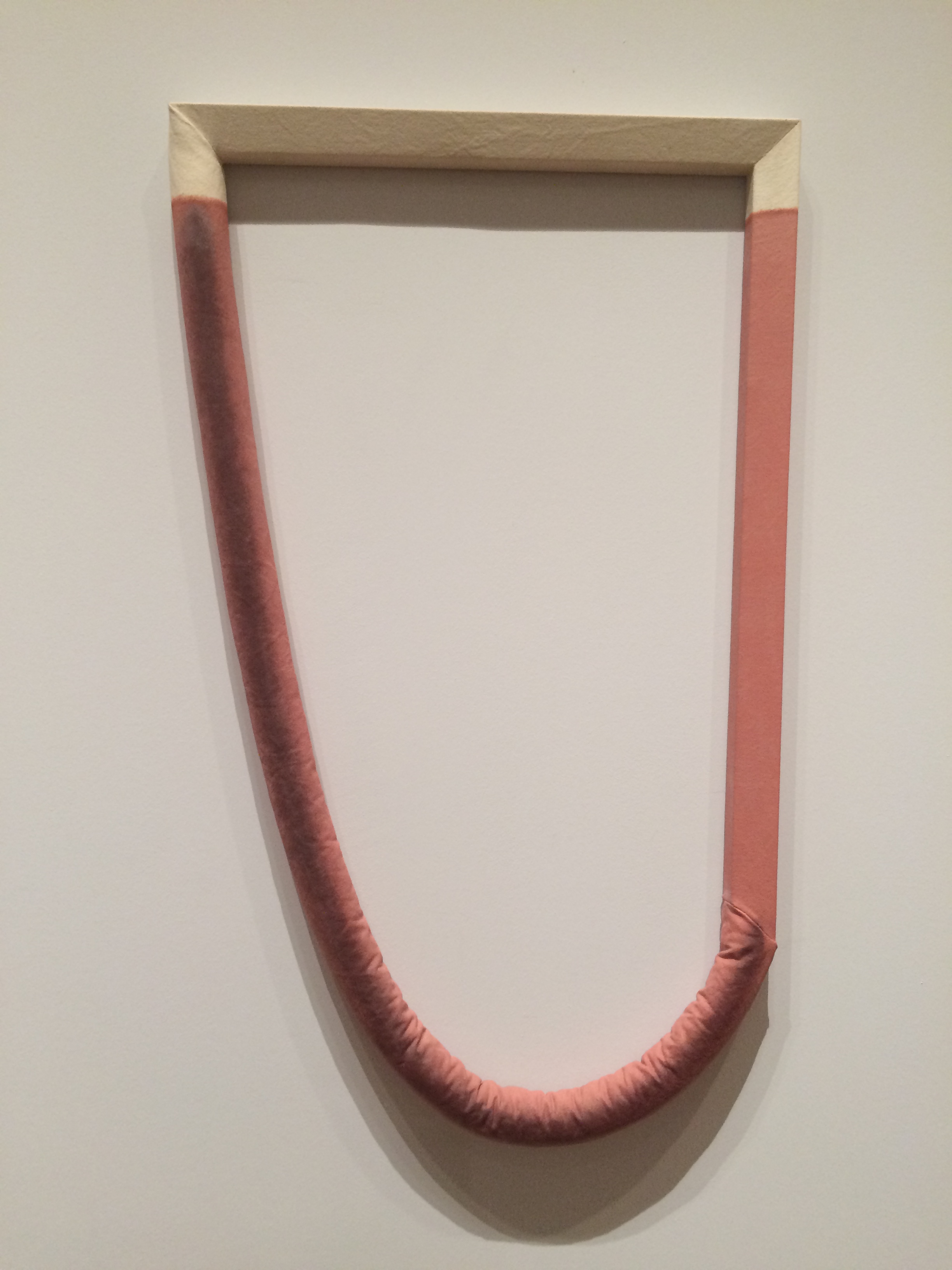
Both of these works address the idea of the rectangular perimeter of traditional easel paintings. Molzan has distorted the geometry of the shape by either slashing the canvas or replacing the stretcher bar with a fabric sculptural element.
Pictures courtesy of the museum and the artist.
– Susan Happersett
 fibonaccisusan