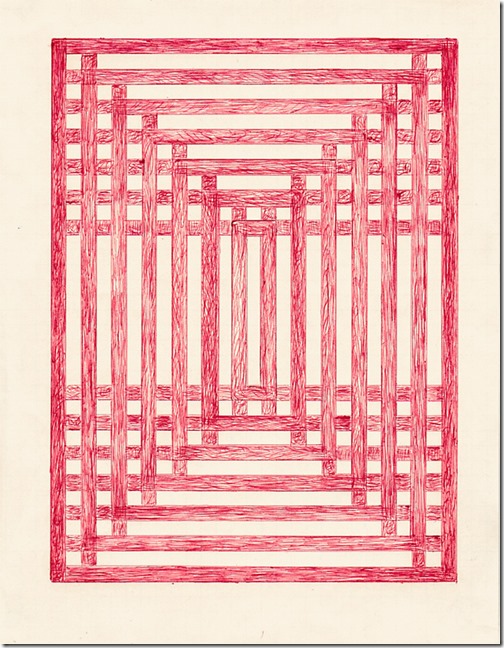
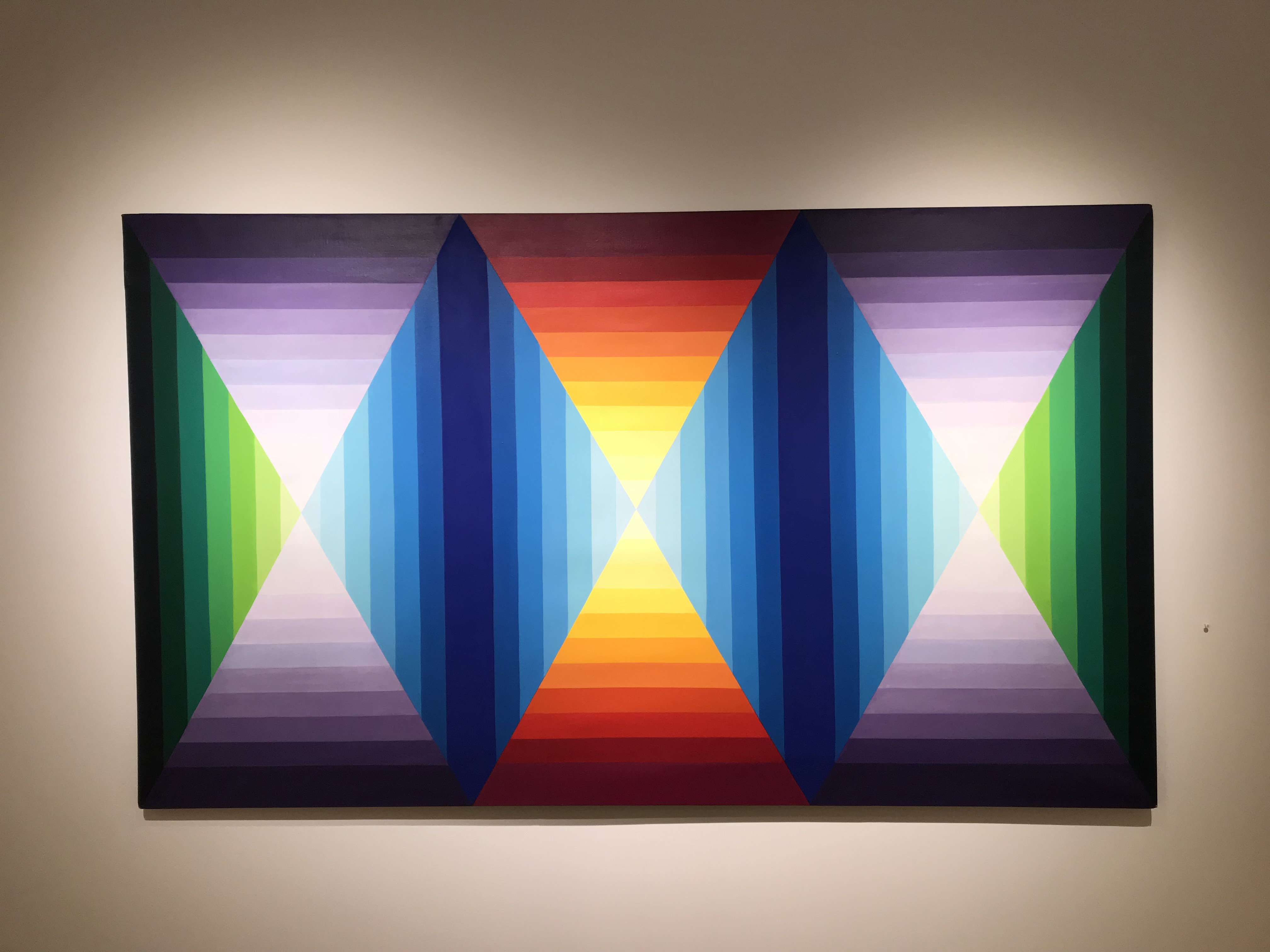
Matthew Larson at Massey Klein

The Massey Klein gallery’s is currently presenting “Vice Versa” a solo exhibition of Matthew Larson’s fiber works. Having developed a unique and arduous technique of embedding parallel rows of yarn into Velcro, Larson has created a series of stretched linen panels with geometric themes.
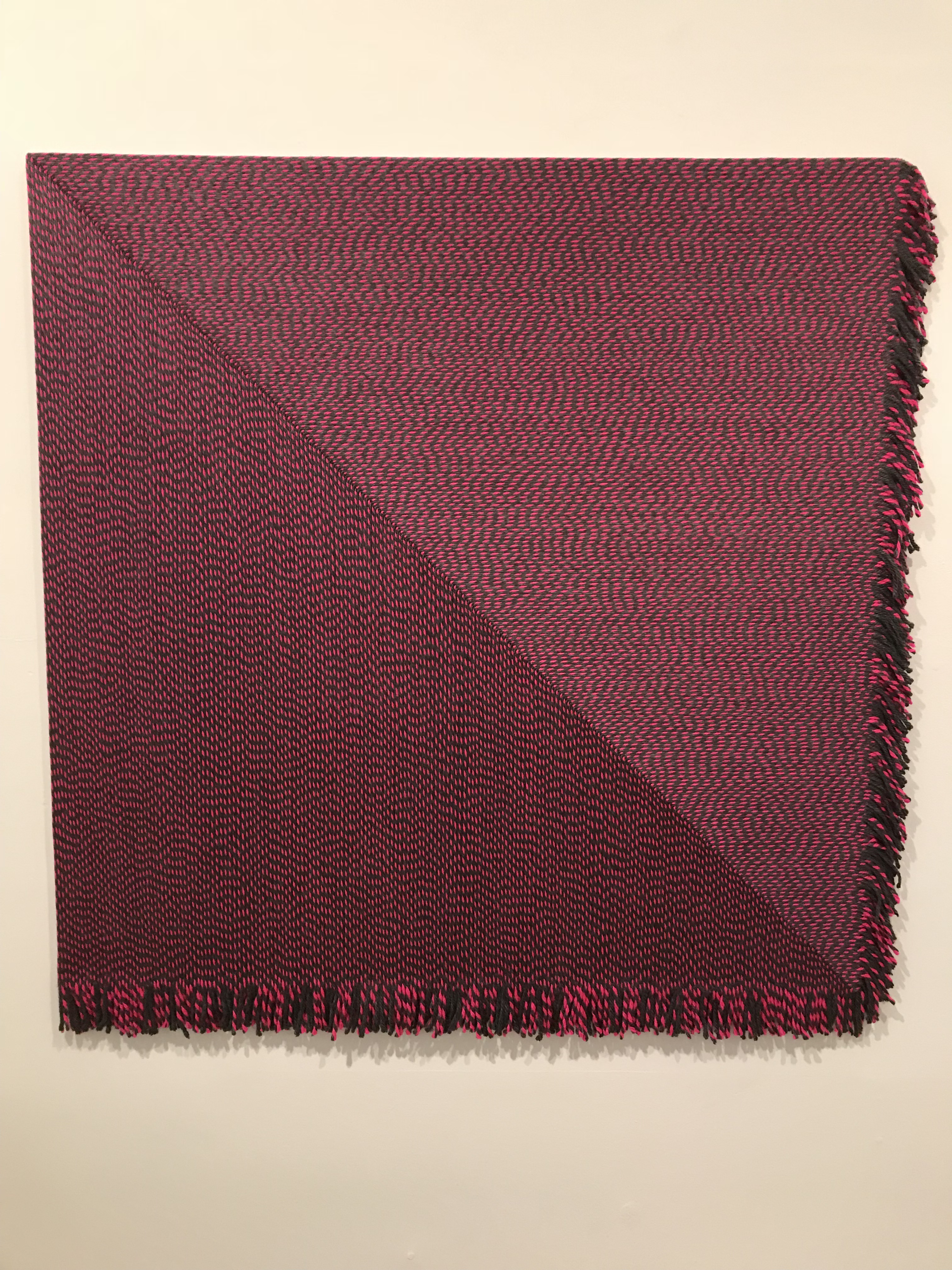
“Flat Structure” from 2017 at first glance seems to be a square with a diagonal line. Upon closer inspection that line is actually formed by a bend in each of the sections of yarn at the left upper corner.
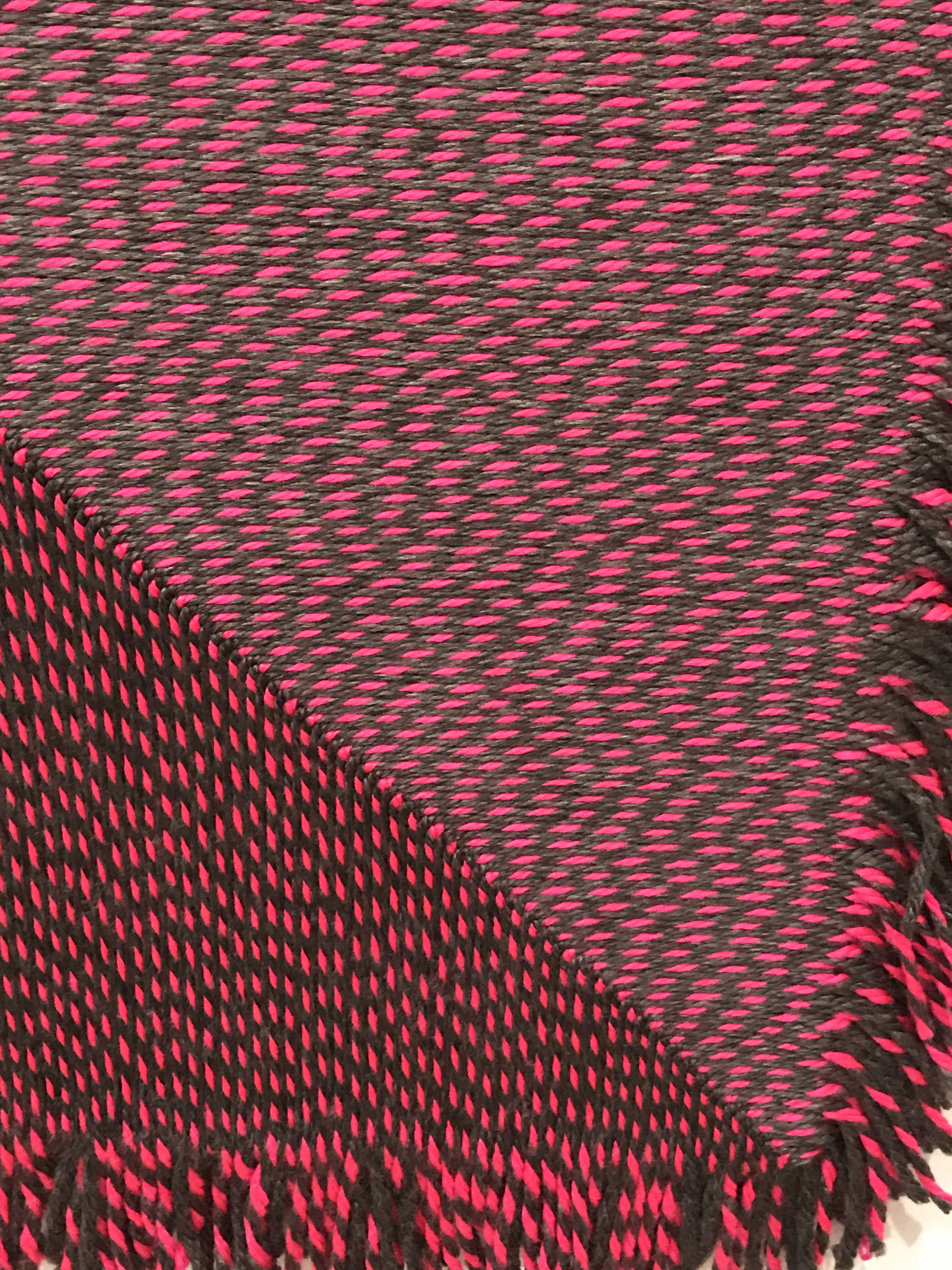
Every line of yarn is s different length running from the right side of the square to the bottom. The nature of the fibrous material makes each bend slightly curvilinear, adding a subtle organic element to the geometric form. This juxtaposition of the idea of a straight edge square with a diagonal line with the softer corner folds creates a fascinating composition.

Susan Happersett
Tom Bronk at Andrew Edlin Gallery

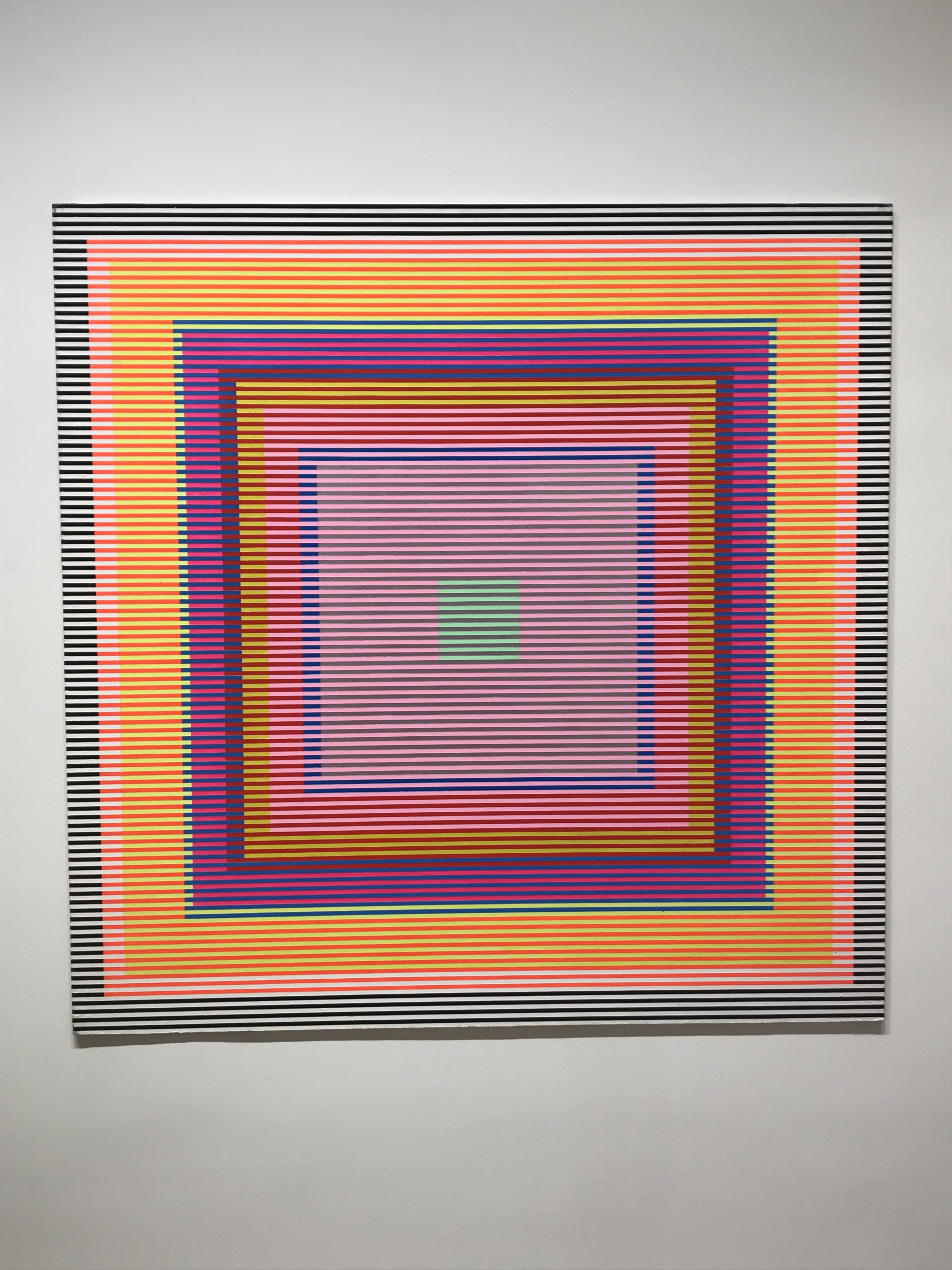
Concentric squares have been a popular theme for geometric painters like Josef Albers and Frank Stella. Tom Bronk has added a fresh and frenetic quality to the form.
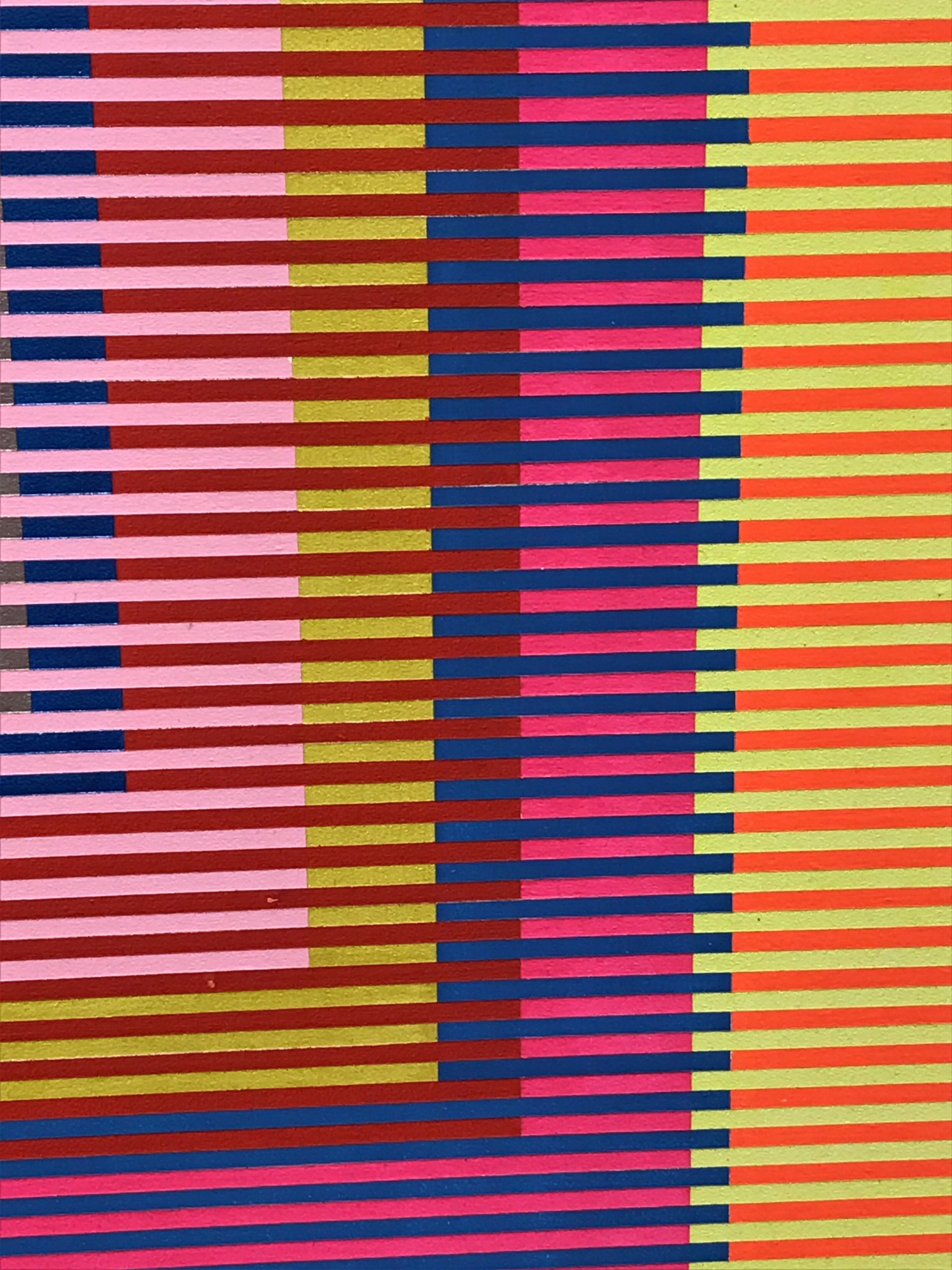
 Bronk’s painting “96(e)-1” from 1996 is currently display as part of his solo exhibition at the Andrew Edlin Gallery.
Featuring narrow horizontal bands of alternating contrasting colors, the squares seem to vibrate right off the canvas.
Tom Bronk is a self-taught artist having never attended an official traditional art school. But he did  interact with artists since arriving in NYC in the 1970’s. He worked as  a wall painter at the Leo Castelli Gallery and was introduced to the trends in contemporary art. That influenced combined with his inherent appreciation of geometry has resulted in an exciting body of work.
Susan Happersett

Vandorn Hinnant at the New York Hall of Science

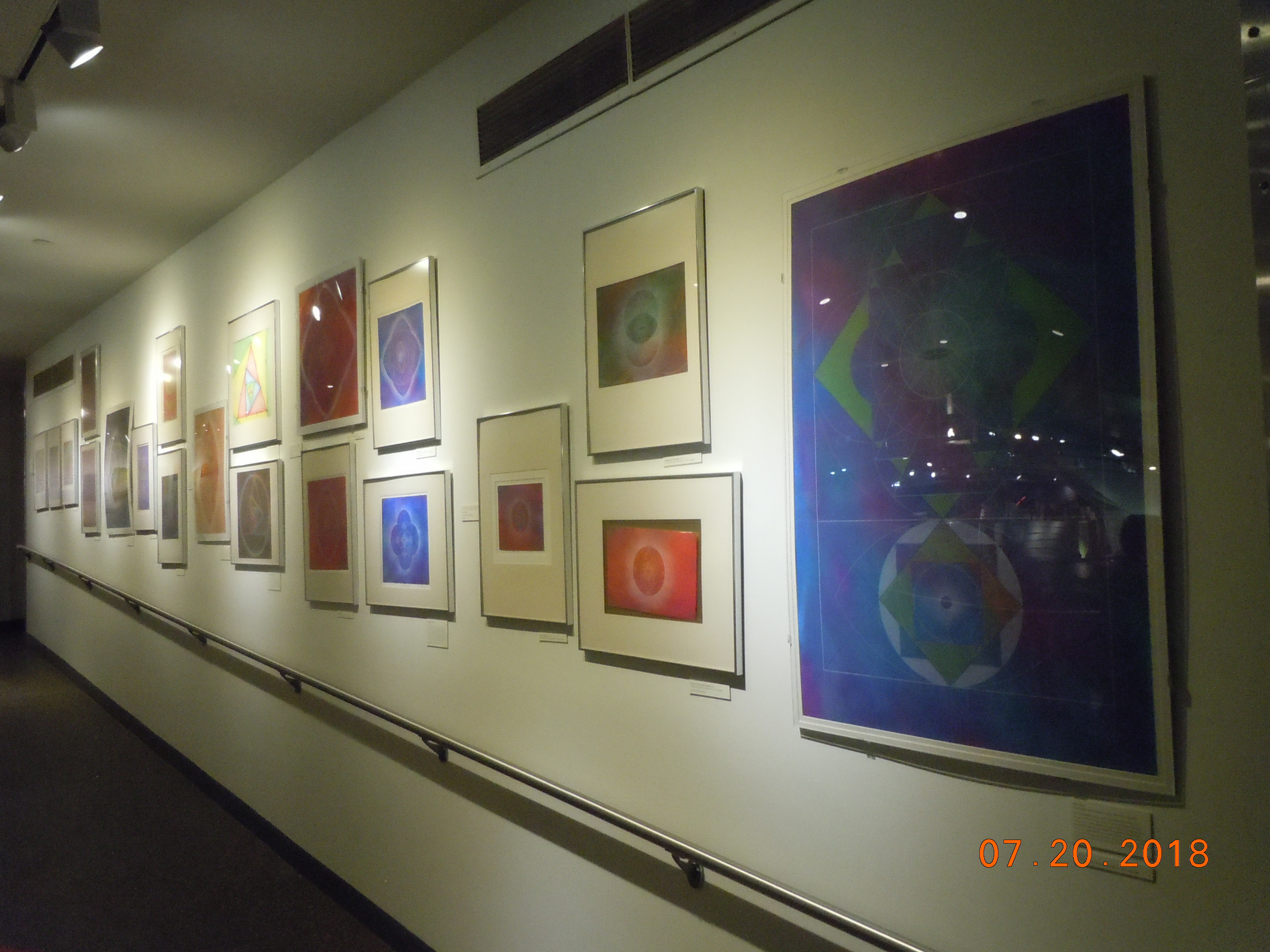
I am so happy Vandorn Hinnant sent me an invitation to his current solo exhibition “The Hidden Mathematics: a surprising connection between Math and Art” at The New York Hall of Science. This was my first visit to the Hall of Science located in a stunning 1964 World’s Fair building in Corona Queens NY. I had wanted to see the museum’s permanent “Mathematica” display for a long time but it was an amazing discovery to find out about their art galleries. What a great place to see Math Art!
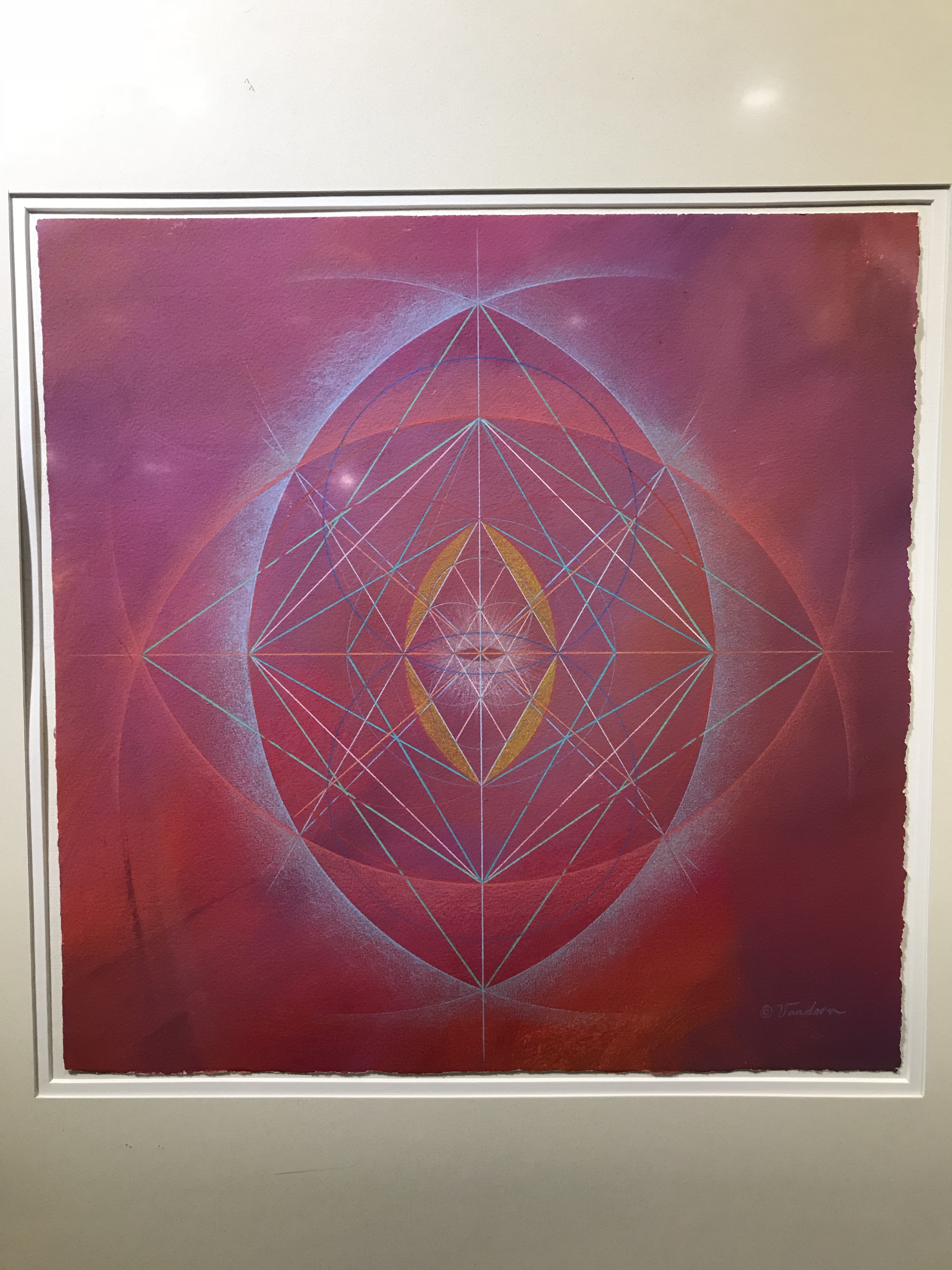
Hinnart’s artistic practice is a perfect example of the visualization of meta-mathematics. Interested in exploring mathematical geometric as complete systems, his drawings achieve detail and accuracy relying only on the construction rules of Euclidean geometry using a straight edge and a compass.
Inspiration for these drawings and paintings come from numerous mathematical sources including the Fibonacci numbers, the Golden Mean and fractals.
“Navigator’s Song” from 1995 features both horizontal and vertical lines of symmetry as well as isosceles triangle forms.
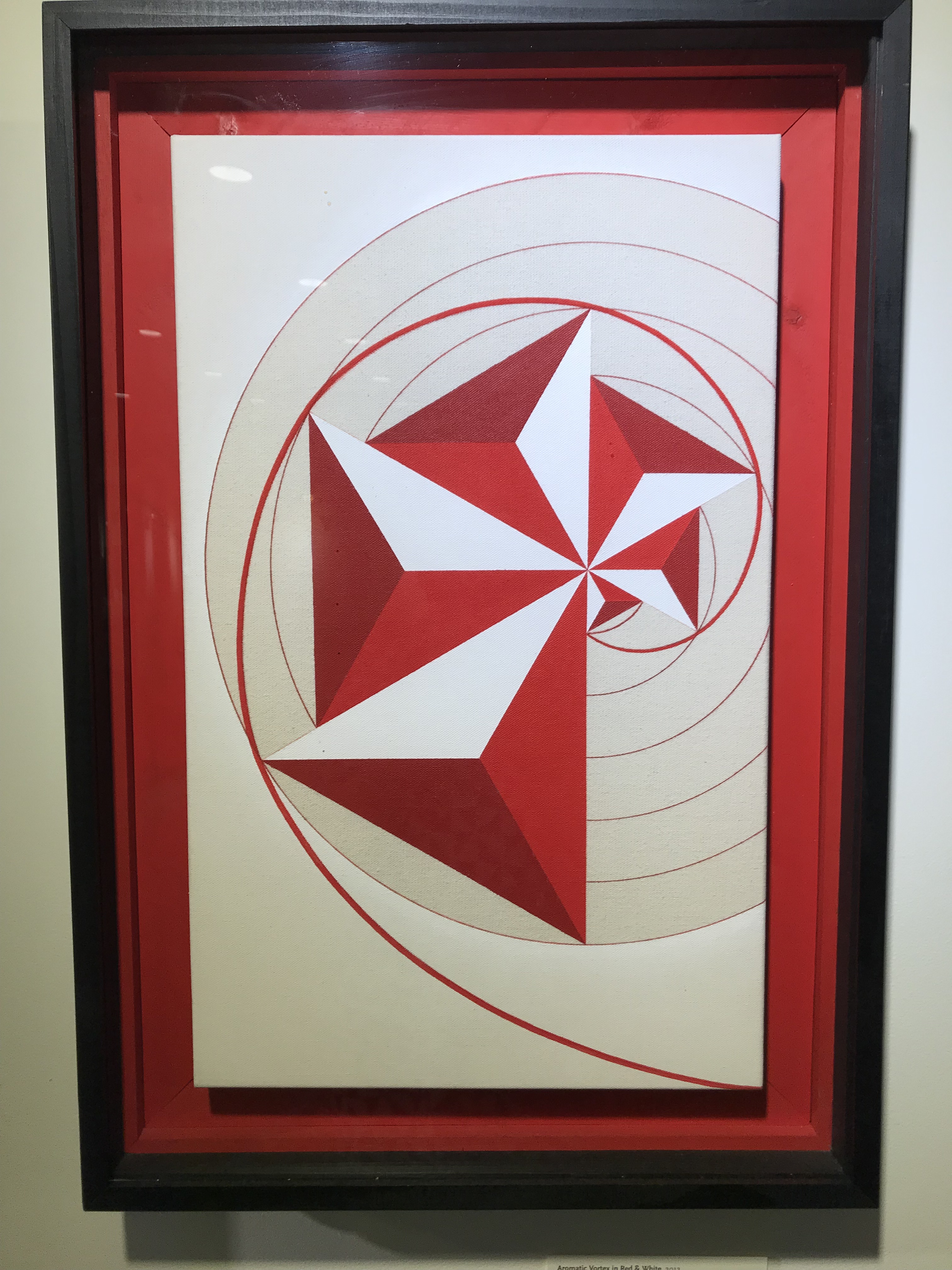
“Aromatic Vortex in Red & White” from 2012 depicts a rotating series of equilateral triangles to build a spiral, referencing the Padovan sequence.
Hinnant credits the work of numerous historical figures in the development of his decades long creative process including Pythagoras and Buckminster Fuller.
Susan Happersett

Eleanor White at Matteawan Gallery, Beacon, NY

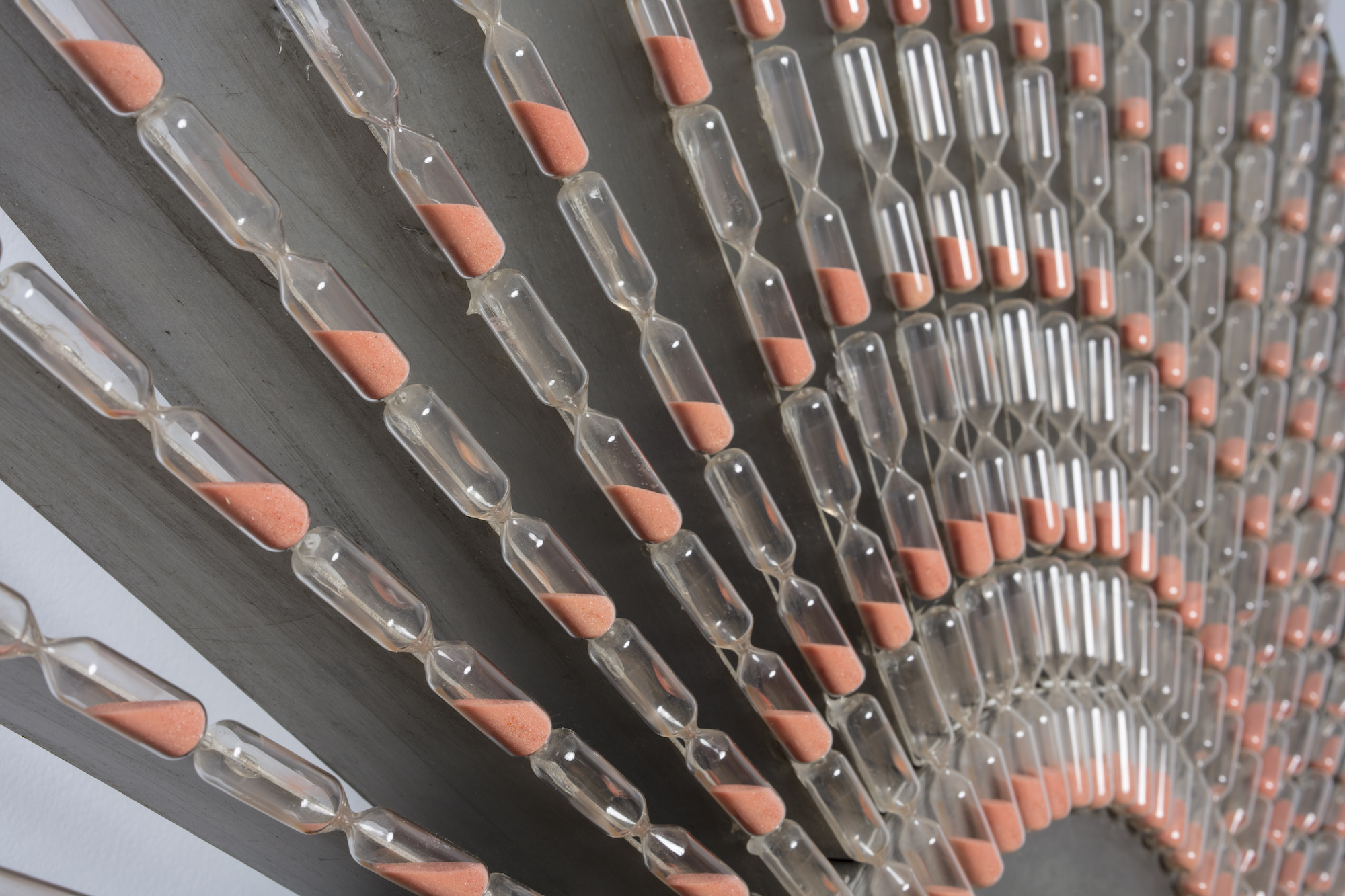
Matteawan Gallery is presenting “It’s About Time” a solo exhibition of the work of Eleanor White. On display is the kinetic wall sculpture “Continuous Timer”. This work is comprised of hundreds of glass and sand timers arranged on a spinning wheel. Featuring a high order of rotational symmetry by adding movement this piece references the infinite symmetries found in circles.
The constant re-leveling of the sand within each glass timer breaks the symmetry with the introduction of the concepts of gravity and equilibrium.
“Continuous Timer” is one of the best examples of a work of art using mathematics as a metaphor for time and relativity that I have seen.
Susan Happersett

Bridges Conference Stockholm, Sweden (Part 2)

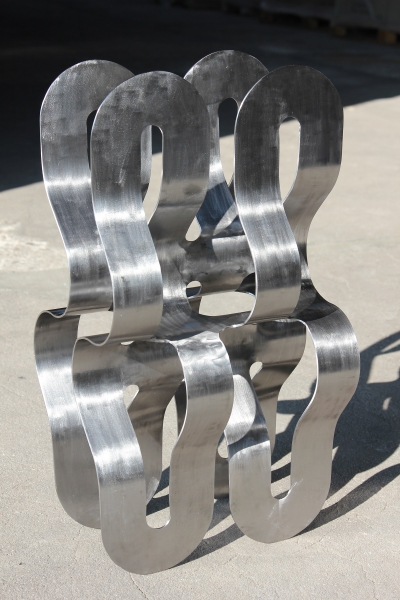
Christoph Ohler’s  sculpture “MBC” was created fom a flat sheet of steel. Curved sections were cut away. Then the form was bent and soldered resulting in eight connected Moebius strips. One of the cool things about the Moebius strips is how much their appearance changes depending on the viewers vantage point. “MBC” enhances the property of multidimensional visual perspective.
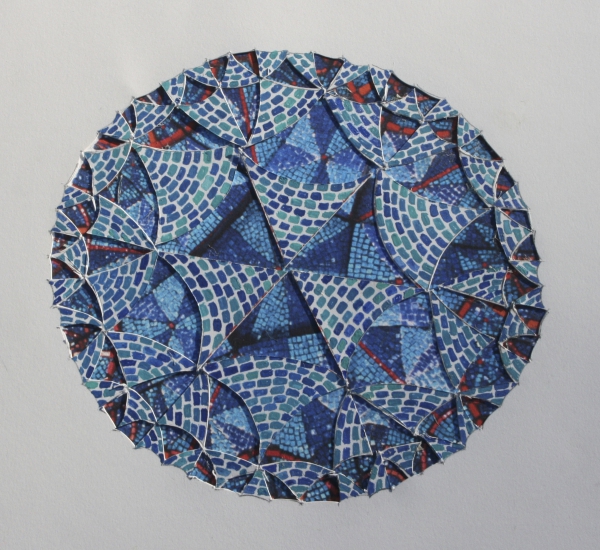
“Towards Infinite Smallness in layered Space” by Irene Rousseau is a 3-D paper construction. This work illustrates the negative curvature on a hyperbolic plane. The repetitive forms become increasingly small as they reach out to the boundary of the round disc. The paper shapes are not applied to create a flat surface, but instead the elements are of differing thicknesses, giving the work a complex surface.
Susan Happersett

Bridges Conference Stockholm, Sweden (Part 1)

This year the annual Bridges Math Art conference was held in Stockholm Sweden. Along with a busy program of lectures and workshops, the art exhibit is always a highlight of the event. There was so much interesting work on display that is hard to select just a few to write about in the blog. I encourage everyone to take a look at the on line gallery available on the Bridges website.
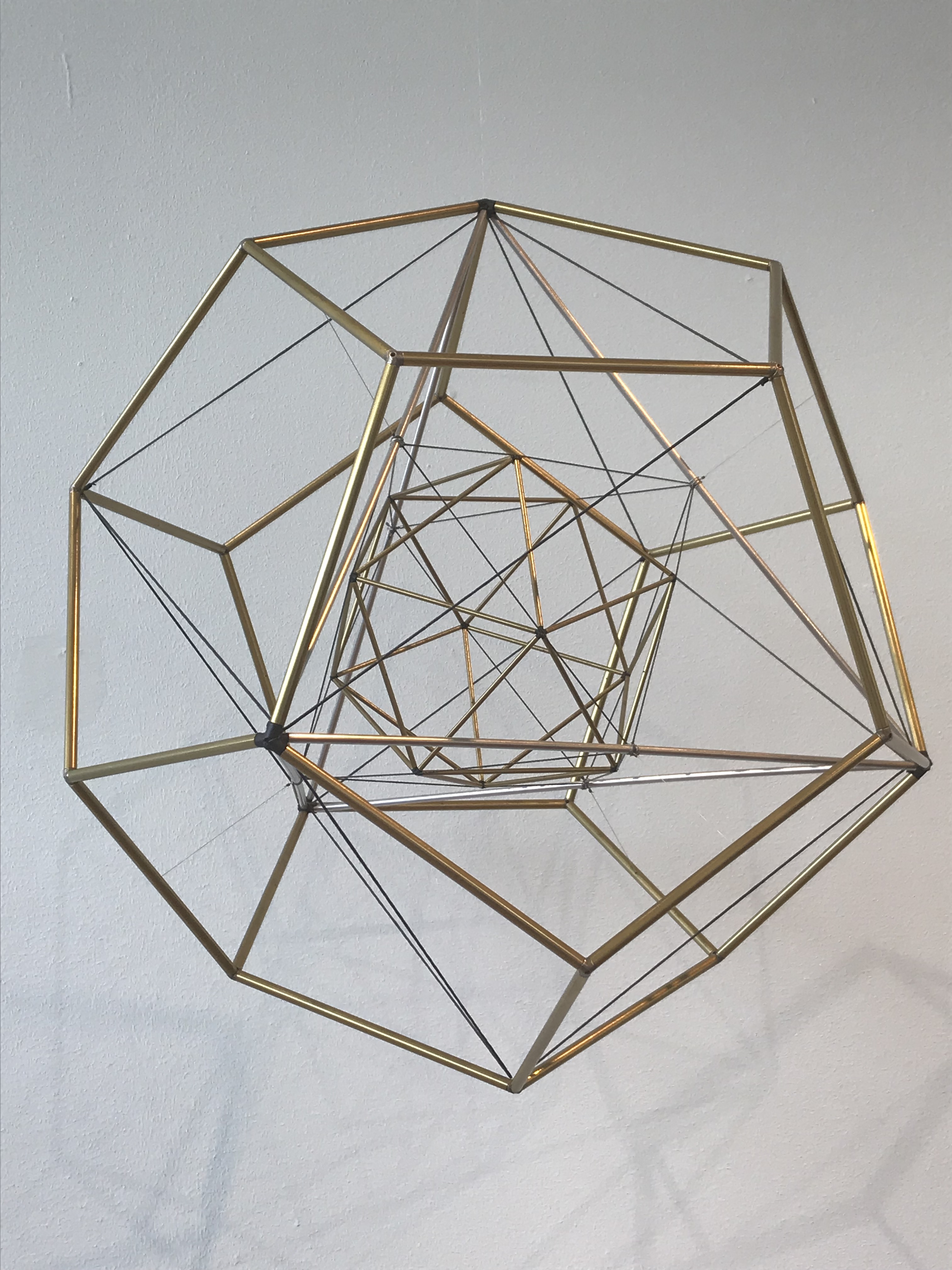
Martin Levin’s brass and aluminum sculture “Altogether II” was particularly fascinating to me because it includes all five of the platonic solids. By using thin rods as lines in 3-D space, Levin outlined the figures so you can see the shapes stacked inside each other. Platonic solids are comprised of faces that are regular polygons and at each vertex there are an equal number of faces meeting. The five Platonic are: Tetrahedrons with 3 equilateral triangular faces at each vertex, Cubes with 3 square faces at each vertex, Octahedrons with 4 equilateral triangle faces at each vertex, Dodecahedrons with 3 pentagons at each vertex and, Icosahedrons with 5 equilateral triangles meeting at each vertex. In Levin’s structure the shapes with triangular faces all share a common face plane, and the solids that have three shapes meeting at the vertices share common vertices.
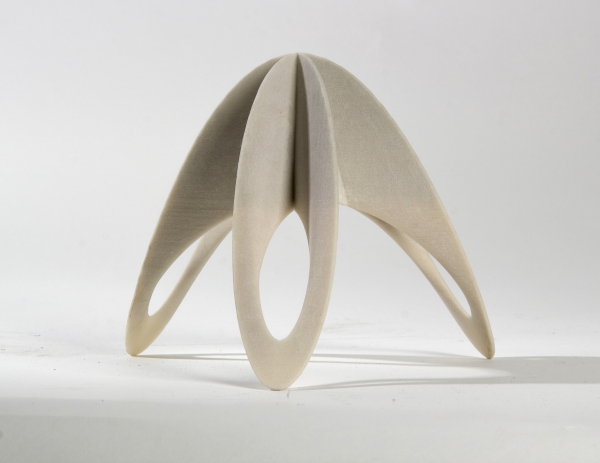
“Triboid” is a resin sculpture by Alfred Peris that is a ruled surface, which means that on any point of the surface there is a straight line that lies on the curved surface. Peris generates these curved surfaces by taking a 2-D curve with no end points and then projects it into paraboloid of revolution to get a 3-D curve. The resulting sculpture has an elegant organic floral presence.
Susan Happersett

Olafur Eliasson at Moderna Museet Stockholm, Sweden

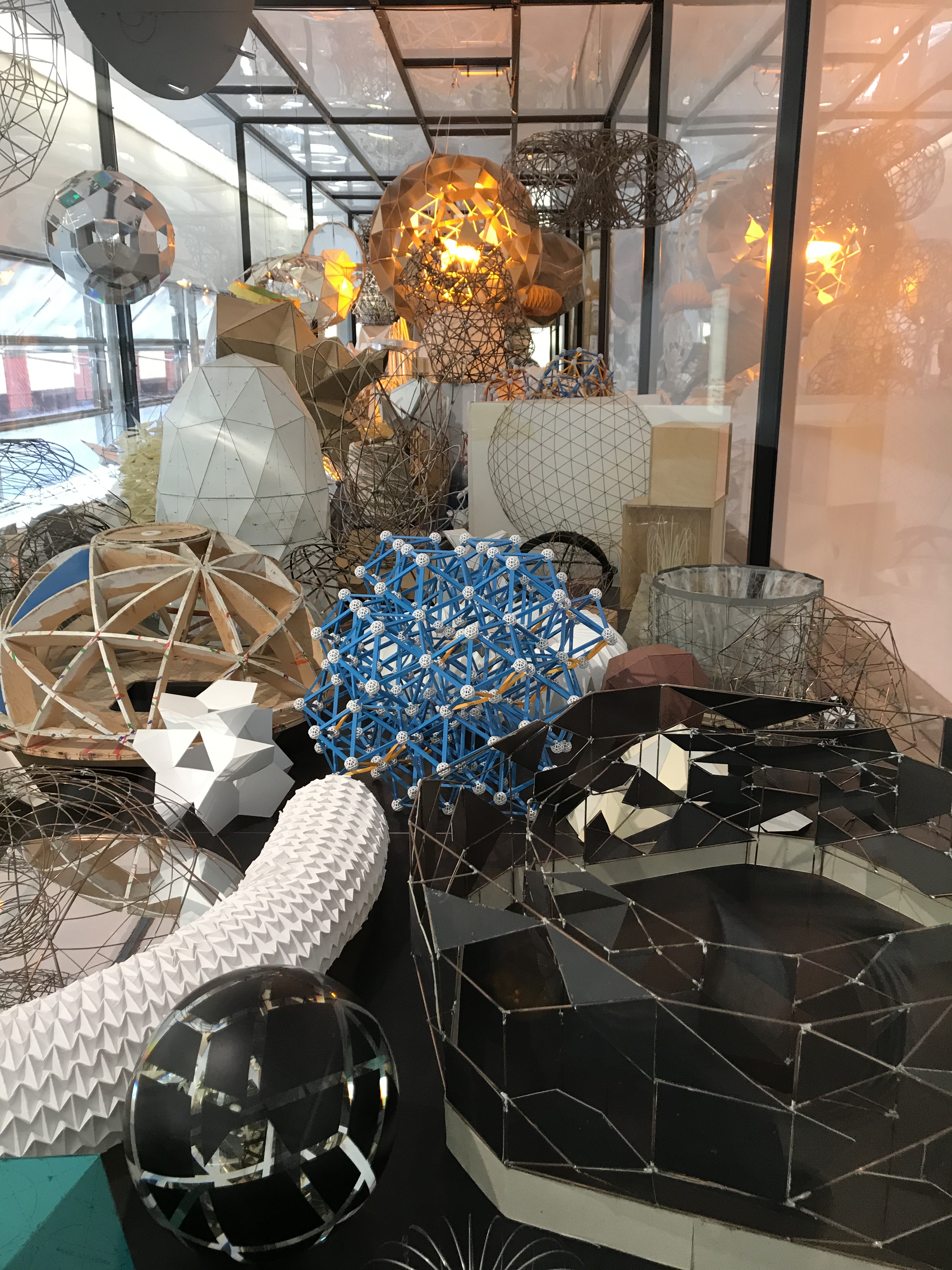
“Model Room”,  Olafur Eliasson’s huge installation of geometric models is on display at the Moderna Museet. The models were created in collaboration with Icelandic mathematician and architect Einar Thornsteinn.

Situated in a light filled entrance corridor of the museum, the huge vitrines contain an impressive cornucopia of mathematical forms. Eliasson refers to “Model Room” as a generous, spatial archive containing the entire DNA of his artistic oeuvre.

Susan Happersett

Thomas Bayrle at The New Museum

Thomas Bayrle’s art explores the connections between technology and society. He creates large images through the repetition of a smaller images.
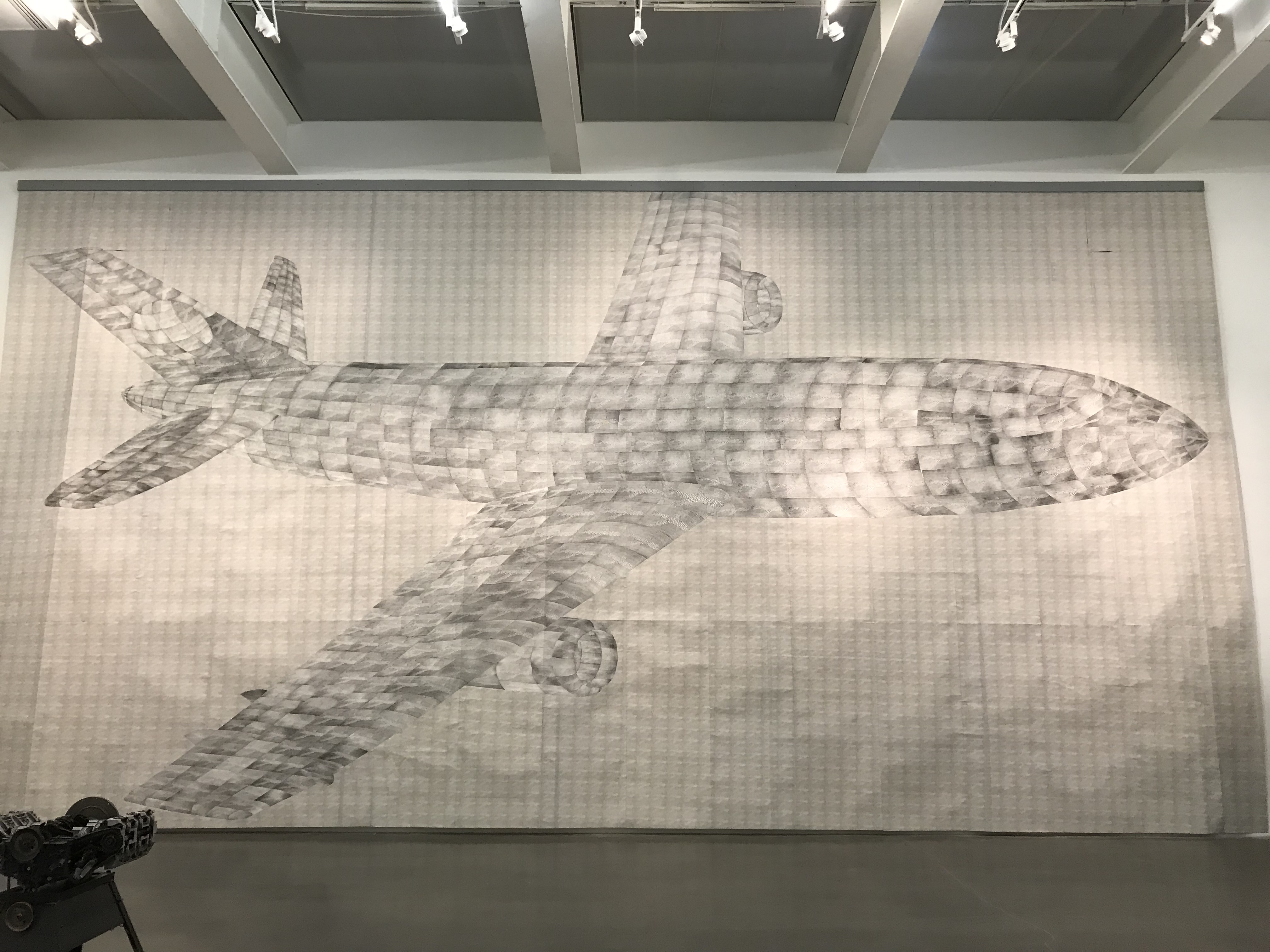
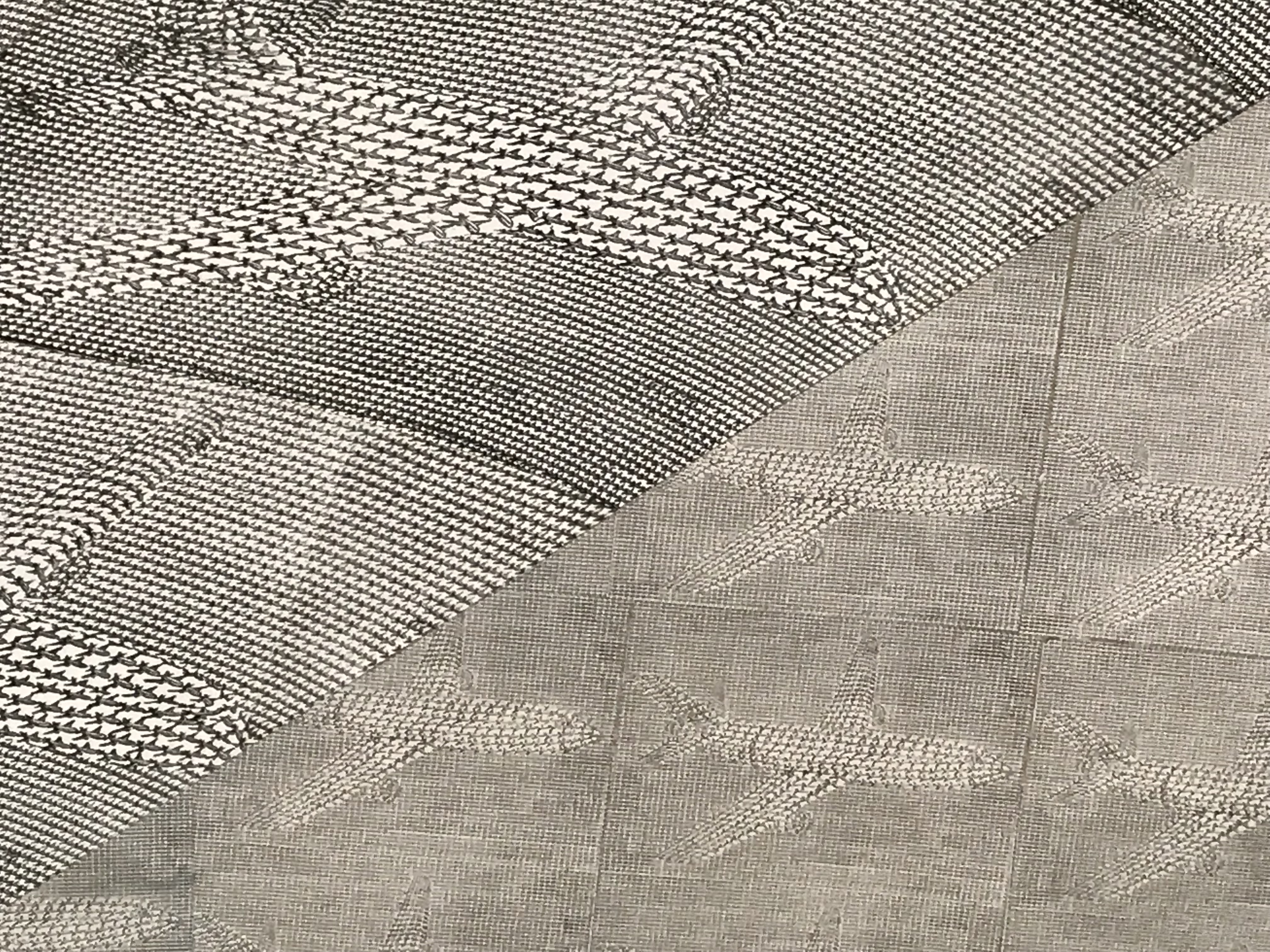
The enormous paper photo-collage work “Flugzeug (Airplane)” from 1982-1983 is currently on display at The New Museum in Bayrle’s solo exhibition titled “Playtime”. The gigantic (full scale) airplane is made up of 14 million tiny planes.
The artist addresses the mathematical concepts of scale and self-similarity as they relate to digitization and the standardization world infrastructure systems.
Susan Happersett

“The Possibilities of Line” at McKenzie Gallery

The current Summer Group exhibition at McKenzie Gallery titled “The Possibilities of the Line” features the work of sixteen artist who employ a sense of linearity in their artistic practice.
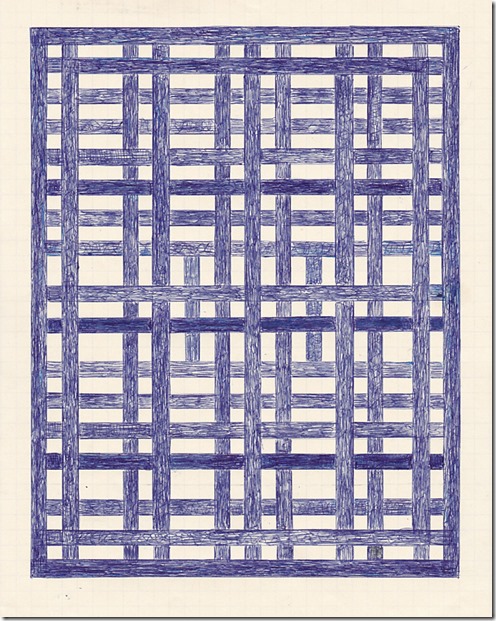
Although there is a lot of great art in this show I was immediately impressed by the drawings of Caroline Blum. Executed on graph paper these two works manage to render complex, precise geometric spaces while still preserving the scratchy quality the ball point pen. The hand of the artist is juxtaposed with the structured nature of the drawings.
“Blue Abstract” from 2107 creates a lattice work of horizontal and vertical bands that seem to weave over and under forming pattern of square and rectangular empty spaces.
“Path to Beach” (also from 2017) uses horizontal and vertical bands as well, but in this case there is a reference to concentric rectangles that gives the work a feeling of depth. To me, a series of architectural openings appears, leading the viewer deeper into the composition.
Susan Happersett
Chelsea Group Shows Part 2: Carter Burden Gallery

The Carter Burden Gallery is presenting the exhibition “A Shared Interest” that shows work with an emphasis on color and surface. Lilyan R. Stern’s “Variation on Theme #1” from 1970 features three vertical rectangles. Each rectangle has been divided into a series of concentric bands of color.

The center form has two lines of symmetry both horizontal and vertical, but the two outer rectangles only have a horizontal axis of symmetry. Stern’s use of bright color makes the obtuse and acute isosceles triangles seem to vibrate off the canvas.

Susan Happersett