Off the Wall in Chelsea

I discovered a very interesting trend at the Chelsea galleries this week. I found three different exhibitions where an artist presented drawings, paintings, or sculptures, but also built an installation work that protrudes off of a gallery wall.

Robert Curry at Bryce Wolkowitz Gallery

Bryce Wolkowitz Gallery  had a collection of Robert Currie’s perspex cases with monofilament line 3-D drawings.
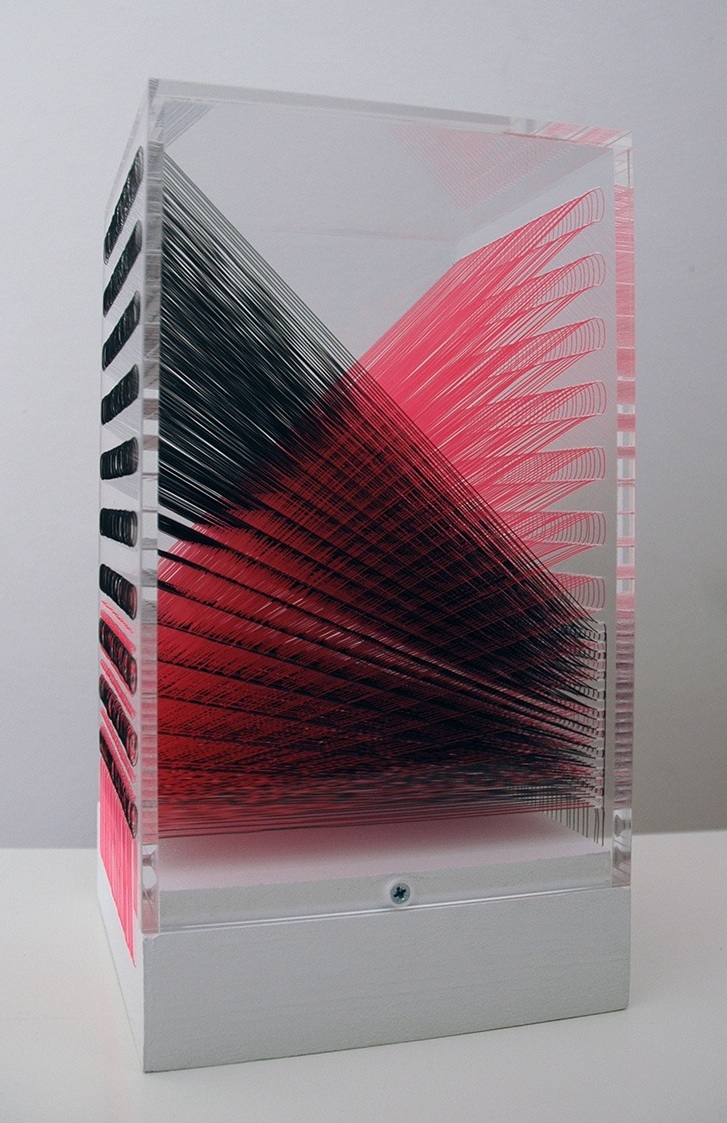
27-1a

9,772 inches of Black and Red Monofilament (2013)
Picture courtesy of the artist and the gallery

In the sculpture “9,772 Inches of Black and Red Monofilament”,  Currie uses a series of threads hand-strung in grids to form angled wedges of red and black that intersect at the center, forming an area of at what – at first – looks like disorder. Upon closer inspection the consistency of the patterns becomes clear. This work has a number of mathematical connections: The careful measurement of the monofilament is a defining factor in the title for this work. Currie uses a series of grid patterns to thread the work. There are intricate geometric shapes created within the cases. The finally mathematical connection is his allusion to Chaos Theory, where there is underlying order in what at first appears to be disorder.

At the entrance and in the hall of the gallery, Currie has installed a site-specific thread drawing based on the architecture of the room “12 miles 1647 yards of Black Filament”. This work explores the gallery space using repetitive straight lines.
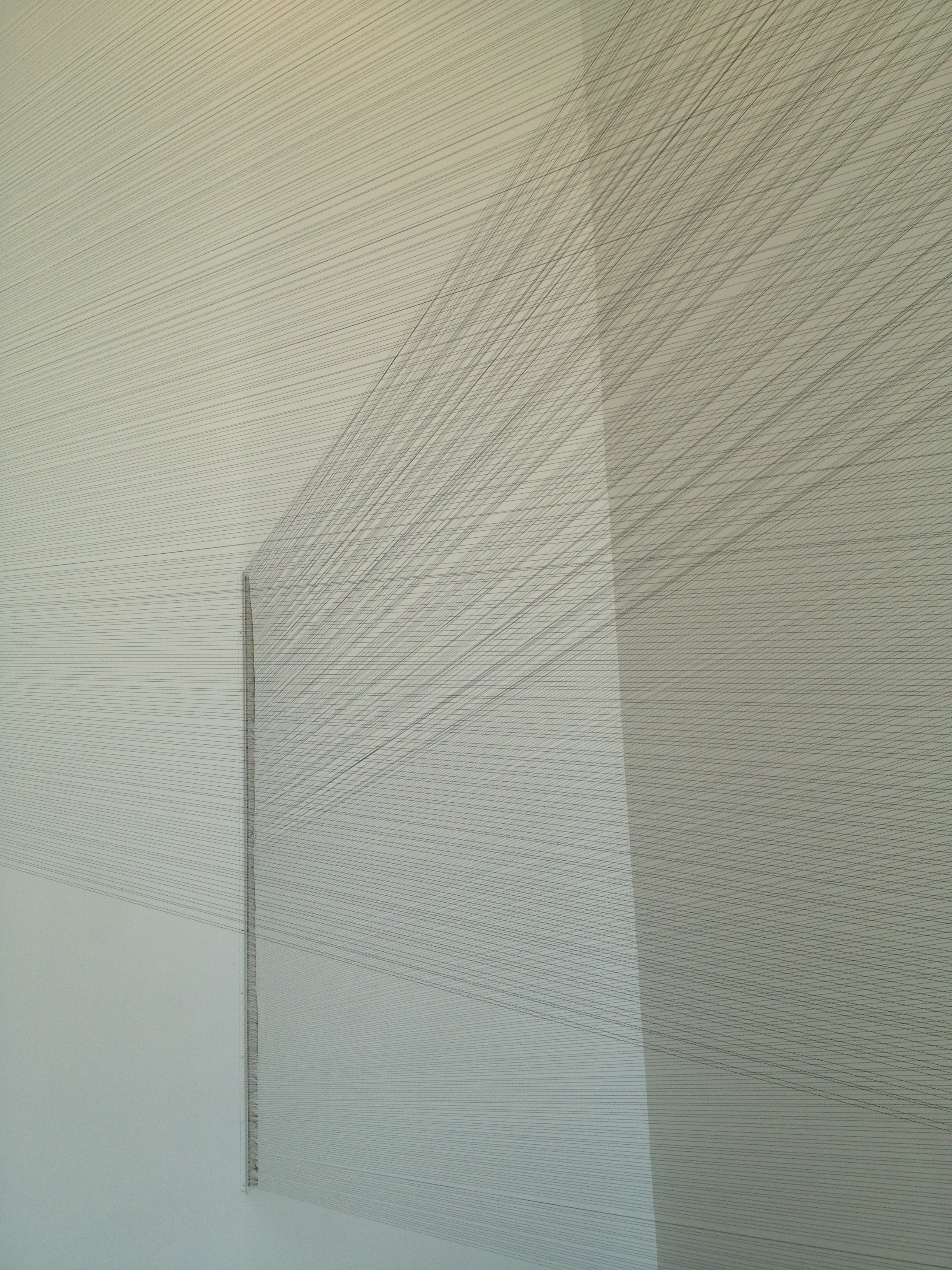
27-2

12 miles 1647 yards of Black Filament
Picture courtesy of the artist and the gallery

Mark Hagen at Marlborough Chelsey Gallery

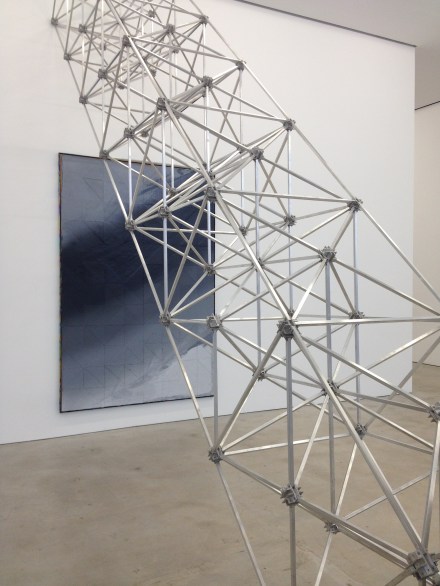
At the Marlborough Chelsea Gallery, Mark Hagen has created an aluminum and stainless steel space frame installation named “To Be Titled Ramada Chelsea #3”,  that climbs in front of his “To Be Titled Gradient Painting #35”. This geometric construction features cube formations meeting at star formations formed by 12 line segments radiating out from a central point.
27-3
“To Be Titled Ramada Chelsea #3″in front of “To Be Titled Gradient Painting #35”
Picture courtesy of the artist and the gallery
Ryan Roa at Robert Miller Gallery

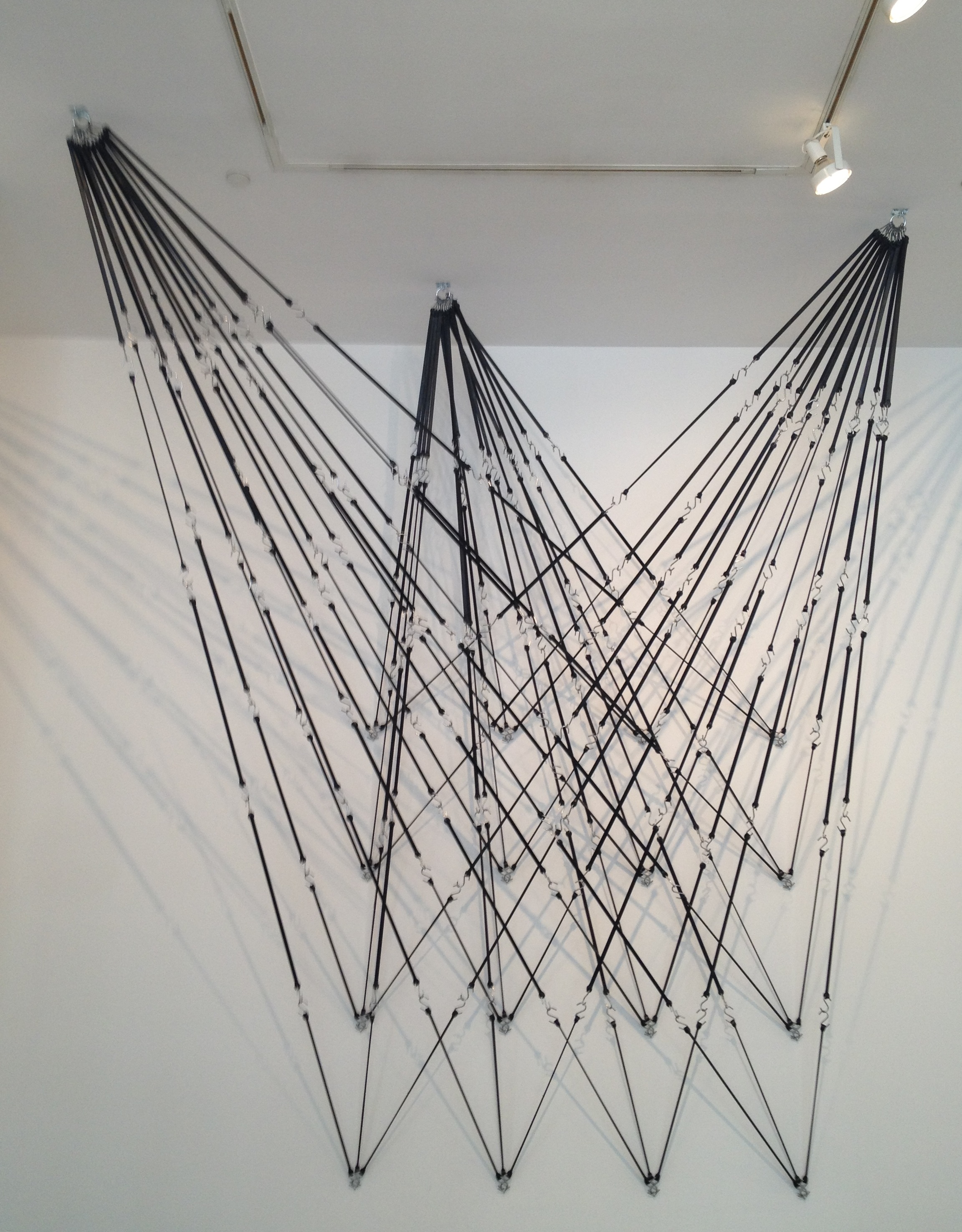
The Robert Miller Gallery is presenting a group show titled “Six Features”.  One of the artists, Ryan Roa, is exhibiting drawings that relate to fractions and geometry. In the same room he has created site-responsive installation that create a sense of movement within the space.
27-4

Site-specific installation
Picture courtesy of the artist and the gallery

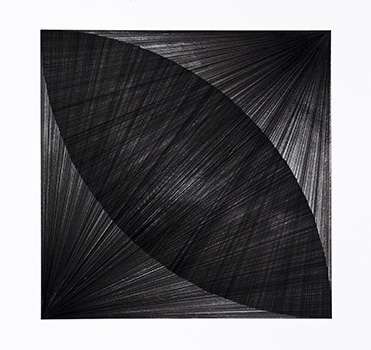
In his drawing “12X12 series #01”,  Roa has drawn a multitude of equal line segments radiating out from two opposite corners of the square, creating two equal quarter circles that overlap along the diagonal.
27-5a

12X12 series #01
Picture courtesy of the artist and the gallery

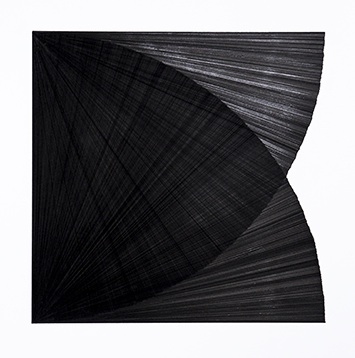
In “12X12 series #02”, the artist uses the same technique of drawing equal line segments, but in this case they radiate out from the two left corners of the squares. The circles overlap to form a pointed dome shape.  The right square is not completely filled in with lines: it  retains the curves of the circle segments.
27-6B

12X12 series #02
Picture courtesy of the artist and the gallery

It is fascinating to me how Roa has been able to create two drawings with such different proportion shapes and energy using basically the same technique by only changing one parameter.

It is amazing that within the course of an afternoon walking only a few blocks I was able visit three installations of Mathematical constructions by artists with very different practices and techniques. By expanding their formats off the gallery walls, each artist has created an exciting space to engage with the measures, proportions, and geometries that make up their work.

Susan Happersett
Dominick Talvacchio at Matteawan Gallery

Matteawan Gallery in Beacon, New York is currently exhibiting works on paper by Dominick Talvacchio, in a show named “The Eros of Mathematics”.  Talvacchio has a background and education in mathematics. His work has been exhibited extensively throughout the United States and Europe. The visual dialog in his print and drawings express his interest in the inherent beauty of the order and structure found in mathematics.

25-1-Arcs Missing Arcs

Arcs Missing Arcs – 2012
Giclée Print
Picture courtesy of the artist and the gallery

In the print “Arcs Missing Arcs”, Talvacchio has created a 4 by 4 grid of touching circles with only sections of the circles visible. These arcs create a series of graceful and organic curves. The viewer senses the existence of the underlying grid pattern, but is allowed to enjoy the sensual aesthetics of the segmented curves.

25-2-KairouanBelow

Kairovan Below – 2012
Drawing on paper
Picture courtesy of the artist and the gallery

The drawing “Kairovan Below” features two elements. First, an underlying, lightly-drawn tiling. Second, a selection of line segments from the tiling, drawn in a darker black. The tiling has a four-fold rotational symmetry. Within this symmetrical pattern there are five-point non-symmetrical stars. The juxtaposition of the overall symmetry of the tiling against the not-quite-symmetrical stars creates an interesting tension. By making some of the lines darker and more pronounced, Talvacchio allows a simplified but elegant pattern to emerge.

Artist talk and reception

On June 1st from 2-4 at Matteawan Gallery there will be an artist talk and closing reception for “The Eros of Mathematics”. I will be there to participate in the discussion about the relationships between mathematics and art. All are welcome.

Beacon

Matteawan Gallery is located in Beacon. A small city north of New York City, situated on the Hudson River. It is the home of DIA Beacon, a museum dedicated to displaying long-term, large-scale gallery presentations of single artist displays, with emphasis on conceptual art and minimalist work. They have an excellent selection of Sol LeWitt’s wall drawings currently on view. I would suggest DIA Beacon as an excellent destination for a day trip for any math art enthusiast. While you are in town, check out the galleries on Main Street.


Lower East Side Galleries – March 2014

The Lower East Side neighborhood of Manhattan has a large and varied gallery scene. Though there are fewer galleries here than in the Chelsea Area, there is still a lot of great art. The galleries in the LES tend to be smaller and more intimate then in other parts of NYC . Many of the galleries are newer and less established and will take on different types of work.

Gil Blank at Joe Sheftel Gallery

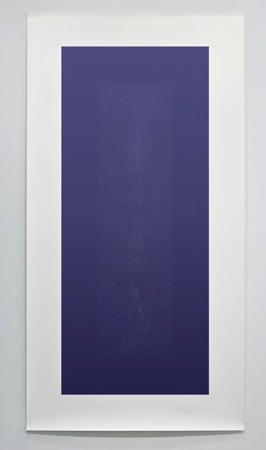
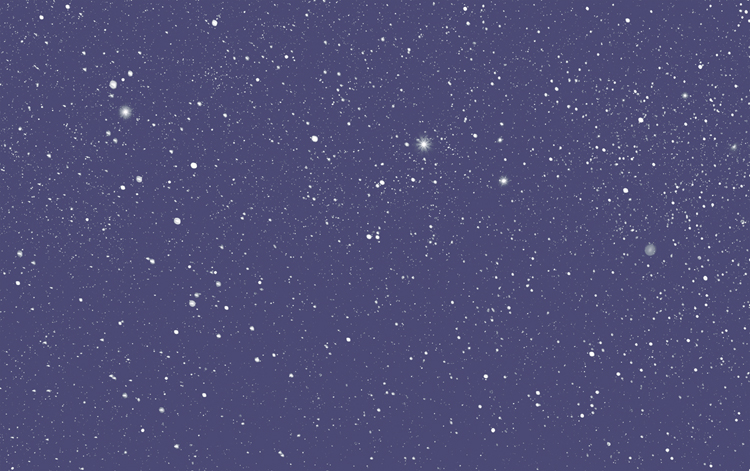
The Joe Sheftel Gallery  has a exhibition of photographs by Gil Blank that are an exploration of the night sky. Blank uses an interesting technique of taking thousands of photos throughout a year then superimposing them until they accumulate into a single image. He has created one for each year beginning in 1986. The black background of the dark night sky is removed and replaced by another color. This new color is determined using a digital random color generator.

15-1

Gil Blank – Unti­tled – 2012 – Pig­ment ink jet print on poly­ester film
Picture courtesy of the gallery and the artist

Here is a detail of the same work:

Gil Blank - Unti­tled - 2012 - Pig­ment ink jet print on poly­ester film   Picture courtesy of the gallery and the artist

Gil Blank – Unti­tled – 2012 – Pig­ment ink jet print on poly­ester film (detail)
Picture courtesy of the gallery and the artist

There are two elements to these photographs that appeal to my interest in mathematics. First, the choice of color for the background. By removing the dark night sky, Blank has taken stars in the sky and abstracted them to become geometric points on a plane. Then, allowing the new color to be digitally randomly generated, the algorithm of the generating software becomes part of the artistic process. The second mathematical component is the accumulation of thousands of these sets of points with each set already containing a multitude of points. This series of photographs work flirts with the concept of Infinity.

 Laura Watt at McKenzie Fine Art Gallery

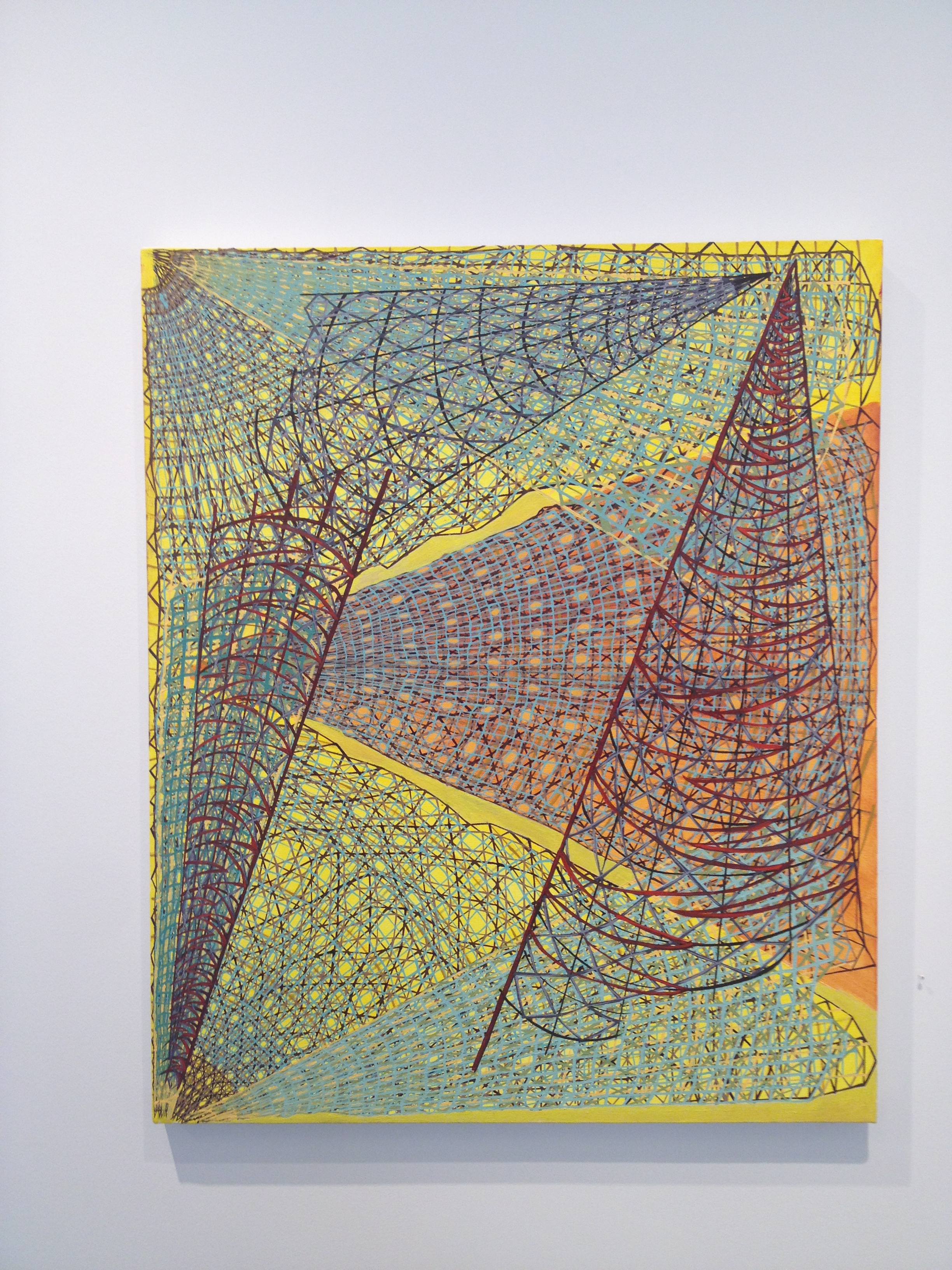
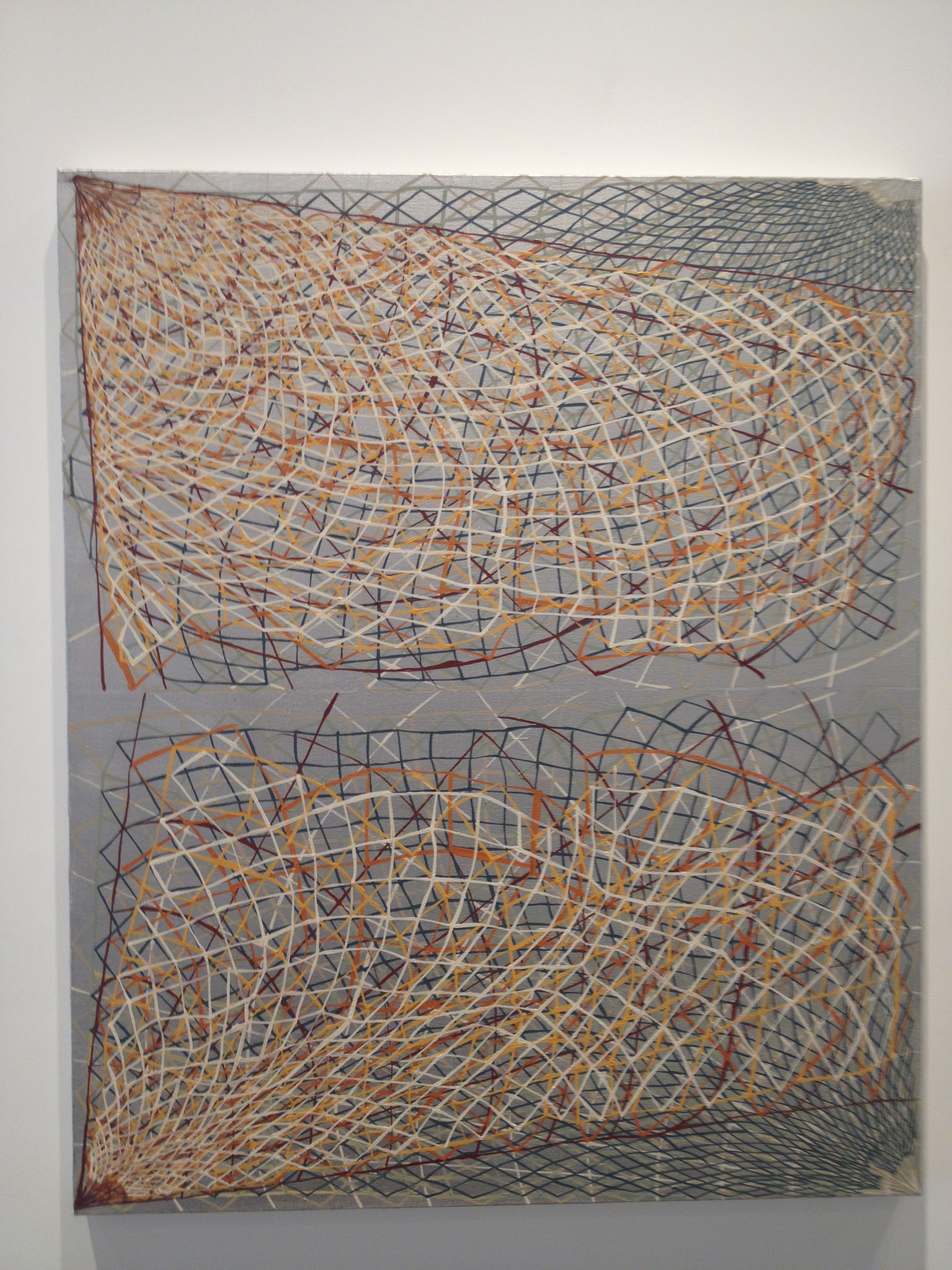
Vector diagrams are an interesting starting point for making abstract art. Laura Watt uses vectors to structure the patterns in some of her oil paintings. There are two excellent example of this work exhibited in her solo show at McKenzie Fine Art gallery. In “Vector Finding” Watt has used series of vectors fanning out from points near the corners of the canvas. Then, the triangular areas bound within these rays, are filled in with diamond-shaped grids and arcs of circles. The final image resembles cone-shaped structures consisting of nets of lines.

15-2

Laura Watt – Vector Finding – 2014 – Oil on canvas
Picture courtesy of the gallery and the artist

In “Oriented Vision” the vectors are starting from only two points at the top and bottom left hand corners of the canvas. The artists uses arcs to give the illusion of a curved surface and there are multiple sets of rotated and superimposed grid patterns . This painting is reminiscent of a globe or map, but lines of latitude and longitude, however, are only one of the sets of grids. Watt embraces the use of vibrant and intricate patterning in her paintings. These two examples illustrate how mathematics can be part of this process.

15-3

Laura Watt – Oriented Vision – 2014 – Oil on canvas
Picture courtesy of the artist and the gallery

Symmetry in Antique Peruvian Textiles

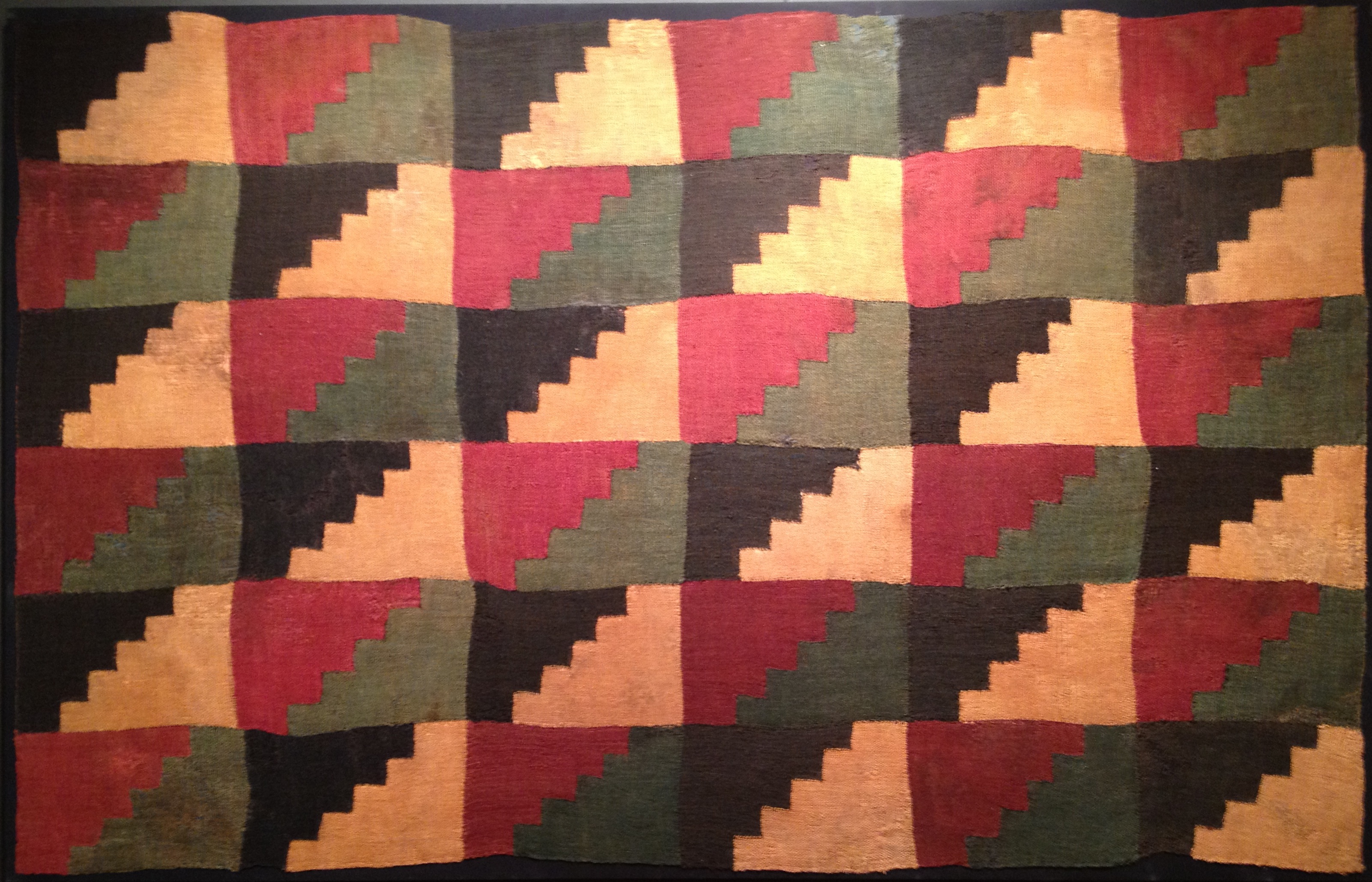
Last week I visited the Metro Show in New York. This is an art and antiques fair where 35 dealers display a wide range of items including folk art, outsider art, and ethnic antiquities. I did not necessarily expect to find Mathematical Art in this venue. Much to my surprise the first thing that caught my eye, as I walked into the exhibition hall was a Peruvian textile in the William Siegal Gallery  area, made by weavers from the Nasca Culture (sometimes spelled “Nazka”) from the Southern coast of Peru. It was made somewhere between 200-600 AD from camelid wool and natural dyes. This Stepped Mantle has interesting symmetrical properties. If you only look at shapes and ignore the colors, this is a great example of order 2 rotational symmetry, also called a “point symmetry”. Rotating at any point where all four colors meet you can rotate the four rectangles 180 degrees and still have the same pattern (disregarding colors):

Nasca Culture (200-600 AD) - Camelid Wool and Natural Dyes

Nasca Culture (200-600 AD) – Stepped Mantle – Camelid Wool and Natural Dyes

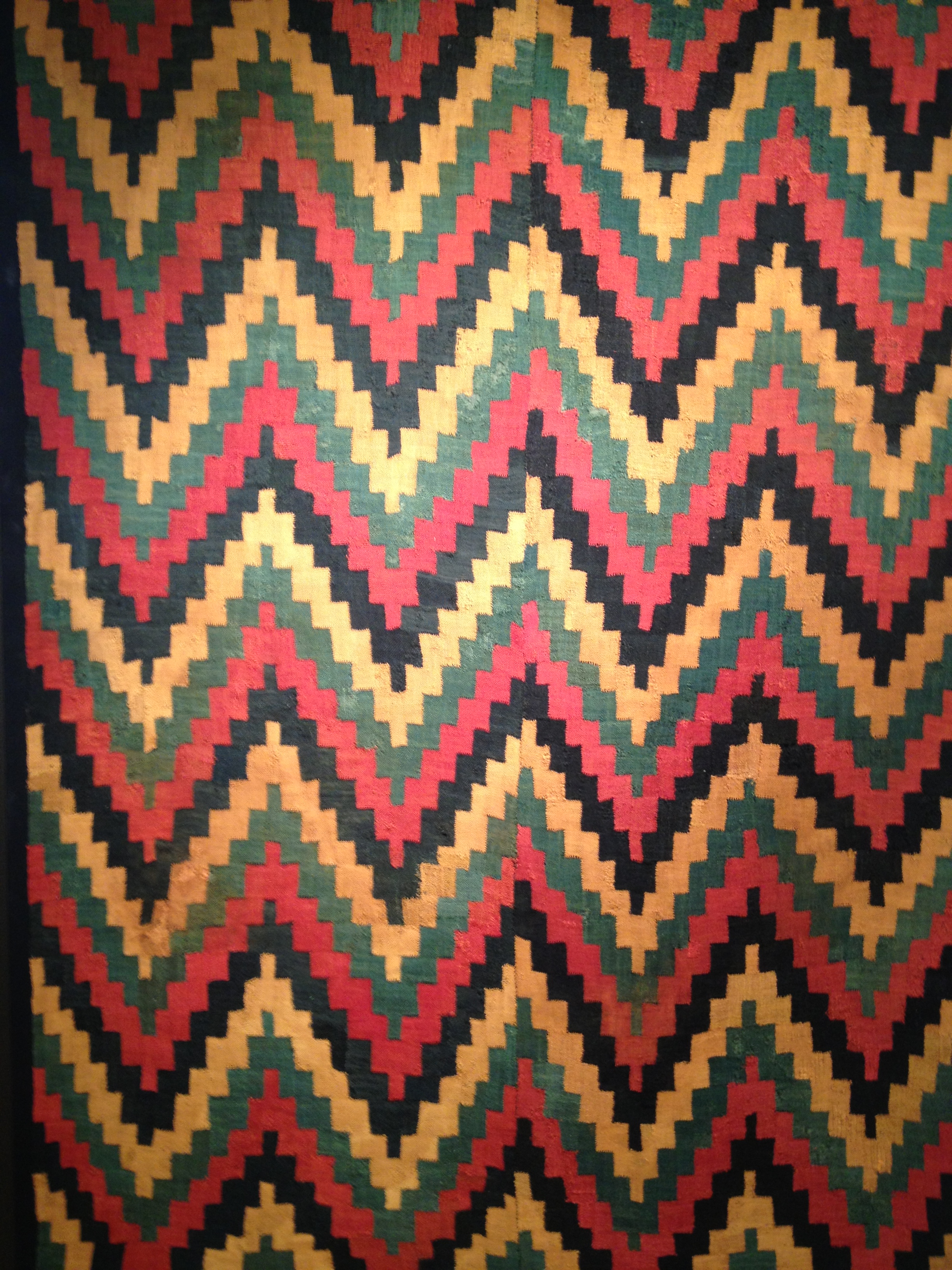
On another wall in the booth of the William Siegal Gallery there was a Stepped Cushma (one piece dress) also Nasca 200-600 AD. This textile demonstrates reflection symmetry,  also referred to as “mirror symmetry”. There are 7 vertical lines of symmetry that can be drawn through this example. If you consider each on the four columns of V-shaped chevron patterns, they have lines of symmetry through the center. Then, each of the two pairs of adjacent columns have a line of symmetry between them. Finally, the complete textile has a line of symmetry down the middle:

photo43

Nasca Culture – Stepped Cushma – Camelid Wool and Natural Dyes

The moral of this blog is to keep your eyes out for Mathematical Art everywhere. The connections between Mathematics and Art can be found in unexpected places.

– FibonacciSusan