MANUSxMACHINA, Fashion in the age of Technology at the Met

Every year in May the Metropolitan Museum of Art presents an elaborate fashion exhibit. The Costume Institute at the Museum produces a huge show, not in their usual space in the basement, but instead in transformed rooms in the main galleries. This year the exhibition is titled “MANUSxMACHINA, Fashion in the age of Technology”. It examines the way relationship of couture designer clothing and the use of machines. I was not expecting to see any Mathematical references, but I was pleasantly surprised.
16-18-01

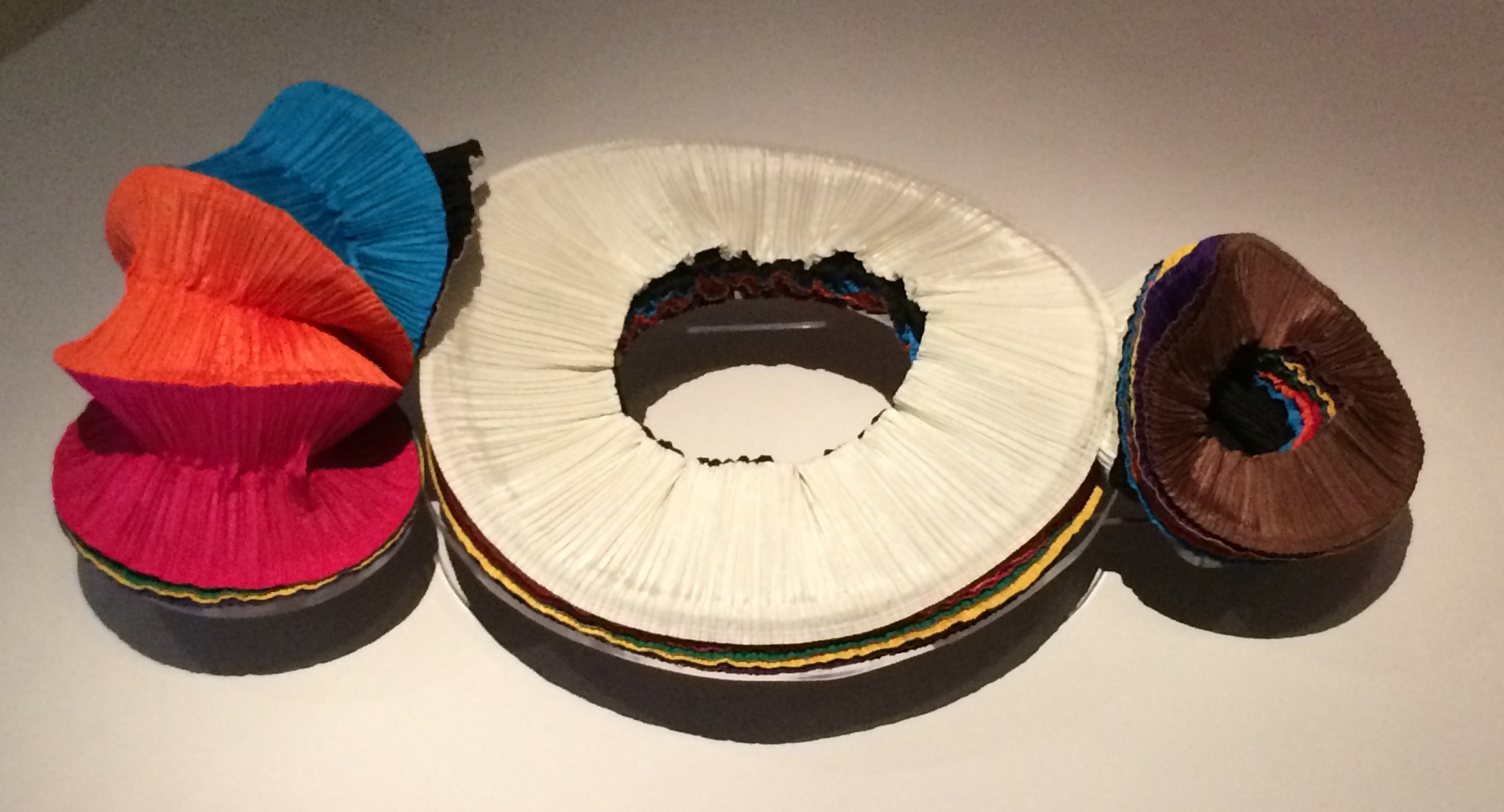
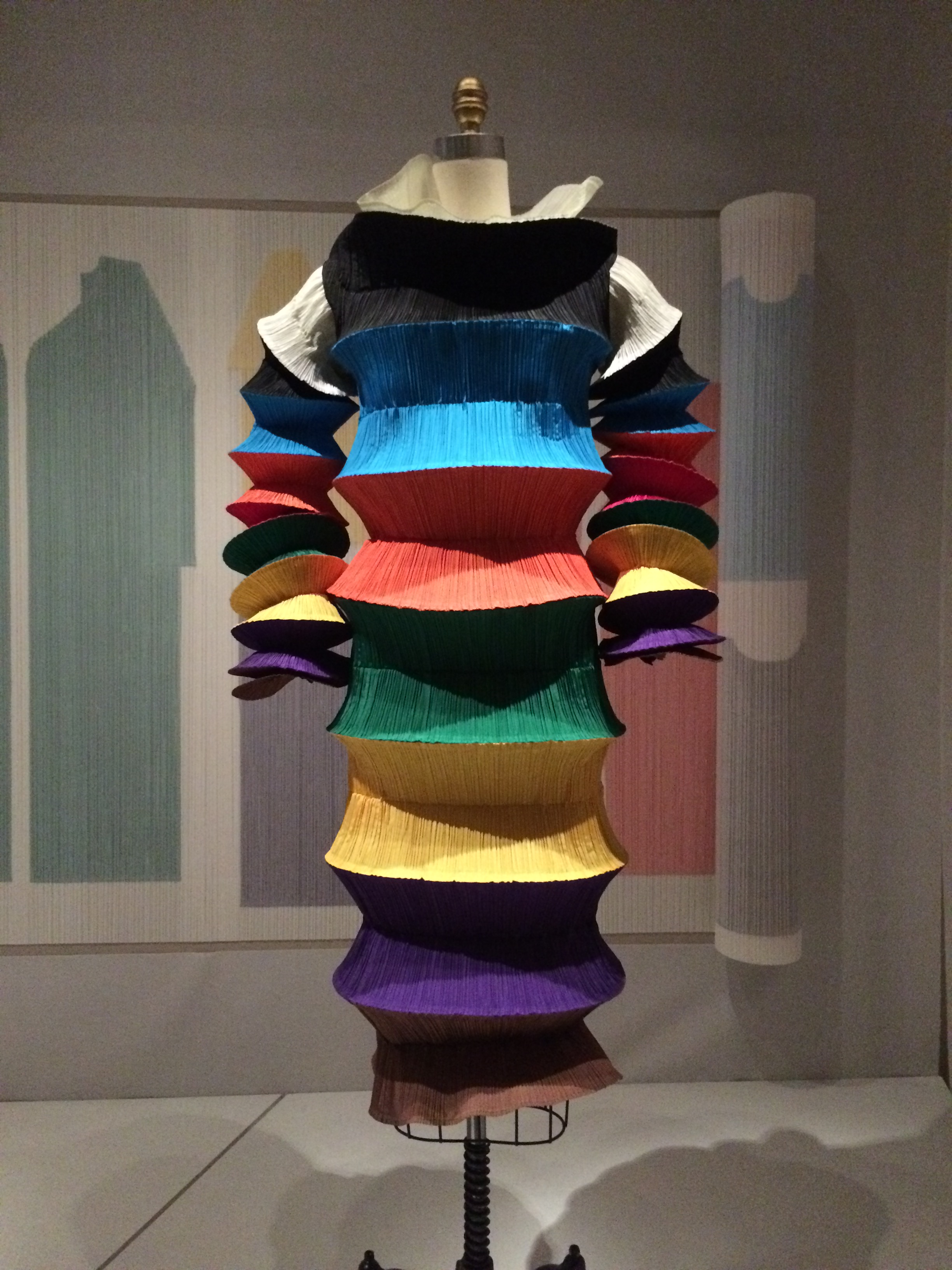
Miyake Design Studio “Flying Saucer” , Dress (flat), 1994

The  pleats on “Flying Saucer” Dress by Miyake Design were machine garment-pleated, creating a series of pleated circles. When lying flat it is easy to see the large center circle that create the body of the dress and smaller circles that form sleeves. The center points of the circles are in a straight line.
16-18-02

Miyake Design Studio “Flying Saucer” , Dress (unfolded), 1994

When the dress is opened to show its accordion construction, the body and sleeves become pleated cylinders.
16-18-03

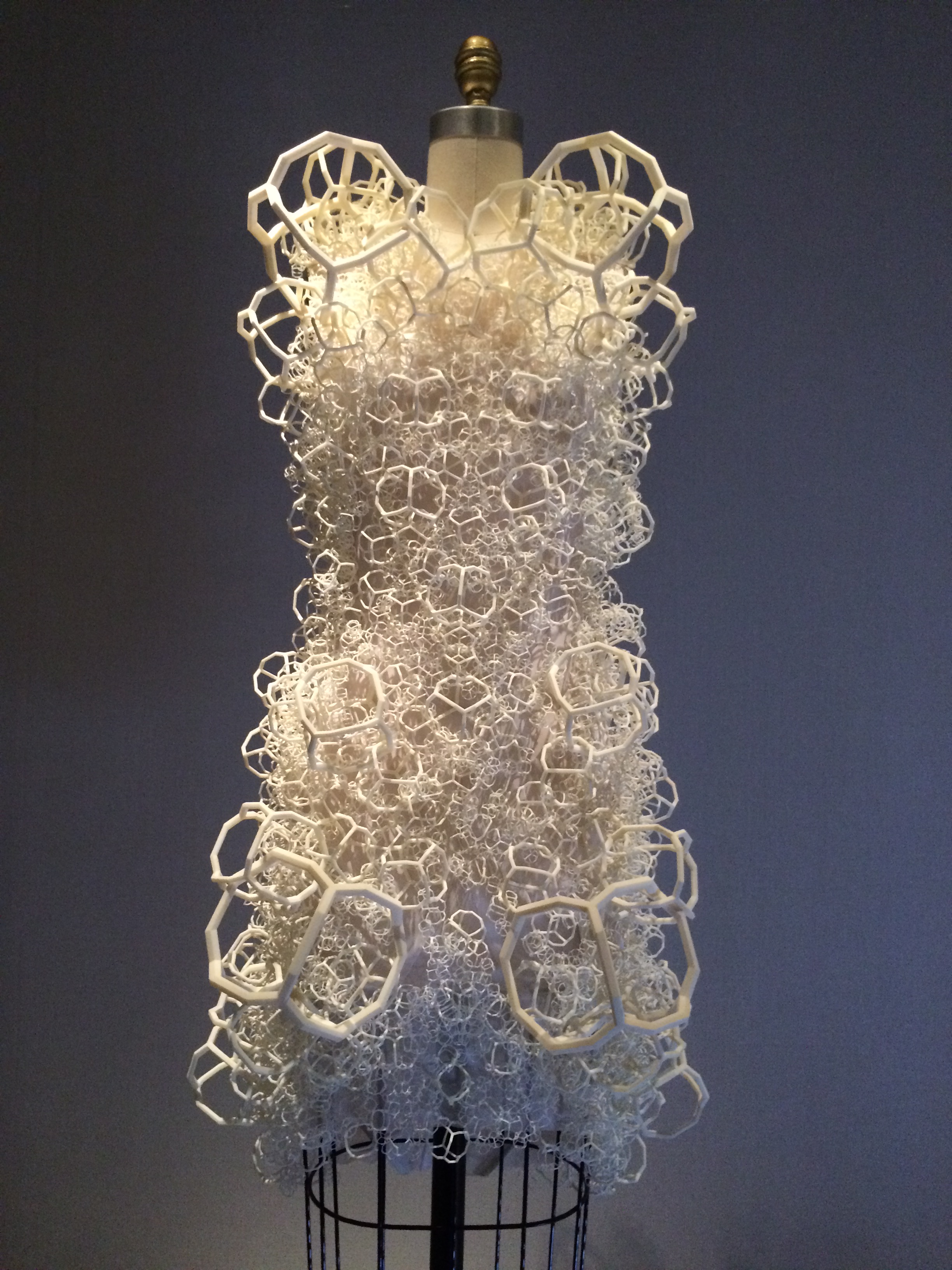
Threeasfour, “Bahai” dress, 2014

The “Bahai” dress by design team Threeasfour features 3-D  printed elements by Materialise. The structure of this dress alludes to complex geometries. Here is a quote from Threeasfour from the exhibit’s wall signage:

“Next-generation 3-D modeling programs were used to construct the six degrees of fractal growth where each element operates independently from the rest”.

It is obvious mathematics was an intrinsic tool used to create this garment. As more and more designers have access to advanced technology, there will be great opportunities for them to use Mathematical themes and processes in their work.

Susan Happersett
Chinati

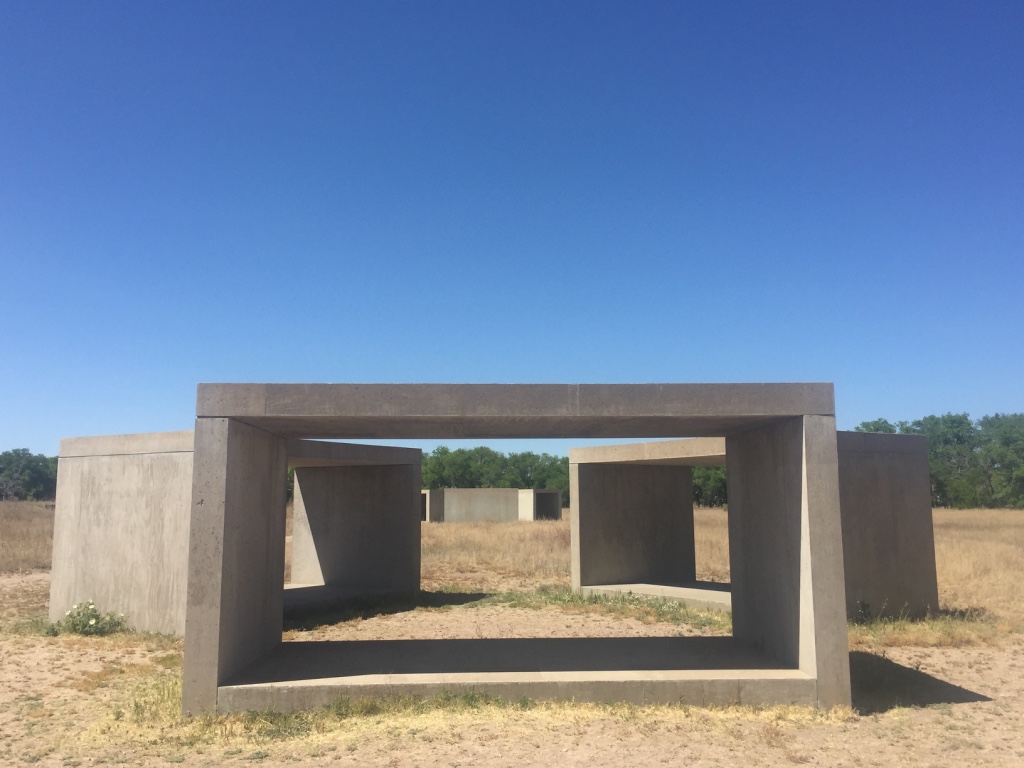
Donald Judd put the town of Marfa, Texas on the art world map. He founded this amazing museum, so that large conceptual art installations could be on permanent display. Originally this project was in conjunction with DIA but now it is supported by the independent Chinati Foundation. The museum is situated in the high desert of Western Texas with views of the Chinati mountain range. Art can be seen both in large re-purposed military buildings and outside on the expansive grounds.

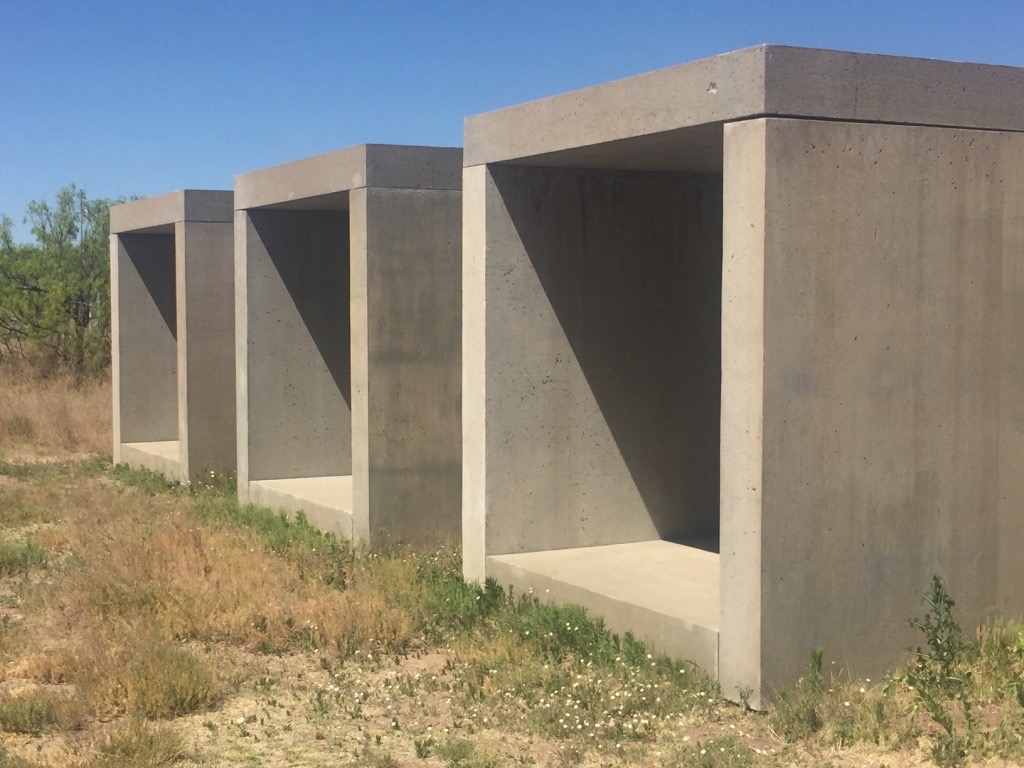
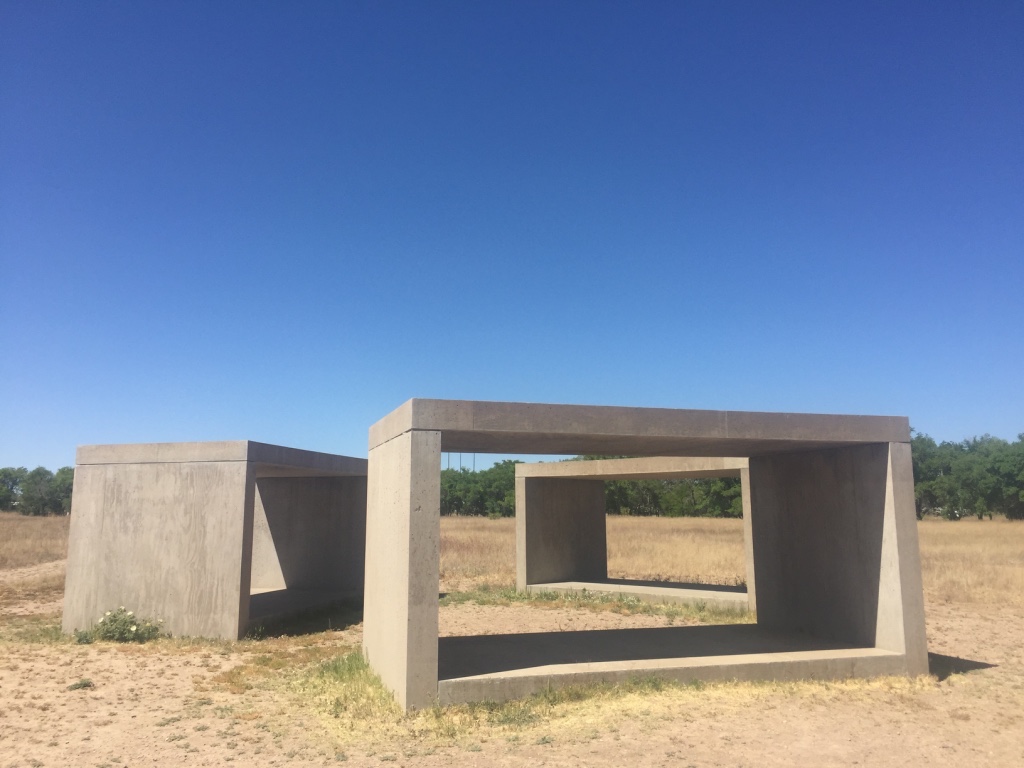
Access to the interior galleries is limited to pre-arranged tours but Judd’s iconic work “Untitled, 15 works in concrete” from 1980-1984 can be visited without reservations.

16-17-03 16-17-01 16-17-02

The 15 arrangements of concrete rectangular solids consist of a total of 60 forms all fabricated on site. All have of these elements have the same exterior measurements of 2.5 meters high by 2.5 meters deep by 5 meters long. The slabs of concrete are 25 centimeters thick.  The grouping of forms are situated in a straight line and  60 meters apart over a length of 1 kilometer. Each arrangement has between 3 and 6 of the concrete sculptural elements. Judd’s placement of the rectangular open blocks is also mathematically specific relying on a series of ratios to best differentiate the 15 installations and the shadows created by the natural light.

I went to visit the site twice.  Once in the bright sun of mid morning and again in the late afternoon. The pictures above were taken during my afternoon visit. The angles of the shadows, both within the concrete forms and on the landscape varies dramatically. By creating a set of numerical rules that allowed for a uniformity of the elements then exploring 15 permutations for this these building blocks in a dramatic setting Judd has provided the viewer an amazing experience to feel a physical connection to the art.

Susan Happersett
Exhibitions 2d, Marfa, Texas

For the past month I have been traveling throughout the USA and one of the most interesting destinations has been Marfa, Texas. This small West Texas town is a haven for Minimal and Conceptual Art. The gallery Exhibitions 2d has a lot of mathematically art work on display. Two artists represented by the gallery – Gloria Graham and John Robert Craft – were of particular interest.

16-16-01

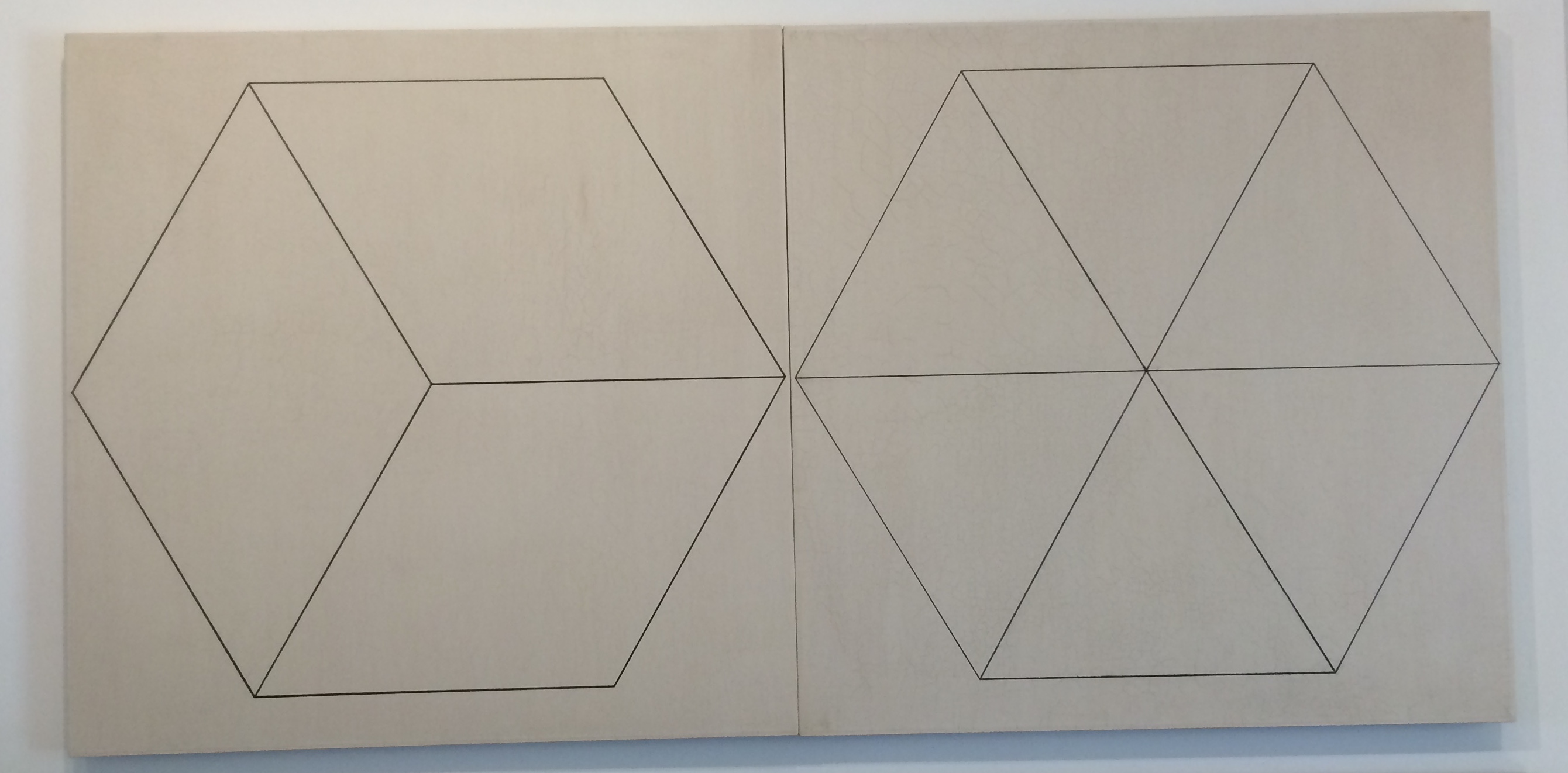
Gloria Graham – “NaCl H2O Salt Water” – 1994
graphite, kaolin, canvas on two wood panels
Picture courtesy of the gallery

Graham’s geometric paintings are based on the patterns found in the atomic structures of natural elements.  “NaCl H2O Salt Water” features two crystal-like forms, both regular hexagons. The hexagon on the left is divided into three congruent rhumbi.  The hexagon on the right is divided into six equilateral triangles. The addition of the three extra line segments to divide the rhumbi into triangles changes the hexagon dramatically. The symmetry goes from order 3 rotational symmetry to order 6. The perception of the possible 3-D form goes from a cube to a faceted diamond shape with 6 facets on top. Graham’s painting process for this work involves a layer of kaolin (a clay-like mineral) applied to canvas stretched over wood. The lines are drawn into this base. Through the drying process tiny cracks in the surface have formed. This gives the work a complex physicality that alludes to the natural environmental inspiration for the painting.


16-16-02

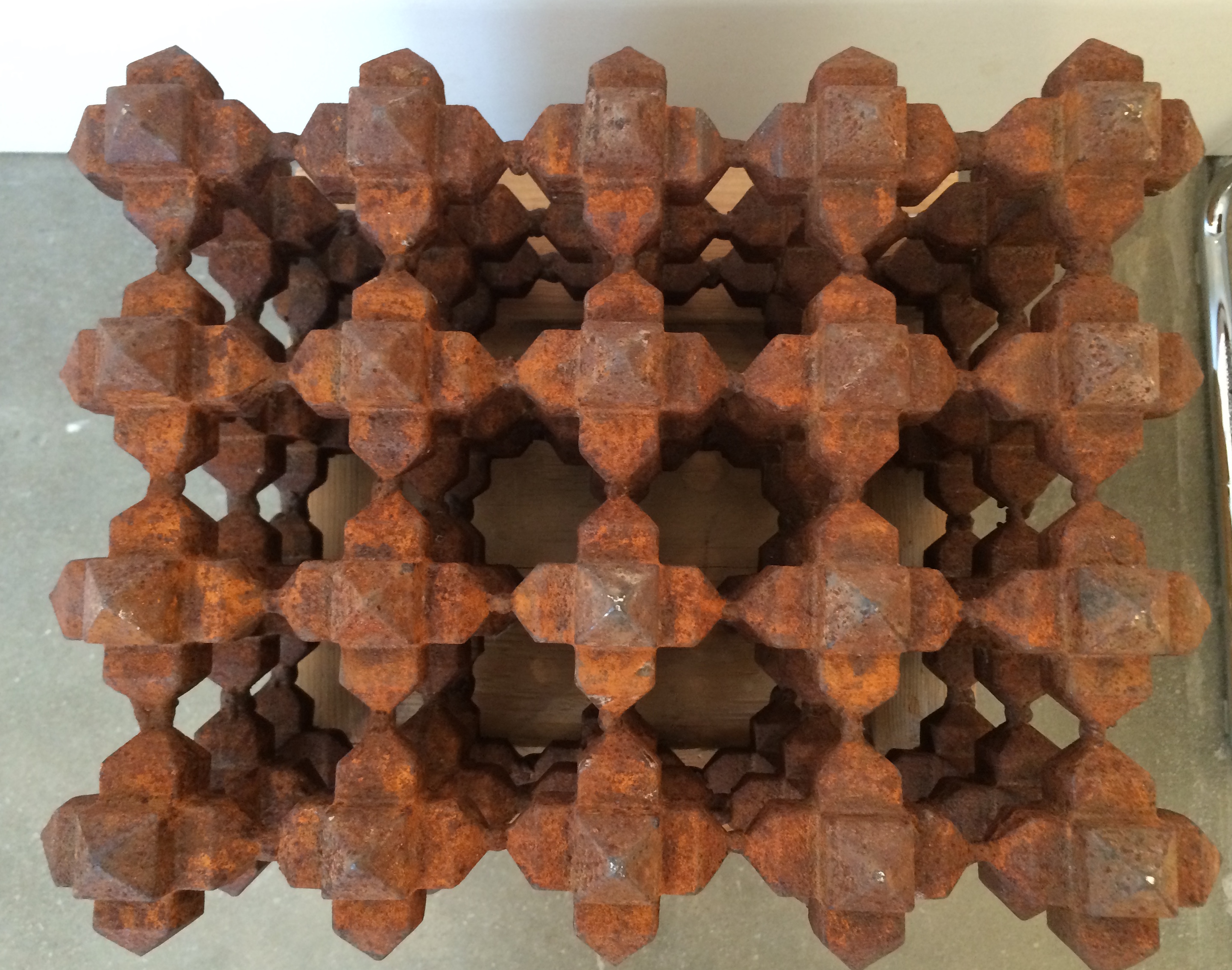
John Robert Craft
Cast iron
Picture courtesy of the gallery

Craft’s cast iron sculptures are related to his life as a Texas rancher. They are solid and heavy, and have a rustic patina. Their rough physicality is juxtaposed to their intricate geometric forms. This work is made up of 60 basic elements stacked into a 4 by 5 by 3 rectangular solid. Each of the elements is a type of double cruciform with a pyramid set on each of the six ends. This forms negative spaces with 16-sided regular polygon shaped windows. Craft’s work presents complex 3-D repetitive tiling-like formations, while retaining the physical realities of the artist’s ranch experience.

Susan Happersett
Anish Kapoor at the Peabody Essex Museum

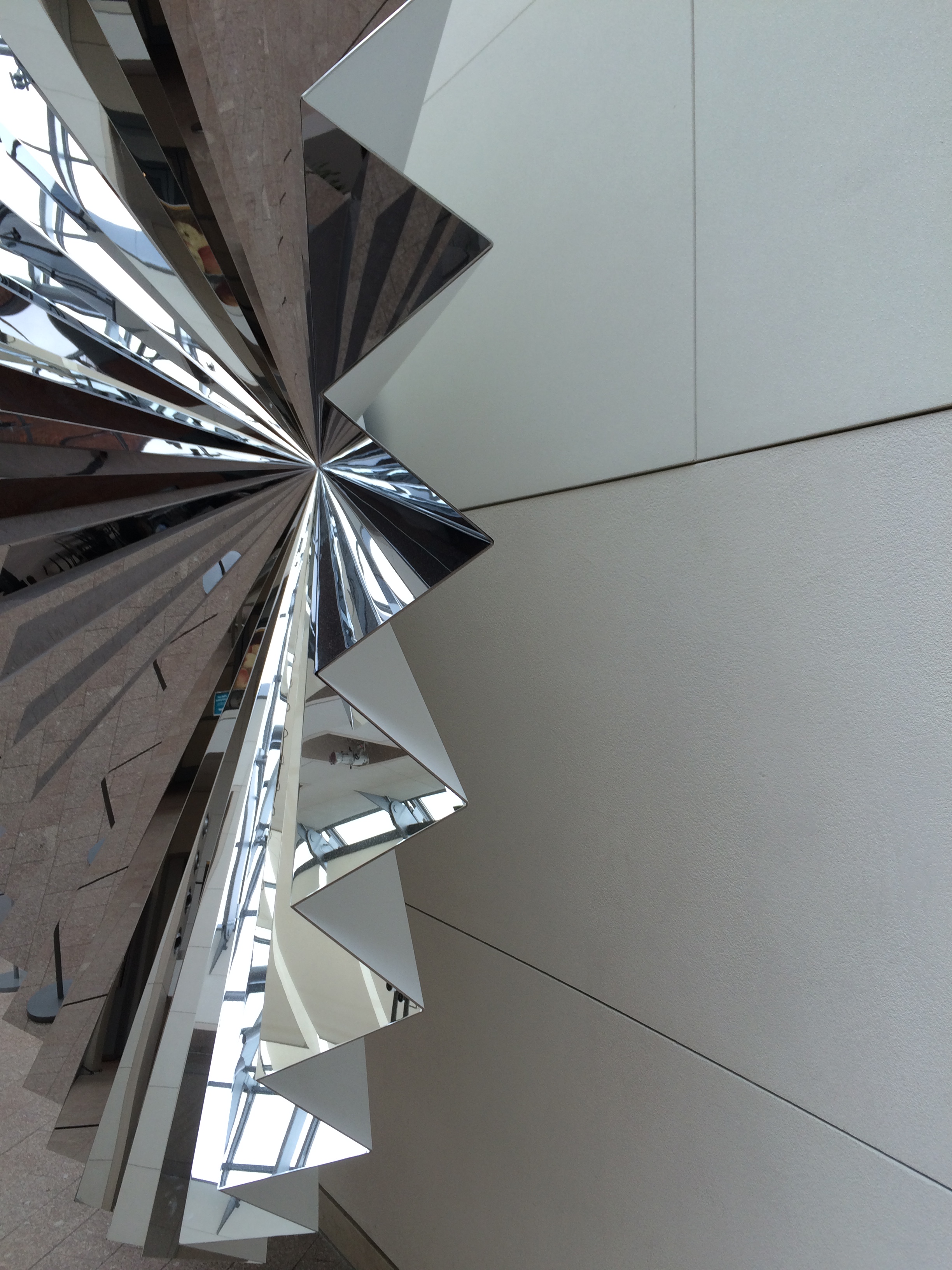
Anish Kapoor’s wall sculpture “Halo”  is currently on display in the atrium of the Peabody Essex Museum in Salem, Massachusetts.

16-15-1
The stainless steel construction from 2006 is a concave disc with accordion type folds.The narrow circular sections come together in 90 degree pleated folds.

16-15-2
Although the stainless steel has a mirror reflective finish, when you stand in front of  “Halo” you do not see your reflection. The angles of the mirrored sections face away from the viewer.
Kapoor demonstrates interesting phenomena of concave surfaces, as well as the principles of folding within a circle.

Susan Happersett

Judith Braun at McKenzie Fine Art Gallery

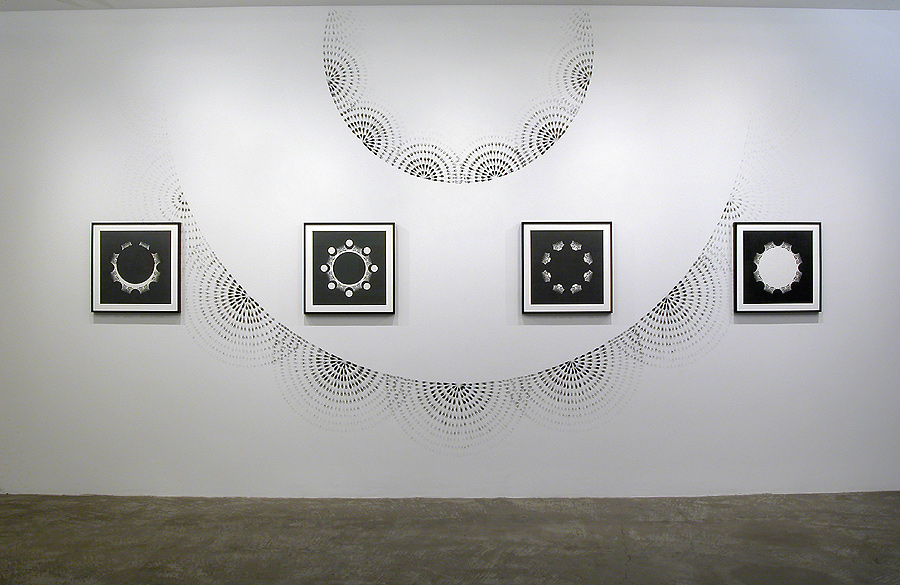
Homeostasis is the current solo exhibition of Judith Braun’s charcoal and graphite drawings at McKenzie Fine Art Gallery. This work is all part Braun’s series titled “Symmetrical Procedures”, a long term commitment to the exploration of symmetry. Since 2003 the artist has been creating abstract drawings that use the rich gray scale attainable through the use carbon based materials. On one wall of the gallery there is a particularly intriguing installation. Four square framed drawings are presented within a large wall drawing.
16-14-01

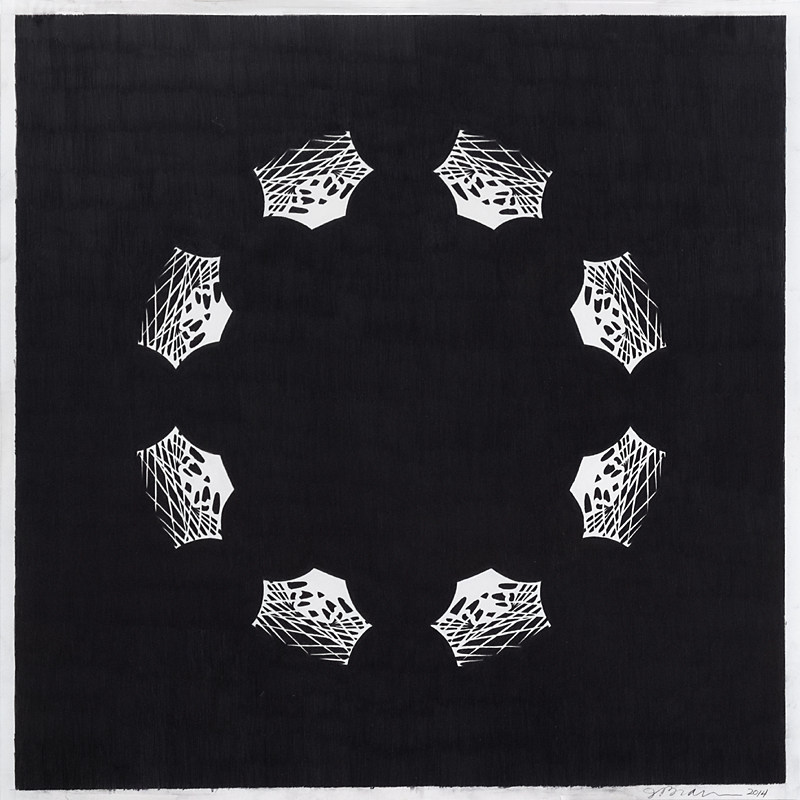
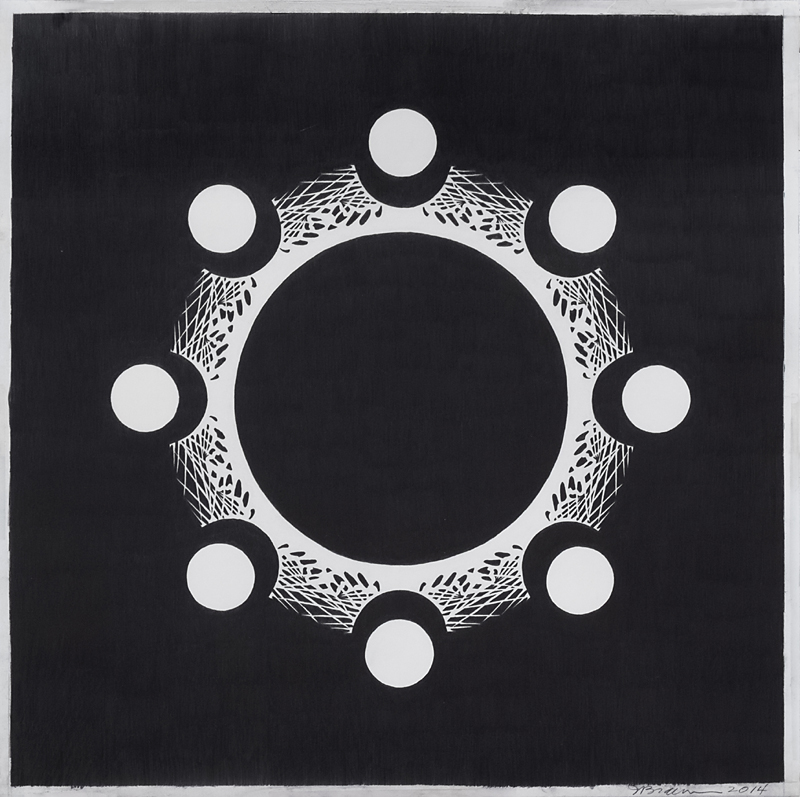
Each of the four squares contains a circular figures with order-8 rotational symmetry. Here are two examples:

16-14-02

“Symmetrical Procedure” NE-21-3, 2014, Graphite on Dura-lar
Picture courtesy of the gallery

16-14-04

“Symmetrical Procedure” NE-21-4, 2014, Graphite on Dura-lar
Picture courtesy of the gallery

In these examples there is a secondary symmetry, each of the eight lace-like elements around the central circle possess reflection symmetry. The intricate use of positive and negative space in this work demonstrates the complexity and richness that can be achieved with just black and white.

The wall drawing, in contrast, uses the gray scale to allow the large circles to fade away into the top of the wall. There is an allusion to the underlying symmetry of the forms, but it is incomplete. The lower of the two circles has the semi-circles forming on the exterior. The upper circle has the semi- circles going into the interior. This is a great demonstration of convex and concave curves. The marks of this drawing are the artist finger print, created by the artist pressing her charcoal covered finger directly on to the wall to create varying shades of grey. This tactile method creates an emotional connection to the viewer, adding another more human element to the exhibition.

McKenzie Fine Art Gallery is at 55 Orchard Street. Judith Braun’s exhibition is up through April 24.

Susan Happersett

Mark Hagen at Marlborough Chelsea

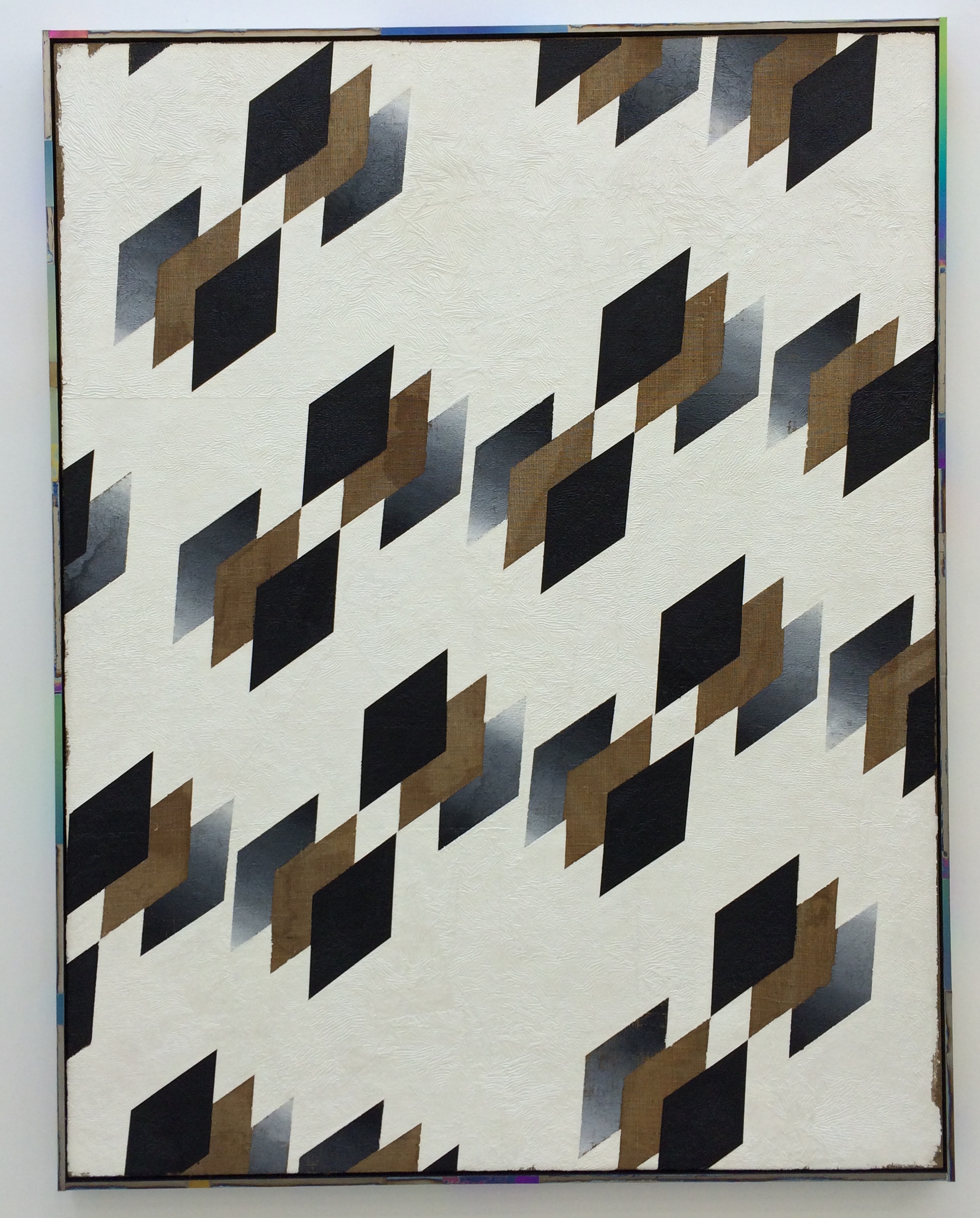
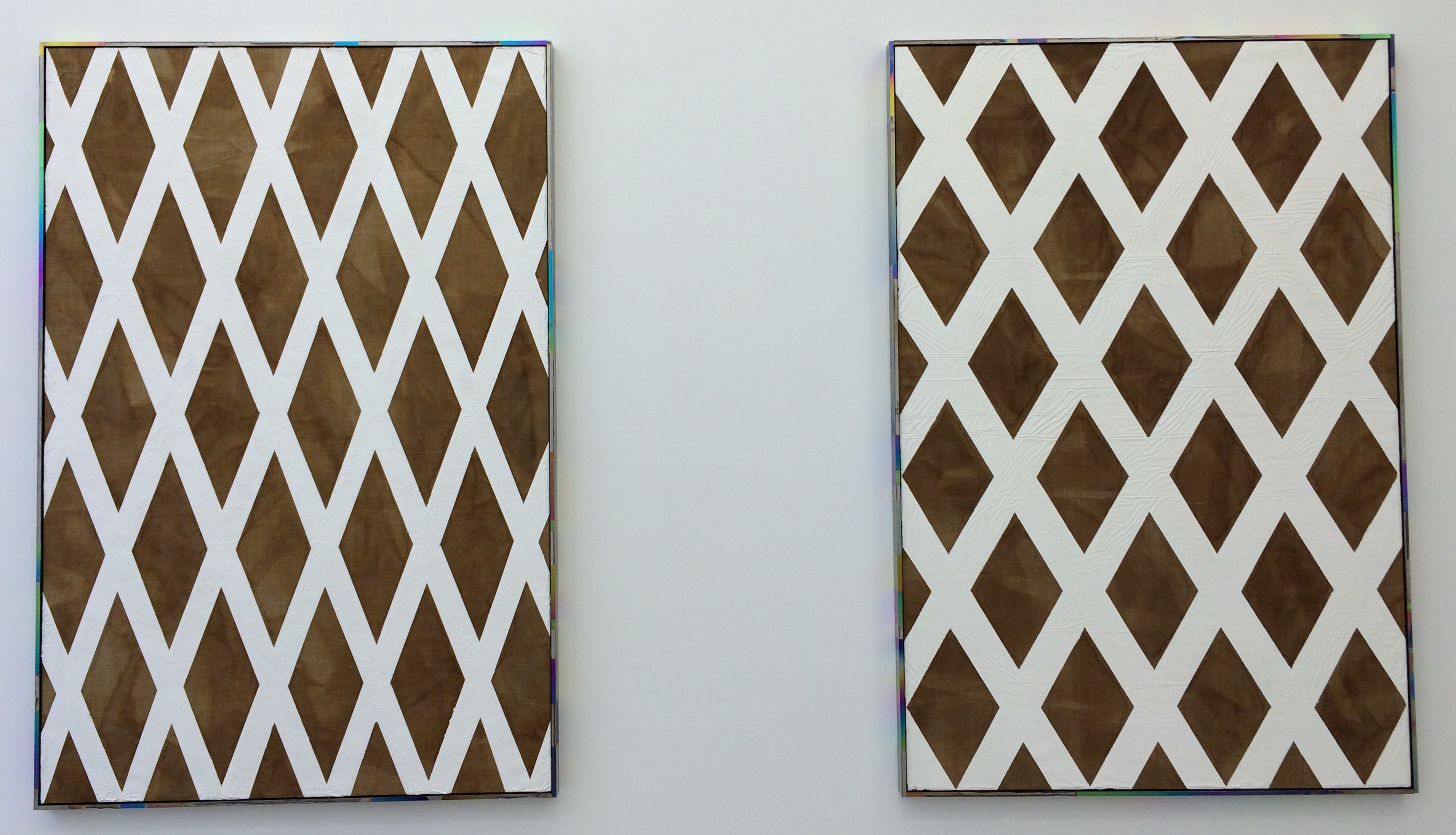
The exhibition titled “Black Hole” at Marlborough Chelsea is a solo show of new work by Mark Hagen. In the back gallery there is a series of paintings based on rhombi. A rhombus is a equilateral quadrilateral, a four sided figure where all sides have the same length. In these paintings the rhombi are diamond-shaped, similar to the shape found in wire fencing.

16-13-01

“Bumping into this thing or that from conception to decomposition like dumb pebbles on a beach on an alien beach in a remote corner of the universe” 2016, acrylic through burlap, artist frame (titanium anodized with diet coke)

This first work features a series of scattered rhombic triples, created by shifting and overlapping the rhombi along the shorter of the two diagonals. It is important to know that these are not your typical hard edge paintings. Hagen masks off his shapes using tape and plastic then paint is poured through sun-exposed burlap. His unique process creates a more textural quality.

16-13-02

Left “To Be Titled” (Screen Painting #8), 2016 acrylic through burlap, artist frame(titanium anodized with diet coke). Right “To Be Titled” (Screen Painting #1), 2016.

These next two paintings are non-square grids. By changing the thickness of the number of lines between the two works the artist presents various examples of the diamond pattern theme. By limiting his geometric vocabulary to one type of shape in this series of work, Hagen has created a visual dialog of comparison.

Pictures courtesy of the gallery and the artists.

Susan Happersett

“Incomplete Cubes” at Mike Weiss Gallery

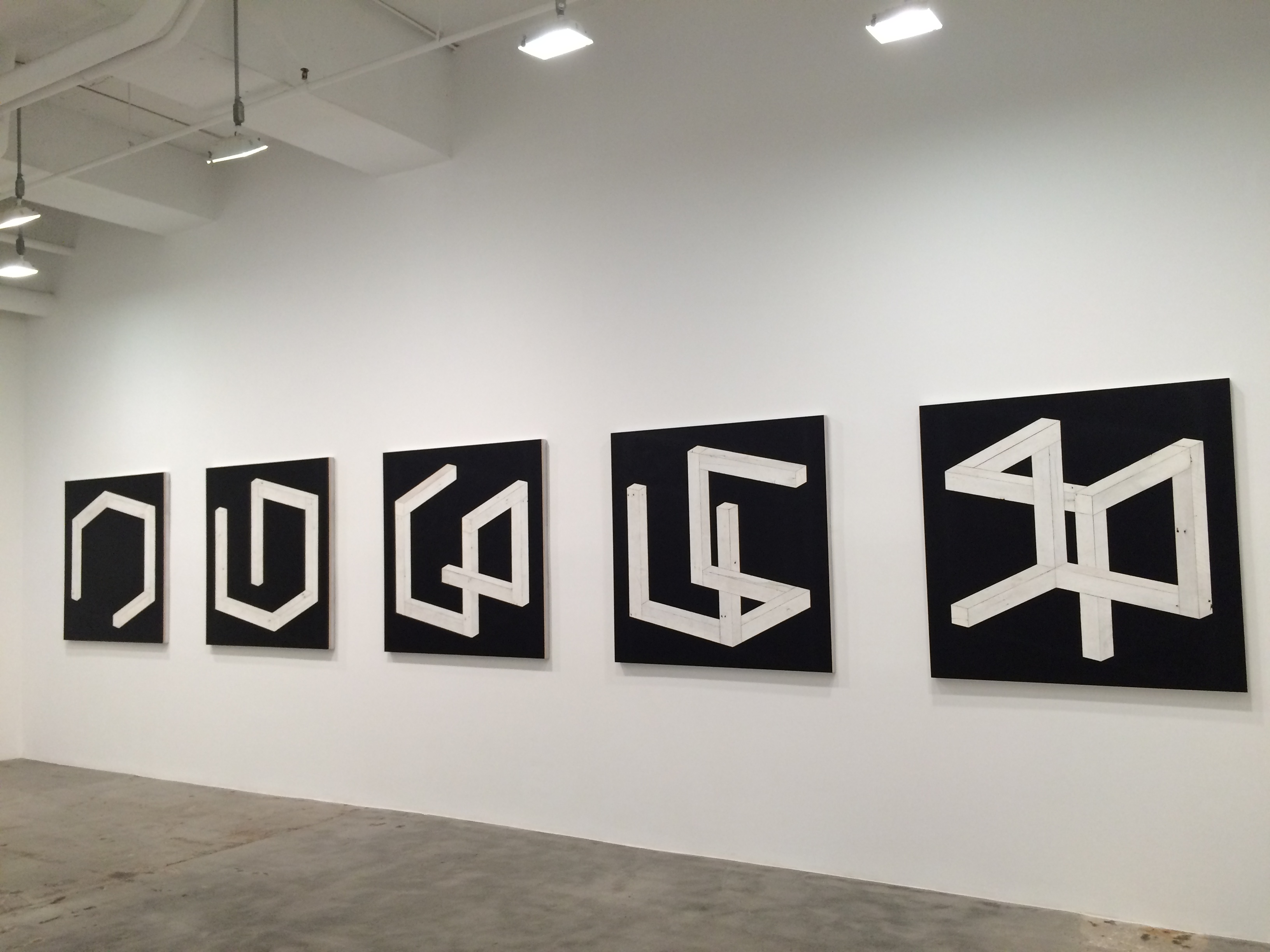
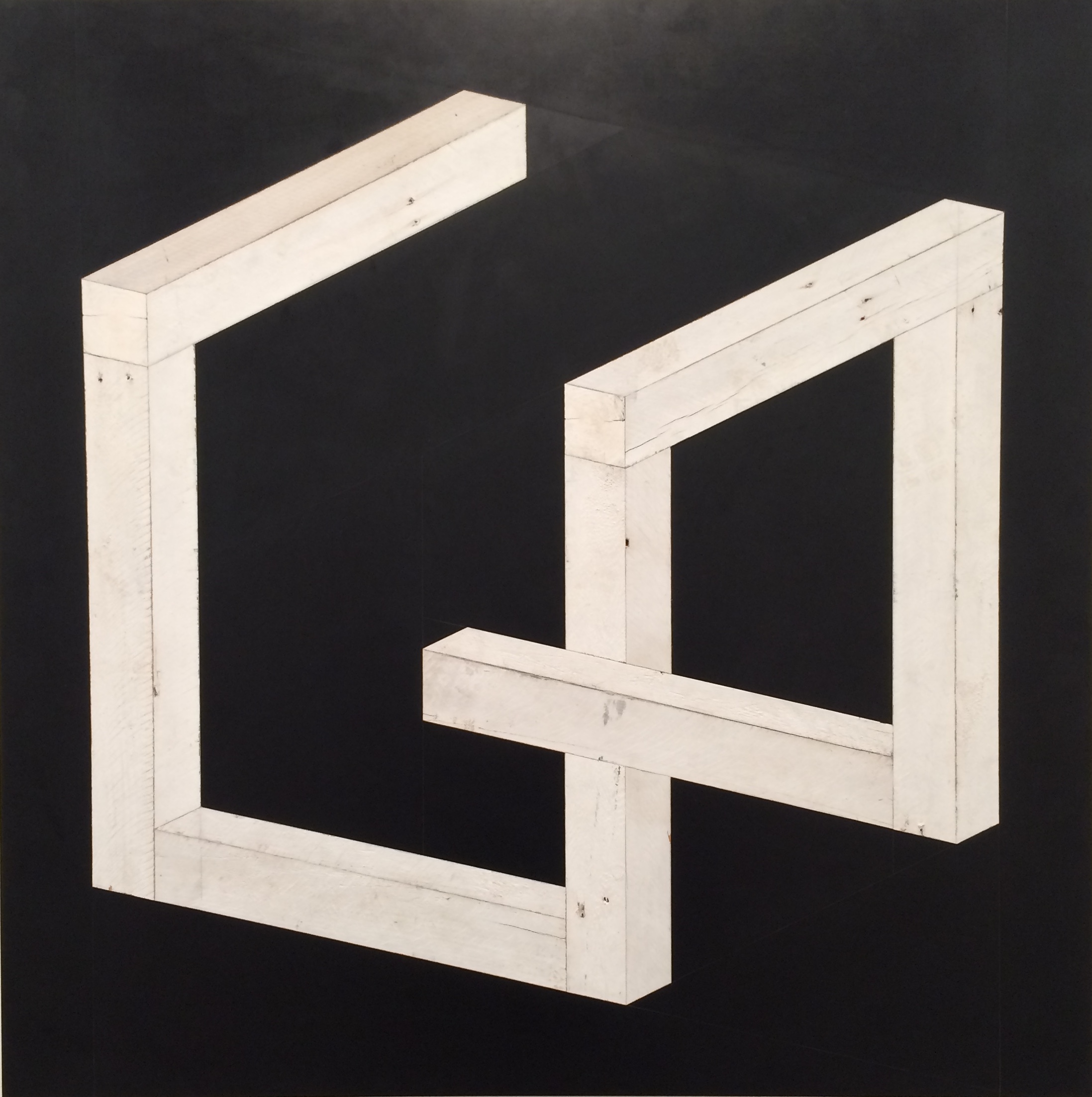
“Objects and Everyday Goods” a group show at the Mike Weiss Gallery includes a series of five of Michael Zelehoski‘s “Incomplete Cube” re-purposed wood and ply wood paintings.

16-12-01The subject matter, the title as well as the materials, immediately reminded me of Sol Lewitt’s 1974 installation “Incomplete Open Cubes”. But these paintings have an extra element of complexity. The 2-D paintings acquire their perception of depth without the use of shading. Instead foreshortening and lines are used to illustrate which elements of each cube is in the foreground or the background.
16-12-02
In this middle painting the center horizontal leg seems to be cutting across the front of the figure but it is attached to the vertical leg at the right of the image that seems to be in the background. So this is not really a cube. if all of the angles in the form are 90 degrees it is actually an impossible figure. What I found so interesting about this work is the way it appears to directly reference historically important work but up on closer inspection there is an unexpected twist that takes the work into a more complex geometry.

Susan

Atoms and Bytes at Bellevue Arts Museum in Washington State

The Bellevue Arts Museum in Washington State is currently presenting “Atoms and Bytes – Redefining Craft in the Digital Age”. This exhibition addresses art, crafts, and design that utilize new technologies and software to create objects. Digital interfaces and equipment once found only in laboratories now are available to a more general public. Most of  work on display has been created using tools like computer-aided design, additive layer manufacturing ( 3-D printing), and computer numerical control, which is a process that enables a machine to cut into a solid to create a new shape. There is also work  created using constantly updated web based data in the galleries.

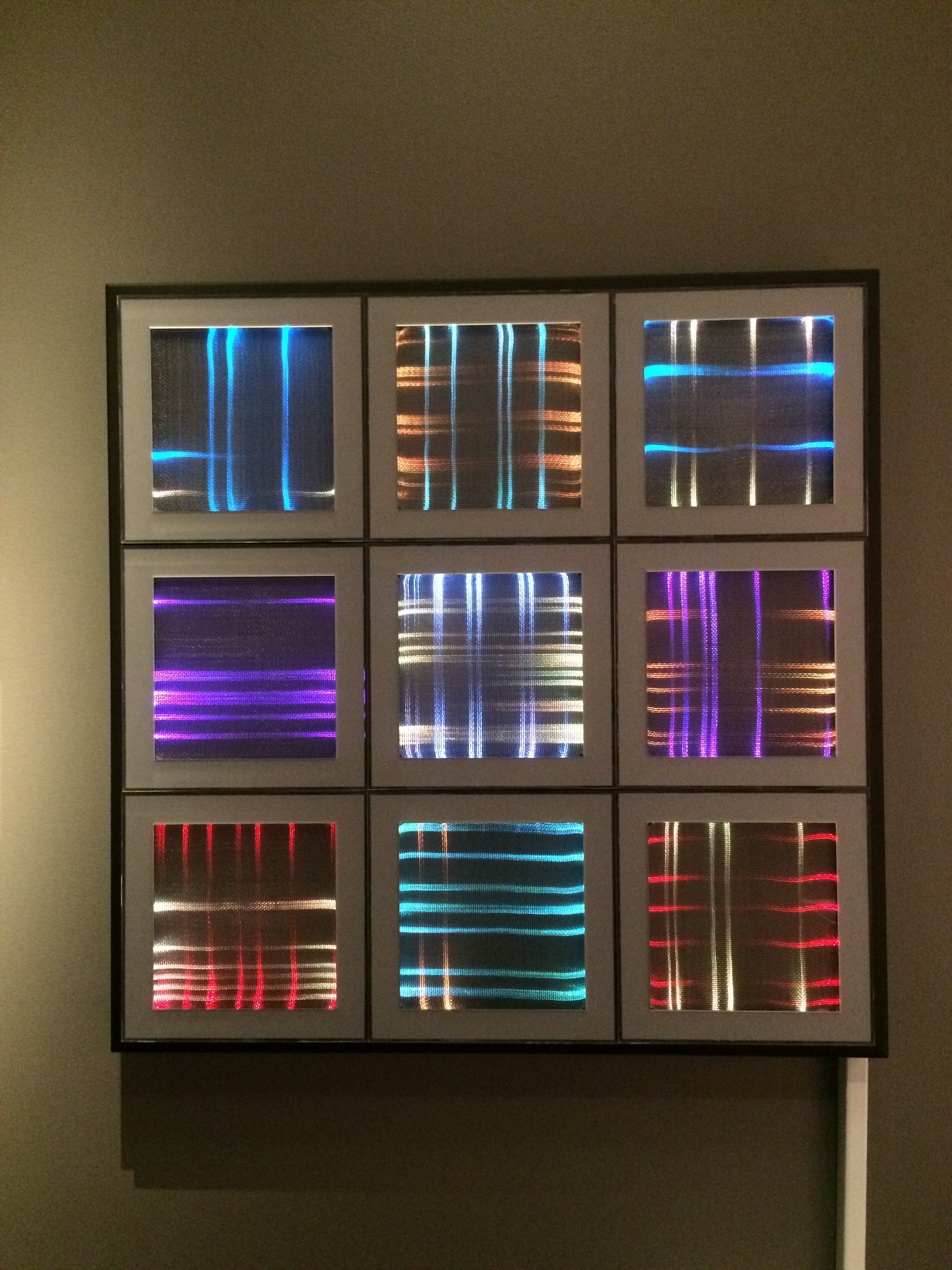
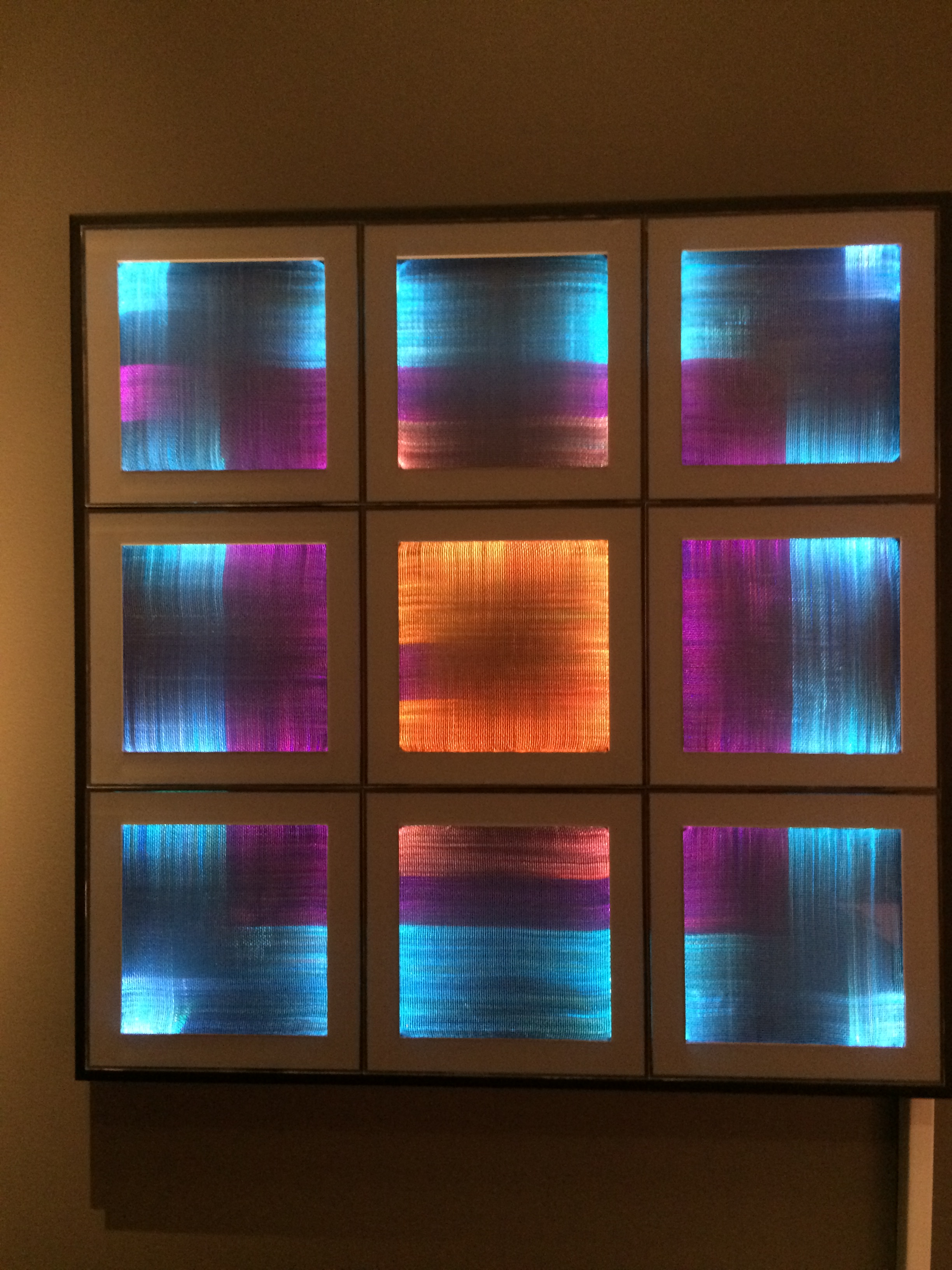
“50 Different Minds (Homage to Josef and Anni Albers)” by LigoranoReese is hand-woven from fiber optic threads. The patterns are determined by software that provides real-time web based data on air traffic at the nine busiest airport in the US. The colors are based on Josef Albers’ color theory and change in response to responses from viewers that use color words in their tweets.

16-11-01

16-11-02
LigoranoReese have woven together technology and the sociological implications of this technology to create an deceptively beautiful tapestry.

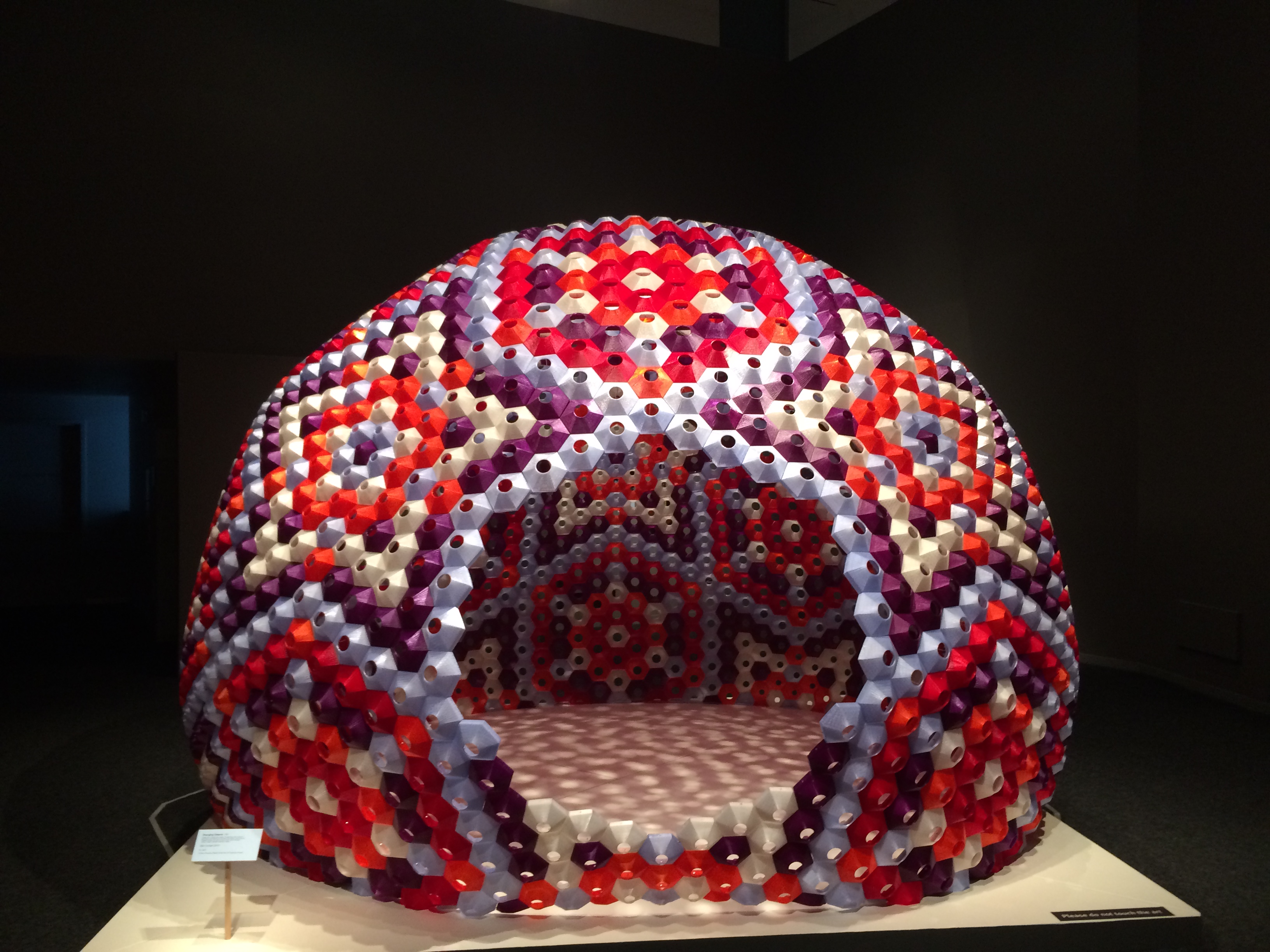
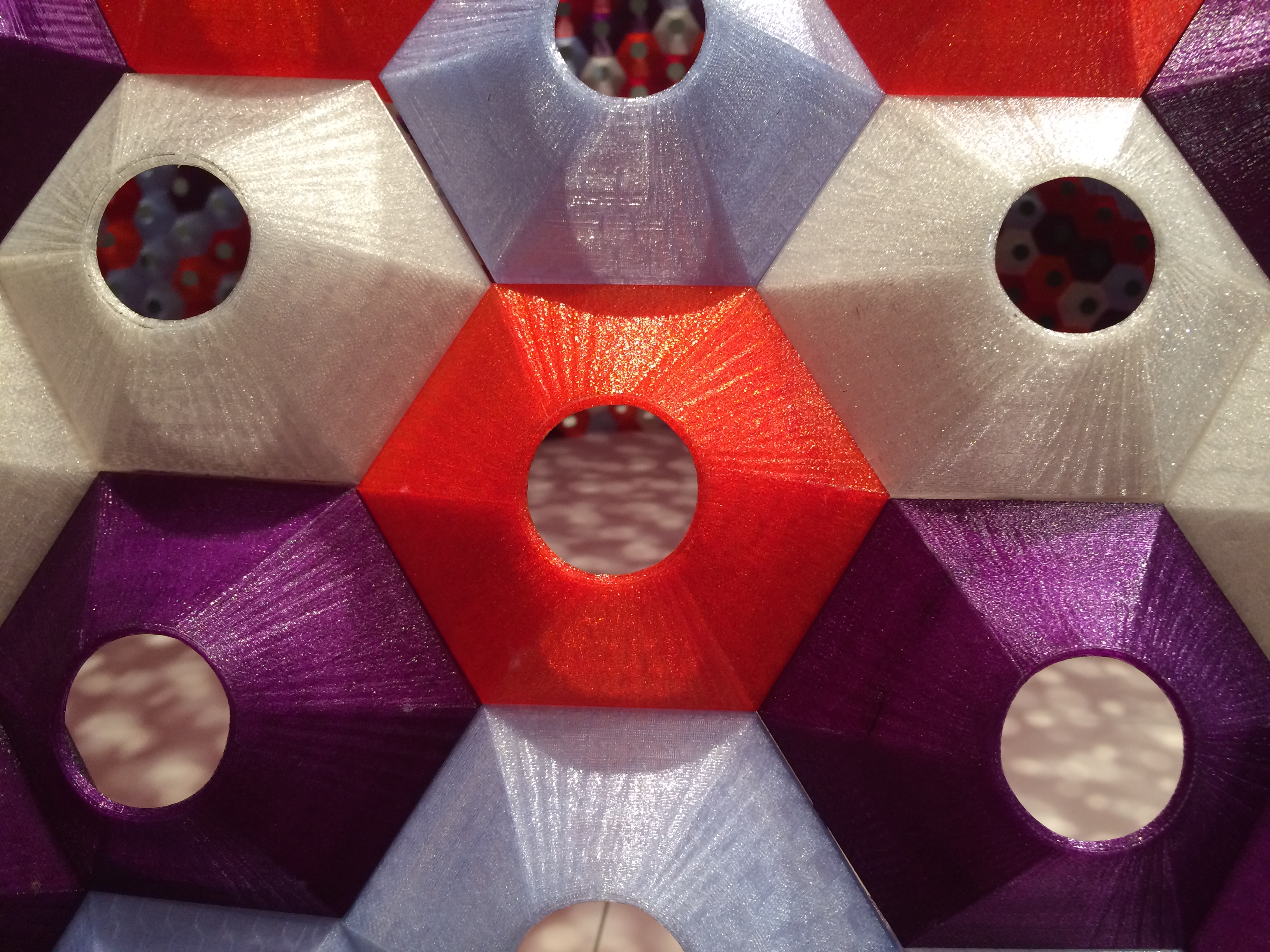
“Emerging Objects”, a design collaborative, uses small PLA plastic elements to build a structure that acts as a room. “Star Lounge” is composed of a multitude of PLA plastic hexagons. Some keep their shape as a regular hexagon, some are slightly misshaped to form this large domed igloo like form.

16-11-03

16-11-04

“Atoms and Bytes” presented the a broad selection of work intersecting the boundaries of crafts, design and art. The exhibition approached these objects on two fronts. The technical properties of actual the production were explained with an overview of educational wall texts. Individual signage addressed the cultural inspiration or implications of the items on display. This was one of the most technologically based, well documented, educational shows I have seen.

Susan Happersett

Art Fair Week NYC

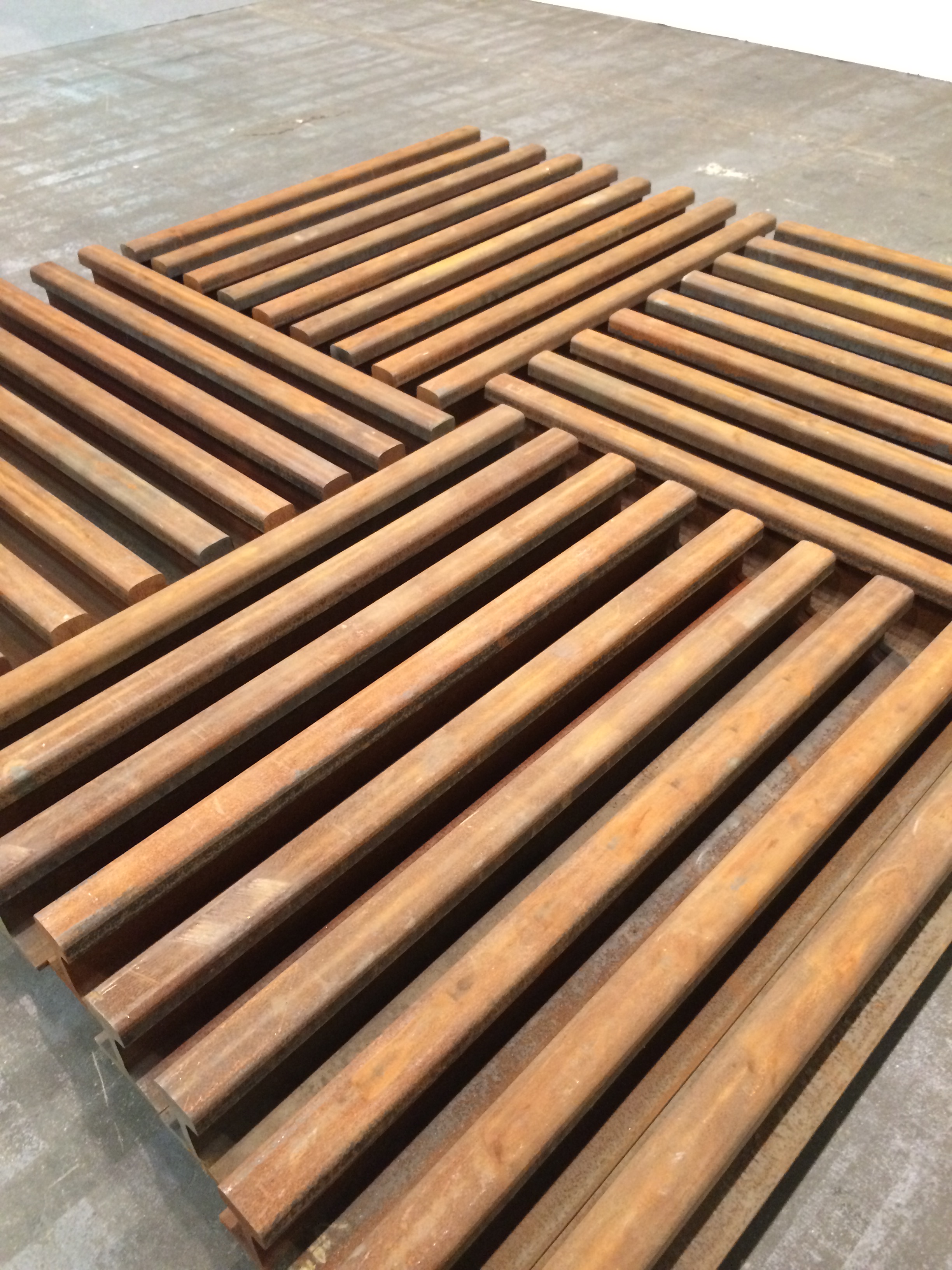
This past week there were nine different art fairs held in New York City. The largest was the Art Fair Week NYC that was held on a pier on the west side of town. The Contemporary Fine Arts Gallery from Berlin was there, featuring the work of Marianne Vitale. She made with this very interesting floor sculpture made of rusted steel rail road track.

16-10-01

Marianne Vitale – 2016 – Steel
Picture courtesy of the gallery and the artist

This piece is a square composed of four squares that are placed so the parallel lines of each square are perpendicular to the parallel line of the adjacent squares. This reminded me of the process of weaving with the perpendicular warp and weft.

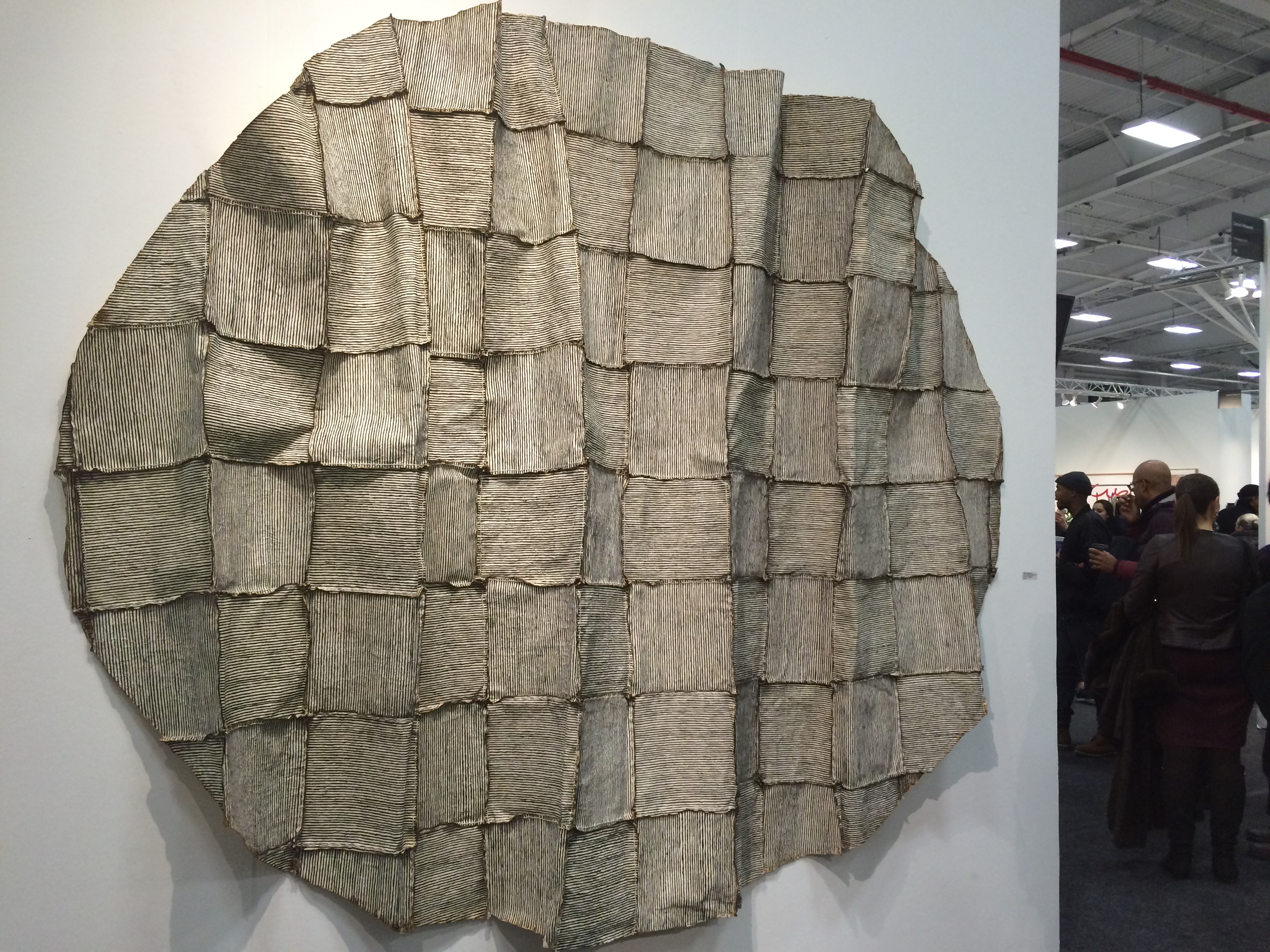
The next day I went to the Art on Paper Fair where I saw this wall hanging “16th Vanishing and Emerging Wall” by Hideho Tanaka at the browngrotta arts (Wilton, CT) booth.

16-10-02

Hideho Tanaka – “16th Vanishing and Emerging Wall” – 2009
Picture courtesy of the gallery and the artist

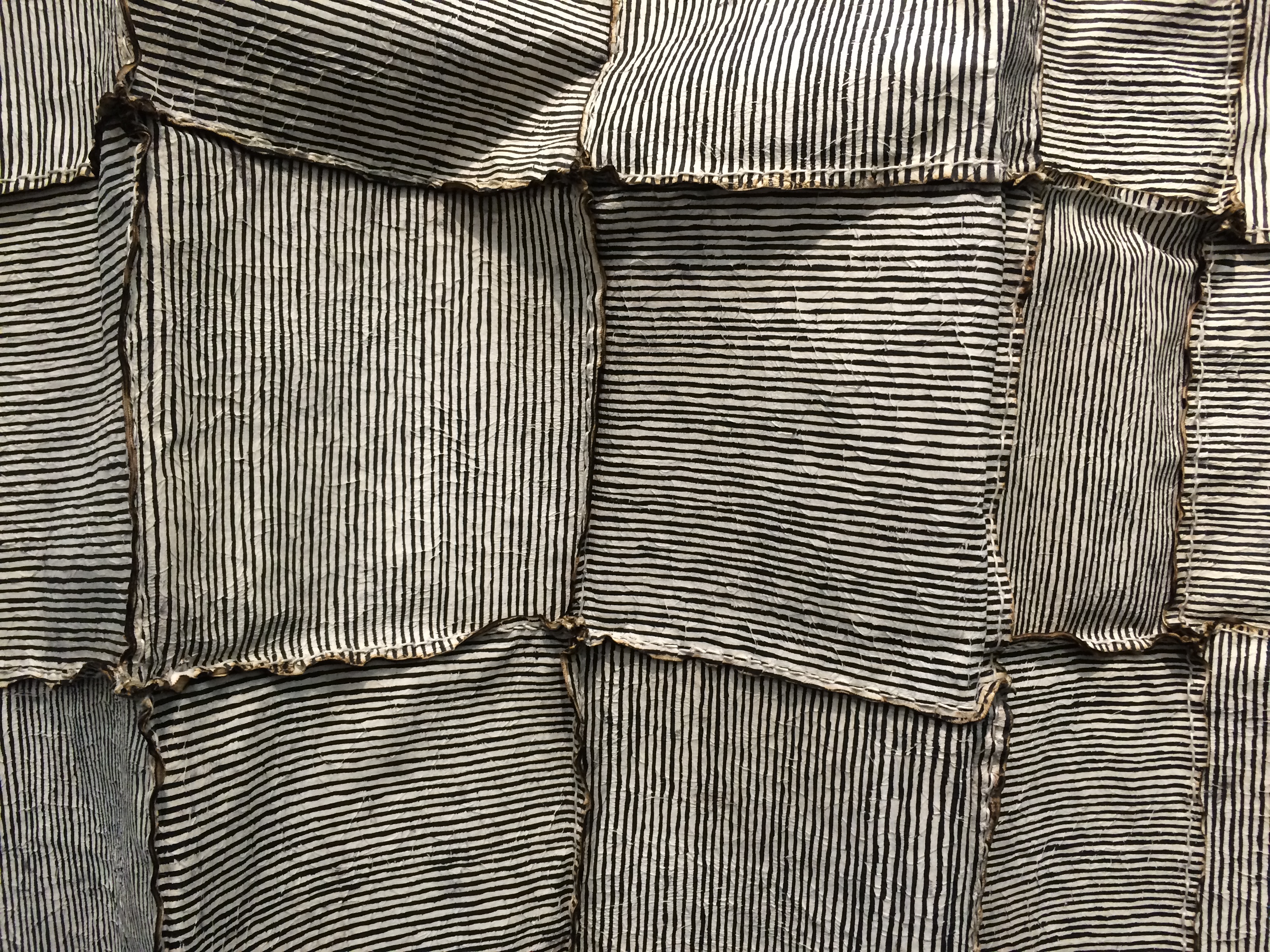
Although the outer edge of this work is an oval the piece is all about parallel and perpendicular.

16-10-03

Hideho Tanaka – “16th Vanishing and Emerging Wall” (Detail) – 2009
Picture courtesy of the gallery and the artist

Each of the sections – most are square – are placed so that the parallel lines in each square are at a 90 degree angle with the parallel lines in the adjacent squares  in a similar fashion as the squares in Vitale’s floor sculpture.

Over the course of three days I saw a lot of art and navigated crowds of people. At some points it was bit overwhelming. It was gratifying to see two artists tackle the same geometric theme in two unique ways.

Susan Happersett

Hayal Pozanti at The Aldrich Contemporary Art Museum

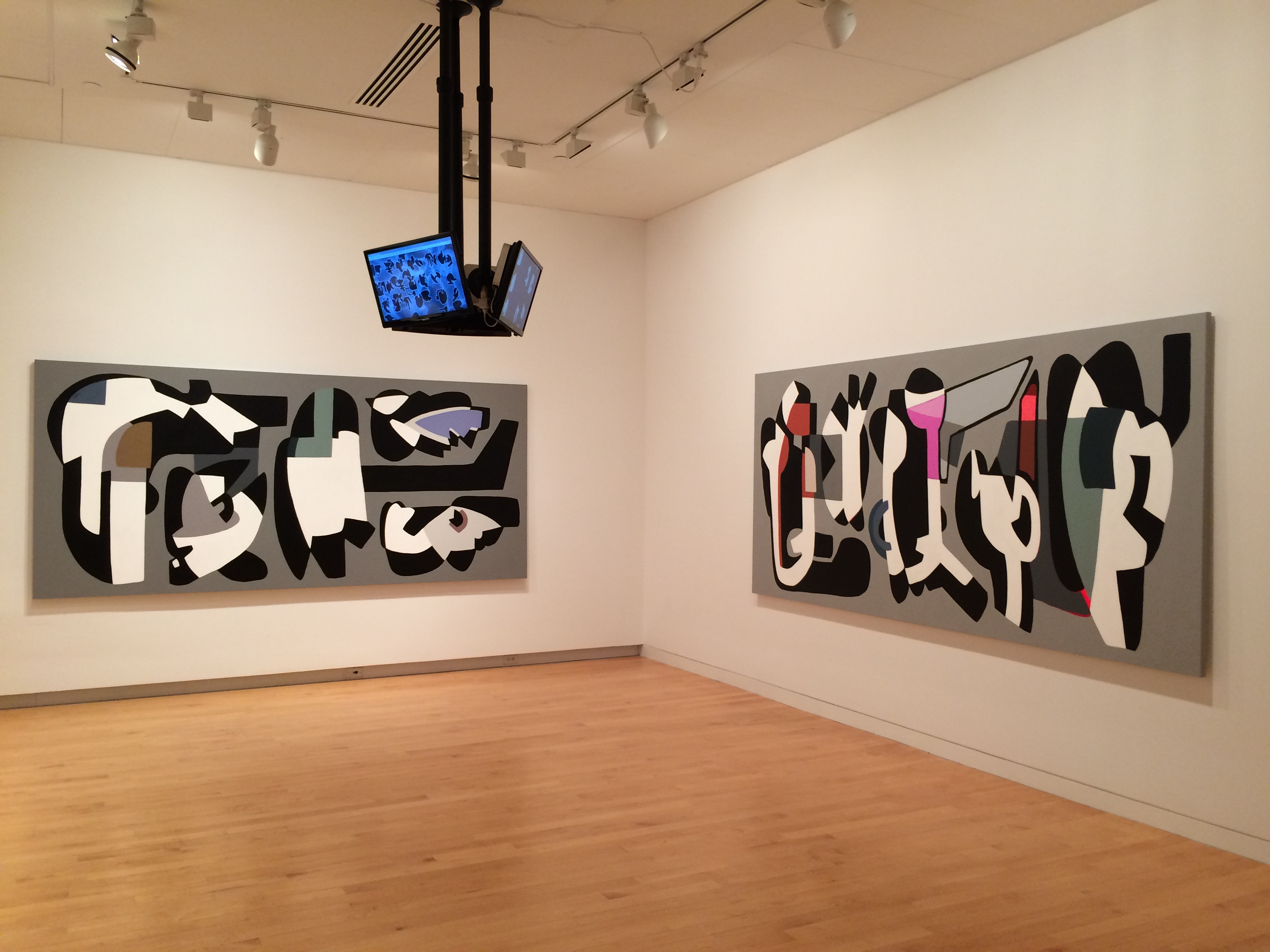
“Deep Learning”,  Hayal Pozanti’s solo show, currently on display at the Aldrich Contemporary Art Museum in Ridgefield Connecticut, features work related to technology and the human experience. Robert D. Hof’s article “Deep Learning” (MIT Technology Review, April 23,2013) is quoted in the catalog: Deep Learning in reference to “software [that] attempts to mimic the activity in layers of neurons in the neocortex”.

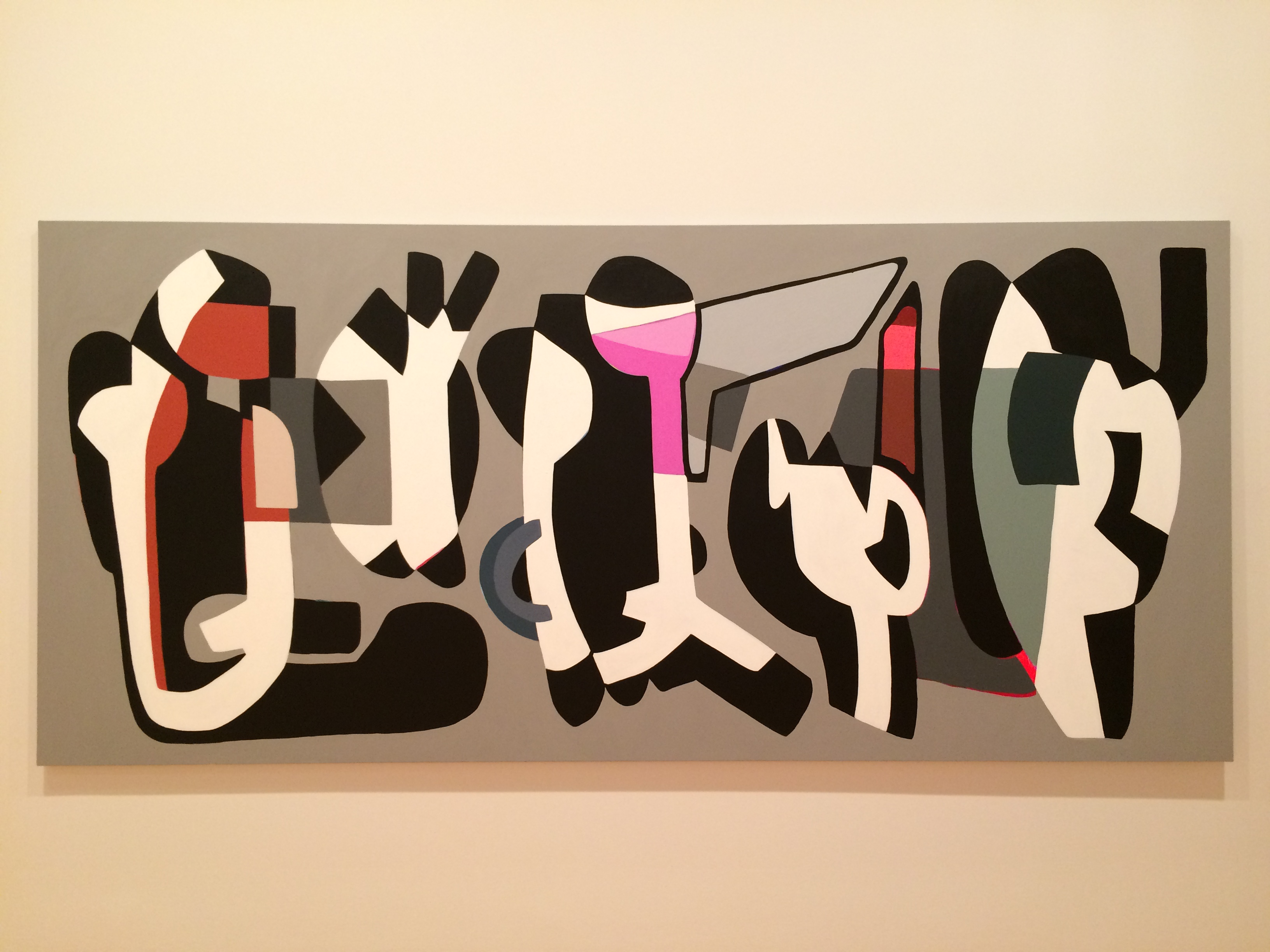
Pozanti employs her own alphabet of 31 shapes named “Instant Paradise” to create paintings and digital animations. Her new, large scale rectangular paintings are the same proportions of a smartphone screen but blown up to almost room sized canvases.

16-09-01

“Sixty Seven” – 2015
Courtesy the artist, Jessica Silverman Gallery San Fransisco and the Aldrich Museum

The paintings are all based on source data that is documented in the curatorial signage. “Sixty Seven” has “Source data: milliseconds it takes for the human brain to form a microexpression”.

Pozanti generates images through a process of selecting and overlapping shapes from her alphabet. The more the images are repeated over time the more recognizable they become. This is similar to the way Deep Learning software operates. All of these canvases were hand painted. Instead of using a computer to create these images, the artist is generating the work in reference to the software.

16-09-02

Gallery View

In the center of the gallery, video screens are suspended from the ceiling above eye level. Their placement and size are like an airport terminal or waiting room. Each screen is playing one of Pozanti’s digital videos featuring images generated from the “Instant Paradise” alphabet. The videos have a sound track of abstract poetry developed by assigning the shapes sounds.

Hayal Pozanti’s work relates to mathematics in two ways. The images have been created using algorithmic rules to explore the permutations of possibilities combining 31 distinct shapes. The paintings and videos are also an expression of computer’s ability to mimic human processes, as well as, how humans react to the technology that is now part of everyday life.

Susan Happersett