Étienne Gélinas at Thompson Landry Gallery Toronto

Whenever I have the opportunity to travel I make a point of visiting the local museums and galleries and I am always on the hunt for MathArt.

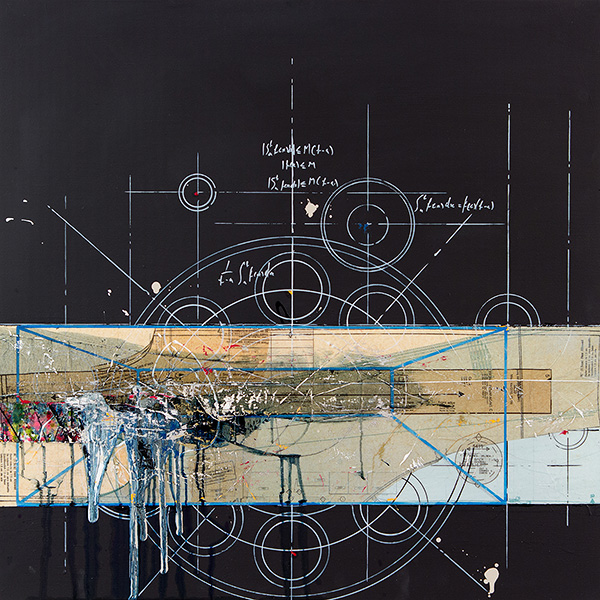
In Toronto, I visited the Distillery District, which is a collection of brick historic buildings that was once a whiskey distillery, but is now filled with galleries, restaurants and artist’s studios. I was in the Thompson Landry gallery when I spotted mathematical formulas that seemed to come directly out of my old Integral Calculus text book. I became immediately interested in the work of Étienne Gélinas. He uses a variety of techniques to create multi-media work: scratching  geometric drawings into a thick base coat of paint or medium, collaging with paper blueprints, floor plans and garment patterns, and carefully painted shapes and formulas. The artist also adds a random accidental quality to each work by including an expressive element of abstract splatter drip and mark painting.
gelinas128

Étienne Gélinas – “Composition 365” – Mixed media on wood
Picture courtesy of the artist and the gallery

In the work “Composition 365” Gelinas has used a circle as his underlying geometry. There is a series of larger concentric  circles which have been segmented into 8 equal sections with smaller series of concentric circles within each segment. Around this circle pattern there are mathematical formulae, specifically integral formulae. This formulae painted in white on the black background are quite beautiful. Dividing the work horizontally, the artist has placed layers of vintage patterns for making clothing. On top of the collaged element Gélinas has painted a free form abstract painting. There is a lot going on in this work and that is what I like about it. The seemingly disparate techniques yield complex work with a great textuality. To me the work addresses the layers of mathematics in society. There is the obvious association of the calculus formulae, and the geometric implications of the drawn diagrams relate to the geometry used in making the paper garment patterns. Finally, the wild abstraction of the gestural painting adds a level of spontaneity and emotion to the visual dialog. It is not often I find  single work of art with so levels mathematical aesthetic.

Susan Happersett
 

Eureka at Pace Gallery

The current exhibition at Pace Gallery takes its name from the Edgar Allan Poe poem from 1848.  The press release contains a quote from the poem: “I design to speak of the Physical, Metaphysical and Mathematical-of the Material and Spiritual Universe: of its Essence, its Origin, its Creation, its Present Condition and its Destiny…….”

This group show features work form the 1840’s to 2010 that builds a links between science and Mathematics and the artistic spirit. In one of the first galleries there is a copy of Edwin Abbot’s 1884 book “Flatland: A Romance of Many Dimensions”. In this novel Abbott creates a two dimensional society and introduces a three dimensional character with interesting results and exciting prospects about further dimensional expansion. Abbott’s art allows his readers to imagine the possibility of a fourth dimension, a Mathematical idea that was very new at the time.

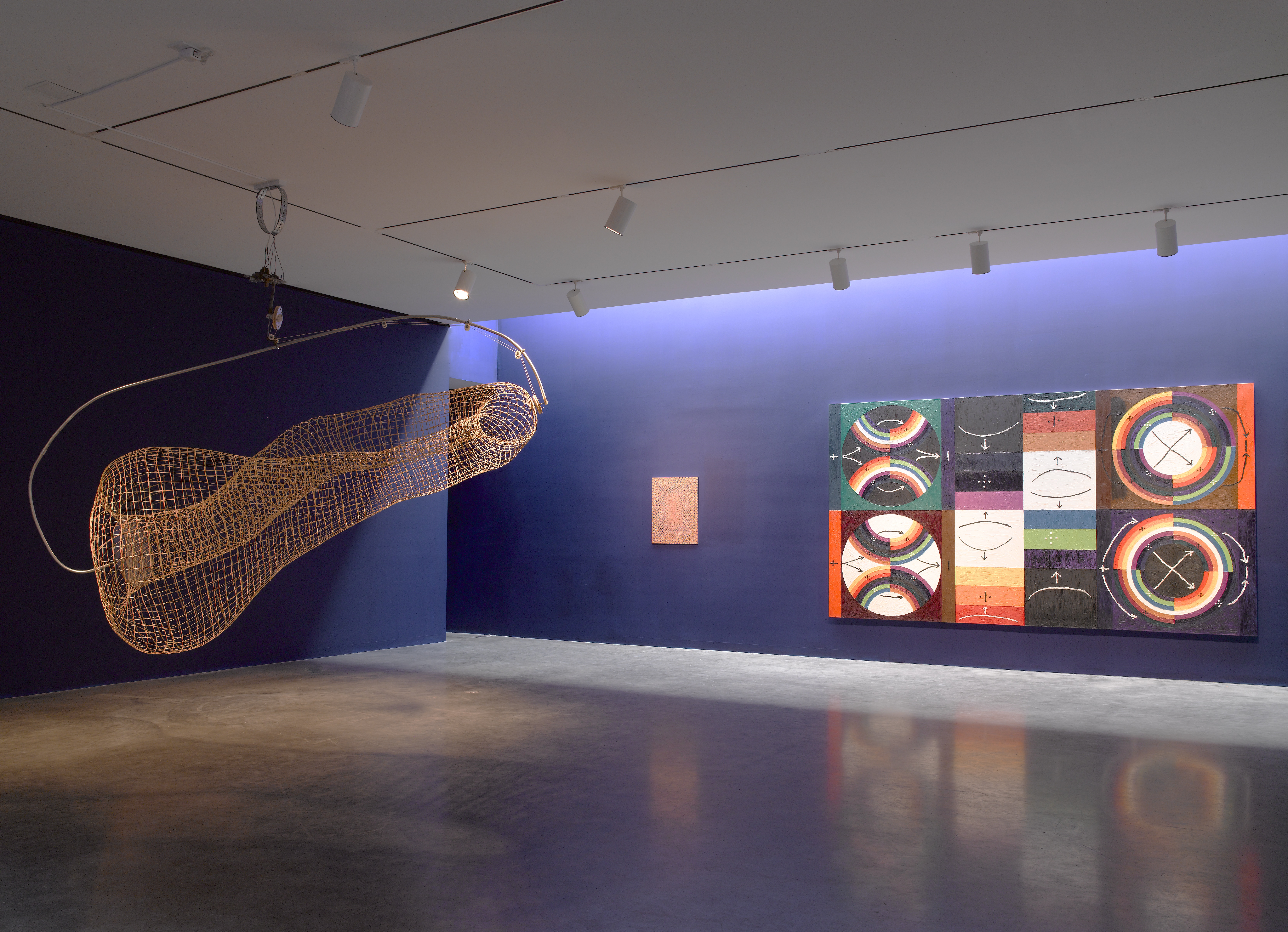
Installed in the largest room of the gallery is Tim Hawkinson’s large rotating sculpture “Gimbled Klein Basket” a wonderful homage to the “Klein Bottle”. A Klein Bottle is an impossible form first introduced by mathematician Felix Klein in 1882. Like a Moebius strip it has only one side, but a Klein Bottle has no boundaries, whereas  a moebius strip has boundaries at its edges. Compare to, for instance,  a sphere, which has no boundaries either.

Video

The basket structure of Hawkinson’s “Gimbled Klein Basket” creates an interesting grid pattern on the shape, adding another visual element to the form. The hand crafted quality of the object makes it seem as if this shape is actually possible in 3-D. By rotating the sculpture the viewer has  a chance to examine the form from all angles.

15-24-2

Installation view of the exhibition, Eureka, Pace Gallery, 508 West 25th Street, New York, May 2–June 27, 2015. From left: Hawkinson, Gimbled Klein Basket, 2007; Siena, Battery, 1997; Jenson, Physical Optics, 1975. Photograph by Tom Barratt, courtesy Pace Gallery.


Robin Kang

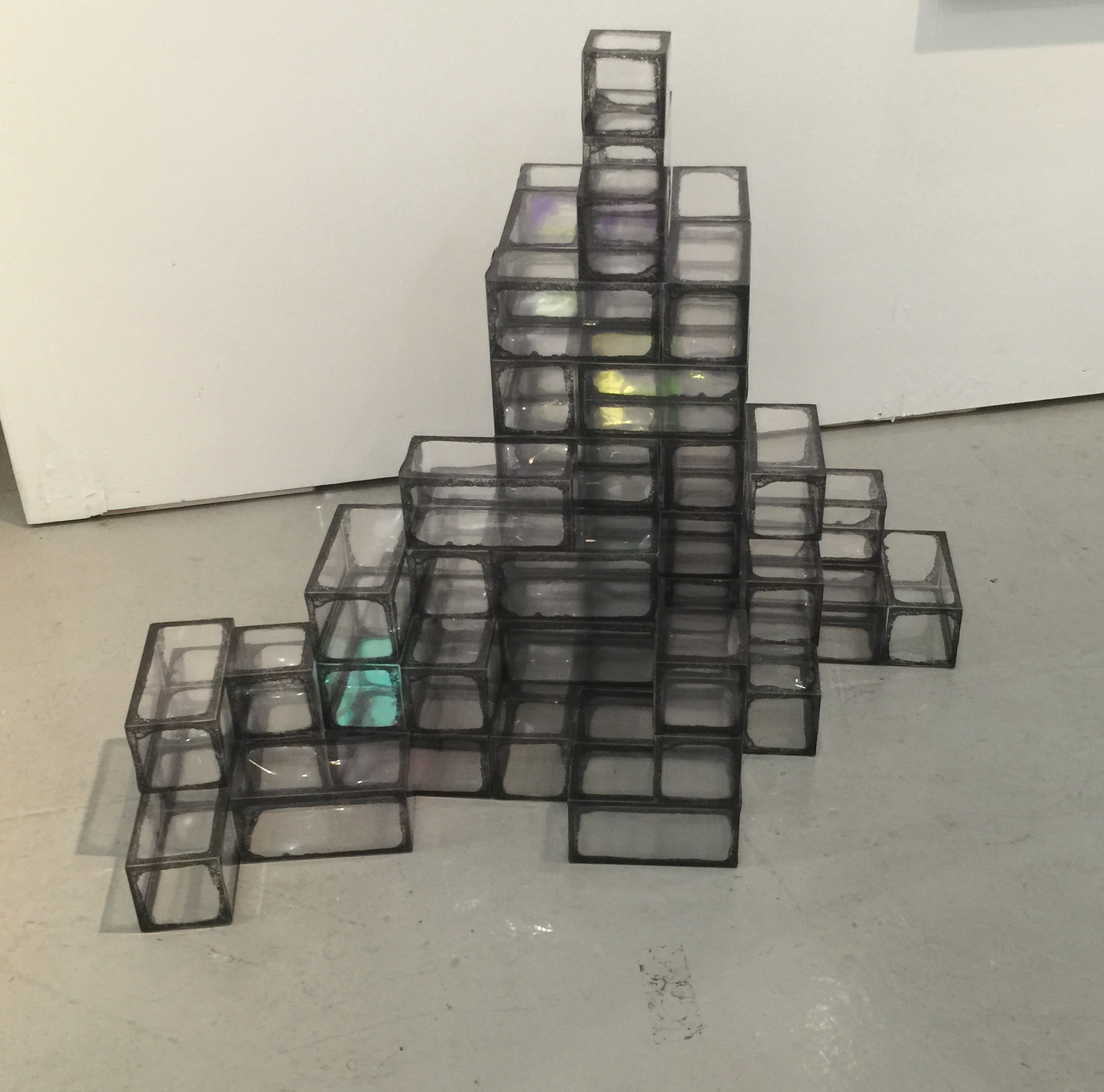
The New Apostle Gallery featured sculptures and tapestries by Robin Kang at their booth at the Select Fair. Kang works in two very diverse styles. The sculptures are created using clear plastic BRXL bricks in two shapes: cubes and rectangular prism that are basically the size of two of the cubes side by side. The edges of each brick have a dark shading to accentuate them. Some of the interior walls are lined with radiant film creating reflections. “Artifact 435” from 2015 is a floor construction that is all about geometry by limiting the shapes Kang focuses on the interiors as well as the exteriors of cubes and prisms.

15-23-1

Robin Kang – “Artifact 435” – 2015 – Plastic BRXL and radiant film
Courtesy of the artist and New Apostle Gallery

Robin Kang also has work included in a very interesting exhibition at the 1285 Avenue of the Americas Gallery (the lobby of the USB building) titled “Between a Place and Candy: New Works in Pattern + Repetition + Motif”. This show, organized by Norte Maar, presents recent work that relates to the Pattern and Decoration tradition of the 1970’s. This movement also had a basis in the craft and ornament. The use of repetition quite often has Mathematical implications and I saw a number of exciting connections. To see complete set of images go here.

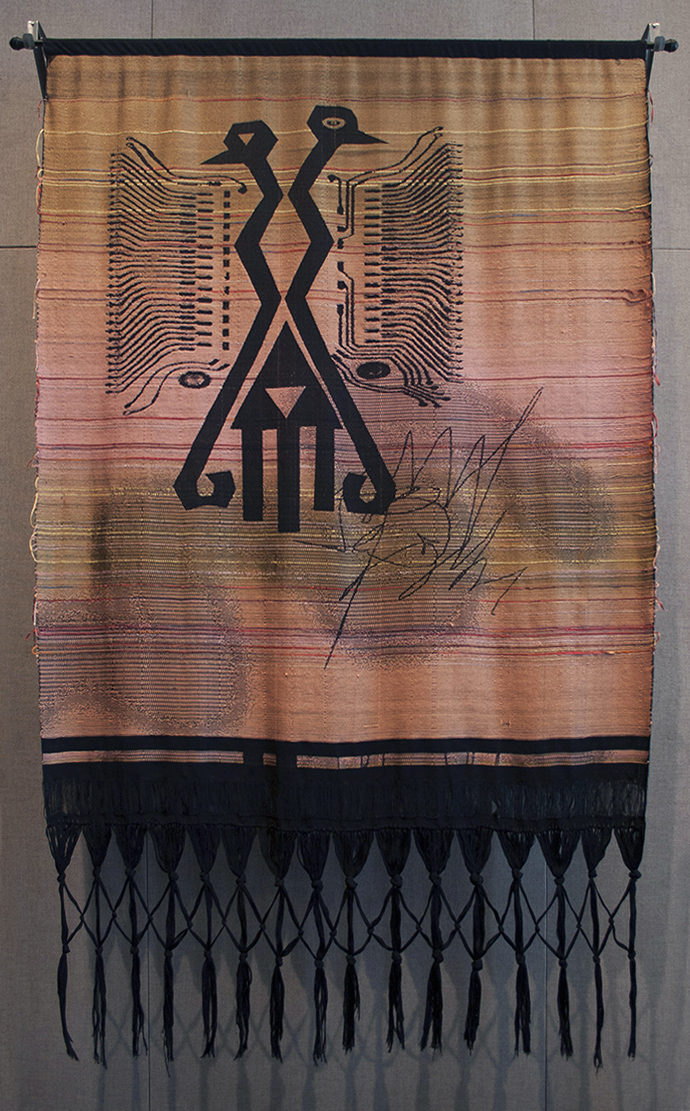
Kang’s contribution to the show is a tapestry “Two Birds with Diamonds” from 2015. It was made on a digitally operated Jacquard loom (a binary operated loom). The images of the birds have a bold simplicity that remind me of ethnographic patterns. The vector-type parallel lines remind me of computer circuit boards.  Kang has managed to integrate the history of textiles with the history of technology.

15-23-2

Kang – Two Birds with Diamonds” hand woven Cottton and Tincel – 2015
Courtesy of Norte Maar and the artist

The work of Robin Kang relates to mathematics on two fronts: the sculptures elevate basic geometric figures by  revealing their interior structures, the tapestries combine the mathematics of early computer science with the cultural significance of the textile arts.

Susan Happersett


Gilbert Hsiao at Select Fair

The Select Art Fair in NYC last week had an emphasis on Performance and Installation Art. I was not sure I would find any work with Mathematical elements besides my own work and the Tessellation prints of Dikko Faust. After the smoke cleared, and I mean that literally – an installation piece featuring mating bigfoot mannequins used a smoke machine during the busiest hours of the show – I was able to find some Math Art. The Transmitter Gallery exhibited the work of Gilbert Hsiao in their booth. I was particularly impressed with The sculpture “Headstone Friends”.
IMG_1861
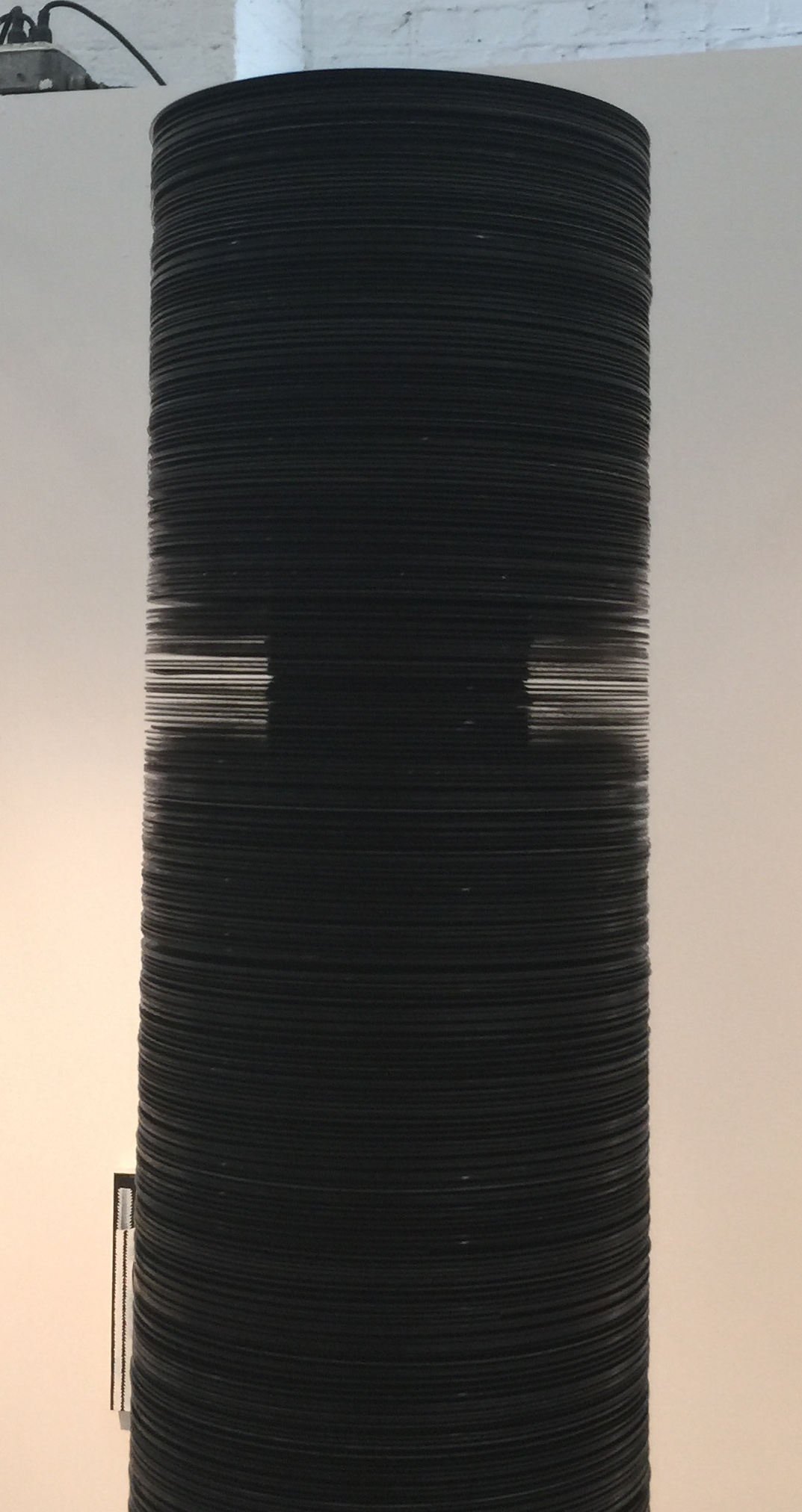
“Headstone Friends” from 2015 is a cylindrical column made up of a stack of vinyl records. The circular discs are all parallel with a uniform sliver of space between each record. There is a smaller solid column steel and concrete column running up through the center of the sculpture. The most amazing aspect of this work is the way the light shines through the records at the viewers sight line. Only when the viewer looks straight between the discs is the light between the vinyl visible. Here is a video demonstrating how the light moves up and down with the sightline.
“Headstone Friends” is an interesting use of circular discs to create a column but it is also about how the viewer’s line of vision behaves like a vector. Hsiao enables the viewer to take an active role in the mathematics.
Susan Happersett

Select Fair in NYC this week

2015-20-1
This is another big week for Art Fairs in New York. I will be at the Select Fair in Chelsea, New York with Purgatory Pie Press. It will run from Wednesday night through Sunday. If you are in the area stop by for a visit and see some new work. I will be showing some of my Mathematical Marking Drawings, Fibonacci Flowers, Spirals and Trees. Dikko Faust’s Tessellation prints will be on display, as well as his newest work (the ink is still wet) with Mathematical Moiré patterns. This is an exciting new process Faust has developed using rotating grids. It should be an exciting week!

Mark Knoerzer at Bertrand Delacroix Gallery

Picture courtesy of the gallery and the artist

Susan Happersett

Phil Wagner at UNTITLED Gallery

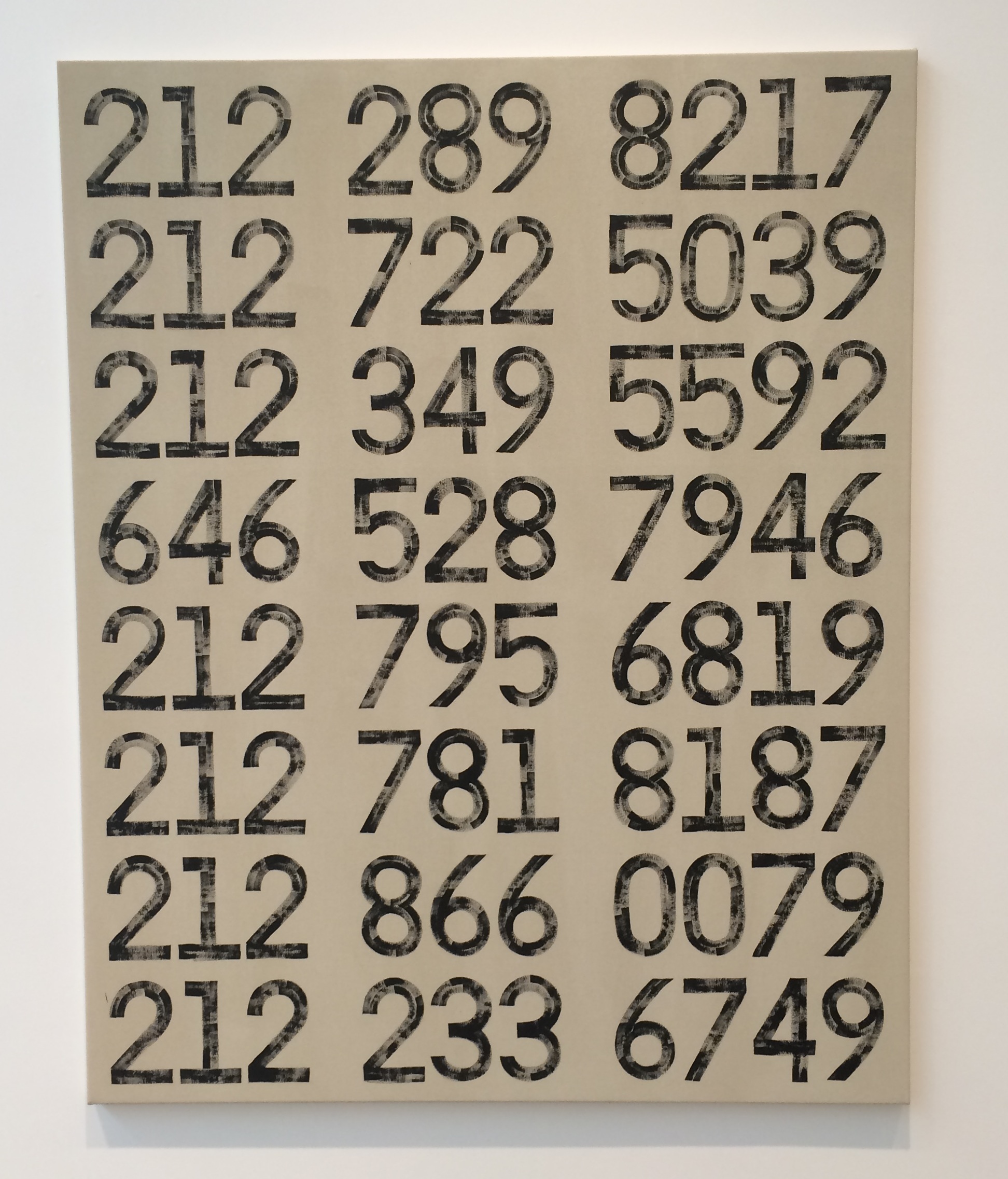
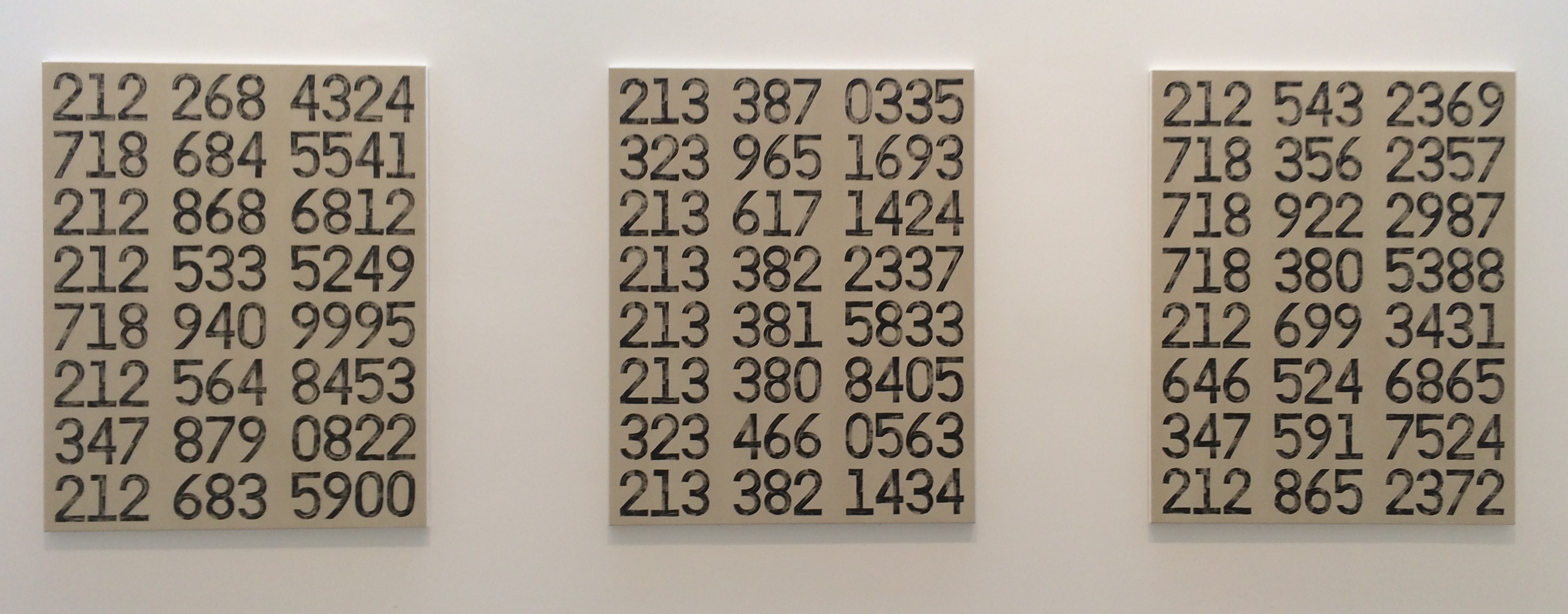
The exhibition “It’s Been Too Long” at the UNTITLED Gallery on Orchard Street features a recent (2015) series of paintings based on telephone numbers. Wagner has randomly selected telephone numbers from the NYC and LA white pages. He paints columns of the enlarged numbers.

15-18-1
The numbers have been painted with uneven brush strokes so that the resulting numerals look as if they have been stamped with an old fashioned rubber stamp and ink pad onto the parchment-colored background. These paintings are an exploration into society’s association with numbers. The rows and columns of numerals become abstract geometric patterns. Removed from the initial source they lose their meaning and purpose. The whole concept of a paper telephone directory is becoming obsolete. In this digital age the once important pages are becoming visual artifacts.

15-18-2
The gallery installation fills an entire room with these canvases, creating an environment of numerals. As some one who likes to work with numbers, I found it quite soothing, almost meditative. It makes me think of all of the other places we see numbers: train cars, mileage signs along the road, credit card numbers, etc… and never stop to think about the aesthetics. Numbers are an important part of our lives but quite often we tend to only use them for practical applications, never stopping to appreciate their visual qualities.

Susan Happersett

James Siena “New Sculpture” at Pace Gallery

Pace Gallery on 25th street in Chelsea is currently presenting the geometric sculptures of James Siena. Well known for his algorithmic paintings, Siena has been making sculptures throughout his career. At first working with tooth picks, and now new work using bamboo skewers, as well as bronze casts of previous pieces. Some of the work has very clear geometric patterns and others seem more chaotic. I have chosen two of the bamboo sculptures that  are about a particular  mathematical geometric phenomenon.

15-17-1

“Richard Feynman” , 2014

“Richard Feynman” from 2014 is a great illustration of self-similarity in three dimensions. Named after the famous 20th century Theoretical Physicist, this work is a cube within a cube within a cube. Each cube structure is composed of 4 by 4 by 4 cubes. Four of smallest cubes make up one cube in the medium cube structure and four of the medium cubes make up one of the large cubes on the large cube structure. Using the bamboo skewers as lines in the 3-D space the artist has created grids on three different scales.

15-17-2

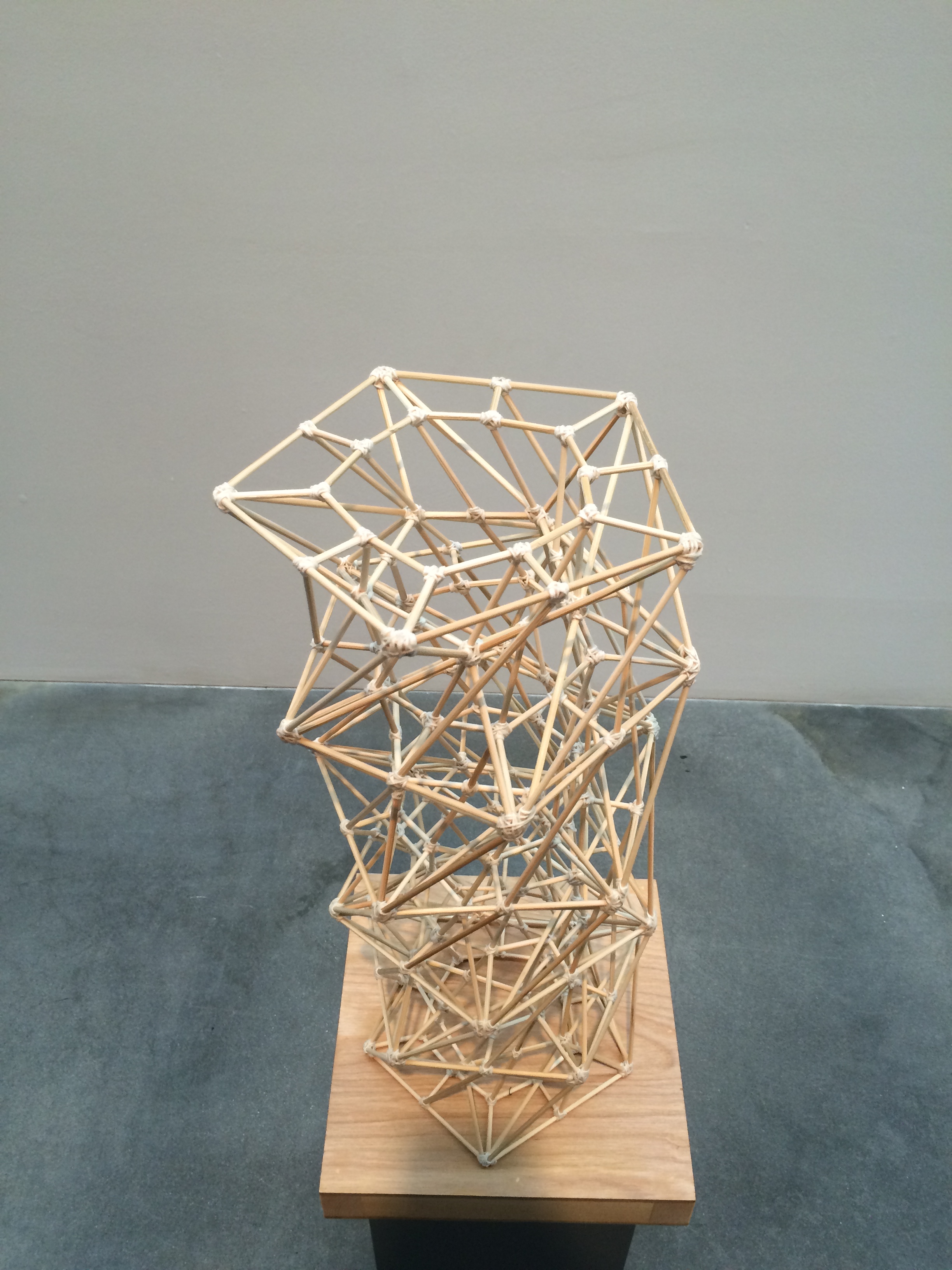
“Morthanveld: Inspiral, Coalescence, Rungdown” 2014, 2015

“Morthanveld: Inspiral, Coalescence, Rungdown” from 2014-2015 is complex tower created using 6 regular pentagons. Instead of stacking them at the same angle, Siena has  twisted  each consecutive pentagon 36 degrees. The finished sculpture is a spiraling geometric column. Siena uses a building  technique of wrapping string around the vertices to to attach the bamboo skewers both in the interior and the exterior shapes. This requires a a very hands on process adding a human element to the Mathematical subject matter.

Pictures courtesy of the gallery and the artist.

Susan

Holly Laws “Cage Crinolines” at Muriel Guépin Gallery

The exhibition “No Woman, No Cry” at Muriel Guépin Gallery features the work by three women whose subject matter is the female identity in society. They reference both the tradition of feminine crafts, as well cultural expectations.

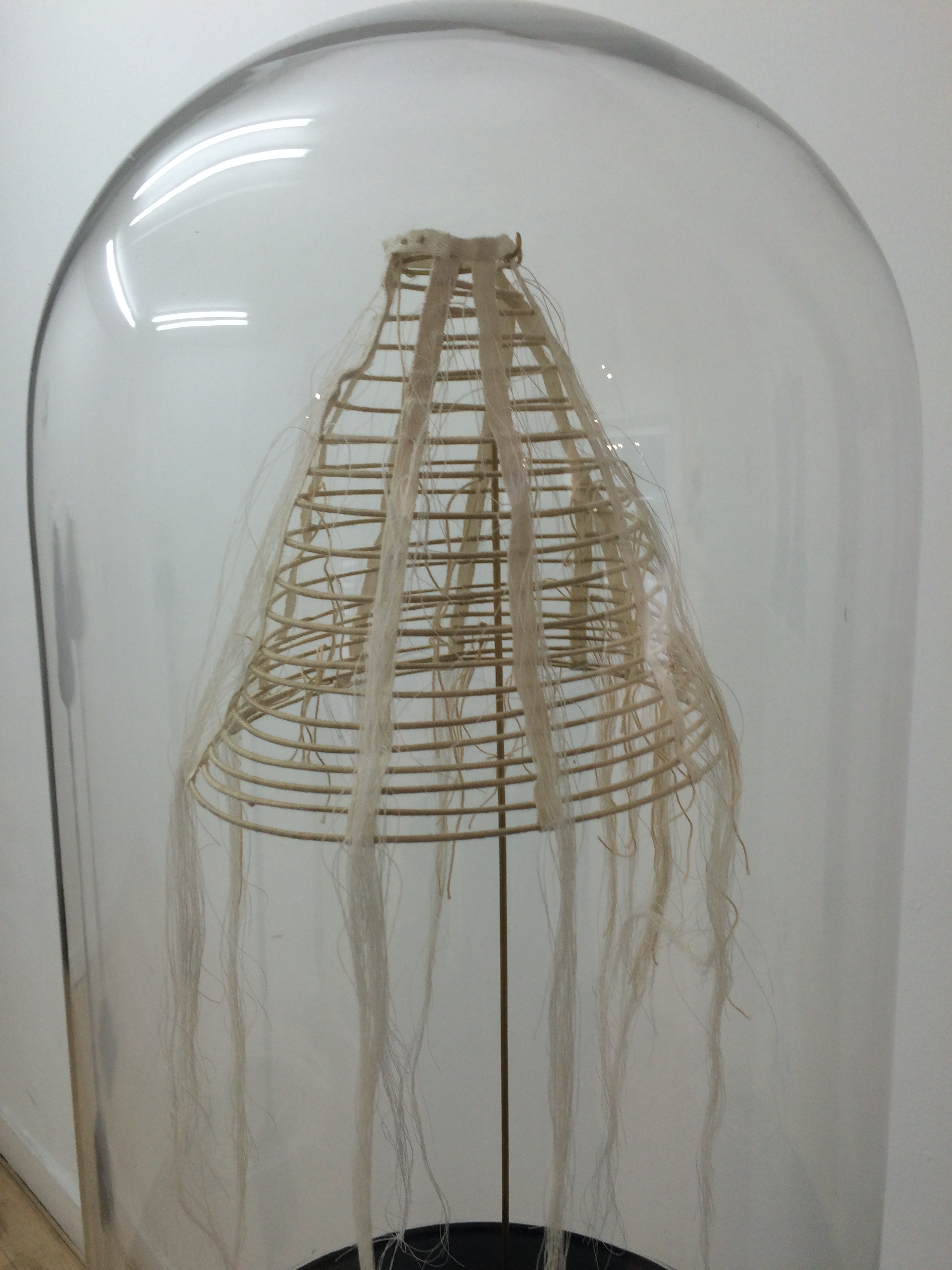
Holly Laws has created a series of small, detailed, handmade models of historic garments. Her intricate “Cage Crinoline” sculptures show the mathematics involved in the design of these 19th century hoop skirt figure enhancers. They are on  display under glass domes, hinting at the Victorian practice of preserving and displaying things like a tiny skeleton in a cabinet of curiosities.

15-16-1

Holly Laws – “Cage Crinoline 1864” – 2015
Picture courtesy of the artist and the gallery

The structure for “Cage Crinoline 1864” consists of a series of concentric ellipses. They have been used to create a vertical column with two perpendicular reflection planes of symmetry. With the utmost precision Laws has built a 3-dimensional expression of the aesthetic qualities of ellipses. This complex geometry has been used in a miniaturization of an undergarment that if it were an actual garment would not even be seen in public. The mathematics would be hidden under a showy display of skirt fabric. I was really drawn to this “Crinoline Cage” because it reminds me to look beneath the surface and in unexpected place to find the beauty in Mathematics.

Susan

Math at the Cooper Hewitt

The Cooper Hewitt, Smithsonian Design Museum in Manhattan was closed for renovation for three years before  it reopened at the end of 2013. The current exhibition features an overview sample of their vast collection. I was very happy to discover that they have chosen to display quite a bit of work with direct Mathematical links. The debate over the critical delineations between Fine Art and Design is a hot button issue I am not going to address in this blog post. I have selected two pieces that have specific Mathematical themes.

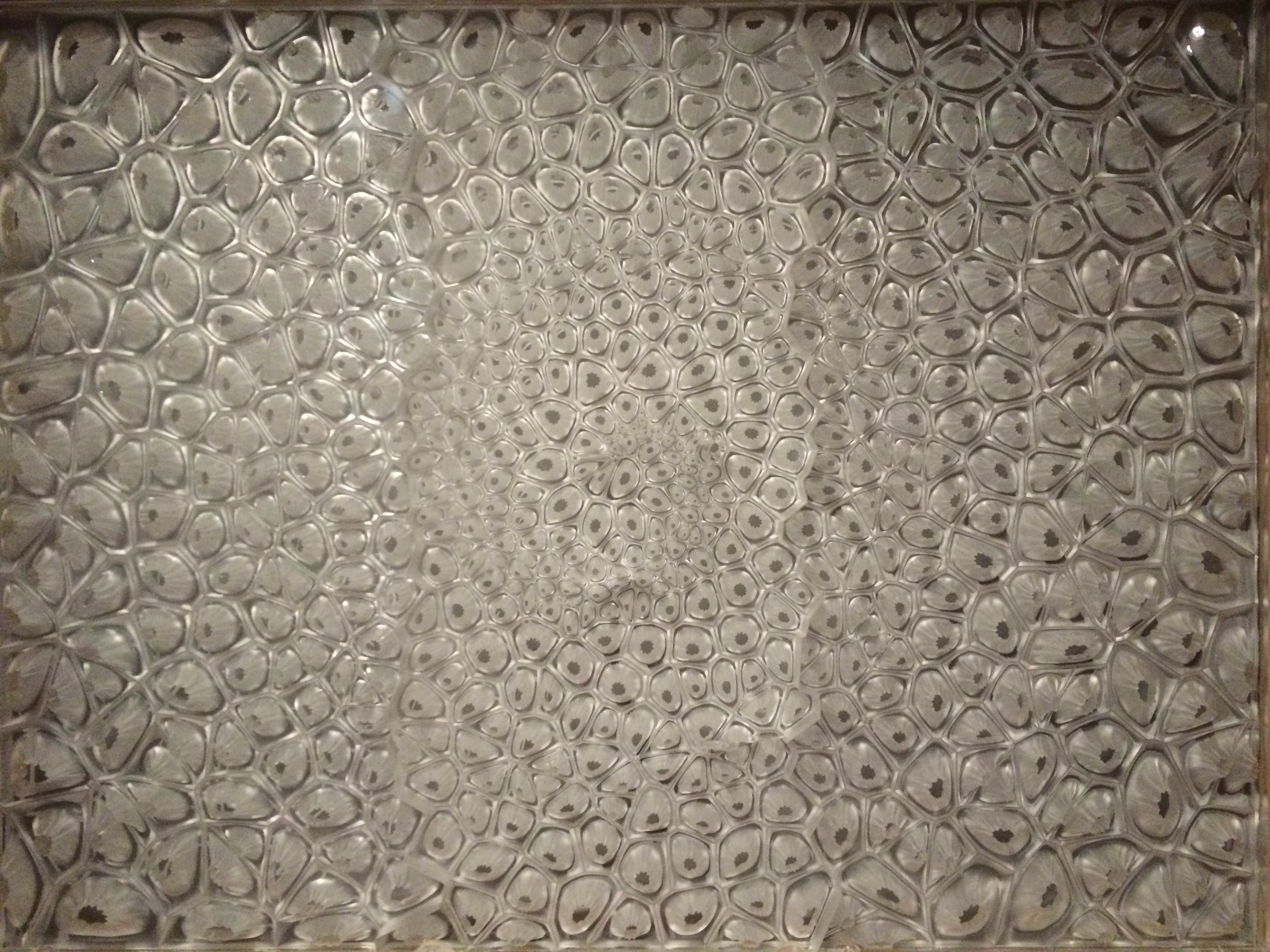
“Prototype for an Environmental Screen, Fibonacci’s Mashrabiya”, 2009 is an architectural element designed by Neri Oxman at MIT Media Lab with Professor W. Craig Carter. It is was created using algorithms and digital processes but is based on traditional screens found in historic middle Eastern design.

15-15-1

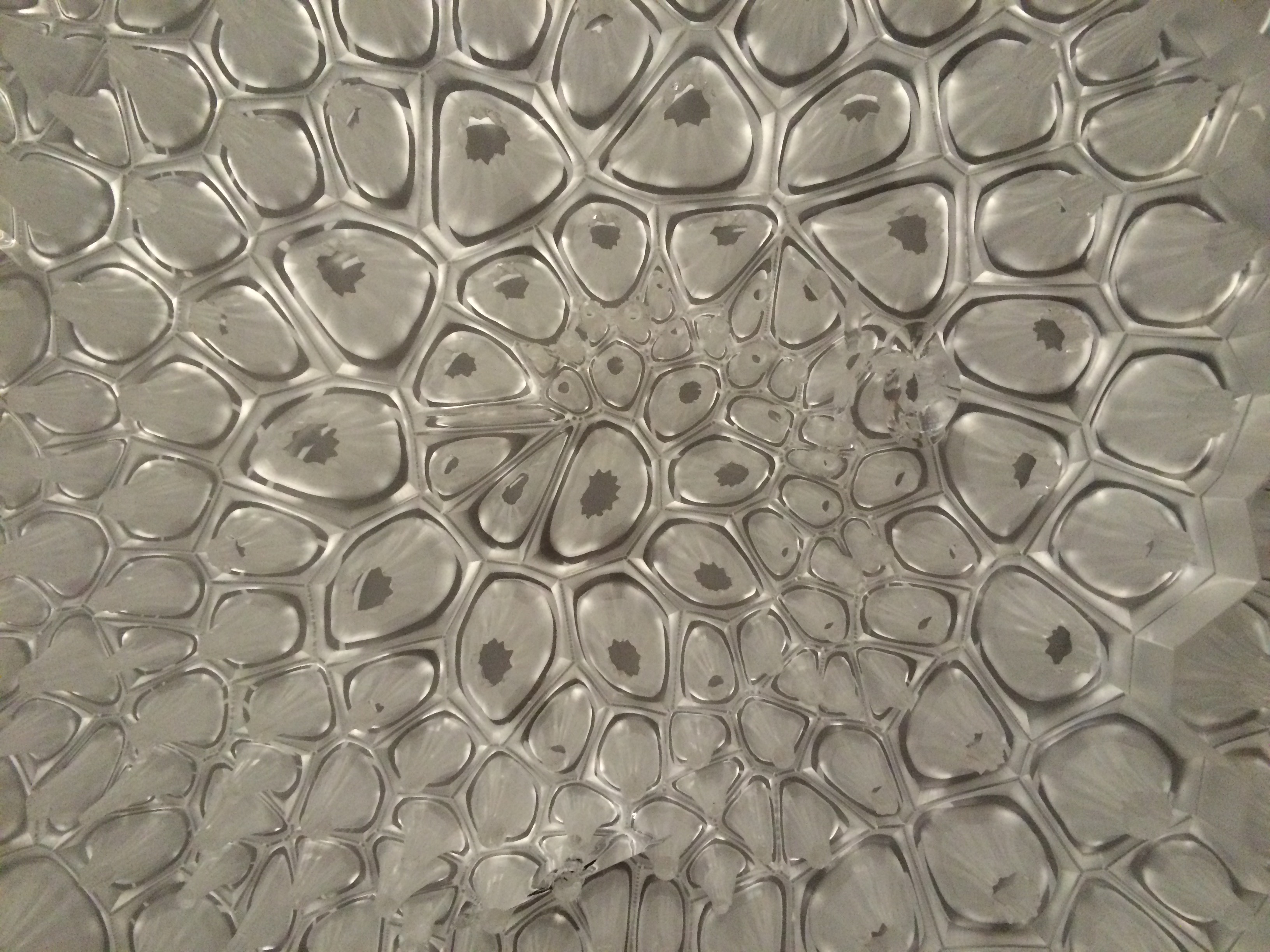
The recursive Fibonacci Sequence was used to create the spiral pattern. Here is a detail of the center of the spiral.

15-15-2

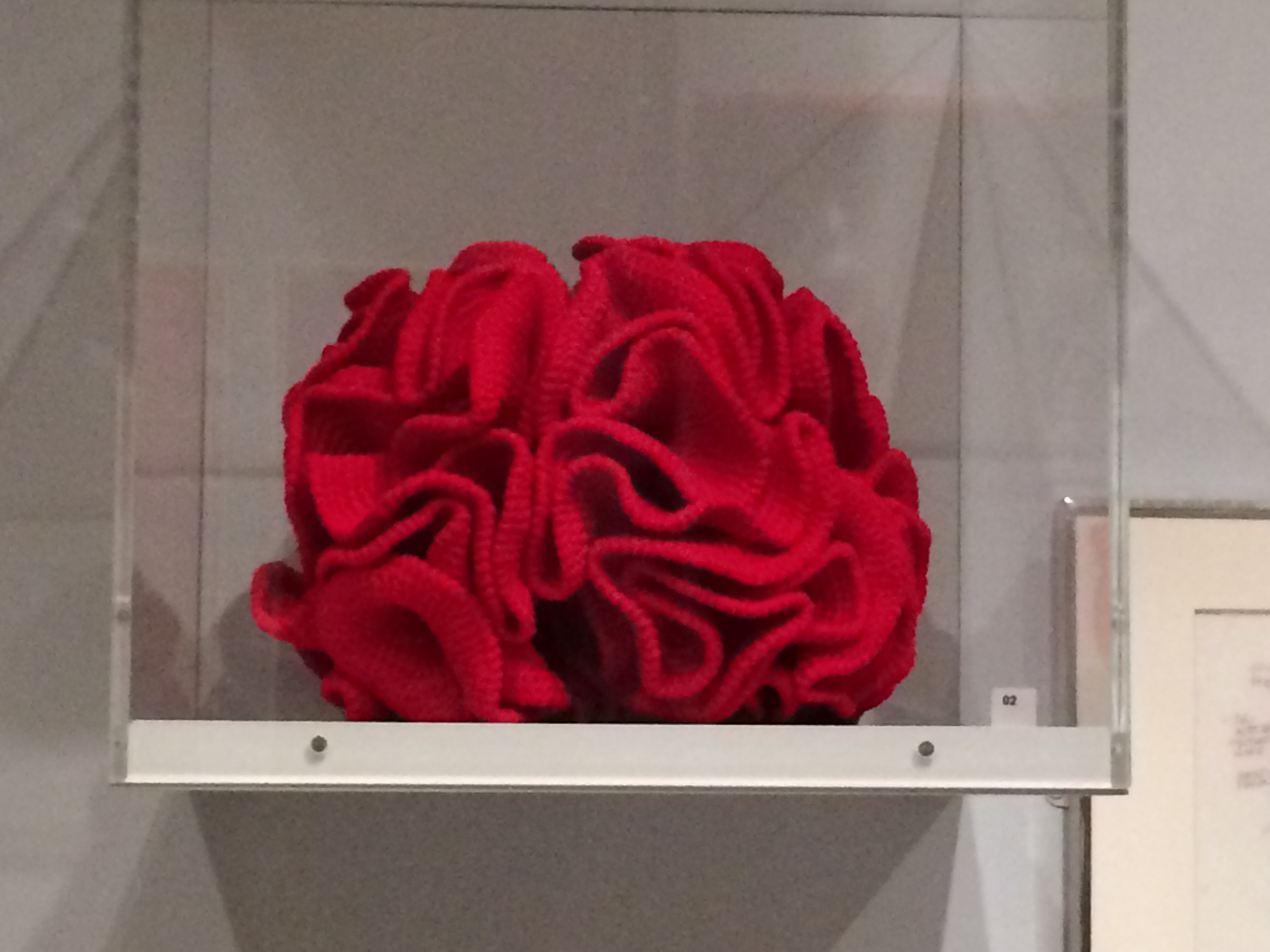
Mathematician and artist Daina Taimina has been quite well known for her crocheted sculptures of Hyperbolic Geometry.

15-15-3
“Model of a Hyperbolic Space” 2011, is crocheted out of wool yarn. Working on these sculptures since 1997, Taimina has made major breakthrough on the modelling of figures in Hyperbolic space. Hyperbolic Geometry is a Non-Euclidean Geometry discovered by Janos Bolyai and Nicholay Lobatchevsky in the first half of the 19th century. In Hyperbolic Geometry each point has negative curvature and seems to curve away from itself.

At the Cooper Hewitt there were many more items that featured Mathematics as a design element. There was a very direct indication of the importance Mathematics plays in the field of both decorative and industrial design.

Susan