Mathematics and Fashion: Charles James at The Metropolitan Museum of Art

When you think about evening gowns, mathematics may not be the first think that comes to mind, but Charles James used geometry and engineering to design his stunning sculptural creations. In 1944, Vogue Magazine referred to his “Mathematical tailoring”.
The Metropolitan Museum has devised an exhibition that celebrates the mathematical structures of James’ work using technology to enhance the viewer experience. Robotic arms with cameras and video recorders present close-up details of structural elements of the gowns. X-rays provide an inside glimpse at the architectural support systems. Computer models provide 360 degree topological maps of the twists, spirals, and folds incorporated into the fashion. Unfortunately it was very dark in the gallery and impossible to take photos but the Metropolitan Museum has a great website with videos and images at metmuseum.org. I have included two of my favorite dresses.

32-1

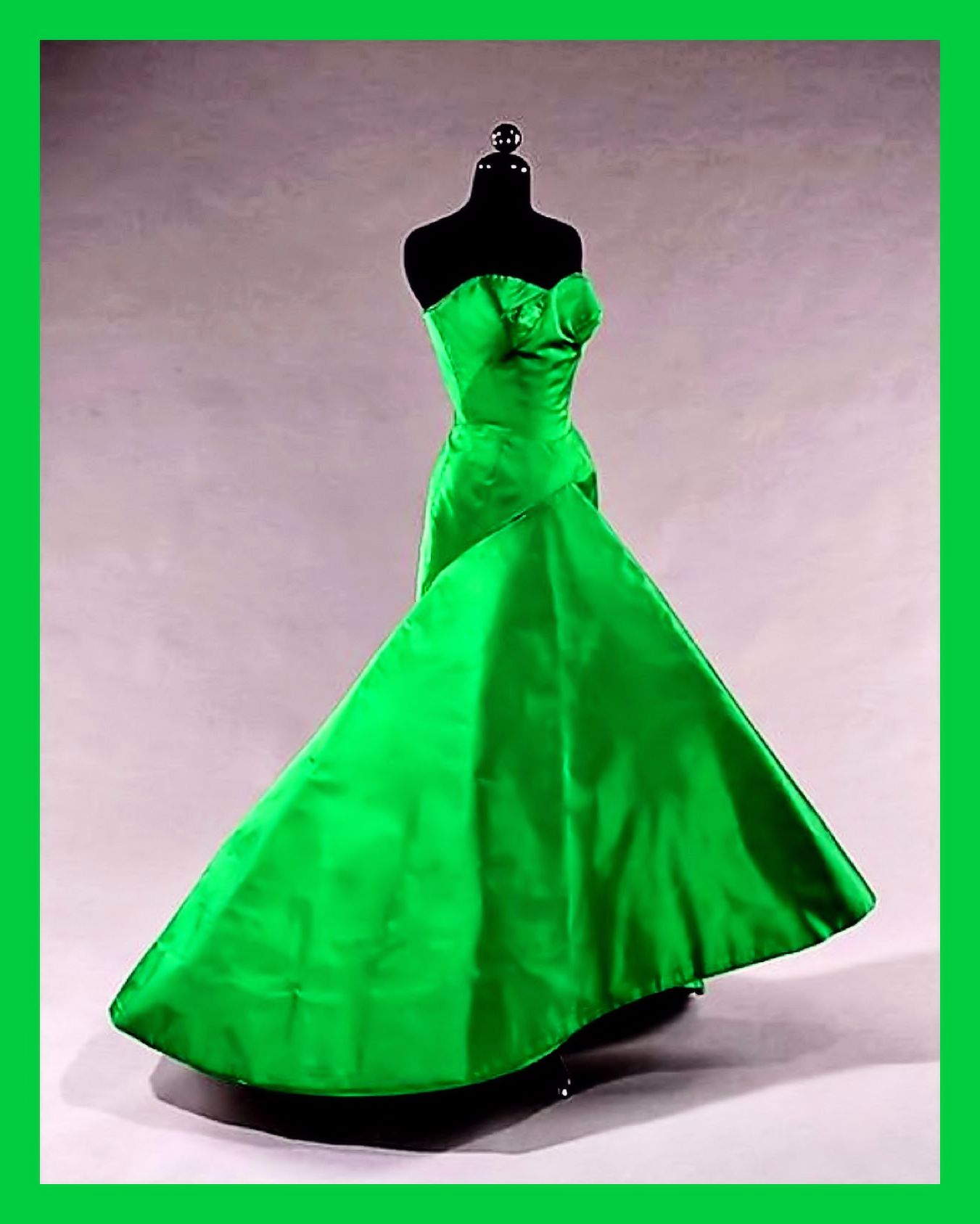
Charles James – Four leaf clover dress

The evening dress “Four Leaf Clover”  features a hyperbolic curve for a sweeping skirt.
32-2

Charles James – Spiral Dress

The green satin Spiral dress incorporates a spiral of fabric that seems to flow directly back into itself creating an Moebius strip that encircles the wearer.

There are many other examples in the exhibition of the complex geometry utilized to design these creations. Throughout his career James was also involved with teaching other designers to use his mathematical techniques. He invented his own schematic dress forms and mannequins that are also on display at the museum.

The engineering nature of Charles James’ approach to fashion combined with the technologically curated presentation of the Metropolitan Museum creates an exhibition that reveals connections between Mathematics and fashion design.

— Susan Happersett
Water Weavers at The Bard Graduate Center

“Water Weavers, The River In Contemporary Colombian Visual and Material Culture” is currently on view at the gallery of the Bard Graduate Center in Manhattan. This exhibition explores the connections between the river and culture exploring the art, craft, and design that has manifested from these connections. A number of the displays reflect the cultural importance of the symmetry in the objects created.

31-1

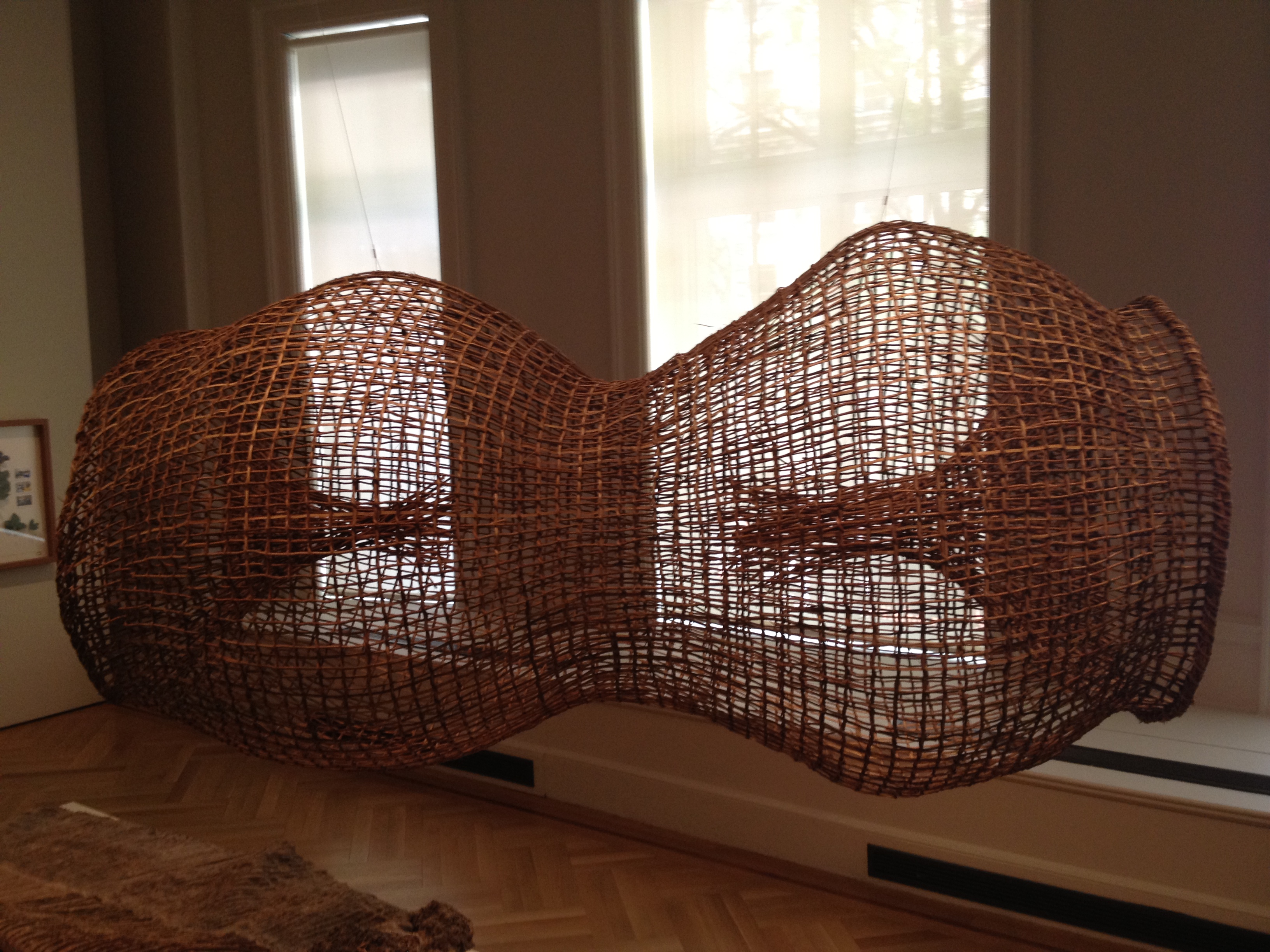
Abel Rodriquez – Fish Trap
Picture courtesy of the artist and the gallery

The large scale woven form “Fish Trap” (2013)  by Abel Rodriquez was created using Yare’ fiber. This form features 3-D symmetry with a central horizontal axis of rotational symmetry as well as a vertical axis of reflection symmetry. In these weavings Rodriguez has expressed the grace and elegance of form of a traditional and functional object.

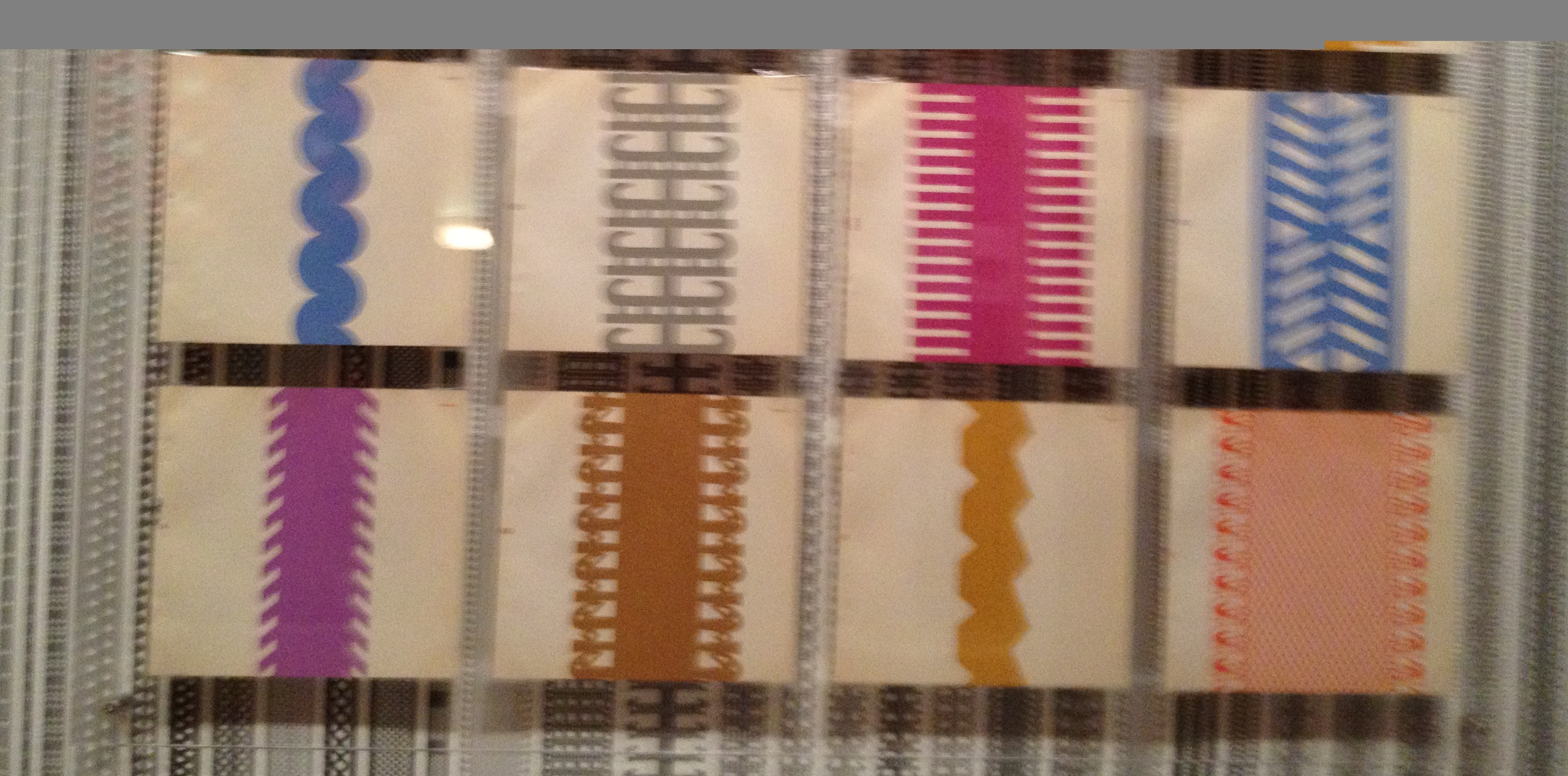
David Consuegra was one Columbia’s most influential graphic artists. In the 1960’s he developed a series of abstracted patterns based on the esthetics of pre-Hispanic designs. A group of his prints of the individual geometric images are on display in the gallery. Each of these elements of his visual dictionary is based on either reflectional or glide-reflectional symmetry.

31-2

The art collective Tangrama has used technology  called “Applique” (2014) to create  wall paper designs incorporating the work of David Consuegra.

31-3

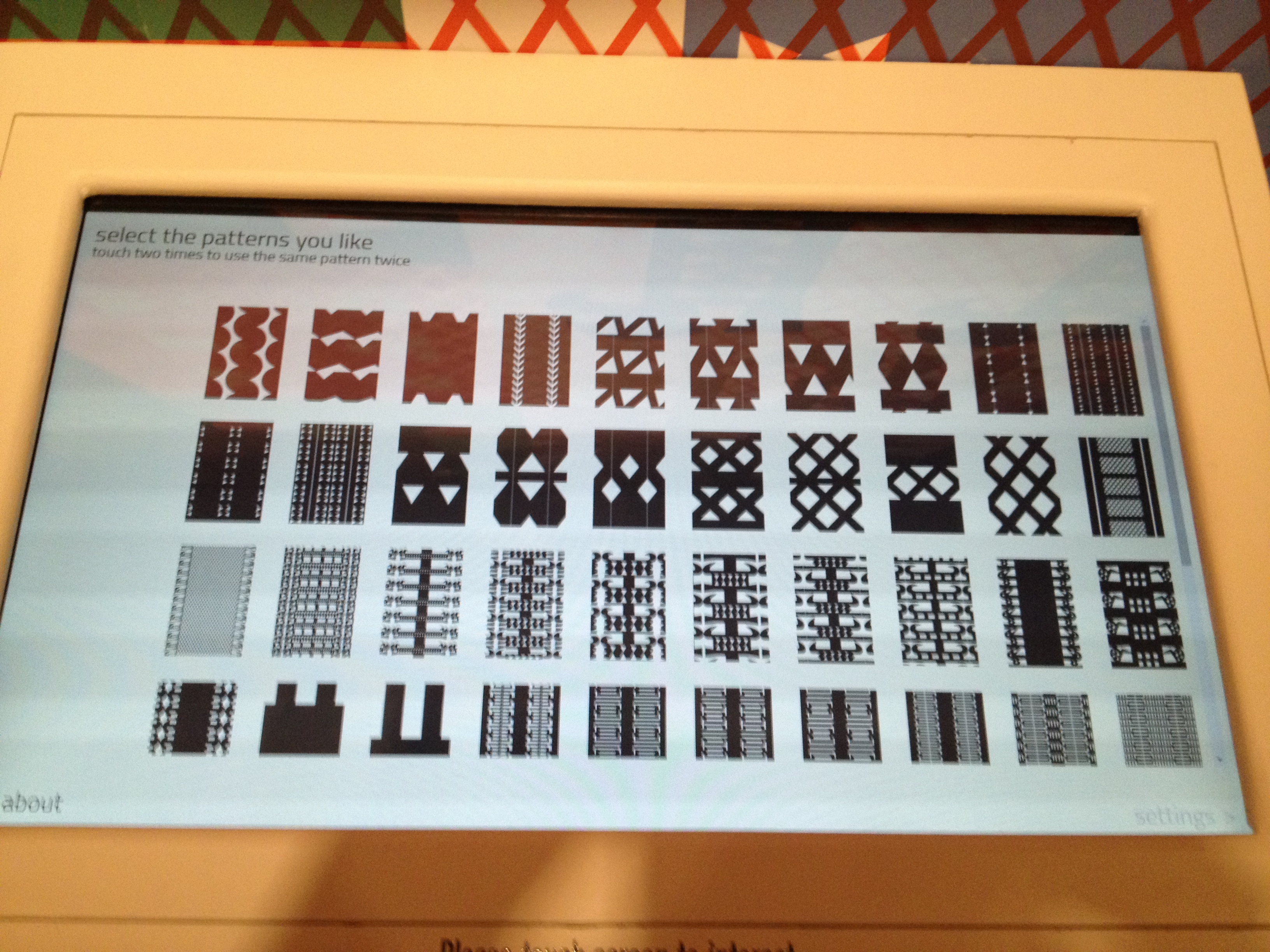
Tangrama has also provided the viewer an opportunity to explore these patterning opportunities with a tablet-optimized web application based on David Consuegra’s designs installed in the gallery.31-4

This interactive software allows the participant to layer up to five different patterns with ten color choices, ten gradient variations, as well adjusting size. There is also the ability to allow the patterns to move by scrolling across or up and down the screen. I had a great time exploring a few of the multitude of visual possibilities available with this amazing design generator.

Susan Happersett

Transmutations – Benigna Chilla at Tibet House NYC

Benigna Chilla has incorporated mathematics into her art practice throughout her career. Her recent, large scale canvasses on display at Tibet House are inspired by her stay in Bhutan in 2011.

30-1

Overview of the exhibition
Picture courtesy of the artist and the gallery

Chilla has included small segments of cultural pattern and textiles into the texture of these paintings. This enhances the connections between the bold symmetries and traditional Tibetan Art. In the painting “Two black Triangles” there is the obvious reflection symmetry of the black triangles, but there are also subtle almost-reflective symmetries. Near the bottom of the canvas there two added sculptural elements, but the right one is higher than the left. On the right hand side of the bottom border there are two red triangles with grey circles on top. On the left hand side, the triangles re grey, but the circles  are red.

30-2

Two Black Triangles – Mixed Media – 8′ x 6′ – 2012
Picture courtesy of the artist

The painting “Full Moonstone” features a large central Mandala with 8-fold rotational symmetry.

30-3

Full Moonstone – Mixed Media on Canvas – 8′ x 6′ – 2013
Picture courtesy of the artist

In the press release for this exhibition, Chilla discusses the importance of both the meditative and physical processes involved in the creation of these works. There are not many artists who can discuss creating mathematical symmetries and meditation, and I personally find that combination very inspiring.

Susan Happersett


Summer Show at McKenzie Fine Art

One of my favorite things about NYC in the Summertime is the Summer Group shows at the galleries. During the next month or so there are many opportunities to attend exihbitions that feature the perspectives of numerous artists, whose work is related by a consistent theme. The McKenzie Fine Art Gallery‘s current show is titled “Color as Structure” and exhibits the work of 16 artists, whose use of color defines the geometries within their paintings, drawings, and sculptures.

Elise Ferguson

29-1

Elise Ferguson – NW, bold
2014 – Pigmented plaster on mdf – 24 x 124 inches
Picture courtesy of the artist and the gallery

Elise Ferguson uses pigmented plaster on board in her work “NW,bold”. This square work is structured using reflection or mirror symmetry. The diagonal on the square running from the upper left corner to the lower right corner is the line of symmetry. Ferguson creates a dynamic rhythm in this work through her use of parallel lines of modulating widths. The bolder set of lines parallel to the top and left edge of the board contrast with the thinner lines that are parallel to either the edges or the diagonals. There are only a few lines that are not parallel to either the edges or the diagonals. These lines divide the board into geometric regions, creating defined sections of parallel lines going in different directions. There is a hand drawn qualtity to this work that I really appreciate. I feel that the varying widths of the lines enhances the nature of the material and gives the work great energy.

Alain Biltereyst

29-2

Alain Biltereyst – 2/0/12
2012 – Acrylic on wood panel – 10 1/2 x 7 1/2 inches
Picture courtesy of the artist and the gallery

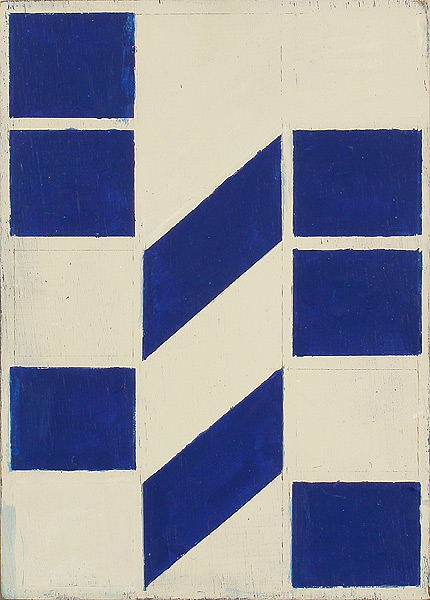
Alain Biltereyst’s intimate painting on wood panel “2/0/12” has historical references to earlier geometric abstractions from the 1960’s. With a background in graphic design Biltereyst is interested in signage in the public environment. This work brings the cultural phenomenon of text and images we see in advertising and street art and distills the geometric content to abstract paintings. He introduces the imperfections of the shapes inherent in the street and some handmade signs into the realm of the clean edge geometries of his historical influences. In “2/0/12” Biltereyst has created a rectangular grid system: three columns of five rectangular sections. The pattern in the left column has has been shifted down one rectangle and is repeated in the right column. The middle column features two parallelograms that have the same width as the rectangles in the other columns but are stretched to reach the corners at twice the height.

Paul Corio

29-3

Paul Corio – Megalicious
2011 – Acrylic on canvas – 60 x 48 inches
Picture courtesy of the artist and the gallery

Near the front of the gallery Paul Corio’s painting “Megalicious” drew me into the gallery like a sirens song. All of the pulsing squares and triangles painted like color wheels are the perfect marriage of math and art. Corio has divided the squares into ten triangles by trisecting the sides of each square and then drawing lines from each of those six points and each of the four corner points to the the center of the square. The resulting triangles have been filled in with the colors from a color wheel in sequence. To decide which color goes into the top triangle to begin the progression, Corio has created his own random number generator, using the numbers of the winning thoroughbred horses from race tracks in NY. The number one results in yellow being the top center triangle. Not only does “Megalicious” use geometric forms, there is also an interesting algorithm to determine color placement.

Math Trends at the Whitney Biennial

The Whitney Biennial exhibition closed last week, but for those of you unable to visit the museum I wanted to briefly discuss a few examples of work with Mathematical implications.

Terry Adkins26-3

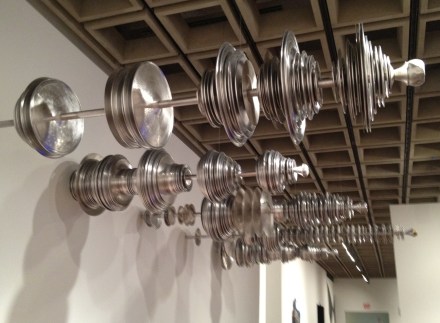
Terry Adkins’ large wall installation “Aviarium” from 2014 was assembled using repurposed stacked cymbals. Adkins was a musician and the sizes of the cymbals were determined by the mathematics of bird songs. The horizontal columns of circles protruding from the gallery wall become a physical manifestation of sound.

Suzanne McClelland

26-1

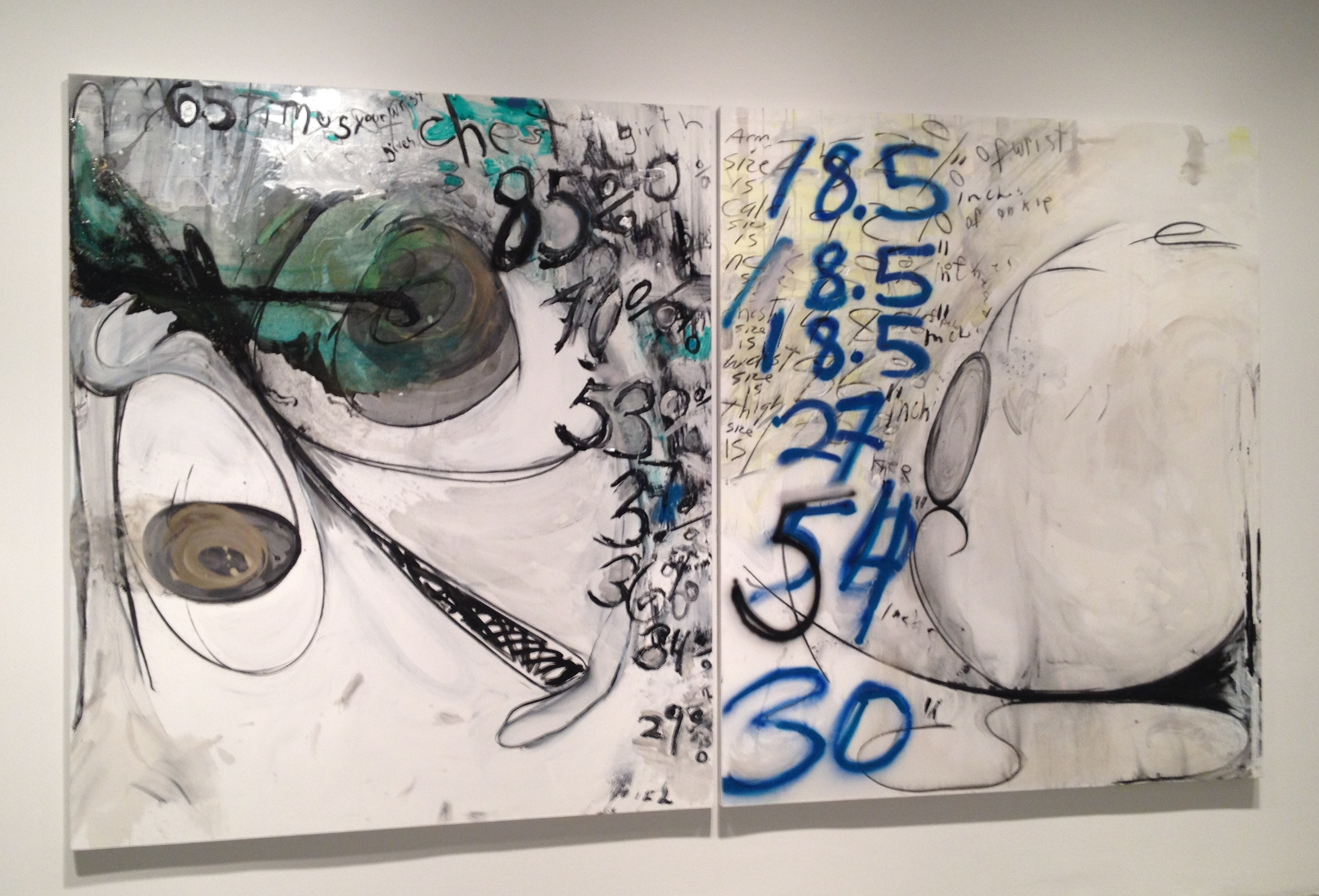
In her diptych “Ideal Proportions” 2013, Suzanne McClelland explores the psychological and social implications of our relationship to numbers. McClelland’s expressive renderings of groups of Arabic numerals reveal the anxiety and judgement associated with numbers that refer to the weights and measures of the human body.

Shio Kusaba

26-2

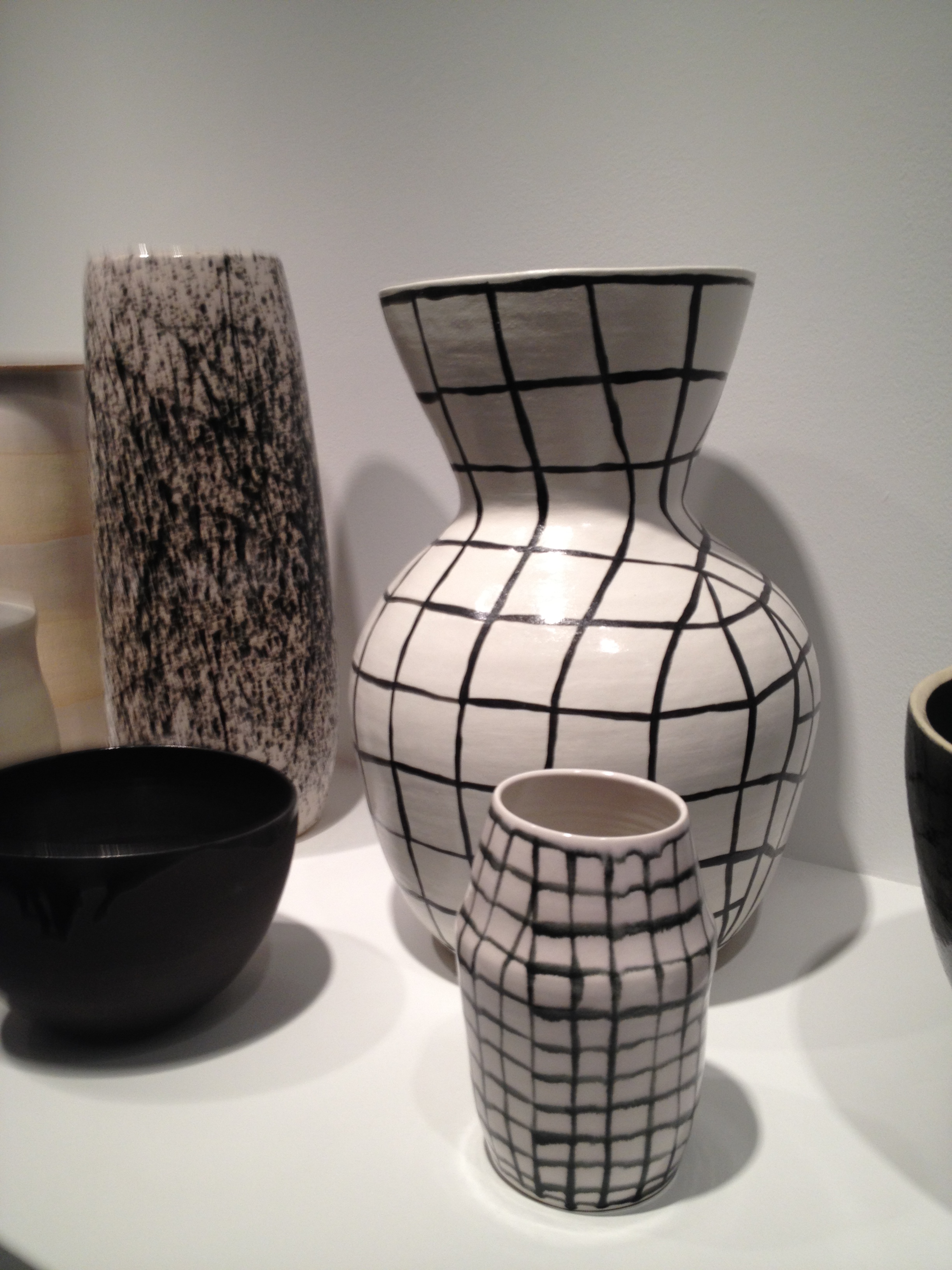
Ceramicist Shio Kusaba has created a series of vessels featuring striking pattern work. I am particularly interested in her pieces that have grid patterns. The use of linear rectangular grids on the organ forms create a subtle juxtaposition between the curved surfaces and the lines. I find the spaces  where the gridded sections meet in triangles fascinating. The concept of lines on curves is an area of geometry ripe for artistic exploration.

The Whitney Biennial always received a lot of attention and press. Now that the excitement and fan fare have concluded I wanted to offer some personal observations.

PULSE Show New York – May 2014

Sabrina Gschwandtner at LMAKProjects

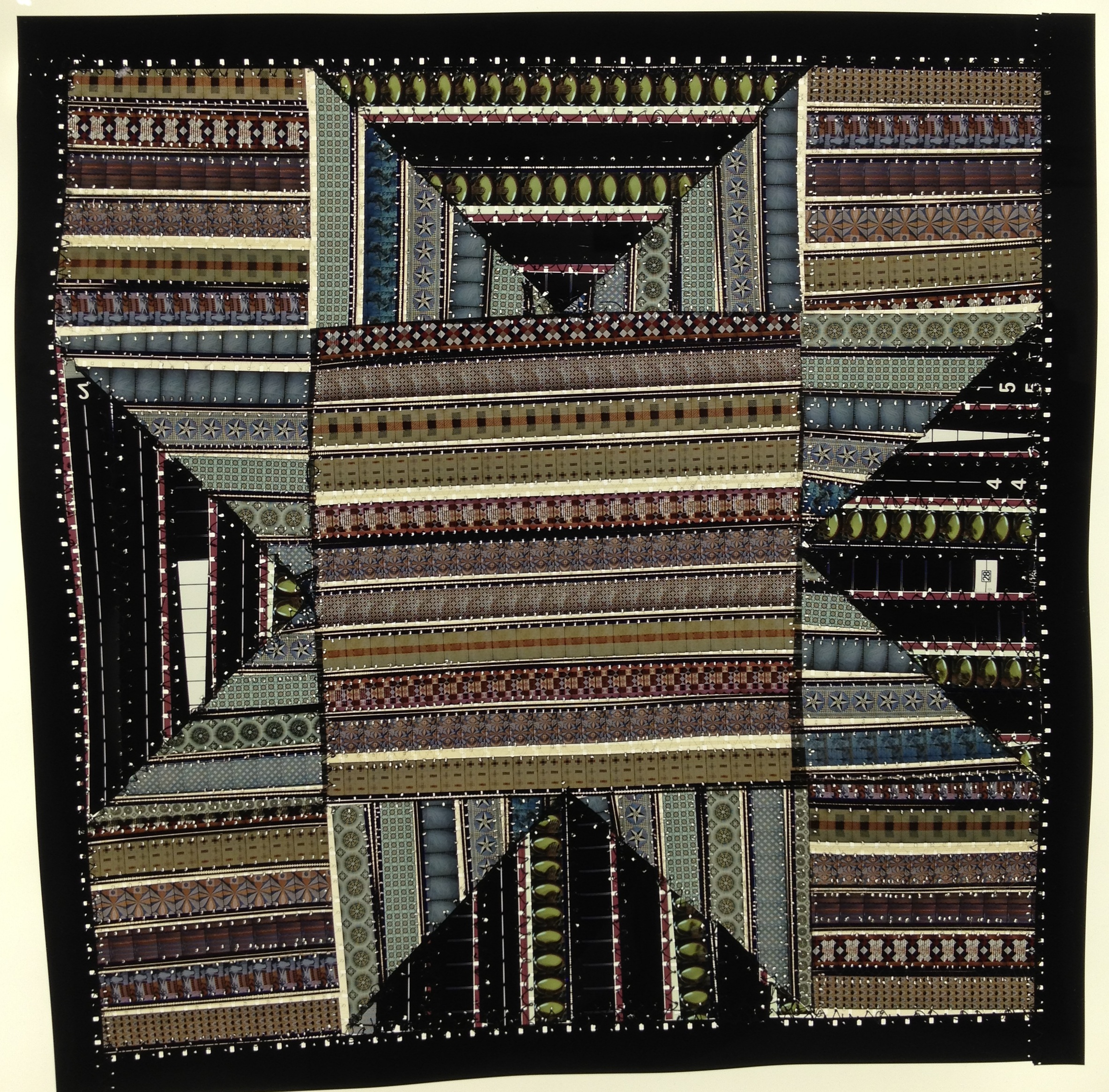
May is the month for many large art fairs in NYC. I recently spent an afternoon at the Pulse Show. There were quite a few works that had mathematical connections. The geometric structures of quilts have frequently  been discussed in books papers and lectures. Sabrina Gschwandtner has developed a unique process: instead of cloth, she uses segments of film footage. The LMAKprojects booth at the fair had some wonderful examples of Gswandtner’s work on display. The films for these quilts were produced between 1952 and 1982 and were documentaries about women and textile craft practices. Although at first the patterning in the sections of the work appear to be repetitive abstract patterning there is a actually a self-referential social statement imbedded in the “fabric” of each work.

23-1

Hearts and Hands Black Block 2014
Courtesy LMAKprojects NY

The work ” Heats and Hands Black Block” order 4 rotational symmetry, and an interesting repetition of the squares. The large center square has four times the area of each of the corner squares and is one quarter the size of the entire piece.This creates a great example of self-similar forms at play.

Amanda Means at Jayne H Baum Gallery

I am always looking for different ways geometry can be used to make art. The Jayne H Baum gallery booth had a display of the work of Amanda Means, who has incorporated grids into her photographic darkroom process. Means scratches the lines of the grid directly into the surface of the paper. Then, while listening to music she uses a pen light to manipulate the images.

23-2

Amanda Means Grid Abstraction 52 – 2005 Gelatin silver print, scored – 24″ x 20″ Courtesy Jayne H Baum gallery

In the work “Abstract grid” 51 2005 what  I find fascinating is the way the scratches of the grid has effected the flow of the work. The valleys and the raised edges around the scratched lines have created the square gridded patterns forcing the free flowing quality of the pigment to conform to the underlying geometric structure.

— Susan Happersett
“Evidence of Absence” at ZieherSmith Gallery

The ZieherSmith Gallery in NYC current group exhibition is titled “Evidence of Absence”. Two of the artists in the show create work that uses mutated repetition of geometric shapes.

Ryan Mrozowski

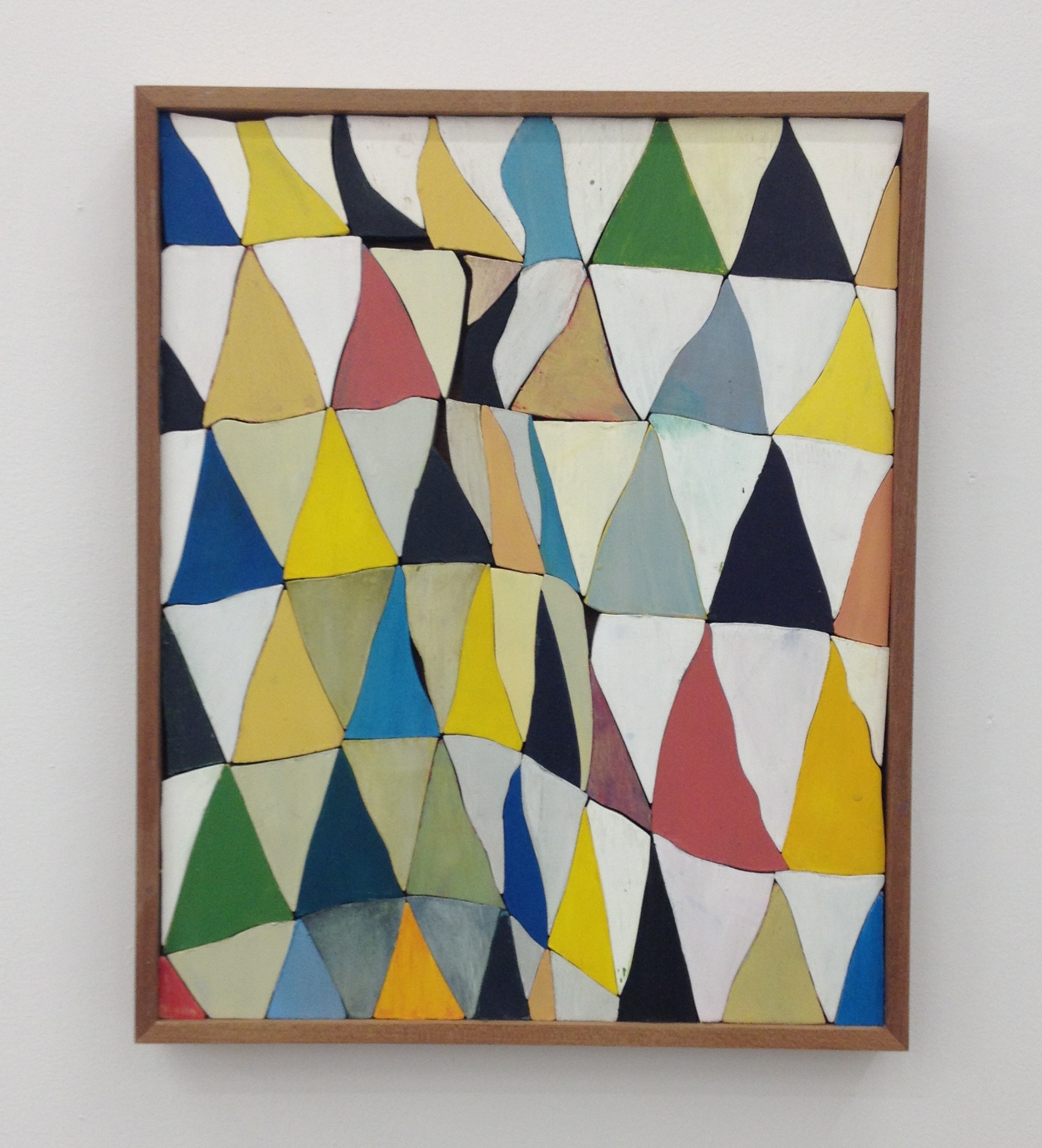
Ryan Mrozowski makes wood blocks that are coated in acrylic and vinyl then they are held together in a rectangular frame. This creates a patterned plane or a 2D tiling pattern from 3D blocks. His assemblages give the illusion that all of the blocks started out the same size and shape, but they have been squished together and distorted by the limits of the frame capacity.

21-1

Courtesy Ryan Mrozowski and ZieherSmith New York
“Dark Blue, Red, Maroon, Green III” 2014

In Mrozowski’s “Dark, Blue, Maroon, Green III”, rows of isosceles triangles appear to have been compressed into a frame that is too small, distorting the geometry of what could have been a very repetitive geometric pattern. As the viewer I get the feeling that the order we associate with mathematical patterning has been disturbed and mutated. So it is the imaginary starting point of this pattern before it was compacted that holds the mathematical connections. Although the wood blocks are solid, there is the false appearance of plasticity that hold the memory of the geometrical starting point.

Adam Winner

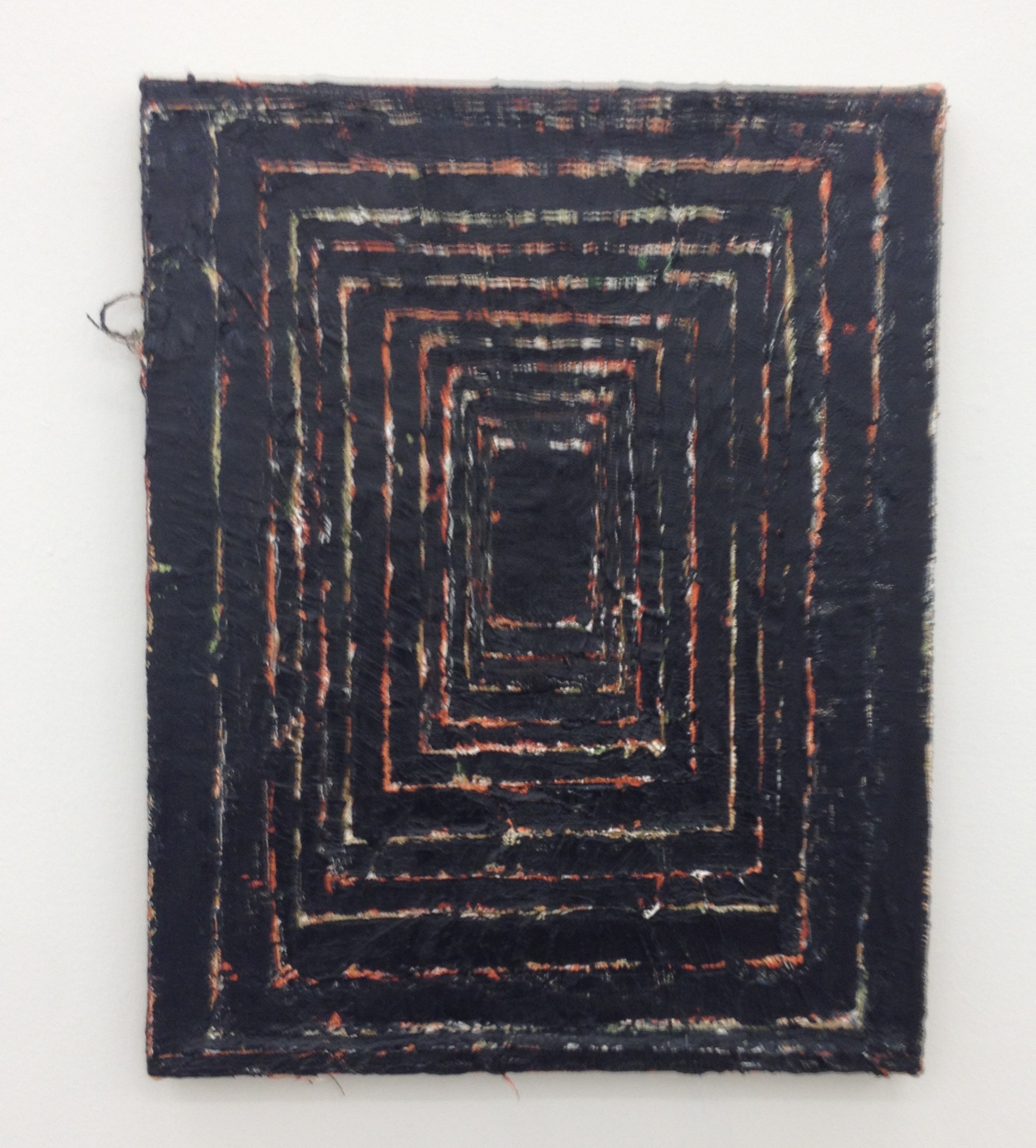
Adam Winner creates minimalist paintings with a hand-made edge. Instead of brushes he uses palette knives, instead of a smooth solid canvas he pieces together torn linen canvas. He uses the rough edges of the linen to create straight lines. Winner is interested in the Golden Section and incorporates this into the proportions of his work.

21-2

Courtesy Adam Winner and ZieherSmith Gallery New York
Untitled 2014

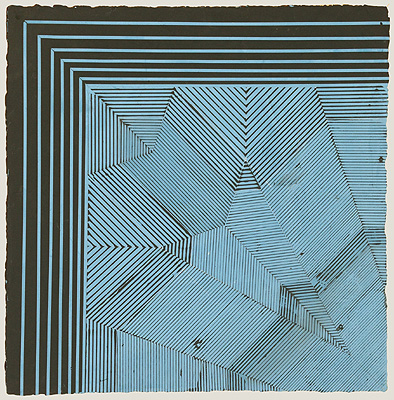
Winner’s untitled oil painting above features a series of twelve concentric rectangles (including the outer edge of the canvas). This is a theme that has been explored by Minimalist artists including Frank Stella, but Winner’s unique technique breaths new life into the subject matter. Earlier interpretations of the parallel lines of concentric rectangles relied of the slickness of clean and accurate lines. This painting has rough not quite perfect lines created from the torn edges of canvas strips. I am always looking for work like Winner’s that revisits how mathematics has been used before, but in some way alters the process.

– Susan Happersett

Denise Bibro Fine Art INC

Henry Bermudez

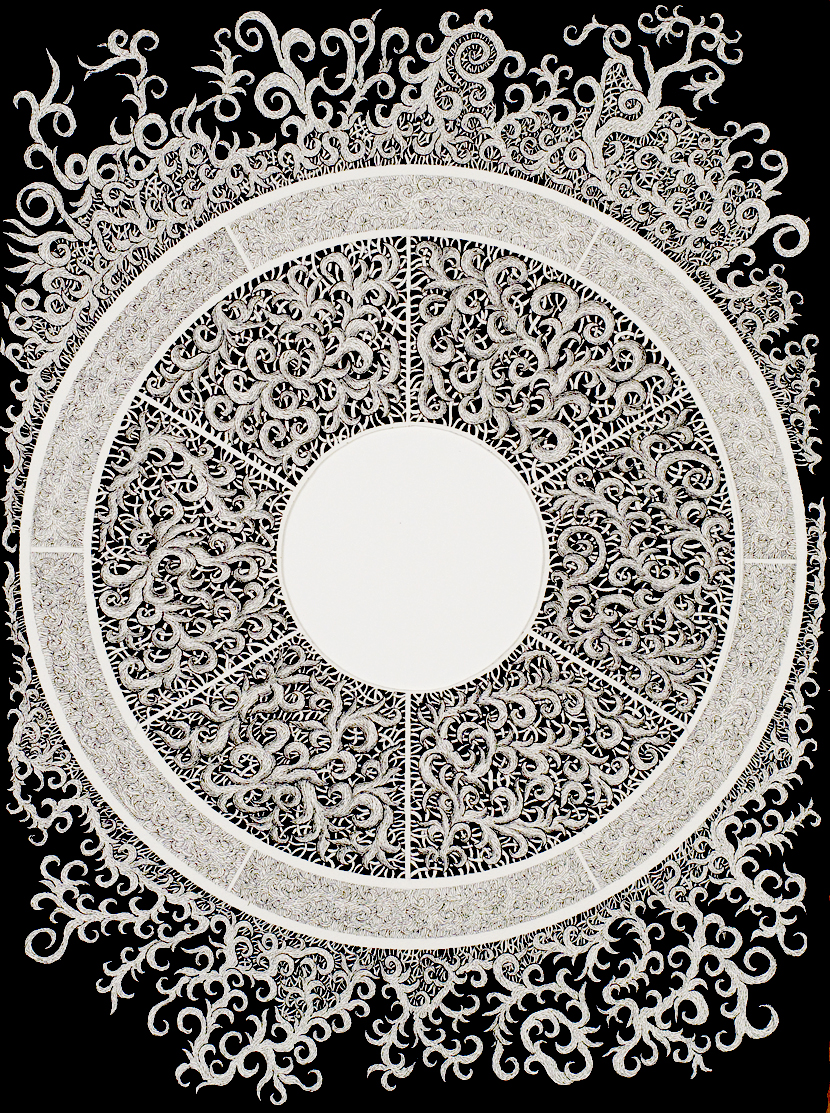
Denise Bibro has two adjacent gallery spaces in Chelsea. The main Gallery and in a separate room, the Platform Project Space. On a recent visit, the drawings of Henry Bermudez were on display. Two of the drawings have very mathematical frameworks, that create structure for his freehand patterning. Bermudez is a renowned artist, who has exhibited extensively throughout the world. His work is included in many  important collections. He represented his native country of Venezuela at the Venice Biennale in 1986. Bermudez takes inspiration for his art from pre-Columbian and religious themes. His black on white drawings are intricate and detailed with swirls of patterns.

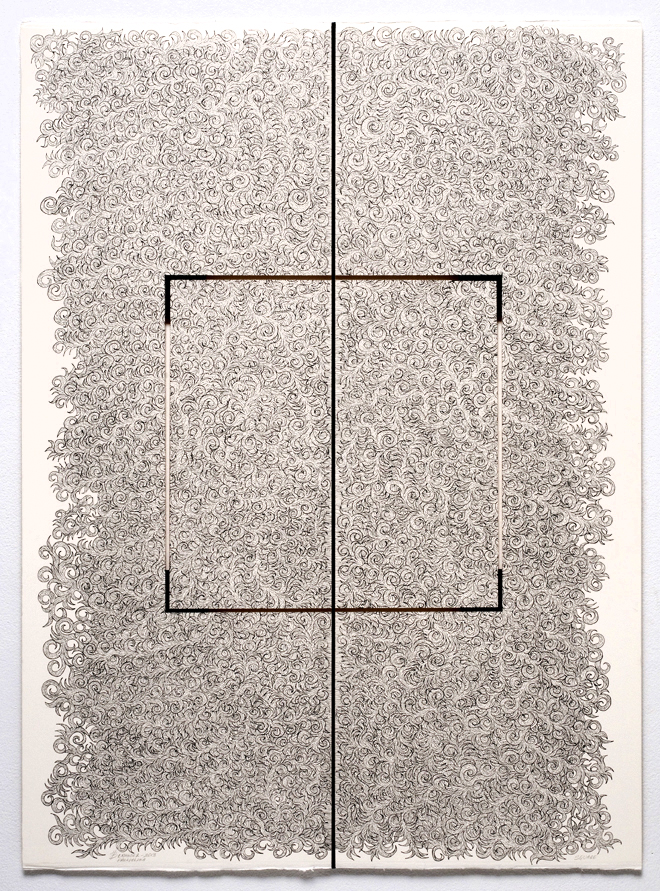
6_Bermudez_Square

Henry Bermudez
Square, 2014
pen and ink drawing, acrylic paint, paper
30” x 22”
Picture courtesy of the gallery and the artist

In the drawing “Square” the swirling pattern is broken up by a vertical line bisecting the paper and a line drawing of a square in the center of the page. The bisecting line creates a line of symmetry for the square. This symmetry seems to anchor Bermudez’s frenetic free-for-all of patterning.

7_Bermudez_Center Piece

Henry Bermudez
Center Piece, 2012
pen and ink drawing, acrylic paint, paper
30” x 22”
Picture courtesy of the gallery and the artist

The exuberance of pattern is also evident in the drawing “Center Piece”. This drawing again features the curls and waves of pattern. This time – however – the structure is based on a circle. The circle has been divided into two separate concentric rings and a center circle that is empty. The inner ring is divided in to six equal sections. The outer ring is also made up of six equal sections but it has been rotated 30 degrees. The two rings each have a different type of patterning. In this drawing you can really see Bermudez’s cultural influences. There is a connection to pre-Columbian calendars. Bermudez uses  geometric mathematical frameworks to create order for his freeform patterning.

David Ambrose

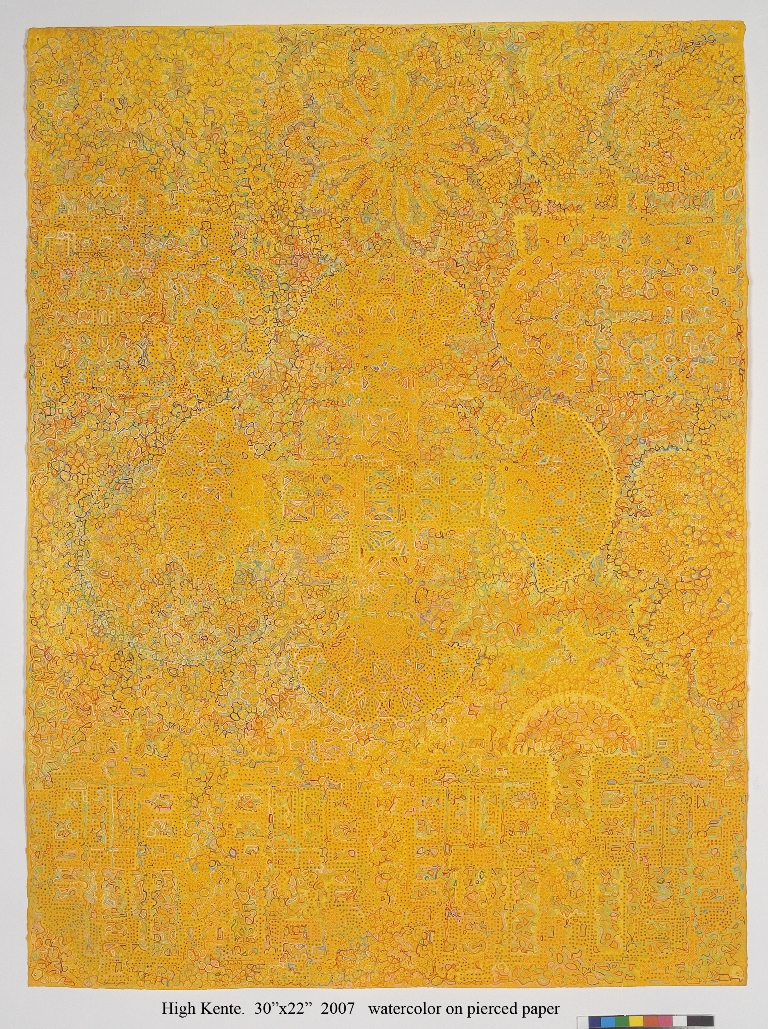
In the main gallery there is a group show of ten artists titled “Process”. I was immediately drawn to the work of David Ambrose. He has a very interesting approach to working with paper. He first pierces the paper, making a multitude of tiny holes with raised lips. These pierces create patterns. When a pigment is then applied to this uneven surface it is forced to interact with the pattern.

High Kente (2)

David Ambrose
High Kente, 2007
watercolor on paper
30’’ x 22’’
Picture courtesy of the artist and the gallery

The punctured patterns in “High Kente”  have an architectural element. Near the top there is a circular form divided up into ten even segments. It reminds me of patterns found in both stained glass windows and Middle Eastern ornamentation. There are other sections of the paper with rectangular grids and other geometric forms. Some of Ambrose’s work uses lace patterning as inspiration. The piercing of this work creates a type of paper lace. Lace making is probably one of the most mathematical of all needlework. That mathematical sensibility has carried over to this watercolor on  pierced paper .

— Susan Happersett
Daniel Canogar at bitforms gallery

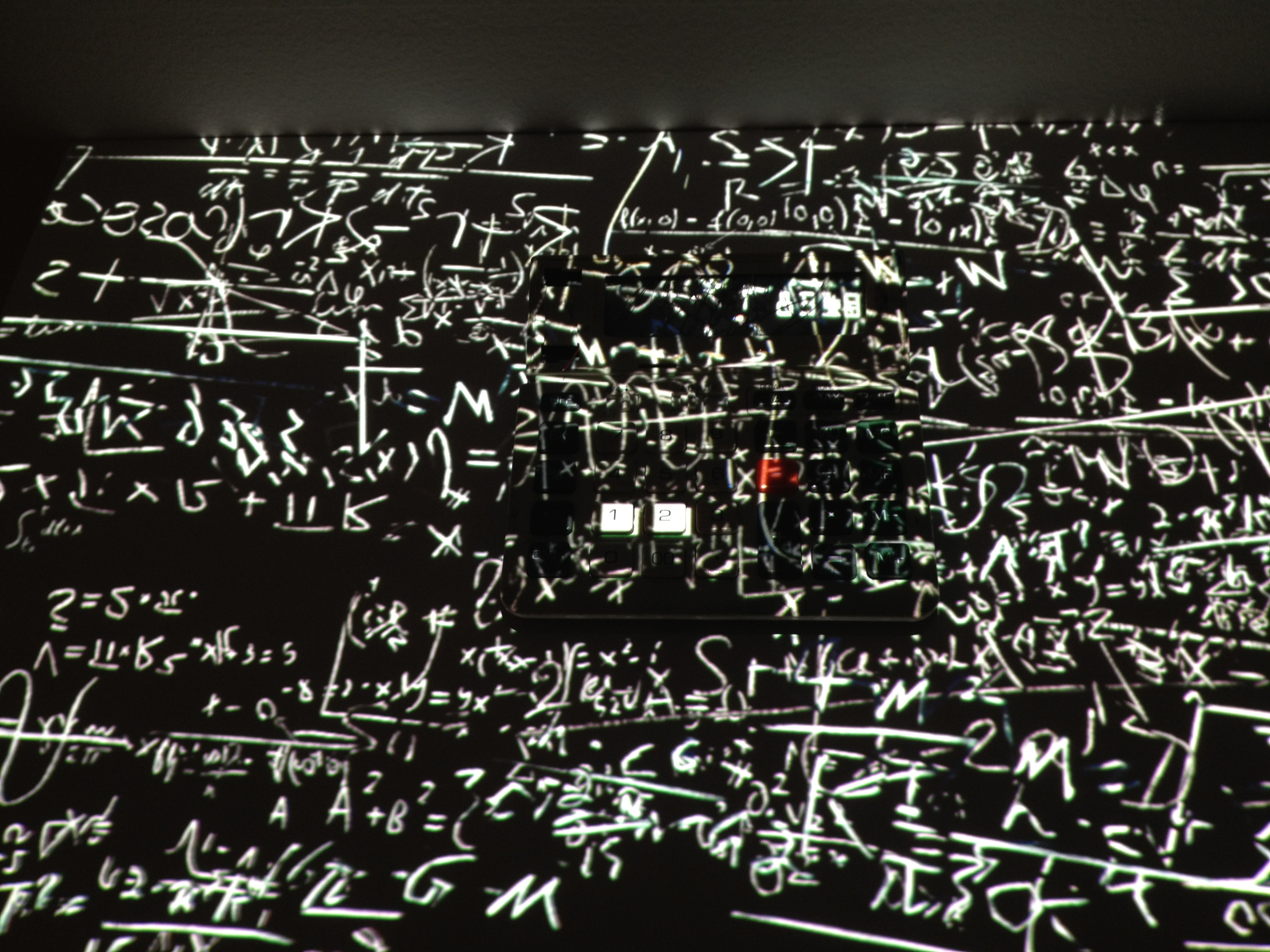
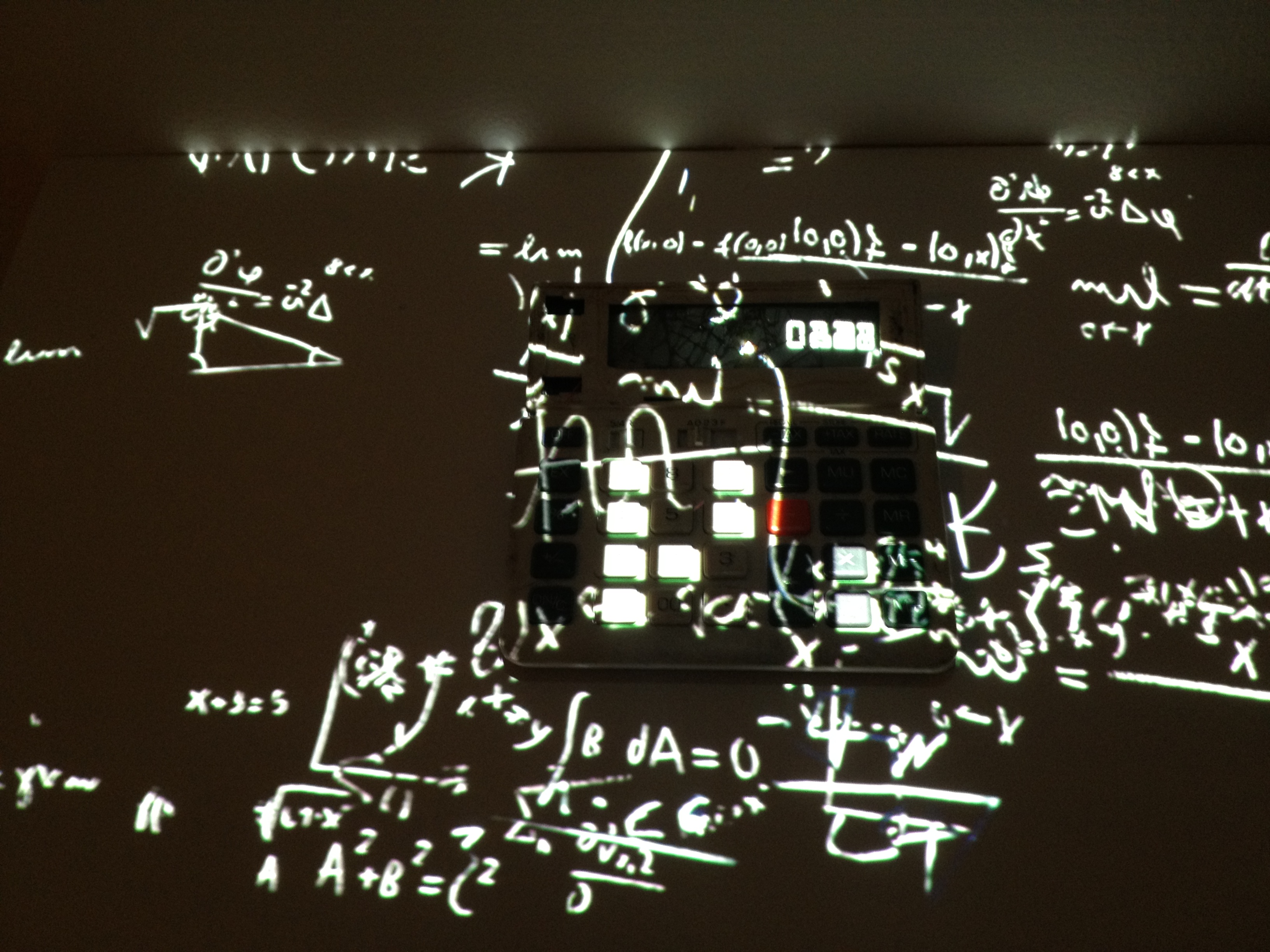
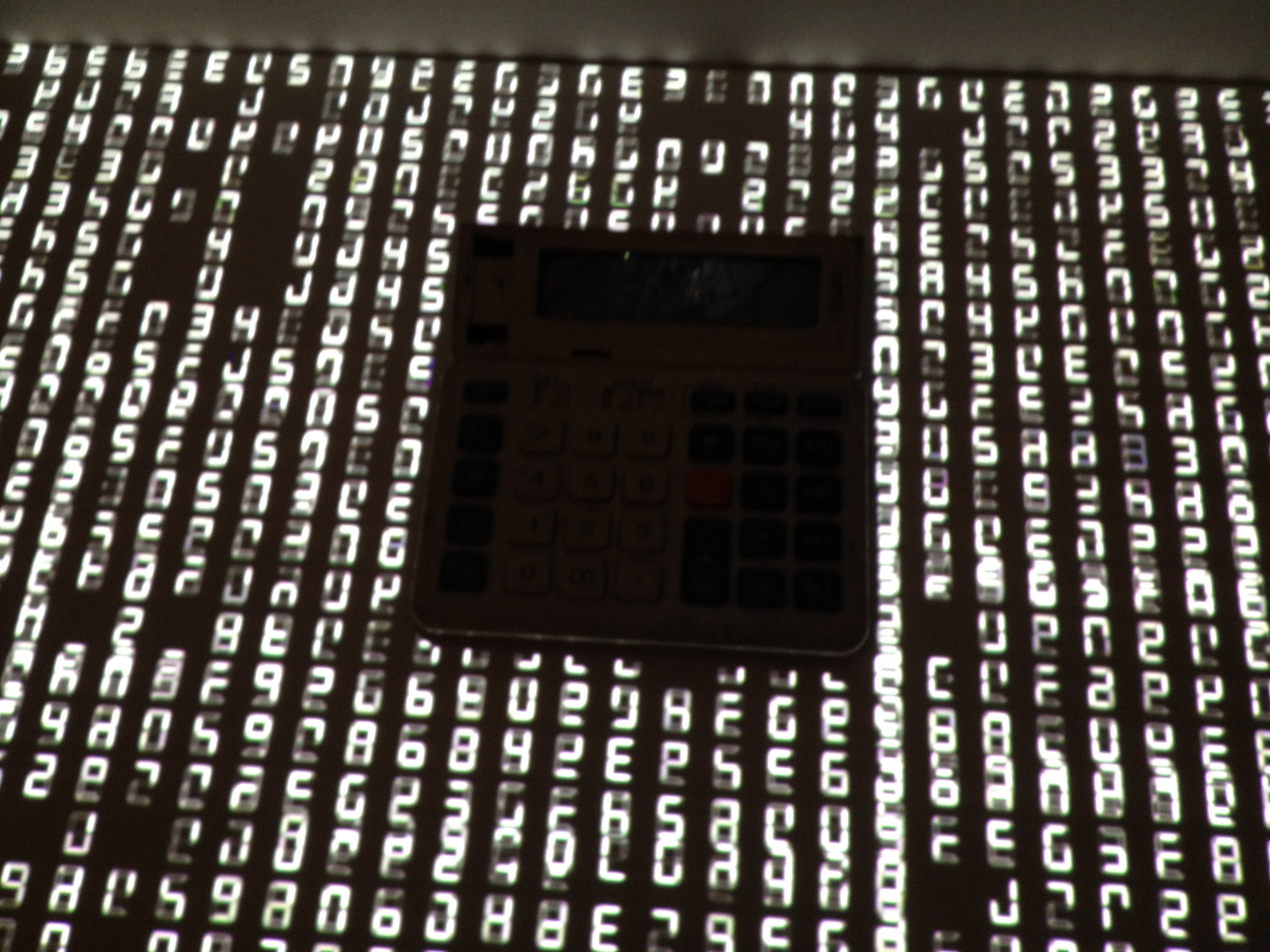
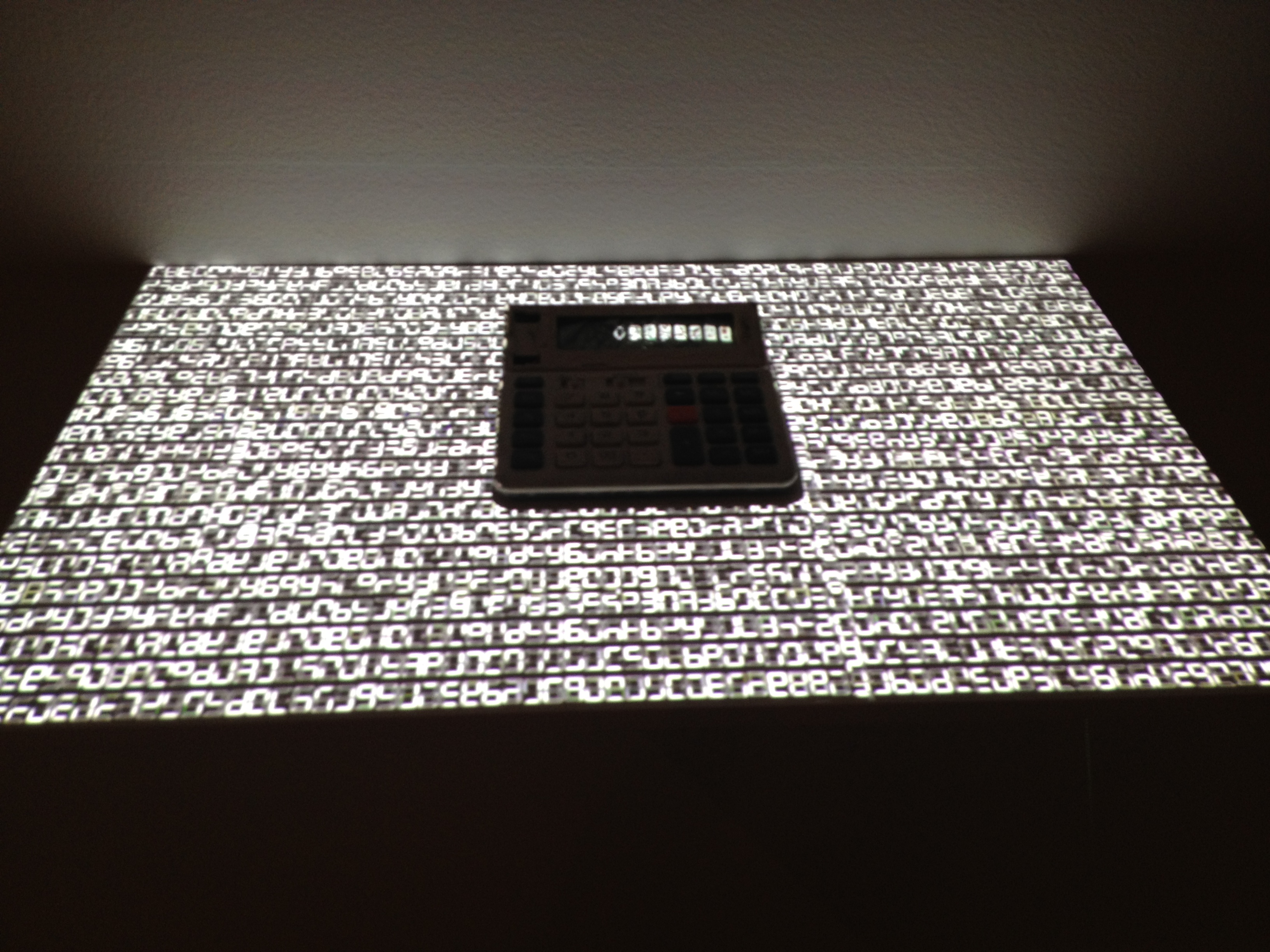
Bitforms gallery specializes in exhibiting work in the realm of new media and digital art. Daniel Canogar is  known for his photographic, video, and installation art. He has exhibited extensively throughout Europe and the United States, including numerous site specific public art displays. Canogar’s current show at bit forms gallery is titled “Small Data” and consists of nine small installations. Each of the nine works include some sort of used personal technical device that the artist has bathed in an overhead photographic video projection.

20-1

20-2

20-3

20-4

In the work “AC, 2014”  Canogar uses an old calculator with a broken screen. A black and white video presentation incorporating a series of LCD numbers, hand written mathematical formulas, as well as other images is projected onto the calculator. The scale of this work makes it a very personal statement about the tenuous and fickle relationships humans have with our electronic devices. The device is no longer useful for its original purpose, but the remnants of the numbers it displayed and the formulas it helped solve still linger. It seems to me that “AC, 2014” is not only about the technological apparatus, it is also a statement about society’s relationship with numbers and mathematics. The rows of glowing calculator numbers, as well as the scribbles of formulae  – that accumulate and then recede – create a sense of anxiety.

— Susan Happersett
Pius Fox at Pablo’s Birthday Gallery

The German artist Pius Fox is having his first solo exhibition in New York City at Pablo’s Birthday Gallery. The title of the show is “We expected something better than before” and features  wonderful abstract paintings, whose geometries are based on interior architectural elements. I have chosen two works that seem to me to have the most mathematical significance.

Pius Fox - Zeitland Schaft - Oil on Canvas - 2014Picture courtesy of the artist and the gallery

Pius Fox – Zeitland Schaft – Oil on Canvas – 2014
Picture courtesy of the artist and the gallery

The first painting is “Zeitland Schaft”,  an oil painting from 2014. This work features four rectangles. Each is bisected diagonally to form eight right triangles. What I find interesting about this work is how it relates to the work of Piet Mondrian and Kazimir Malevich. Malevich used the geometric forms as his subject matter: the paintings were traditional in the fact that, even though he was depicting  abstract themes, they were still  pictures  of shapes within a background. In Mondrian’s square canvases the square itself becomes both the format and the subject. There is no longer a delineation between subject and artwork. I feel that in some ways Fox’s work is taking this use of geometric forms a step further. In this painting rectangles and triangles might – at first glance – seem to be the subject of this work, but in fact it is much deeper. The geometric shapes are a vehicle for Fox’s use of layers of color and his lush painting technique. The symmetrical properties of the painting – for example the glide reflections in the placement of the pink and yellow triangles – enhance the relationships of colors, making them seem to glow.

19-2

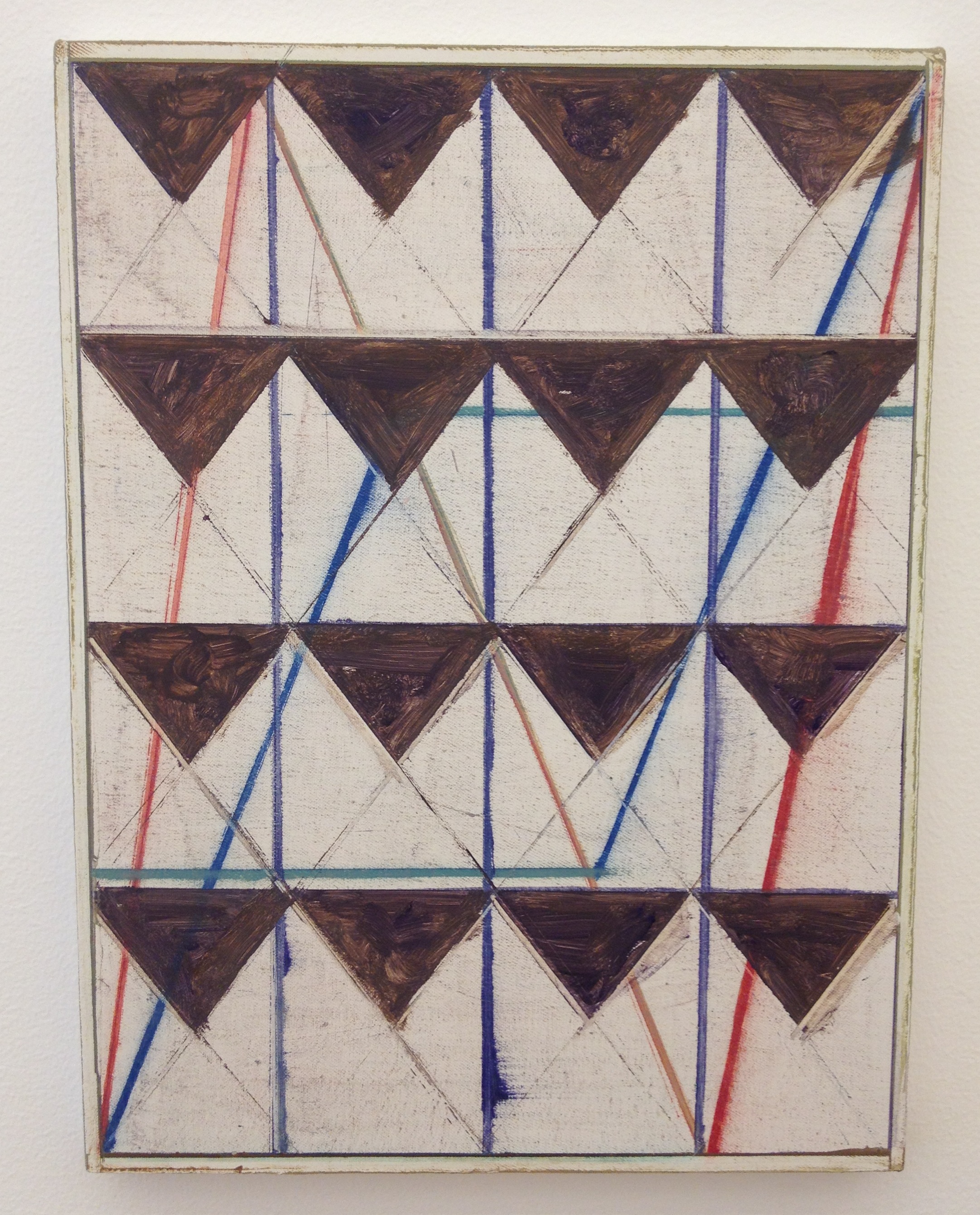
Pius Fox – Untitled (PF 1403-41) – Oil on canvas – 2014
Picture courtesy of the artist and the gallery

The next painting I would like to discuss is an untitled oil on canvas also from 2014. I Particularly like the use of both line and solid shapes this painting. Dividing the rectangular canvas into four columns and four rows, Fox has set up an interesting grid to draw lines connecting the points of intersection on the grid. Lightly drawing in both diagonals of each rectangular grid cell, he fills in a dark isosceles triangle in the top half of each. This creates a strong pattern that superimposes the other lines of the painting. Behind the triangles there is a 180 degree rotational symmetry to the red blue and gold lines. Looking at this  painting the viewer gets the feeling that it is about more than just the geometry. Again,the shapes are the language that Fox is using to convey a sense of place.

— Susan Happersett