Metro Curates

Every January there are a whole host of Art and Antique Fairs in NYC. One of my favorites is the Metro Curates Show. This event features dealers that together present a broad eclectic selection: Ethnographic Art, 20th century Modernist abstract paintings, folk art, as well as new work by contemporary artists.
15-4-1

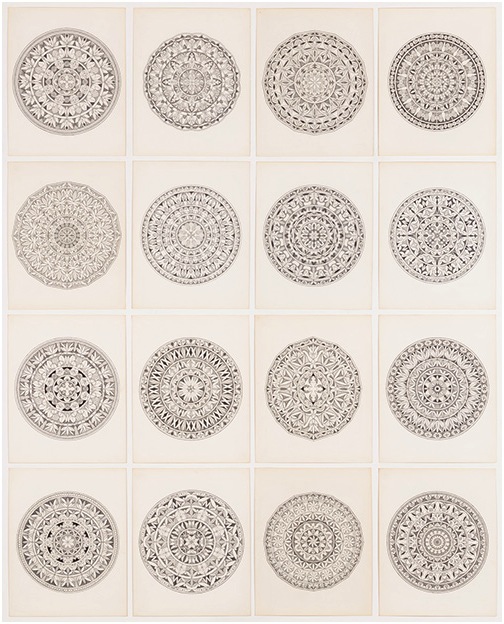
Constantine Karron, Untitled, 1940’s
ink on paper, 16 x 13 in.
Picture courtesy of Ricco Maresca Gallery

In the Ricco Maresca Gallery booth I found this amazing grid of drawings made in the 1940’s by Constantine Karron. These intricate works were all handmade using basic drafting tools. All but one of the 16 drawings are circles or regular polygons. The elaborate decorations feature rotational symmetries of varying degrees up to 16-fold. The precision and detail in these drawings is amazing. The only work that does not feature a circle or a regular polygon and  has only 2-fold rotational symmetry is the drawing in the third column from the left, and is the third down from the top of the grid. This is a drawing of an irregular 16-sided polygon (hexadecagon) that has both horizontal and vertical lines of reflection symmetry. Ricco Maresca Gallery is displaying and selling these works as a group. Although each of the drawings is very interesting on its own, together they have an even more powerful visual impact.
15-4-2

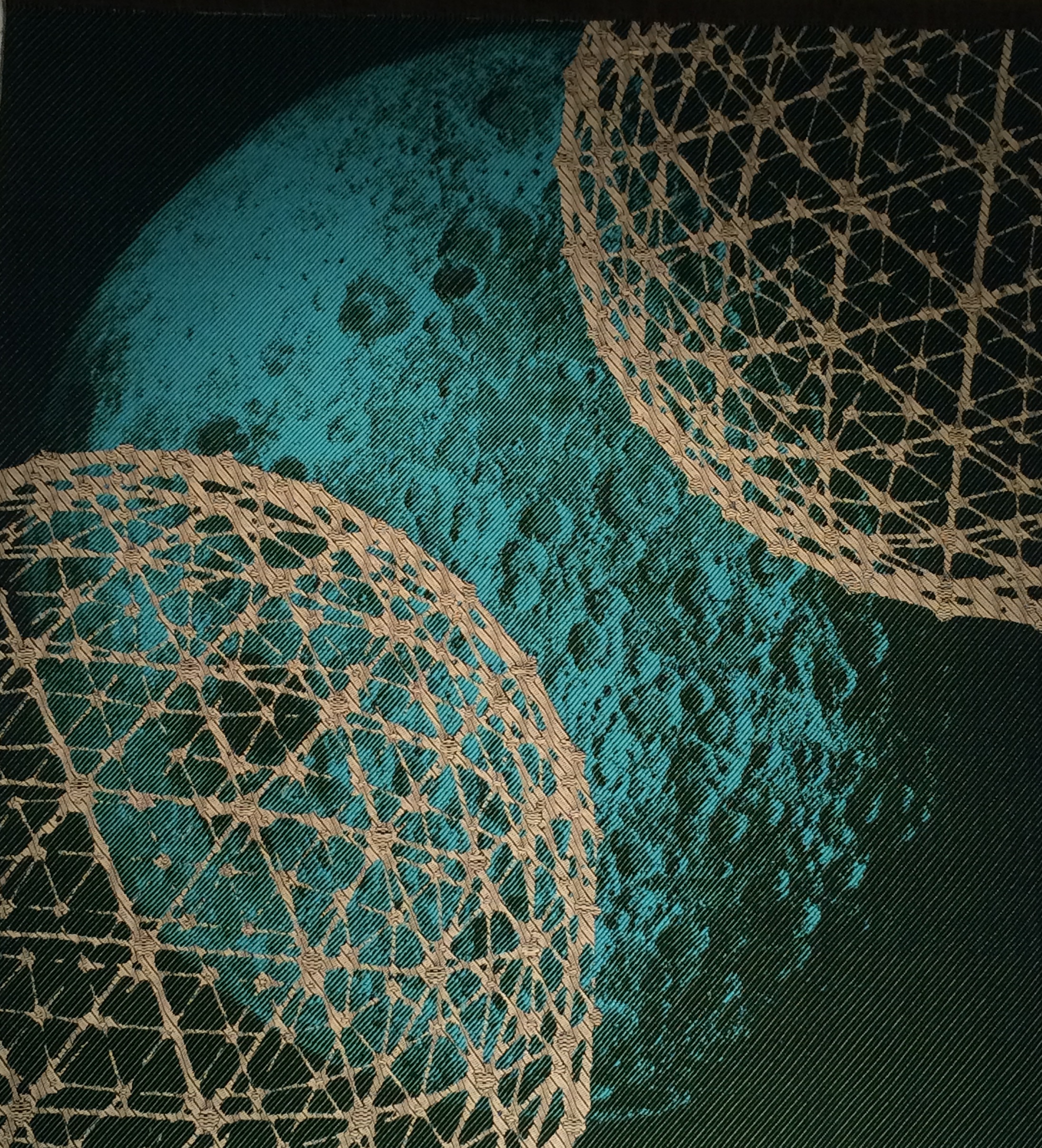
Annette Cords, “Combined Operations”, 2012
handwoven jacquard tapestry
Picture courtesy of Umbrella Arts

Annette Cords’ handwoven jacquard tapestry “Combined Operations” from 2012 was on display at the Umbrella Arts booth. I was immediately drawn into their space when I saw the geodesic spheres woven into this work. Cords also creates paintings and installations all dealing with systems of information and physics. The geometry of the spheres are quite clear but the jacquard weaving technique gives the lines a nice sketch quality. The lunar background gives the work an ethereal presence.
I spoke with Umbrella Arts gallerist and curator Margaret Bodell about my interest in Art and Mathematics and she gave me a preview of some of the amazing work that will be featured in the next show at their gallery in lower Manhattan.  The exhibition is titled “Off the Grid” and it will take place from February 5th to February 28th. I will definitely be heading downtown to see and review the show. I know already there will be art with interesting Mathematical connections.

Susan

Jan Schoonhoven at David Zwirner

The David Zwirner Gallery’s 20th Street branch in Chelsea is presenting a large show of the work by one of the most influential Dutch artists of the last half of the twentieth century, Jan Schoonhoven. A member of the Nul Groep in Holland, Schoonhoven was connected to the international art movement “ZERO Group”. The artist members of these groups worked to develop a type of art that was more objective then the more emotionally expressive art created after WWII. Schoonhoven established techniques to create monochromatic wall sculptures that relied on clean geometric lines to explore form,light, and shadows.

15-4-1

Jan Schoonhoven – “R70-28” – 1970

The rectangular grids like the ones seen in “R70-28” from 1970 are probably the types of structures that became most famous. A square relief sculpture with 5 columns with ten rows each. The white walls are the grid lines, creating rectangles with a 1:2 ratio of height to width. The exhibition at David Zwirner is quite inclusive and includes works on paper, earlier geometric work, as well as work featuring more complex geometry.

Schoonhoven used latex paint, paper, cardboard and wood to assemble these sculptures. The hand of the artist has given these 3-D spaces an ageless quality. Although the geometry is all straight edges there is a softness to the lines of these shadow boxes.

15-4-2

Jan Schoonhoven – “R69-33”

The work “R69-33” from 1969 has a rather complex pattern made up of trapezoidal surfaces. They are positioned into rows with horizontal axes of symmetry. The longer side of each trapezoid is closest to the viewer. This work offers a dramatic example of Schoonhoven’s use of shadows.

15-4-3

Jan SChoonhoven – “Diagonalen” – 1967

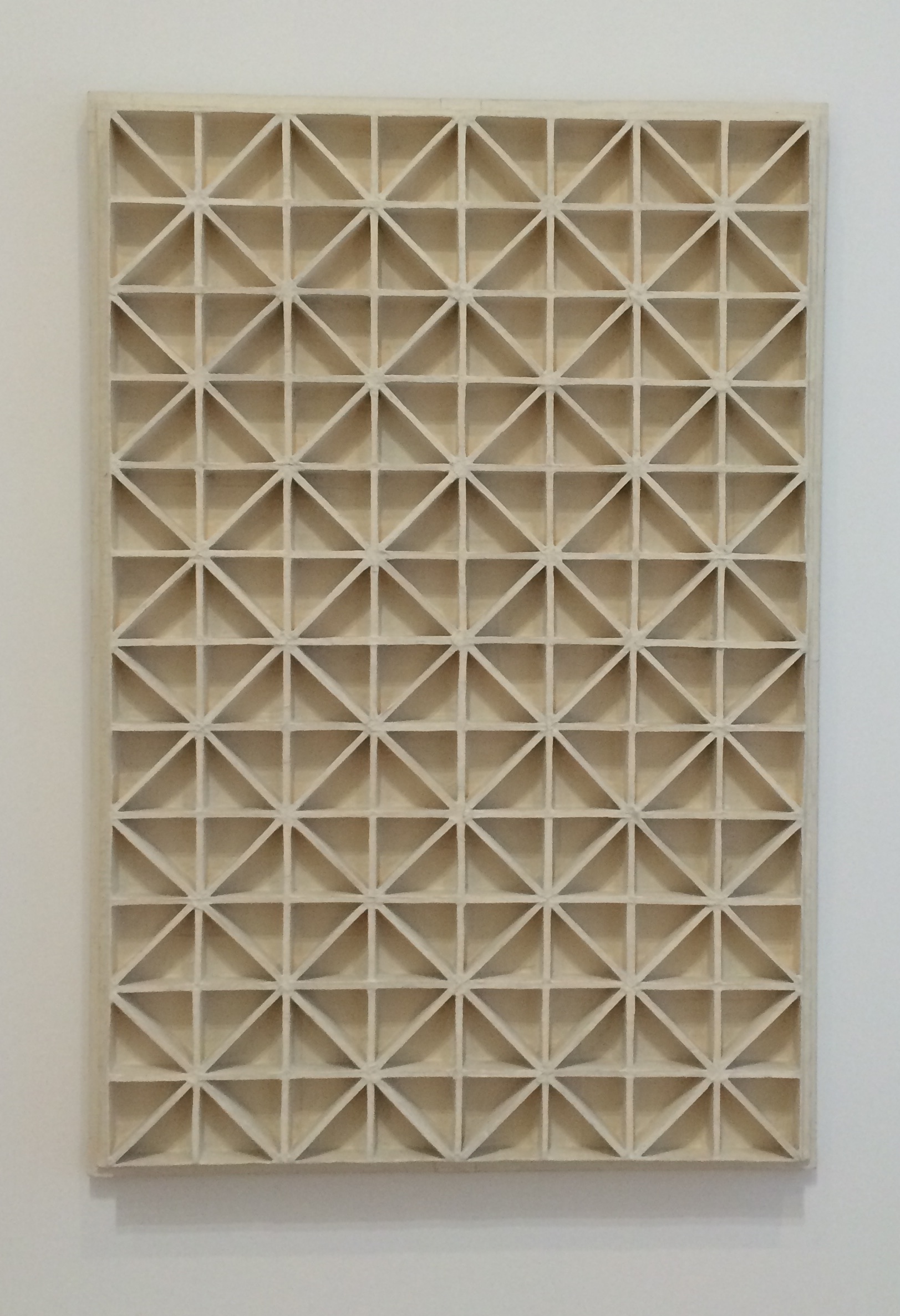
“Diagonalen” from 1967 is one of my favorite pieces in the show. The grid format is intact but by bisecting each grid square on alternating diagonals the artist has created a lattice of right triangles. One of the most exciting elements of Schoonhoven’s wall sculptures is that they change depending on the angle from which you see the art. As the viewer moves around the gallery the shadows are changing.

All pictures courtesy of the gallery.

Susan Happersett

Warren Isensee at Danese Corey Gallery

The Danese Corey Gallery is currently exhibiting the abstract geometric paintings of Warren Isensee. The artist uses a playful vocabulary of color to achieve an exciting sense of light. The straight edges are all hand painted without the aid of taping and Isensee uses adjacent colors that create enough tension that the work pulses with energy.

15-3-1

“Dark Heart”, 2014

The large square canvas “Dark Heart” provides an interesting perspective on the grid. Floating in a field of steel blue, the yellow black and red figure is made up of solid and striped squares. Alternating from horizontal to vertical of striped squares, the patterning draws the viewer’s eye to the two central horizontal bands. This work features both horizontal an vertical axises of symmetry through its center .

15-3-2

“Surface Noise”

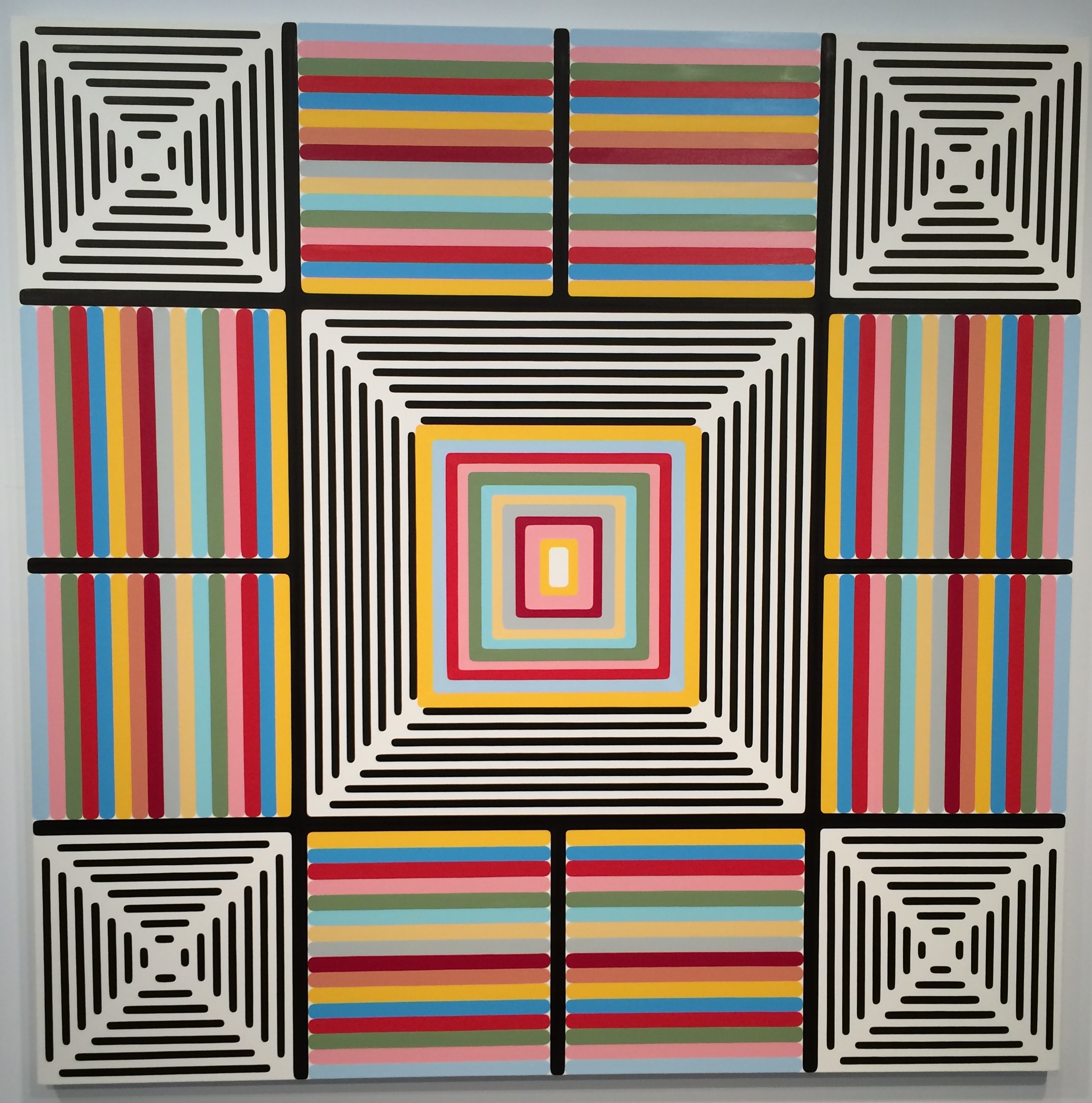
“Surface Noise” offers the viewer an optical trick. At first glance it appears to have a nice neat four-fold rotational symmetry. The artist has painstaking created detailed elements of the composition that possess four-fold rotational symmetrical patterns. Only after close inspection you realize that the small center form is a rectangle and not a square. This painting has horizontal and vertical axises of symmetry, but it is not four-fold rotational symmetry. I think the slight deviation makes “Surface Noise” more interesting. It becomes a commentary on the visual expectations of symmetry.

Pictures courtesy of the gallery and the artist.

More math art next time

Susan

Dianna Molzan at MOMA

The Museum of of Modern Art is currently hosting an exhibition of the work of 17 diverse artists entitled “The Forever Now, Contemporary Painting in an Atemporal World”. The work is all made in the 21st Century, and the general theme of the show is that this work does not have defining elements that would indicate when the work was produced. The term “atemporal” refers to timelessness, as well as the way the art incorporates ideas from the past. The internet offers contemporary artists access to massive amounts of images and texts about previous generations of  artists and their work. This knowledge is then incorporated into this new 21st century art.

Dianna Molzan has two works in the show that relate to the traditional rectangular dimensions of a stretched canvas paintings. The first, “Untitled 2010”,  features a set of wooden stretcher bars with canvas attached on the two vertical sides. the painted canvas has been slashed with a series of horizontal cuts that creates ribbons of canvas that drape down in curve.

15-2-1

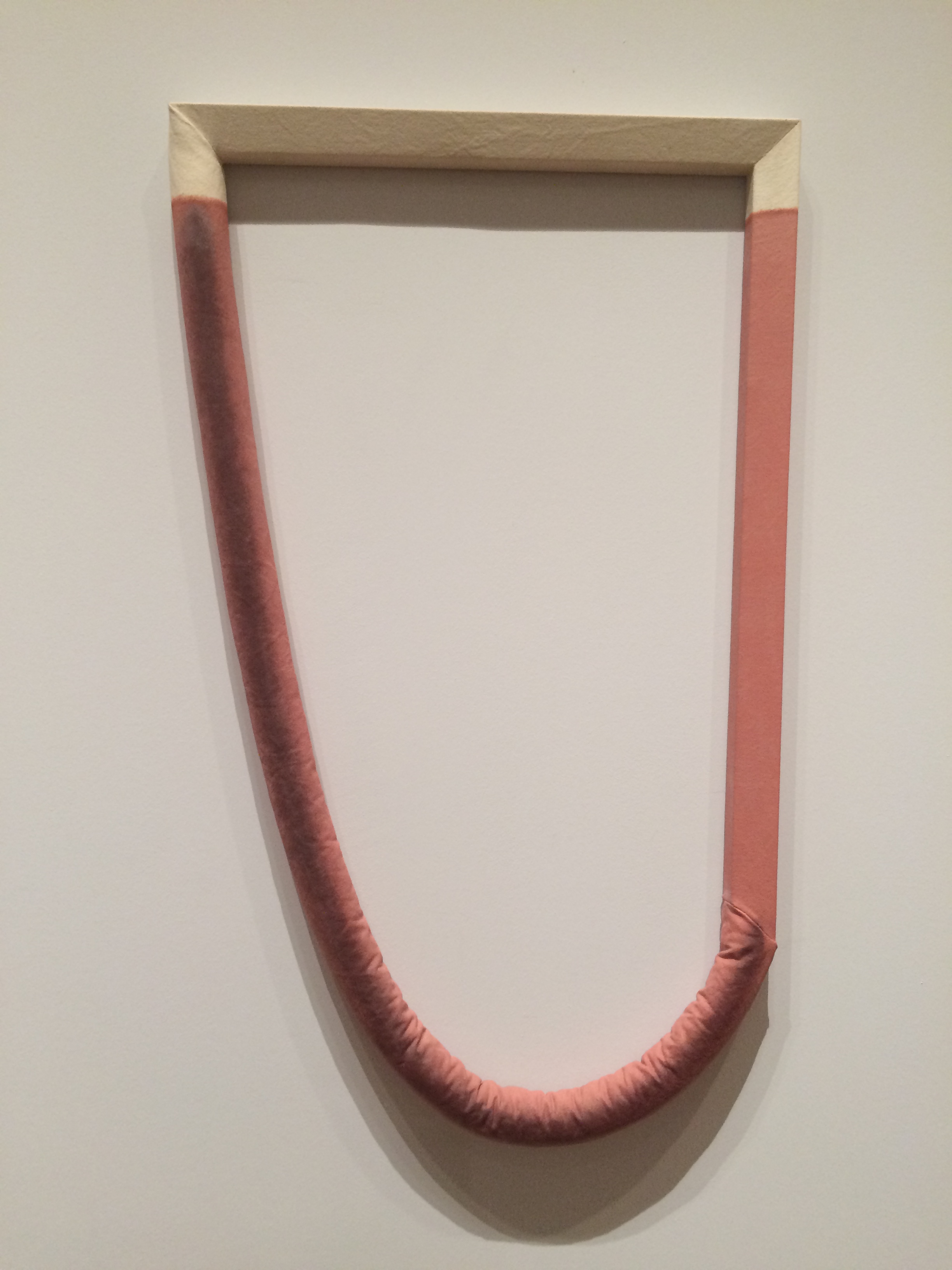
The second painting, “Untitled 2011”,  is also based on a rectangle, but instead of having all four sides made out of wood, the left side of the frame and the bottom edge have been replaced with a stuffed and painted canvas tube. This has created a slack curved line.

15-2-2

Both of these works address the idea of the rectangular perimeter of traditional easel paintings. Molzan has distorted the geometry of the shape by either slashing the canvas or replacing the stretcher bar with a fabric sculptural element.

Pictures courtesy of the museum and the artist.

– Susan Happersett

Thomas Houseago at Hauser and Wirth

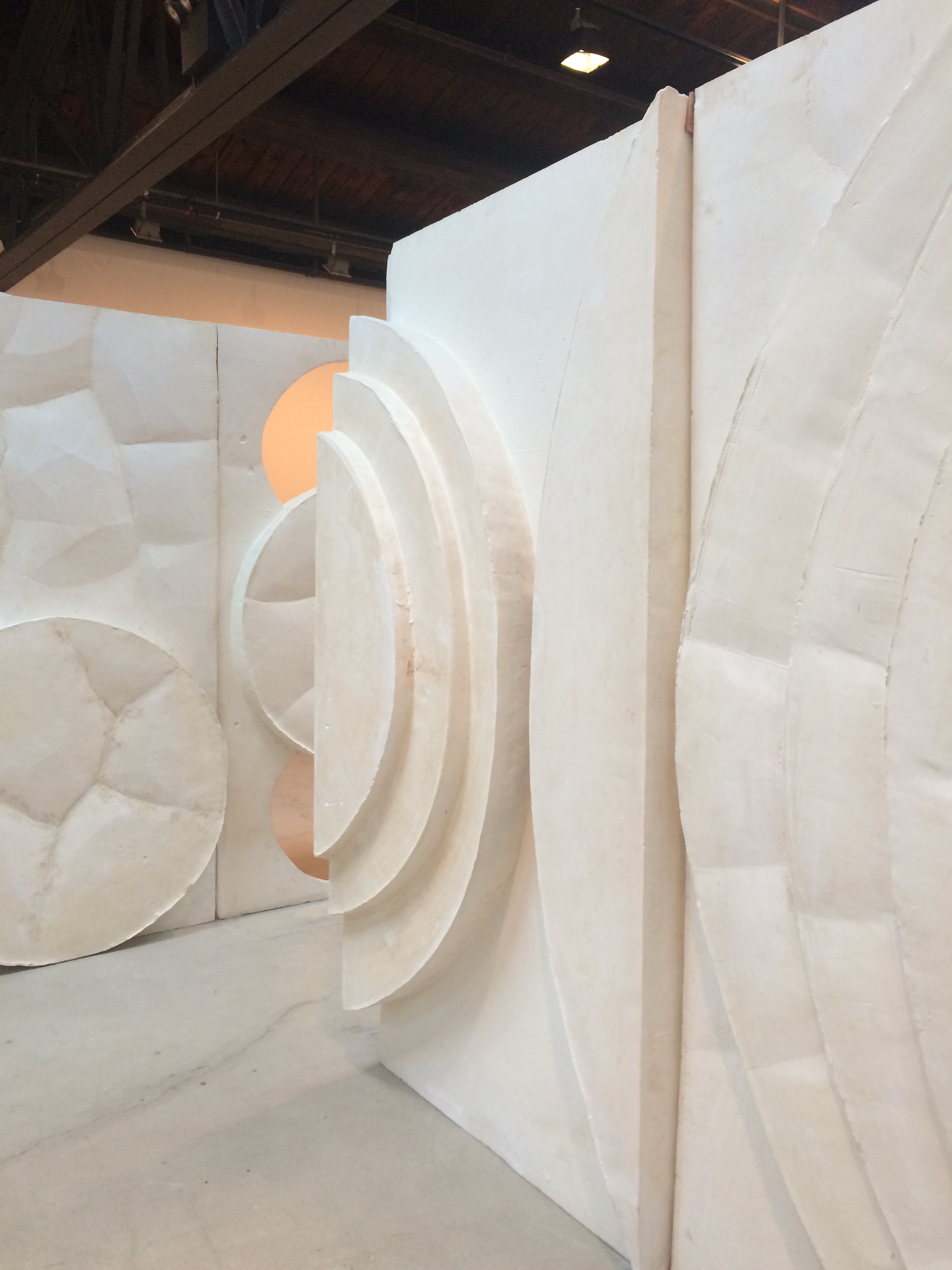
The huge installation construction “Moun Room” by Housago is currently on display at the Hauser and Wirth Gallery on 18th street in Manhattan. The plaster and iron re-bar structure is actually three rooms –  one inside the other – like nesting dolls. There are circular and arched openings so the viewer can see into the layers of the structure from the outside, as well as walk into the construction.

15-1-1

The artists choice of materials as well as his building techniques create a contrast from the rough exterior where the support elements are visible to the smoothness of the interior plaster walls. It was snowy day in Manhattan on the afternoon that I visited the gallery and the interior corridors almost seemed to glow liked packed snow. There is definitely a spiritual element to the experience.

15-1-2

The architecture of this work is very much invested in the geometry of circles. Houseago explores circles as both positive and negative space. Sets of consecutive circles, and circles divided by arcs and chords are also featured throughout the installation.

15-1-3

Houseago uses the same geometric principles found in modernist paintings since the middle of the 20th century. The scale, materials and textures of “Moun House” offer a fresh perspective to the circular theme.

All pictures courtesy of the gallery and the artist.

Susan Happersett

Happy Holidays

Each December the department stores in NYC create elaborate window displays to celebrate the season. This year, the window at Barney’s on Madison Avenue include Mathematical art. “The Snow Spirits” is a collection of kinetic sculptures by Anthony Howe that creates an eye catching display. The sculptures are based on circular rings that serve as the axis of rotation for rows of spinning, graduated circles. Because the axis is round, the circles fly into the center, and then fly outward again. These shining sculptures are one of the best expressions of snow flakes I have ever seen.

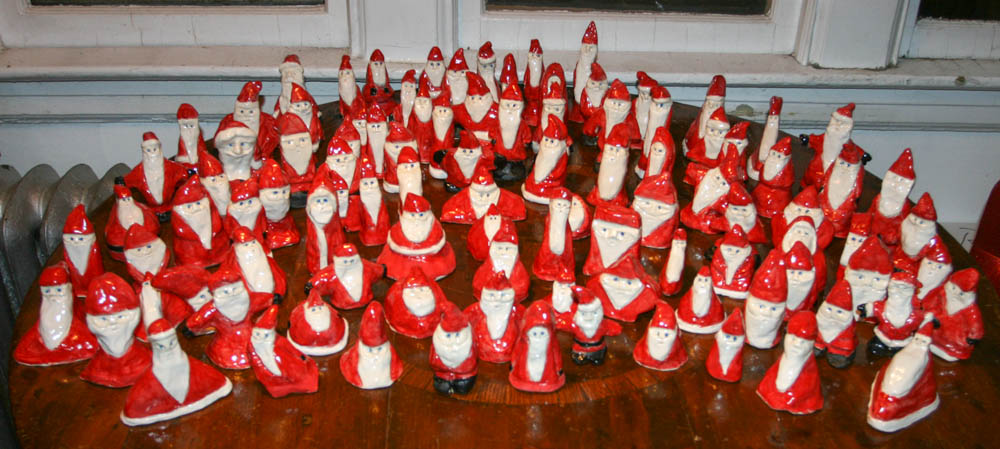
On a different, but also Mart-Art-related note, I like the use of repetitive images. Over the past year I have created a series of over 100 ceramic Santas.

Fibonacci Growth 2000 - Susan Happersett
Happy New Year – and let’s all look for more Math Art in 2015!

Susan Happersett

“Bright Matter” at the Muriel Guepin Gallery

“Bright Matter” at the Muriel Guepin Gallery is an exhibition highlighting the work of five artists using new technology, whose artistic practice address the spacial aesthetics produced through technology. Curated by participating artist Joanie Lemercier, the show features an exciting  selection of interesting geometric patterns created using machines.

blog1

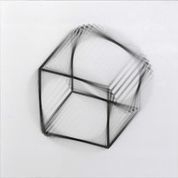
A series of prints by Francois Wunschel immediately caught my eye. “Rotation X”is  a series of lenticular prints that have been made using special magnifying lenses that change the magnification based on the angle from which an image is viewed. This creates the illusion of depth in a 2-D image. This technology has been around for a long time but it has just recently been improved so the results are much more 3-D. Standing directly in front of the prints you are looking at the 2-D line drawing of a cube but as you move the cube cube seems to rotates in space creating cylinders.

blog2

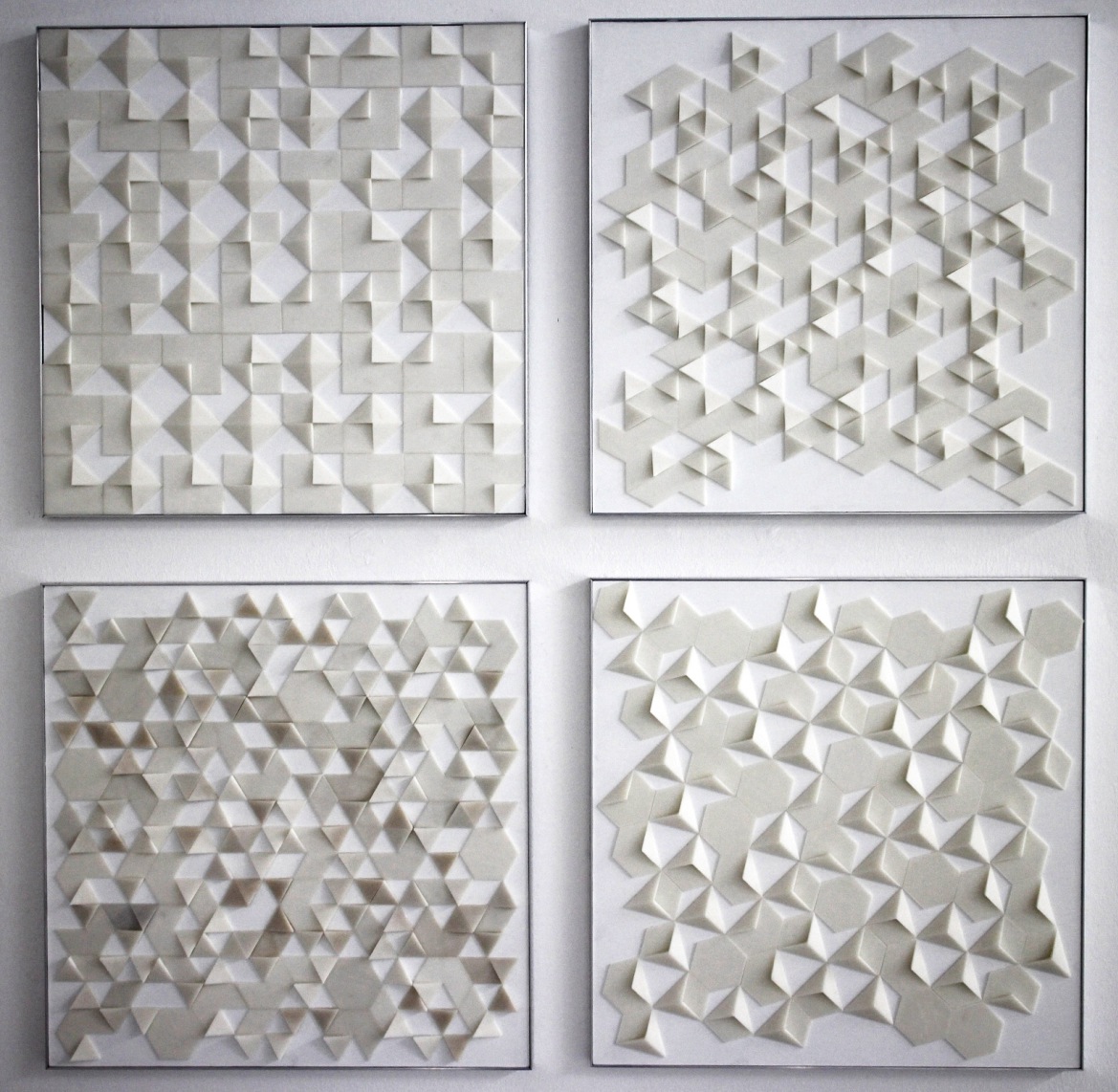
Another set of prints was designed by Lab[au] titled “Origam-Form Studies”, created on a 3-D printer. These prints are grids composed of small square tiles. The individual tiles are either flat or have the illusion of having one, two ,or three corners folded over. Using these basic simple tile elements, complex patterns develop within the grids. It seems to me the artist is mimicking the processes of computers. Built on simple, binary operations computer operations can grow to become extremely complicated and powerful.

The Muriel Guepin gallery is dedicated to exhibiting the work of artists that use the newest technology. I look forward to see future shows.

All pictures courtesy of the gallery and the artists.

Susan Happersett

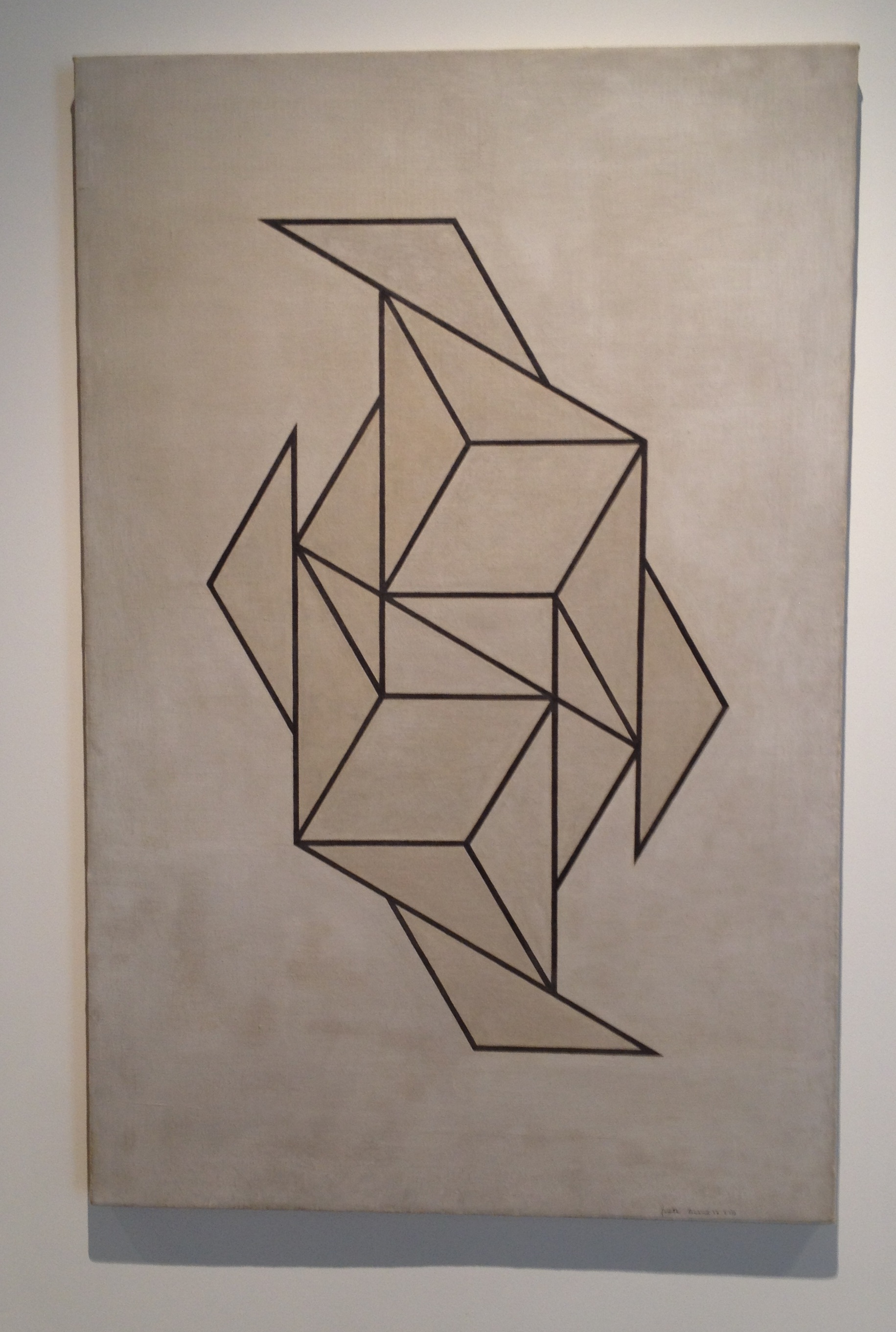
Judith Lauand at Driscoll/Babcock Galley

Judith Lauand is referred to as “Dama do concretismo” or “The First Lady of Concretism”. She is an important figure in 20th century Brazilian Art. Concretism (called “Arte Concreta” in Brazil) is an international post WWII artistic Movement that included the use of a networks of mathematical geometry to build precise abstract systems of pattern.

The exhibition at Driscoll/Babcock is Lauand’s first solo show in NYC. Dr Aliza Edelman has curated “Judith Lauand: Brazilian Modernism 1950s-2000s”. This collection of paintings and drawings demonstrates Lauands significant geometric vocabulary. Her paintings feature bright flat hard edge figures.

67-1

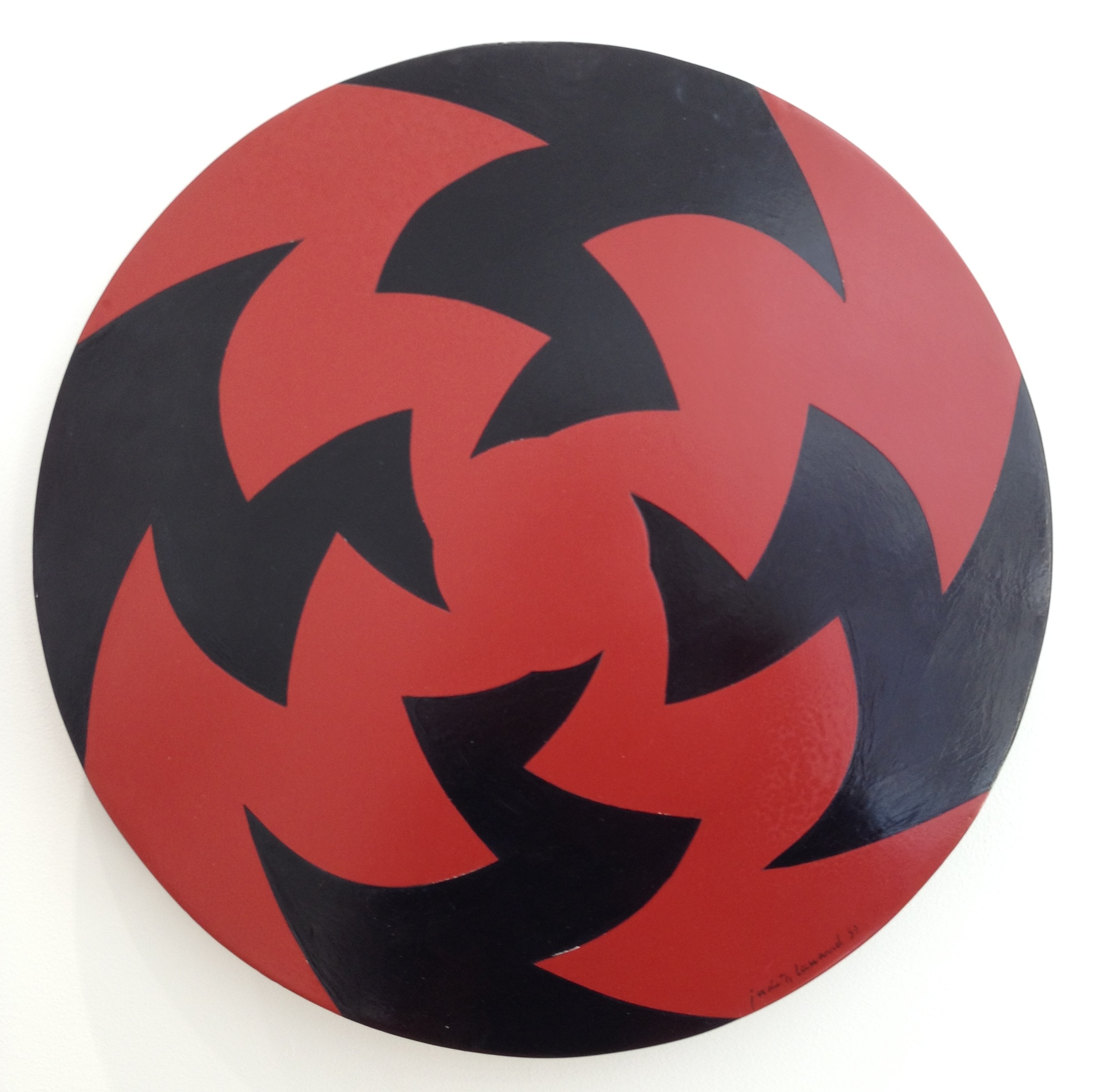
Concerto 66 – 1957

“Concerto 66” is a circular panel with four lightening bolt shapes radiating from the center, creating a four fold rotation symmetry.

67-2

Concerto 178

“Concerto 178” is tempera on canvas and is more of a line drawing. Two rhombi are surrounded by a host of triangles building a tiling type of pattern with 2 fold rotational symmetry.

Lauand’s work is a great example of the emphasis on mathematics in important  post-war abstract artistic practices.

Susan Happersett

Central Booking – Art and Science Celebration

I have written about Central Booking before here. It is a Lower Eastside Gallery run by Maddy Rosenberg that specializes in Art & Science-related content, as well as book arts. On Thursday, December 4, there will be a gathering for contributors to their current campaign. This cause is close to my heart, obviously. And, they will be serving chocolate and champagne while you’re checking their new exhibition “Psyched“.

Chocolate (from Central Booking's web site)

Chocolate (from Central Booking’s web site)

The event promises to be a lot of fun. If you are interested go here to make a tax-deductable donation and maybe I will see you there!

Screenprinting Math op-art at Kayrock Screenprinting

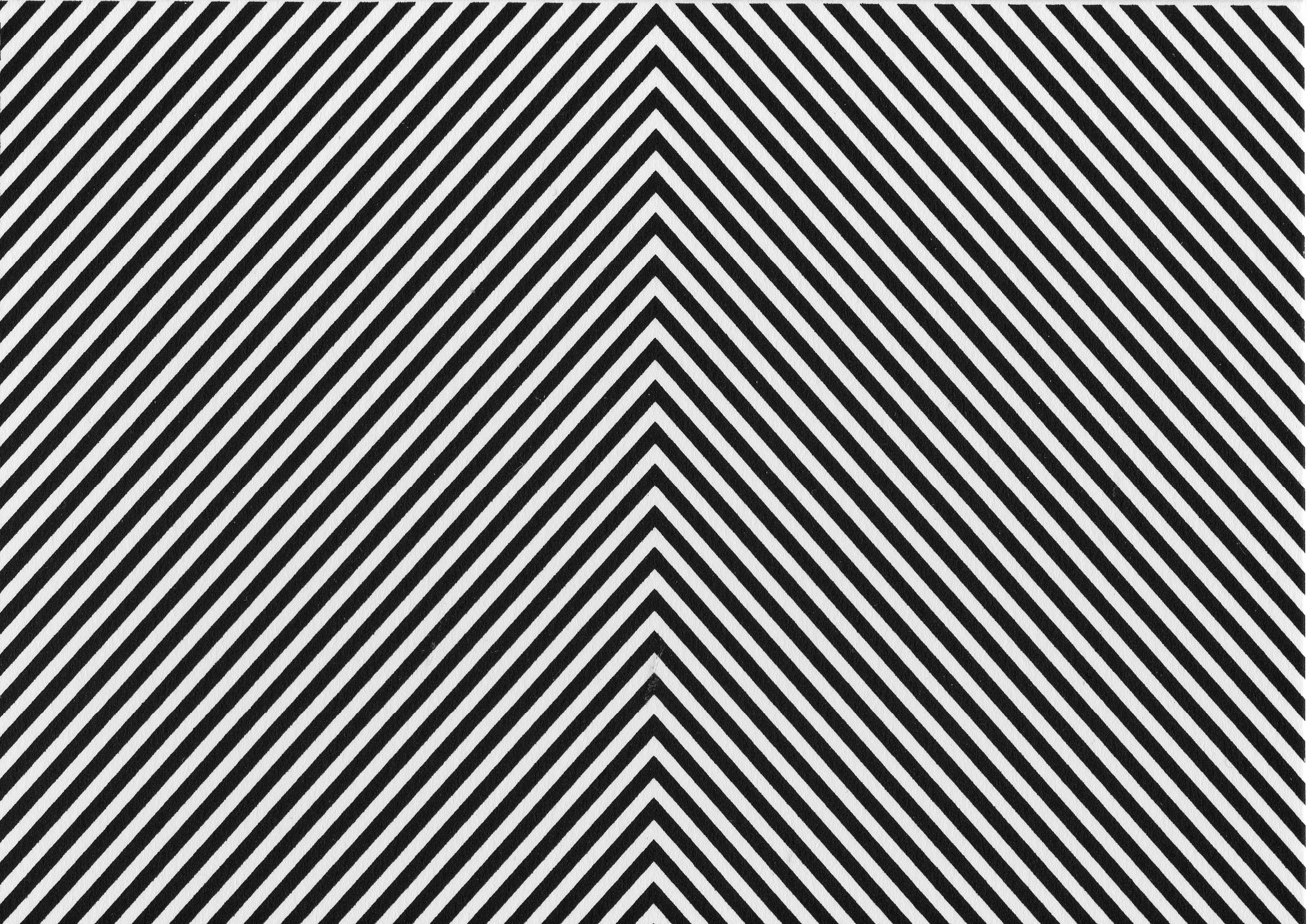
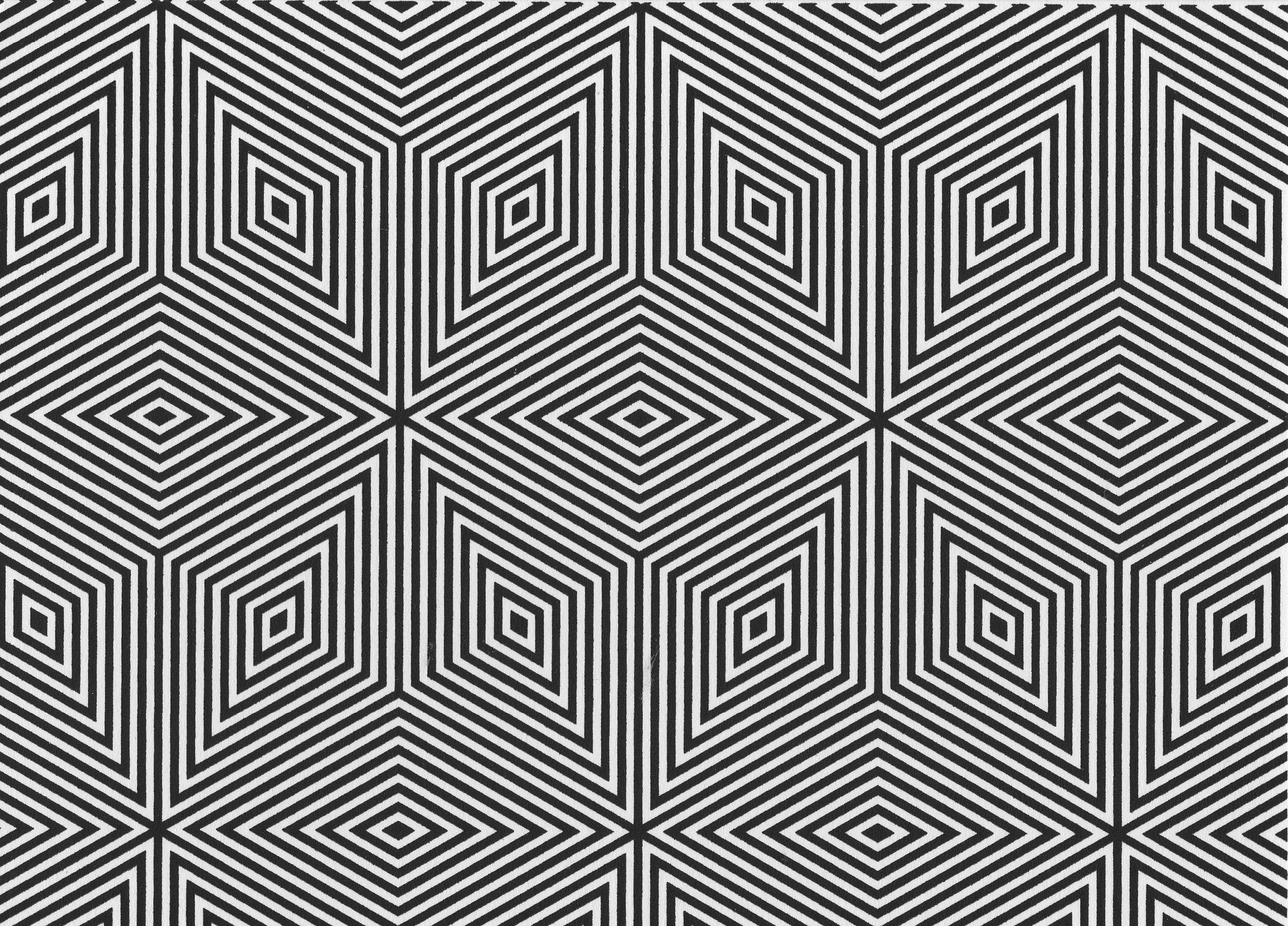
A few weeks ago at the EA/B art fair in NY I visited the booth of Kayrock Screenprinting from Brooklyn NY. The shop is run by Karl Larocca who has printed some amazing graphic patterns. I purchased a set of black and white cards with some striking use of parallel lines.

EPSON MFP image

This first card has a very basic design but the optical impact is impressively kinetic. The rectangle is divided in half with the parallel lines running at a 45 degree angle to the edges of the card so that the two sets of lines meet at a 90 degree angle along the center line. This creates a line of reflection symmetry.

EPSON MFP image

The second card is much more complicated. Creating identical kite shaped forms that are assembled into equilateral triangles, Larocca has built a mathematical tiling. Then by patterning each kite shape with parallel lines he creates a pulsating optical effect.

Even though the the patterns on each card are limited to just two alternating colors, using only straight lines of uniform width, the geometric patterns and the optical experience are surprising complex.

Susan