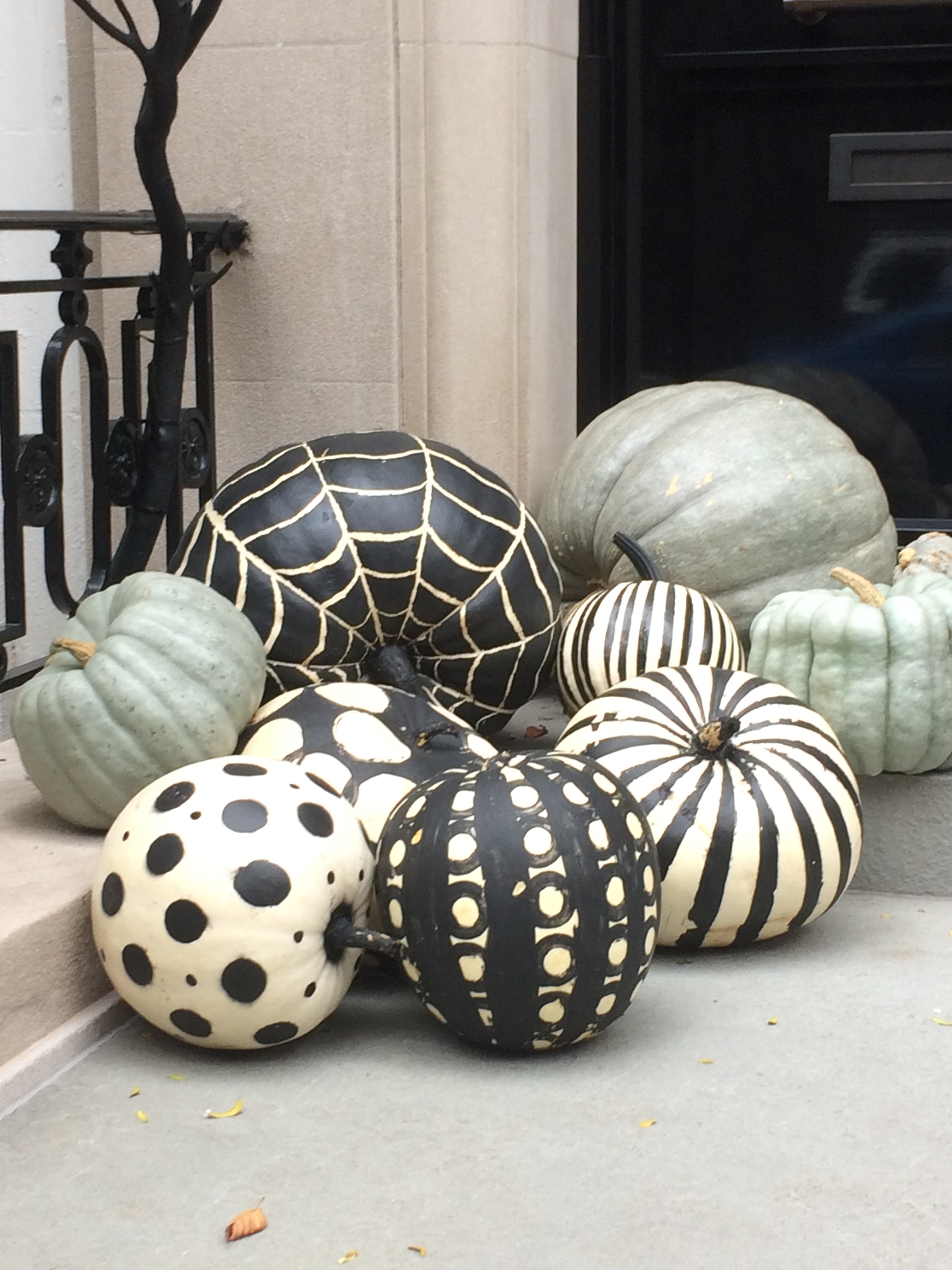
I saw this striking Halloween display in front of a town house on the Upper East Side. I think the black paintings on the white pumpkins offer some fun geometric patterns that mirror the shapes of the pumpkins. Not too scary!
Susan Happersett
I saw this striking Halloween display in front of a town house on the Upper East Side. I think the black paintings on the white pumpkins offer some fun geometric patterns that mirror the shapes of the pumpkins. Not too scary!
Susan Happersett
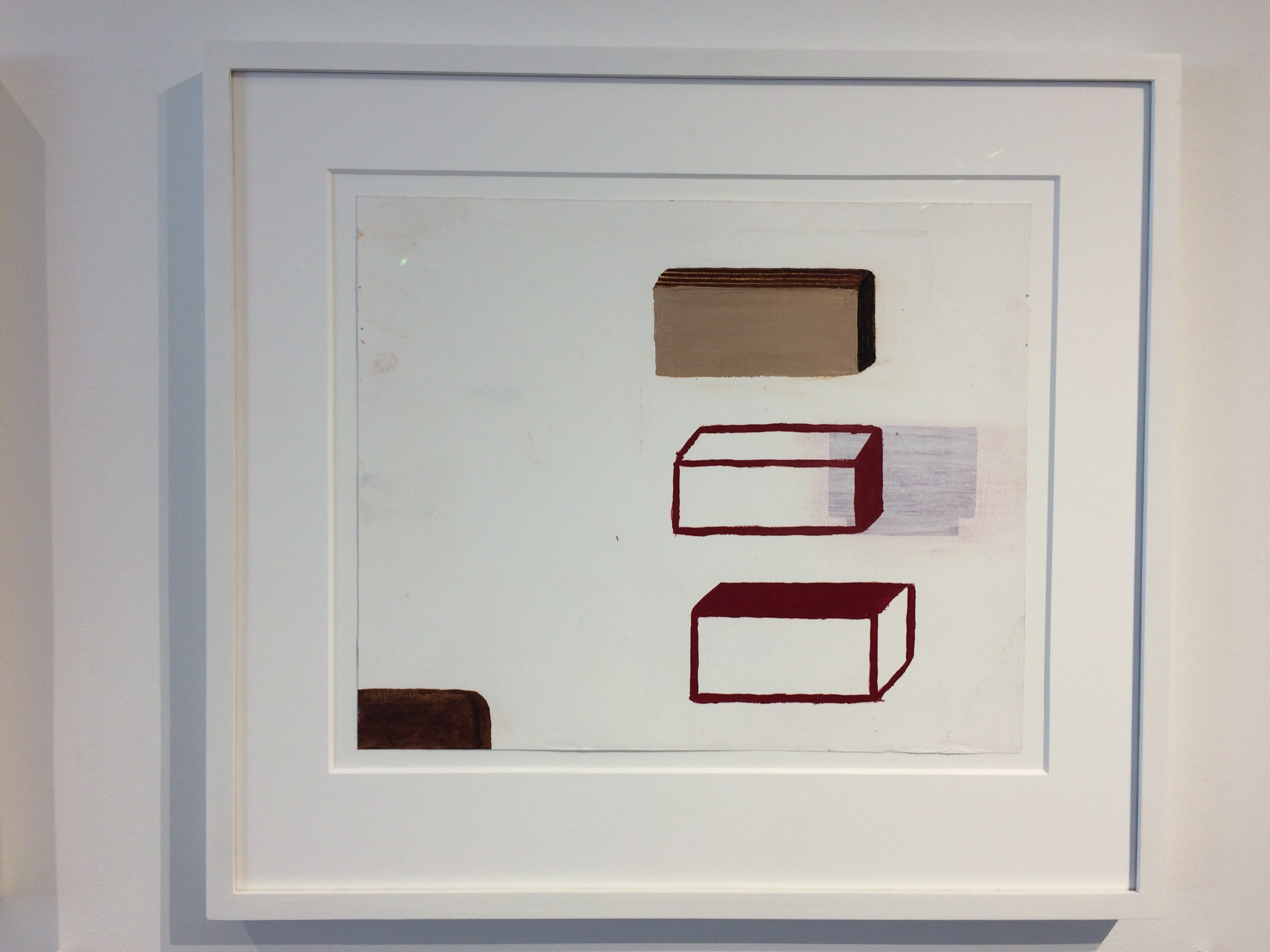
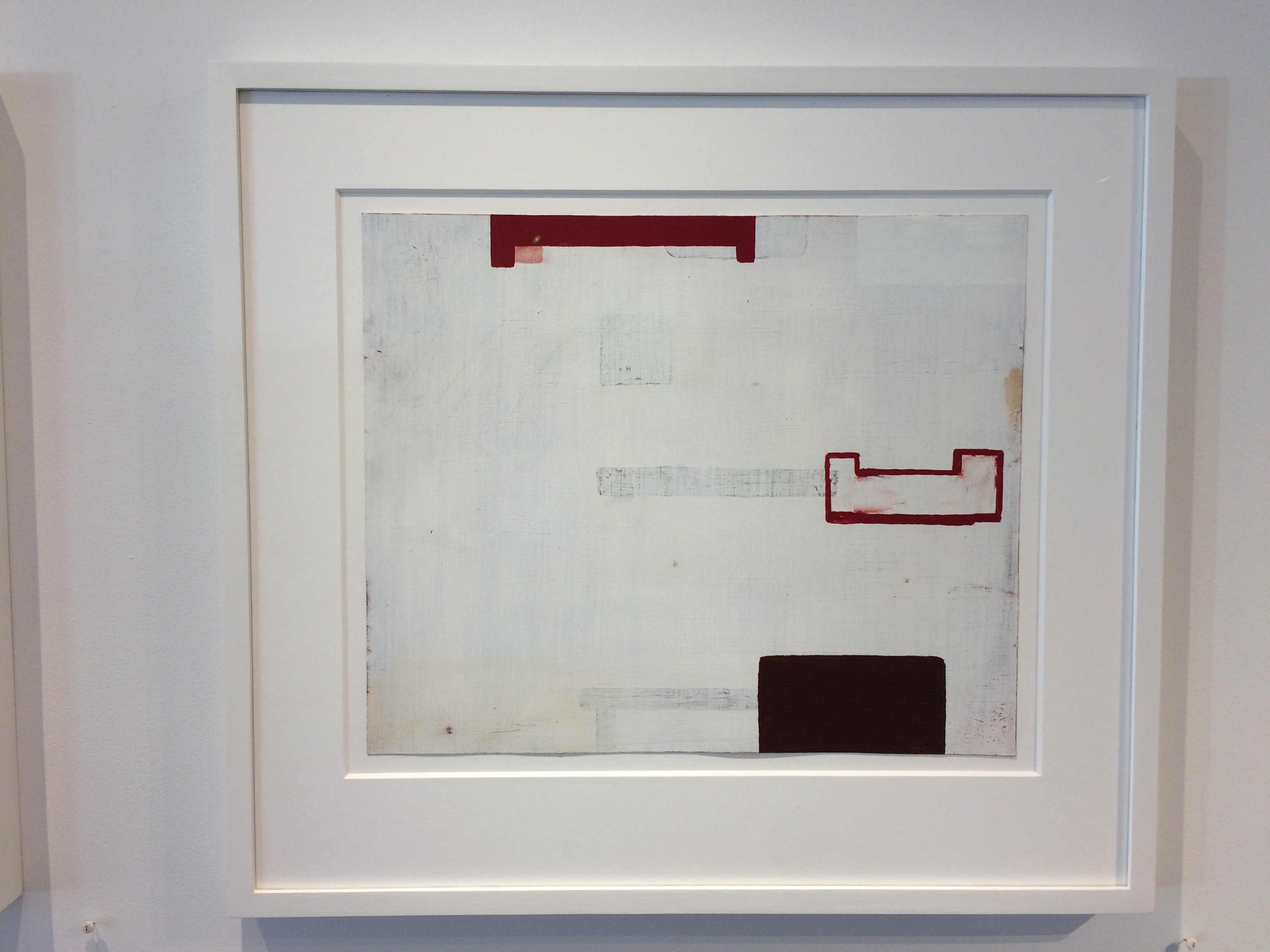
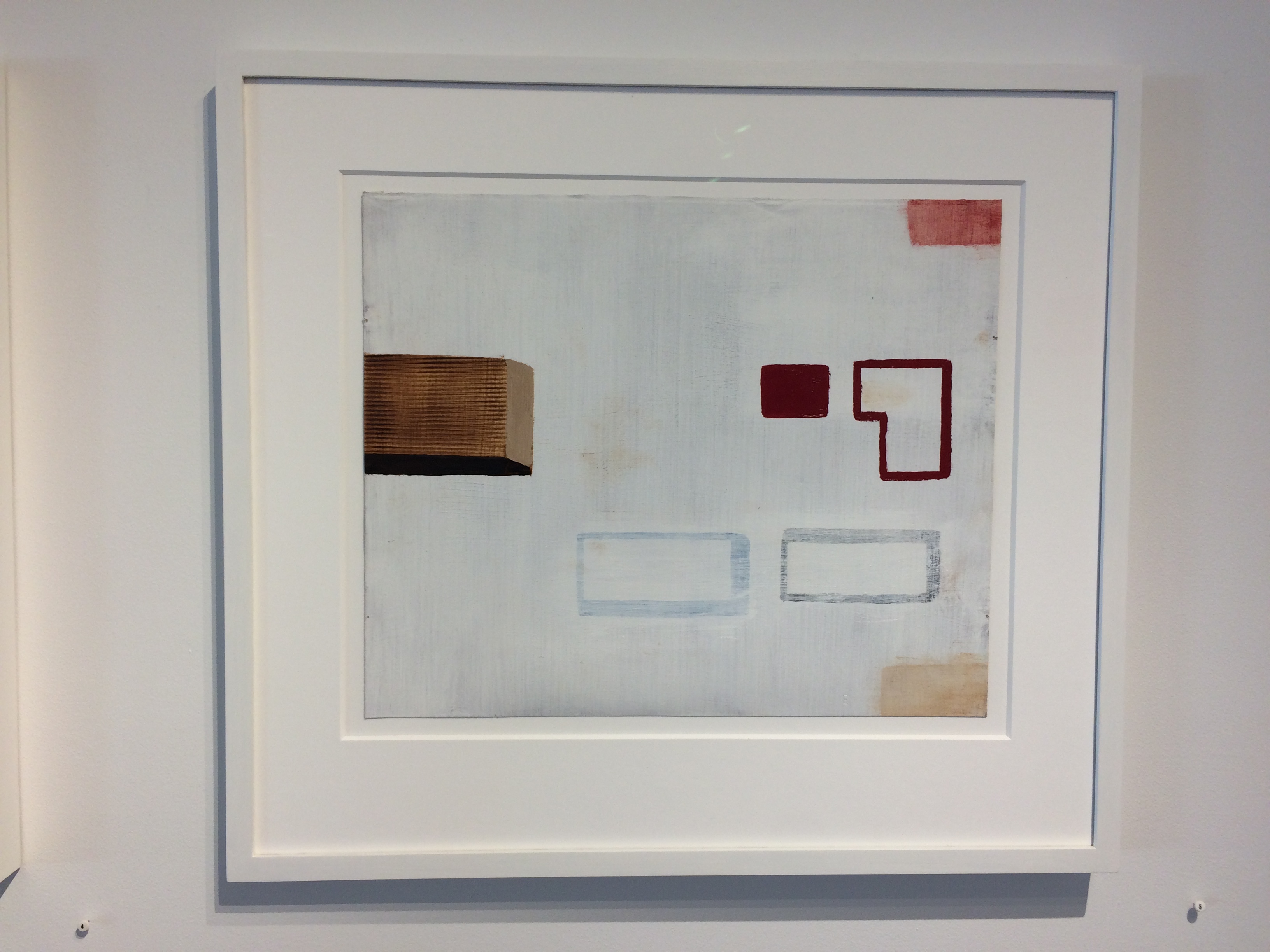
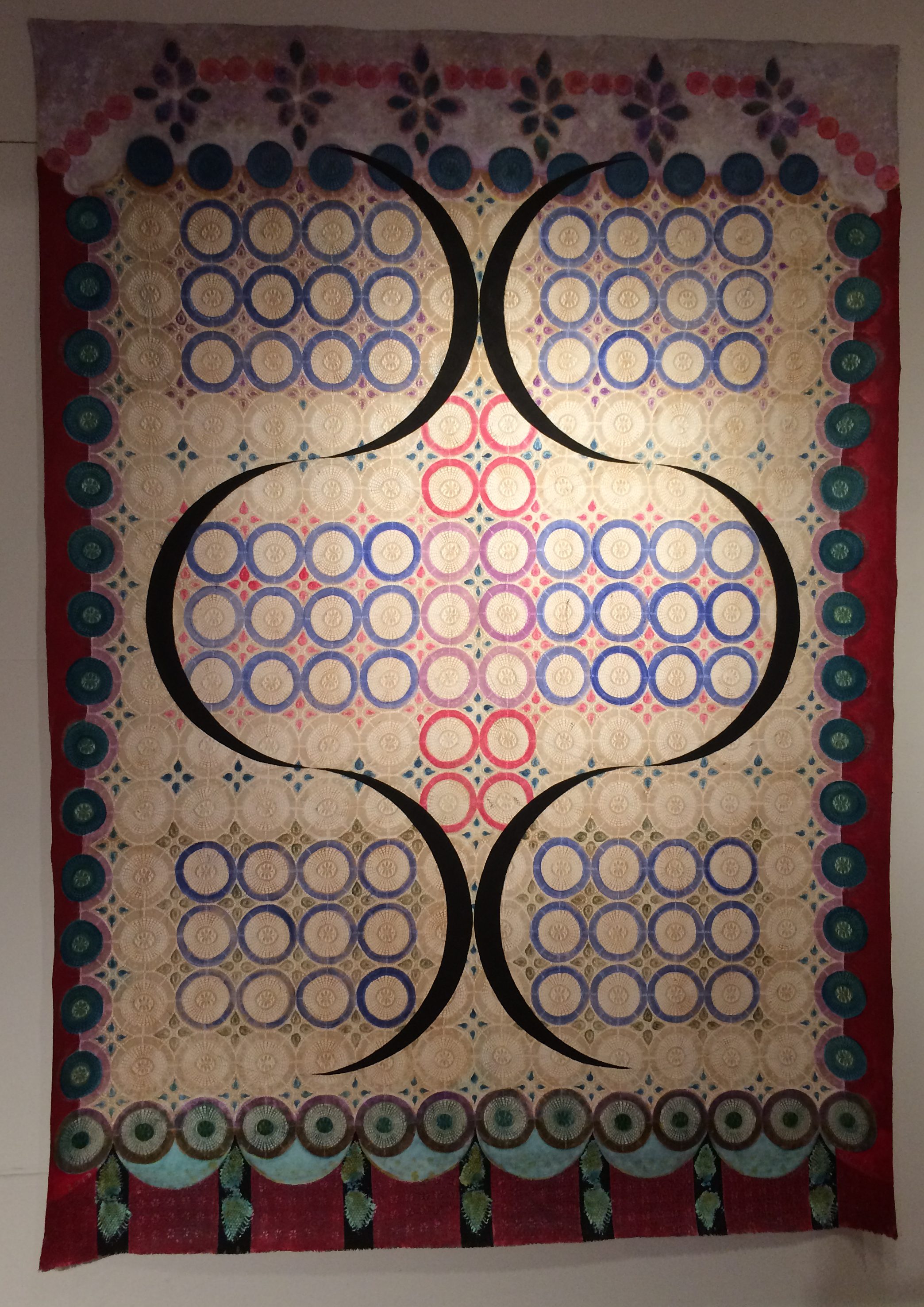
Benigna Chilla, “Crescents” 2013, Vegetable pigments and acrylic on canvas
Picture courtesy of the artist and the gallery
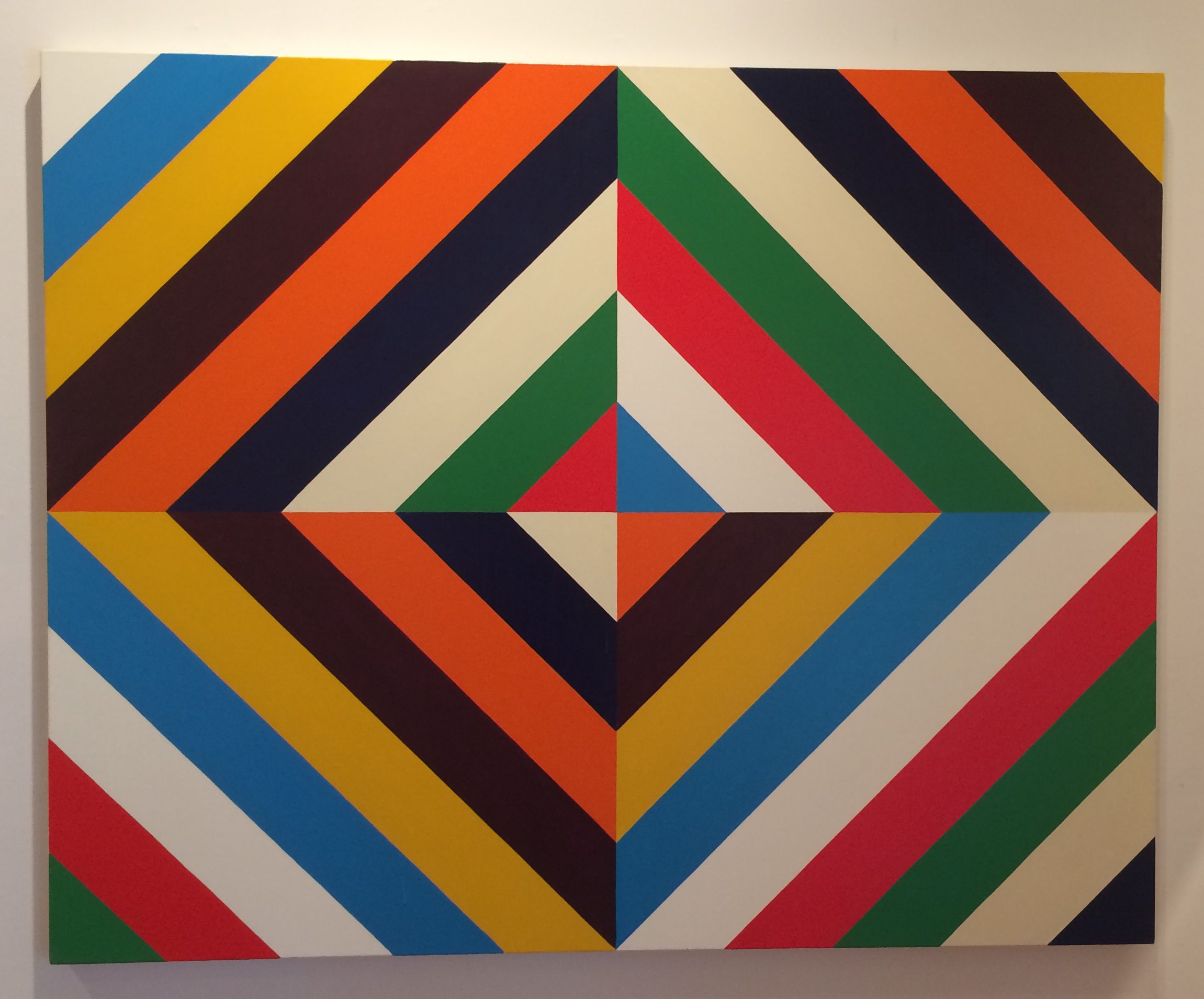
Stephen Westfall, “Live for Tomorrow”, 2010, oil and alkyd on canvas
Picture courtesy of the artist and the gallery
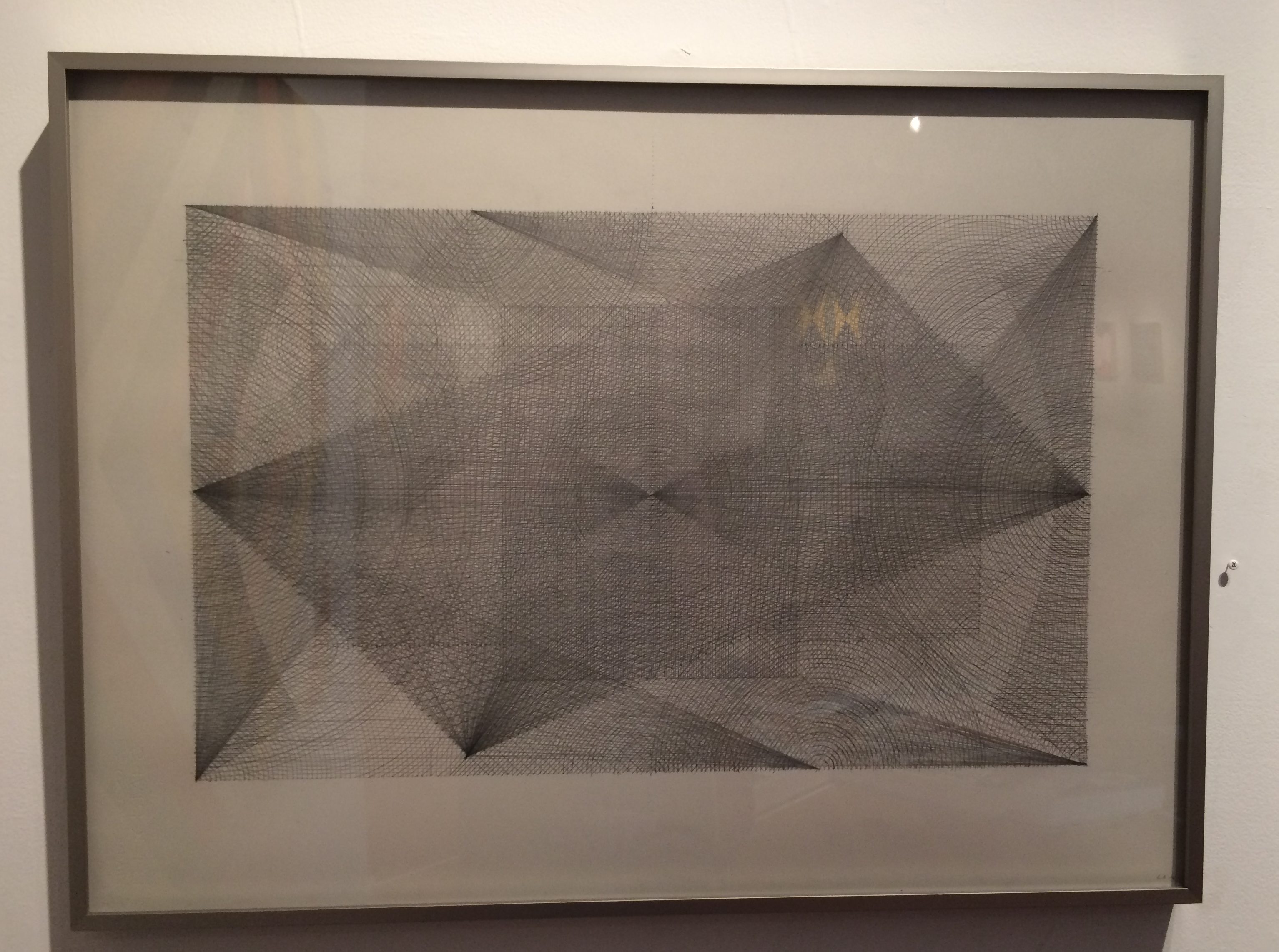
Laura Battle “Prism” 2016, Graphite on gray Arches paper
Picture courtesy of the artist and the gallery
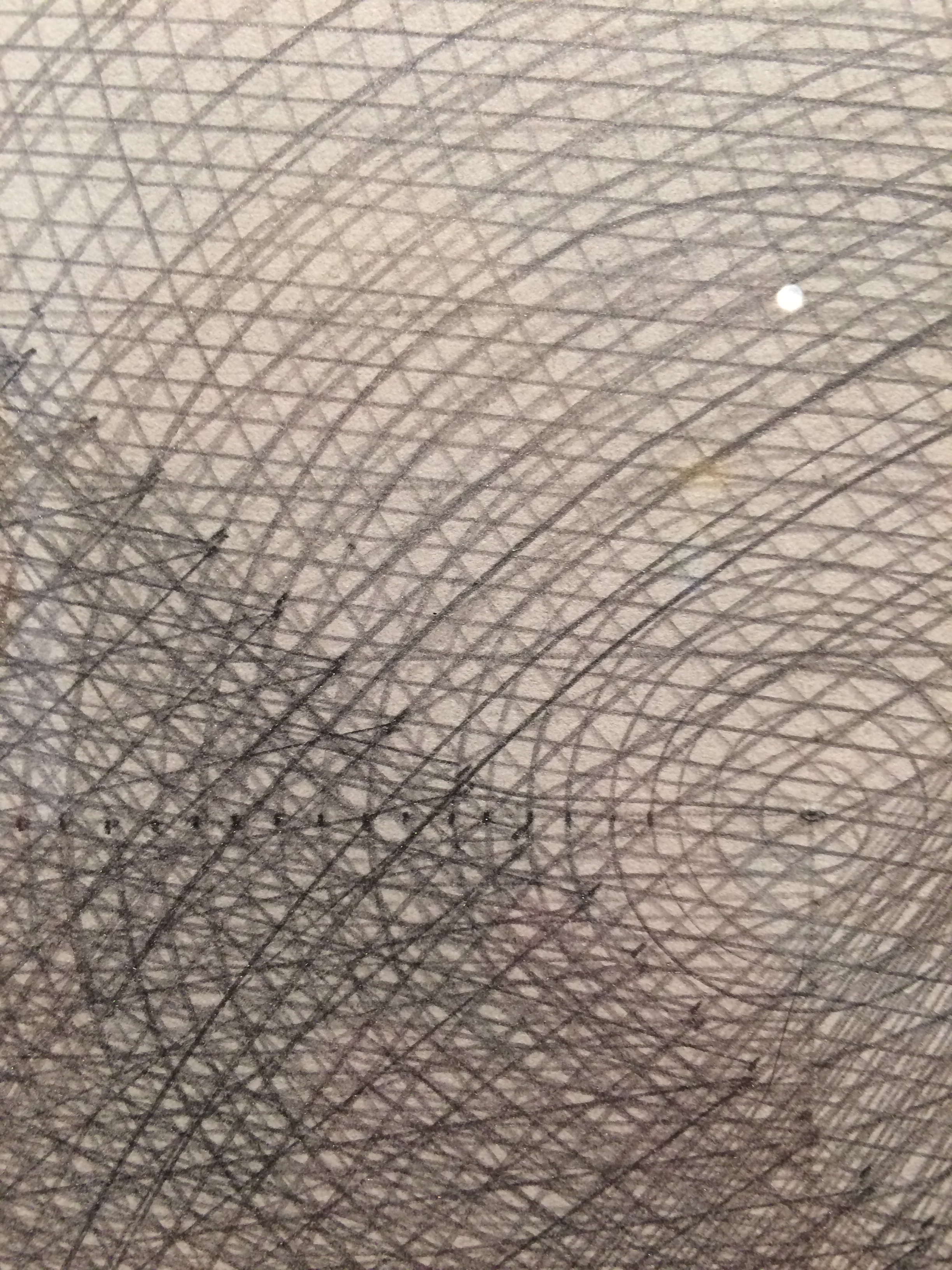
Laura Battle “Prism” 2016, Graphite on gray Arches paper (Detail)
Picture courtesy of the artist and the gallery

Olafur Eliasson, “The listening dimension” (Orbit 3), 2017
Picture courtesy of the gallery and the artist
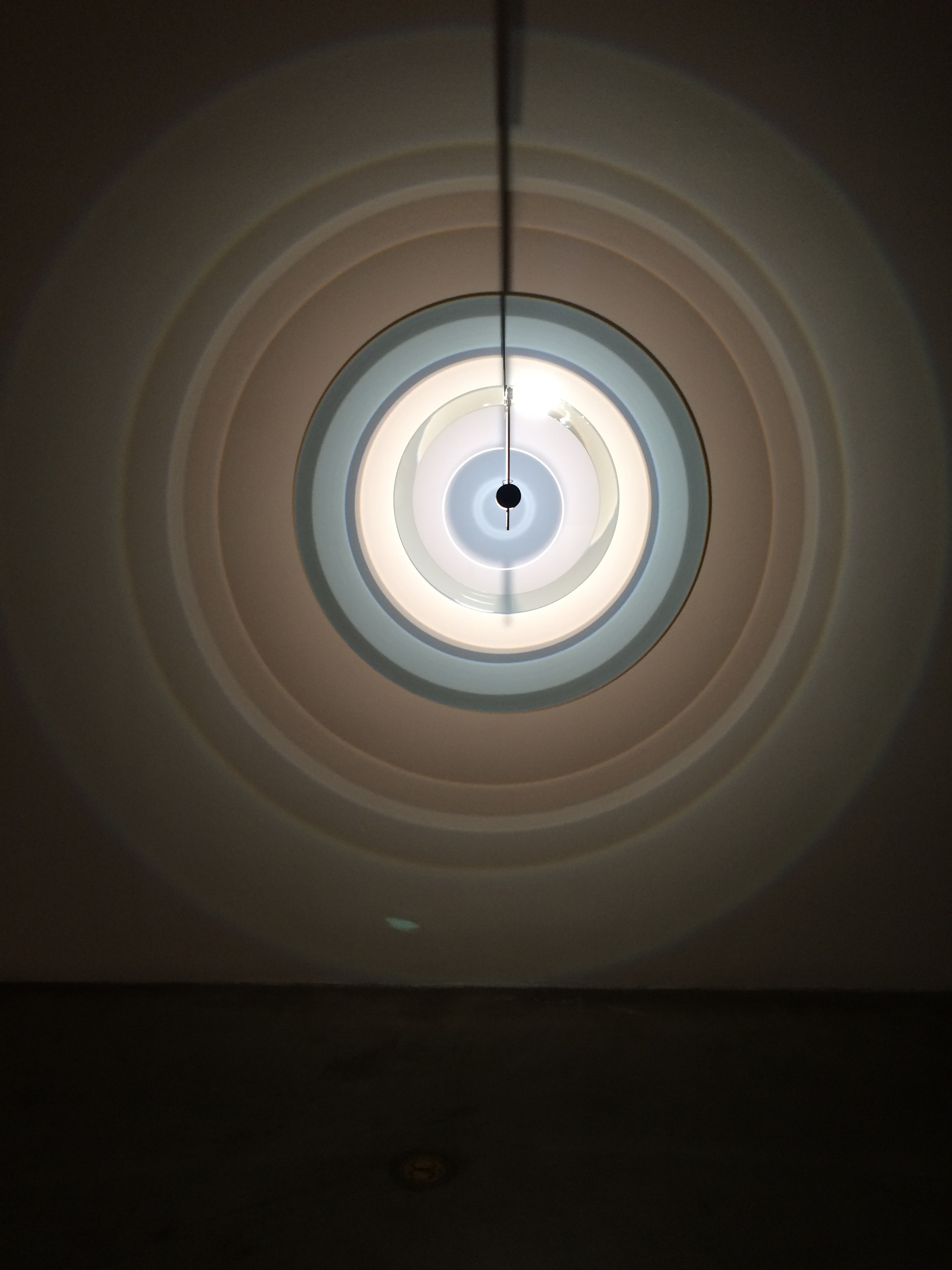
Olafur Eliasson, “Space resonates regardless of our presence”, 2017
Picture courtesy of the gallery and the artist
“There’s No Distance” is Reas’ fourth solo show at bitform gallery. On display are the artist’s new software-generated “Still Life”series videos.
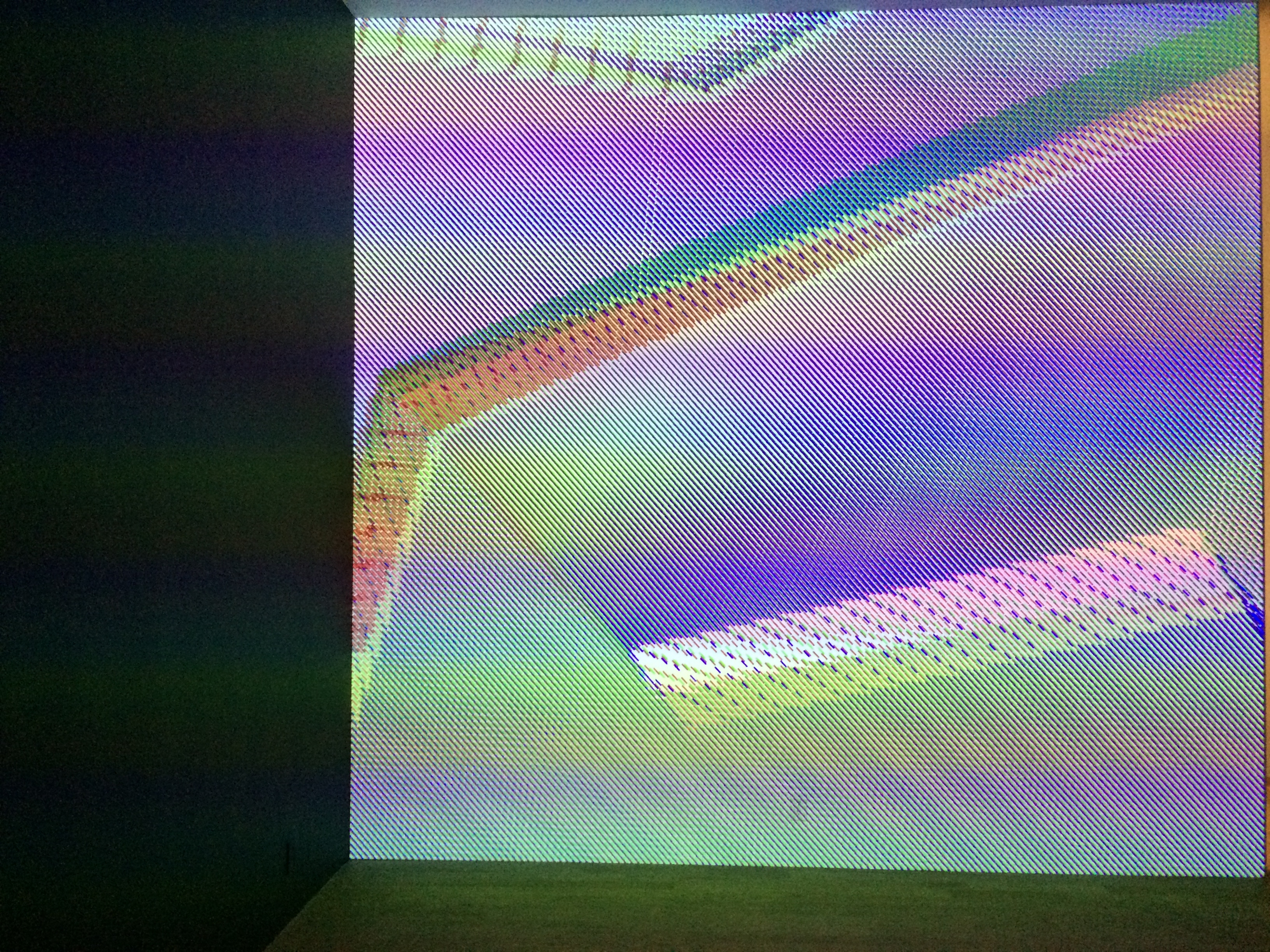
“Still Life (RGB-AV A)” (gallery view), 2016
Picture courtesy of the gallery and the artist
The work in this series is based on the decomposition of a platonic solid using custom software to create an ever changing image of iterations. Reas has collapsed or flattened the multiple planes of a 3-D object allowing them to be visible on the screen at the same moment in time. These works are meant to be seen as performances, with the exhibition space and sound being integral to the work. Derived through a set of instructions or rules, the software adds a time-based element that changes the processes and continues to create new iterations. The subject matter for this series is pure geometry, but the viewer experiences the analysis of the shapes through the exploration by the computer system.
Susan Happersett
For the past month I have been traveling throughout the USA and one of the most interesting destinations has been Marfa, Texas. This small West Texas town is a haven for Minimal and Conceptual Art. The gallery Exhibitions 2d has a lot of mathematically art work on display. Two artists represented by the gallery – Gloria Graham and John Robert Craft – were of particular interest.
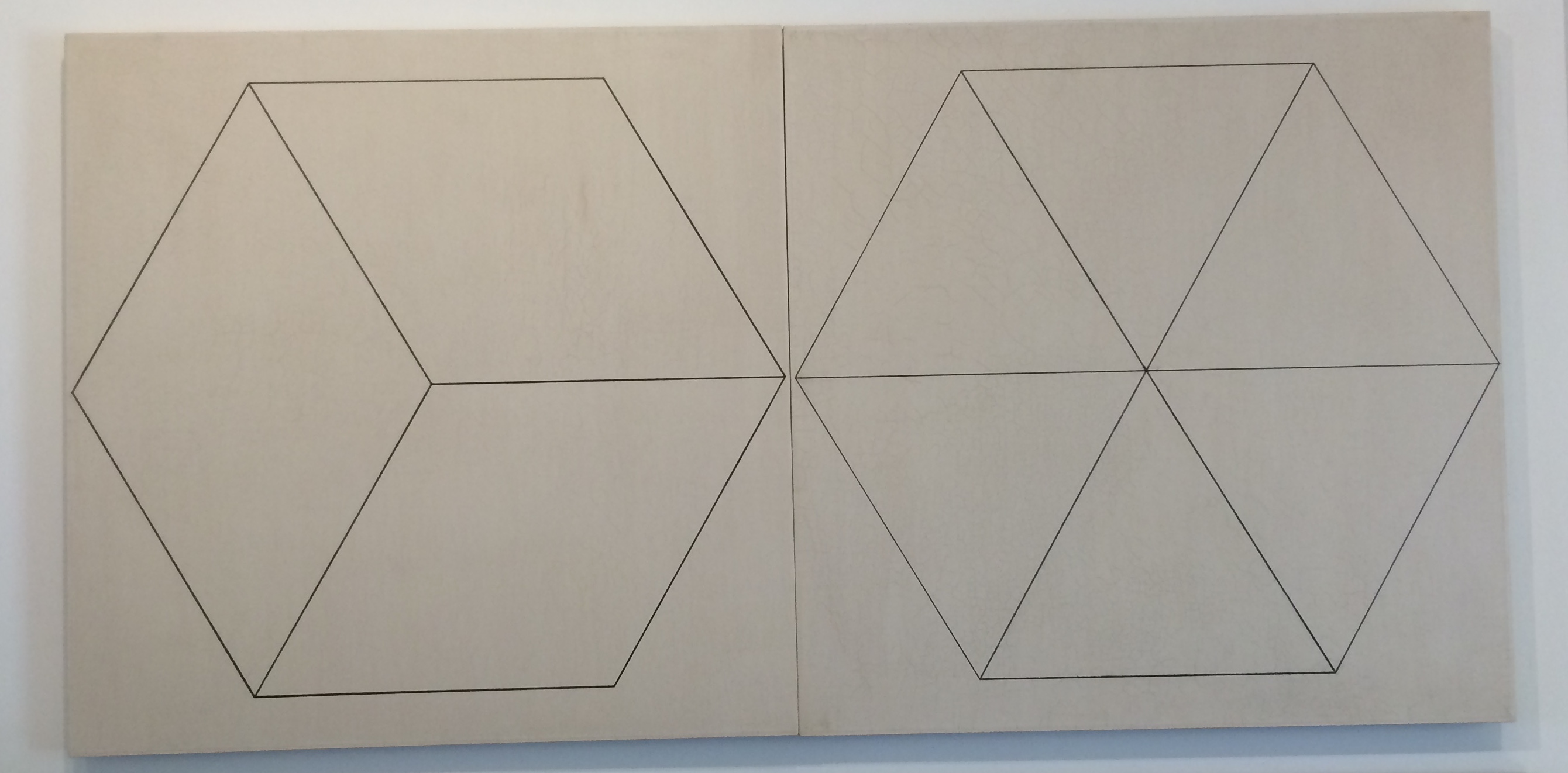
Gloria Graham – “NaCl H2O Salt Water” – 1994
graphite, kaolin, canvas on two wood panels
Picture courtesy of the gallery
Graham’s geometric paintings are based on the patterns found in the atomic structures of natural elements. “NaCl H2O Salt Water” features two crystal-like forms, both regular hexagons. The hexagon on the left is divided into three congruent rhumbi. The hexagon on the right is divided into six equilateral triangles. The addition of the three extra line segments to divide the rhumbi into triangles changes the hexagon dramatically. The symmetry goes from order 3 rotational symmetry to order 6. The perception of the possible 3-D form goes from a cube to a faceted diamond shape with 6 facets on top. Graham’s painting process for this work involves a layer of kaolin (a clay-like mineral) applied to canvas stretched over wood. The lines are drawn into this base. Through the drying process tiny cracks in the surface have formed. This gives the work a complex physicality that alludes to the natural environmental inspiration for the painting.
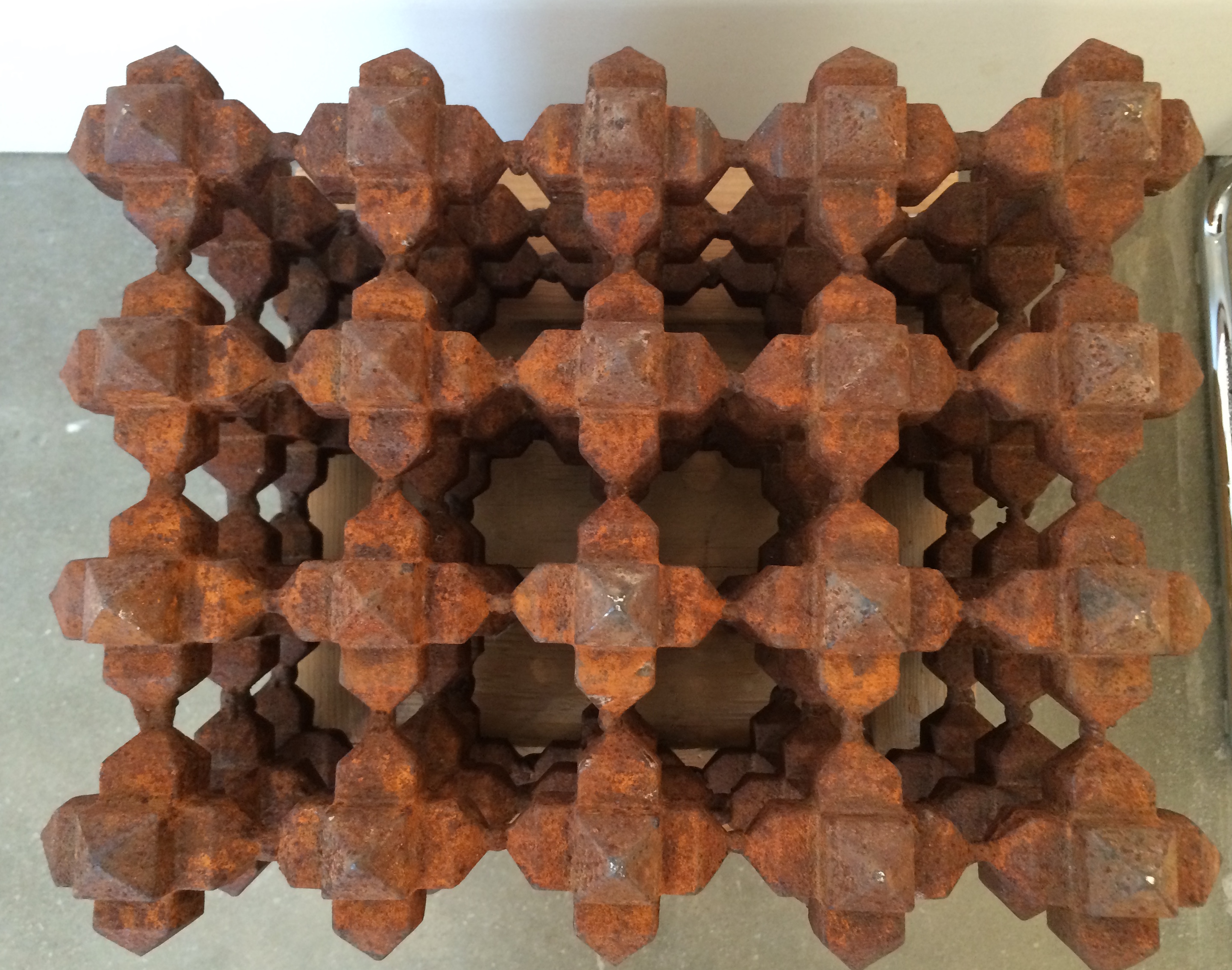
John Robert Craft
Cast iron
Picture courtesy of the gallery
Craft’s cast iron sculptures are related to his life as a Texas rancher. They are solid and heavy, and have a rustic patina. Their rough physicality is juxtaposed to their intricate geometric forms. This work is made up of 60 basic elements stacked into a 4 by 5 by 3 rectangular solid. Each of the elements is a type of double cruciform with a pyramid set on each of the six ends. This forms negative spaces with 16-sided regular polygon shaped windows. Craft’s work presents complex 3-D repetitive tiling-like formations, while retaining the physical realities of the artist’s ranch experience.
Susan Happersett
The “Geometric Cabinet” at Kristen Lorello Gallery is an exhibition based on an instructional tool used in Montessori early childhood education to teach geometry. This tool consists of 6 puzzle-like drawers with removable trapezoids, triangles, quatrefoils, and other shapes. The children learn about the shapes by running their fingers along the edges of the shapes, as well as the process of fitting the shapes into the corresponding cutout frame. Two of these drawers are laid out on mats on the floor of the gallery. Kristen Lorello has curated this exhibition by selection work that relate to these geometric shapes and the prescribed educational activities.
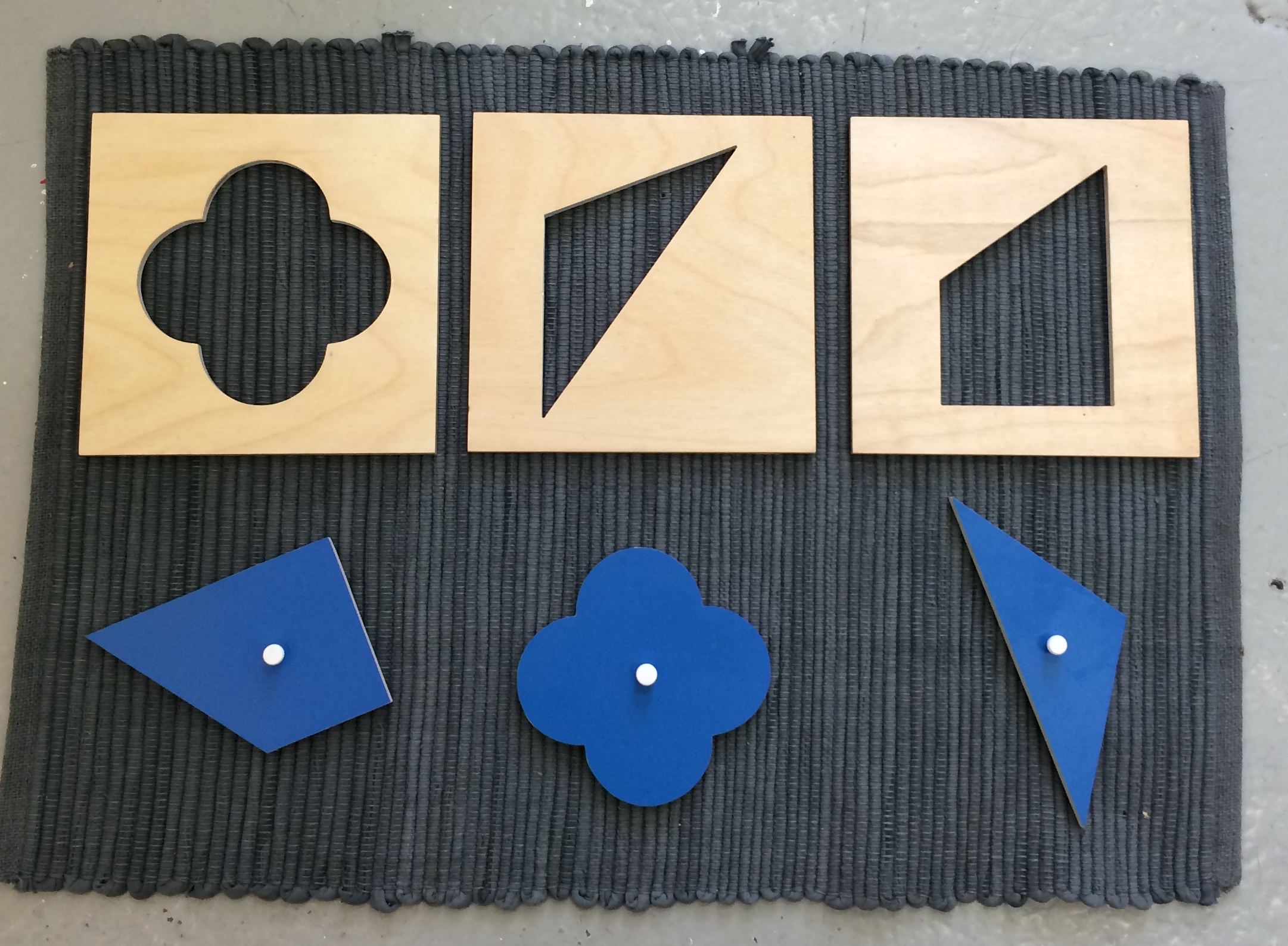
Drawer from a Montessori “Geometric Cabinet”
Picture courtesy of Kristen Lorello
The work of eight artists has been included included in this show. There is a kinetic, rotating, circular stone-like wall sculpture by Rachel Higgins that reminds the viewer of the tactile experience of a young student running their fingers along the curved sides of the circular shape taken from the cabinet. Michael DeLucia has provided a direct response to the quatrefoil shaped piece with his drawing “Quatrefoil” .
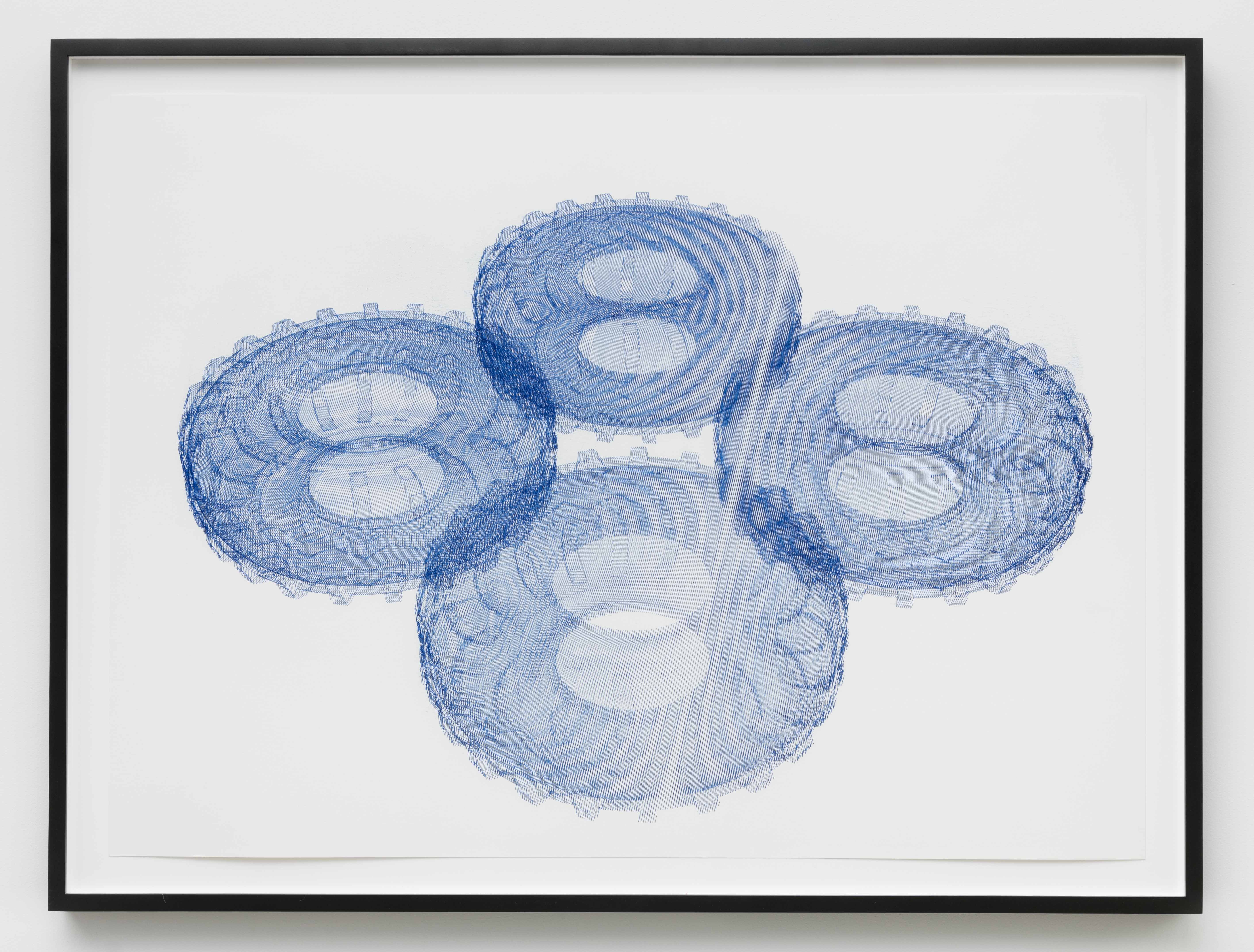
Michael DeLucia, “Quatrefoil”, 2016, ink on paper
Picture courtesy of Gallery 11r
“Quatrefoil” features a 2-dimensional depiction of four tire-like tori. A torus is a 3-dimensional topological form that has genus one. This means it has only one hole, like a bagel. The tori have been drawn in perspective so that front single torus is larger and in the foreground. There is a pair of tori in the middle ground and the smallest torus in the background.
Through this work De Lucia has not only referenced the basic geometry of the flat cabinet shape but he elevated the quatrefoil to a complex form. The structure of each torus has been expressed by drawing a series of circles rotating in 3-dimensional space around a circular axis. Adding the tire tread element to the shapes gives the form a textural quality that take the drawing out of the realm of text book figures.
The exhibit Geometric Cabinet has one of the most interesting curatorial premises I have encountered. The history and principles of Mathematics education are a fertile ground for creative interpretation and Kristen Lorello has presented a thought provoking selection and installation to explore these ideas.
Susan Happersett
The use of repetitive geometric patterns is a prevalent theme in abstract art. Lori Ellison’s paintings and drawings celebrate the hand of the artist, featuring a lyrical, hand drawn quality. Through the use of basic geometric shapes Ellison created lively compositions that hum, buzz and pulsate. The current exhibition at the McKenzie Fine Art gallery include small scale paintings on wood panels and drawings on notebook paper. All of this ambitious work was completed the year or so before the artist’s death in 2015.
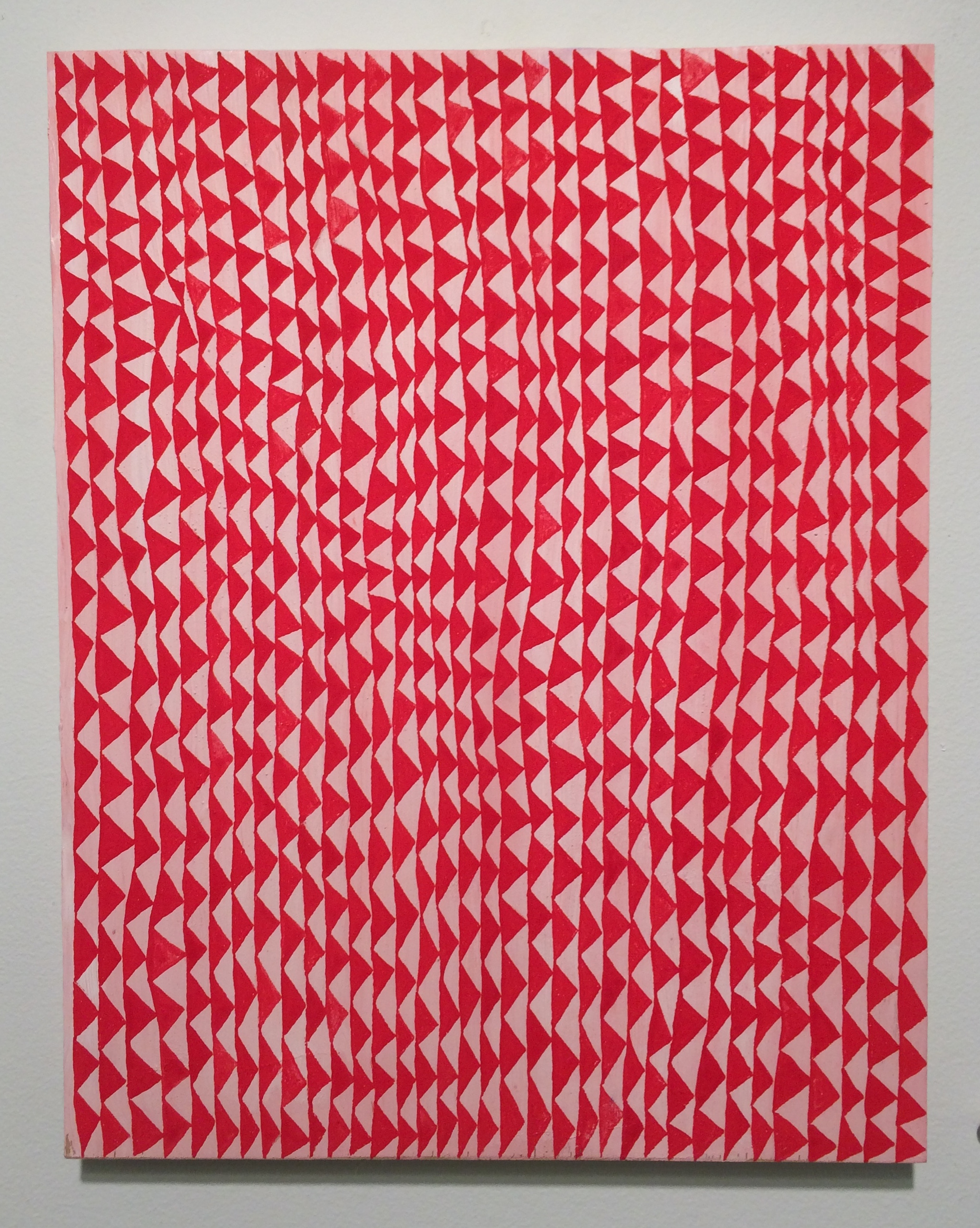
This gouache on wood panel from 2015 measures 14 x 11 inches. Its compact format holds a profusion of triangles. The almost parallel columns of almost isosceles triangles are packed tightly on the plane. Alternating the the red and pink shapes, all of the red triangles seem to point right and all pink ones point left. This forms an interesting dialogue between positive and negative space.
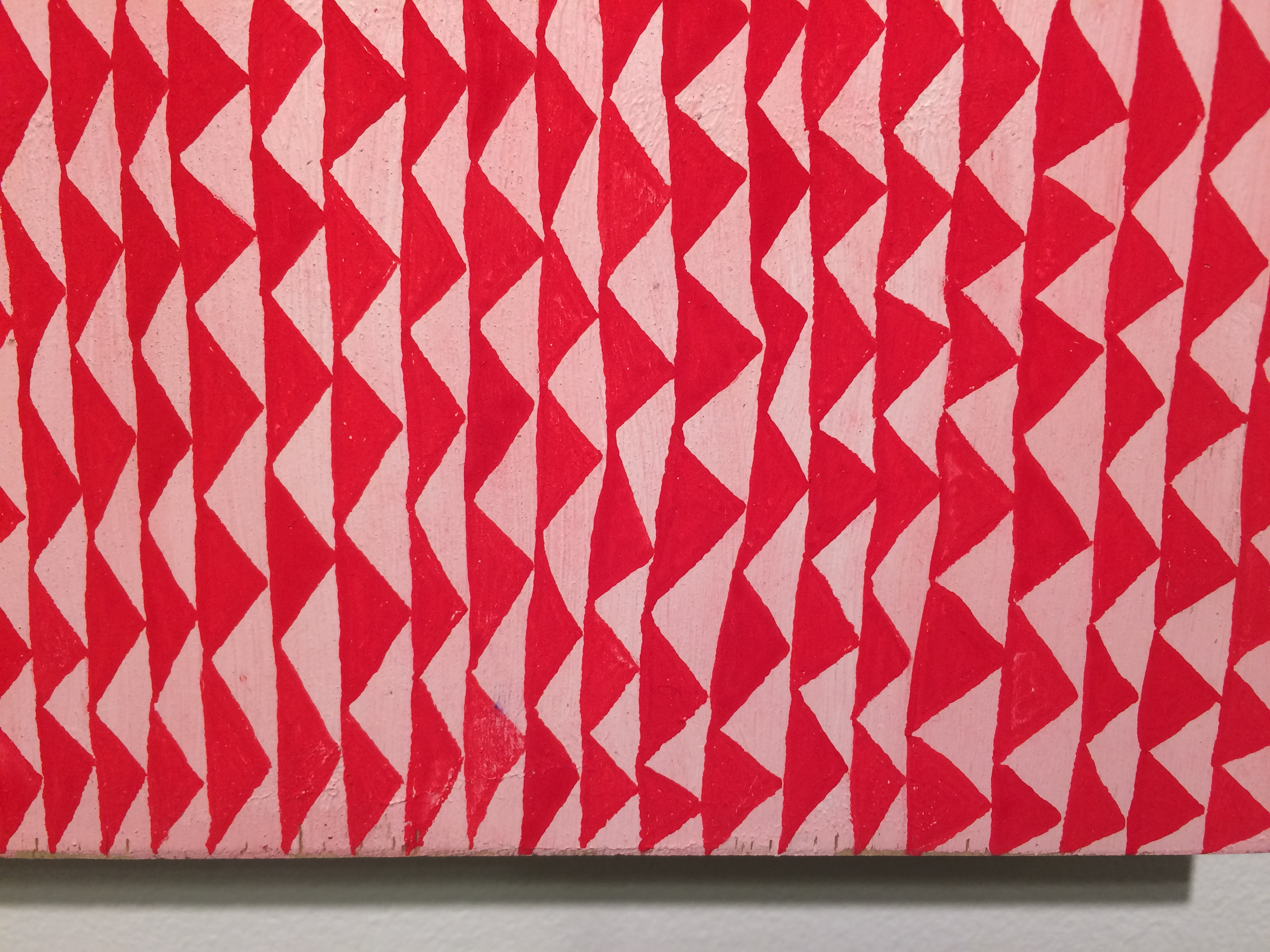
In this close up of the same panel we can see more clearly that this work is not about the accurate measurement of pure clean geometry. It is some ways more complicated, more human. This is definitely a painting about lines, triangles, positive and negative, but it is also about the artist. The personal scale makes the viewer stand close to the work and be drawn into the patterning. Art can be about mathematics with out having to use a ruler or striving for perfection.
Susan Happersett
The current exhibition in the North gallery room of the Klein Sun Gallery is called “The Simple Line”. The show features the work of Beijing artist Gao Rong. Each of Gao Rong’s installation pieces is based on a circular hoop framework. Threads are stretched across the circle from evenly placed locations around the circumference. Although the basis of her subject matter is circular, through careful placement of the threads Gao Rong is able to create geometric arrangements featuring straight lines and angles.
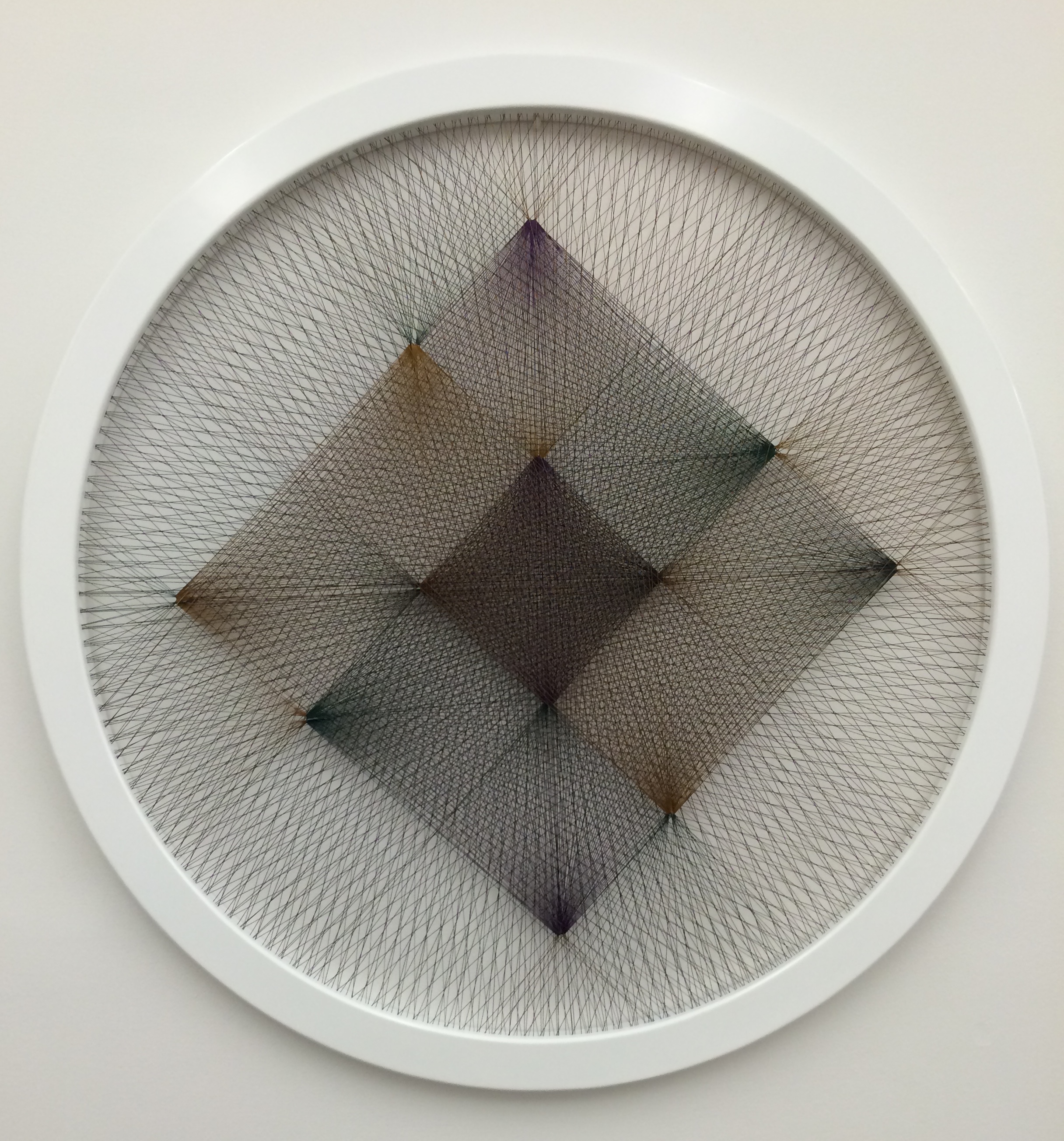
This work contains a square grid of nine squares with the center square darkened with the overlapping of many lines of thread. this work at first appears to have two axis of reflection symmetry but this is only superficial. Upon closer inspection we see that some of the corners of the of the squares are much darker than others and taking that into consideration there is an order-2 rotational symmetry.
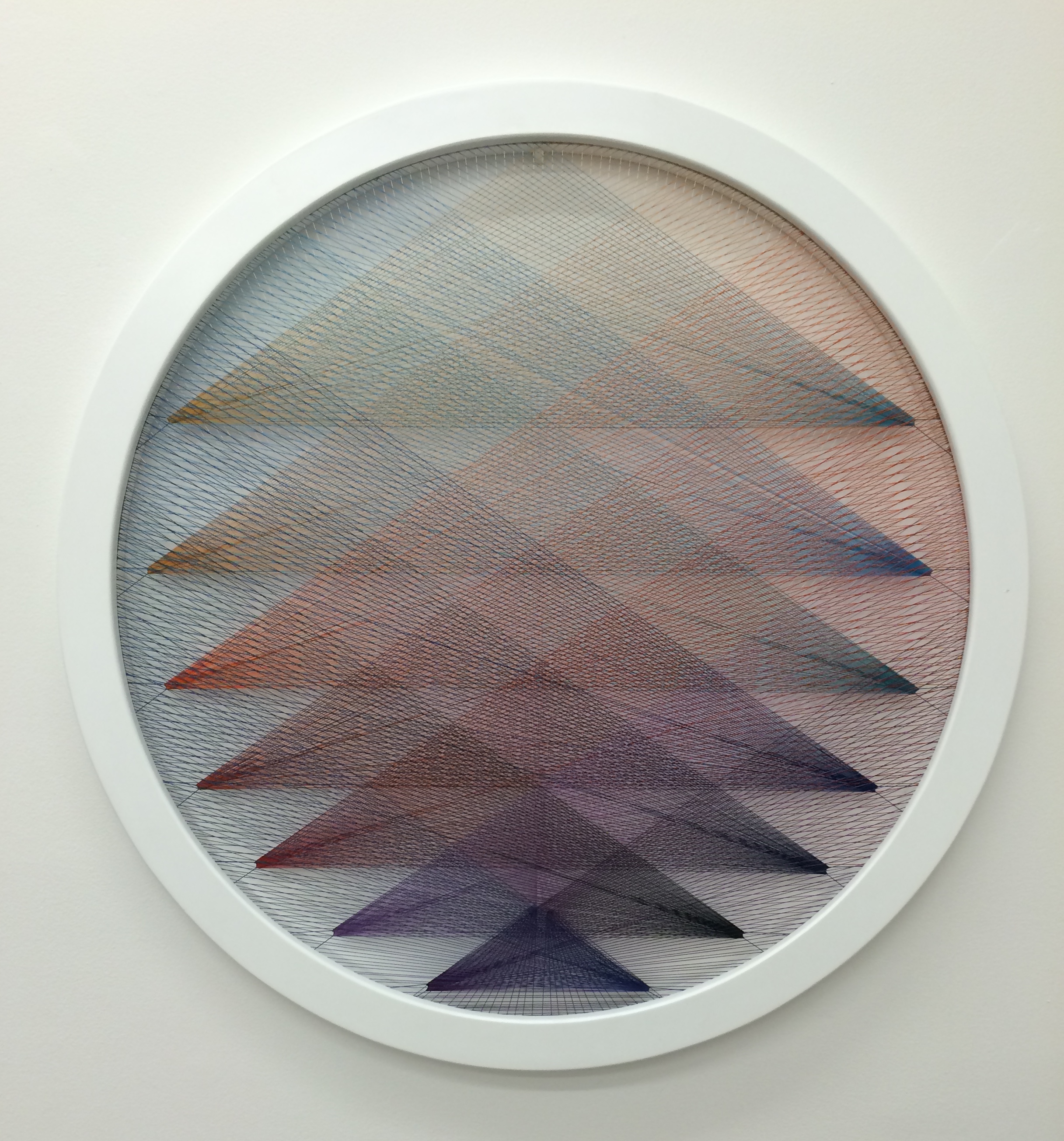
The next work is based on triangles. Starting at the bottom with single unit isosceles triangle, then moving up the structure, this single unit is overlapped by a triangle with a base twice as long. The next overlapping triangle has a base three times the length of the initial triangle Each subsequent triangle gets larger but also lighter in color. The shape seems to fade into the top of the circular frame.
There are two sets of theoretical juxtapositions in Gao Rong’s work. First and most is obviously the fact that the work illustrates linear structures within a curvilinear environment. Second, there is also the social statement of the use of colored thread, traditionally seen in women’s decorative needle work, to create very structured geometric diagrams that are heavily influenced by Mathematics.
Susan Happersett
Happy New Year!
I decided to start 2016 with a big show and the Frank Stella exhibition at the Whitney Museum definitely qualifies as a really big exhibition. When the elevator door opens into the first gallery,the viewer is met by two very different canvases: a large, geometric, consecutive squares painting, and a huge abstract that is exuberant to the point of being Baroque. The dichotomy of these two works highlights the the range of styles and themes explored throughout the galleries. On display are the all black paintings from the late 1950’s, as well as the colorful geometric square-and-shape canvases from the 1960’s. Also included are the wall sculptures from the 1980’s and the more recent work created using 3-D printing.
For the purposes of this entry I decided to concentrate on Stella’s paintings from the 1960’s. These works are clearly about geometry. Some of the artist’s sketches and schematic diagrams are on display as a group. I highly recommend taking a close look at these plans, they really highlight the mathematical processes involved in the paintings.
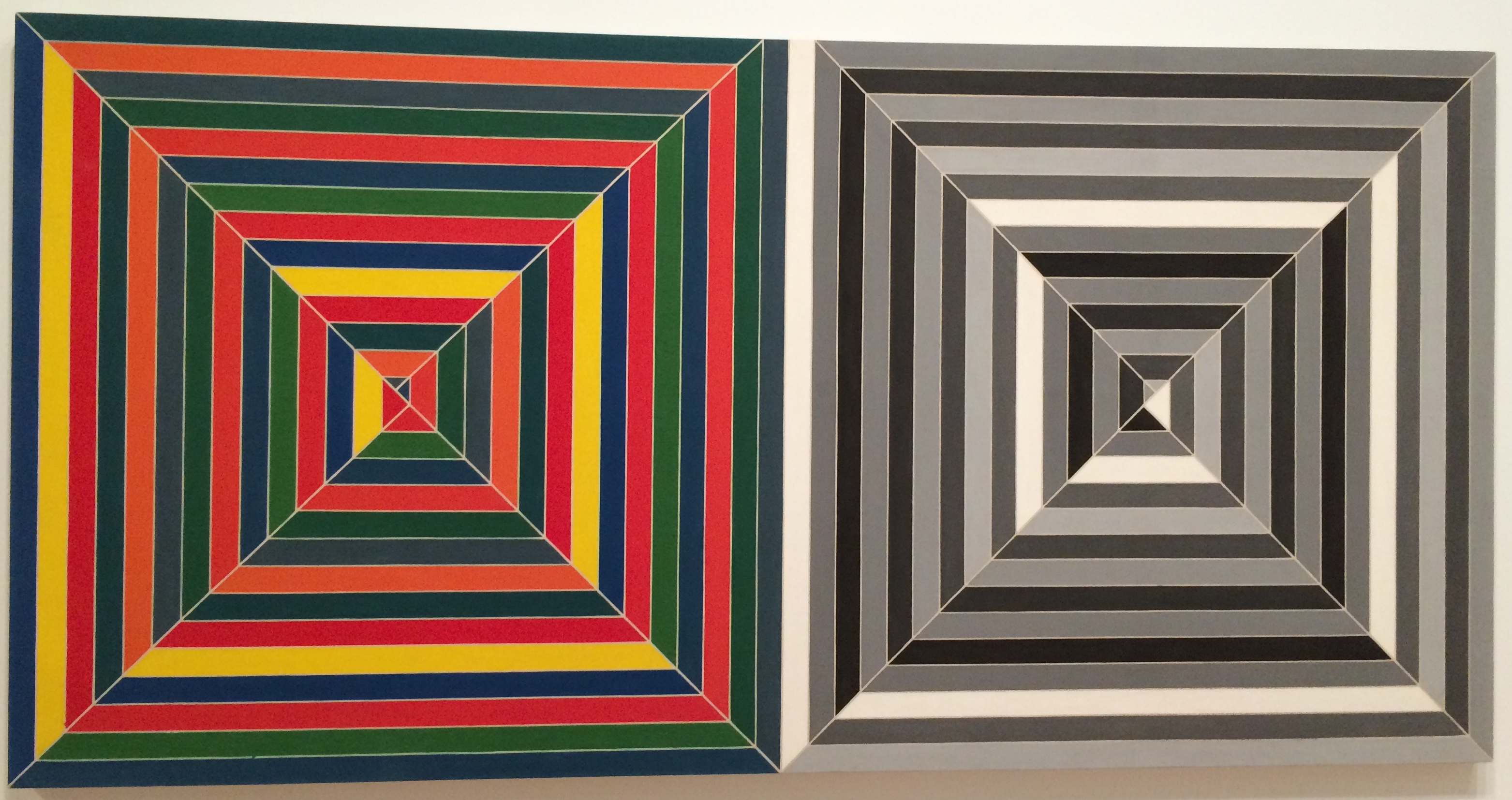
Stella – “Jasper’s Dilemma” – 1962
The two canvases of “Jasper’s Dilemma” each have the same spiral geometric structure, but the left canvas features a system of the color spectrum, while the right canvas is composed of shades of gray. Stella has built these spirals within the squares by creating two sets of isosceles triangles. The set with vertical bases are slightly larger than the triangles with the horizontal bases. This results in only one diagonal line on each canvas and the four triangles do not all meet at the same point.

Stella – “Empress of India” -1965 – Metallic powder in polymer emulsion on canvas
“Empress of India” is a monumental shaped canvas featuring a series of four V-shaped sections, each featuring a line of reflection symmetry and a 60 degree angle at the point of the “V”. There is also an interesting line of order-2 rotational symmetry running diagonally through the center section of the work.
Both “Jasper’s Dilemma” and “Empress of India” spotlight Frank Stella’s dedication to developing complex geometric structures in his work during the 1960’s.
Keep posted for many more observations on Mathematics and Art in 2016
Susan Happersett
 fibonaccisusan