Mary Heilmann at 303 Gallery

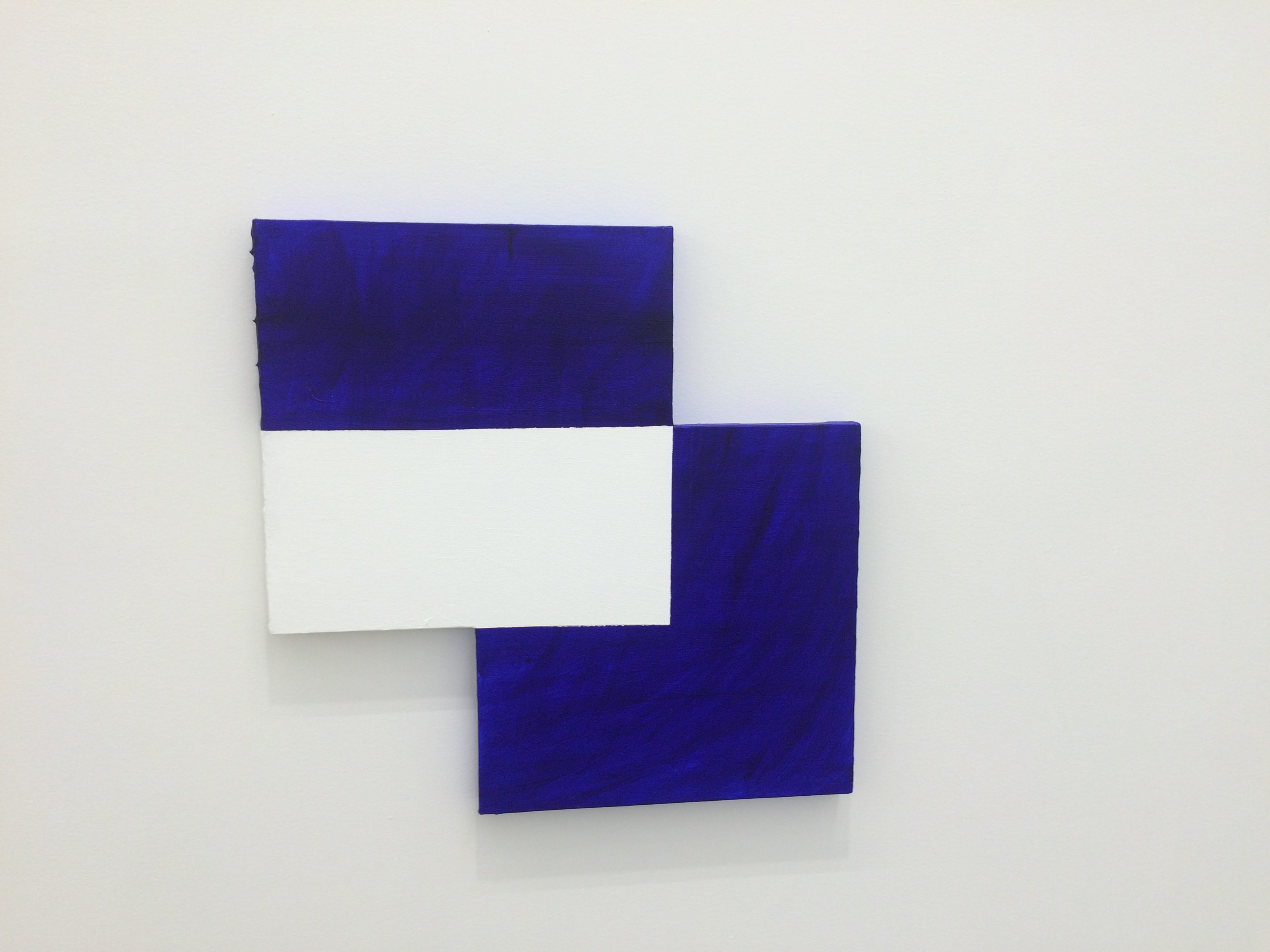
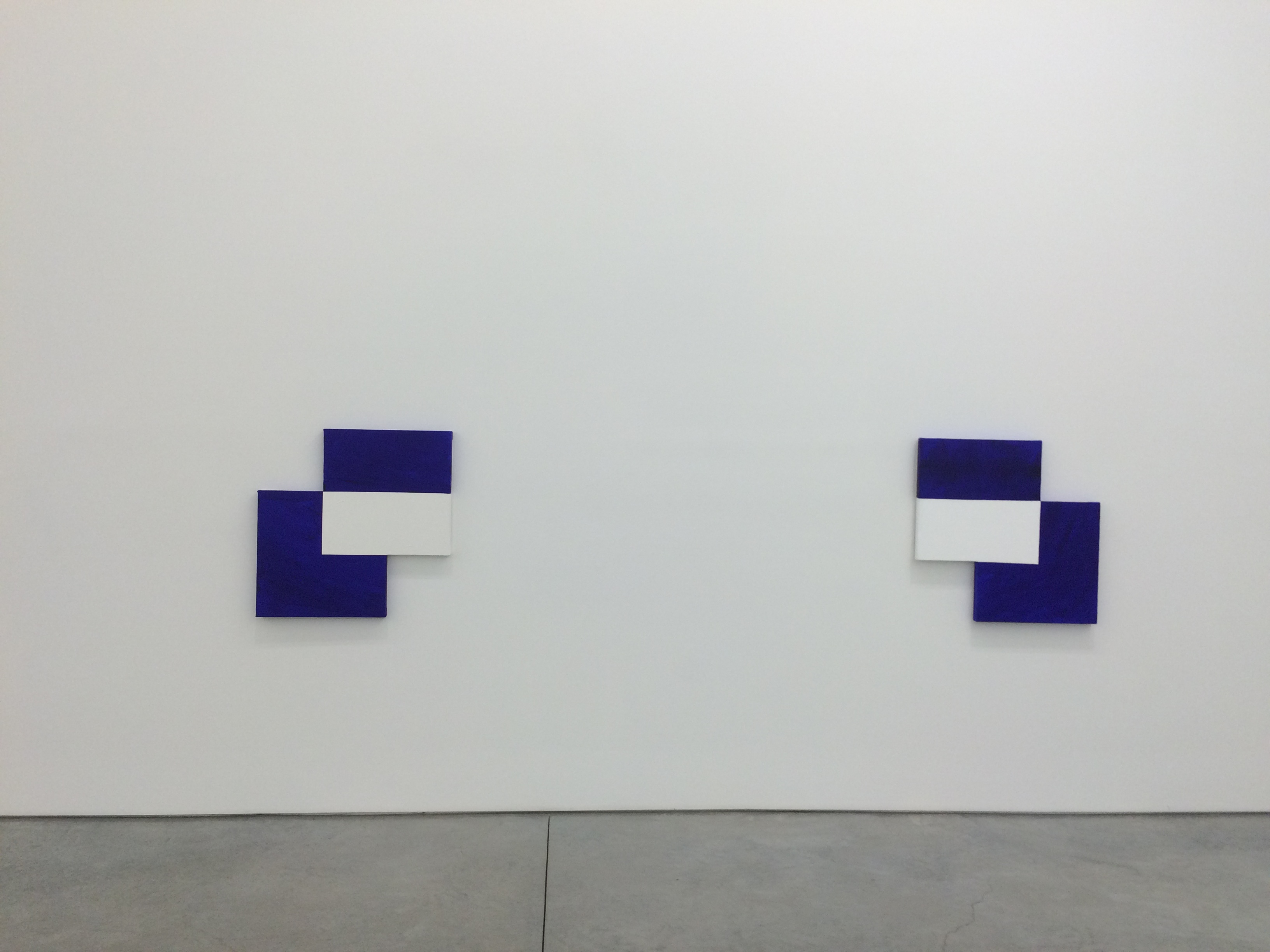
“Geometrics: Waves, Roads, Etc”, Mary Heilmann’s current solo show at 303 Gallery in Chelsea, features work with an emphasis, as the title suggests, Geometry. My favorite pieces were two shaped canvases, “Geometry Right’ and Geometry Left” both acrylic on canvas from 2015.

15-48-1
15-48-2
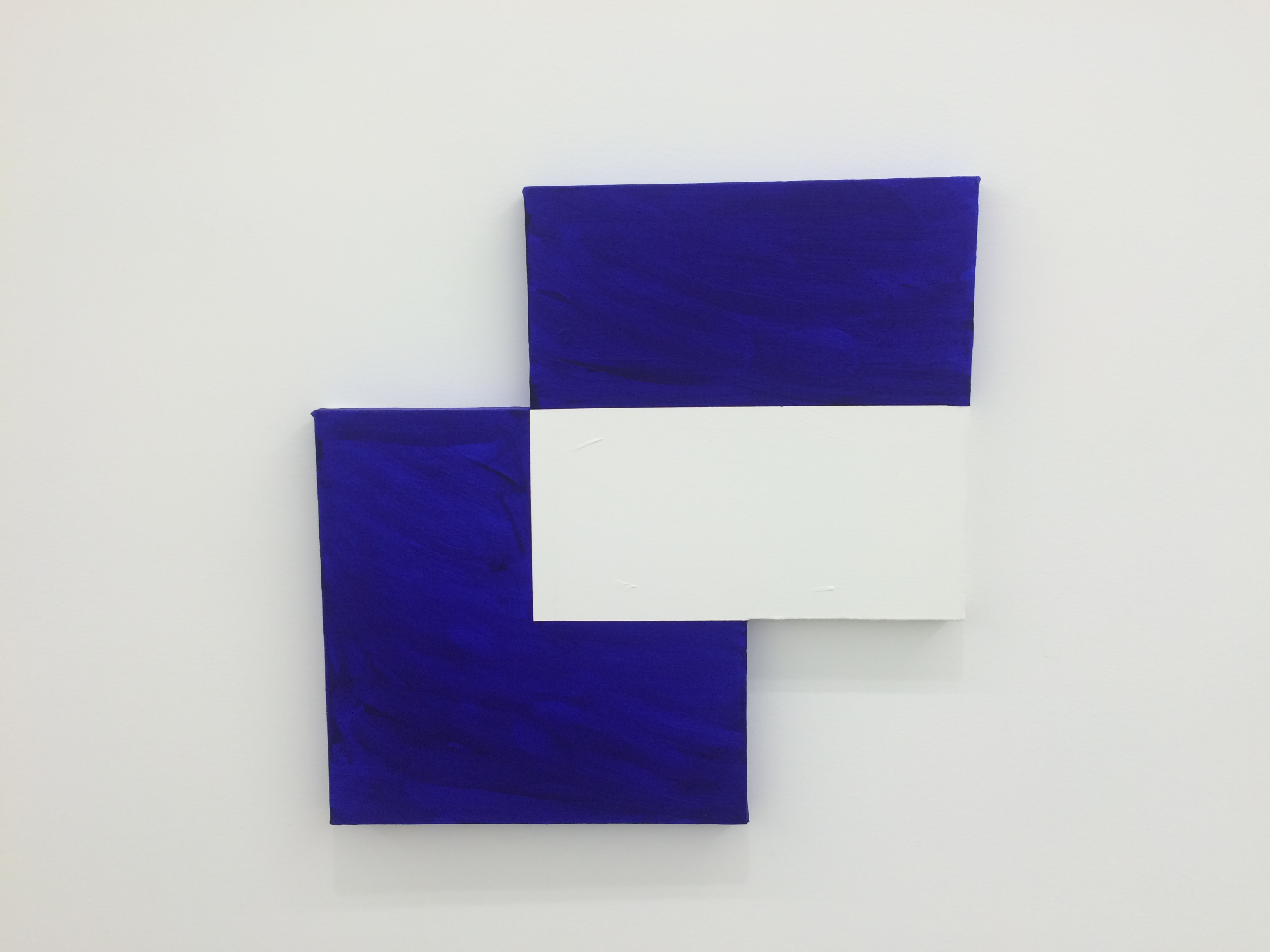
Each painting consists of two squares that overlap on a diagonal so that they share a corner quarter square. The top square of each pair is divided horizontally in half to create two congruent rectangles. The top rectangle is bright blue and the bottom rectangle is matte white. The two canvases are displayed in the gallery in a symmetrical fashion. The installation creates a reflection symmetry with the vertical axis of symmetry running midway between the works.

15-48-3

Although I was first drawn to these two canvases because of the geometry they represented. When I stood back to observe their placement in the gallery space, I realized the intriguing perspective of positive and negative space within the parameters of reflection symmetry.

Susan Happersett

Eleanor White at Matteawan Gallery

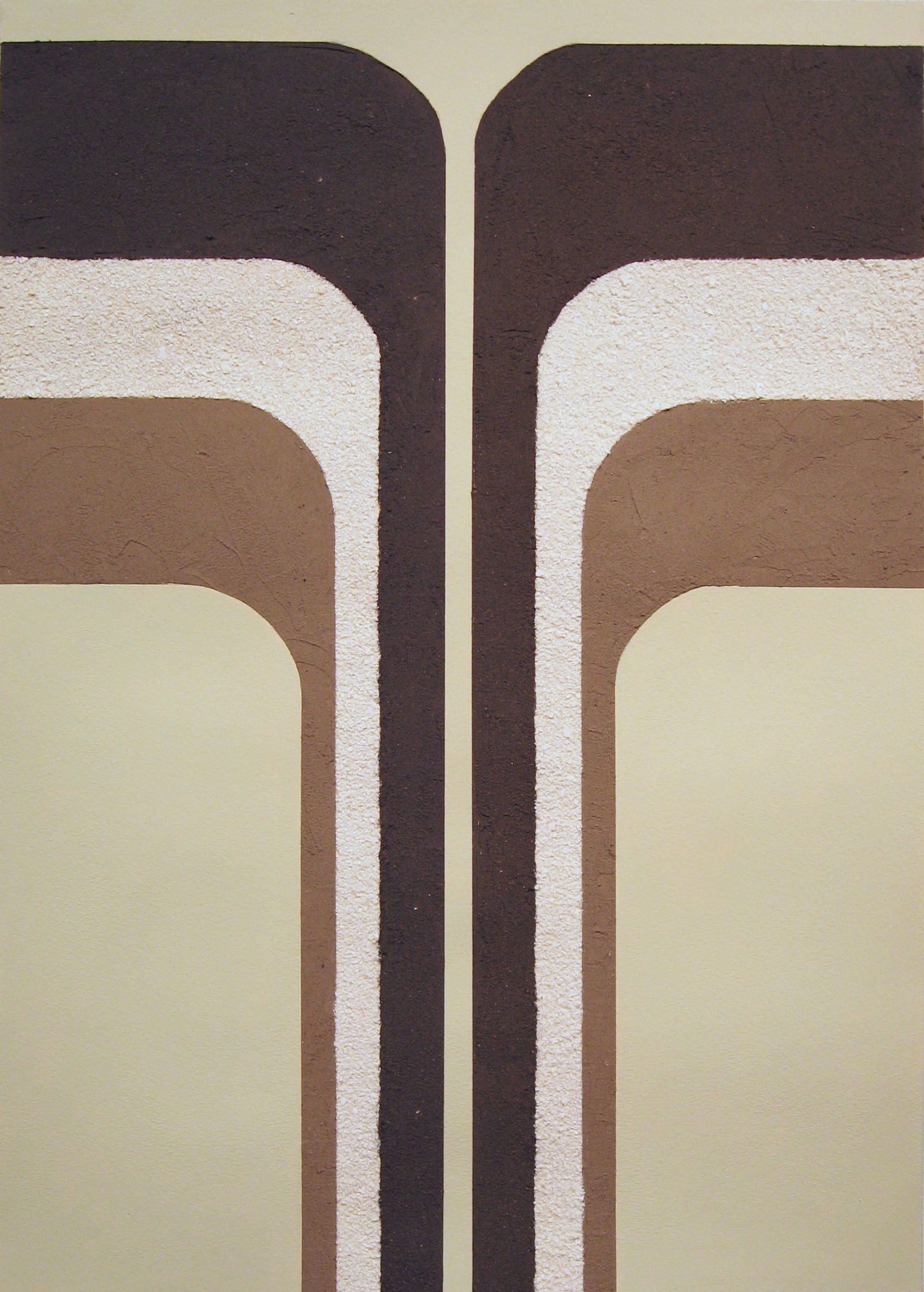
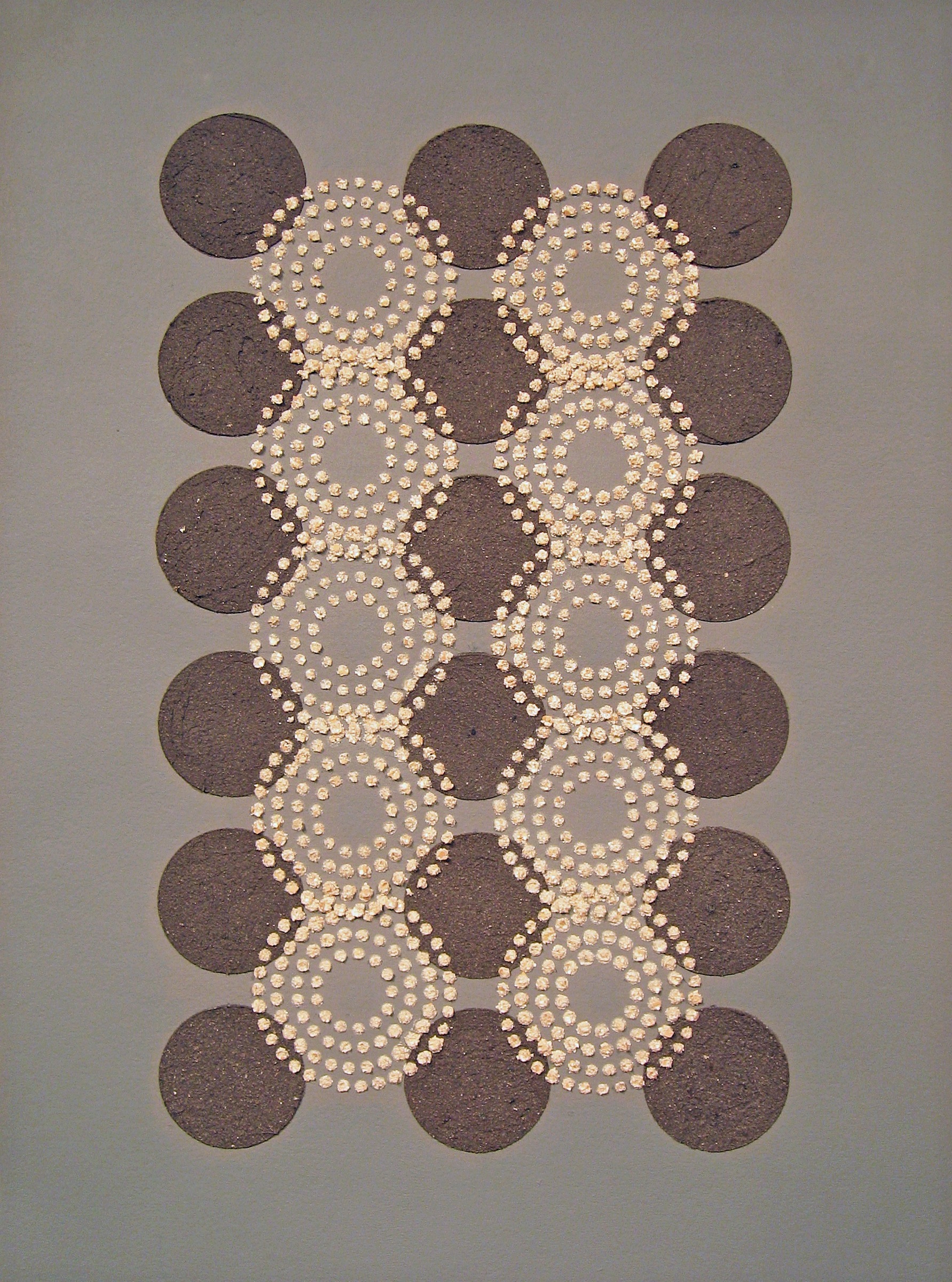
I have written about art in a variety of mediums,  but Eleanor White’s recent work on paper currently on display at the Matteawan Gallery in Beacon, NY is probably the most unique. White incorporates crushed egg shells and wood ash into paint resulting in a beautiful but gritty texture. Minimalism and 1960’s and 1970’s design are references for the artist and lead to the geometric qualities of the work.

eleanor stripes low res

“Untitled” 2015 eggshells, wood ash and paint on paper
Picture courtesy of the artist and the gallery

In this first drawing, “Untitled” from 2015, there is the obvious reflection symmetry with the line of symmetry running vertically through the center of the work. There is also the interesting visual effect of the thickness of the parallel bands of color. Narrow vertical section blend into thicker horizontal bands.

tan circles_black dots

“Untitled” 2015 Eggshells wood ash and paint on paper
Picture courtesy of the gallery and the artist

This next drawing is all about circles. It features a top layer of a 2 by 5 grid of slightly overlapping sets of 4 concentric circles. Each circle composed of dots of ground egg shells. The inner circles have 13 dots, then 20, 27 and finally 34 dots in the outer circle. The underlay of circles is a 3 by 6 grid of solid circle. The 2 by 5 grid packs elegantly on top of the 3 by 6 grid. It is an excellent illustration of how the proportions 3:6 relate to the proportions of 2:5.

White’s work has a lot of geometric and numerical mathematical elements. There is also a more subtle theme in the shapes of the tiny bits of crushed egg shells. The original oval 3D shape of the egg has been fractured and spread across the flat plane of the paper. But if you look closely you can still see tiny bits of the curved planes. These optical remnants of the original eggs give these drawings a complex surface that is inspired.

Susan Happersett

Josiah McElheny at Andrea Rosen Gallery

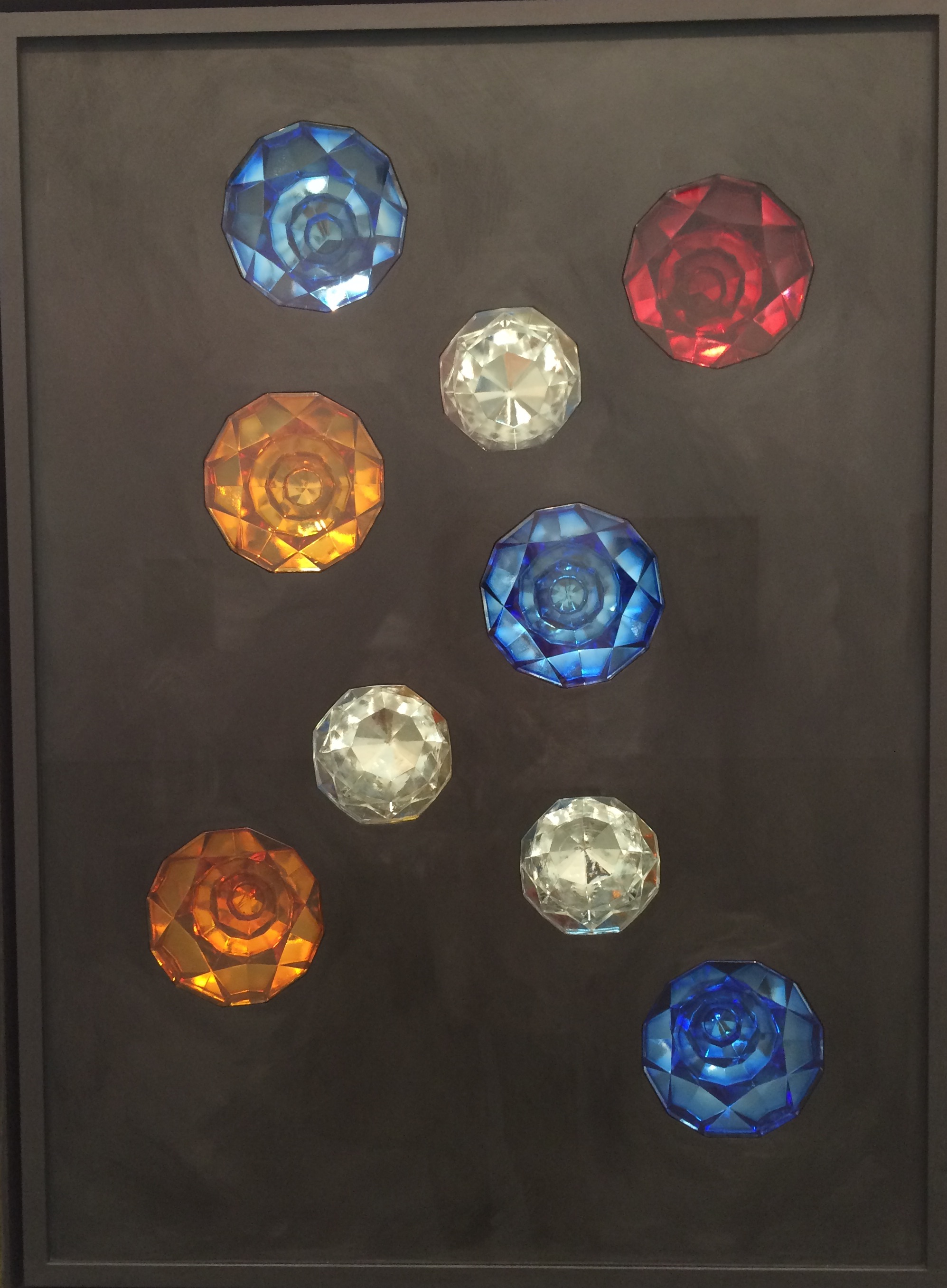
The mathematics used in the study of crystallography relies heavily on geometry. Josiah McElheny’s “Crystalline Prism Painting” series – on view at Andrea Rosen Gallery – offers a unique expression of the visual qualities of crystal forms.

15-42-1

Josiah McElheny – “Crystalline Prism Painting III” – 2015

The painting in this series are a type of shadow boxes with a smooth glass over the 3-D press-molded polished glass crystals. This construction offers a foreground, the glass, a middle ground, the crystal sculpture elements, and as a background the black painted board. The glass crystals are both the subject of the artwork, as well as the physical material or medium of the work. Out of the frame they would be beautiful objects but by displaying them on a black background and hanging them on the wall the artist invites the viewer to look at them more closely. McElheny’s work showcases the geometries and symmetries of crystals.

Susan Happersett

Richard Long at Sperone Westwater

Richard Long has along career of creating art about nature based on his walks through different landscapes. I saw more recent work last week at Sperone Westwater.

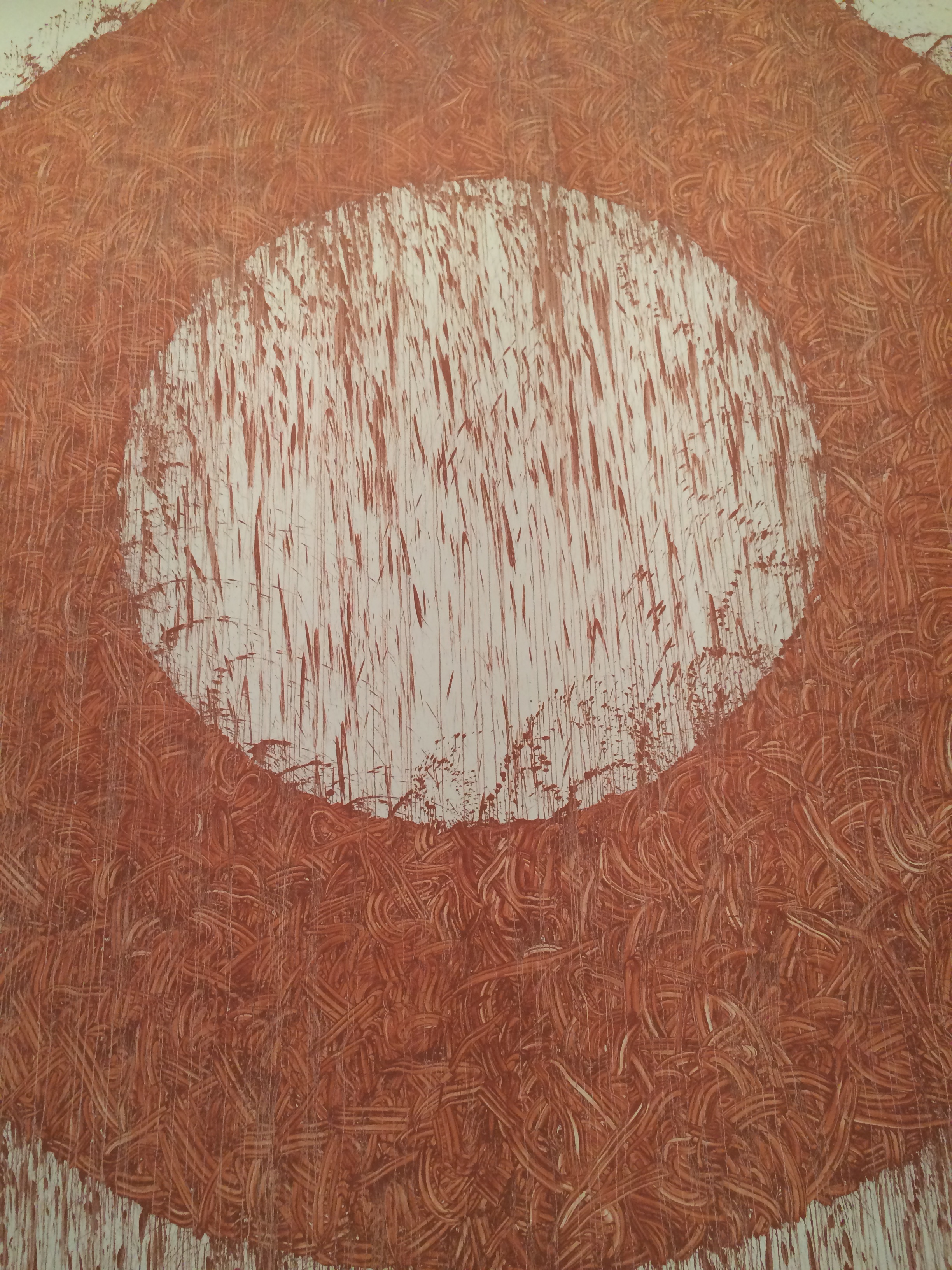
One double height wall in the gallery features a sight-specific giant circular drawing created by the artist by hand, by applying red mud directly to the wall.
15-41-1
This gallery room is taller than it is wide, so the viewer must look up to see the entire circle. This creates an interesting optical element. Although the circle has a consistent width it appears to be thicker at the bottom and thinner at the top. It is a perfect expression of how geometric appearance can change based on the location of the form and the viewer in space.
15-41-2
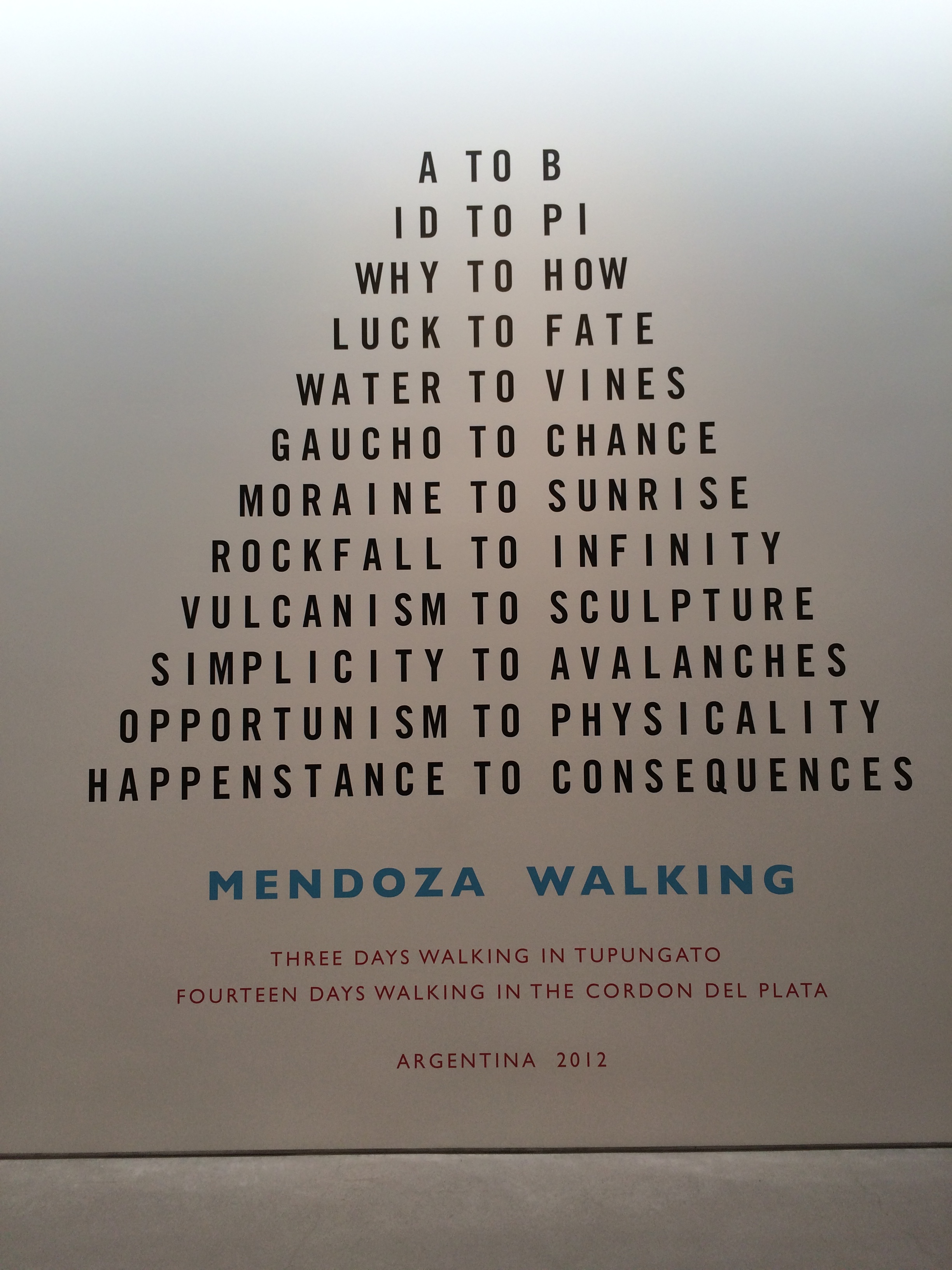
Richard Long’s artistic practice also includes text based work. The visual poem “Mendosa Walking”  incorporates an interesting use of counting and mirror symmetry. The 12-line text has a center column using the two letter word “TO” to join the a word on each side. the number of letters in these words increases by one letter going down the rows. From “A”  “TO” “B” at the top all the way down to “HAPPENSTANCE” “TO”  “CONSEQUENCES”.

Susan Happersett

Dan Flavin at David Zwirner

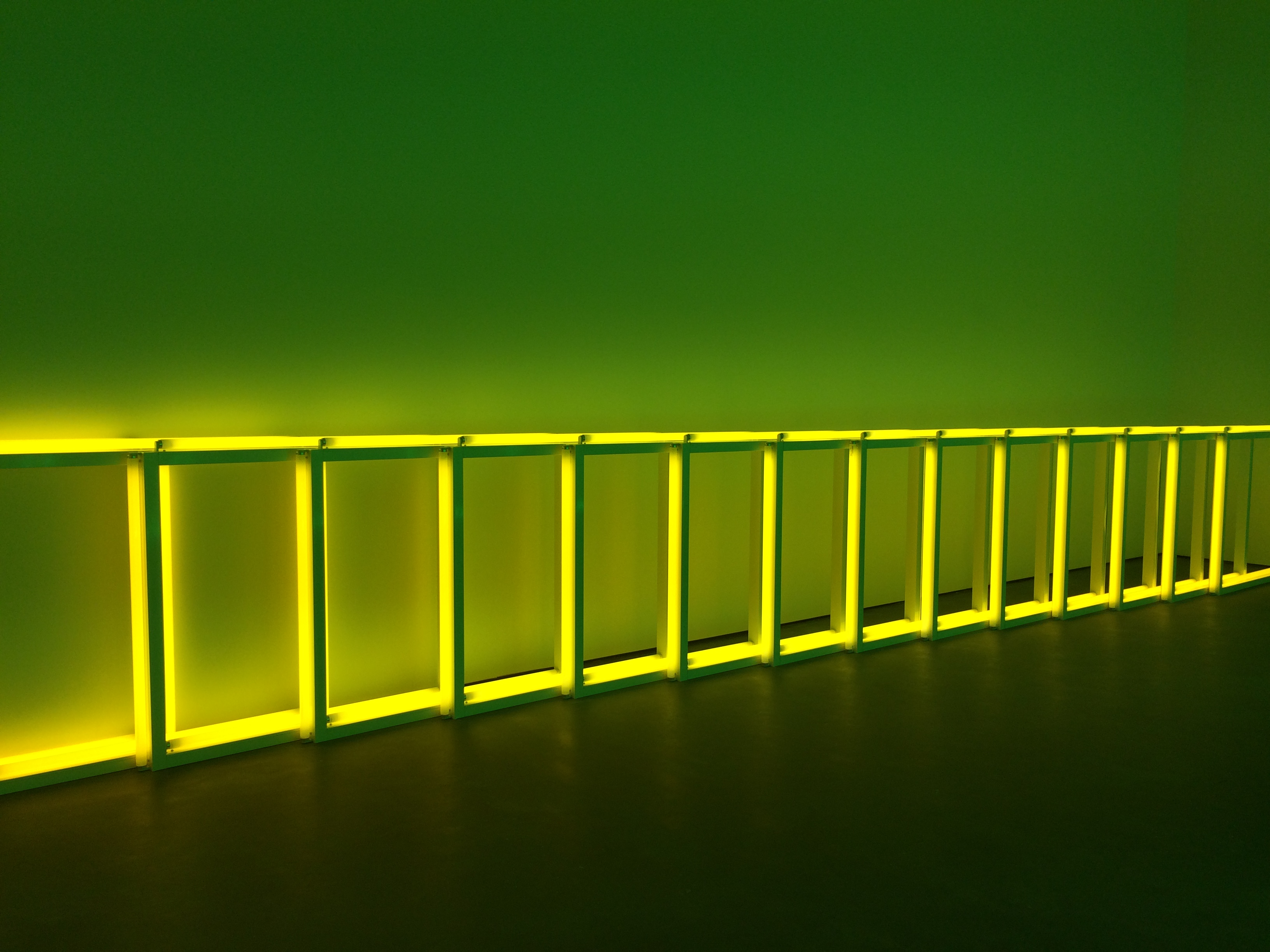
David Zwirner is presenting the exhibition “Corners, Barriers and Corridors” at the 20th street gallery. This show presents the work of Dan Flavin from the late 1960’s into the 1970’s. The artist is famous for his use of fluorescent light constructions to define geometry within a space.

15-39-1

“Untitled (to Sonja)”, 1969

Much of Flavin’s work involved the use of straight lines and grids. I was particularly happy to see a work that was all about circles.

15-39-2

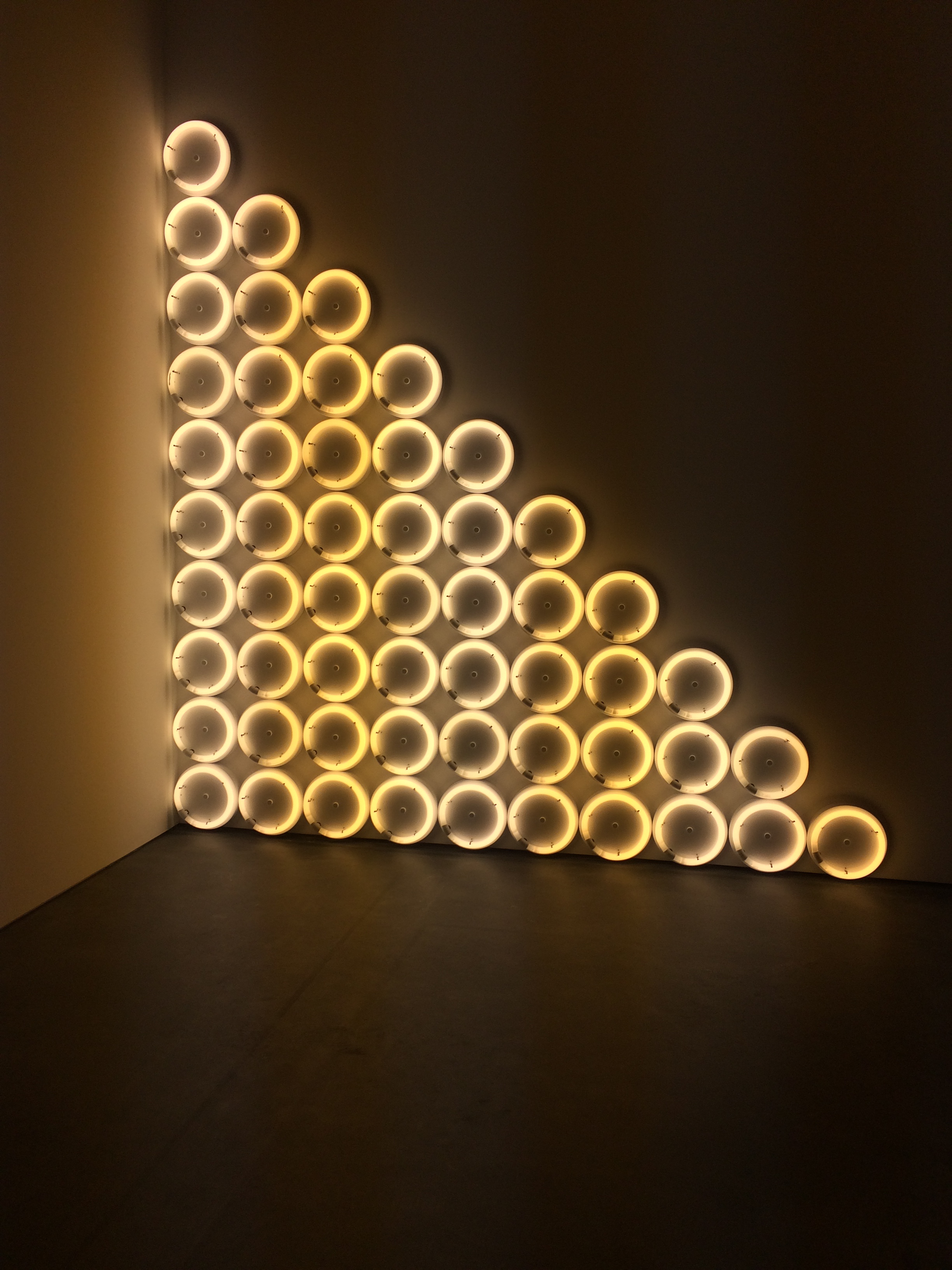
“Untitled (to a man,George McGovern) 2” ,1972

Situated in the corner of the room “Untitled (to a man, George McGovern) 2” from 1972 is made up of a series of columns of circles of light. They descend in order from a height of ten circles to a single circle. The juxtaposition of the curves of the circles with the straight edges of the corner space and the placement of the circles with in a grid creates an interesting tension. The 45 degree angle produced by the descending columns gives the illusion that the circles are rolling down the construction. Dan Flavin is known as a minimalist and this work uses only the most basic elements, circles within an environment of straight lines, but the impact is impressive.

Susan Happersett

Robin Kang

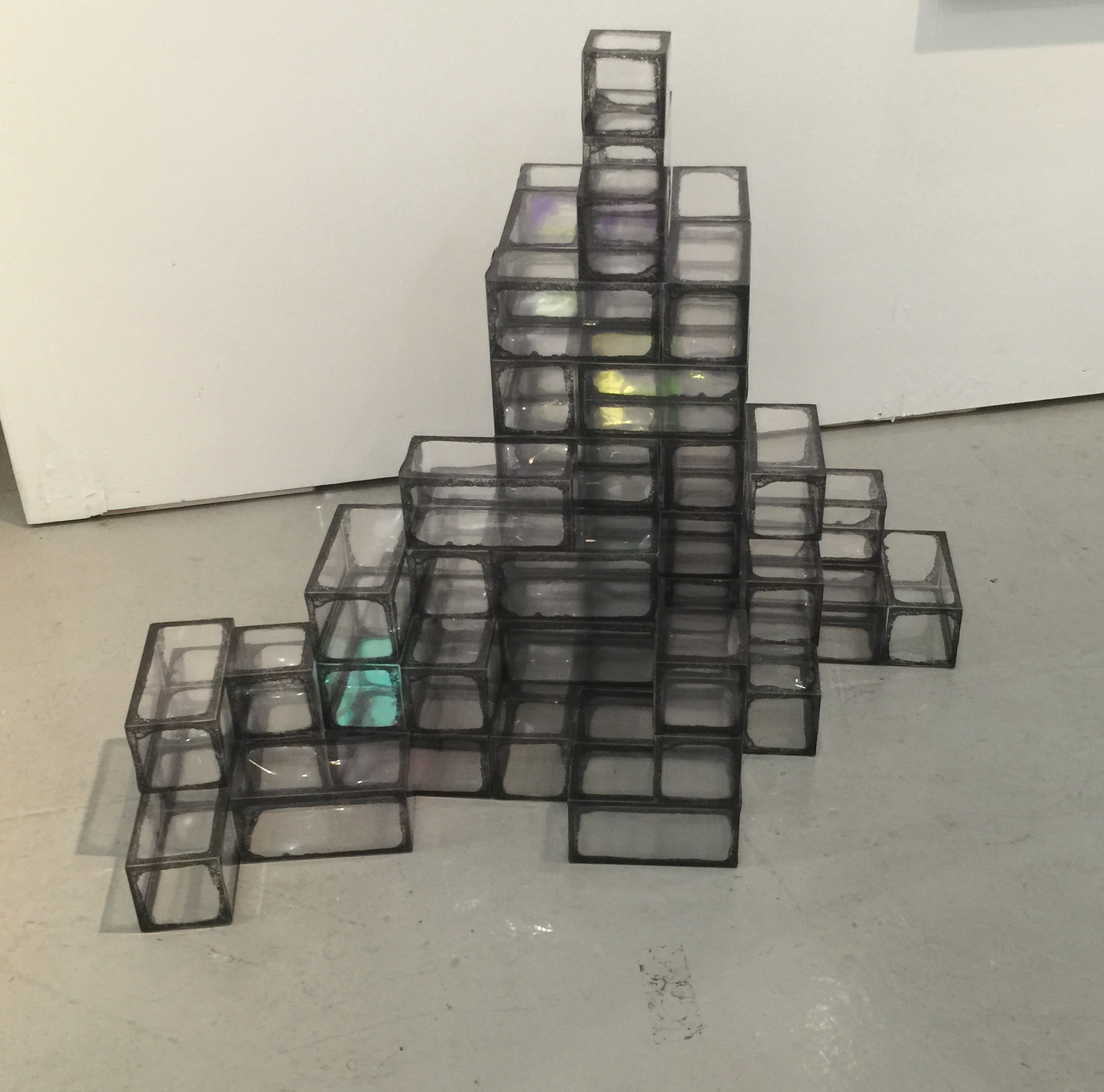
The New Apostle Gallery featured sculptures and tapestries by Robin Kang at their booth at the Select Fair. Kang works in two very diverse styles. The sculptures are created using clear plastic BRXL bricks in two shapes: cubes and rectangular prism that are basically the size of two of the cubes side by side. The edges of each brick have a dark shading to accentuate them. Some of the interior walls are lined with radiant film creating reflections. “Artifact 435” from 2015 is a floor construction that is all about geometry by limiting the shapes Kang focuses on the interiors as well as the exteriors of cubes and prisms.

15-23-1

Robin Kang – “Artifact 435” – 2015 – Plastic BRXL and radiant film
Courtesy of the artist and New Apostle Gallery

Robin Kang also has work included in a very interesting exhibition at the 1285 Avenue of the Americas Gallery (the lobby of the USB building) titled “Between a Place and Candy: New Works in Pattern + Repetition + Motif”. This show, organized by Norte Maar, presents recent work that relates to the Pattern and Decoration tradition of the 1970’s. This movement also had a basis in the craft and ornament. The use of repetition quite often has Mathematical implications and I saw a number of exciting connections. To see complete set of images go here.

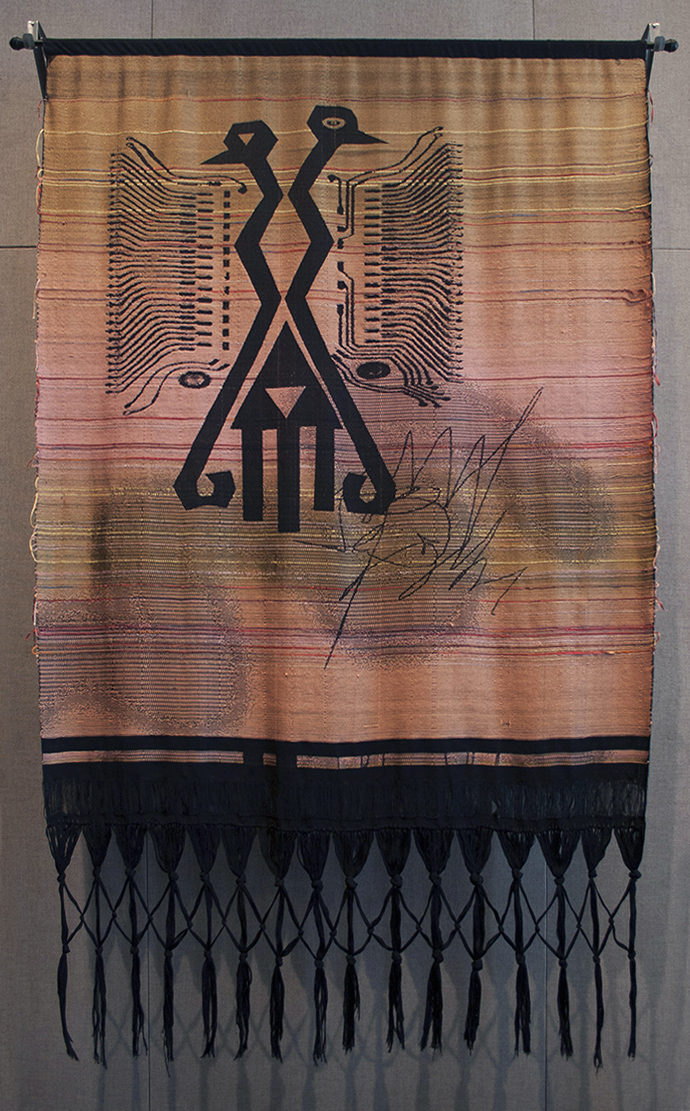
Kang’s contribution to the show is a tapestry “Two Birds with Diamonds” from 2015. It was made on a digitally operated Jacquard loom (a binary operated loom). The images of the birds have a bold simplicity that remind me of ethnographic patterns. The vector-type parallel lines remind me of computer circuit boards.  Kang has managed to integrate the history of textiles with the history of technology.

15-23-2

Kang – Two Birds with Diamonds” hand woven Cottton and Tincel – 2015
Courtesy of Norte Maar and the artist

The work of Robin Kang relates to mathematics on two fronts: the sculptures elevate basic geometric figures by  revealing their interior structures, the tapestries combine the mathematics of early computer science with the cultural significance of the textile arts.

Susan Happersett


Sarah Stengle – Inspirational Conics

I look at a lot of art and I find quite a bit of work with Mathematical elements, but when I find new art inspired by a book of Mathematical proofs and figures I get really excited. Stengle’s new and ongoing series of drawings is based on Apollonius of Perga’s book “Conic Books I-IV”.  Apolonius of Perga (262BC-109BC) was an ancient Greek geometrist who is famous for his innovated work in the mathematical field of conics. He explored the properties of conic sections and furthered our understanding of ellipses, parabolas, and hyperbolas.

Stengle has been collecting vintage postcards for a year. These postcards serve as the background image for her drawings. The choice of postcards is very important, as the artist looks for older non-glossy cards that can be drawn on. The subject matter on the card must also be fairly uninteresting visually so they can support but not over power Stengle’s mathematical imagery.

Each drawing is based on a proposition from “Conics Books I-IV”. There are three types of cards in this series. Some of the cards feature an accurate figure from a proposition in the book. In this case the book and proposition are written on the back of the card. Some of the other drawings have deviations from the figures in the book, but the aesthetics are interesting. Here the artist uses the work, and states the proposition and the fact there is a error on the back of the card. Finally, there are drawings that are imaginary propositions inspired by a particular figure.
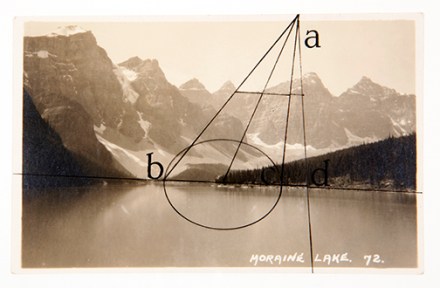
Stengle_Postcard from Perga_Moraine Lake72_imaginary Prop 6Med Low Res

“Perga Moraine Lake 72”

The card “Perga Moraine Lake 72” is the third type of card: it features an imaginary proposition. The artist had started to draw an Apolonius of Perga proof, but stopped at a point when the drawing reached a point of aesthetic completion. From the tip of the cone to its elliptical base, the mathematical figure leads the viewer’s eye from the mountain peaks in the landscape behind the lake to the shoreline.
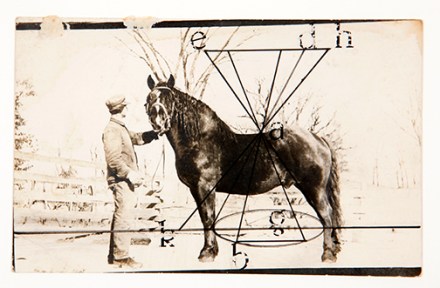
Stengle_Postcard from _Perga_Book1_Prop2_third_image_2015

“Post Card from Perga, Book 1, Proposition 2 Third Image”

This second Post card from Perga, “Book 1, Proposition 2 Third Image” shows the third of the four figures in the proposition. The background card is an overexposed photo card of a horse . The uneven quality of the card could be due to the fact it was probably made to promote the sale of the horse. This card features a figure drawn directly from the text with no changes. The axis of symmetry of the mathematical figure goes through the center of the animal.

Stengle_Postcard_from Perga_Book1Prop4_Med Low Res

“Lilac Conics Book 1 Proposition 4”

“Lilac Conics, Book 1 proposition 4” is also an accurate representation of the proposition in  Apollonius of Perga’s book. The four conics are lined up along a beach mimicking the points of the masts of the fishermen’s boats.

Using carefully selected appropriated images as the backdrop for her geometric figures, Stengle has created a link between her mathematical subject matter and the world around us. The basis of the Perga post cards is an ancient text and the actual cards are vintage. When combined these elements lead to a sort of suspension of time. This series of work is a wonderful expression of the timeless aesthetics of Apollonius of Perga’s conic geometry.

Susan Happersett
“Evidence of Absence” at ZieherSmith Gallery

The ZieherSmith Gallery in NYC current group exhibition is titled “Evidence of Absence”. Two of the artists in the show create work that uses mutated repetition of geometric shapes.

Ryan Mrozowski

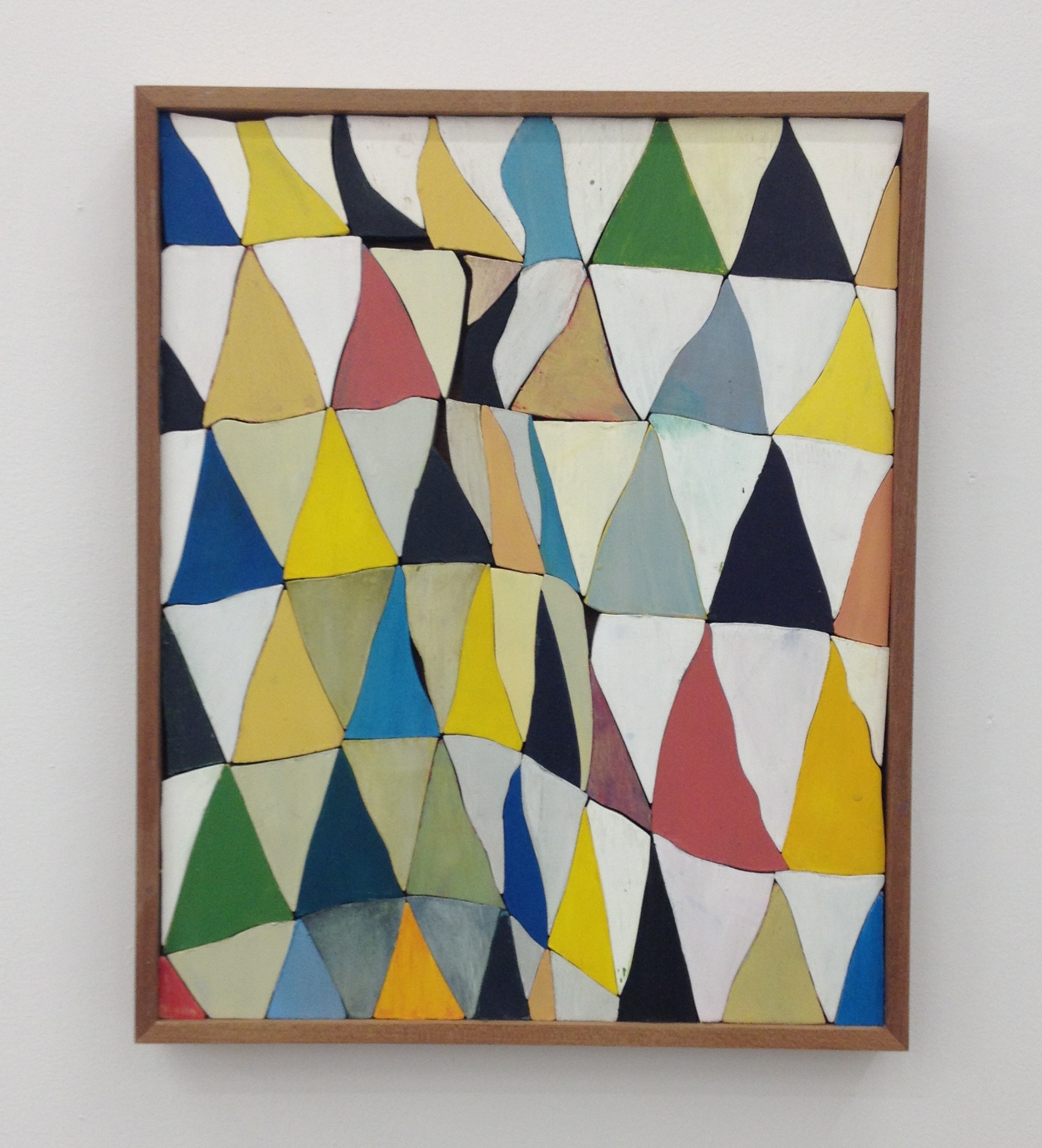
Ryan Mrozowski makes wood blocks that are coated in acrylic and vinyl then they are held together in a rectangular frame. This creates a patterned plane or a 2D tiling pattern from 3D blocks. His assemblages give the illusion that all of the blocks started out the same size and shape, but they have been squished together and distorted by the limits of the frame capacity.

21-1

Courtesy Ryan Mrozowski and ZieherSmith New York
“Dark Blue, Red, Maroon, Green III” 2014

In Mrozowski’s “Dark, Blue, Maroon, Green III”, rows of isosceles triangles appear to have been compressed into a frame that is too small, distorting the geometry of what could have been a very repetitive geometric pattern. As the viewer I get the feeling that the order we associate with mathematical patterning has been disturbed and mutated. So it is the imaginary starting point of this pattern before it was compacted that holds the mathematical connections. Although the wood blocks are solid, there is the false appearance of plasticity that hold the memory of the geometrical starting point.

Adam Winner

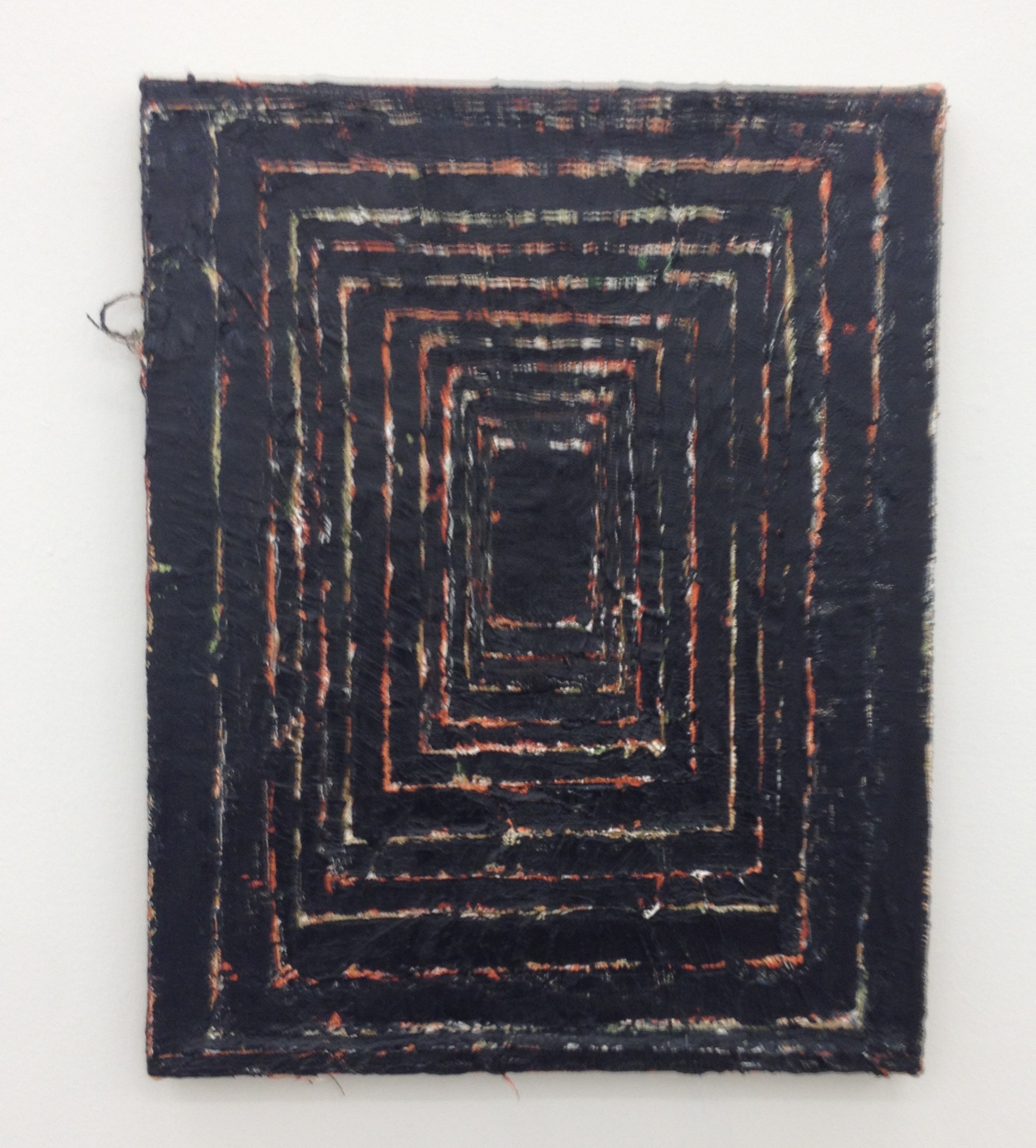
Adam Winner creates minimalist paintings with a hand-made edge. Instead of brushes he uses palette knives, instead of a smooth solid canvas he pieces together torn linen canvas. He uses the rough edges of the linen to create straight lines. Winner is interested in the Golden Section and incorporates this into the proportions of his work.

21-2

Courtesy Adam Winner and ZieherSmith Gallery New York
Untitled 2014

Winner’s untitled oil painting above features a series of twelve concentric rectangles (including the outer edge of the canvas). This is a theme that has been explored by Minimalist artists including Frank Stella, but Winner’s unique technique breaths new life into the subject matter. Earlier interpretations of the parallel lines of concentric rectangles relied of the slickness of clean and accurate lines. This painting has rough not quite perfect lines created from the torn edges of canvas strips. I am always looking for work like Winner’s that revisits how mathematics has been used before, but in some way alters the process.

– Susan Happersett

Pius Fox at Pablo’s Birthday Gallery

The German artist Pius Fox is having his first solo exhibition in New York City at Pablo’s Birthday Gallery. The title of the show is “We expected something better than before” and features  wonderful abstract paintings, whose geometries are based on interior architectural elements. I have chosen two works that seem to me to have the most mathematical significance.

Pius Fox - Zeitland Schaft - Oil on Canvas - 2014Picture courtesy of the artist and the gallery

Pius Fox – Zeitland Schaft – Oil on Canvas – 2014
Picture courtesy of the artist and the gallery

The first painting is “Zeitland Schaft”,  an oil painting from 2014. This work features four rectangles. Each is bisected diagonally to form eight right triangles. What I find interesting about this work is how it relates to the work of Piet Mondrian and Kazimir Malevich. Malevich used the geometric forms as his subject matter: the paintings were traditional in the fact that, even though he was depicting  abstract themes, they were still  pictures  of shapes within a background. In Mondrian’s square canvases the square itself becomes both the format and the subject. There is no longer a delineation between subject and artwork. I feel that in some ways Fox’s work is taking this use of geometric forms a step further. In this painting rectangles and triangles might – at first glance – seem to be the subject of this work, but in fact it is much deeper. The geometric shapes are a vehicle for Fox’s use of layers of color and his lush painting technique. The symmetrical properties of the painting – for example the glide reflections in the placement of the pink and yellow triangles – enhance the relationships of colors, making them seem to glow.

19-2

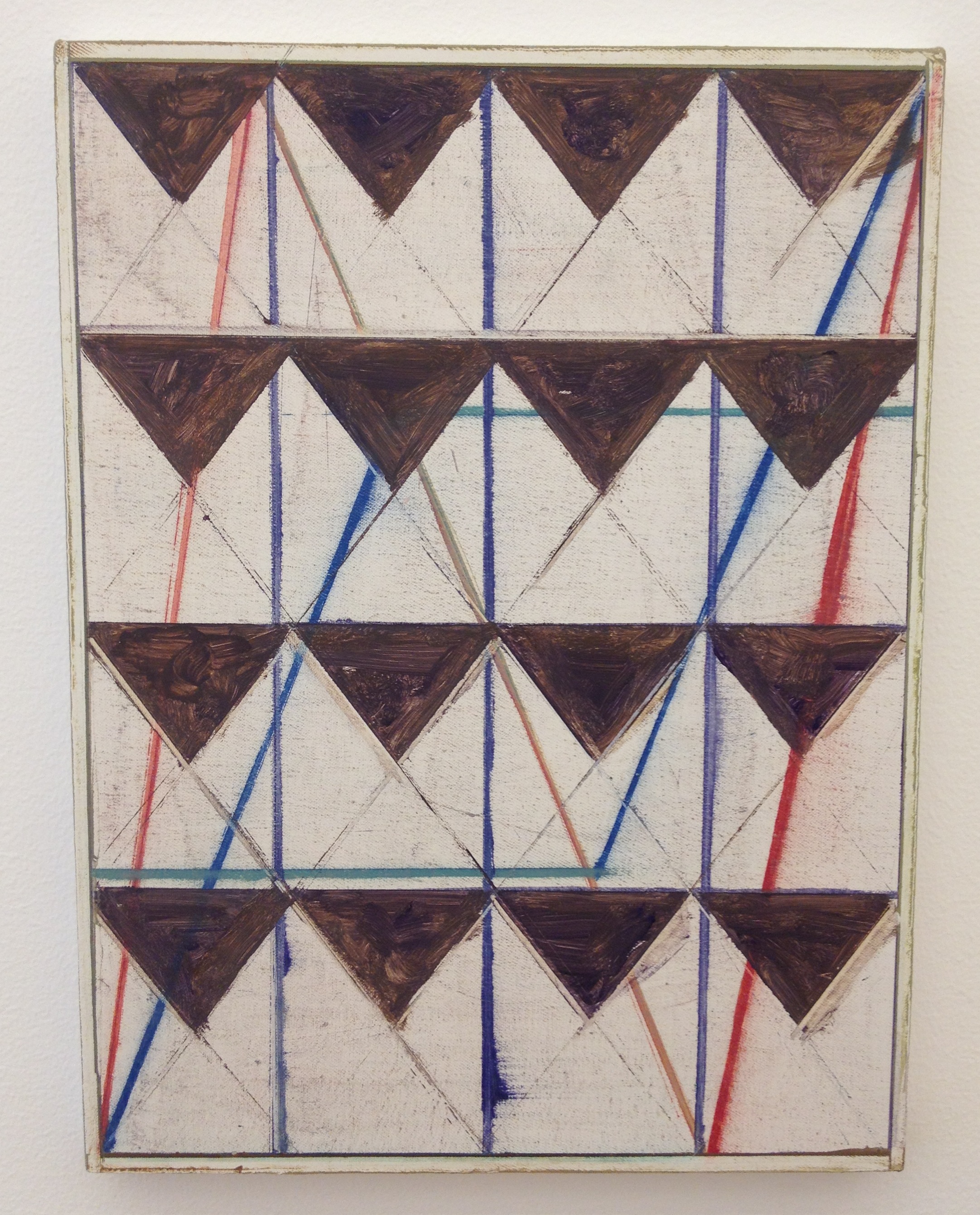
Pius Fox – Untitled (PF 1403-41) – Oil on canvas – 2014
Picture courtesy of the artist and the gallery

The next painting I would like to discuss is an untitled oil on canvas also from 2014. I Particularly like the use of both line and solid shapes this painting. Dividing the rectangular canvas into four columns and four rows, Fox has set up an interesting grid to draw lines connecting the points of intersection on the grid. Lightly drawing in both diagonals of each rectangular grid cell, he fills in a dark isosceles triangle in the top half of each. This creates a strong pattern that superimposes the other lines of the painting. Behind the triangles there is a 180 degree rotational symmetry to the red blue and gold lines. Looking at this  painting the viewer gets the feeling that it is about more than just the geometry. Again,the shapes are the language that Fox is using to convey a sense of place.

— Susan Happersett

Steven Naifeh – Found in Translation

The Leila Heller Gallery is currently exhibiting painting and sculpture by Steven Naifeh. Many people will recognize the name Steven Naifeh. He is a world renowned art historian and academic who has published biographies on Jackson Pollock and Vincent Van Gogh. He is also an accomplished artist whose work is inspired by historic Middle Eastern architecture. Growing up in a diplomatic family, Naifeh was raised both in the USA and the Middle East. Building patterns with basic geometric shapes in repetition, Naifeh  assembles complicated images. Using a computer to calculate the specifics, the shaped canvases  and copper plated steel elements fit together with precision. The paint on the canvases has been applied using tape and a sprayer. This is a technique popular with Minimalist artists. To me these works however are a step away from Minimalism with their emphasis on pattern as it relates to architecture.
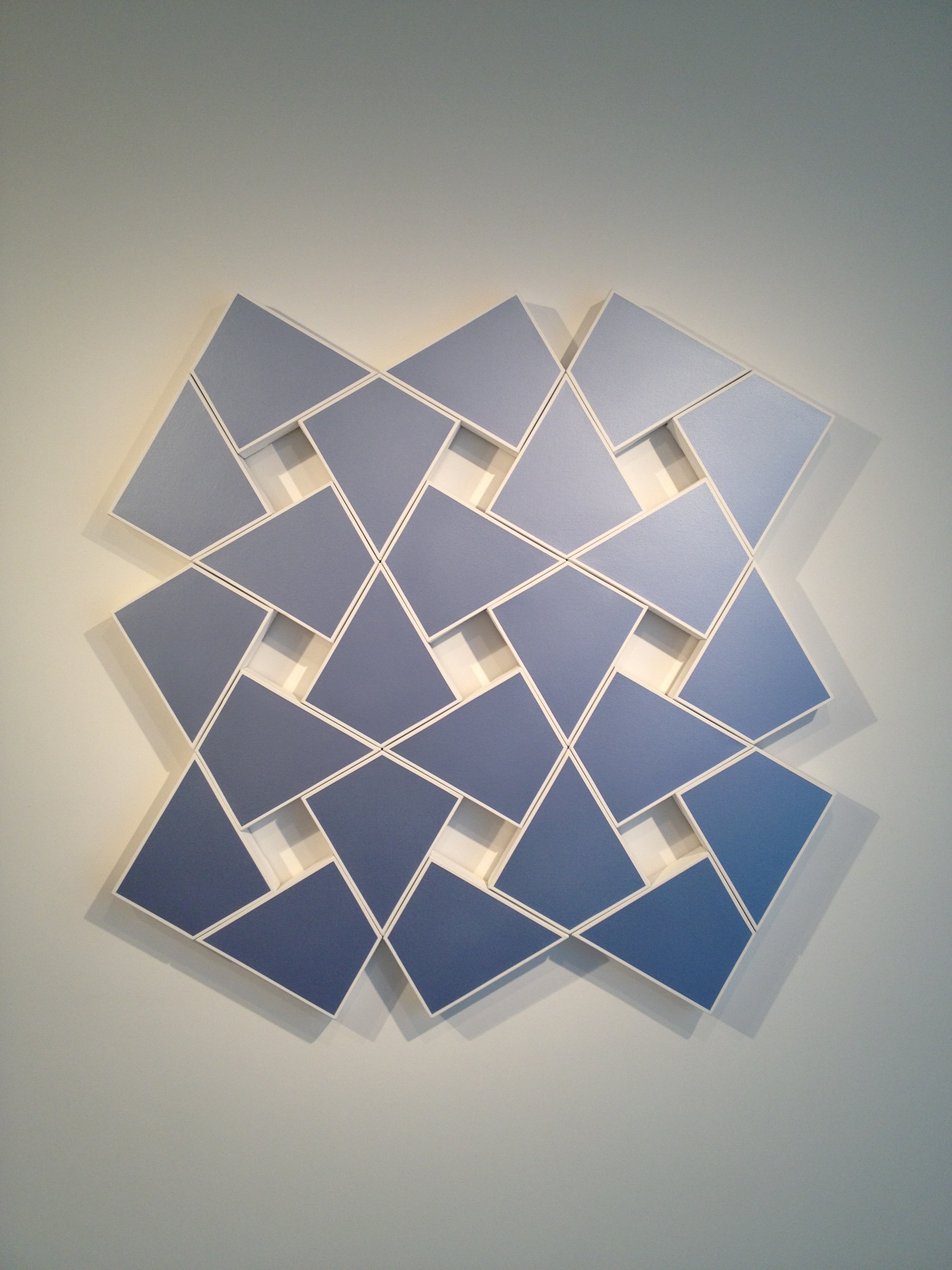
In “Cyrene IX:Shimmering Sky” four identical kite-shaped quadrilaterals, each with two 90 degree angles make up each square. There is a smaller square opening within each large square. This puzzle-like painting is quite complex and visually satisfying. This is an artistic accomplishment considering that all of the pieces have the same shape and size,  they have just been just repeated and rotated.

17-1

Steven Naifeh – Cyrene IX:Shimmering Sky – 2010
Picture courtesy of the artist and the gallery

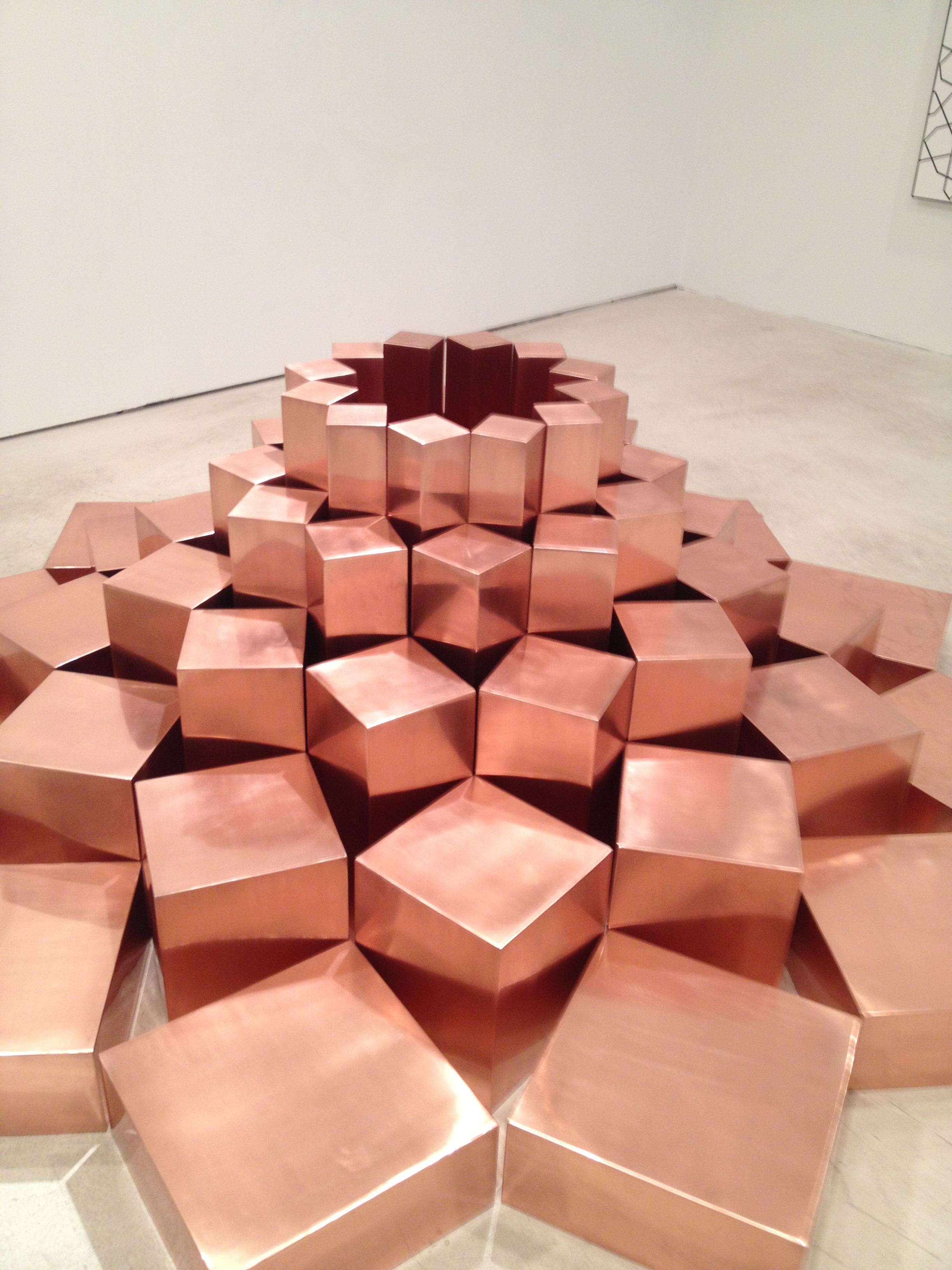
“Saida XXXVI” is a large scale copper-plated steel sculpture. It is composed of individual prisms with square top faces. The prisms in the outermost ring have the largest square top faces, but are the shortest. Each consecutive ring of prisms have smaller top faces but are taller, in the 5th and center ring the prisms have the smallest square top faces and are the tallest. This sculpture takes up most of the floor space in one of the gallery rooms. Gallery patrons  interact with this structure by walking around the circle of prisms. “Saida XXXVI” for me was the piece in the show that most closely aligns itself mathematically with Middle Eastern architectural elements. Naifeh has created an elegant blossom using only a collection of simple square faced prisms. Many artists cite historic buildings and decoration as their inspiration, but very few have been as successful as Naifeh in making these connections seem contemporary. His process of fabrication and his choice of materials bring the beauty and essence of Middle Eastern architecture into the aesthetics of the 21st Century.

17-2

Steven Naifeh – Saida XXXVI – 2014
Picture courtesy of the artist and the gallery