Off the Wall in Chelsea

I discovered a very interesting trend at the Chelsea galleries this week. I found three different exhibitions where an artist presented drawings, paintings, or sculptures, but also built an installation work that protrudes off of a gallery wall.

Robert Curry at Bryce Wolkowitz Gallery

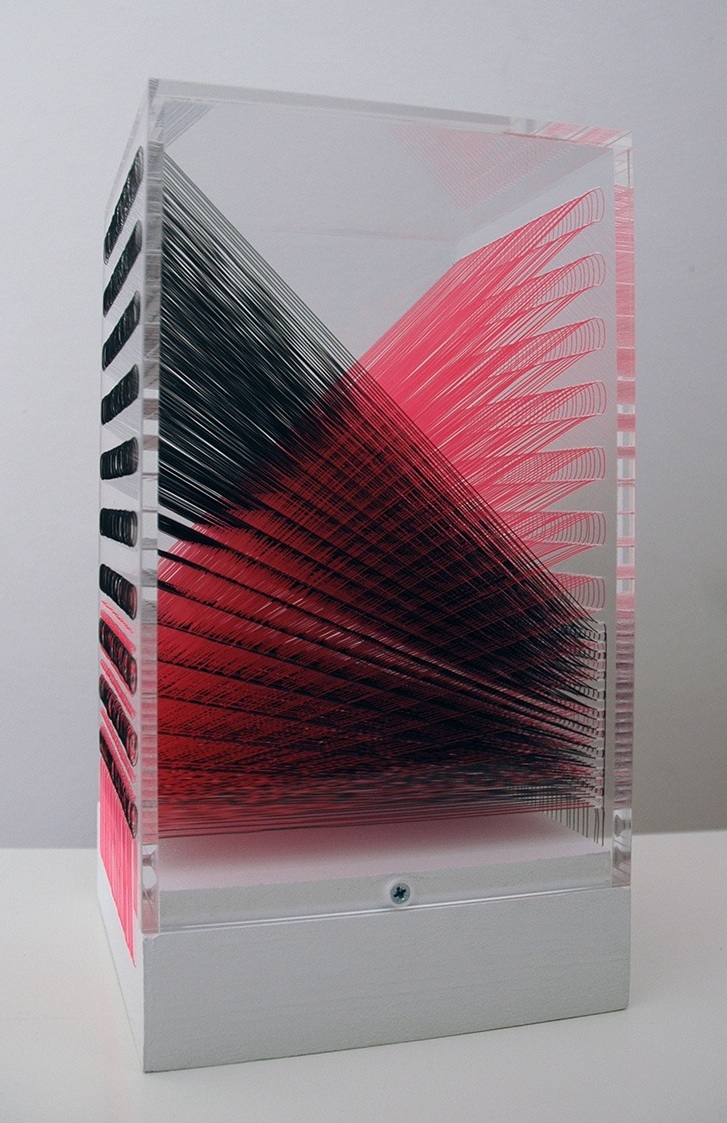
Bryce Wolkowitz Gallery  had a collection of Robert Currie’s perspex cases with monofilament line 3-D drawings.
27-1a

9,772 inches of Black and Red Monofilament (2013)
Picture courtesy of the artist and the gallery

In the sculpture “9,772 Inches of Black and Red Monofilament”,  Currie uses a series of threads hand-strung in grids to form angled wedges of red and black that intersect at the center, forming an area of at what – at first – looks like disorder. Upon closer inspection the consistency of the patterns becomes clear. This work has a number of mathematical connections: The careful measurement of the monofilament is a defining factor in the title for this work. Currie uses a series of grid patterns to thread the work. There are intricate geometric shapes created within the cases. The finally mathematical connection is his allusion to Chaos Theory, where there is underlying order in what at first appears to be disorder.

At the entrance and in the hall of the gallery, Currie has installed a site-specific thread drawing based on the architecture of the room “12 miles 1647 yards of Black Filament”. This work explores the gallery space using repetitive straight lines.
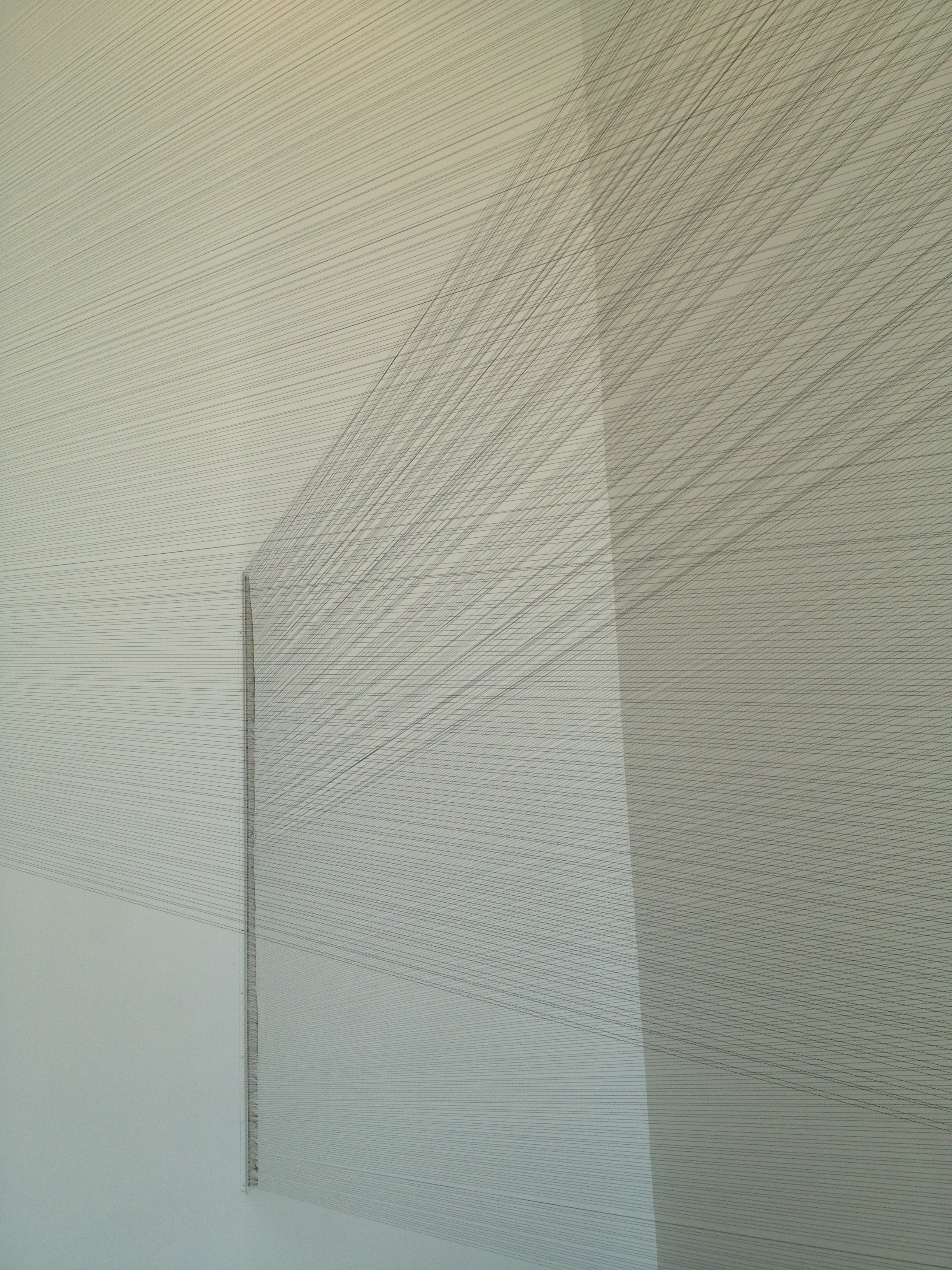
27-2

12 miles 1647 yards of Black Filament
Picture courtesy of the artist and the gallery

Mark Hagen at Marlborough Chelsey Gallery

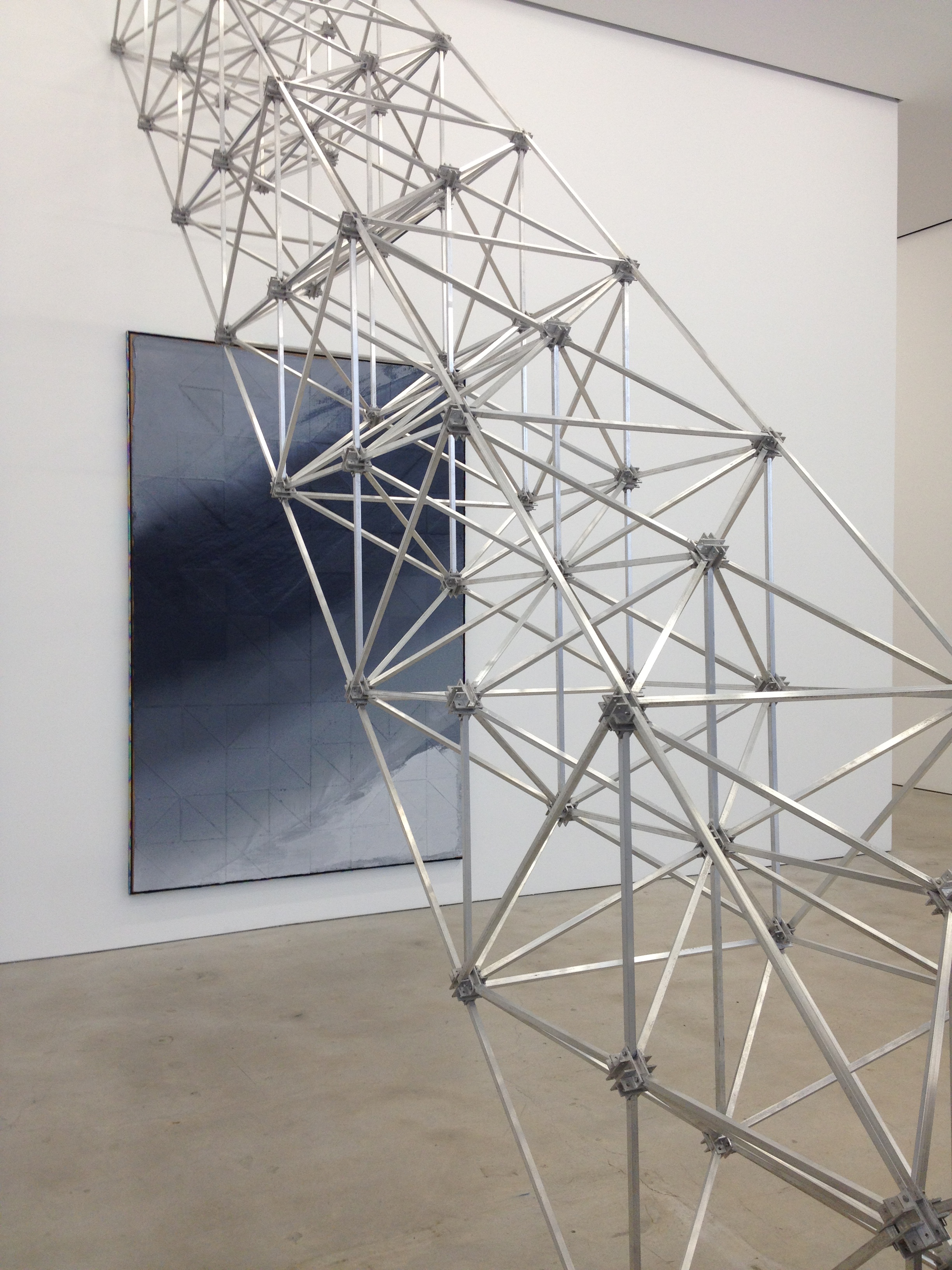
At the Marlborough Chelsea Gallery, Mark Hagen has created an aluminum and stainless steel space frame installation named “To Be Titled Ramada Chelsea #3”,  that climbs in front of his “To Be Titled Gradient Painting #35”. This geometric construction features cube formations meeting at star formations formed by 12 line segments radiating out from a central point.
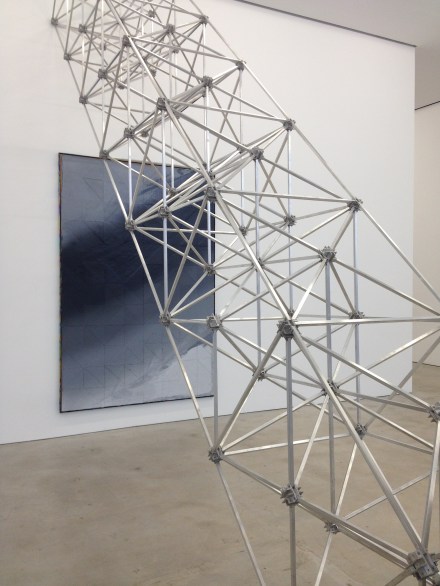
27-3
“To Be Titled Ramada Chelsea #3″in front of “To Be Titled Gradient Painting #35”
Picture courtesy of the artist and the gallery
Ryan Roa at Robert Miller Gallery

The Robert Miller Gallery is presenting a group show titled “Six Features”.  One of the artists, Ryan Roa, is exhibiting drawings that relate to fractions and geometry. In the same room he has created site-responsive installation that create a sense of movement within the space.
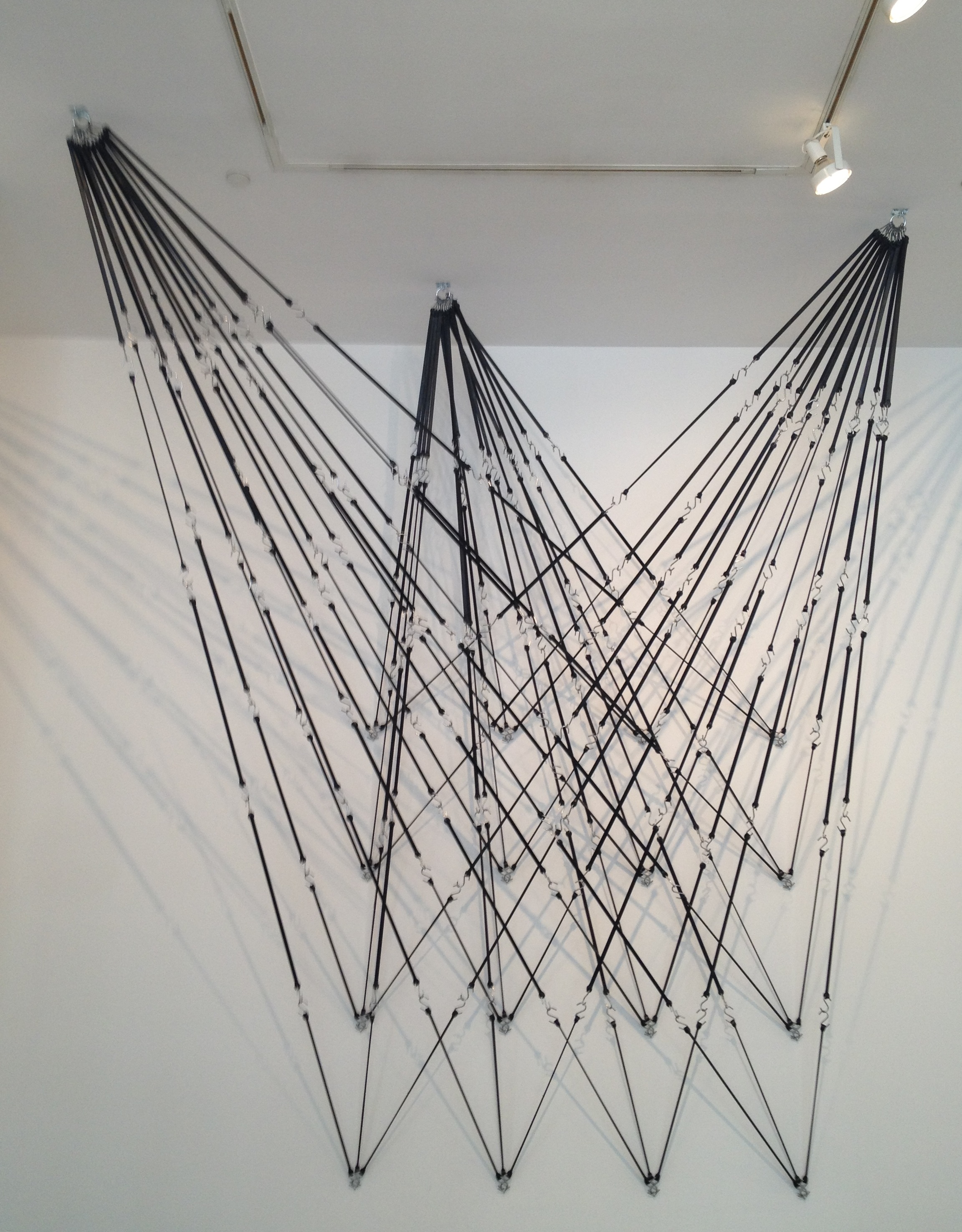
27-4

Site-specific installation
Picture courtesy of the artist and the gallery

In his drawing “12X12 series #01”,  Roa has drawn a multitude of equal line segments radiating out from two opposite corners of the square, creating two equal quarter circles that overlap along the diagonal.
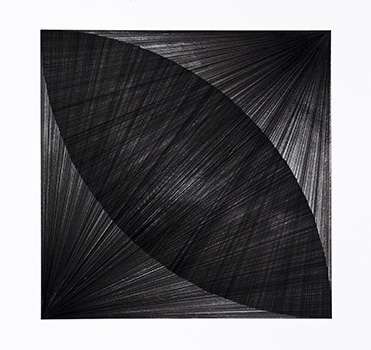
27-5a

12X12 series #01
Picture courtesy of the artist and the gallery

In “12X12 series #02”, the artist uses the same technique of drawing equal line segments, but in this case they radiate out from the two left corners of the squares. The circles overlap to form a pointed dome shape.  The right square is not completely filled in with lines: it  retains the curves of the circle segments.
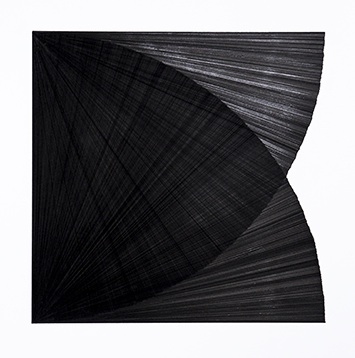
27-6B

12X12 series #02
Picture courtesy of the artist and the gallery

It is fascinating to me how Roa has been able to create two drawings with such different proportion shapes and energy using basically the same technique by only changing one parameter.

It is amazing that within the course of an afternoon walking only a few blocks I was able visit three installations of Mathematical constructions by artists with very different practices and techniques. By expanding their formats off the gallery walls, each artist has created an exciting space to engage with the measures, proportions, and geometries that make up their work.

Susan Happersett
Steven Naifeh – Found in Translation

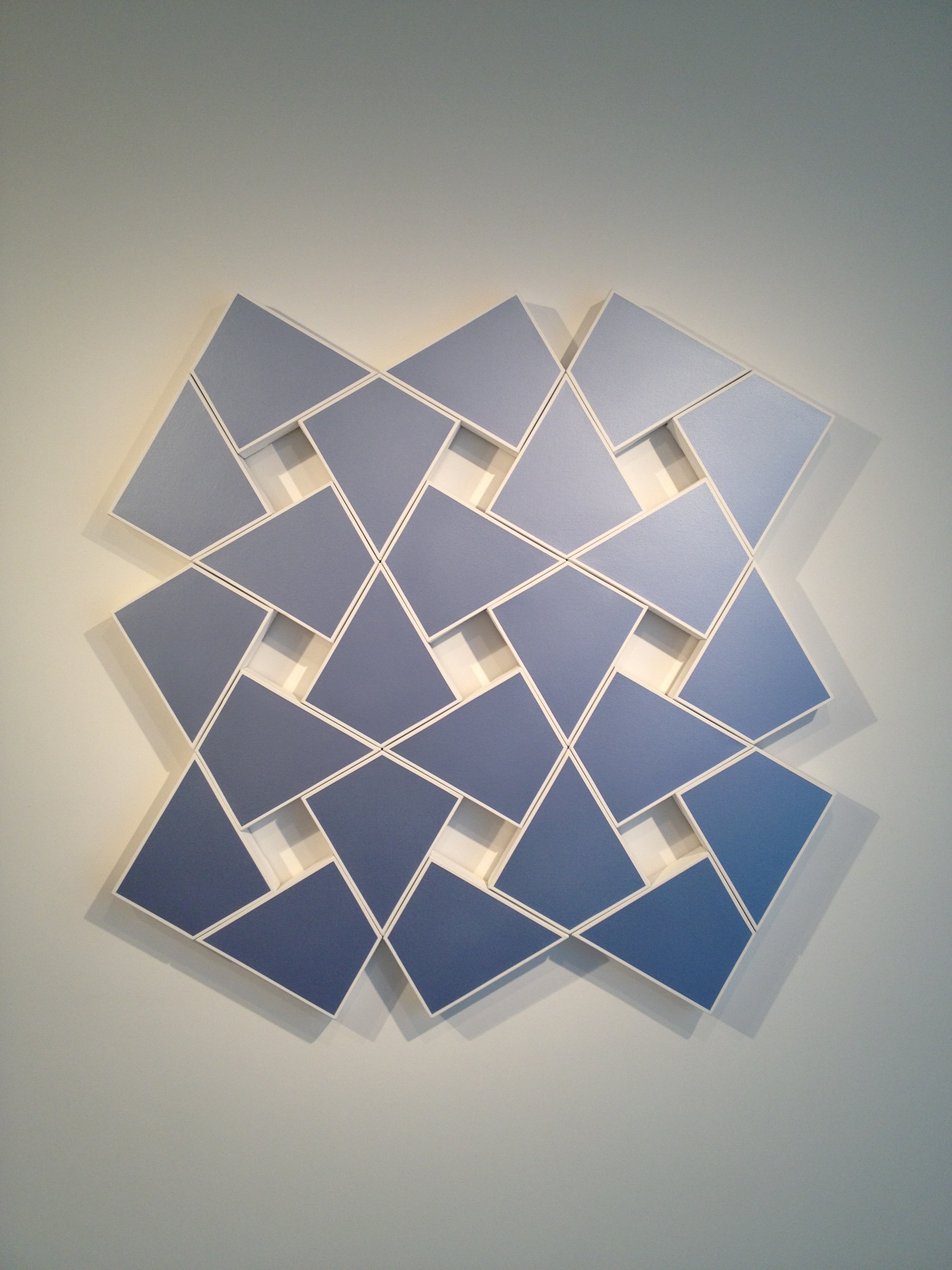
The Leila Heller Gallery is currently exhibiting painting and sculpture by Steven Naifeh. Many people will recognize the name Steven Naifeh. He is a world renowned art historian and academic who has published biographies on Jackson Pollock and Vincent Van Gogh. He is also an accomplished artist whose work is inspired by historic Middle Eastern architecture. Growing up in a diplomatic family, Naifeh was raised both in the USA and the Middle East. Building patterns with basic geometric shapes in repetition, Naifeh  assembles complicated images. Using a computer to calculate the specifics, the shaped canvases  and copper plated steel elements fit together with precision. The paint on the canvases has been applied using tape and a sprayer. This is a technique popular with Minimalist artists. To me these works however are a step away from Minimalism with their emphasis on pattern as it relates to architecture.
In “Cyrene IX:Shimmering Sky” four identical kite-shaped quadrilaterals, each with two 90 degree angles make up each square. There is a smaller square opening within each large square. This puzzle-like painting is quite complex and visually satisfying. This is an artistic accomplishment considering that all of the pieces have the same shape and size,  they have just been just repeated and rotated.

17-1

Steven Naifeh – Cyrene IX:Shimmering Sky – 2010
Picture courtesy of the artist and the gallery

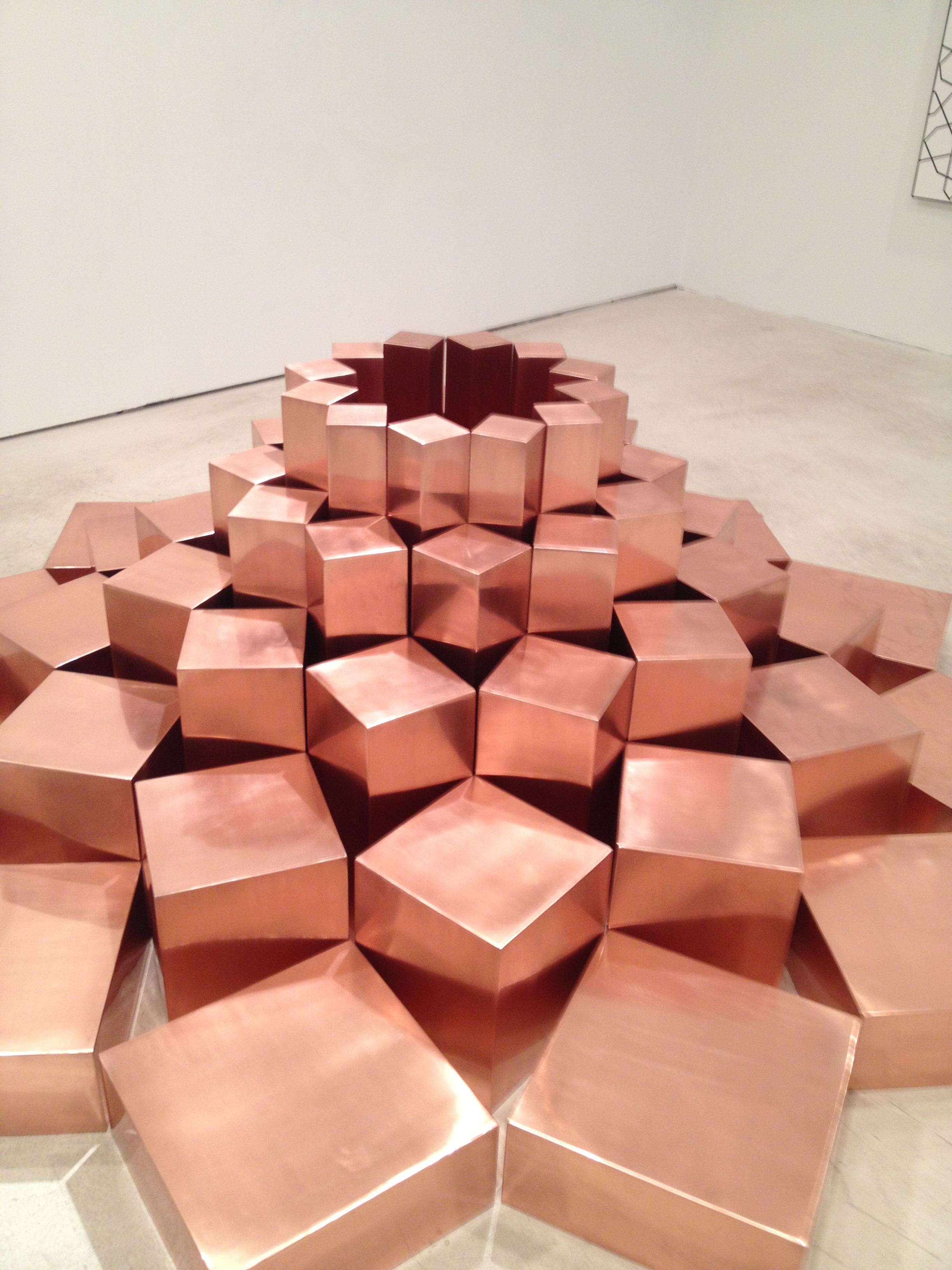
“Saida XXXVI” is a large scale copper-plated steel sculpture. It is composed of individual prisms with square top faces. The prisms in the outermost ring have the largest square top faces, but are the shortest. Each consecutive ring of prisms have smaller top faces but are taller, in the 5th and center ring the prisms have the smallest square top faces and are the tallest. This sculpture takes up most of the floor space in one of the gallery rooms. Gallery patrons  interact with this structure by walking around the circle of prisms. “Saida XXXVI” for me was the piece in the show that most closely aligns itself mathematically with Middle Eastern architectural elements. Naifeh has created an elegant blossom using only a collection of simple square faced prisms. Many artists cite historic buildings and decoration as their inspiration, but very few have been as successful as Naifeh in making these connections seem contemporary. His process of fabrication and his choice of materials bring the beauty and essence of Middle Eastern architecture into the aesthetics of the 21st Century.

17-2

Steven Naifeh – Saida XXXVI – 2014
Picture courtesy of the artist and the gallery

More Chelsea Galleries – February

Robert Morris at Sonnabend Gallery

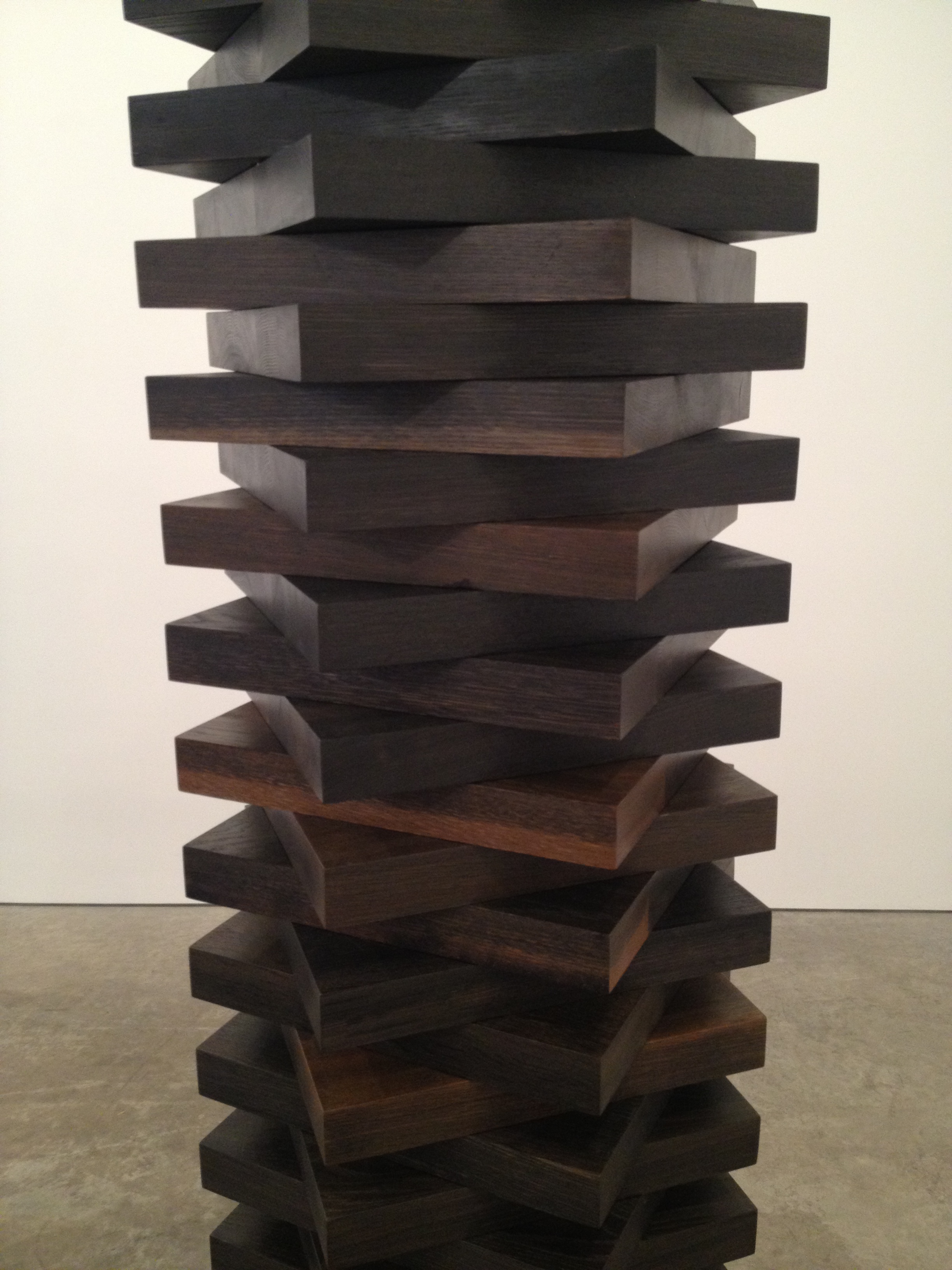
Sonnabend Gallery is exhibiting large wooden sculptures by Robert Morris. Morris is one of the most important American artists and preeminent practitioner of Minimalism. The twelve sculptures in this show are from his “Hardwood Series” and they are all recent reinterpretations of plywood constructions from the 1960’s. Craftsman Josh Finn facilitated the actual production of the work. I was particularly drawn to three totem-like sculptures that were each stacked columns of square planks. In “Serrated Column” (2012) each consecutive plank is rotated 90 degrees. Each square has diagonals that are parallel to the sides of the squares above and below.

photo

Morris – Serrated Column – 2012 – Wood

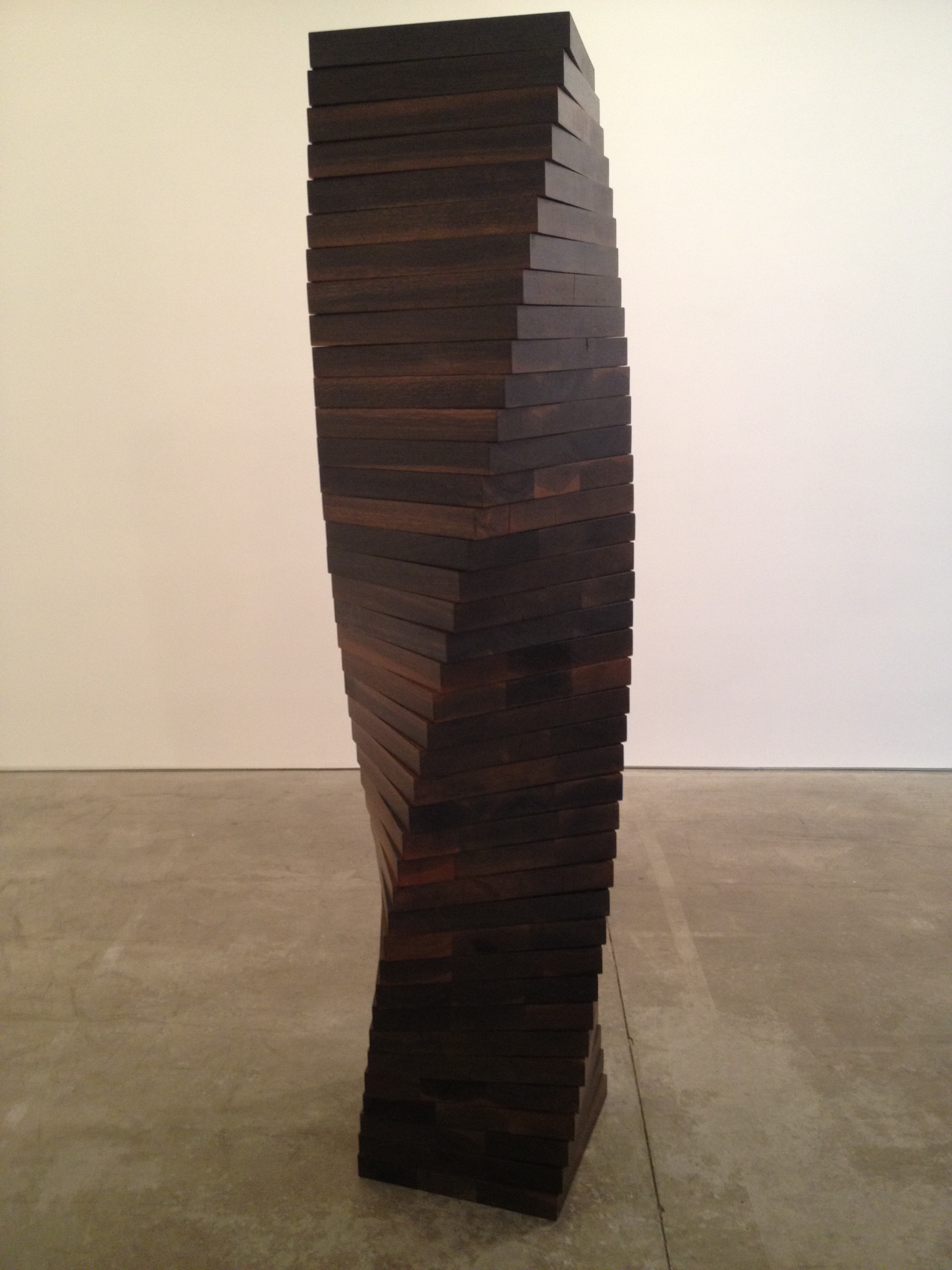
“Twisted Column” (2012) is a stack of  40 squares that rotate a total of 90 degrees. Each square is only rotated 2.25 degrees. This subtle rotation gives the illusion that it is a smooth surface instead of separate square planks.

Morris - Twisted Column - 2012 - Wood

Morris – Twisted Column – 2012 – Wood

In “Spiral Column” (2013) the squares are rotated around a corner instead of the center. One full turn of the spiral is formed by planks. This work is an engineering marvel. Standing in front of this sculpture in the gallery it seems like magic that it does not tip over. Morriss’ column sculptures illustrate the many visual possibilities that can be explored using the repetition of a single geometric element.

Morris - Spiral Column - 2012 - Wood

Morris – Spiral Column – 2012 – Wood

Beth Campbell at the Project Room at Josee Bienvenue Gallery

In the Project Room at Josee Bienvenu Gallery, Beth Campbell is exhibiting her drawings and mobiles in an exhibition titled “My Potential Futures”. The works on paper are handwritten text-based diagrammatic drawings. The wire mobiles are a 3-D extension of the drawings. The structure of the mobiles create a binary fractal pattern. Each mobile is attached to the ceiling by a single wire that then divides into two wires, then each of those wires split again into two wires each. The 4 wires split into two wires each (now 8 wires). This continues through 7 iterations. Start at the top and then there is a choice of two possible routes, a yes or no question or ones and zeros if you are thinking in binary code.

Campbell - Mobile

Campbell – Mobile