Happy Holidays

Each December the department stores in NYC create elaborate window displays to celebrate the season. This year, the window at Barney’s on Madison Avenue include Mathematical art. “The Snow Spirits” is a collection of kinetic sculptures by Anthony Howe that creates an eye catching display. The sculptures are based on circular rings that serve as the axis of rotation for rows of spinning, graduated circles. Because the axis is round, the circles fly into the center, and then fly outward again. These shining sculptures are one of the best expressions of snow flakes I have ever seen.

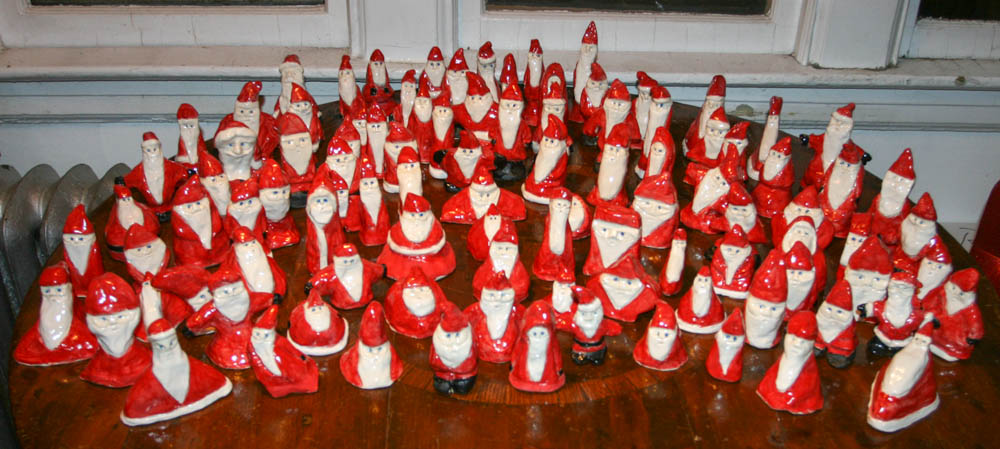
On a different, but also Mart-Art-related note, I like the use of repetitive images. Over the past year I have created a series of over 100 ceramic Santas.

Fibonacci Growth 2000 - Susan Happersett
Happy New Year – and let’s all look for more Math Art in 2015!

Susan Happersett

“Bright Matter” at the Muriel Guepin Gallery

“Bright Matter” at the Muriel Guepin Gallery is an exhibition highlighting the work of five artists using new technology, whose artistic practice address the spacial aesthetics produced through technology. Curated by participating artist Joanie Lemercier, the show features an exciting  selection of interesting geometric patterns created using machines.

blog1

A series of prints by Francois Wunschel immediately caught my eye. “Rotation X”is  a series of lenticular prints that have been made using special magnifying lenses that change the magnification based on the angle from which an image is viewed. This creates the illusion of depth in a 2-D image. This technology has been around for a long time but it has just recently been improved so the results are much more 3-D. Standing directly in front of the prints you are looking at the 2-D line drawing of a cube but as you move the cube cube seems to rotates in space creating cylinders.

blog2

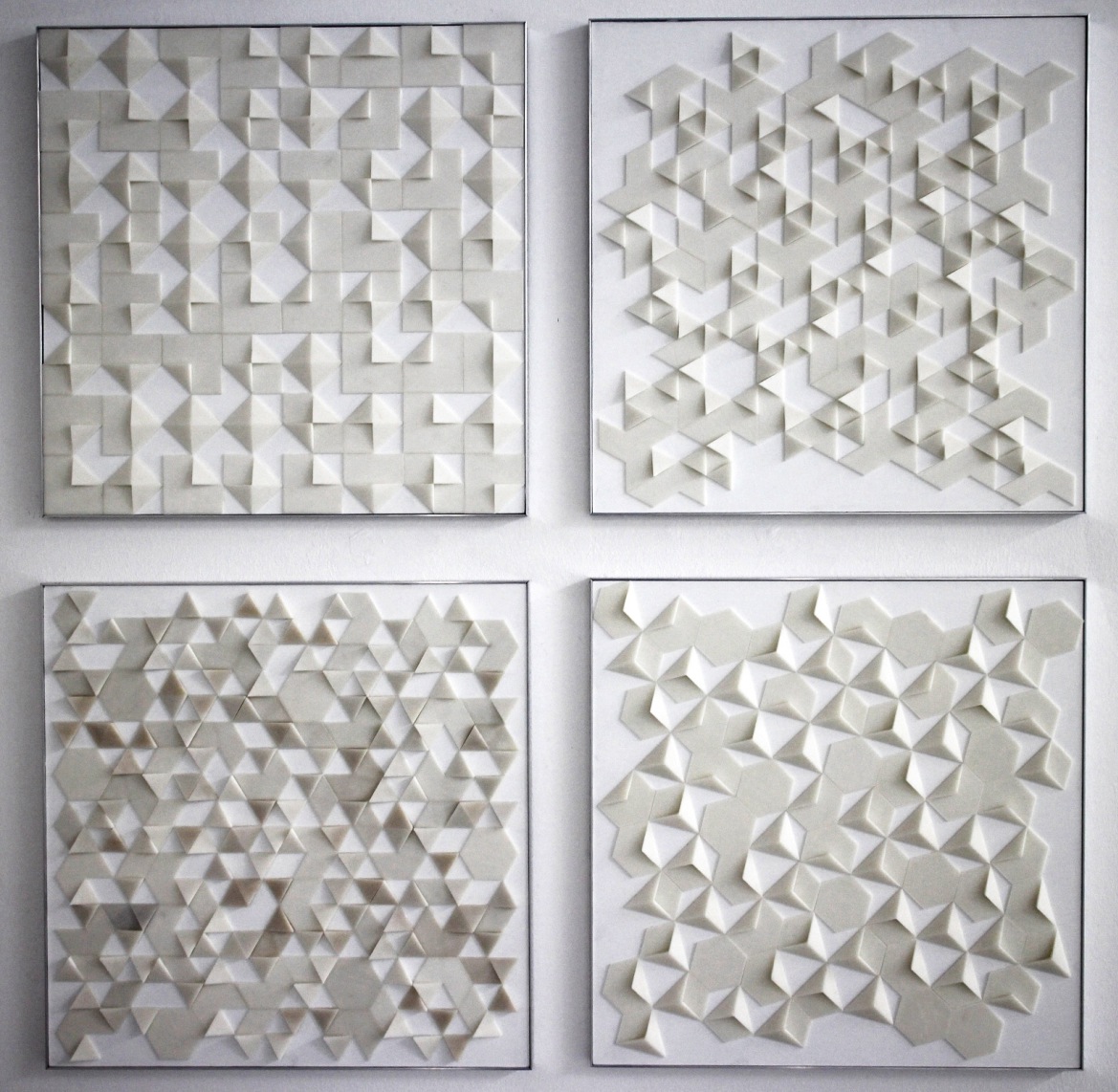
Another set of prints was designed by Lab[au] titled “Origam-Form Studies”, created on a 3-D printer. These prints are grids composed of small square tiles. The individual tiles are either flat or have the illusion of having one, two ,or three corners folded over. Using these basic simple tile elements, complex patterns develop within the grids. It seems to me the artist is mimicking the processes of computers. Built on simple, binary operations computer operations can grow to become extremely complicated and powerful.

The Muriel Guepin gallery is dedicated to exhibiting the work of artists that use the newest technology. I look forward to see future shows.

All pictures courtesy of the gallery and the artists.

Susan Happersett

Judith Lauand at Driscoll/Babcock Galley

Judith Lauand is referred to as “Dama do concretismo” or “The First Lady of Concretism”. She is an important figure in 20th century Brazilian Art. Concretism (called “Arte Concreta” in Brazil) is an international post WWII artistic Movement that included the use of a networks of mathematical geometry to build precise abstract systems of pattern.

The exhibition at Driscoll/Babcock is Lauand’s first solo show in NYC. Dr Aliza Edelman has curated “Judith Lauand: Brazilian Modernism 1950s-2000s”. This collection of paintings and drawings demonstrates Lauands significant geometric vocabulary. Her paintings feature bright flat hard edge figures.

67-1

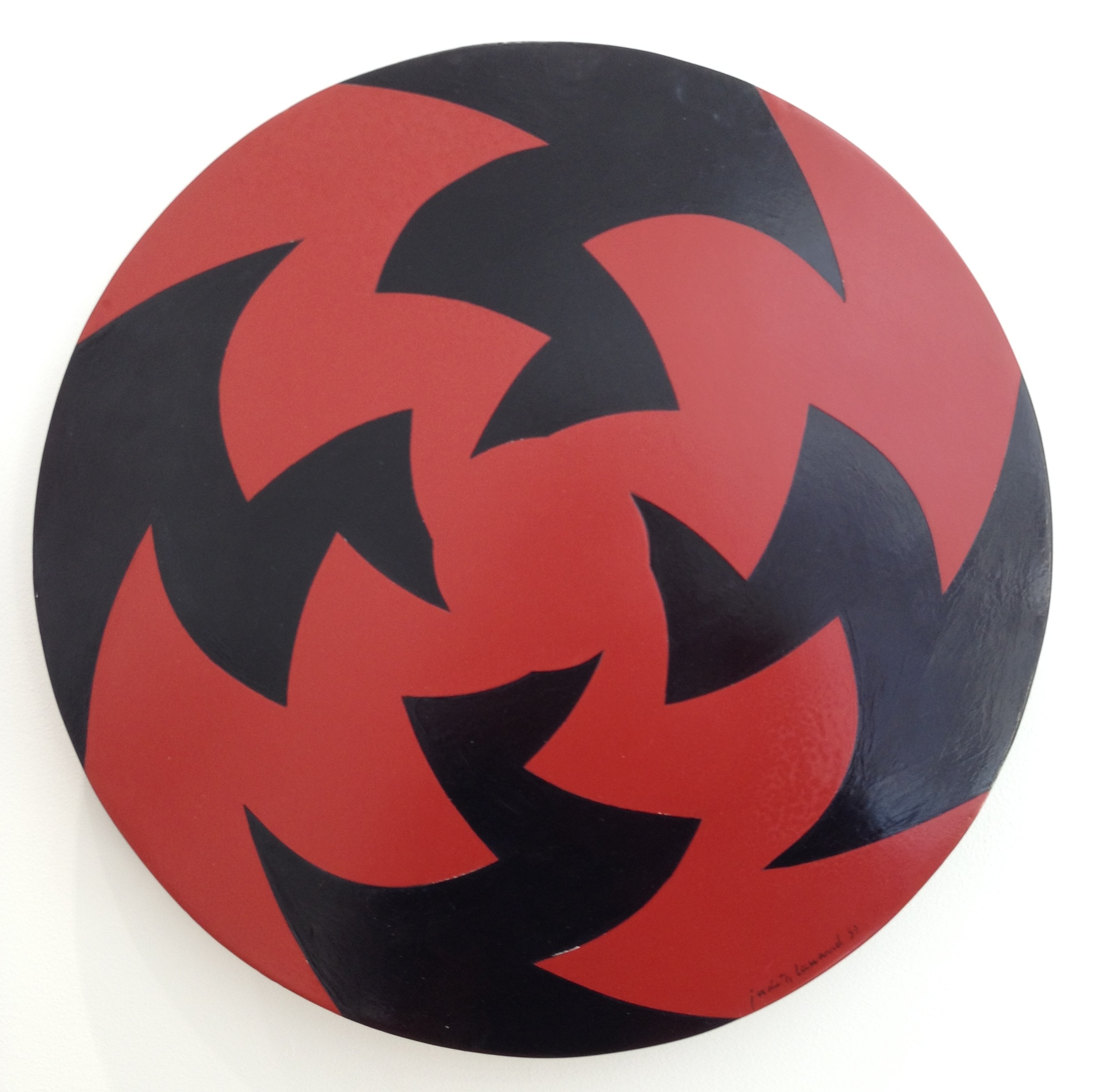
Concerto 66 – 1957

“Concerto 66” is a circular panel with four lightening bolt shapes radiating from the center, creating a four fold rotation symmetry.

67-2

Concerto 178

“Concerto 178” is tempera on canvas and is more of a line drawing. Two rhombi are surrounded by a host of triangles building a tiling type of pattern with 2 fold rotational symmetry.

Lauand’s work is a great example of the emphasis on mathematics in important  post-war abstract artistic practices.

Susan Happersett

Central Booking – Art and Science Celebration

I have written about Central Booking before here. It is a Lower Eastside Gallery run by Maddy Rosenberg that specializes in Art & Science-related content, as well as book arts. On Thursday, December 4, there will be a gathering for contributors to their current campaign. This cause is close to my heart, obviously. And, they will be serving chocolate and champagne while you’re checking their new exhibition “Psyched“.

Chocolate (from Central Booking's web site)

Chocolate (from Central Booking’s web site)

The event promises to be a lot of fun. If you are interested go here to make a tax-deductable donation and maybe I will see you there!

Screenprinting Math op-art at Kayrock Screenprinting

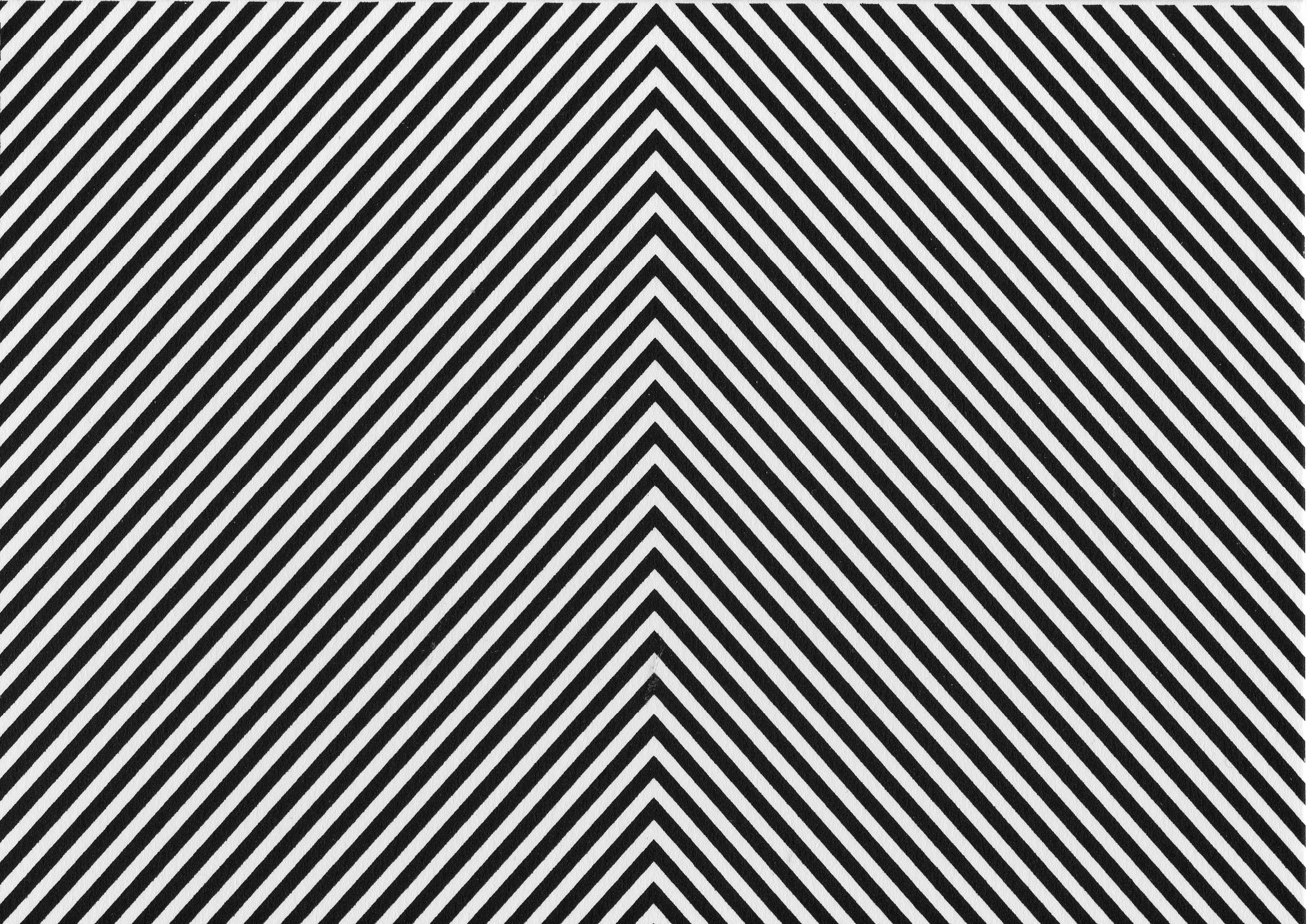
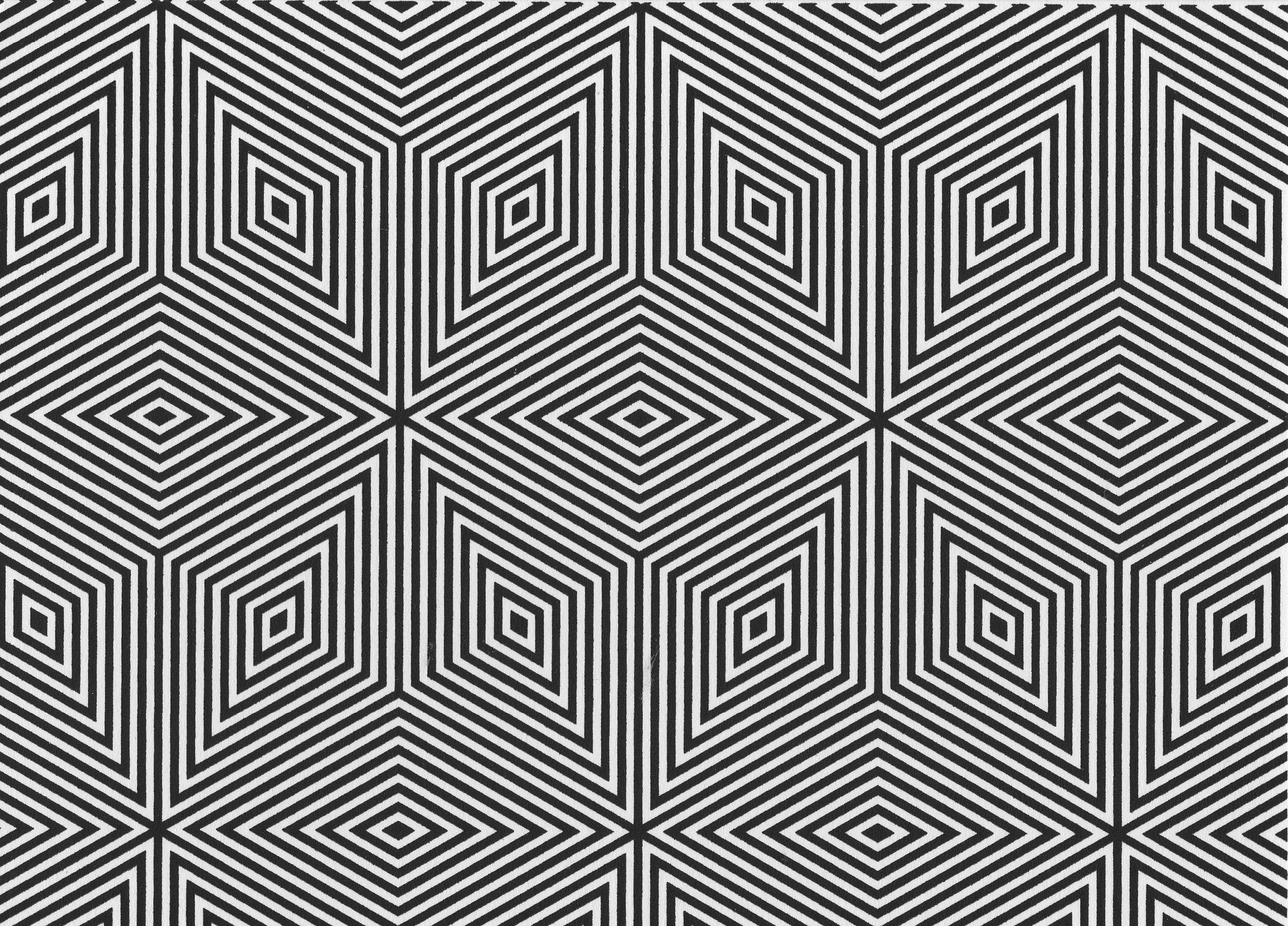
A few weeks ago at the EA/B art fair in NY I visited the booth of Kayrock Screenprinting from Brooklyn NY. The shop is run by Karl Larocca who has printed some amazing graphic patterns. I purchased a set of black and white cards with some striking use of parallel lines.

EPSON MFP image

This first card has a very basic design but the optical impact is impressively kinetic. The rectangle is divided in half with the parallel lines running at a 45 degree angle to the edges of the card so that the two sets of lines meet at a 90 degree angle along the center line. This creates a line of reflection symmetry.

EPSON MFP image

The second card is much more complicated. Creating identical kite shaped forms that are assembled into equilateral triangles, Larocca has built a mathematical tiling. Then by patterning each kite shape with parallel lines he creates a pulsating optical effect.

Even though the the patterns on each card are limited to just two alternating colors, using only straight lines of uniform width, the geometric patterns and the optical experience are surprising complex.

Susan

El Anatsui at the Jack Shainman Gallery

El Anatsui is one of the greatest and most famous Contemporary African artists. His work is in the collections of most major museums throughout the world. I have been an admirer of his constructions for many years. He creates wall hangings and 3-D structures using metal bottle caps, printing plates, copper wire, as well as other recycled materials.

In the exhibition at the Jack Shainman Gallery titled “Trains of Thought” there is a huge wall hanging with some interesting mathematical elements.

64-1

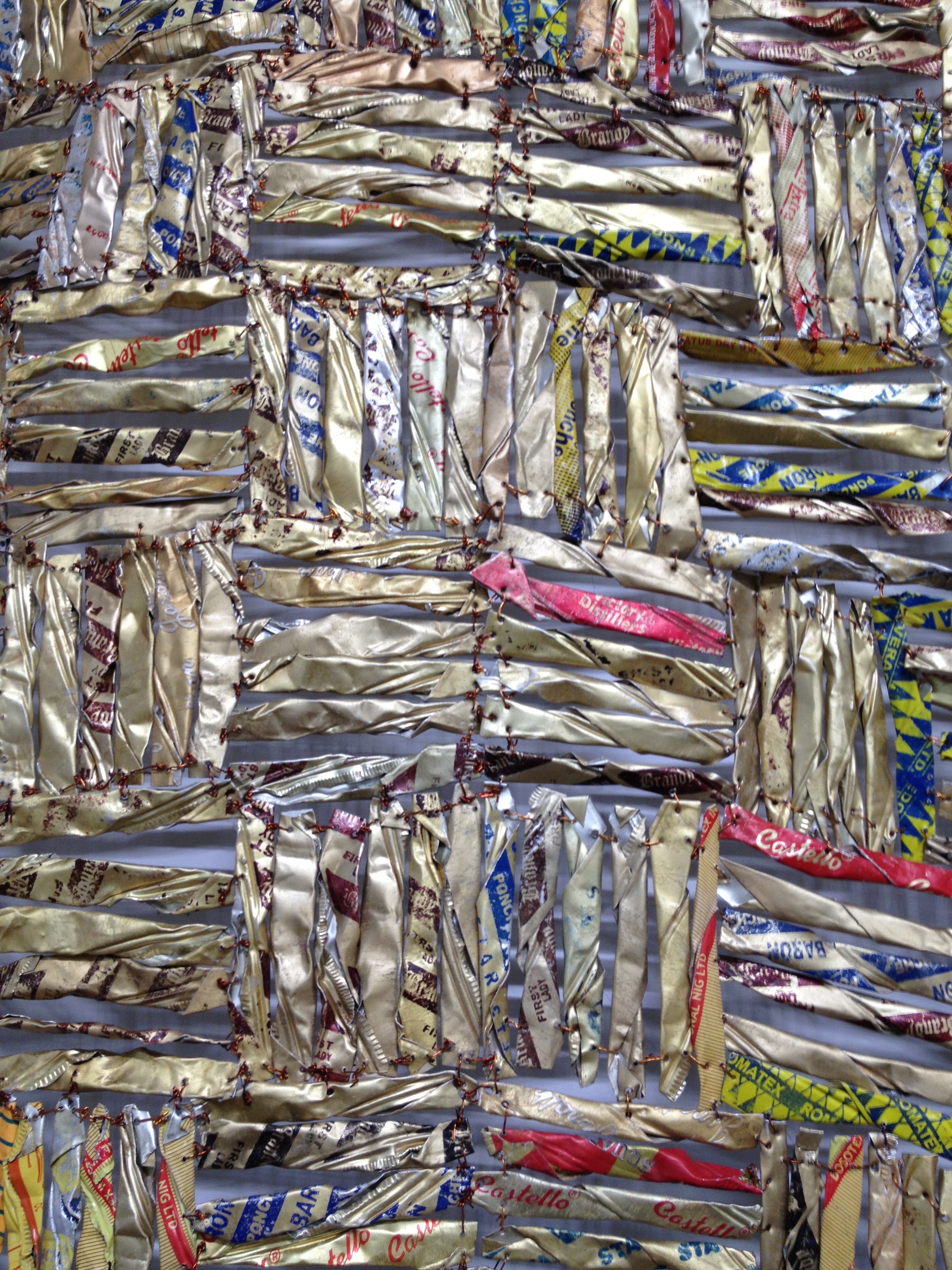
El Anatsui uses multiples of the same type of object and flattens and folds them into uniform geometric shapes.

64-2

Here is a close up of a top section of the wall hanging. Using narrow rectangles of rolled metal elements he constructs squares. He patterns  the squares either with vertical stripes or horizontal stripes, creating a mathematical tiling using recycled materials.

Susan

Math meets Art at the EA/B Fair in NYC

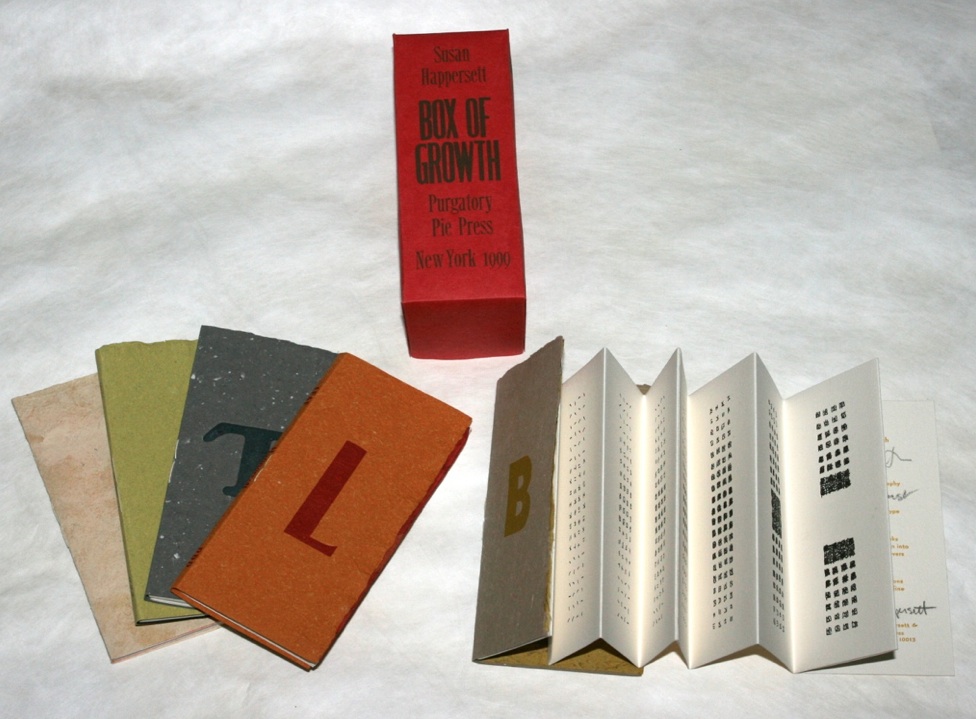
This weekend at the Editions/Artist’s Books Fair Purgatory Pie Press will be exhibiting limited edition letterpress artist’s books featuring my mathematical drawings. I have been collaborating with Purgatory Pie Press for fifteen years and we have published numerous Mathematically themed artworks.

“Box of Growth” is a set of five small accordion books. Each features a series of my counted marking drawings based on different growth patterns created using the Fibonacci Sequence.

61-1b

Another topic we have explored is Cantor Set. “Infinity Remove” has two sides; one with self-similar gridded marking drawings, the reverse had famous quotes about Infinity.

61-2

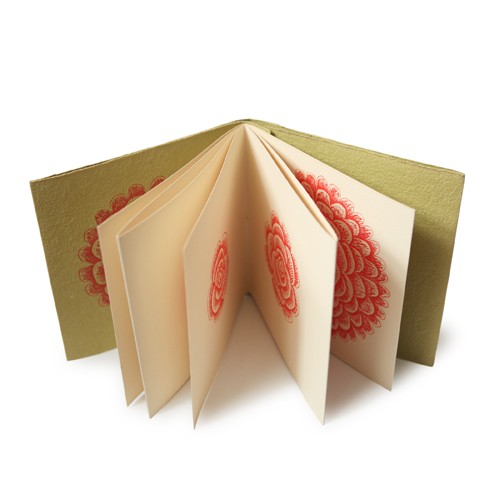
“Fibonacci Flower” shows the development of a Mathematically generated flower using the Fibonacci Sequence.

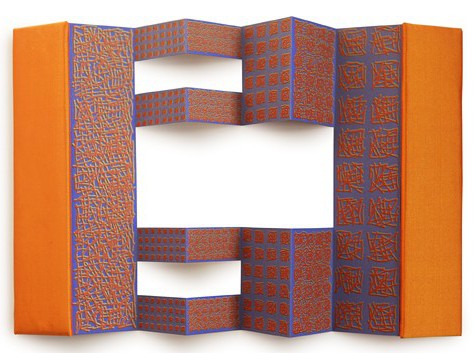
61-3Our most recent project is “Box of Chaos” is a series of four paper sculptures with my fractal chaos drawings.

IMG_1835

The EA/B Fair is free and open to the public this Friday (November 7, 2014) to Sunday at 540 West 21st Street NYC.

— FibonacciSusan

Michelle Grabner at James Cohan Gallery

The exploration and study of pattern have been defining elements in the artistic practice of Michelle Grabner. One of the topics addressed through abstract patterning is the structures and geometries underlying weaving knitting and crocheting. Her current exhibition at the James Cohan Gallery features a large collection of her two-color paper weaving panels spread out flat on two pedestals in the gallery.

60-1

The vibrant contrasting colored papers used in the weavings give the viewer a clear impression of the grids and symmetries used in each of the weaving techniques. The gallery arrangement of having many next to each other and overlapping creates an exhuberant riot of color and pattern.

Grabner also creates paintings that uncover the intricate patterns created by knitting and crocheting. They are  more subtle in color but incorporate more intense patterns.

60-2

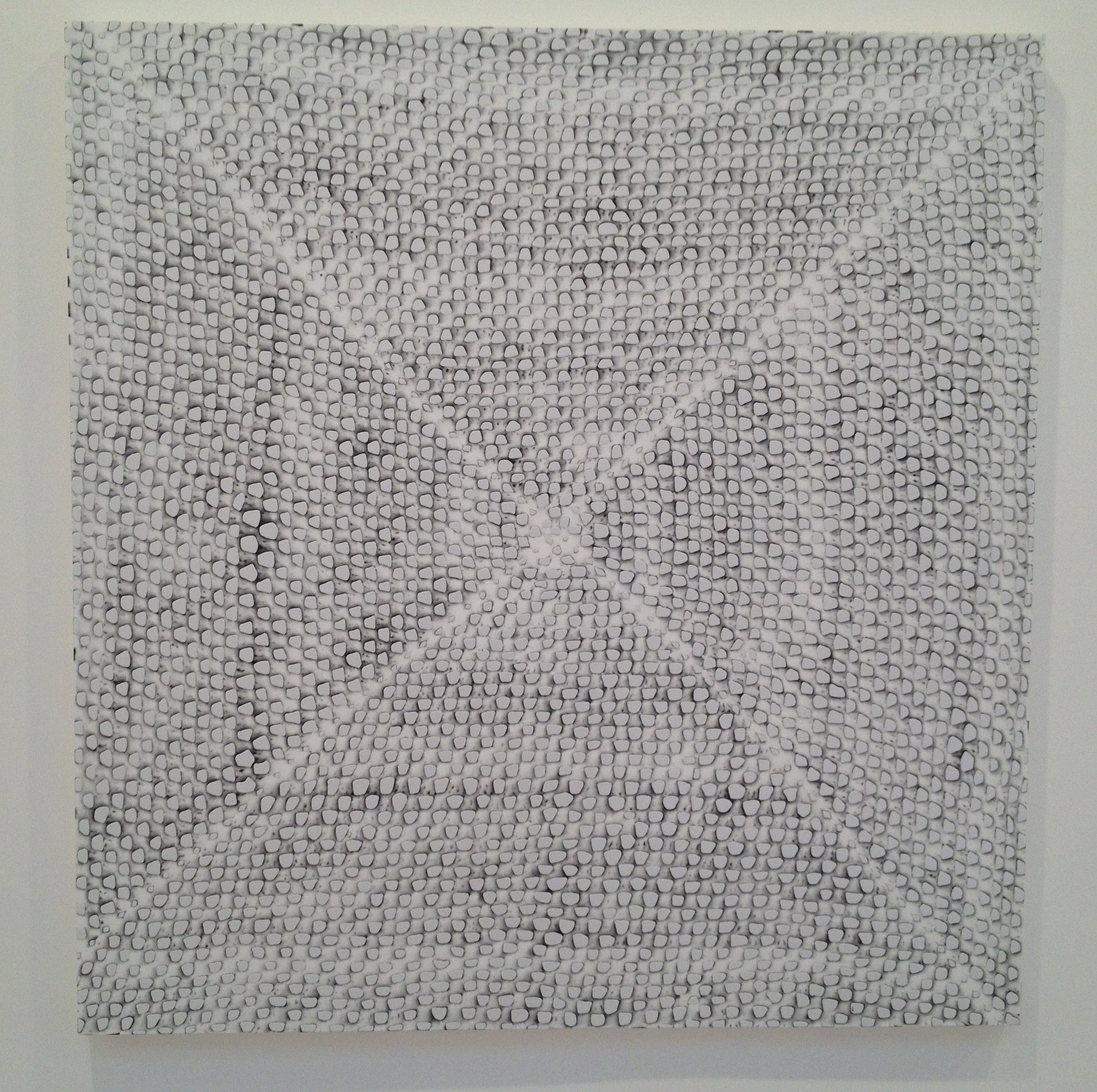
MICHELLE GRABNER Untitled, 2014 Enamel on panel 50 x 48 x 1 1/2 in. (127 x 121.9 x 3.8 cm)

This painting on canvas is a depiction of a giant crocheted square. Removing any indication of color and focusing on the negative space, the  4-fold rotational symmetry becomes quite clear.

This exhibition at the James Cohan gallery reveals Grabner’s commitment to elevating the patterns and Mathematical geometries of what could be considered “woman’s work” to the realm of abstract art. By enlarging the weave patterns and limiting each panel to two bold colors they refer to both color field painting and Op-Art. The more subtle crochet and knit canvases transpose the needle work into a minimalist vocabulary. The field of historical craft traditions has proven fertile ground for the expression of mathematical form.

All pictures courtesy of the artist and the gallery.

– FibonacciSusan

Sol LeWitt at the Metropolitan Museum of Art

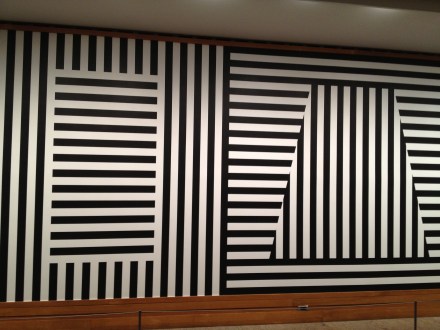
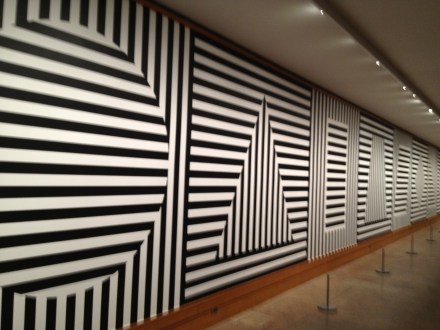
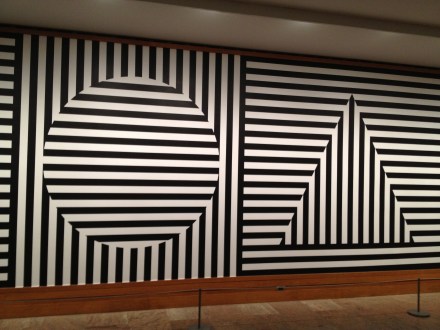
Sol LeWitt’s ” Wall Drawing #370″ is currently on display in a long  corridor on the first floor of the museum.
59-1

The directions for”Wall Drawing #370″ are: “Ten Geometric Figures (including right triangle cross X, diamond) with three-inch parallel bands of lines in two directions”. LeWitt wrote the conceptual plan for these drawings in 1968.

Each of the ten panels feature alternating black and white lines that run either vertically or horizontally. The shapes depicted, however,  feature curves and non-right angles, and lines that cross do so in a perpendicular fashion.
59-2

59-3

Each shape also has some type of symmetry either reflective or rotational.

I have always been a huge fan of Sol Lewitt’s Wall Drawings. Besides the obvious geometric mathematical elements to the work LeWitts underlying conceptual process shares theoretical similarities with Mathematical Algorithms.

In 1967 Sol LeWitt published his “Paragraph’s on Conceptual Art” in Artforum magazine. Here is an excerpt:

“In Conceptual Art the idea or the concept is the most important aspect of the work….all planning and decisions are made beforehand and execution is a perfunctory affair. The idea is the machine that makes the art.”

As a comparison I want to look at what David Berlinski  writes about algorithm in his book “The Advent of Algorithm”:

“As Algorithm is  a finite procedure, written in a fixed symbolic vocabulary governed by precise instructions, moving in discreet steps,1,2,3…whose execution requires no insight, cleverness, intuition, intelligence, or perspicuity, and that sooner or later comes to an end.”

I feel there is definitely a relationship between Sol LeWitt’s description of Conceptual Art and the way that mathematical algorithms perform, I also see a connection in this early work of LeWitt and the birth of the computer age….. But I will leave that for another blog.
If you are going to be in NYC anytime in the next 14 months, go see the Wall Drawings at the Metropolitan.  They are powerful and graceful and up until January 3, 2016!

— FibonacciSusan
Roman Opalka at Dominique Lévy Gallery

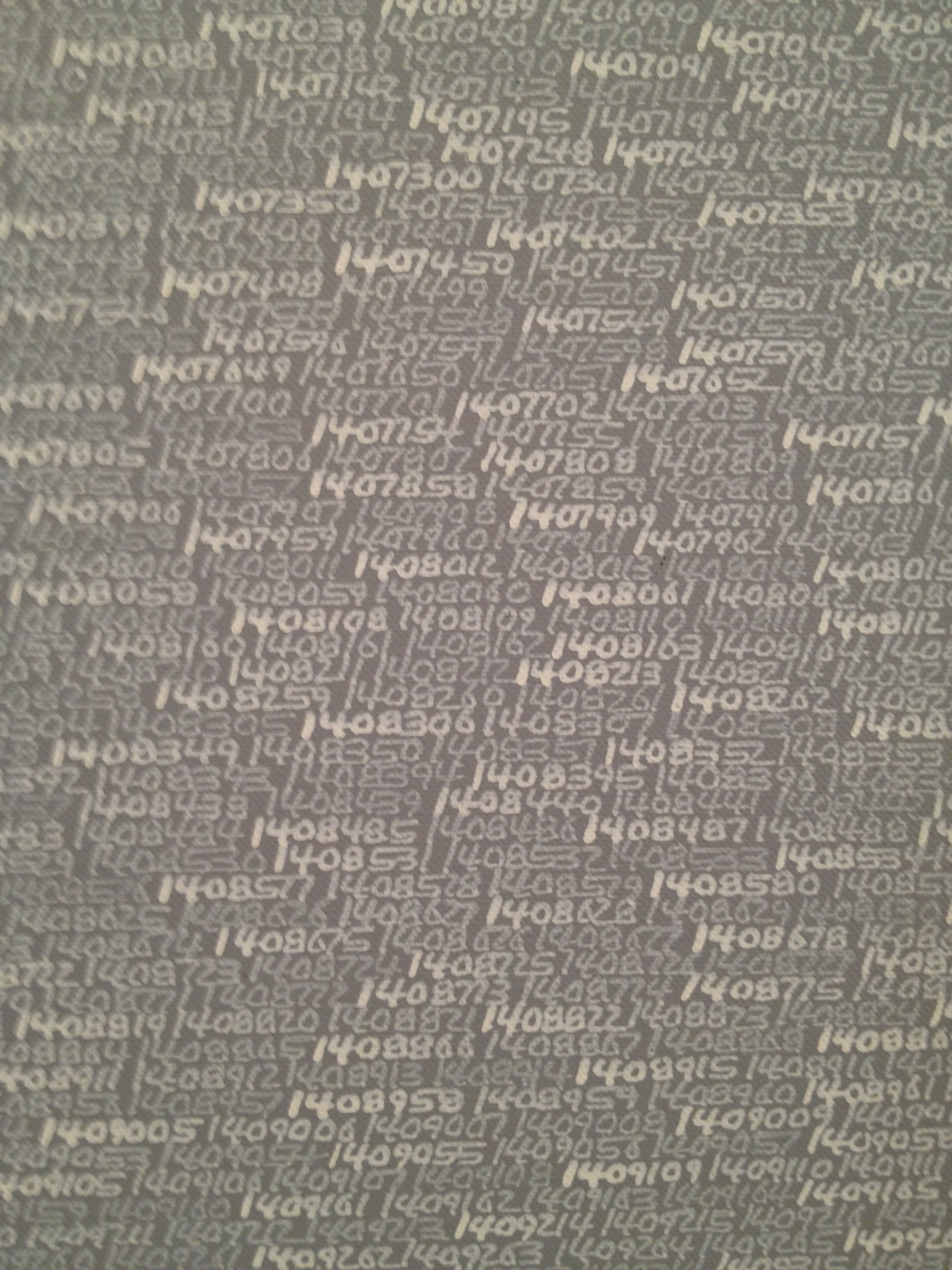
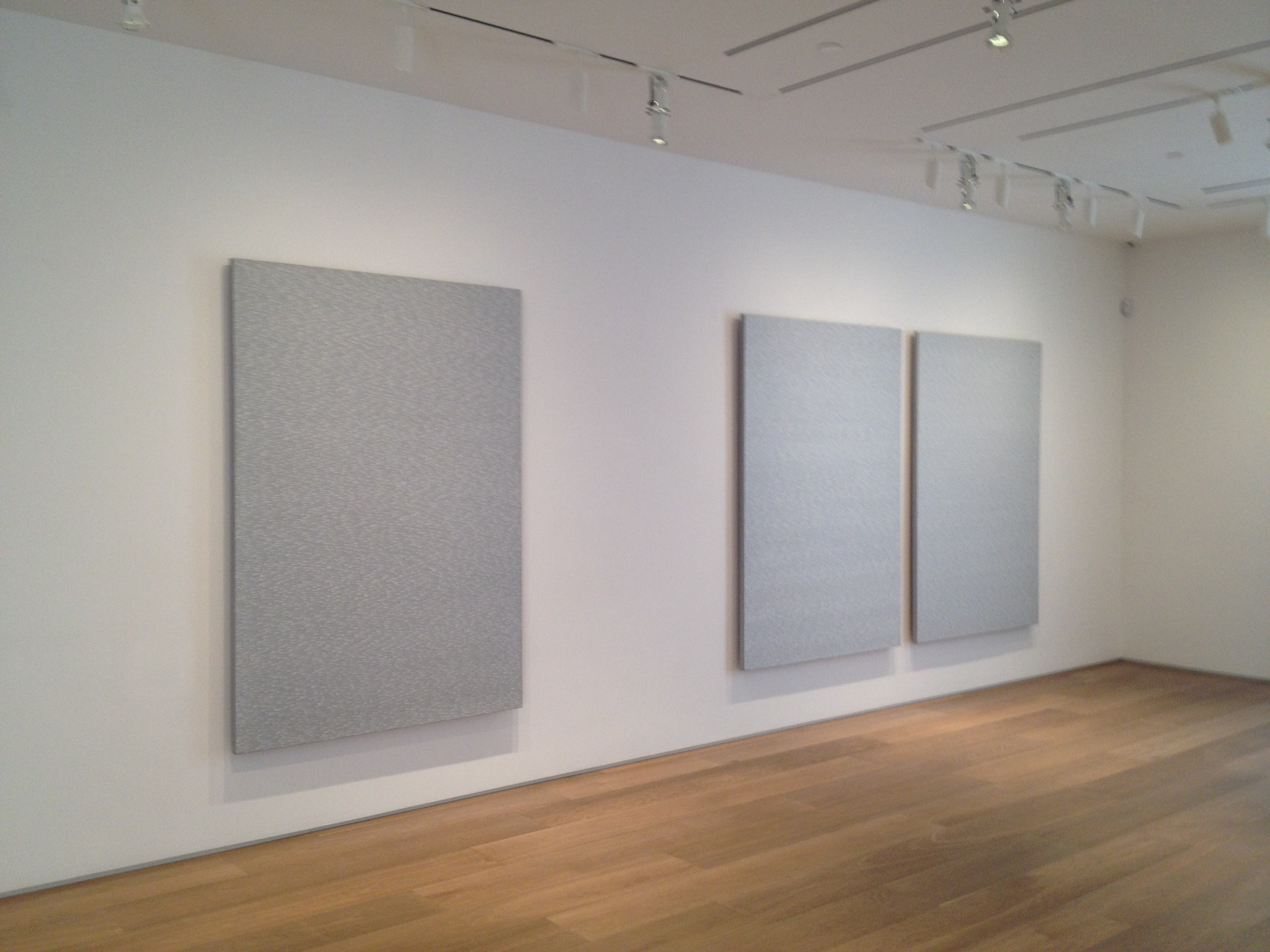
In 1965, Roman Opalka began his mission to paint the numbers from 1 to infinity consecutively. In that year, on a black canvas, he painted the number 1 in the upper left corner with a tiny brush and white paint. He continued this practice through 233 canvases over more than forty years. The title of this monumental work is “1965/1- ∞”. Each of the individual canvases is simply titled “Détails”. There are between 20,000 and 30,000 numbers on each canvas. In 1968 the artist  switched to a gray background, then after counting to one million, he added 1 percent more white pigment to each new background until 2008 when the work became white on white.

58-1
The Dominique Lévy Gallery on the Upper East side of Manhattan is exhibiting a selection of paintings from “1965/1-∞”, as well photographs of the artist that he took everyday in front of the canvas on which he was currently working. This photo documentation of time passing and the artist aging, creates an especially poignant message. There was no way for Opalka to actually reach infinity in his paintings. It is the poetic nature of these canvases that relates the spirituality of counting. The artist addresses the importance of numbers in the human psyche to signify progression.The concentration required to physically paint this list of consecutive numerical digits seems like a meditation on both time and mortality.
58-2Pictures courtesy of the gallery and the artist.

More MathArt next time,

FibonacciSusan