Happy Halloween with Chris Watson’s Tessellation Art

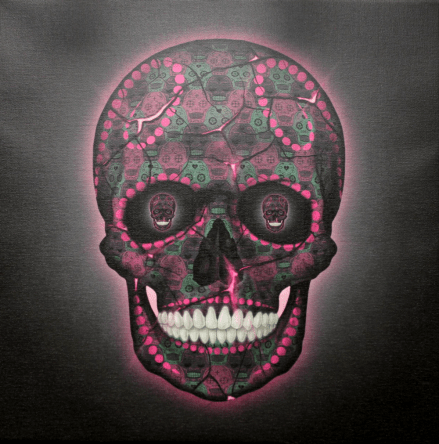
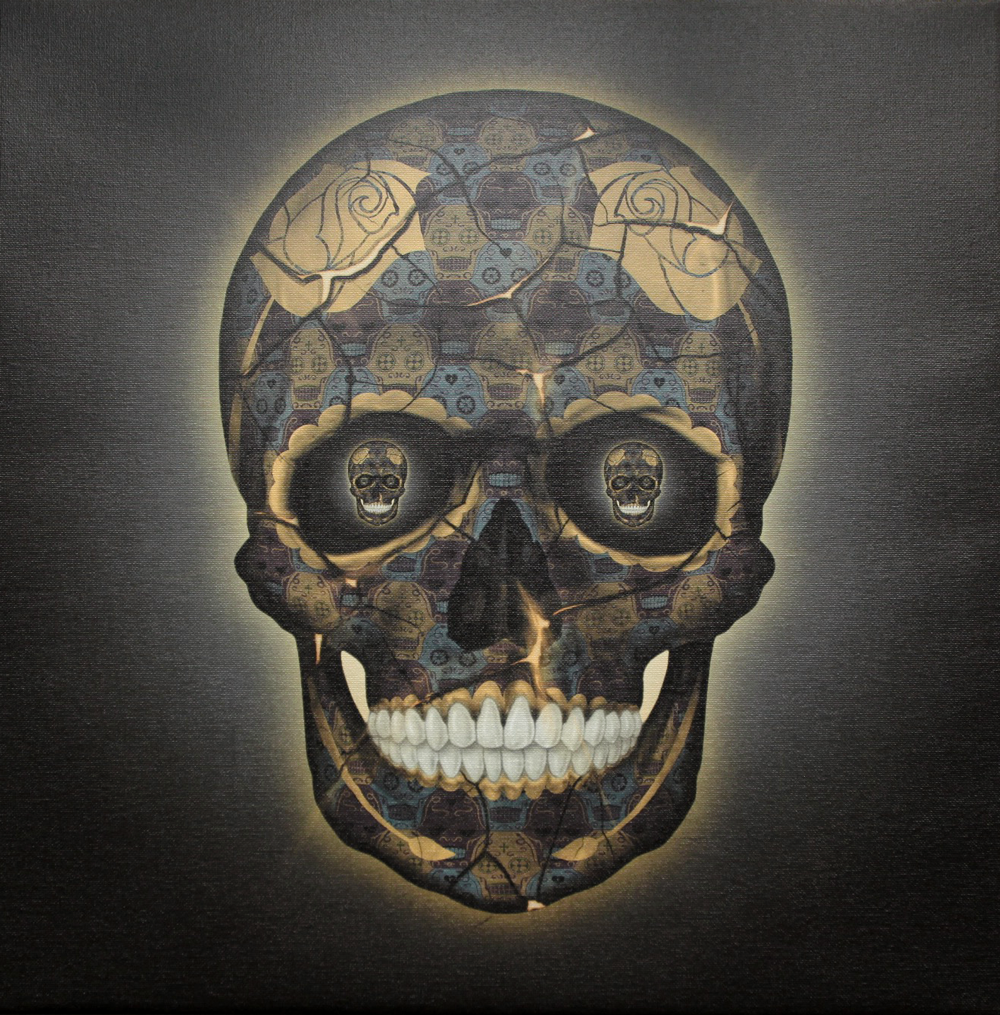
For Halloween, today a contribution by Chris Watson. His latest Tesselation Art release is his Skull Series. It is a new triptych digital artwork composition inspired by M. C. Escher’s work in tessellation and infinity.
16-38-02
A tessellating skull pattern is wrapped around a human skull. The eyes of the skull are scaled down versions of the entire image. This is then repeated infinitely. As TA fans will know, M. C. Escher is widely recognised as the father of tessellation. Both the theme of infinity and the use of skulls were commonly featured in his artwork. The tessellating skulls are decorated as calaveras – also known as sugar skulls. These are used in the Mexican celebration of the Day of the Dead (Día de los Muertos). Each of the three main skulls in the triptych have a unique decoration and color scheme.
16-38-01
The behind the scenes gives an animated time-lapse overview of the entire design and development process in just 3 minutes.

The write-up on this great piece of Tesselation Art can be found here. You can purchase your own day of the dead Tesselation skull print here.

Happy Halloween,

Susan Happersett
Katia Santibanez at Morgan Lehman

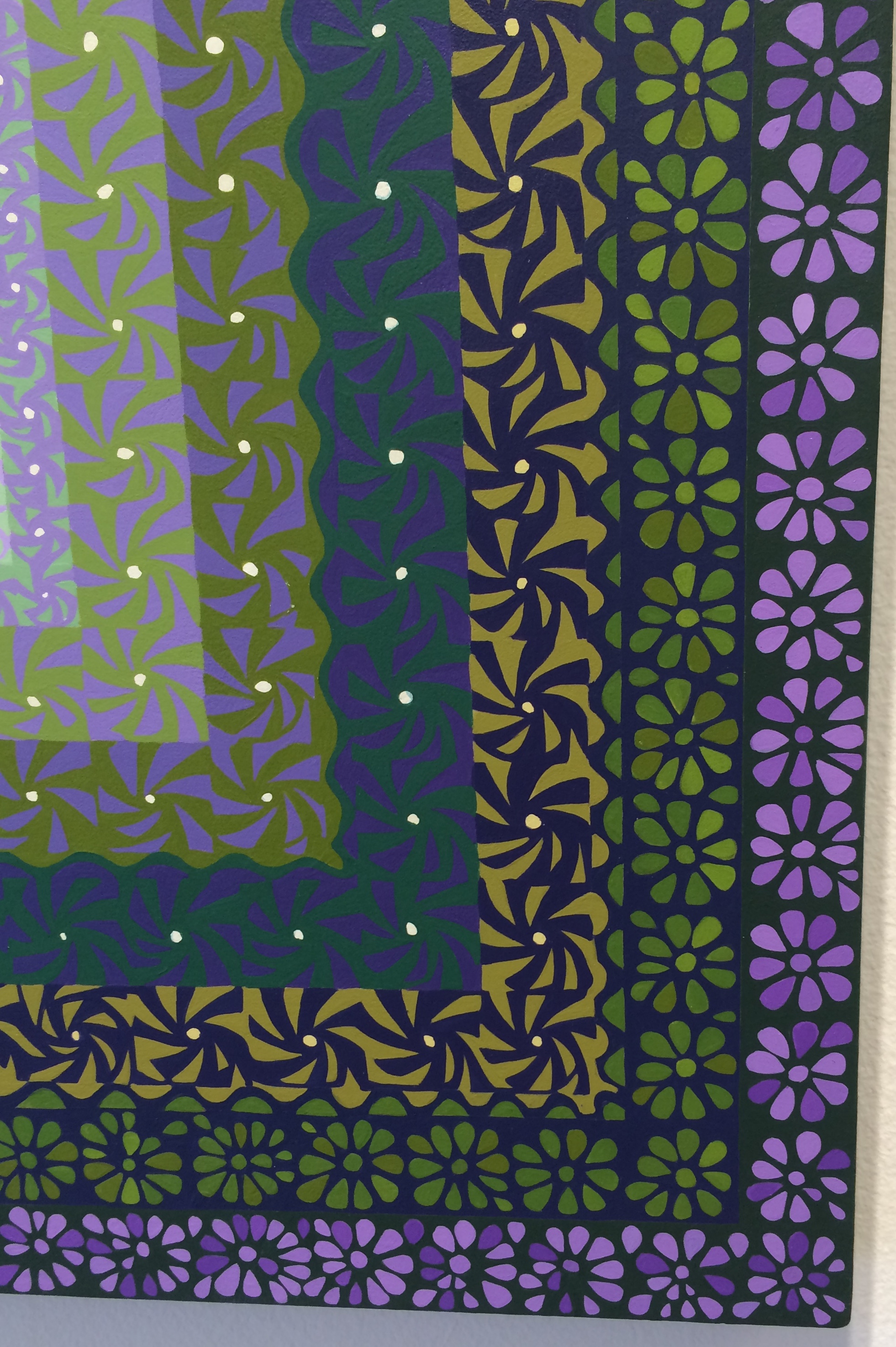
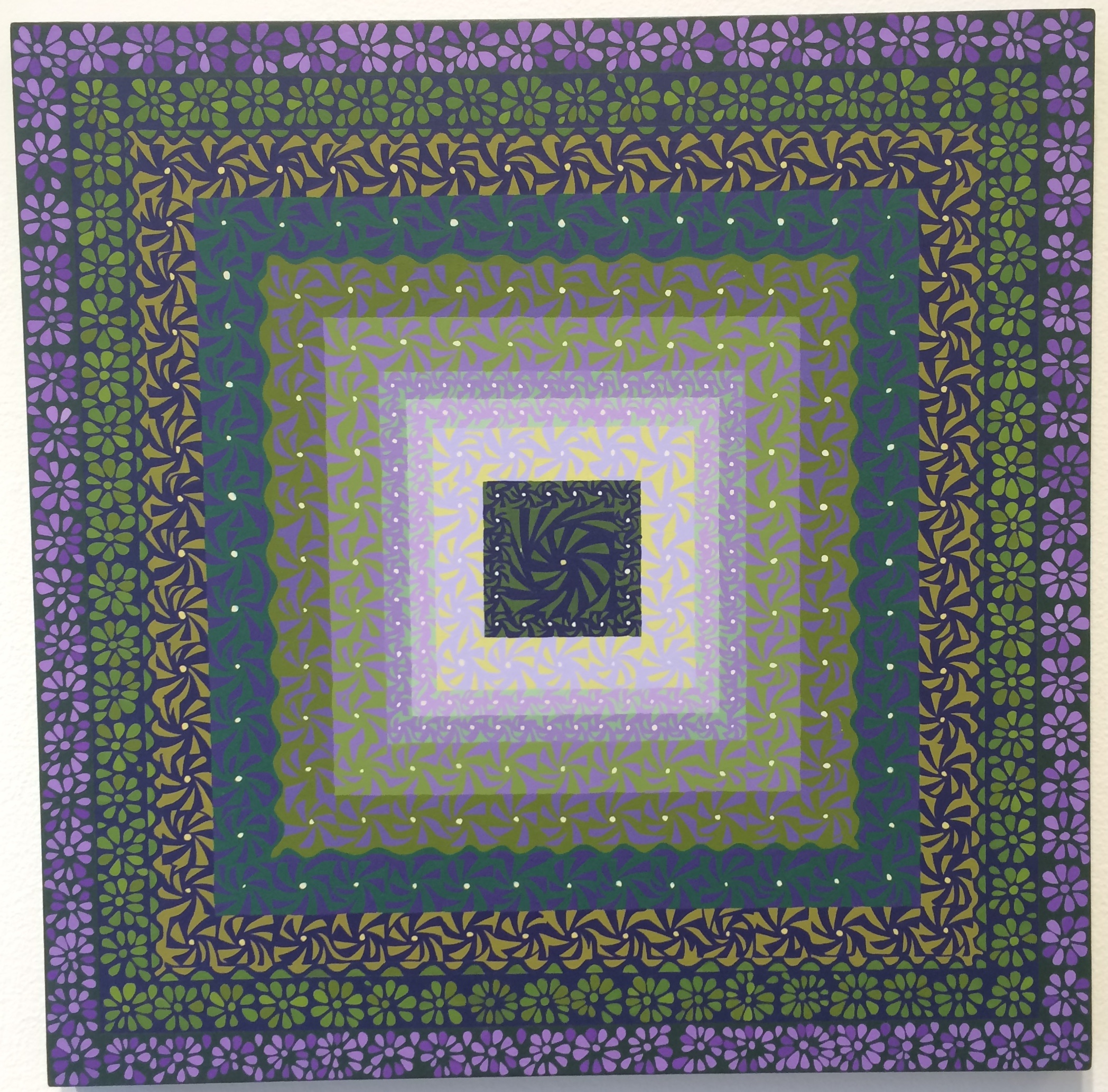
“The Visible and The Invisible”, Katia Santibanez’s new exhibition at the Morgan Lehman gallery, features the artist’s abstract paintings. Embracing patterns found in nature, these works incorporate a variety of geometry, symmetry, and repetition. One painting in particular, “Sleeping Memories”,  incorporates themes from two different twentieth century art movements.

16-37-01

Katia Santibanez, “Sleeping Memories”, 2016
Picture courtesy of the artist and the gallery

Using concentric squares, this work references the practices of the Hard Edge paintings of the 1960’s. The geometric abstractions of Frank Stella immediately come to mind. But this is just part of the story. Santibanez has incorporated detailed strips of patterns of flora, reminiscent of the Pattern and Decoration Movement of the 1970’s. Robert Kushner and Miriam Shapiro often incorporated floral and plant inspired patterns in their work.

16-37-02

Katia Santibanez, “Sleeping Memories”, 2016 (detail)
Picture courtesy of the artist and the gallery

“Sleeping Memories” is an excellent example of work with a Mathematical structure that has been enhanced through the use of less rigid patterning to define the geometric space.

Susan Happersett

Sara VanDerBeek at Metro Pictures

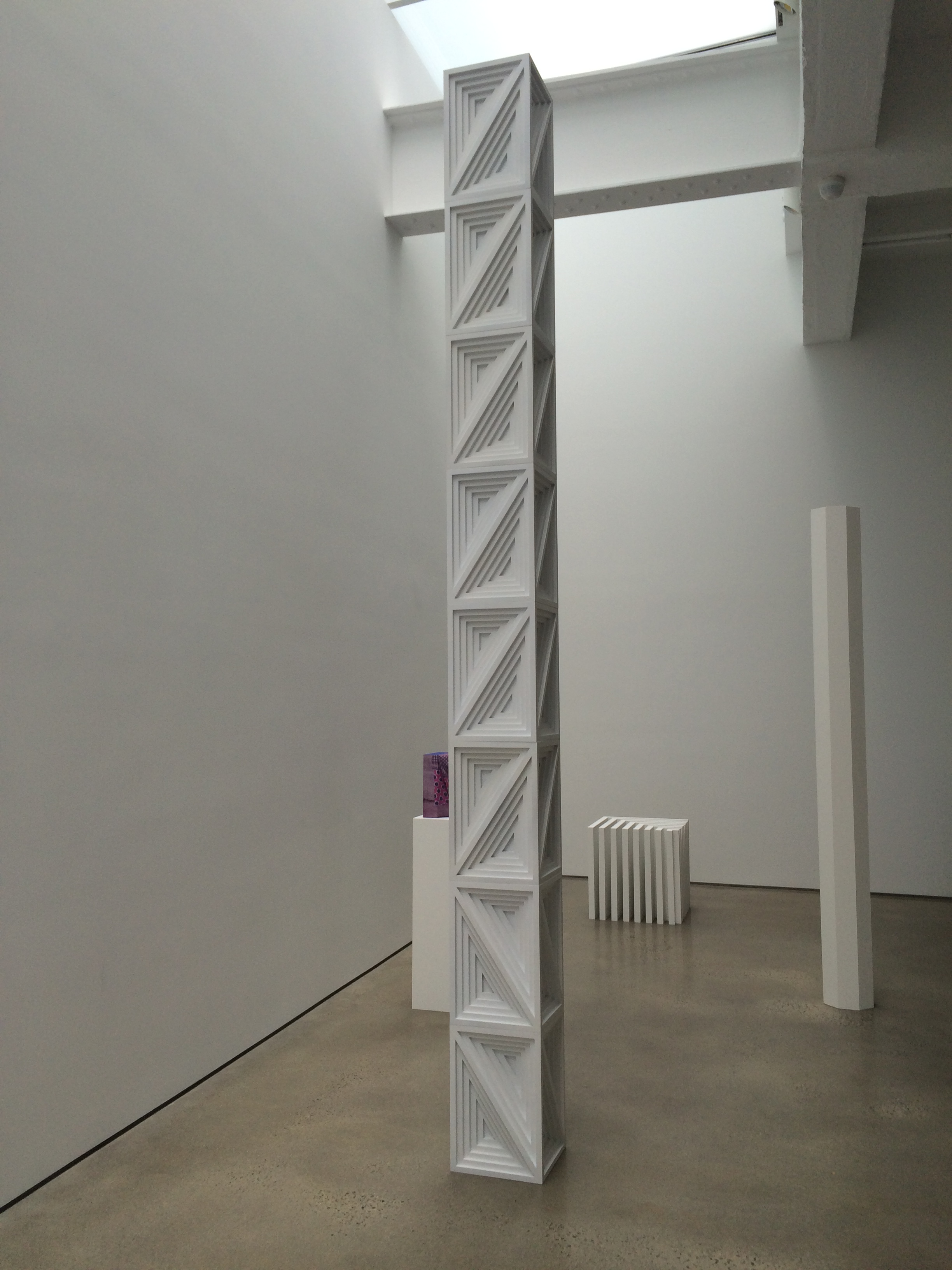
“Pieced Quits, Wrapped Forms” is Sara VanDerBeek’s current solo exhibition at Metro Pictures Gallery. There is a variety of work on display, including large abstract photographs and monochrome sculptures, all with geometric themes based of quilts, Pre-Columbian patterning, and modern textile arts.

16-36-01

Sara VanDerBeek, “XXXVII”, 2013, acrylic on wood
Picture courtesy of the gallery and the artist

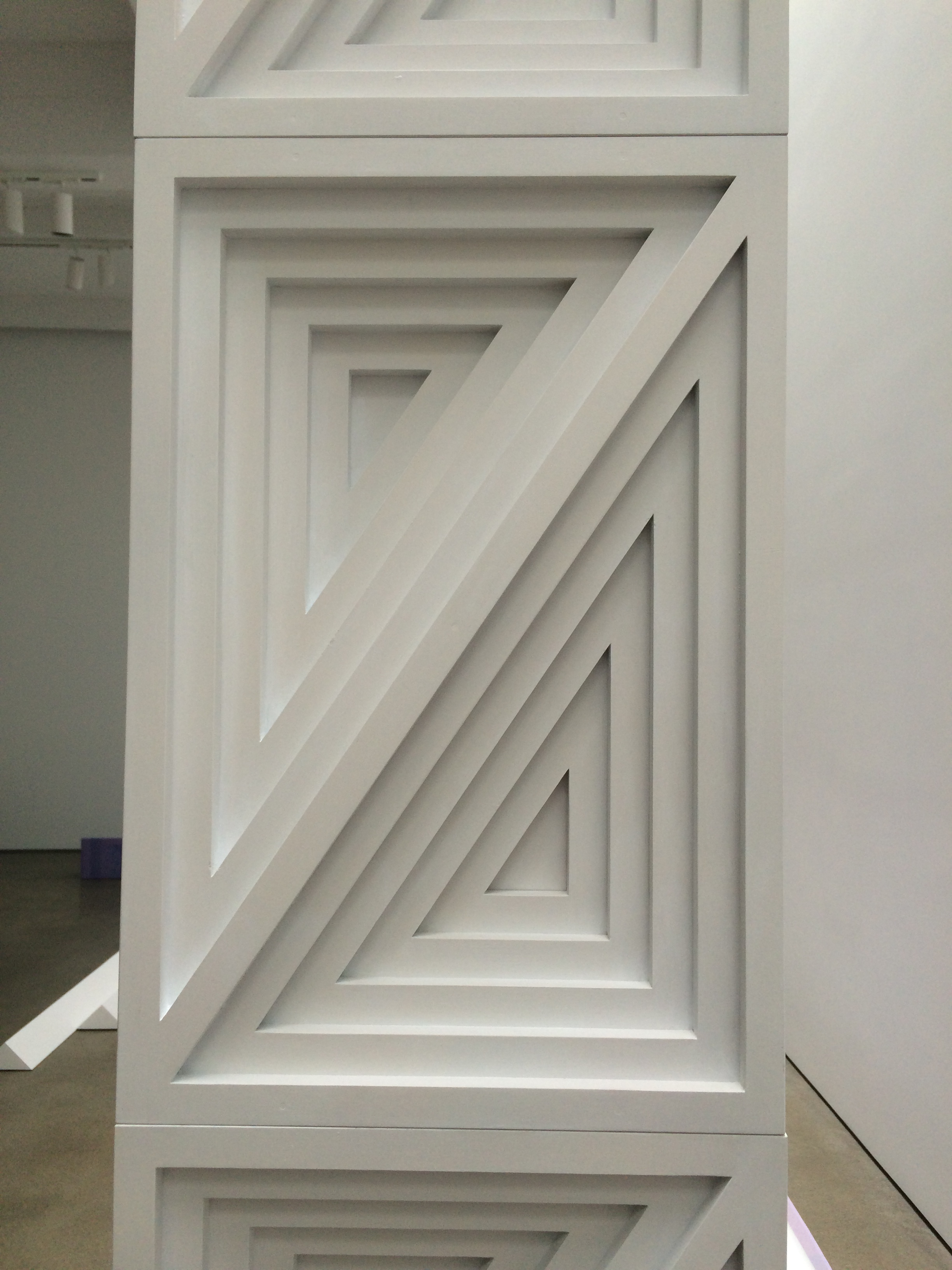
The totem pole-like structure “XXXVII” is a stacked tower of eight rectangular prisms or cuboids. By painting the entire structure white, the artist allows the viewer to focus on the patterns and shadows on each side of the prisms. Each rectangular side has a width to height ratio of 2:3. Bisecting the rectangle along the diagonal, order 2 rotational symmetry is achieved and two right triangles are formed. There is a series of consecutively smaller but similar triangles, that form a step-like pattern into the prism.

16-36-02

Sara VanDerBeek, “XXXVII”, 2013, acrylic on wood (detail)
Picture courtesy of the gallery and the artist

VanDerBeek has successfully taken the geometric basis from textile patterning and distilled it to its purest form, presenting these ideas in a contemporary visual dialog.

Susan Happersett

Carmen Herrera at the Whitney

The Whitney Museum is currently presenting “Carmen Herrera: Lines of Sight”. This outstanding exhibition examines work from 1948-1978. Born in Cuba and educated in Havana, New York and Paris, Herrera developed a distinctive hard-edge geometric style. This is a large show and would require more than one blog post to discuss in fill. I have decided to limit this post to paintings Herrera created in NY after she returned from studying in Paris (1952-1965).

16-35-01

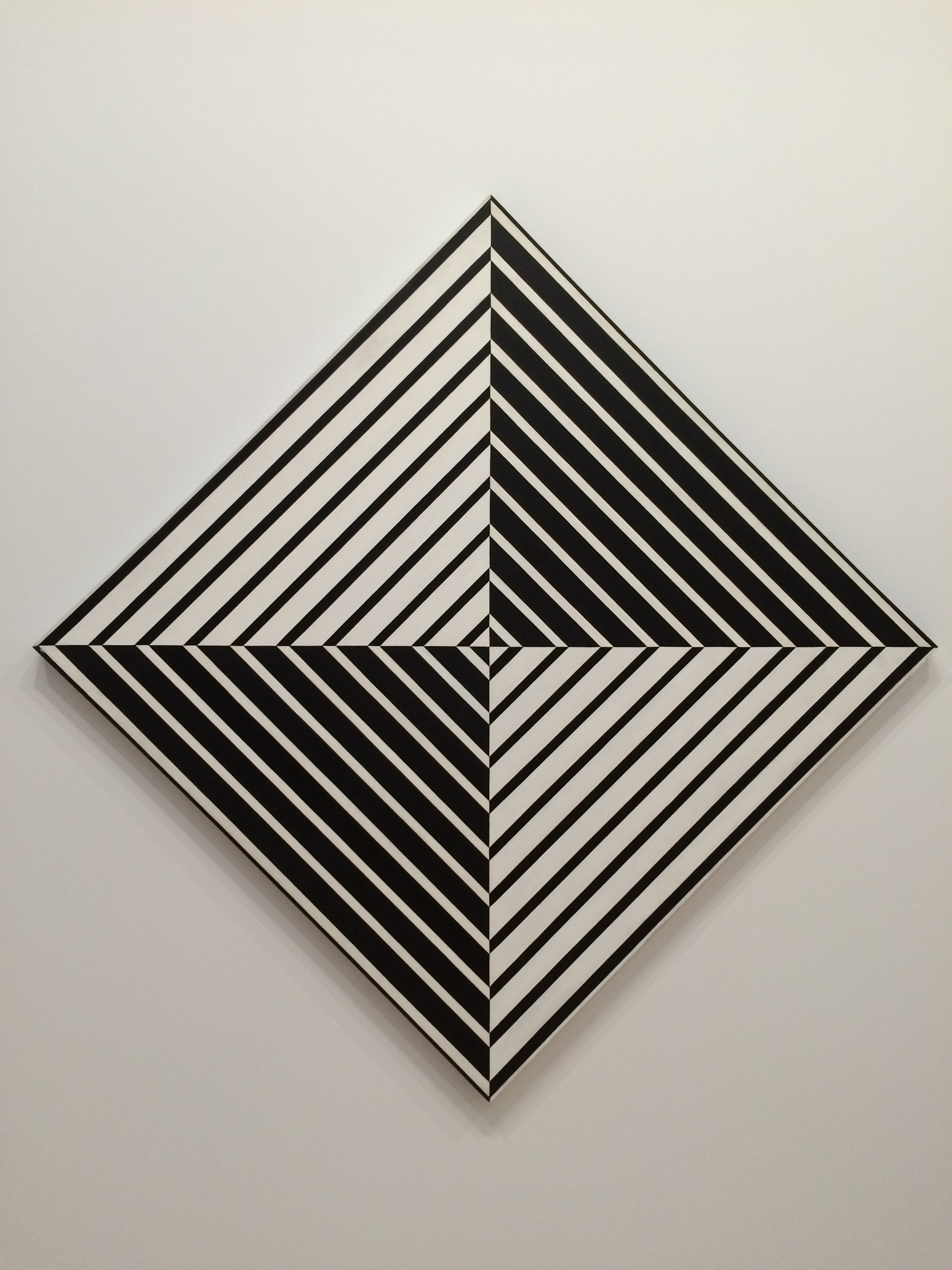
“Black and White”, 1962
Picture courtesy of the Whitney Museum

“Black and White” from 1962 is an excellent example from this time period. The shape of the actual canvas is an important element in the architecture of the work. By rotating the square there are no horizontal or vertical lines, this immediately disrupts the visual experience. Herrera limited her color pallet to two colors creating a dynamic tension of positive and negative space. In this work the thicker white strips are the same width as the thicker black strips but in the gallery there is an optical illusion where the white seems wider. The alternating of black and white parallel lines on the isosceles right triangles creates an order-2 rotational symmetry.

16-35-02

“Horizontal”, 1965
Picture courtesy of the Whitney Museum

“Horizontal” from 1965 also features two colors and a square. This painting again relies on the shape of the canvas to define its structure, but in this case a circular format. The thin horizontal wedges amplify the push and pull of the red and blue triangles and circle segments, formed by the edge of the canvas (arc) and the sides of the squares (chords).

“Lines of Sight” is a long overdue solo museum exhibition for Carmen Herrera It is a welcome opportunity to appreciate the artist’s exciting use of geometry.

Susan Happersett

Casey Reas at bitforms gallery

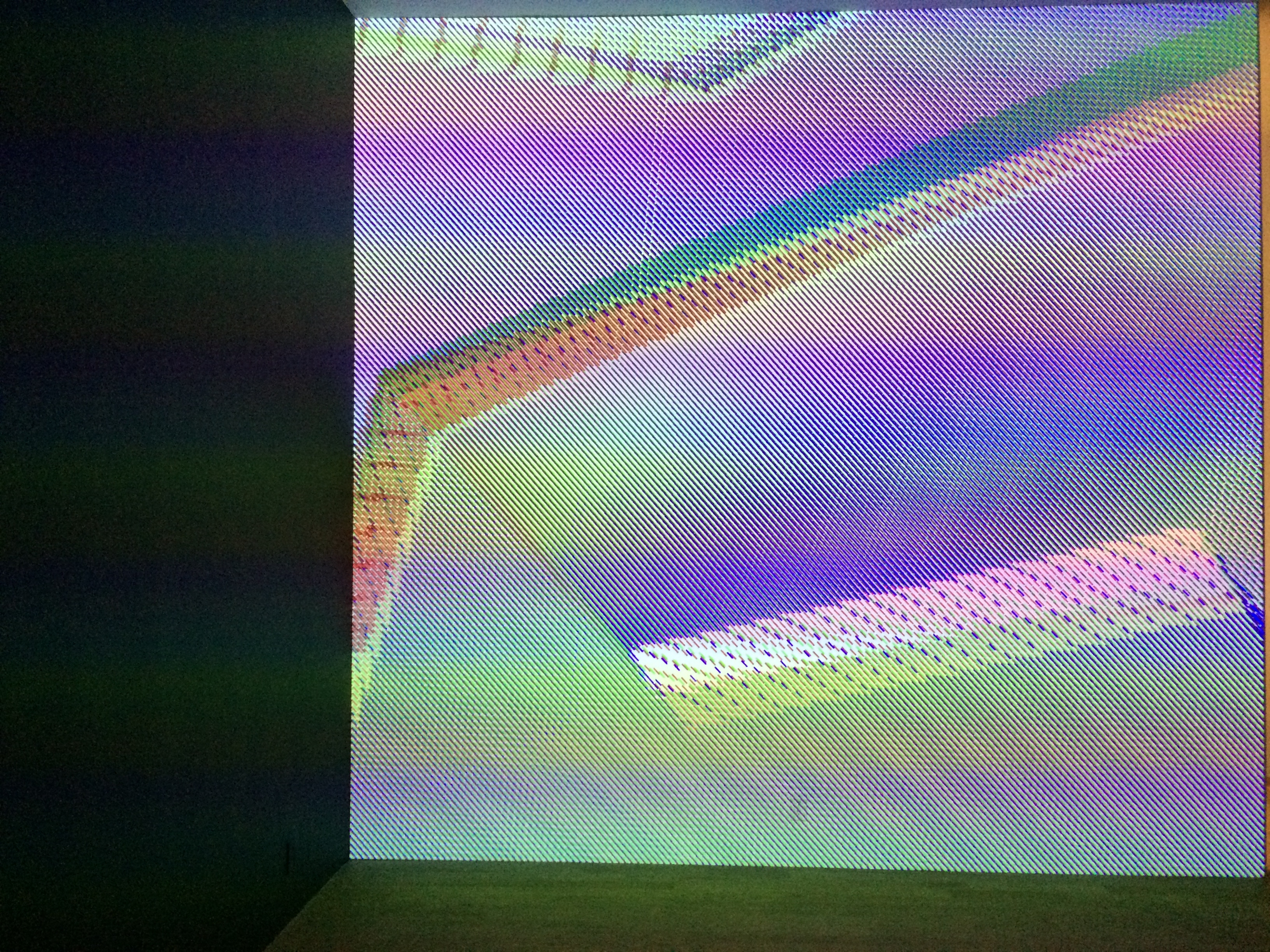
“There’s No Distance” is Reas’ fourth solo show at bitform gallery. On display are the artist’s new software-generated “Still Life”series videos.

16-34-01

“Still Life (RGB-AV A)” (gallery view), 2016
Picture courtesy of the gallery and the artist

The work in this series is based on the decomposition of a platonic solid using custom software to create an ever changing image of iterations. Reas has collapsed or flattened the multiple planes of a 3-D object allowing them to be visible on the screen at the same moment in time. These works are meant to be seen as performances, with the exhibition space and sound being integral to the work. Derived through a set of instructions or rules, the software adds a time-based element that changes the processes and continues to create new iterations. The subject matter for this series is pure geometry, but the viewer experiences the analysis of the shapes through the exploration by the computer system.

Susan Happersett

Victor Victor Vasarely at Maxwell Davidson Gallery

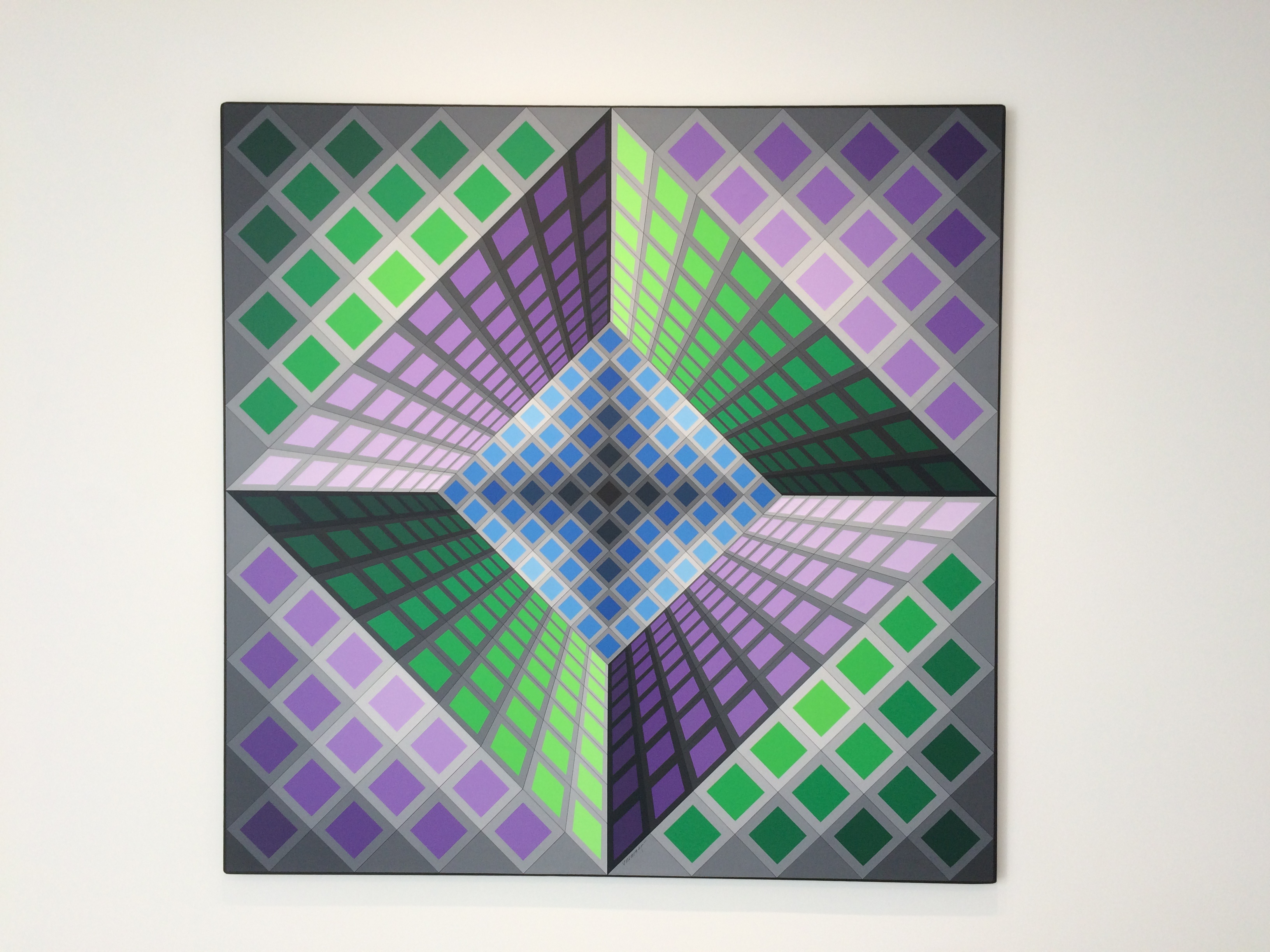
Victor Vasarely was the founder of the Optic Art or Op Art movement. His studies at the Budapest location of Bauhaus education in the 1920’s influenced Vasarely style of geometric abstraction. The paintings in the “Analog” exhibition at Maxwell Davidson Gallery demonstrate Vasarely’s ability to visually bend and stretch the plane of the 2-D canvas into 3-D space. The images seem to bounce and vibrate off the canvas.
16-33-01

The acrylic painting “PHOBOS” from 1979 uses the distortion of squares to create what looks like a square-shaped hole in the center of the canvas that is angled at a 90-degree turn from the edges of the canvas. The four isosceles right triangles in the corners of the canvas feature a pattern made up of purple or green squares. The four isosceles trapezoids have been filled in with distorted representations of squares creating the perspective of falling inward or protruding outward. The central square contains a grid of squares that again flattens out the plane.

Vasarely was the master of painting exacting geometric formations, but the most impressive element to this work is the exciting sense of space and movement. This is the first gallery show of Victor Vasarely’s paintings in many years It was very exciting to see a great selection of these geometric masterpieces all in one location.

Susan Happersett

Sol Lewitt at Paula Cooper Gallery

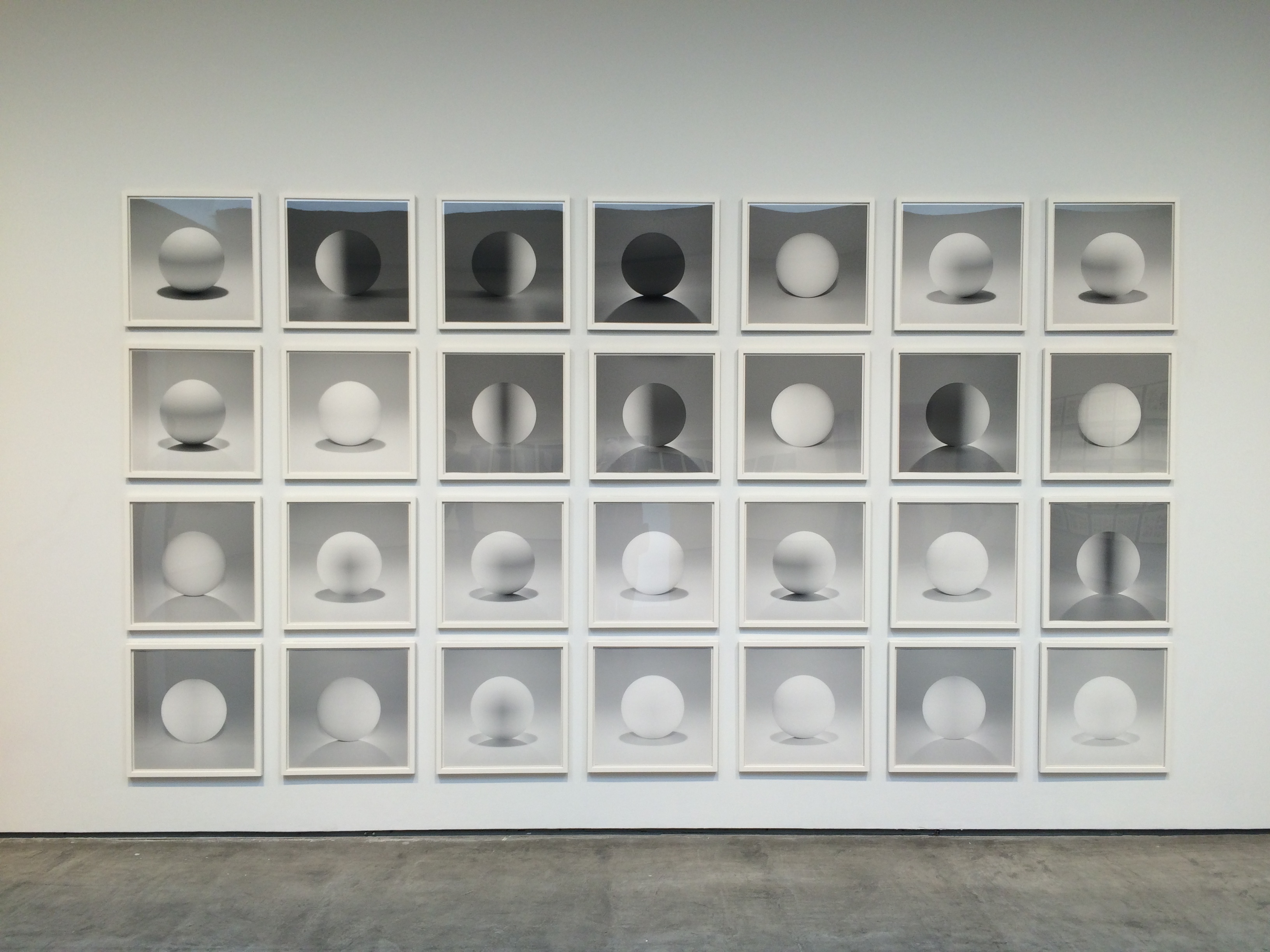
Paula Cooper is currently presenting a wide range of the work of Sol Lewitt at all three of their Chelsea galleries, as well as at the book store 192 Books on Tenth avenue. Wall drawing and sculptures are included in this excellent homage to the artist, but I am going to focus on a photographic work from 2004: “A Sphere lit from the top, four sides, and all of their combinations”

16-32-01

Sol Lewitt – “A Sphere lit from the top, four sides, and all of their combinations” – 2014
Picture courtesy of Paula Cooper Gallery

This series of 28 photographs explores 2-D images of a 3-D sphere. It looks at how the figure changes in space based on how it is lit. A circle possesses infinite lines of reflective symmetry, diameters, and has an infinite order of rotational symmetry in 2-D space. Spheres take these symmetrical properties into 3 dimensions. Lewitt’s use of light from six vantage points reveals the myriad of visual possibilities in portraying what seems to be the purest and simplest of geometric solids. Although the subject of each photograph remains constant, all pictures have a different energy and personality.

I feel that photography is a fertile medium for mathematical art, especially serial work. It allows an artist to explore a geometric theme through different vantage points and permutations.

Susan Happersett

Donald Moffet at Marianne Boesky Gallery

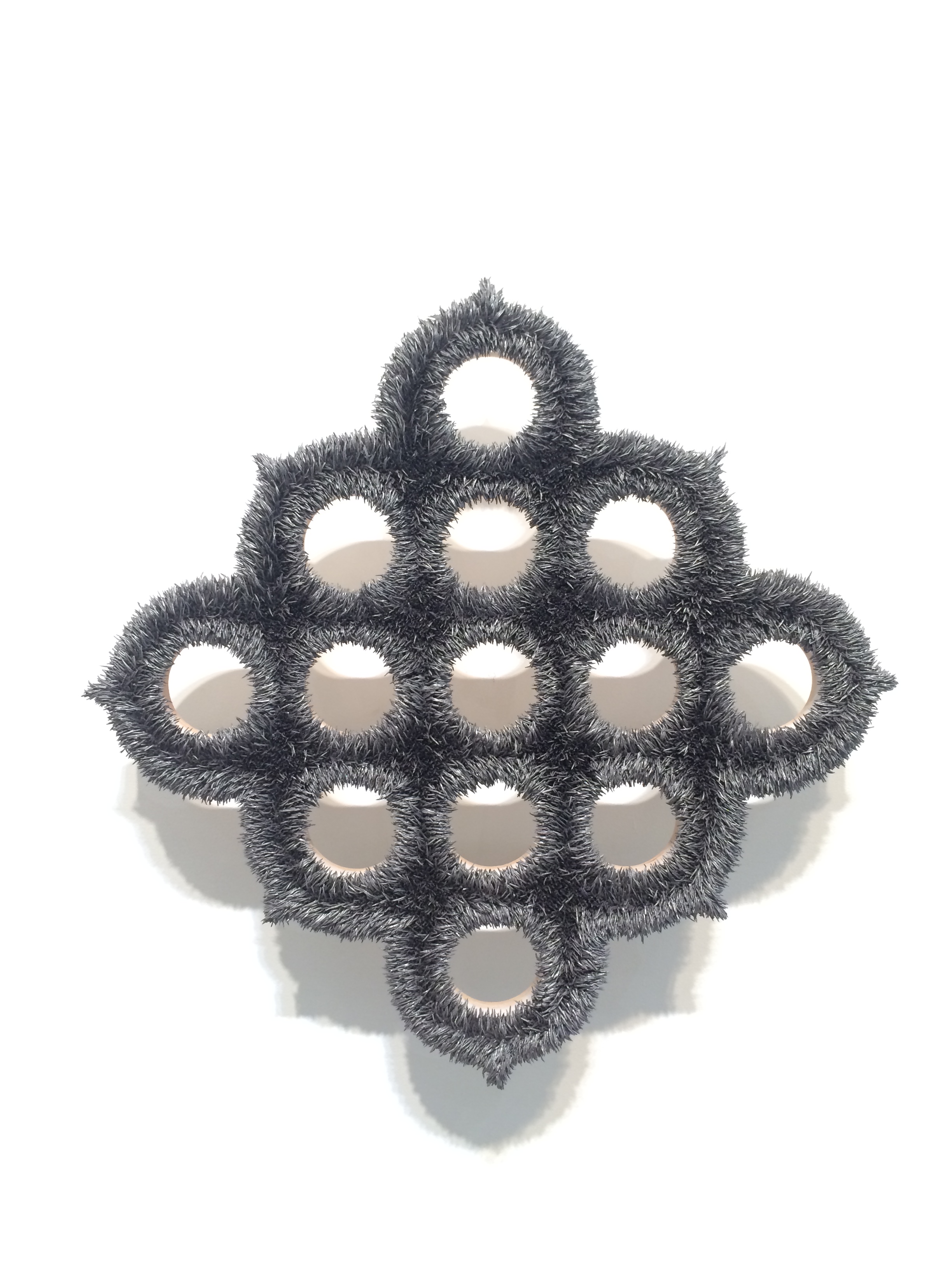
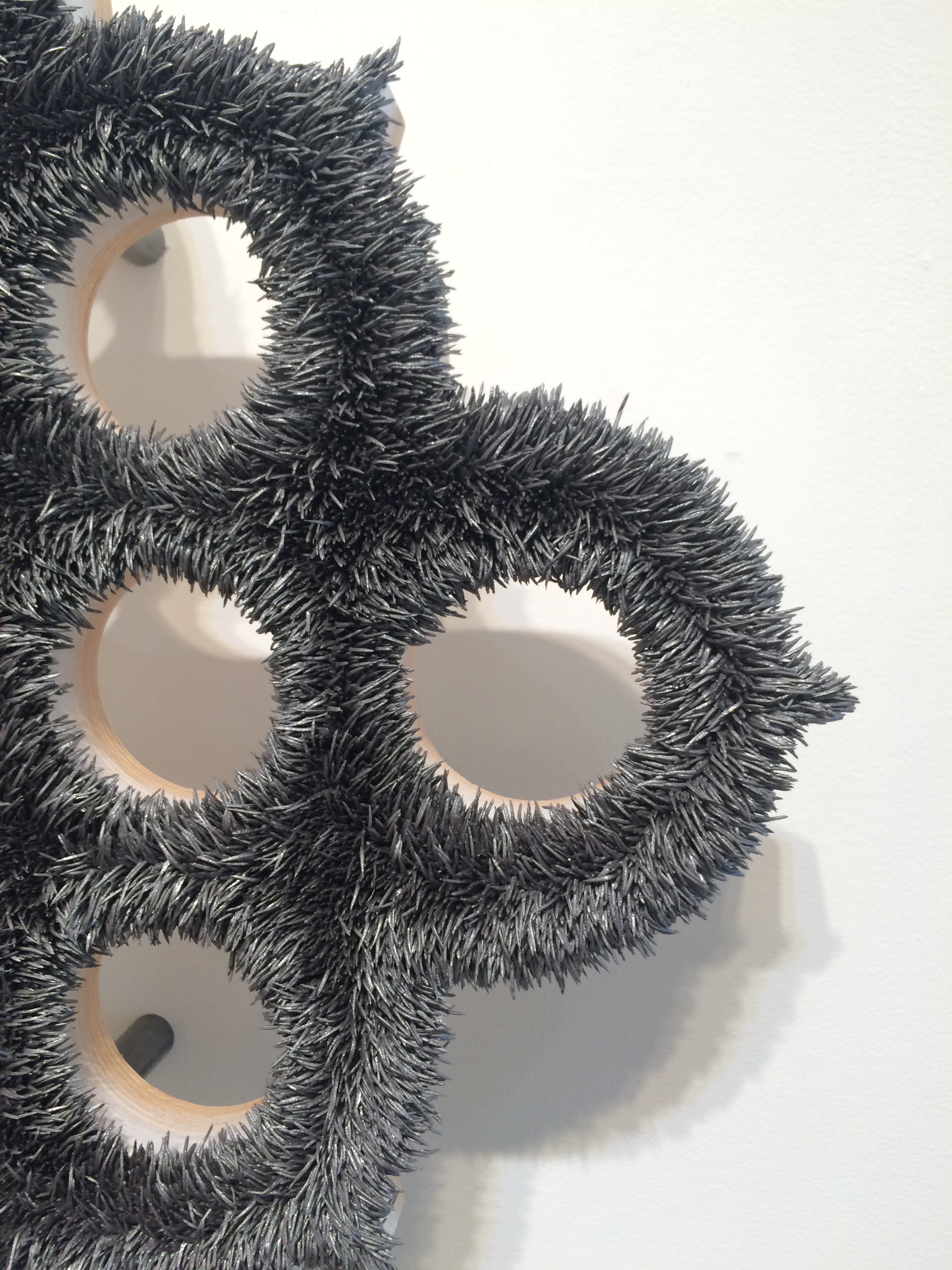
“Donald Moffet: any fallow field”, the current solo exhibition at the Marianne Boesky gallery in Chelsea features work that pose a conversation on human’s apathy for nature.  “Lot 052215 (graphic)” is one of the artists recent extruded paintings, created using a process that coaxes the oil paint into hair like bristles that seem to grow out of the canvas.

16-31-01

“Lot 052215 (graphite)”, 2015


16-31-02

Detail

Like much of the work in the show this painting is structured in a way that brings the work off the wall into the gallery space, creating sculptural quality that produces shadows. The overall pattern explored in this piece is a square format created using 13 circles that has order-4 rotational symmetry. The center section of the shape is a 3 by 3 grid square, but by adding a circle to the center of each of the sides, a diamond with 5 stacked diagonal rows is formed. This structure to me alludes to structures found in nature, like honey combs. The use of the graphite colored bristles lends the work a foreboding presence.

Susan Happersett

Anila Quayyum Agha at The Peabody Essex Museum

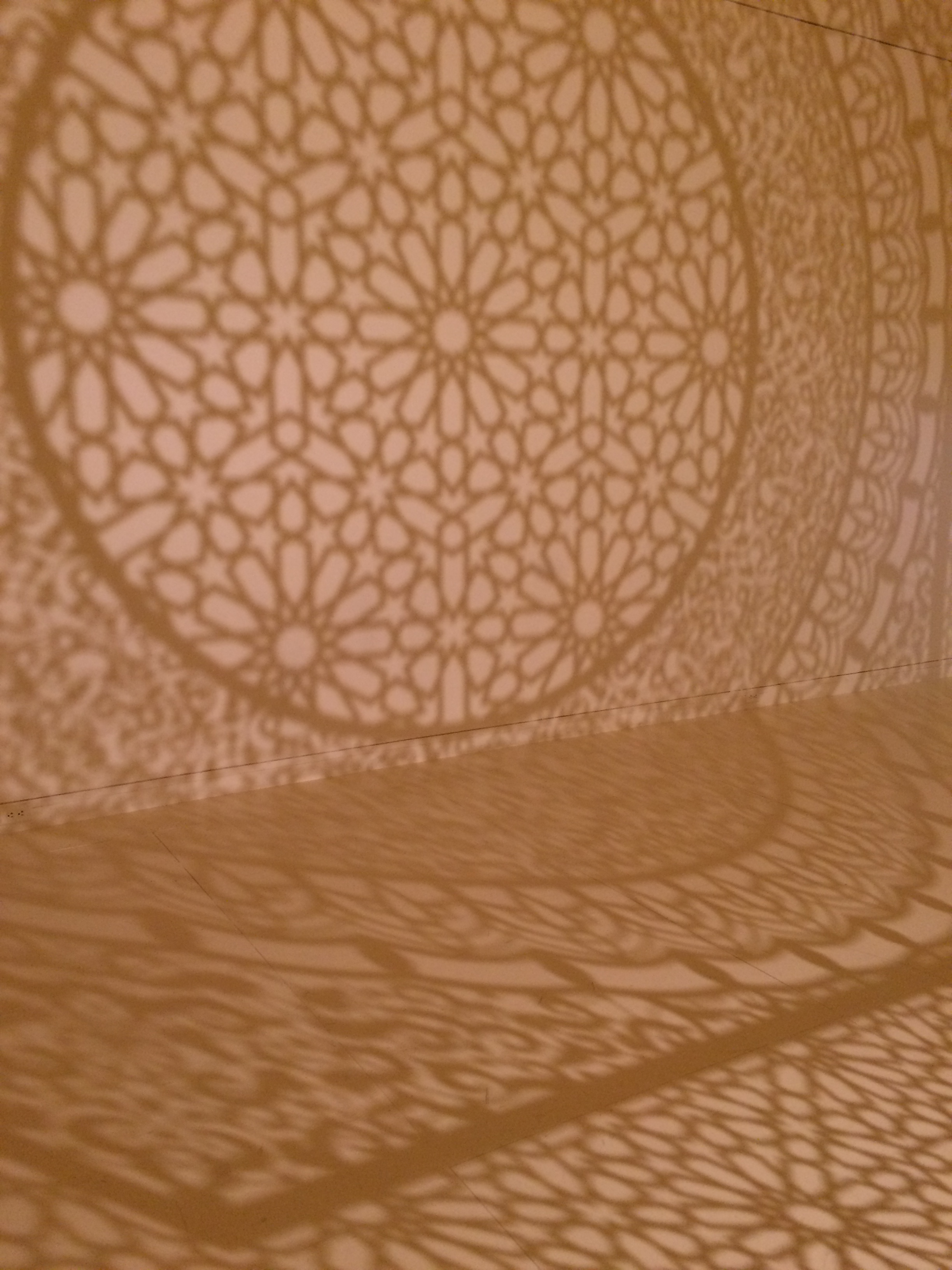
Anila Quayyum Agha’s installation titled “Intersections” is inspired by the intricate decorative elements she encountered in religious buildings as a child in Pakistan. The work consists of a laser cut steel cube lit from within. The lines of the lattice work on the cube are projected unto the painted walls, floor and ceiling of the gallery.

16-30-01
The open work design is based on the geometric properties of Islamic patterning. Each side of the cube features a figure with 8-fold rotational symmetry inscribed with in a circle.

16-30-02
These symmetries get disrupted in the projection onto the gallery surfaces. Especially along the lines where the walls and floor meet. The geometry on the cube is precise but the shadows must bend to fit within the boundaries of the gallery.

Susan Happersett

More Math Art from the Bridges Conference Jyväskylä, Finland

There were so much interesting work at the Art Exhibition this year, is was difficult to choose just a few for my blog.

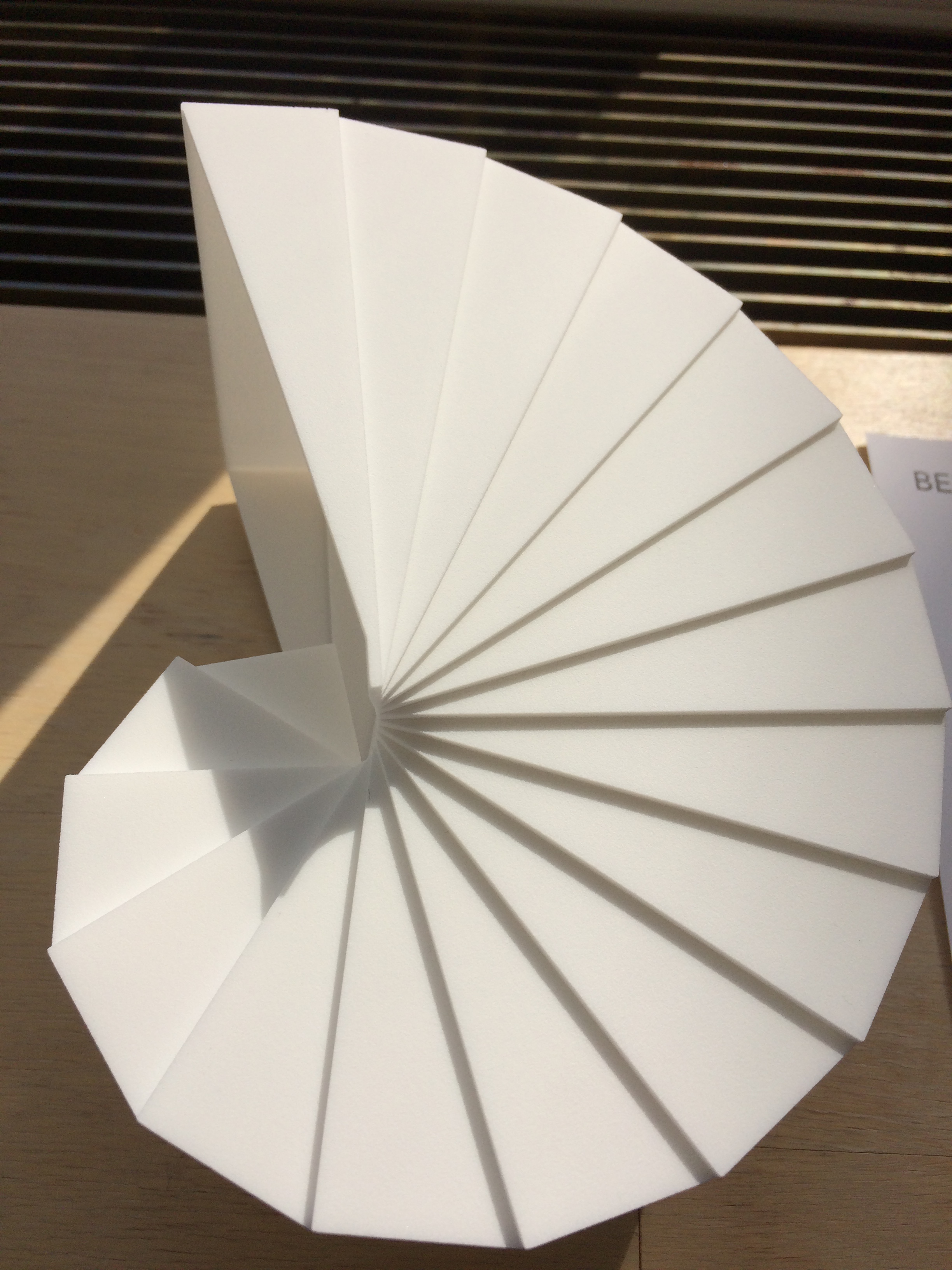
Bernhard Rietzl’s 3-D printing of “Nautilus Theodori” offers an elegant interpretation of a spiral developed by Theodorus of Cyrene in Greece in the 5th century BC.

16-29-01
The Spiral of Theodorus is constructed using right triangles. It begins with a central isosceles right triangle. The legs of this first triangle determine the length of each of the shorter legs for all triangles in the spiral. The second triangle uses the hypotenuse of the first triangle as its longer leg. The third triangle uses the hypotenuse of the second triangle as its longer leg. This process continues to create the spiral. Rietzl’s sculpture uses hollow 3-D wedges to create a shell-like vessel. The clean lines of the triangle give  the nautilus shell an element  of modern design.

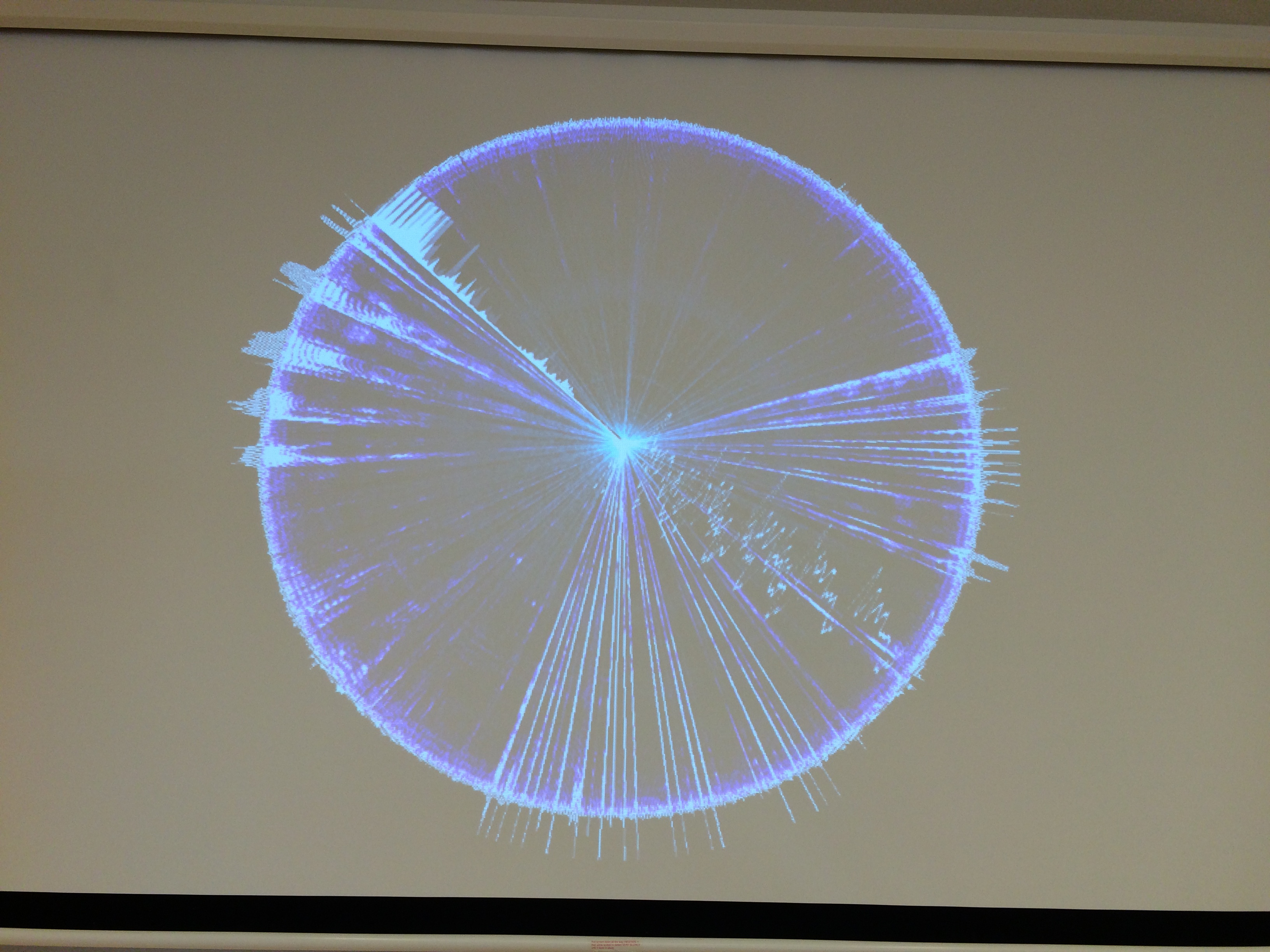
Nathan Selikoff’s video “Audiograph” is produced in real time based on the interaction of environmental factors. The work is a projection of a clock. The hours and the minutes hands are fairly traditional lines using audio waves.

16-29-02
The seconds hand of the clock however, is a representation of the sound over the course of a minute. The sounds and voices in the gallery leave lines radiating out from the center of the clock. The changes in the volume and the tone of the environment create the visual variations.
Selloff’s clock makes the viewer think about both time and sound. Using computer technology and the mathematics of audiology it creates a work that  allows participants to change the visual output of the video within the time limitations of the movement of the seconds hand of a clock.

Susan Happersett