The Curator Gallery is a unique type of gallery. Recently opened by Anne S. Moore, exhibitions at the gallery are developed using visiting curators. Each show will have a different perspective and vision because the curators will always be changing. The inaugural exhibition “Second Nature: Abstract Art from Maine” was curated by Mark Wethli, a professor at Bowdoin College and a painter exhibiting frequently in the North East and in California. Two of the artists included in this show create work with mathematical connections.
Clint Fulkerson
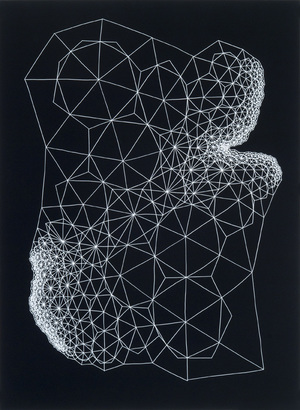
Fulkerson – White Nebula 9 – 2012 – gouache on paper – 30 x 22 inches Picture courtesy of the artist and the gallery
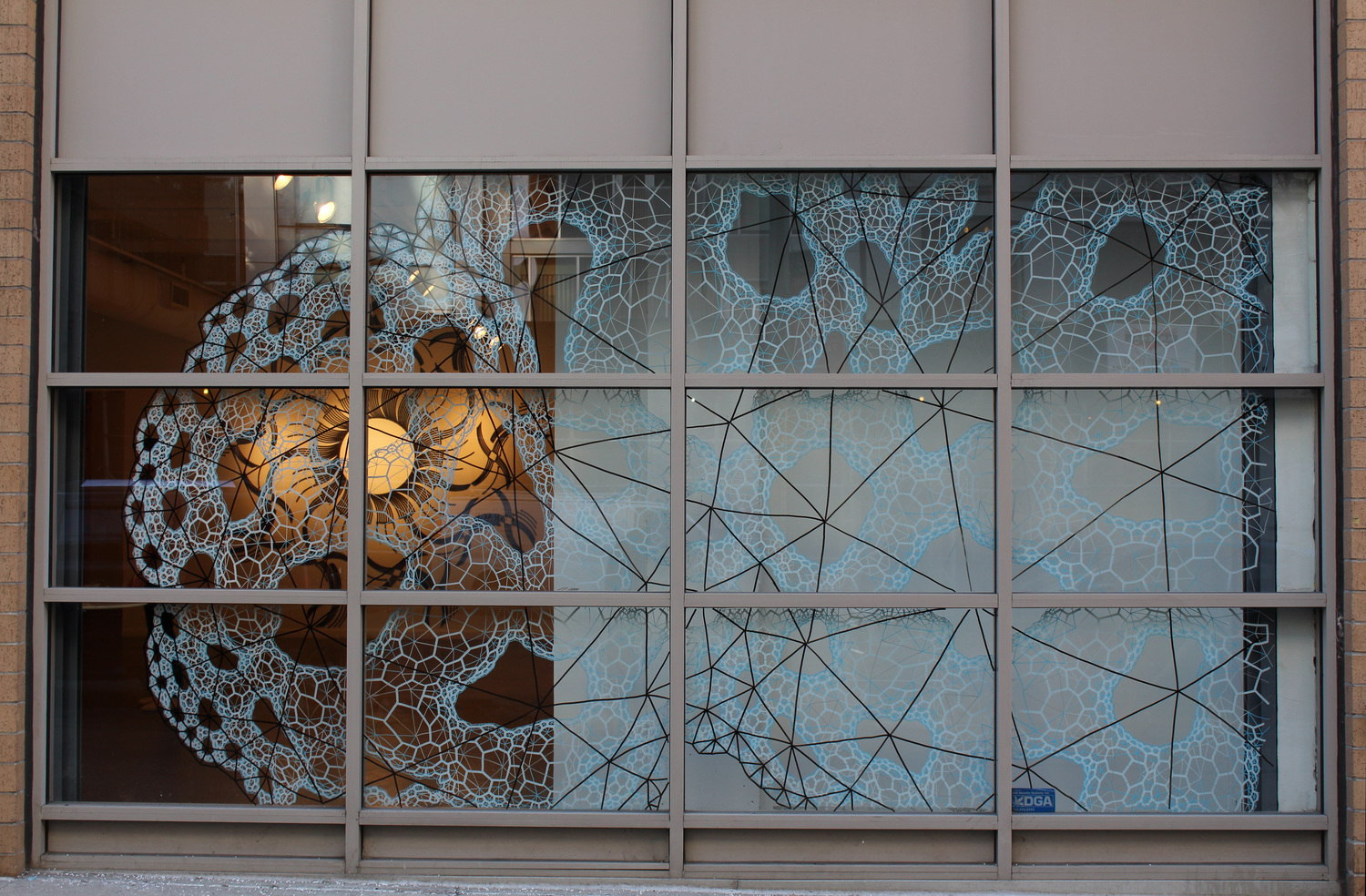
Clint Fulkerson’s intensely detailed gouache drawing “White Nebula 9” from 2012 began with simple geometric figures. Through detailed repetition of self-similar forms the drawing grew into a weblike fractal pattern. According to Fulkerson’s Artist’s Statement: “For each piece I set up a starting condition and devise a set of rules, which are much like algorithms,that limit what and how forms develop.” Fulkerson’s drawings relate to mathematics on two levels. His process is a rule-based system, and the theme of his work is the growth of forms using self-similar geometric elements. What I really liked about “White Nebula 9” is the different density of lines throughout the drawing. In some places the lines are sparse enough that the geometric structures are clear and straight forward. In other sections the accumulation of lines becomes almost feverish with detail. In addition to work on paper Fulkerson makes large site-specific drawings on walls and windows. He has created a black and white drawing in the front window of the gallery for this exhibition that beacons to pedestrians of 23rd street to take a closer look.
Fulkerson – Gallery Window Picture courtesy of the artist and the gallery
Joe Kievitt
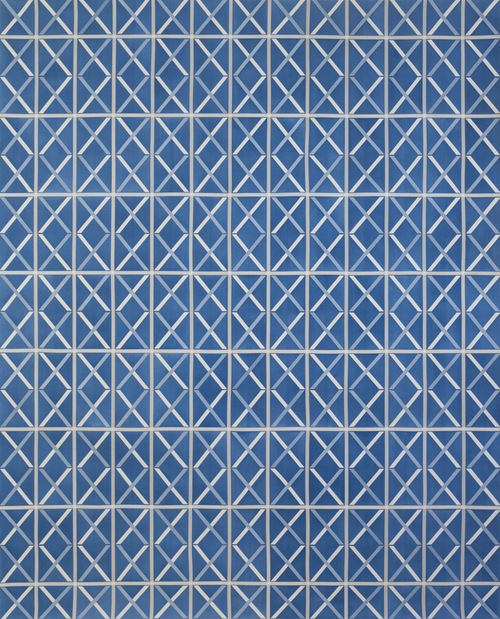
The second artist in the exhibition whose work has mathematical elements is Joe Kievitt. His ink and acrylic paintings on paper are created using an arduous system of taping off sections of the paper and then applying pigment. This produces geometric abstractions with crisp lines and edges. Kievitt cites numerous historical connections to his work including Islamic mosaics and quilts, two areas with well documented relationships to mathematics. Kievett’s painting “XXL” features a gridded structure comprised of X’s. In the top and bottom rows the columns have only one X. Each of the center 7 rows the columns have two X’s one over the other, creating vertical rectangles. Disregarding color there are both a vertical and a horizontal lines of symmetry running through the center point of the paper.
Kievitt – XXL – 2013 – ink and acrylic on paper – 52 x 42 inches Picture courtesy of the artist and the gallery
The Lower East Side neighborhood of Manhattan has a large and varied gallery scene. Though there are fewer galleries here than in the Chelsea Area, there is still a lot of great art. The galleries in the LES tend to be smaller and more intimate then in other parts of NYC . Many of the galleries are newer and less established and will take on different types of work.
Gil Blank at Joe Sheftel Gallery
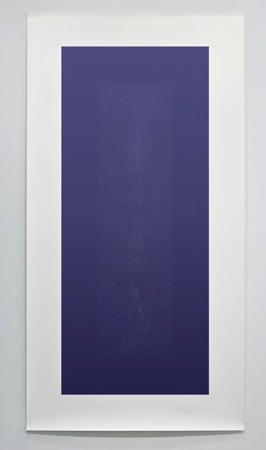
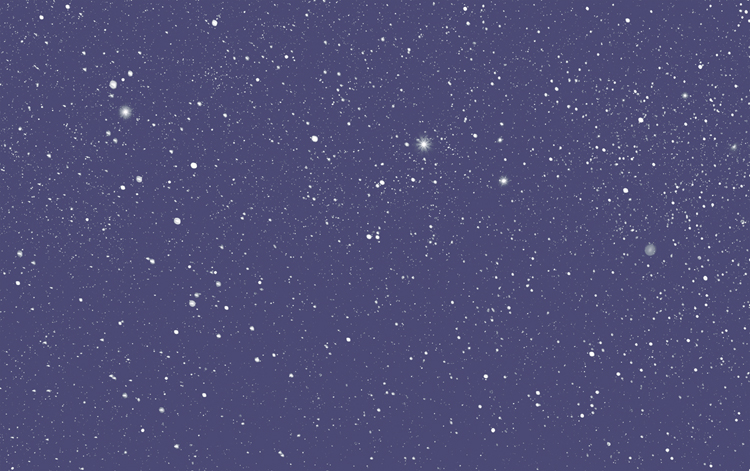
The Joe Sheftel Gallery has a exhibition of photographs by Gil Blank that are an exploration of the night sky. Blank uses an interesting technique of taking thousands of photos throughout a year then superimposing them until they accumulate into a single image. He has created one for each year beginning in 1986. The black background of the dark night sky is removed and replaced by another color. This new color is determined using a digital random color generator.
Gil Blank – Untitled – 2012 – Pigment ink jet print on polyester film Picture courtesy of the gallery and the artist
Here is a detail of the same work:
Gil Blank – Untitled – 2012 – Pigment ink jet print on polyester film (detail) Picture courtesy of the gallery and the artist
There are two elements to these photographs that appeal to my interest in mathematics. First, the choice of color for the background. By removing the dark night sky, Blank has taken stars in the sky and abstracted them to become geometric points on a plane. Then, allowing the new color to be digitally randomly generated, the algorithm of the generating software becomes part of the artistic process. The second mathematical component is the accumulation of thousands of these sets of points with each set already containing a multitude of points. This series of photographs work flirts with the concept of Infinity.
Laura Watt at McKenzie Fine Art Gallery
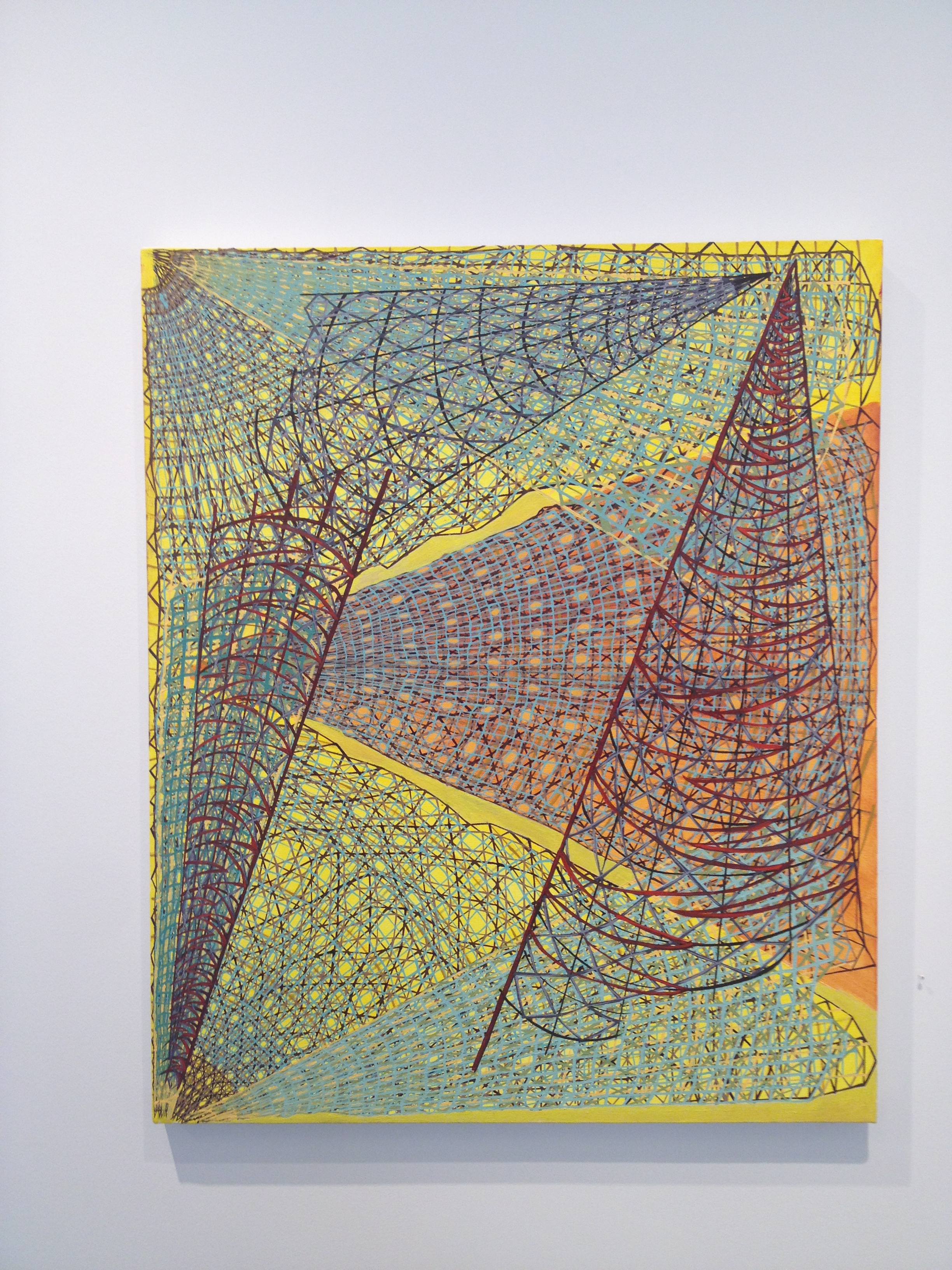
Vector diagrams are an interesting starting point for making abstract art. Laura Watt uses vectors to structure the patterns in some of her oil paintings. There are two excellent example of this work exhibited in her solo show at McKenzie Fine Art gallery. In “Vector Finding” Watt has used series of vectors fanning out from points near the corners of the canvas. Then, the triangular areas bound within these rays, are filled in with diamond-shaped grids and arcs of circles. The final image resembles cone-shaped structures consisting of nets of lines.
Laura Watt – Vector Finding – 2014 – Oil on canvas Picture courtesy of the gallery and the artist
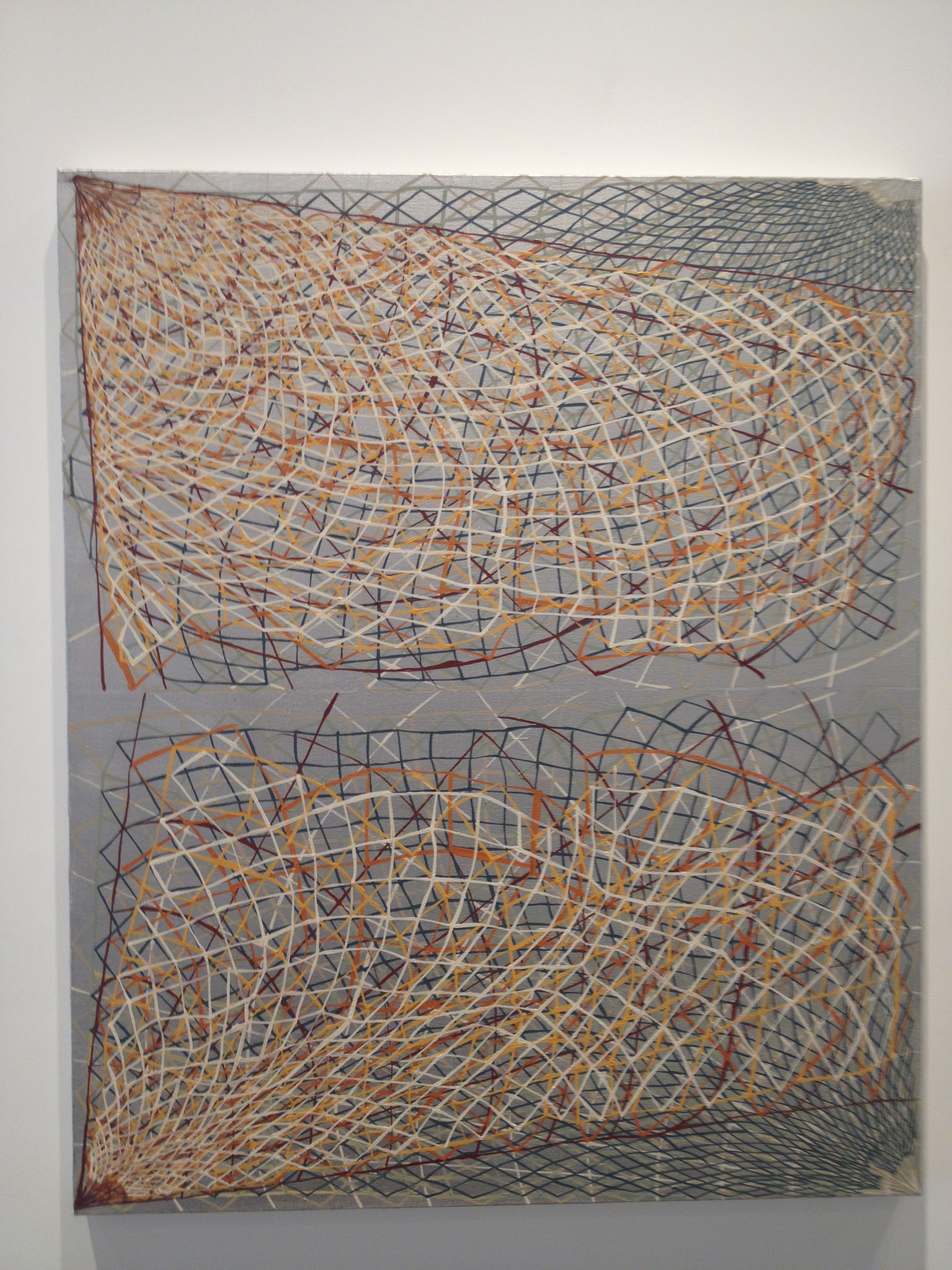
In “Oriented Vision” the vectors are starting from only two points at the top and bottom left hand corners of the canvas. The artists uses arcs to give the illusion of a curved surface and there are multiple sets of rotated and superimposed grid patterns . This painting is reminiscent of a globe or map, but lines of latitude and longitude, however, are only one of the sets of grids. Watt embraces the use of vibrant and intricate patterning in her paintings. These two examples illustrate how mathematics can be part of this process.
Laura Watt – Oriented Vision – 2014 – Oil on canvas Picture courtesy of the artist and the gallery
There are art galleries that occasionally exhibit art work that is of Mathematical interest, and then there are venues that consistently show work with Mathematical elements. Central Booking located on the Lower East Side of Manhattan is an art space that always provides art work that any Mathematics enthusiast would appreciate. Executive Director and Curator Maddy Rosenberg has created two district galleries with in the space. The front gallery ABG (Artist’s Book Gallery) is dedicated to representing Artist’s Books in all of their forms and functions. Currently on view is an amazing piece by famous MathArt collaborators, Eric Demaine and Martin Demaine. The sculpture “Through the Looking Glass” was made in 2013 and comprises of a folded paper form encapsulated in a blown glass vessel. I have seen their beautiful and complex folded forms before, but the introduction of glass takes their work to another level.
The second gallery at Central Booking is HaberSpace,which is dedicated to Art and Science exhibitions. The close relationship to the visual representation of science and the Mathematics used in the study of science makes this the perfect place to find MathArt. The March exhibition “Time and Again” explores the Physics of time, as well as the concept of linearity.
Miriam Carothers
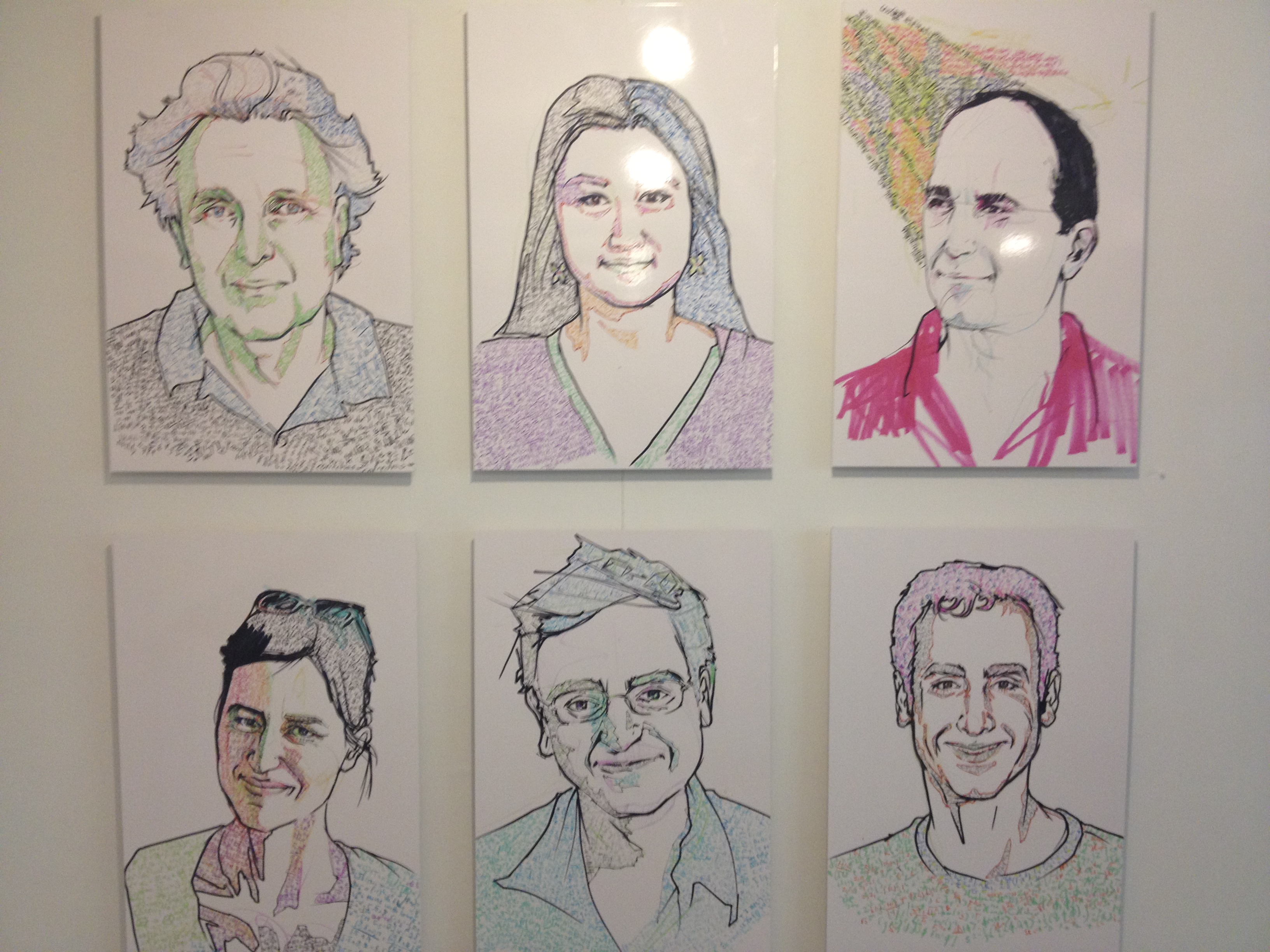
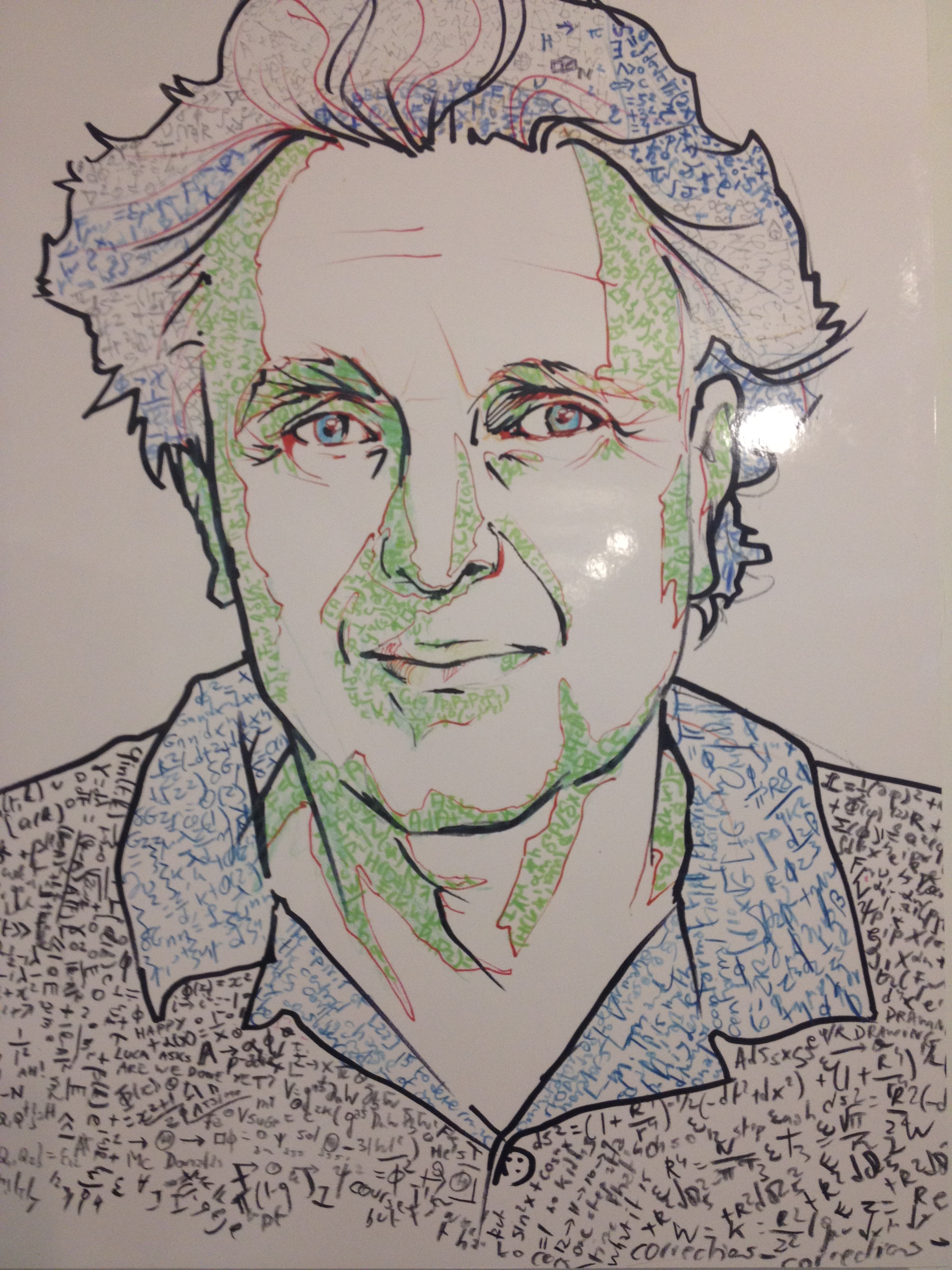
Illustrator Miriam Carothers draws pen outline drawings of physicists. The the spaces are filled in coloring book style with Mathematical equations that relate to the work of each scientist.
Miriam Carothers. All pictures courtesy of the artist and the gallery.
In 2011 Carothers made 30 portraits in this series using a team of physicists, Physics professors and students to fill in the mathematical formulae. Through this series of drawings Carothers creates a dialogue, not only about scientists as people, but also how society relates to the mathematical numerals and symbols that form the language of science.
Miriam Carothers – Alexander Polyakor (2011). All pictures courtesy of the artist and the gallery.
Christiana Kazakou
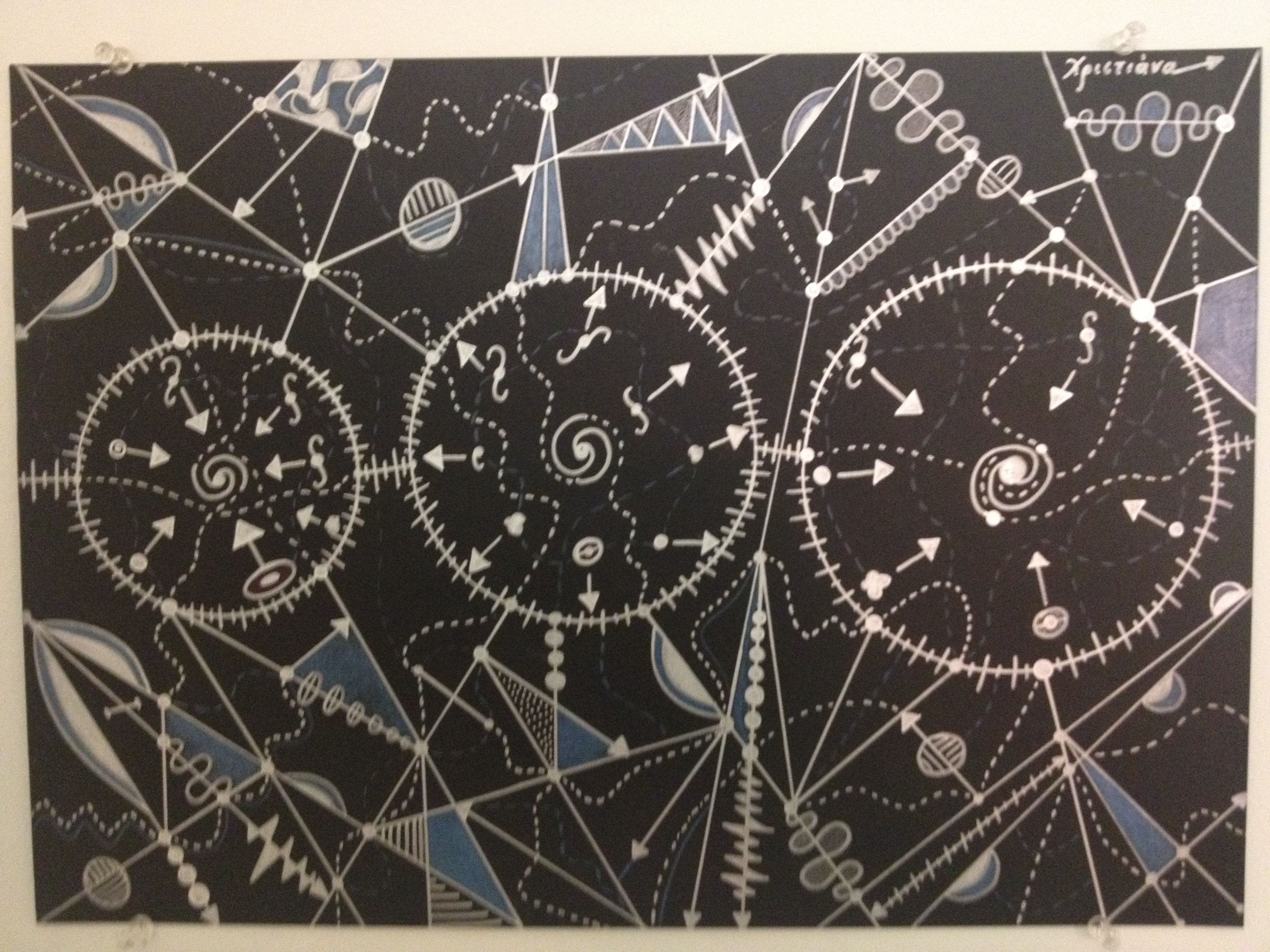
Christiana Kazakou explores the connections between science and art through many mediums, including site specific installations, performance art, architecture and what Kazakou refers to as “Science Maps”. Her drawing “The Past, Present and Future” (2010) is both striking and elegant. The white lines on the black paper create an interesting dynamic of positive and negative space.It features three circles with measurement lines ticking off degrees around their circumferences, like on a protractor. They seem to spin like the mechanism in a clock. Around the circles there is a background pattern created from playful angled vectors which connect to form a variety of triangles.
Christiana Kazakou – The Past, Present and Future ( 2010. All pictures courtesy of the artist and the gallery.
The exhibition Time and Again at the HaberSpace gallery was full of references to Mathematics and I look forward to exploring future shows.
Using symmetry to create a work of art is one way that Mathematics can influence an artist. But what happens when an artists uses symmetry and then makes one small change to upset that symmetry? The resulting work can express very different and exciting dynamics. I saw an exhibition of work by Julije Knifer (1924-2004) at the Mitchell-Innes & Nash Gallery in New York. Looking at Knifers drawings and paintings it is obvious that using reflection and rotational symmetries were a major aspect of his work.
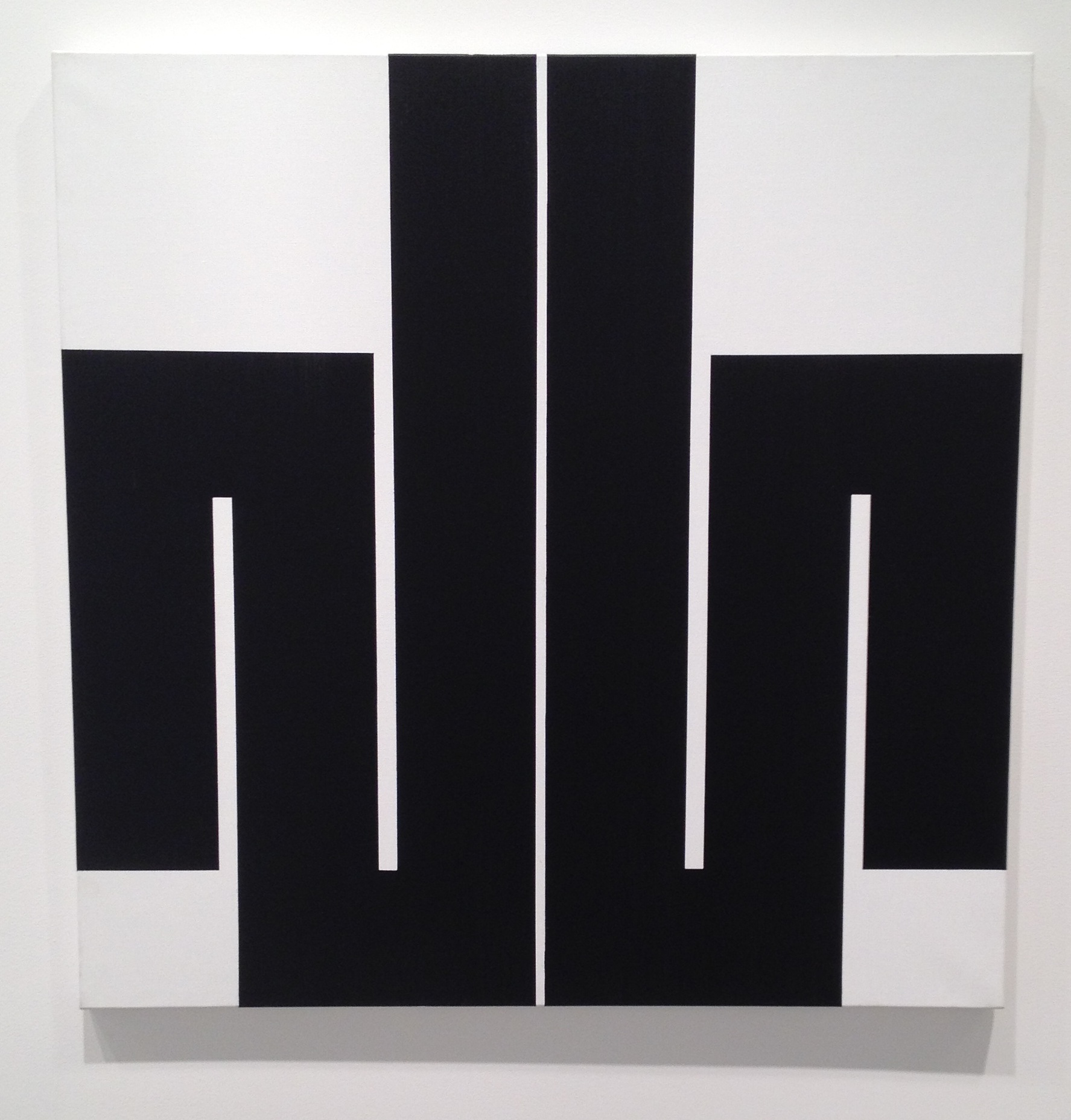
APXL – Julije Knifer – 2003-04 Courtesy of Mitchell-Innes & Nash Gallery
In APXL made in 2003-2004 there is a vertical line of reflection symmetry, but what is also interesting is how each of the “S” like figures would have an order 2 rotational symmetry if the artist had not truncated the outer columns.
Knifer used some type of symmetry in a lot of the work on display at this exhibition, but in much of the work the perfect symmetries were in some way altered.
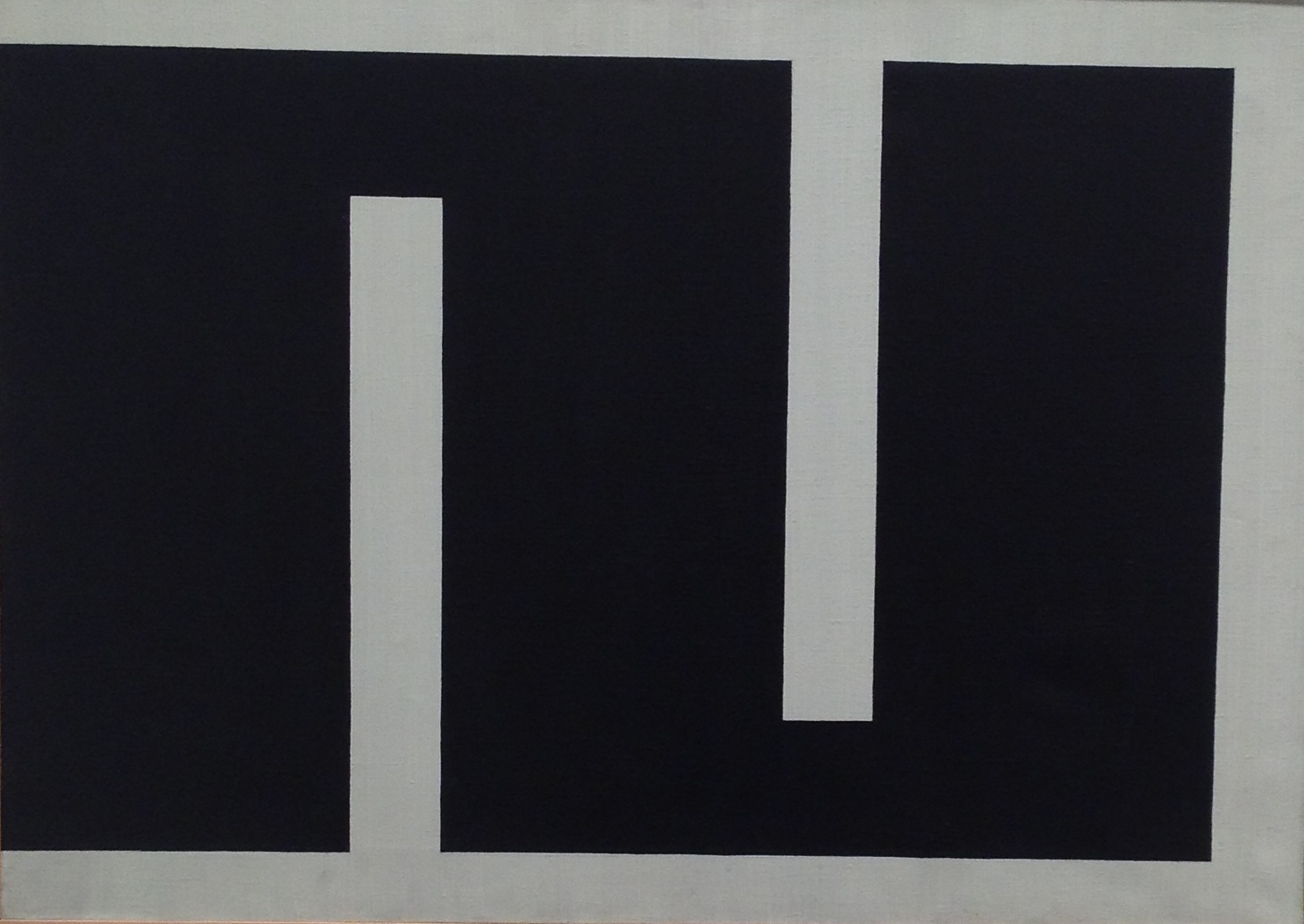
MK 69-43 – Julije Knifer – 1969 Courtesy of Mitchell-Innes & Nash Gallery
The figure in the painting MK 69-43 from 1969 has an unblemished order 2 rotational symmetry but the figure is not centered on the canvas. There is an interesting sense of tension in this canvas because of the imbalance.
MS 09 – Julije Knifer – 1962 Courtesy of Mitchell-Innes & Nash Gallery
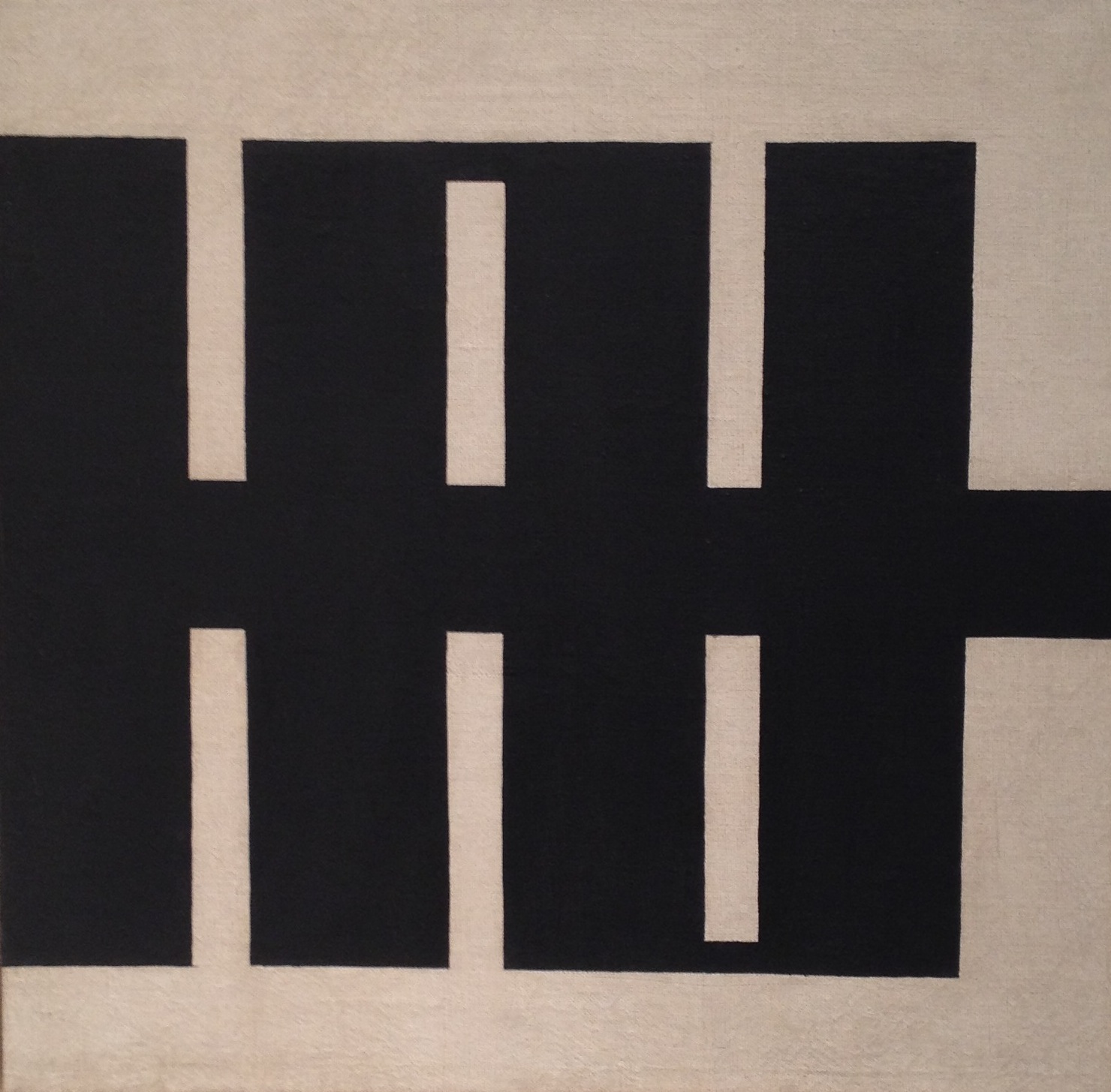
In the painting MS 09 from 1962 there is a horizontal reflection line of symmetry running through the center of the figure except for two small lines. There is a line connecting the center columns at the top and a line connecting the two right columns at the bottom. These act like bridges connecting the columns.
What I find so interesting about these works is how they make me think about symmetry. At first I was not going to write about this exhibition because only one painting had a complete and clear symmetry. But I kept thinking about the paintings and drawings and after a while I realized that by creating these imperfect symmetries Knifer has given us a different but inspired way to look at symmetry. There is enough of a framework provided so the viewer is looking for order in the symmetries, but is thrown off balance. Maybe this uncomfortable imbalance is the perfection of this work.
Julije Knifer is is one of the most important Croatian artists of the 20th century. His work is in many museum collections including MOMA in NYC and has had exhibitions at The Centre Pompidou in Paris and the Museum of Contemporary Art in Sydney Australia. In 2001 he was selected to represent Croatia at the Venice Biennale.
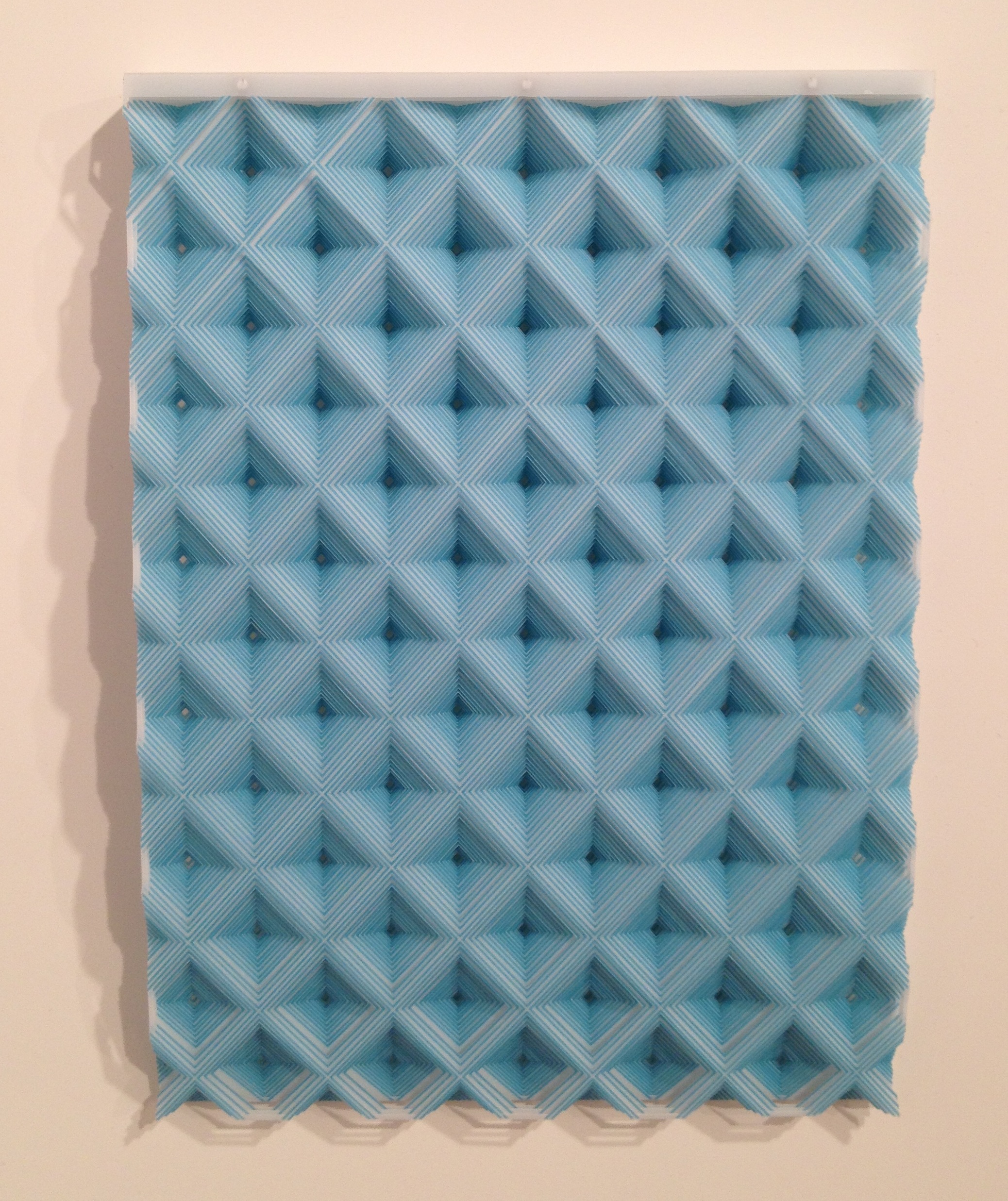
Pavel Zoubok Gallery is exhibiting the hand and laser cut mylar 3-D drawings of Imi Hwangbo. Using layers of colored mylar sheets, Hwangbo creates intricate geometric reliefs that have both depth and line. In the piece “Azure Seer” (2004), a grid of squares is meticulously cut from each sheet of mylar. Sheets with larger squares are at the front. With each sheet the squares get ever so slightly smaller until the farthest sheet has no cutout. This method creates a grid of inverted pyramids. It is very common for Math enthusiasts to cut and fold paper to make 3-D geometric solids. Hwangbo’s process of cutting into the layers to make geometric voids is a fresh approach.
Imi Hwangbo – Azure Seer (2004) Courtesy of the artist and Pavel Zoubok Gallery
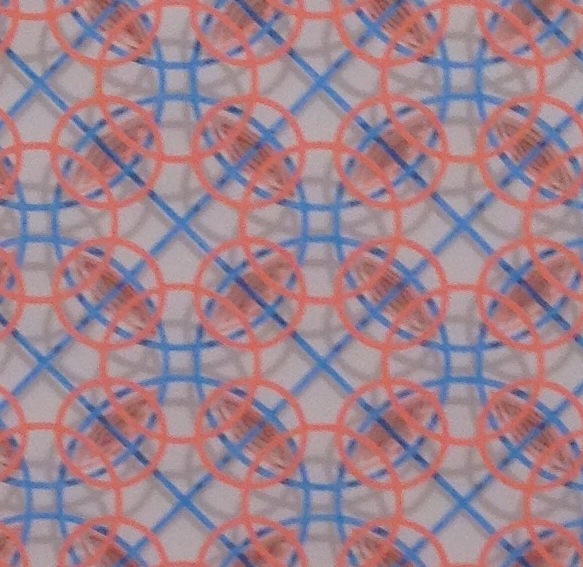
In a more recent work named “Lens 2” (2013) Hwangbo has layered a series of net-like webs of patterns in hand-colored red and blue sheets. In the pattern there are intersecting blue circles with perpendicular diameters. These diameters run diagonally across the work creating a diamond grid. Then, in red layers there are two different sizes of smaller circles. Looking at a small section you can see the order 4 rotational symmetry around the center of each blue circle.
Imi Hwangbo – Lens 2 (2013) – DETAIL Courtesy of the artist and Pavel Zoubok Gallery
Hwangbo has been influenced by ornamentation from religious and spiritual architecture. This inspiration enables her work to transcend the flatness of the mylar and create environments of space, light, and pattern.
Richard Kalina at Lennon Weinberg Inc.
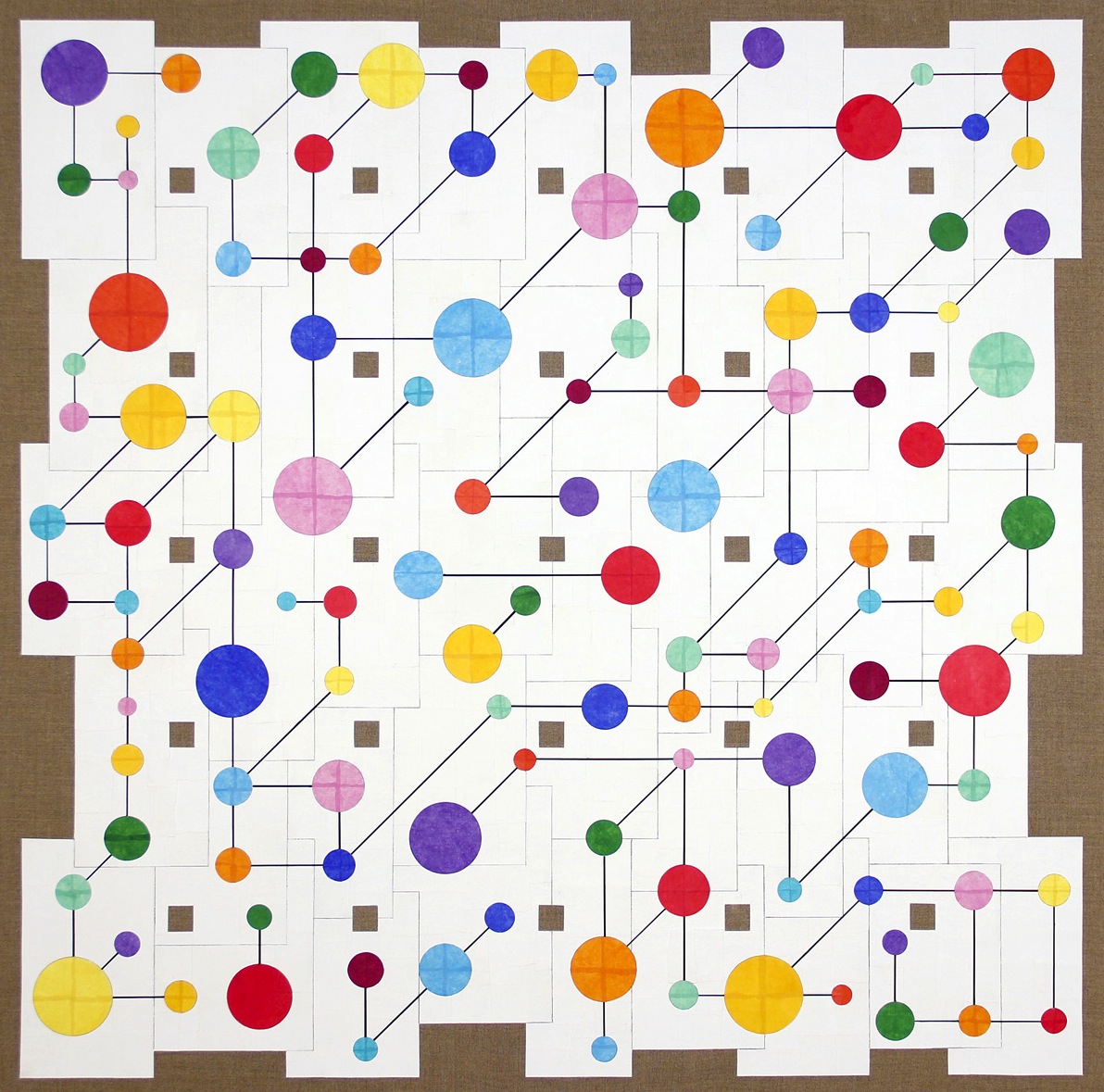
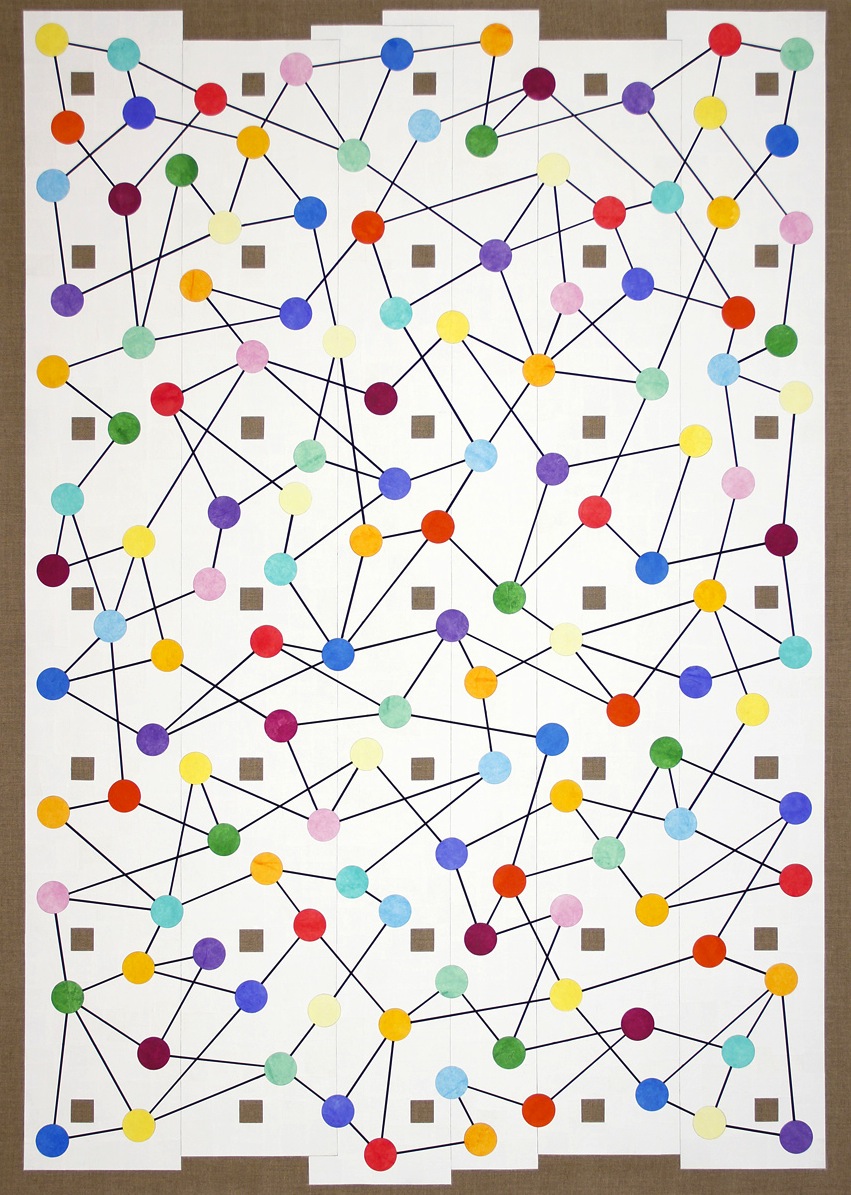
My fascination with MathArt goes beyond art whose direct theme is Mathematics. I am also intrigued by work that is inspired by, or is a reaction to, the systems in Mathematics. Richard Kalina‘s new work falls in this category. Lennon Weinberg Inc is currently exhibiting his works on paper, as well as collages on linen. Using a background grid consisting of overlapping rectangles of white paper in “Nominal Space” (2012) Kalina paints a collection of brightly colored circles. These circles interact through a network of black straight lines that connect them. The lines have one of three possible directions: vertical, horizontal or diagonal, from lower left corner up to upper right corner. Each circle can have one, two, or three connecting lines radiating out from it, creating angles of 45 degrees. 90 degrees, 135 degrees, or 180 degrees. The patterns of connections seem like an homage to the molecular and geometric models we made in high school.
Richard Kalina – Nominal Space (2012) Courtesy of the artist and Lennon Weinberg Inc.
For the collage on linen “Neochrome” (2013) Kalina changed the rules with regard to the angles of the connecting lines. There are many more possible angle structures and the circles can have up to six connections. “Neochrome” has the energy of a complex flow chart with many possible routes to connect different elements within the network. Richard Kalina has had a long and esteemed career in the Arts. His work is included in many museum collections including the National Museum of American Art, the Fogg Museum, and the Wadsworth Atheneum. Kalina has also served as a contributing editor for Art in America magazine.
Richard Kalina – Neochrome (2013) Courtesy of the artist and Lennon Weinberg Inc.
Dikko Faust is the printer and co-owner of Purgatory Pie Press, a letter press publishing company in Tribeca, Manhattan that he runs together with Esther K. Smith. Faust also teaches a course on Non-Western Art History at the City University of NY. It was his experience in looking at Non-Western patterning that has lead to his recent series of prints called Tesselations. The prints are made by hand setting bits of lead to create the pattern, using only red and black ink. Each patterned print has its own set of distinct symmetries. Today, I will discuss two prints from the series.
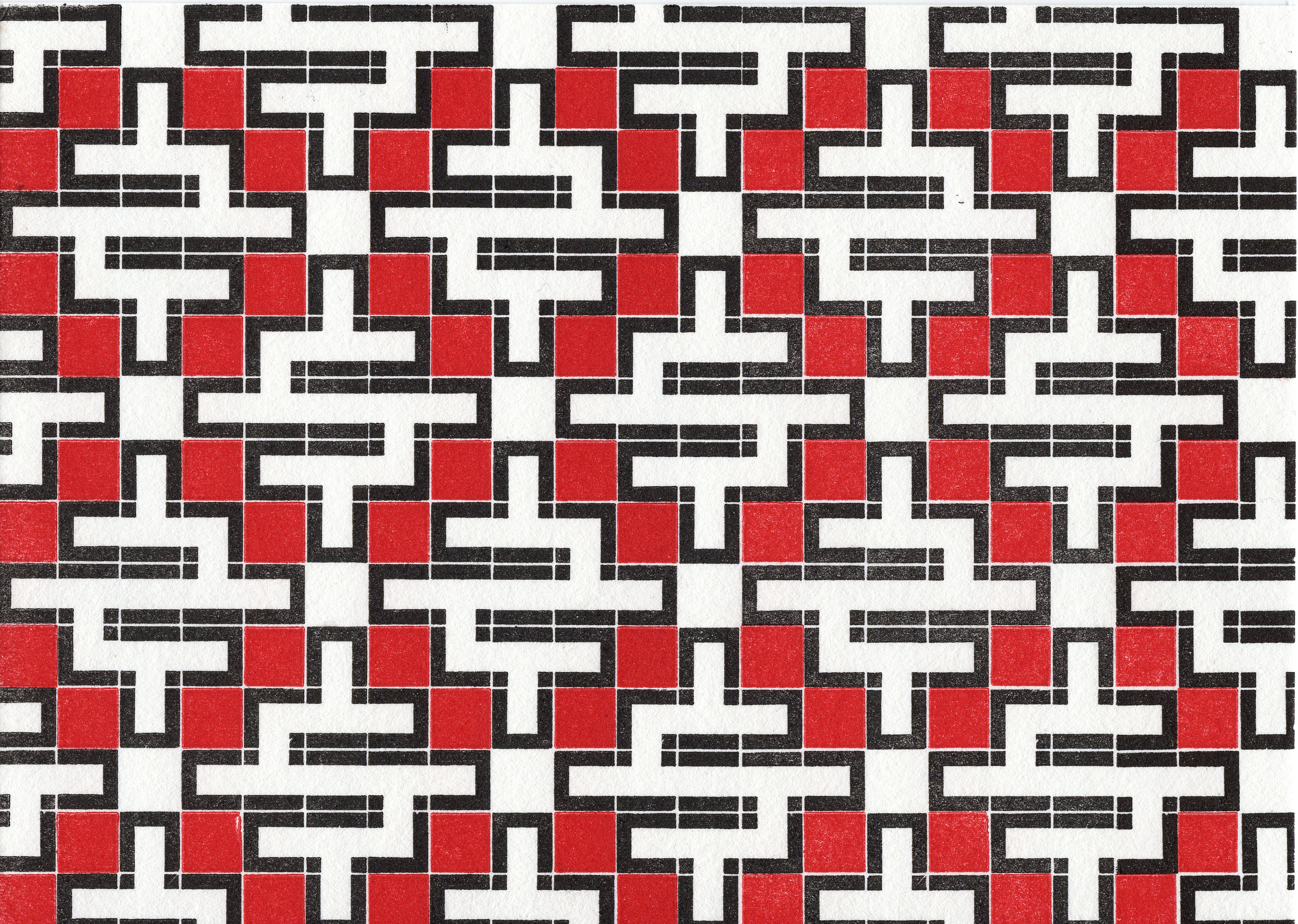
The first one is “Tesselation 4 -Nessonis 1: Pyrassos”. Printed on the back of the card is the following descriptive text: “A serving suggestion for a Middle Neolithic stamp seal design found in three sites in Northern Greece”:
Dikko Faust – Nessonis 1: Pyrassos – Hand set block print – 2012
I see this print as a fragment of a wallpaper symmetry, because the repetition in the pattern is based on the symmetries between the shapes. The white figures with the black outlines that resemble a $ or an S and the 8 red squares around them have order 2 rotational symmetry. If you rotate the figure 180 degrees, you have the same figure again. Each of the $ or s shapes has glide reflection symmetry with the upside down $ or S in the rows above and beneath it. In a glide reflection symmetry we see the mirror image of the original shape, but then it is glided or moved along the plane (in this case, along the paper).
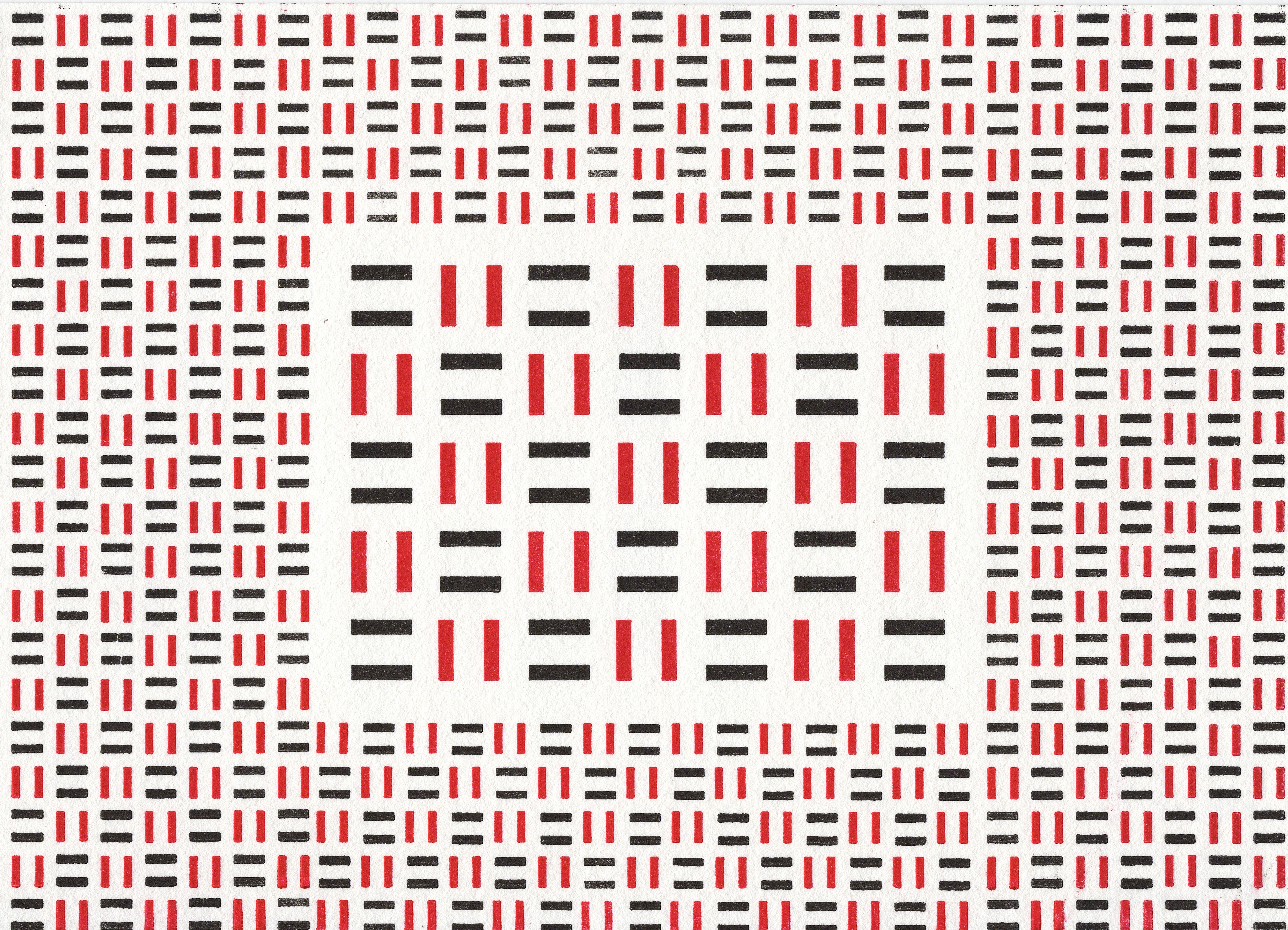
The second print is “Tesselation 6- Magnified Basketweave”. The text on the back of the print states “aka Monk’s Cloth or Roman Square Quilt As seen on NYC sewer covers”:
Dikko Faust – Magnified Basketweave – Hand set block print – 2013
This print is a great example of reflection symmetry. It has two lines of symmetry: one horizontal though the center, and one vertical through the center. Another interesting mathematical feature of this print is the similarity between the larger sets of black or red bars and the smaller sets. Two figures are similar if they have the same shape and are only different in size. Both the large set of bars and the small set of bars form two sides of a square: all squares are similar. The inner rectangle of larger bars measure 5 sets by 7 sets. It requires a rectangle of 11 sets by 15 sets of the smaller squares of bars to frame the large rectangle. There is a border with the width of one small square, so after subtracting 1 set from each dimension, we have the inner rectangle of 5 by 7 surrounded by a 10 by 14 rectangle of smaller sets of bars. The ratio of the dimensions of the larger to the smaller is 2:1.
Faust has made a whole series of these striking Tesselation prints. He has been inspired by what he has encountered teaching art history, and what he sees all around him looking at art, and in the case of Tesselation 6, the streets of New York City. The mathematics in these prints go beyond the patterns themselves and connect the viewer with distant times and cultures, and links us all in a visual aesthetic.
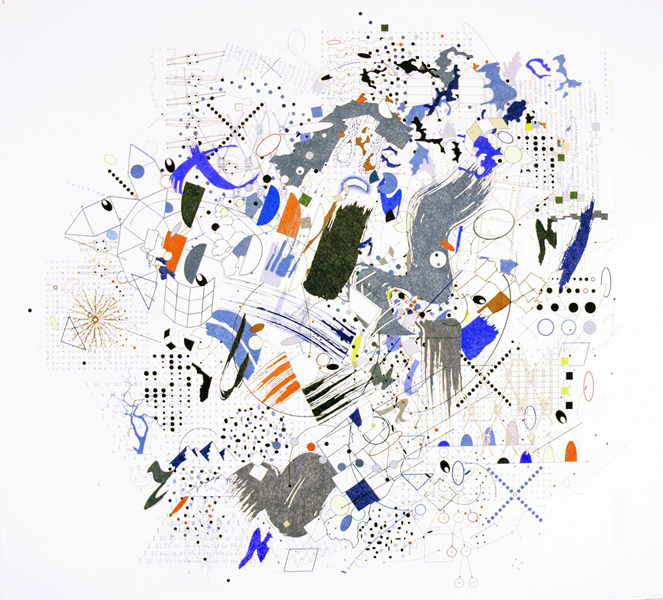
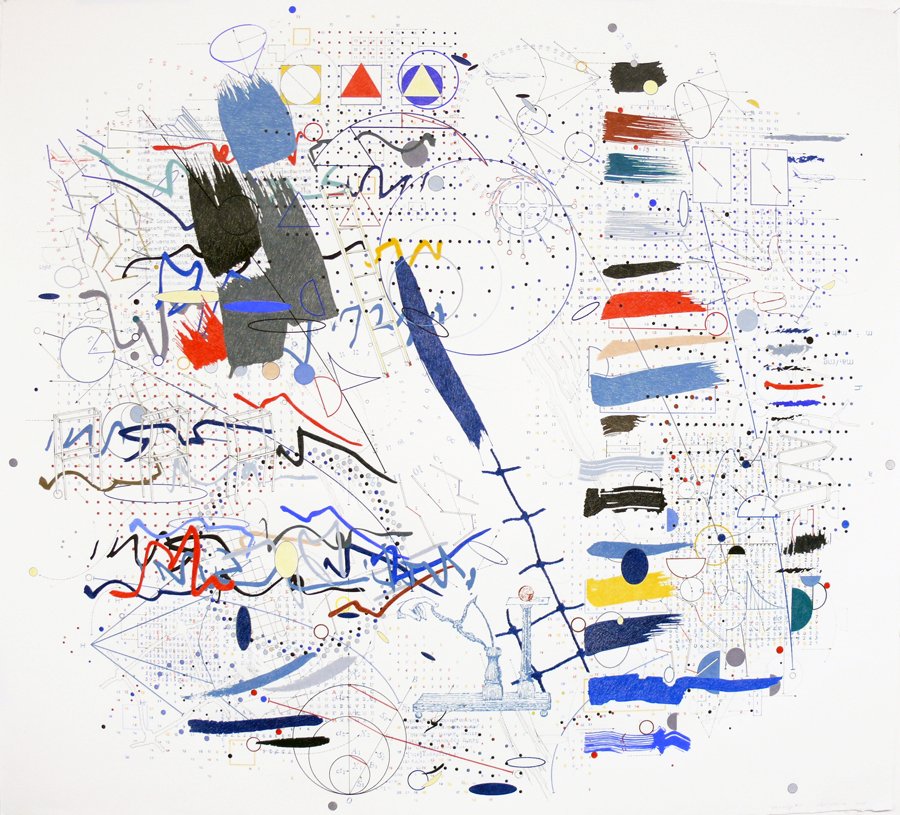
It is my personal mission as an artist to illuminate the intrinsic beauty of mathematics in a purely aesthetic realm. Translating mathematical subject matter to the picture plane of my drawings, I strive to enable viewers to appreciate this aesthetic, regardless of their mathematical background. I express the grace and beauty I find in mathematics through symmetries, patterns and proportions in my art. Many of my drawings are related to growth patterns such as the Fibonacci sequence and binary growth. I begin my work process by creating a plan or an algorithm. I make all of the decisions for the work beforehand and make a detailed plan in a large spiral drawing tablet that I refer to as my plan book. After I write out all of the specifications, I generate the actual drawing by hand using the rules from the plan. Through my drawings I hope to express both the aesthetics of my mathematical subject matter, as well as the aesthetics of the process of algorithmic generation.
In the past few years I have become interested in generating drawings using fractal forms based on the repetition of similar shapes. I begin with a largest instance of a shape and incorporate copies scaled by powers of ½. I developed a drawing based on the four quadrants of the Cartesian coordinate system. Each drawing begins with 8 spokes. The line segments fall on the coordinate axes and the lines y=x and y=-x. Once I have drawn the initial shape, each spoke becomes the starting point for a new 8-spoke shape in which the line segments are ½ as long as the original spokes. Then those 64 spokes become the starting point for 8-spoke figures with line segments ¼ the length of the first line segments. Next, the 512 spokes each become the bases for an 8-spoke shape with line segments 1/8 the length of the original spokes. This process creates a circular fractal network of lines. While producing these drawings, I have developed a type of mantra to remember where I am in the drawing. I need to keep count and this becomes quite complicated and rhythmic, especially when I reach the third iteration.
Mathematics and art both enable humans to better understand the world around them by uncovering patterns and structures. Chaos Theory is one of the topics in mathematics that, I feel, particularly throws light on the intricacies of the human condition. Chaos Theory shows that even within apparent disorder there can often be found both order and structure. My investigation took me to the earliest ideas on Chaos Theory. In 1961 Edward Lorenz inadvertently discovered the phenomenon of sensitive dependence on initial conditions by noticing the effect of rounding off decimals had in a computer-generated sequence of calculations for weather prediction. This event marked the (re-) discovery of what is now commonly known as Chaos Theory. I decided to visually interpret this phenomenon in my drawings, by using my basic 8-spoke pattern and continuing with multiple iterations using stencils with a small margin of error. The errors accumulate to create these cloud-like, chaos- derived drawings. If the viewer spends a few moments gazing into what at first appears to be a chaotic cloud they will begin to see the pattern of the fractals develop. There is a hidden structure to these drawings, as well as a sense of growth through time. This process of layering iteration on top of iteration takes weeks of work and through the process the drawings go through interesting changes and developments. I wanted a way to incorporate this sense of time and change into my art. It was time to make a movie.
I started with a fresh large black sheet of paper. Then I installed a digital camera over my drawing table. I began my drawing process, but after each line I took a still shot of the drawing. I continued this process over months. I wanted the movie to have an organic handmade feeling to it so I made a number of changes throughout the process. The frequency with which I photographed the drawing fluctuated. Sometimes I would take a picture after each line, sometimes I would complete a small cycle of lines before taking a picture. This change produced skips and jumps in the rhythm. Occasionally, I moved the camera closer to or farther away from the drawing. I also included myself in the photos as the generating mechanism: there are a few shots where you can see my hands. At a point where the drawing was getting quite complicated, I adjusted the camera so you could see my feet coming and going from view: the drawing was becoming a dance. Leaning over to draw and then pulling away to take a picture created a very physical element to this work and I wanted to express that physicality. Thousands of still digital photographs were taken during the drawing process. These photographs were put into consecutive order and then repeated in reverse to create the sense of both growth and decay. The edited product is a 6 minute video titled “Chaos Night”.
I knew from the beginning of the process that I would add music into the final production. I contacted composer Max Schreier, and discussed the structure and mathematics I wanted incorporated into the music. I wanted to make sure the number 8 played a major role in the structure of the music to mirror the 8 spokes of the drawing. Max agreed to write and perform a 6 minute composition based on these specifications. Influenced by Arnold Schoenberg, he based the music on a series of 8 sequential notes. While the bottom voice of the organ plays a drawn out rhythm associated with the first iteration of the drawing, the violin accelerates with the increased speed of the smaller iterations. The right hand of the organ creates small disturbances, each catalyzed by the random insertions of hands, feet and rulers in the video.
– Susan Happersett
Originally presented at Bridges Art Exhibition – Banff, Canada – July 2009;
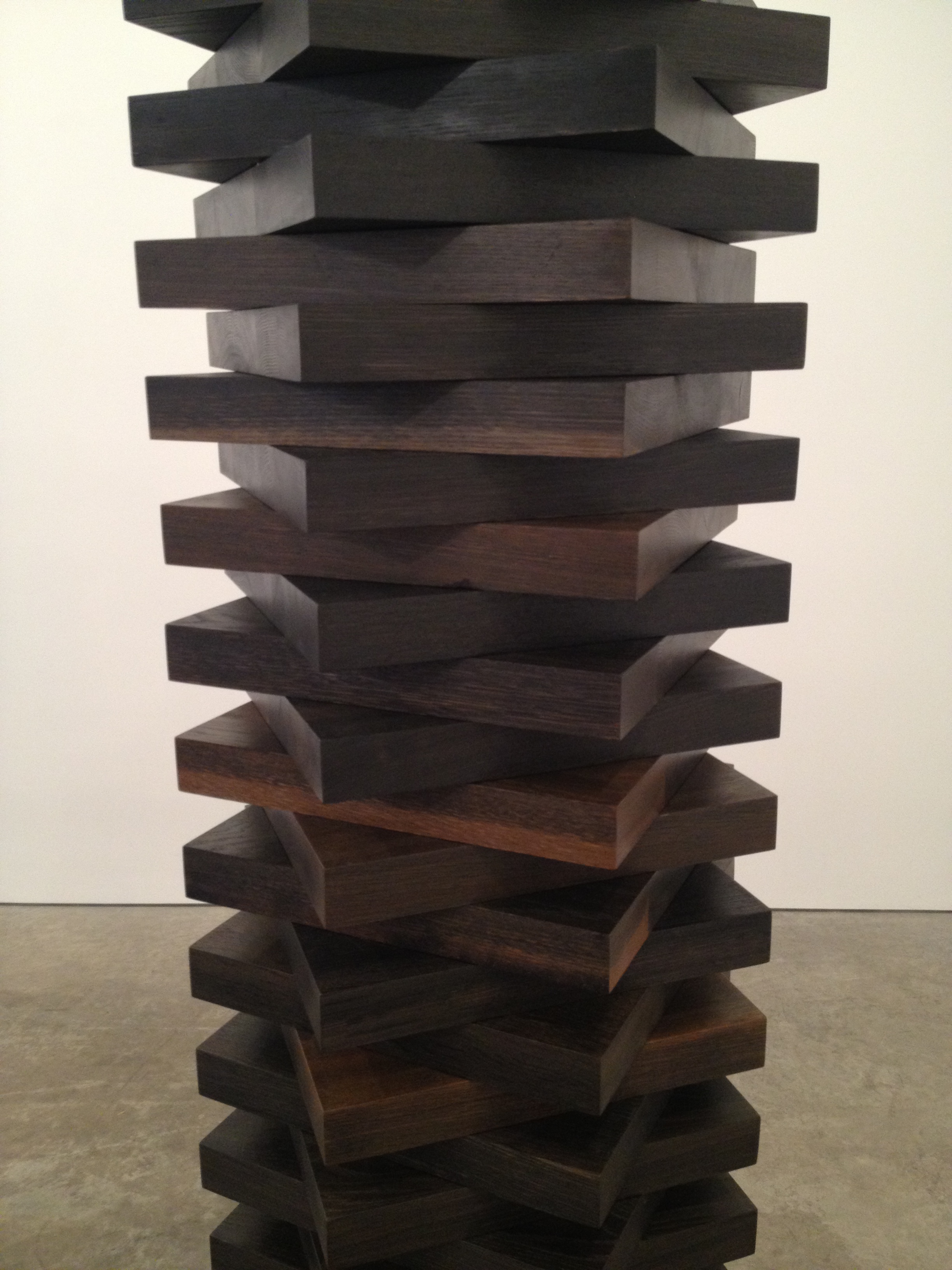
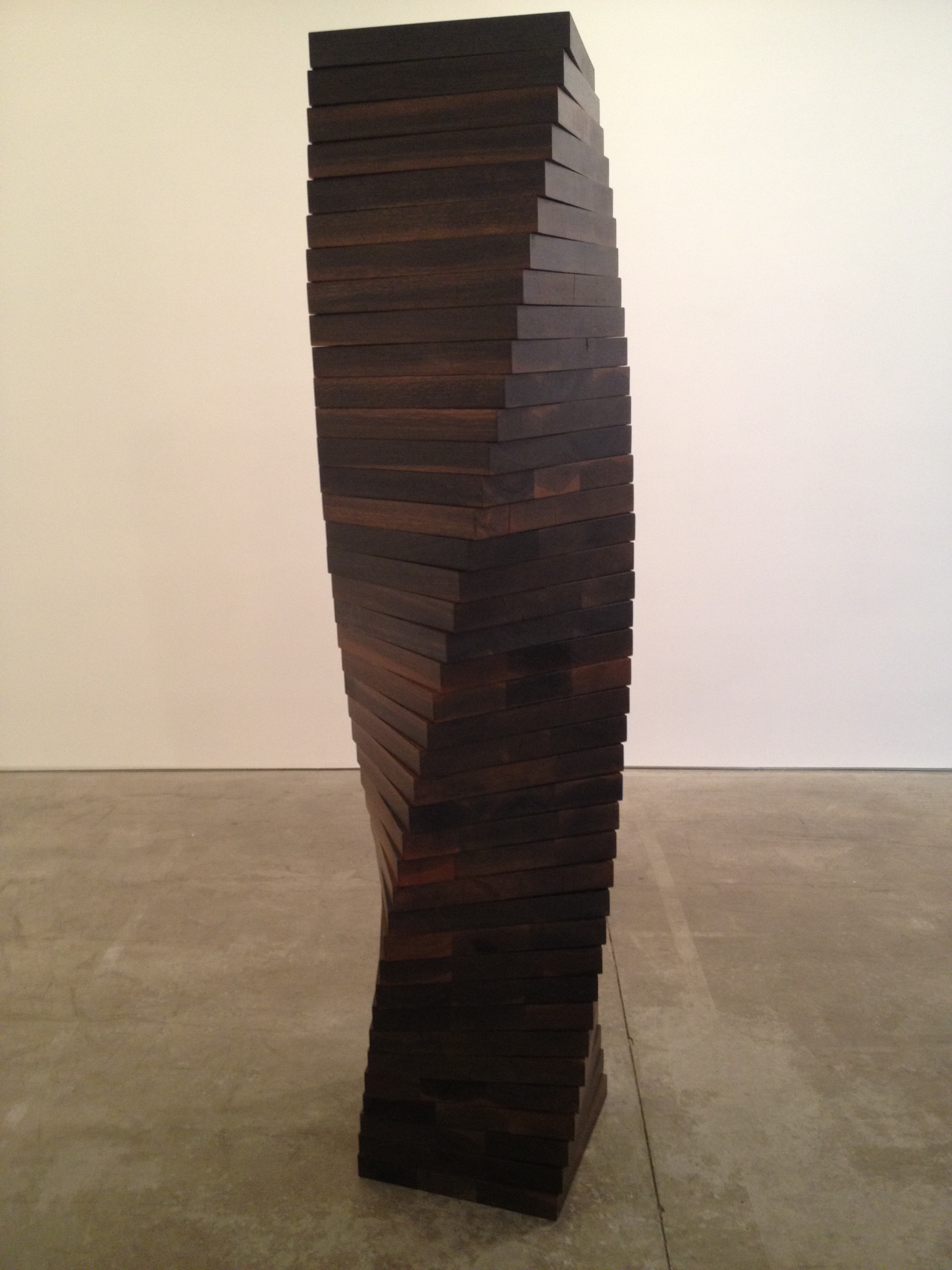
Sonnabend Gallery is exhibiting large wooden sculptures by Robert Morris. Morris is one of the most important American artists and preeminent practitioner of Minimalism. The twelve sculptures in this show are from his “Hardwood Series” and they are all recent reinterpretations of plywood constructions from the 1960’s. Craftsman Josh Finn facilitated the actual production of the work. I was particularly drawn to three totem-like sculptures that were each stacked columns of square planks. In “Serrated Column” (2012) each consecutive plank is rotated 90 degrees. Each square has diagonals that are parallel to the sides of the squares above and below.
Morris – Serrated Column – 2012 – Wood
“Twisted Column” (2012) is a stack of 40 squares that rotate a total of 90 degrees. Each square is only rotated 2.25 degrees. This subtle rotation gives the illusion that it is a smooth surface instead of separate square planks.
Morris – Twisted Column – 2012 – Wood
In “Spiral Column” (2013) the squares are rotated around a corner instead of the center. One full turn of the spiral is formed by planks. This work is an engineering marvel. Standing in front of this sculpture in the gallery it seems like magic that it does not tip over. Morriss’ column sculptures illustrate the many visual possibilities that can be explored using the repetition of a single geometric element.
Morris – Spiral Column – 2012 – Wood
Beth Campbell at the Project Room at Josee Bienvenue Gallery
In the Project Room at Josee Bienvenu Gallery, Beth Campbell is exhibiting her drawings and mobiles in an exhibition titled “My Potential Futures”. The works on paper are handwritten text-based diagrammatic drawings. The wire mobiles are a 3-D extension of the drawings. The structure of the mobiles create a binary fractal pattern. Each mobile is attached to the ceiling by a single wire that then divides into two wires, then each of those wires split again into two wires each. The 4 wires split into two wires each (now 8 wires). This continues through 7 iterations. Start at the top and then there is a choice of two possible routes, a yes or no question or ones and zeros if you are thinking in binary code.
On my recent visit to the Chelsea gallery district in Manhattan I noticed a number of exhibitions featuring art with Mathematical influences. At the Kim Foster Gallery there is a show of exquisite drawings by Paul Glabicki based on Einstein’s Theory of Relativity. These works have layers of scientific data, charts, and mathematical formulae. In drawing RELATIVITY #8 Glabicki has drawn a series of Pascal’s Triangles in the mix of images.
Glabicki- RELATIVITY #8
A Pascal’s Triangle is a triangular array made up of numbers. The number of terms in each row corresponds to the sequence number of the row. For example, the first row has one number (1) , the second row has two numbers (1,1), the third row has three (1,2,1). In Pascal’s Triangle, the first and last term of each row is 1. The middle terms are calculated by adding the two numbers directly above. Here is an example of a small Pascal’s Triangle.
              1
          1      1
      1       2     1
    1     3      3    1
  1     4     6     4   1
 1    5   10    10   5    1
In RELATIVITY #3 Glabicki has drawn Geometric studies of internally tangent circles. These circles share only one point and the smaller is inside the larger.
Glabicki – RELATIVITY #3
What I think is fascinating about these drawings is the way the mathematical and scientific elements are used as small pieces of the total work. They are transposed from abstract ideas into aesthetic elements of a much larger complex picture: the artist’s expression of the Theory of Relativity exploring the physics of time and space, through the arduous process of intense layering of images. Paul Glabicki is well known for his experimental animated films that use hand drawings.They have appeared at many film festivals and exhibits, including at the Whitney Biennial and the Venice Biennale.
Austin Thomas at the Hansel and Gretel Picture Garden
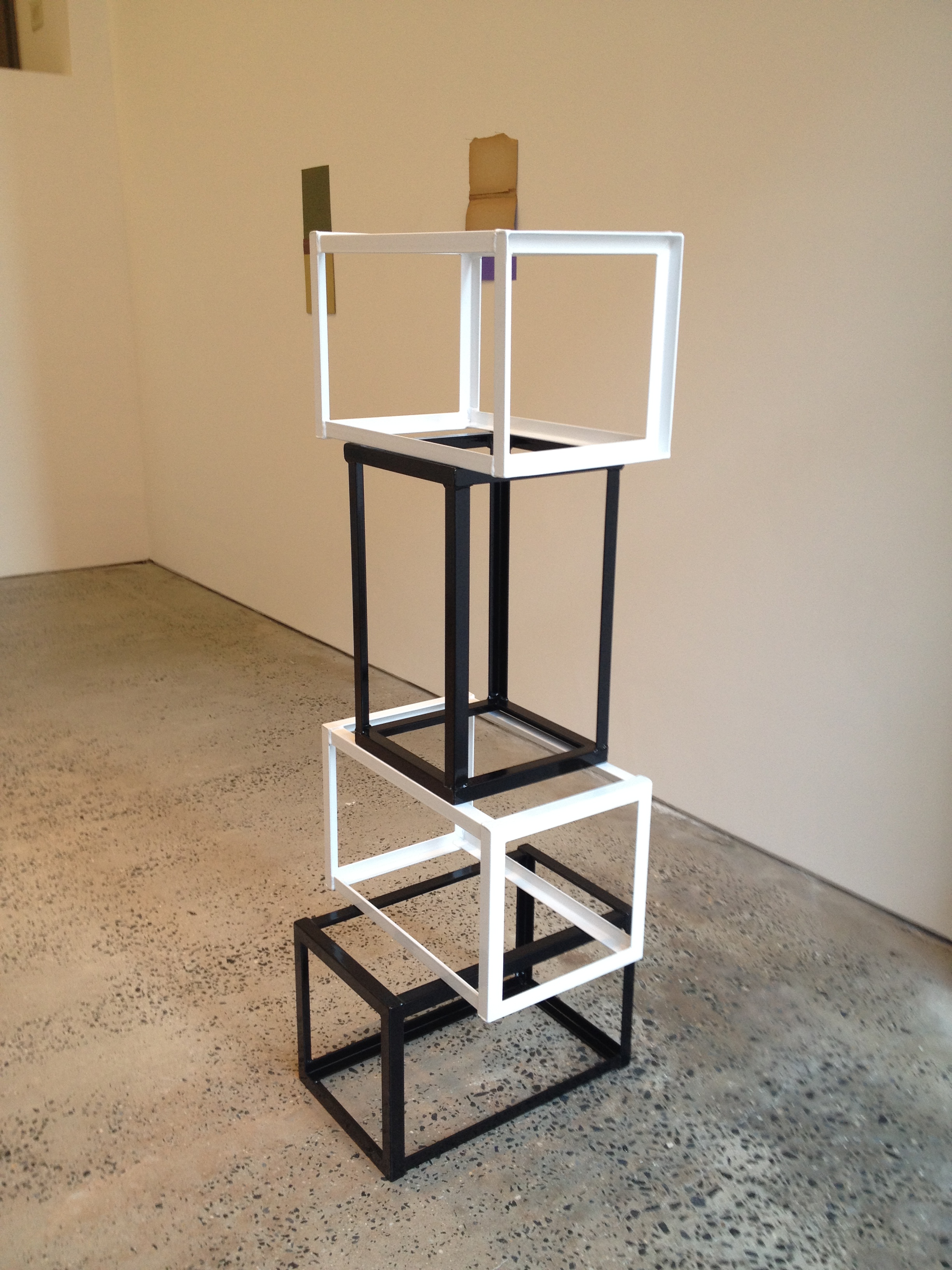
At the Hansel and Gretel Picture Garden there is a show of work by Austin Thomas. Exhibited are twelve drawings on paper, all of which have interesting proportions and geometric elements. The work that seems to really express mathematical principles is a sculpture the artist refers to as a “steel drawing”, made of two black and two white rectangular prisms. These are 3-D line drawings and by stacking them in this perpendicular fashion Thomas presents a nice study on squares and rectangles. Viewing the work from different angles and positions throughout the gallery offers many possible relationships between shapes, as well as the positive and negative spaces created by the open structures. Although it does not move, this is not a static sculpture. The prisms can be stacked in other ways offering Thomas a multitude of permutations to explore.
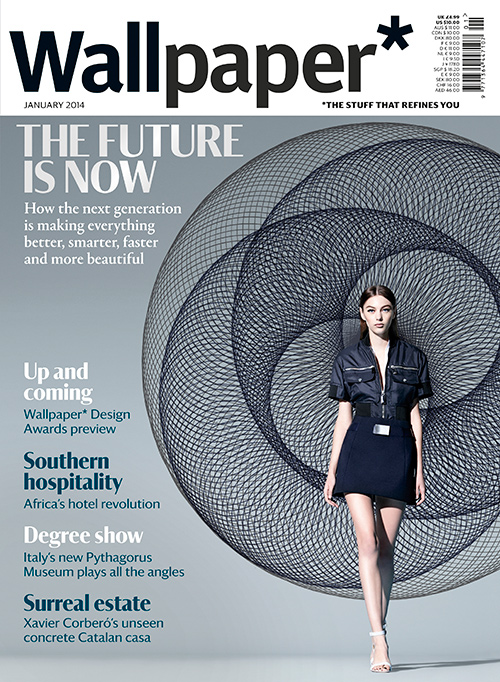
On my quest to find more MathArt I am always looking for clues. The cover of the January 2014 issue of Wallpaper magazine features a beautiful black line drawing . At first I thought the photograph showed a sculpture, but upon closer inspection I discovered that it was, in fact, hand drawn with a compass by Richard Sarson. An award winning British artist and designer, Sarson has had his work featured in many publications, including the New York Times, Seed Magazine, Creative Review, and Eye. Sarson has exhibited extensively in Britain, including a recent show at Somerset House.
Sarson’s meticulous use of the compass creates the optical illusion of what – at first glance – resembles a tangle of three dimensional wire tori. Sarson created a video in 2010 titled “Circle” that shows his process creating a single torus drawing. A torus is the mathematical term for a doughnut-like surface. In topology, a Torus has genus 1 because there is only one hole.
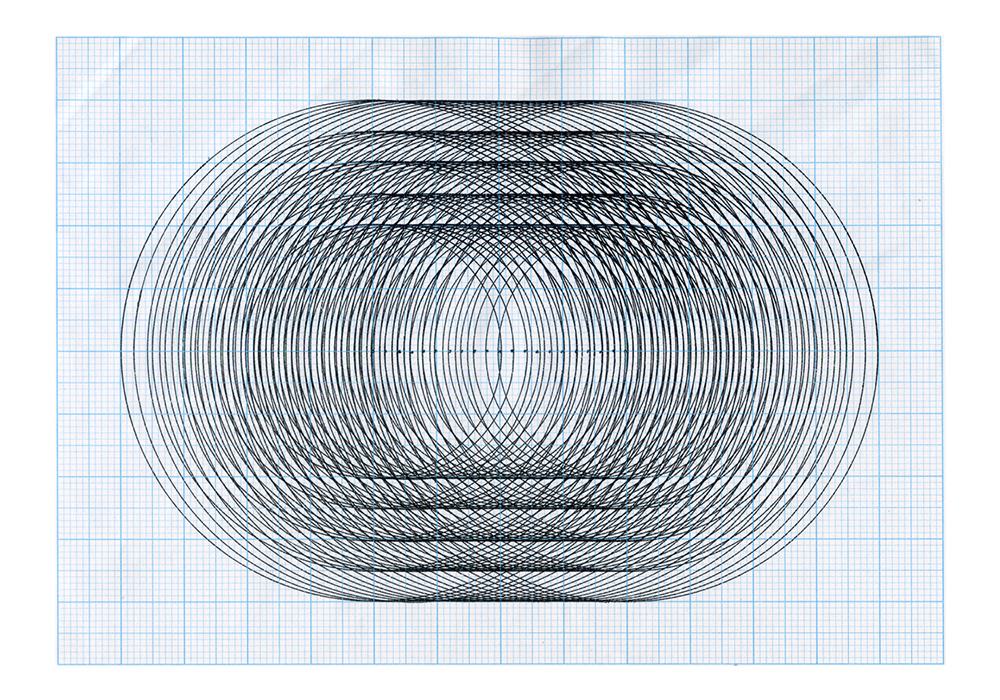
In 2008, Sarson did a series of drawings he calls “Graph”. For these works he drew directly on millimeter grid graph paper. This technique allows the viewer a clear look at the Mathematical backbone of these drawings.
This drawing uses circles in descending order of the lengths of the diameters, starting with 80 mm, down to 70 mm, 60 mm, 50 mm, and finally 40 mm. This is an interesting twist on shifting concentric circles. The largest outer circles have a diameter twice the size of the smallest inner circles.
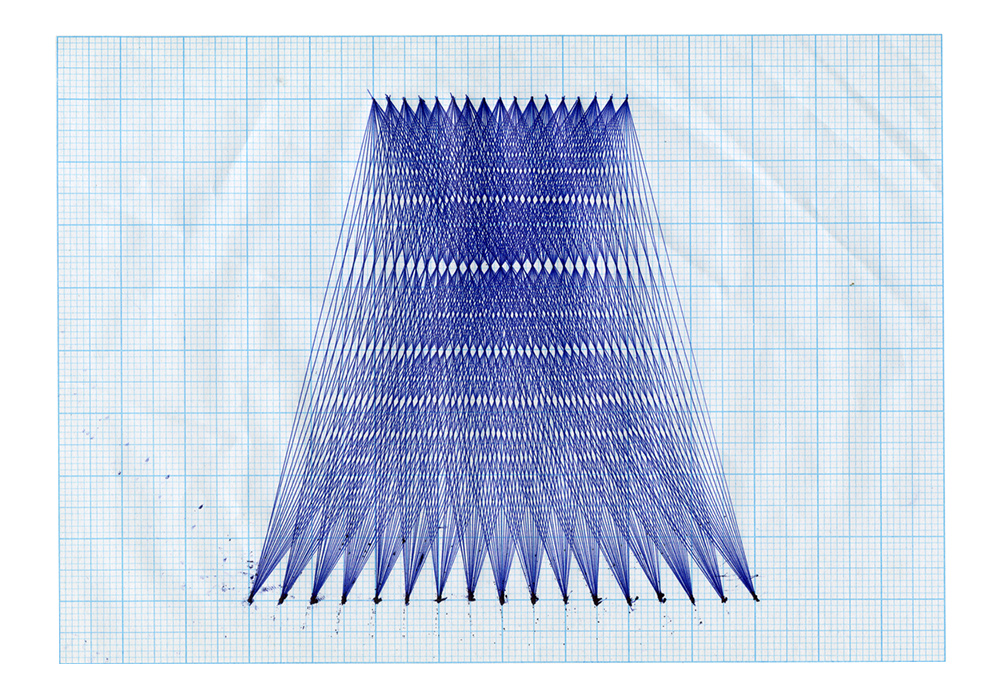
Not all of his drawings are based on circles. In this next drawing Sarson used a straight lines to create a sort of hypnotic drawing, working within the grid. Using 17 evenly spaced points 5mm apart horizontally along the top of the drawing and 17 evenly spaced points 10 mm apart 80 mm below the first line of points. The center points in each of the 2 rows of points line up along the vertical grid line. With this point structure in place, each point on the top row connects with every point in the bottom row. This creates an interesting study in the density of lines and shifts in the diamond patterns from the top 40 mm of the figure and the bottom 80 mm.
Richard Sarson uses Mathematics to build the framework for his drawings and then, painstakingly, brings his drawings to life. I must commend him for only using the most basic tools and executing all of his drawings completely by hand.


 fibonaccisusan