Pathmakers at MAD (Museum of Art and Design – New York City)

The Museum of Art and Design is currently showing the exhibition “Pathmakers: Women in Art, Craft and Design, Midcentury and Today”. It showcases the work of women who were pioneers in Modernist design, as well as the work of contemporary female artists who continue the modernist aesthetic tradition. There is a broad selection of materials represented, fibers, textiles, ceramics, and metal work. One of the most interesting materials used was soap bubbles. The “Surface Tension Lamp” (2014) designed by  Swedish FRONT (Sofia Lagervist, Charlotte van der Lancken and Anna Lindgren) for Booo B.V is a lighting fixture that blows bubbles. Soap bubbles play an important role in Mathematics. The problem of minimal surfaces shows us that the way to enclose a specific volume of air with the least amount of surface area is to create a spherical soap bubble. When you have two bubbles sharing a soap film wall things get even more interesting.

Expect a bunch of new posts next week – the gallery season in New York is kicking off again.

Susan Happersett

More From The Bridges Conference 2015 in Baltimore


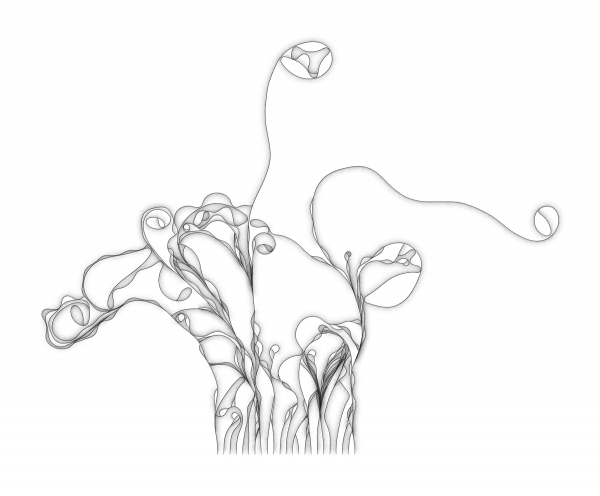
The use of computer generated drawing processes and inkjet printers is a popular means  of expression at the Bridges conference. Some of the more interesting examples on display were created by David Chappell. The artist builds a system of rules to generate graceful line drawings that are mathematically to related plant growth through space and time. The lines begin from a rooted position at the horizontal bottom of the picture plane and playful grow up into reaching tendrils. In order to achieve this lyrical organic quality (not an easy feat using mathematical algorithm computer generation) Chappell modifies the rules throughout the process. This extra attention allows the drawings to change and develop in a more free-form manner.

15-34-01

David Chappell -untitled – 2014
33 x 40 cm – Archival Inkjet Print
Picture courtesy of the artist and the Bridges Conference

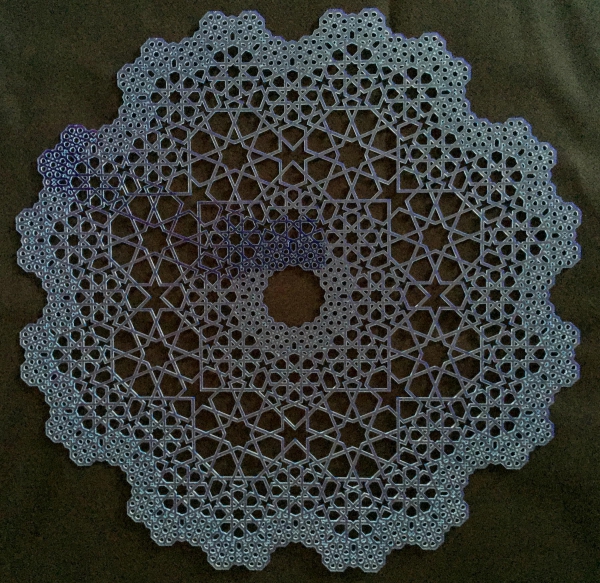
Another means of creating computer assisted art is the use of laser cutting. In his work “Islamic Fractal Starflower”, Pill Webster has cut a lace-like pattern into a clear light blue acrylic sheet. The mathematics behind this pattern is a combination of two geometric themes: the symmetry in Islamic patterns and the recursive properties of fractals. This combination requires some heavy weight mathematics, but Webster’s choice of materials transforms  the complex theories into an ethereal presence. It has the appearance of being built from delicate and complex ice crystal. The juxtaposition between the serious mathematical generation and delicate physicality of the work create an interesting tension.

15-34-02

Phil Webster – Islamic Fractal Starflower – 2014
38 x 38 cm – Laser cut acrylic, light blue
Picture courtesy of the artist and the Bridges Conference

Nathaniel Friedman is one of my favorite artists for two reasons. First, he creates wonderful sculptures and prints and second because he is a very supportive of other artists. As the founder of the organization ISAMA – The International Society of Art, Mathematics and Architecture, he contacted me years ago to speak at one of the first Math Art conferences. This was my introduction into a whole community of other artists and mathematicians devoted to the aesthetics of Mathematics. I will be eternally grateful to Nat.

15-34-03

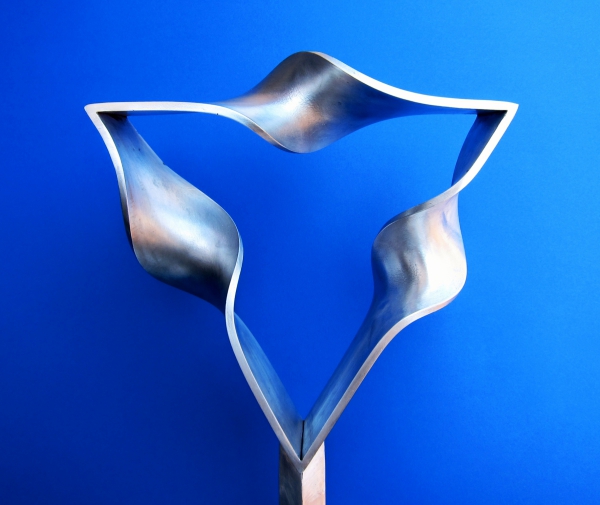
Nathaniel Friedman – Triple Twist Mobius – 2014
29 x 29 x 7 cm – Aluminum
Picture courtesy of the artist and the Bridges Conference

But back to the sculpture…. “Triple Twist Mobius” consists of three equal-sized aluminum bars each with a single twist. They are joined to form a triangle shape. The clean lines and the simplicity of the form are deceiving, this is a powerful shape. The 2-D photo does not do it justice. In the gallery each vantage point offers a different geometry, it  seems to change depending on where your stand. This act of looking at something from different perspectives is referred to as hyperseeing  (a concept Friedman taught me, Thank You!)

Susan Happersett

Bridges Conference 2015 in Baltimore

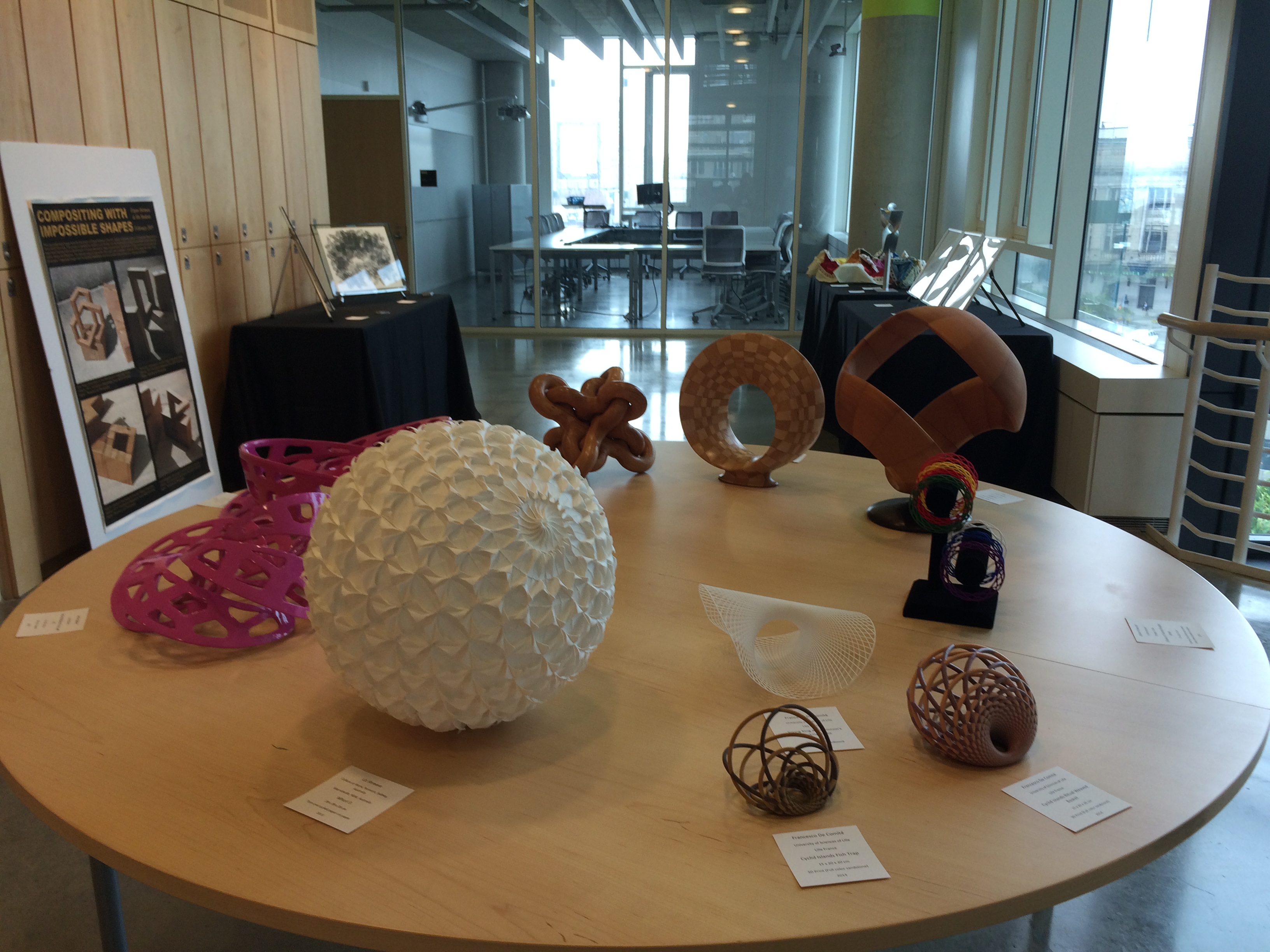
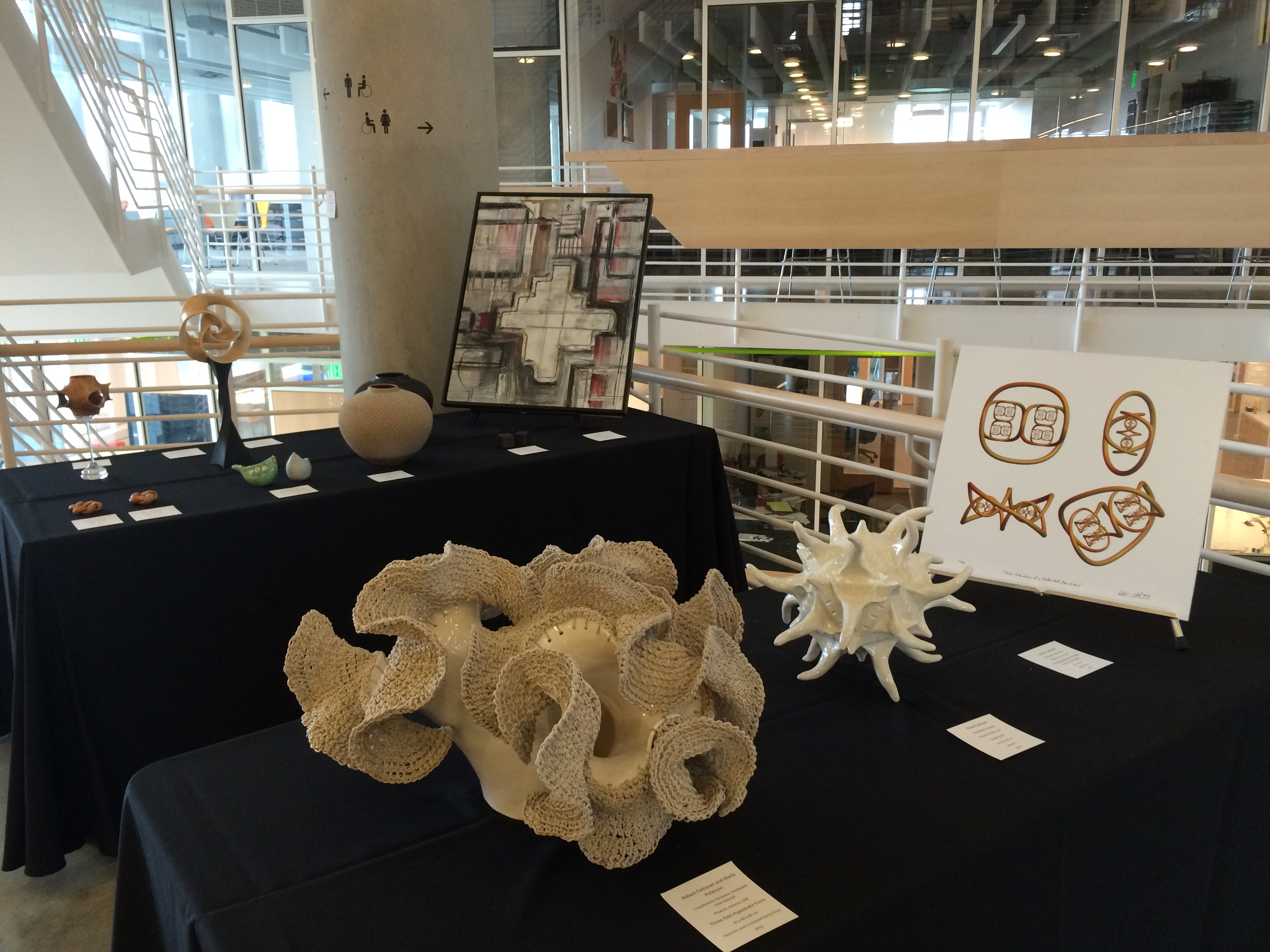
Every Summer the Bridges organization holds a conference devoted to Mathematics and the Arts. Bridges is an international organization whose sole mission is to foster and explore these interdisciplinary connections. This year the meeting was held in Baltimore Maryland in the beautiful University of Baltimore Law building. Each year the Art exhibition is one of the highlights of the gathering. This year was a particularly impressive display of work in a light and open space over three floors. Here are two photos of the gallery.
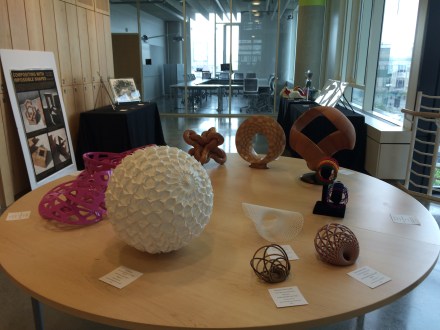
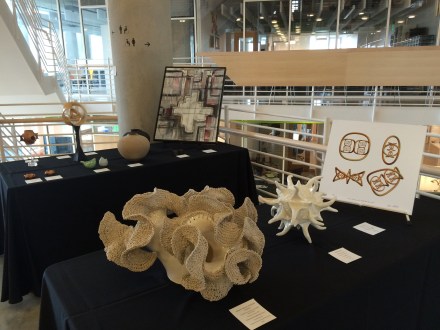
15-33-01
15-33-02

It has been very difficult for me to just single out a few art works to write about, for a complete overview I suggest checking out the Bridges website. Today I will focus on two works by two different artists that struck me particularly.
15-33-03

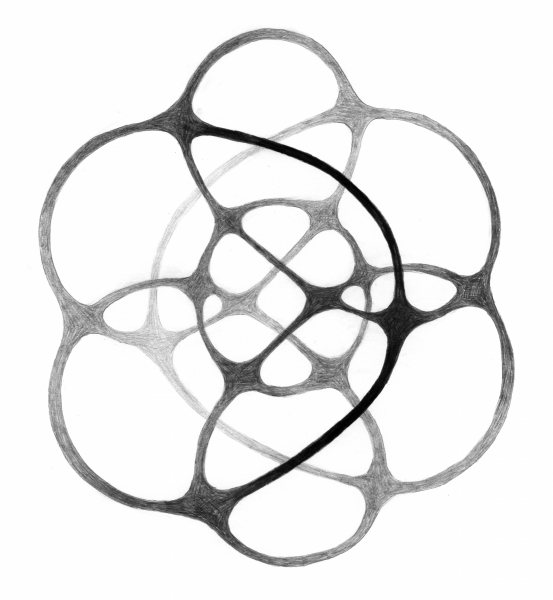
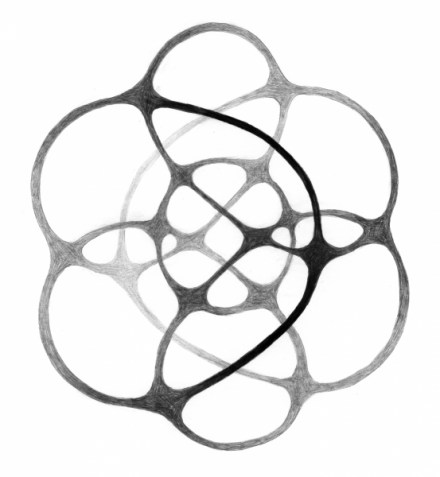
Taneli Luotoniemi – “The Hyper Cube” – 2015
Pencil on paper – 42 x 40 cm
Image courtesy of the artist and Bridges

I will start with a pencil  drawings by Taneli Luotoniemi. I have a real affinity for hand drawing and I feel Luotoniemi is able to achieve a remarkable subtly of line form and grey scale using only a pencil. “The Hypercube” Is a 2-D representation of a 3-D depiction of a 4-D cube. There have been many example of two dimensional art referencing hyper cubes but this is definitely a a more organic representation then most. This is achieved by the use of thick curved lines that meet at crossings of more solid shapes, instead of small points. By adjusting the grey scale of the pencil mark Luotoniemi gives the lines the appearance of weaving over and under each other. This is one of the most graceful visual interpretations I have seen.
15-33-04

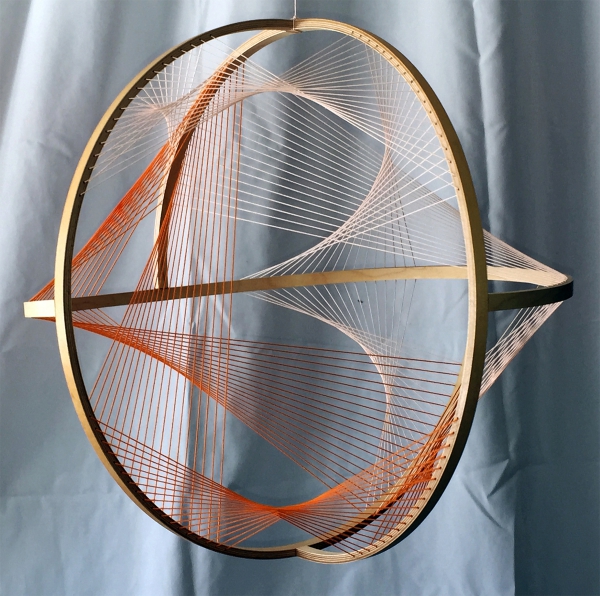
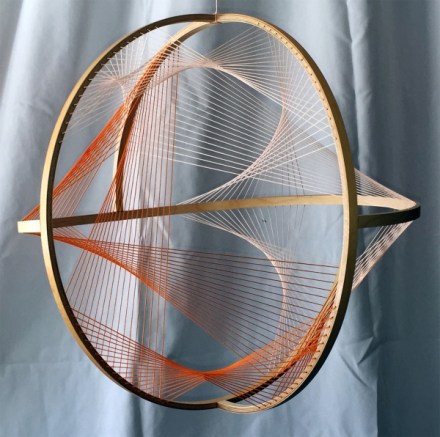
David H Press – “Three ¾ Great Circles in Orange” – 2015
Laminated wood and cotton thread – 40 x 40 x 40cm
Picture courtesy of the artist and Bridges

David H. Press builds elegant hanging sculptures that are a type of 3-D line drawings. The support structures are curved shapes but the wires within these frameworks are straight lines that form what appear to be curved surfaces. Symmetry plays a major role in Press’ work. In “Three Great ¾ Circles in Orange”  the use of three circles would have created a sphere, but the ¾ circles create an asymmetrical frame work. Within the wire line work, however, there are some smaller areas with symmetrical properties. We are used to seeing complicated symmetries in Mathematical sculpture, but the use of the ¾ circles rips open the sphere, granting the viewer a fresh look.

There were so much interesting work on display this year it is hard to discuss it all in one  blog post, I will write more next week.

Susan Happersett
“Empty House Casa Vazia” at Luhring Augustine Chelsea

The current exhibition at the Luring Augustine Gallery in Chelsea, “Empty House Casa Vazia”,  features sculpture that is associated with the Neoconcretism movement in Brazil from 1959 until 1961. Neoconcretism was a reaction against the rationalism of Concretism. Although Neoconcretism continued the use geometry to create abstractions, they were not interested in pure form. Instead, they introduced a human element.
Lygia Clark was an important member of the Neoconcrete movement. She added a participatory element to her sculptures. The viewer was encouraged to manipulate her hinged metal sculptures. I have written an earlier blog post about the MOMA exhibition of Clark’s work, but I was not permitted to take any photos, so I was thrilled the gallery is allowing me to share a photo now.
Lygia Clark-00369-srgb

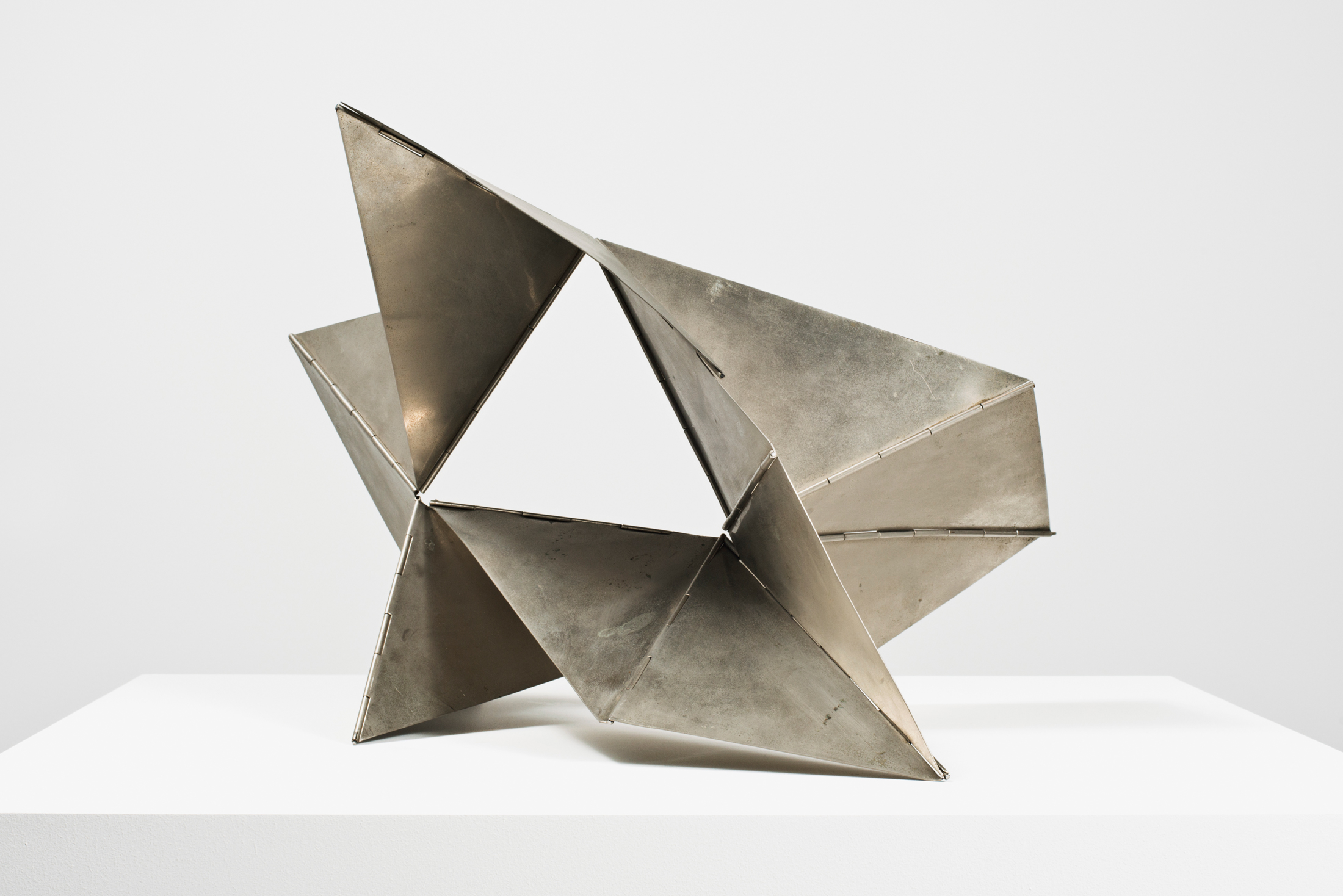
Lygia Clark – Bicho, 1960/1984 – Steel 19 5/8 x 17 11/16 inches (50 x 45 cm) © O Mundo de Lygia Clark-Associação Cultural, Rio de Janeiro. Courtesy of Alison Jacques Gallery, London, and Luhring Augustine, New York Photo: Michael Brzezinski

 “Bicho” consists of a series of sheet steel isosceles right triangles (isosceles triangles whose vertex angle is 90 degrees). They are hinged together to form a complete loop that can be arranged in many different positions.
Lygia Pape-NoiteDia-srgb

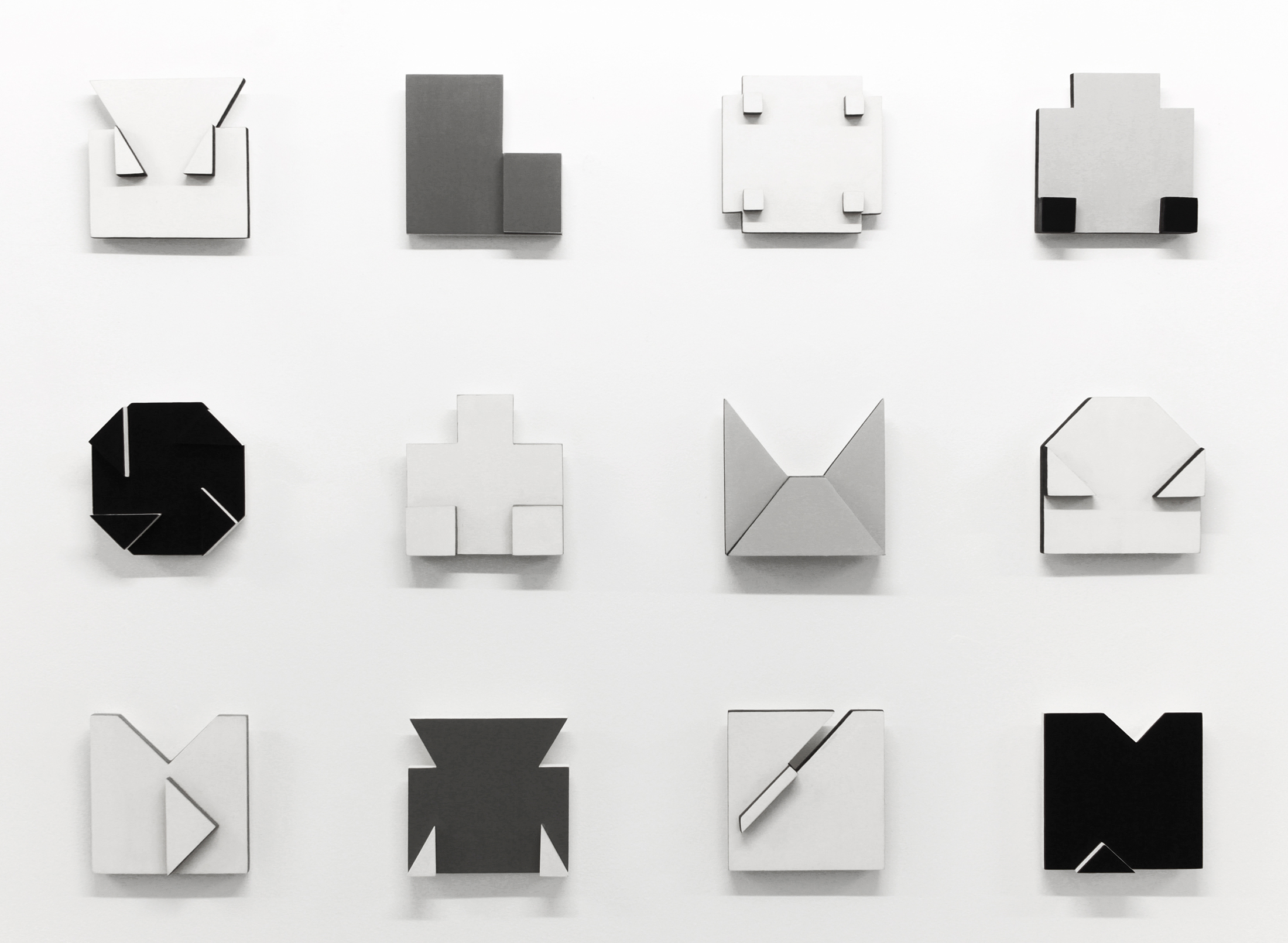
Lygia Pape – Livro da noite e dia, 1963/76 – Acrylic and tempera on wood; group of 4 6 1/4 x 6 1/4 x 5 7/8 inches (16 x 16 x 15 cm) Each: C25912 © Lygia Pape; Courtesy of the artist, Galeria Graça Brandão, and Luhring Augustine, New York Photo credit – António Leal

Lygia Pape’s series of wooden wall sculptures titled “Livro da noite e dia” features a series of 6 1/4″ squares. Each square has at least one geometric shape removed from the edge or corner. Then those shapes, triangles, squares, trapezoid….are shifted and layered onto another part of the square resulting in interesting symmetries.
Amilcar de Castro_estrela-cobre srgb

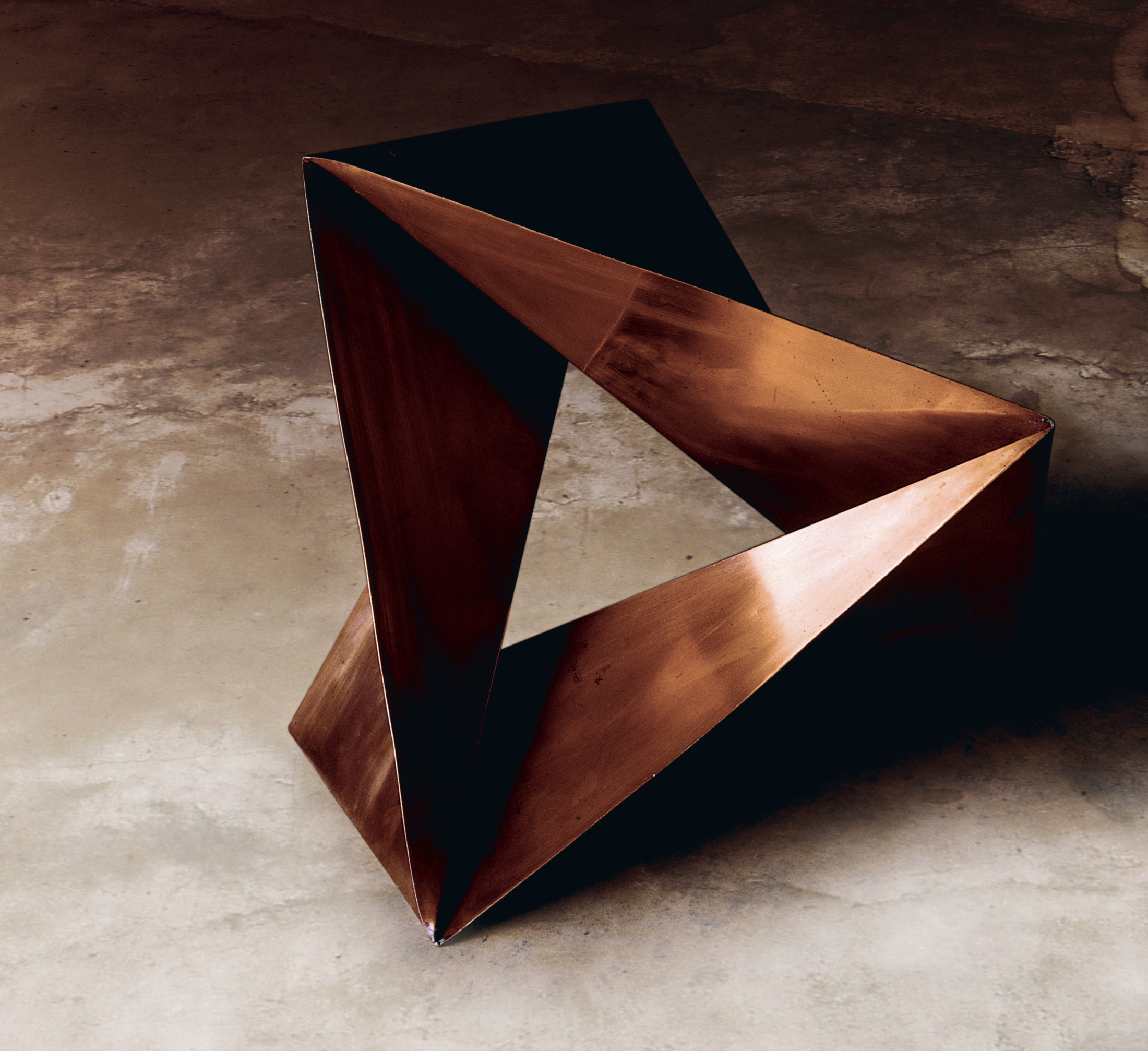
Amilcar de Castro – Estrela, 1952 – Copper 17 11/16 x 17 11/16 x 17 11/16 inches (45 x 45 x 45 cm) .3cm thickness of copper © Amilcar de Castro; Courtesy of the artist, Galeria Marilia Razuk, São Paulo, and Luhring Augustine, New York

“Estrela”, a copper sculpture by Amilcar de Castro, is made up of three rectangles. Each rectangle has been bisected diagonally and folded and joined together to make a sculpture with all sorts of triangular possibilities.

These practitioners of Neoconcretism employed mathematics in their work, particularly Geometry. But their art was about something even deeper, it was about how humans interact with the geometry. This is achieved in a different way by each of the artists: In the case of Lygia Clark through tactile manipulation, Lygia Pace’s intriguing puzzle-like squares encourage the viewer to ponder the missing pieces, and De Castro’s sculpture invites the viewer to walk around the work, because it changes dramatically depending on the location and angle from which it is viewed. In some ways these sculptures reveal more about our relationship with Mathematics than many other artistic movements.
Susan Happersett

Platonic Solids in Rockport, Massachusetts

The G19 Artisan Gallery is located in Rockport, Massachusetts. Rockport is a picturesque town known for its art community for almost one hundred years. Historically, Rockport artists are known for their seascapes, but the G19 gallery exhibits art in a wide range of materials, styles and themes. I was so happy when I discovered some amazing geometric metal sculptures.

15-29-1

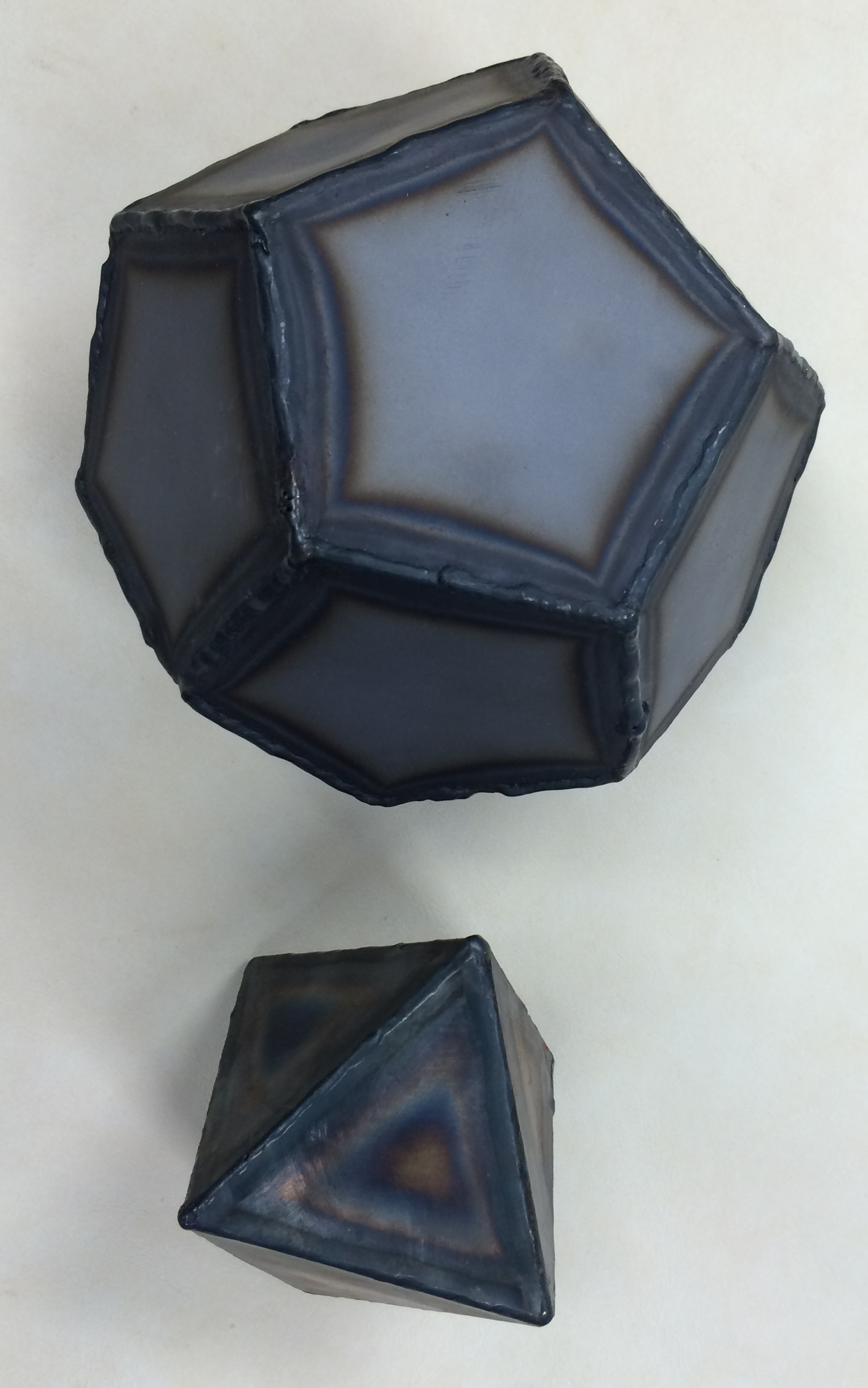
Dodecahedron and Octahedron

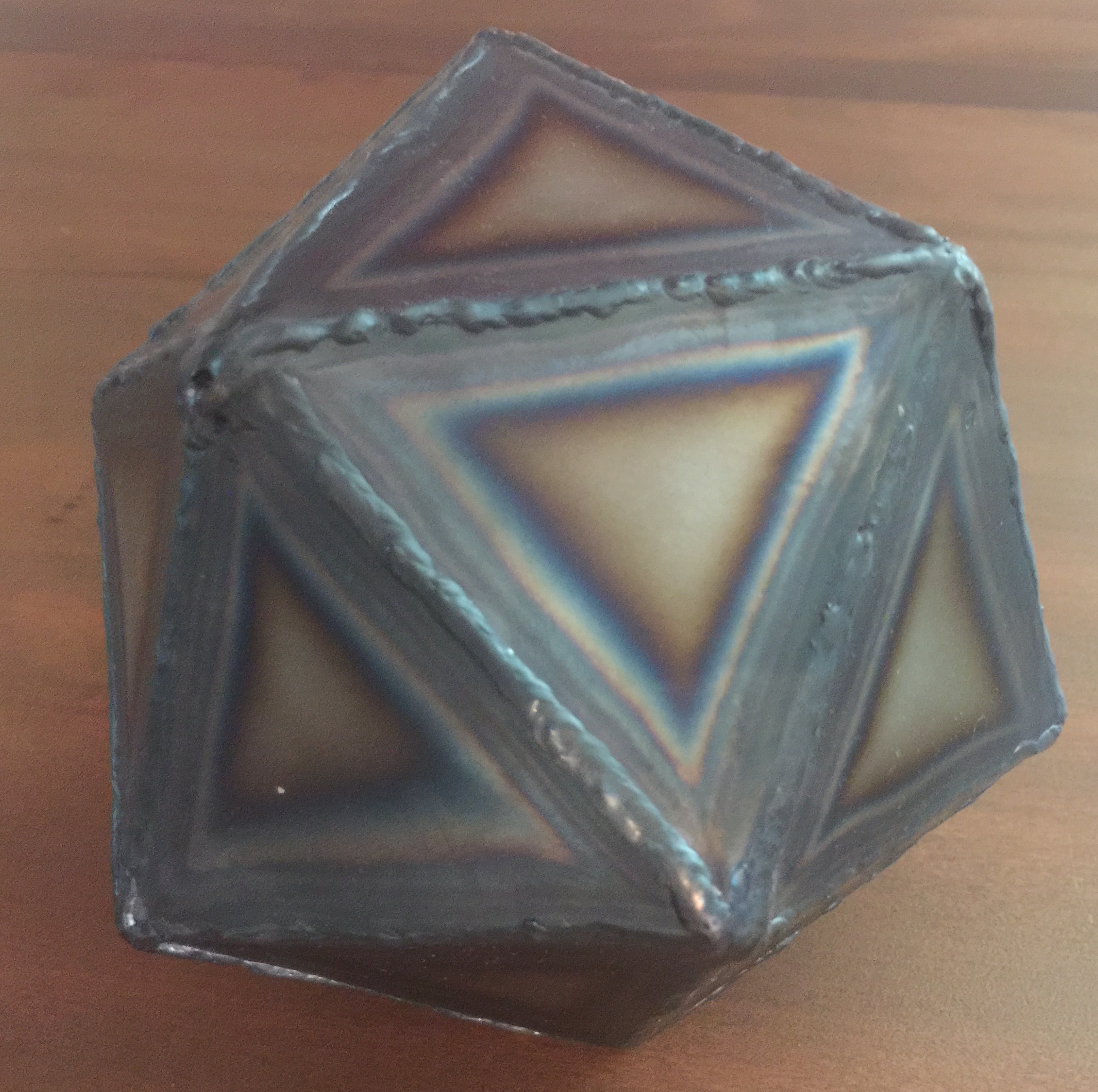
I was able to meet with the – somewhat reclusive – artist who would like to be referred to as Dan H. Dan told me that he first became interested in Dodecahedrons when they were referenced in an episode of the TV series “Doctor Who”. He started out making paper models, but after learning how to weld he found metal a better choice of medium. He quickly figured out that the angles for the pentagons need to be fairly accurate or the shape would not fit together.  G19 is currently exhibiting Dan’s Dodecahedrons, Octahedrons, and Icosahedrons.  These three shapes are all Platonic Solids. The faces of Platonic solids are congruent regular polygons where the same number of faces meet at each vertex. There are only 5 possible Platonic solids and Mathematicians have been studying them for thousands of years. Dan now uses computer software and laser cutting techniques to cut the metal shapes. The finally fabrication, however, is all done by hand. This gives the sculptures a wonderful organic element. The welded edges have a nice texture and the sides retain the flame patterns of the torch. The juxtaposition of using technology for accuracy of the geometry, but then adding the mark of the artists hand makes these sculptures a great example of how artists can use high-tech tools while retaining control of the aesthetics of their work .

15-29-2

Icosahedron

— Susan Happersett

Stephen Andrews at The Art Gallery of Ontario in Toronto

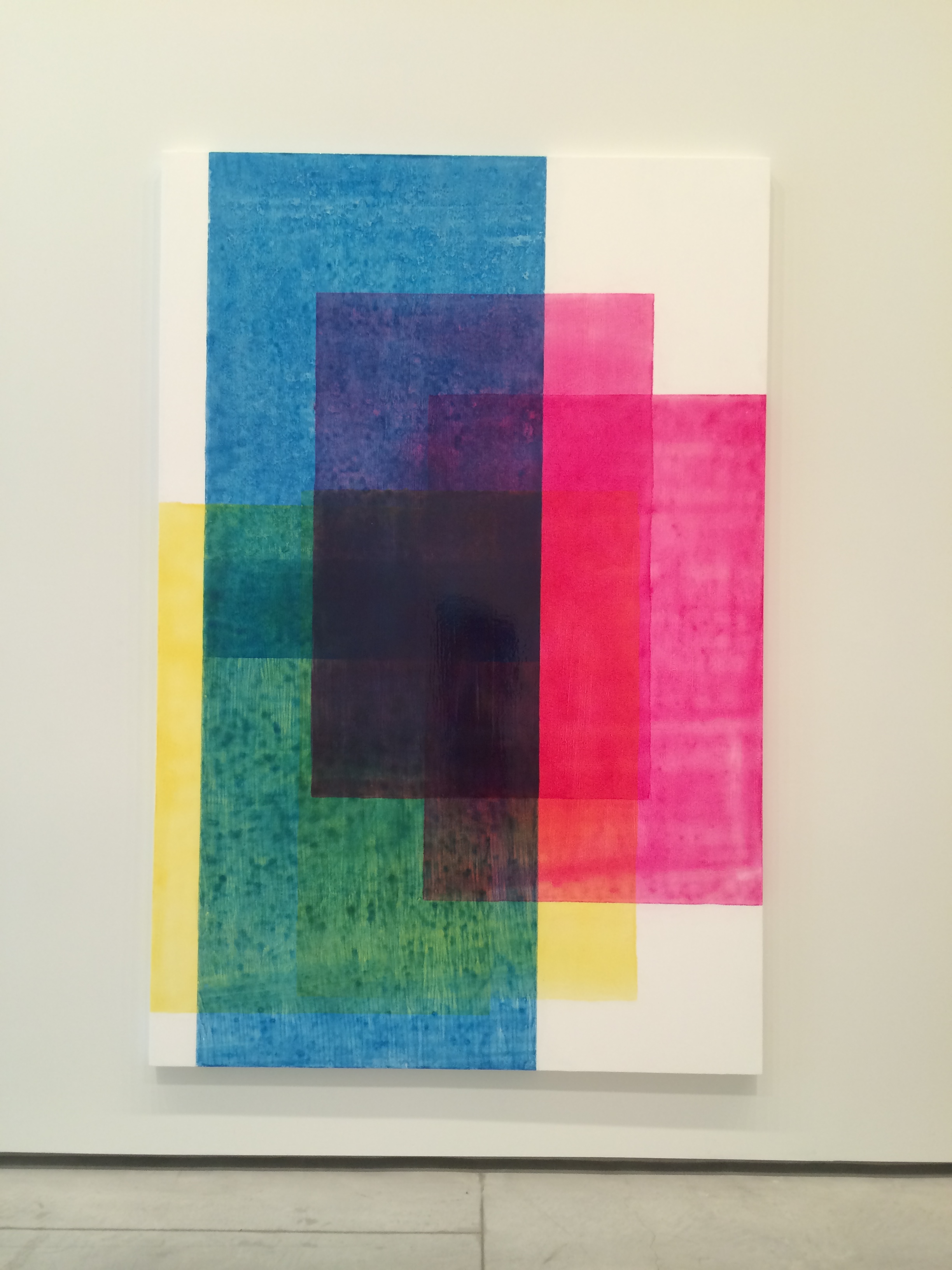
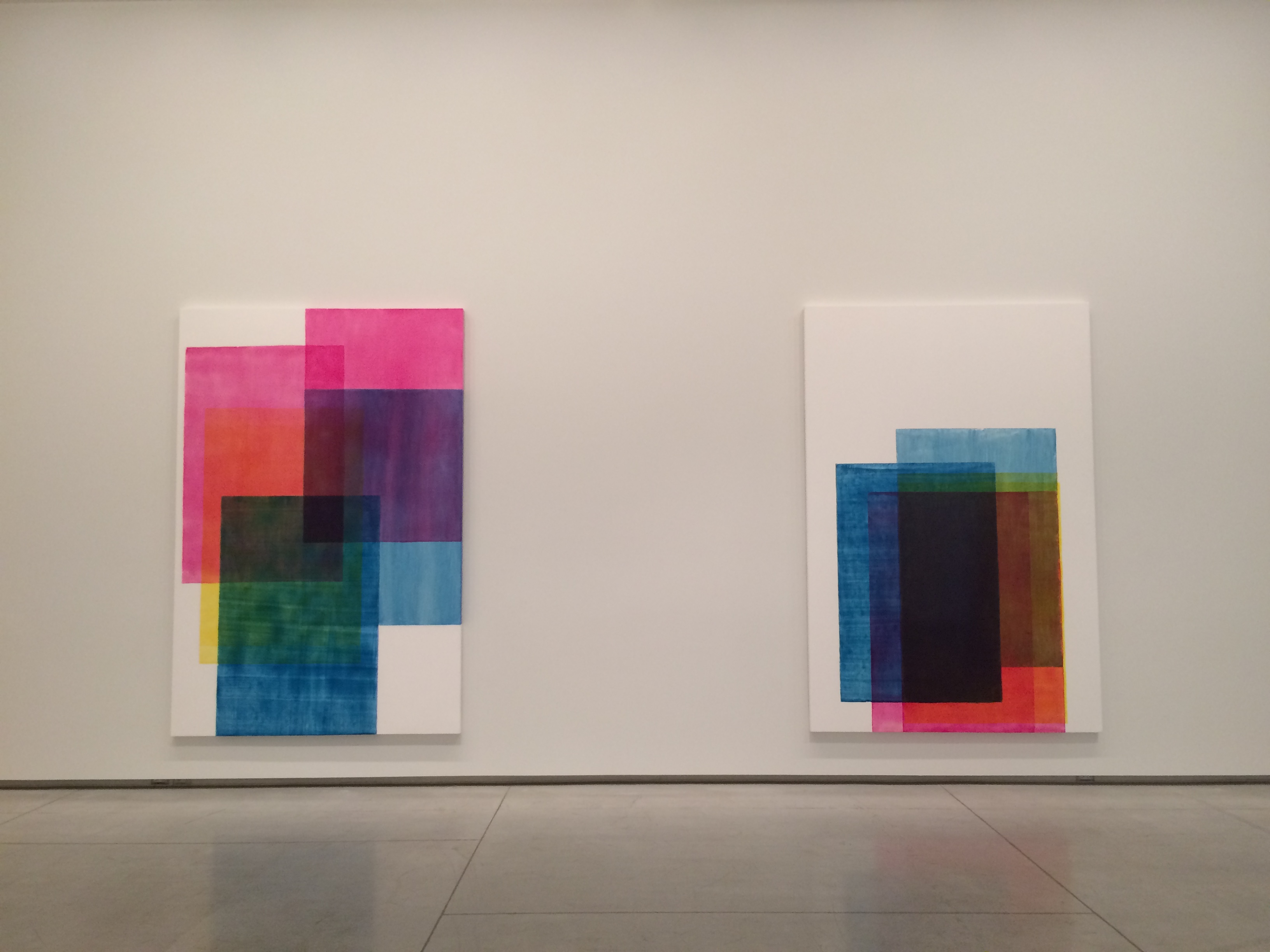
The Art Gallery of Ontario in Toronto is currently exhibiting a large solo exhibition called “Stephen Andrews POV” in their Contemporary gallery. Stephen Andrews is known for his photographs, videos, and paintings that address difficult societal issues, using both representational and abstract formats. A recent (2014-2015) series of paintings titled the “Butterfly effect” is Andrews’ expression of the Chaos Theory. Using a defined set of restrictions the artist explores the multitude of outcomes.

15-6-30-1

“Butterfly Effect”

Each work in the series consists of a white canvas with six rectangles that are identical except for color. Two of the rectangles are red two, are blue, and two are yellow. Each of the primary colors has equal representation. The oil paint has been applied using mylar sheets to ensure the integrity of the rectangles. It is the placement of the rectangles that changes with each painting. There are an infinite amount of possible outcomes. Andrews is interested in the accumulation of colors that eventually make black. The areas where all three colors overlap become black rectangles. These black rectangles appear in different locations on each canvas. At first these painting look random but upon closer inspection you realize they all share the same geometric elements, there is consistency in the chaos.
15-6-30-2
Stephen Andrews has expressed his ideas about the chaos he sees in our troubled world by using the ideas of the mathematical Chaos Theory  to create abstract geometric paintings.

Susan Happersett

Chaos at the Metropolitan Museum

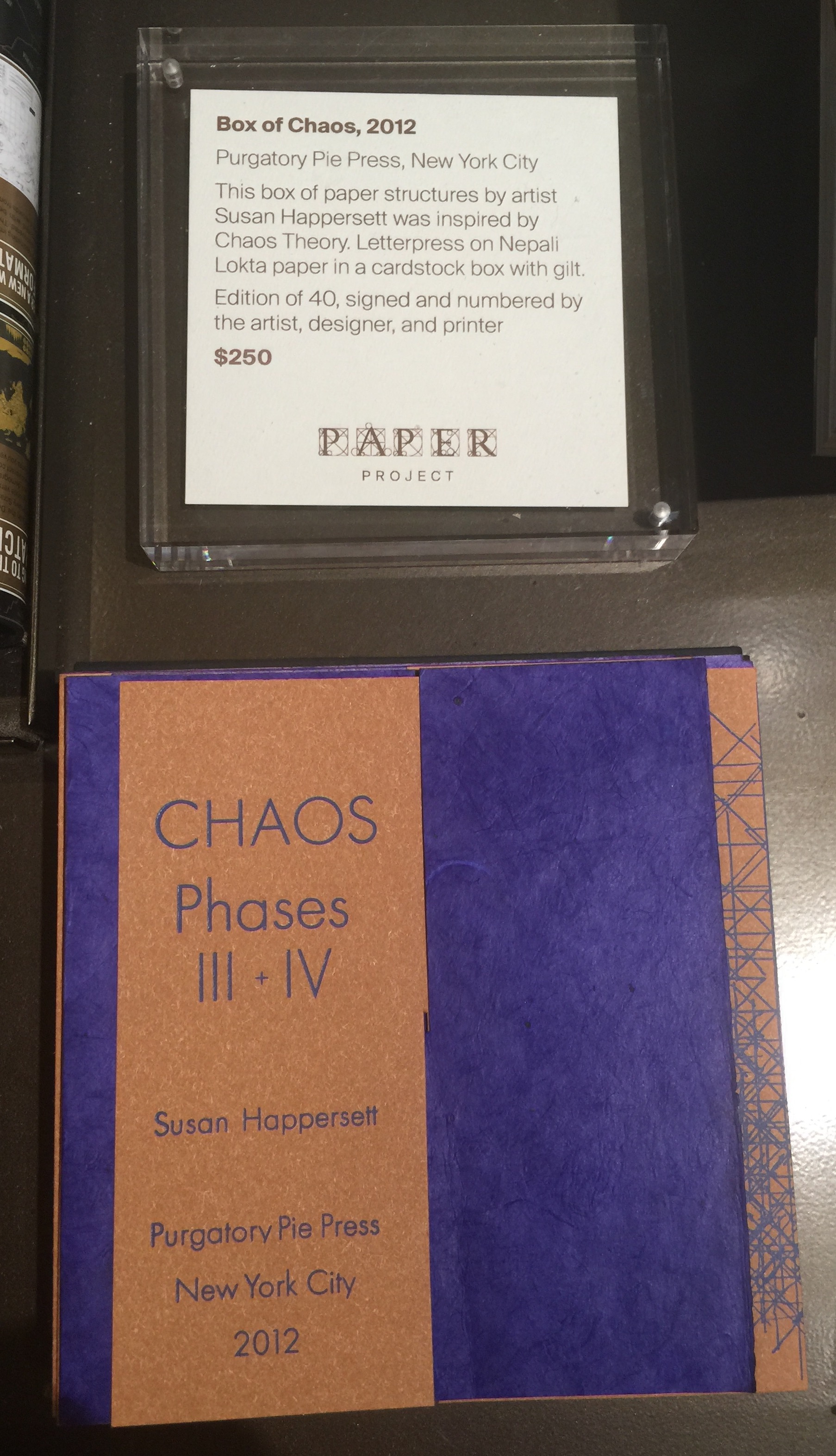
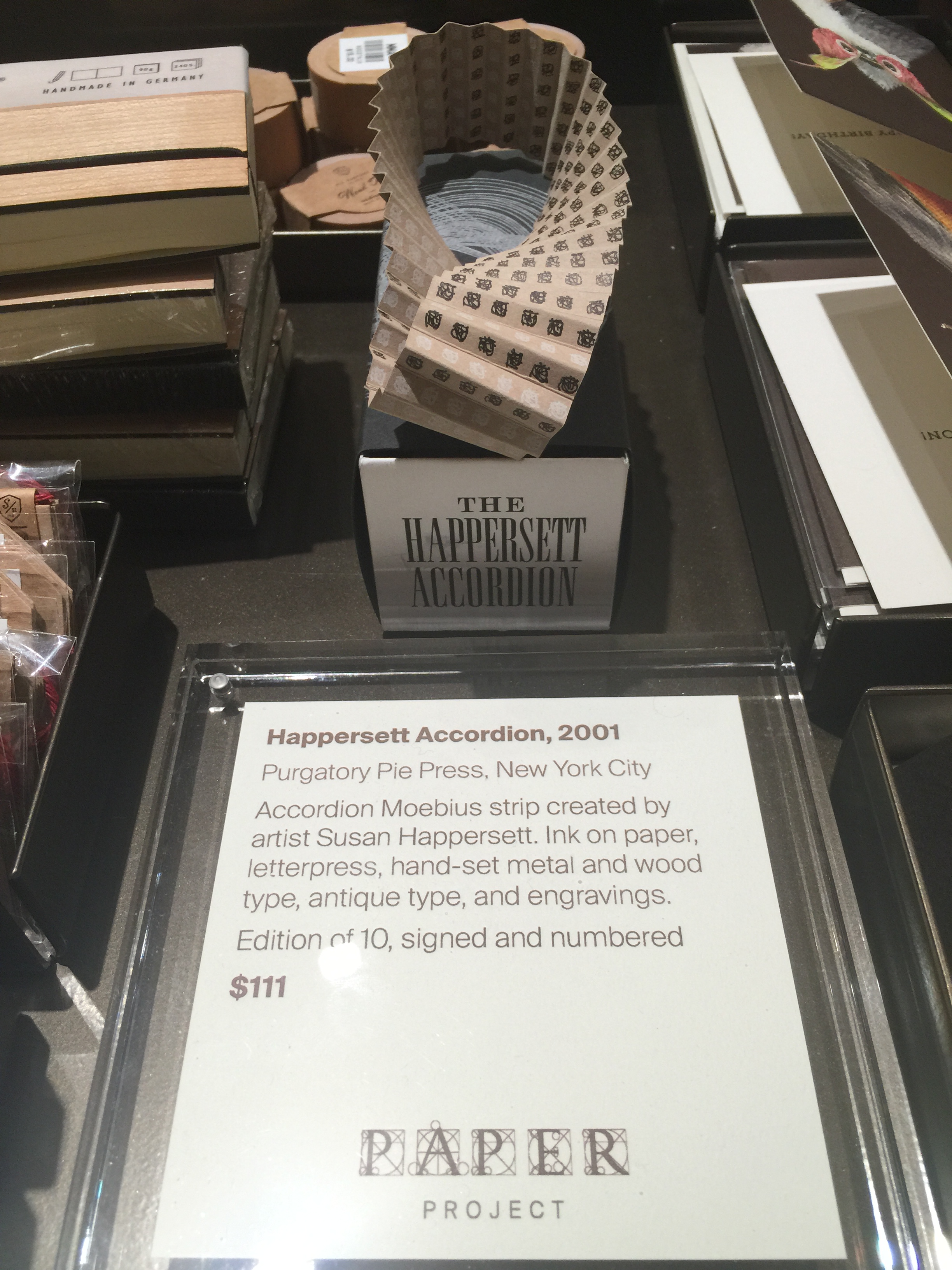
In between observations on math art in Manhattan galleries and beyond, a quick shout-out for my own art work. Two of my collaborations with Purgatory Pie Press are now for sale at the new “Paper Project” gallery at the Metropolitan Museum of Art (back of the lobby on the left side when you come in through the main entrance).

15-30-2

Box of Chaos is a series of 4 paper sculptures based on Chaos Theory.

15-30-1

The “Happersett Accordion” is a modified, folded Moebius Strip

Étienne Gélinas at Thompson Landry Gallery Toronto

Whenever I have the opportunity to travel I make a point of visiting the local museums and galleries and I am always on the hunt for MathArt.

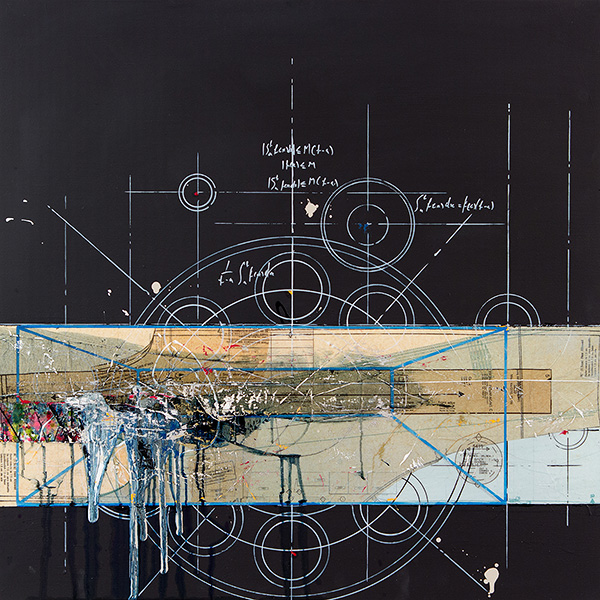
In Toronto, I visited the Distillery District, which is a collection of brick historic buildings that was once a whiskey distillery, but is now filled with galleries, restaurants and artist’s studios. I was in the Thompson Landry gallery when I spotted mathematical formulas that seemed to come directly out of my old Integral Calculus text book. I became immediately interested in the work of Étienne Gélinas. He uses a variety of techniques to create multi-media work: scratching  geometric drawings into a thick base coat of paint or medium, collaging with paper blueprints, floor plans and garment patterns, and carefully painted shapes and formulas. The artist also adds a random accidental quality to each work by including an expressive element of abstract splatter drip and mark painting.

gelinas128

Étienne Gélinas – “Composition 365” – Mixed media on wood
Picture courtesy of the artist and the gallery

In the work “Composition 365” Gelinas has used a circle as his underlying geometry. There is a series of larger concentric  circles which have been segmented into 8 equal sections with smaller series of concentric circles within each segment. Around this circle pattern there are mathematical formulae, specifically integral formulae. This formulae painted in white on the black background are quite beautiful. Dividing the work horizontally, the artist has placed layers of vintage patterns for making clothing. On top of the collaged element Gélinas has painted a free form abstract painting. There is a lot going on in this work and that is what I like about it. The seemingly disparate techniques yield complex work with a great textuality. To me the work addresses the layers of mathematics in society. There is the obvious association of the calculus formulae, and the geometric implications of the drawn diagrams relate to the geometry used in making the paper garment patterns. Finally, the wild abstraction of the gestural painting adds a level of spontaneity and emotion to the visual dialog. It is not often I find  single work of art with so levels mathematical aesthetic.

Susan Happersett


Robin Kang

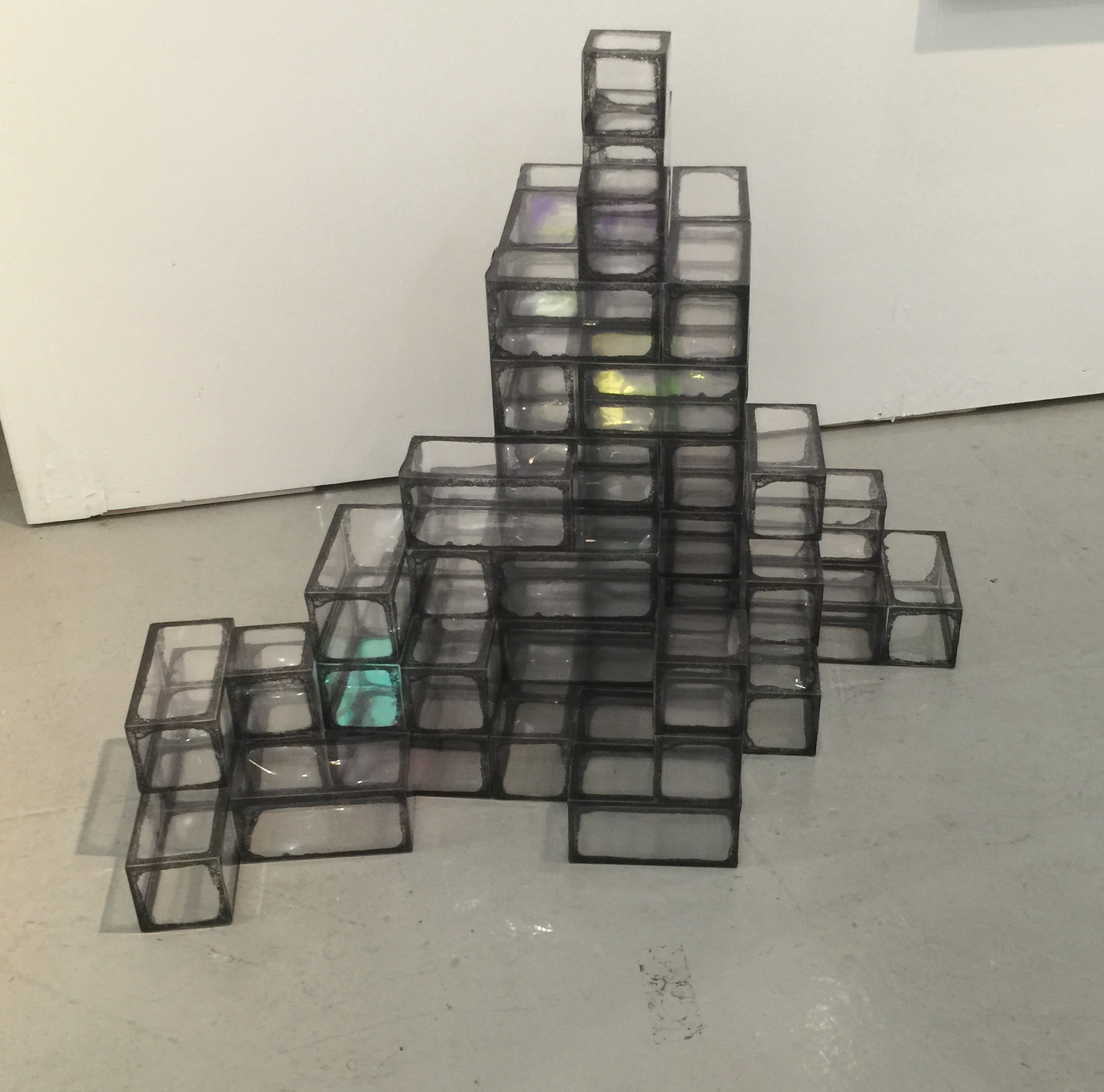
The New Apostle Gallery featured sculptures and tapestries by Robin Kang at their booth at the Select Fair. Kang works in two very diverse styles. The sculptures are created using clear plastic BRXL bricks in two shapes: cubes and rectangular prism that are basically the size of two of the cubes side by side. The edges of each brick have a dark shading to accentuate them. Some of the interior walls are lined with radiant film creating reflections. “Artifact 435” from 2015 is a floor construction that is all about geometry by limiting the shapes Kang focuses on the interiors as well as the exteriors of cubes and prisms.

15-23-1

Robin Kang – “Artifact 435” – 2015 – Plastic BRXL and radiant film
Courtesy of the artist and New Apostle Gallery

Robin Kang also has work included in a very interesting exhibition at the 1285 Avenue of the Americas Gallery (the lobby of the USB building) titled “Between a Place and Candy: New Works in Pattern + Repetition + Motif”. This show, organized by Norte Maar, presents recent work that relates to the Pattern and Decoration tradition of the 1970’s. This movement also had a basis in the craft and ornament. The use of repetition quite often has Mathematical implications and I saw a number of exciting connections. To see complete set of images go here.

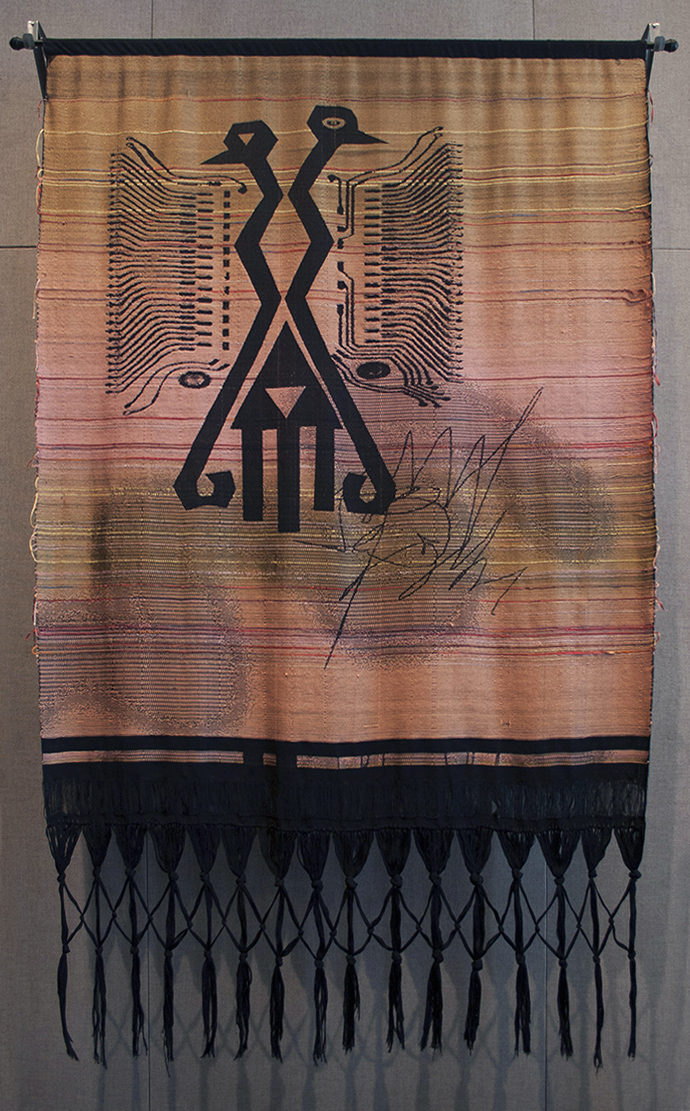
Kang’s contribution to the show is a tapestry “Two Birds with Diamonds” from 2015. It was made on a digitally operated Jacquard loom (a binary operated loom). The images of the birds have a bold simplicity that remind me of ethnographic patterns. The vector-type parallel lines remind me of computer circuit boards.  Kang has managed to integrate the history of textiles with the history of technology.

15-23-2

Kang – Two Birds with Diamonds” hand woven Cottton and Tincel – 2015
Courtesy of Norte Maar and the artist

The work of Robin Kang relates to mathematics on two fronts: the sculptures elevate basic geometric figures by  revealing their interior structures, the tapestries combine the mathematics of early computer science with the cultural significance of the textile arts.

Susan Happersett


Gilbert Hsiao at Select Fair

The Select Art Fair in NYC last week had an emphasis on Performance and Installation Art. I was not sure I would find any work with Mathematical elements besides my own work and the Tessellation prints of Dikko Faust. After the smoke cleared, and I mean that literally – an installation piece featuring mating bigfoot mannequins used a smoke machine during the busiest hours of the show – I was able to find some Math Art. The Transmitter Gallery exhibited the work of Gilbert Hsiao in their booth. I was particularly impressed with The sculpture “Headstone Friends”.
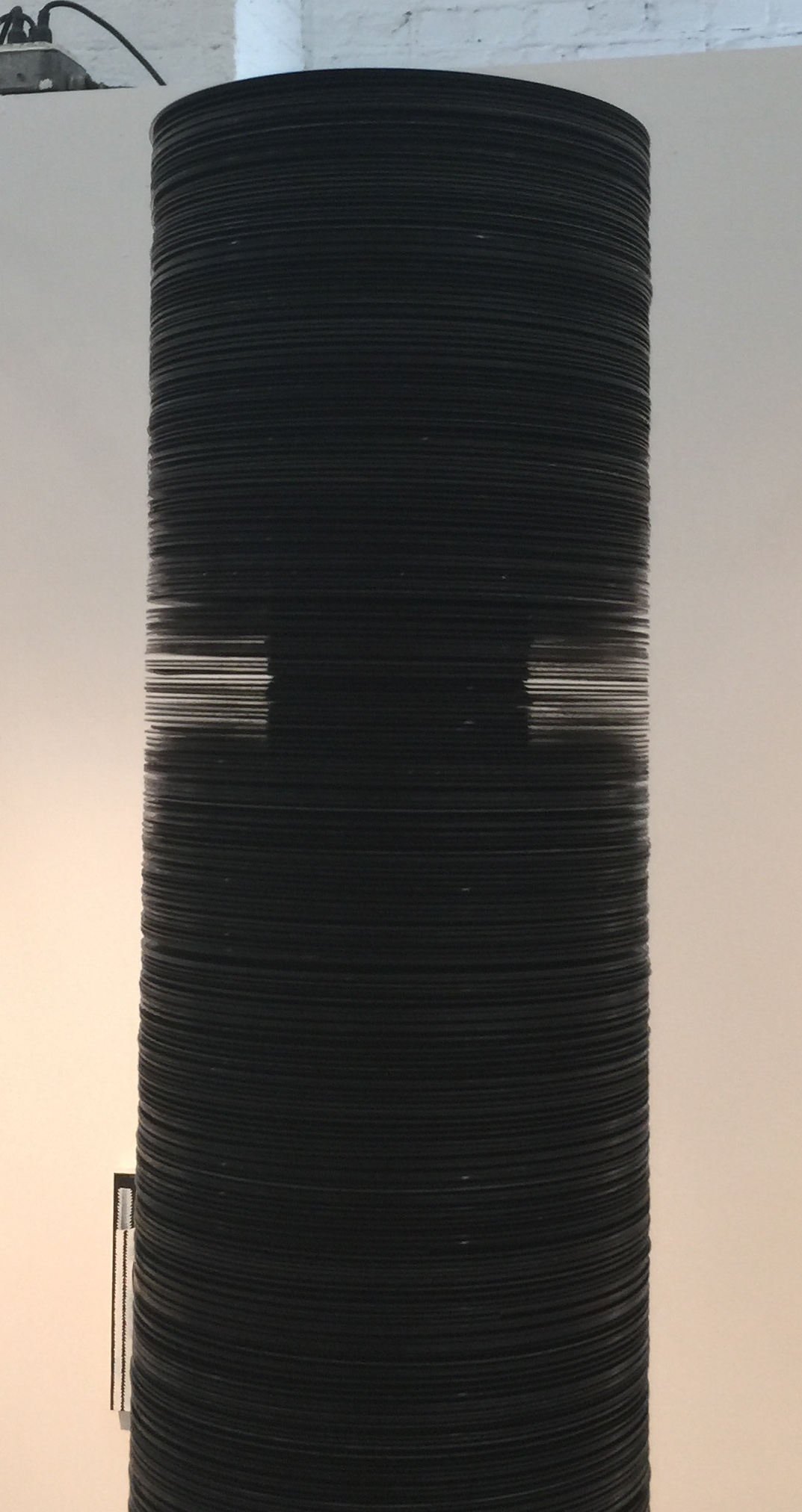
IMG_1861
“Headstone Friends” from 2015 is a cylindrical column made up of a stack of vinyl records. The circular discs are all parallel with a uniform sliver of space between each record. There is a smaller solid column steel and concrete column running up through the center of the sculpture. The most amazing aspect of this work is the way the light shines through the records at the viewers sight line. Only when the viewer looks straight between the discs is the light between the vinyl visible. Here is a video demonstrating how the light moves up and down with the sightline.
“Headstone Friends” is an interesting use of circular discs to create a column but it is also about how the viewer’s line of vision behaves like a vector. Hsiao enables the viewer to take an active role in the mathematics.
Susan Happersett