Donald Moffet at Marianne Boesky Gallery

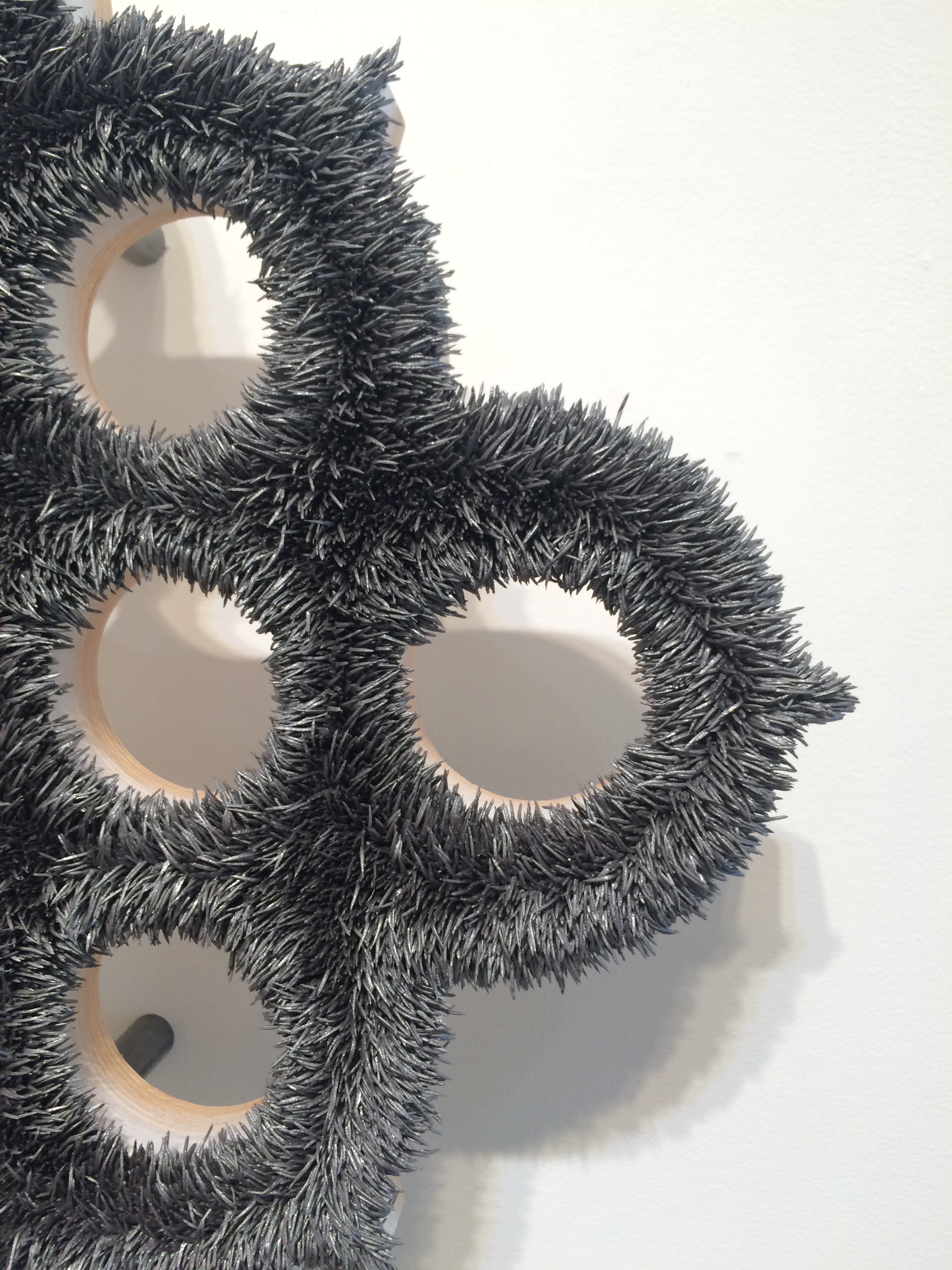
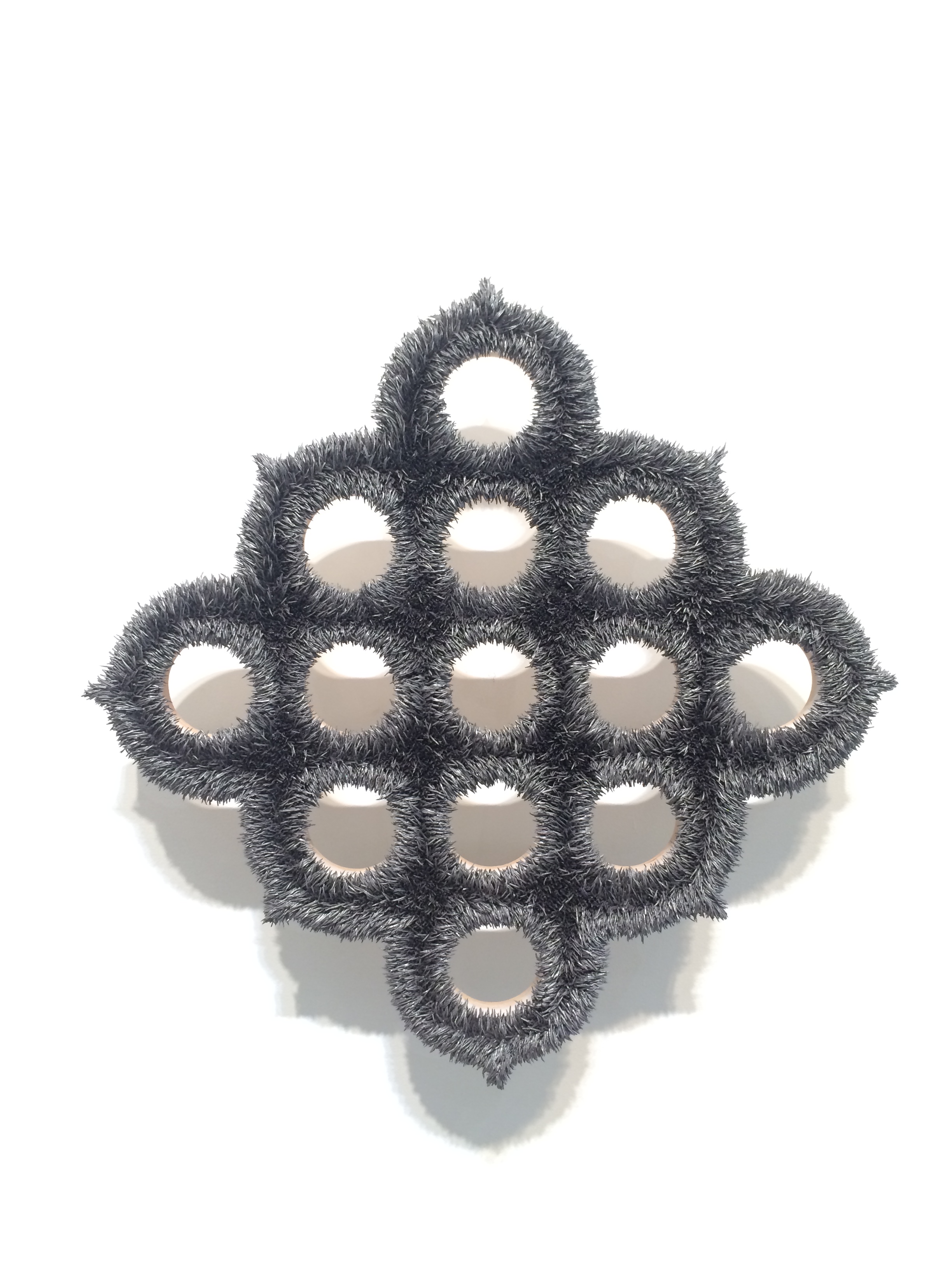
“Donald Moffet: any fallow field”, the current solo exhibition at the Marianne Boesky gallery in Chelsea features work that pose a conversation on human’s apathy for nature.  “Lot 052215 (graphic)” is one of the artists recent extruded paintings, created using a process that coaxes the oil paint into hair like bristles that seem to grow out of the canvas.
16-31-01

“Lot 052215 (graphite)”, 2015


16-31-02

Detail

Like much of the work in the show this painting is structured in a way that brings the work off the wall into the gallery space, creating sculptural quality that produces shadows. The overall pattern explored in this piece is a square format created using 13 circles that has order-4 rotational symmetry. The center section of the shape is a 3 by 3 grid square, but by adding a circle to the center of each of the sides, a diamond with 5 stacked diagonal rows is formed. This structure to me alludes to structures found in nature, like honey combs. The use of the graphite colored bristles lends the work a foreboding presence.

Susan Happersett

Anila Quayyum Agha at The Peabody Essex Museum

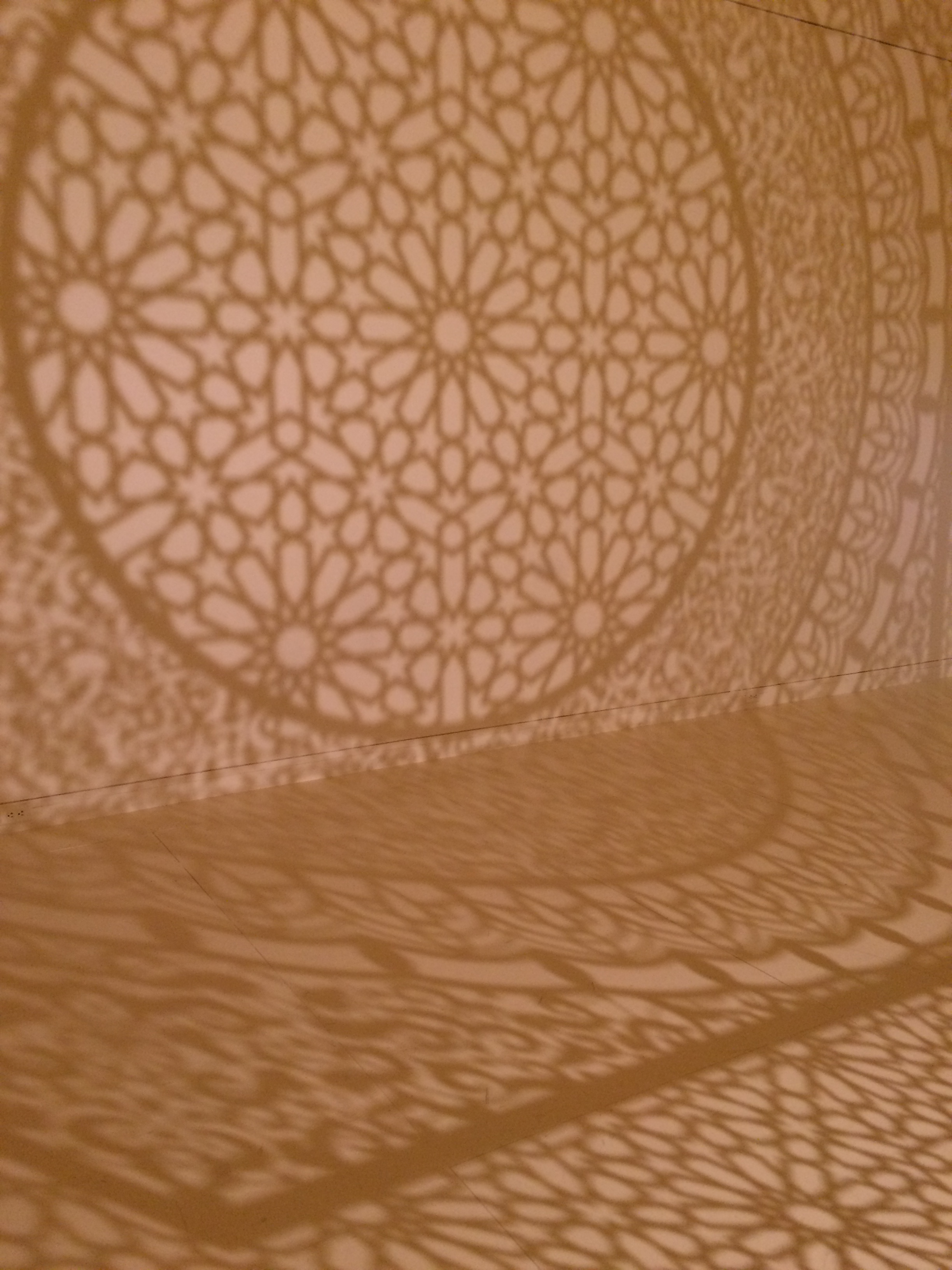
Anila Quayyum Agha’s installation titled “Intersections” is inspired by the intricate decorative elements she encountered in religious buildings as a child in Pakistan. The work consists of a laser cut steel cube lit from within. The lines of the lattice work on the cube are projected unto the painted walls, floor and ceiling of the gallery.

16-30-01
The open work design is based on the geometric properties of Islamic patterning. Each side of the cube features a figure with 8-fold rotational symmetry inscribed with in a circle.

16-30-02
These symmetries get disrupted in the projection onto the gallery surfaces. Especially along the lines where the walls and floor meet. The geometry on the cube is precise but the shadows must bend to fit within the boundaries of the gallery.

Susan Happersett

More Math Art from the Bridges Conference Jyväskylä, Finland

There were so much interesting work at the Art Exhibition this year, is was difficult to choose just a few for my blog.

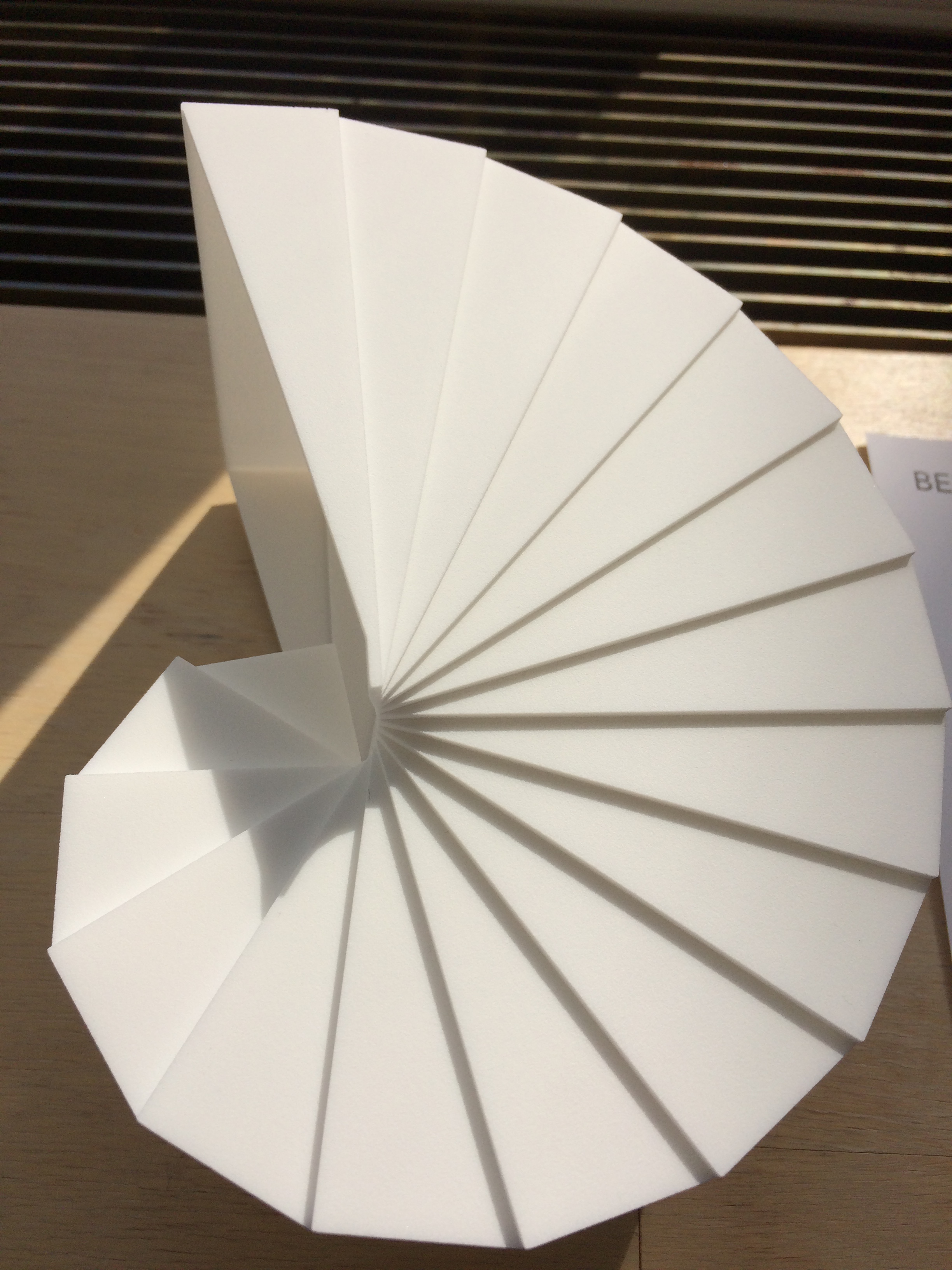
Bernhard Rietzl’s 3-D printing of “Nautilus Theodori” offers an elegant interpretation of a spiral developed by Theodorus of Cyrene in Greece in the 5th century BC.

16-29-01
The Spiral of Theodorus is constructed using right triangles. It begins with a central isosceles right triangle. The legs of this first triangle determine the length of each of the shorter legs for all triangles in the spiral. The second triangle uses the hypotenuse of the first triangle as its longer leg. The third triangle uses the hypotenuse of the second triangle as its longer leg. This process continues to create the spiral. Rietzl’s sculpture uses hollow 3-D wedges to create a shell-like vessel. The clean lines of the triangle give  the nautilus shell an element  of modern design.

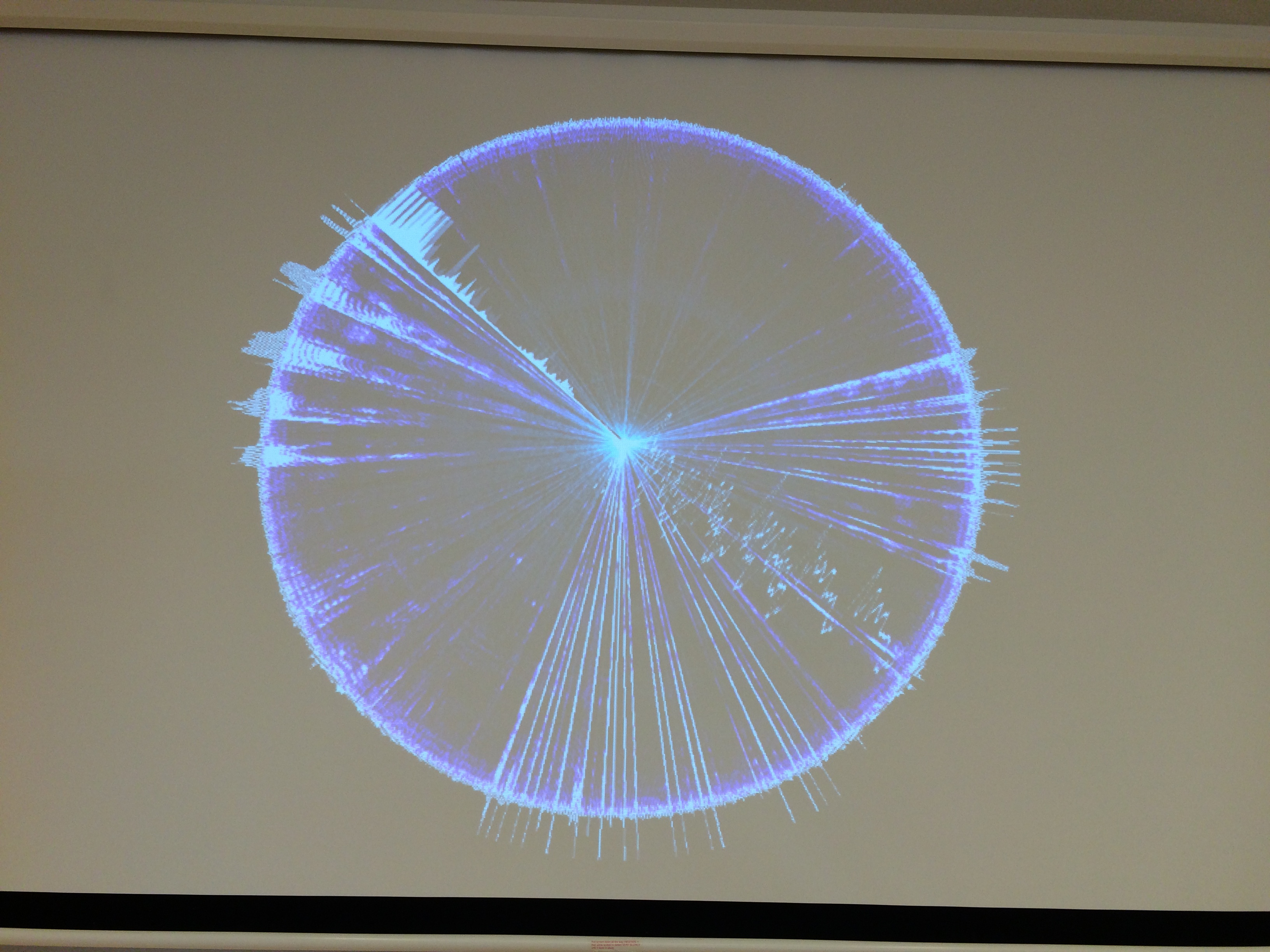
Nathan Selikoff’s video “Audiograph” is produced in real time based on the interaction of environmental factors. The work is a projection of a clock. The hours and the minutes hands are fairly traditional lines using audio waves.

16-29-02
The seconds hand of the clock however, is a representation of the sound over the course of a minute. The sounds and voices in the gallery leave lines radiating out from the center of the clock. The changes in the volume and the tone of the environment create the visual variations.
Selloff’s clock makes the viewer think about both time and sound. Using computer technology and the mathematics of audiology it creates a work that  allows participants to change the visual output of the video within the time limitations of the movement of the seconds hand of a clock.

Susan Happersett

Math Art in Finland

Last week the Bridges organization held their annual conference in Jyväskylä, Finland. This international conference features lectures and workshops that highlight the connections between mathematics, music, art, architecture, education and culture. My favorite part of the five day event is the art exhibition. This year there was a wide range of styles, techniques and mediums on display. it is difficult to select only a few for this blog but I will try.

16-28-01

Sharol Nau

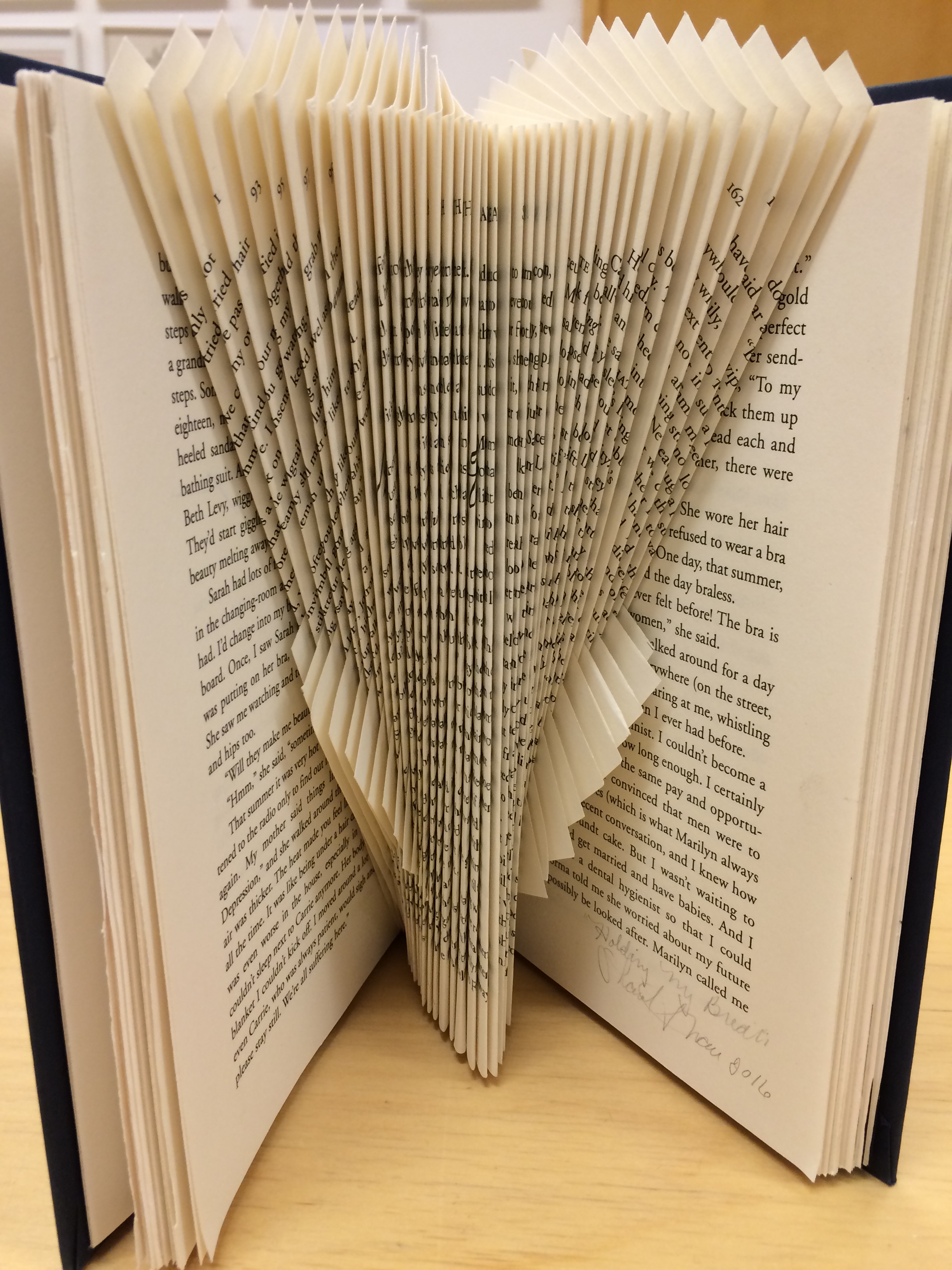
Sharol Nau repurposes unwanted hard cover books to create sculptures that contain parabolas. A parabola is a curve with reflective symmetry, in which each point on the curve is the same distance from a fixed focus point and a fixed line. The artist  carefully measures and folds each page to the common focus point. The resulting portable sculpture preserves the exterior shape of the book but creates a new visual story for the interior.


16-28-02

Nithikul Nimkulrat – “Black & White Striped Knots” – Knotted paper – 2015

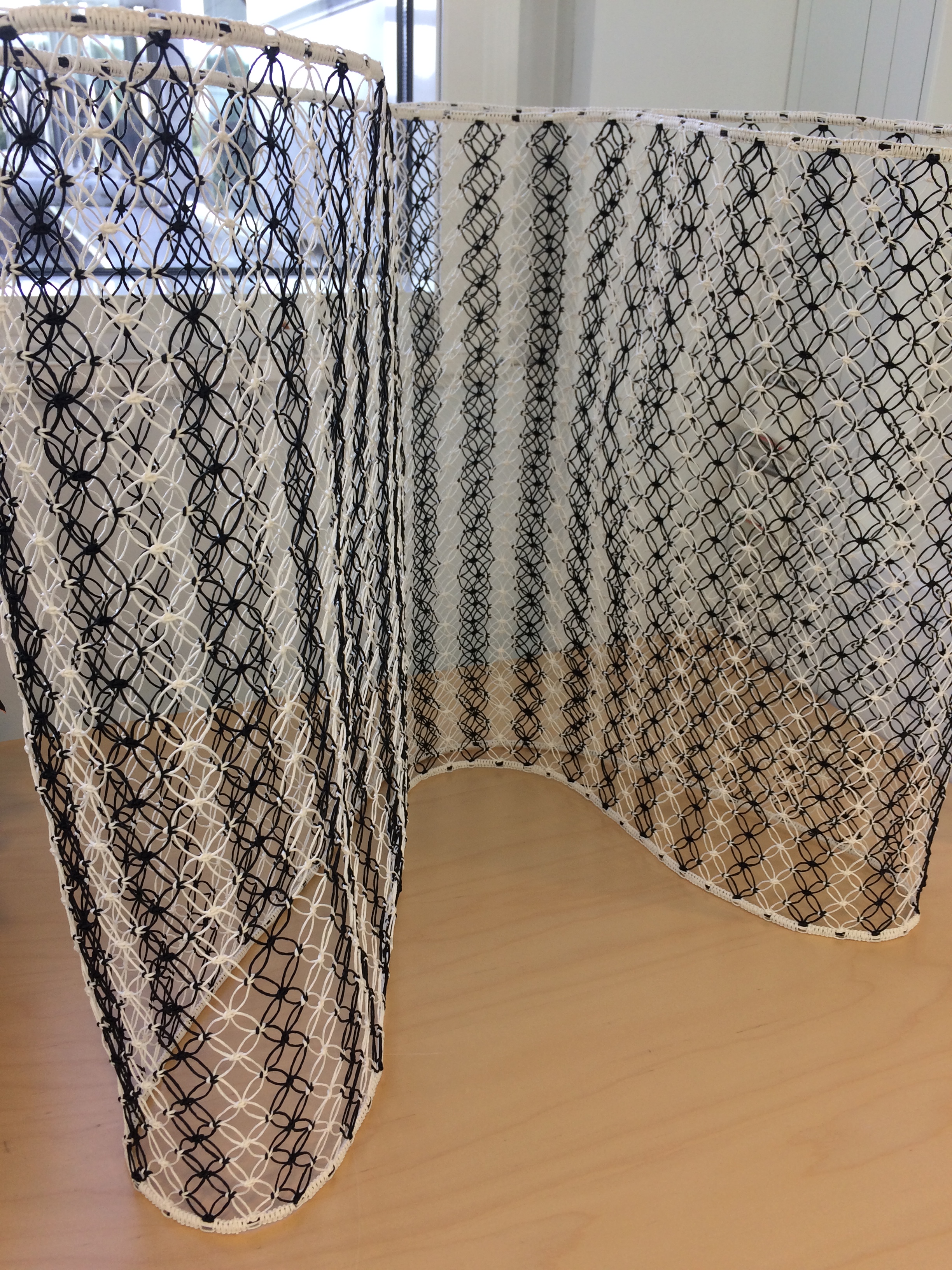
Nithikul Nimkulrat hand-knots sculptures using paper string. Inspired by mathematical knot diagrams, the artist employs two colors of string to better indicate the positions of each stand within the knot structures.”Black & White Striped Knots”examines properties of knotted textiles.

16-28-03

Nithikul Nimkulrat – “Black & White Striped Knots” – Knotted paper – 2015 (Detail)

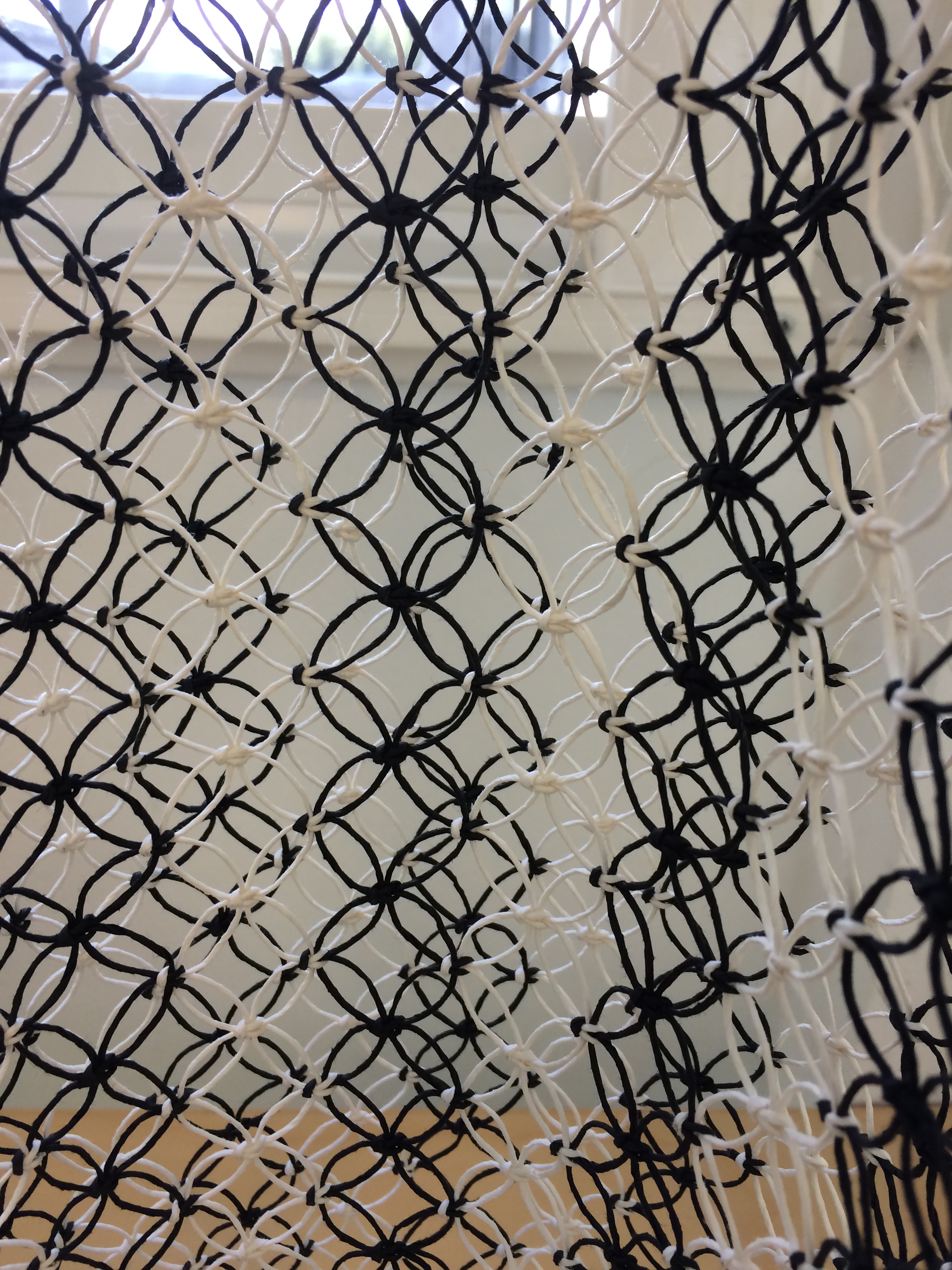
Looking closely at the work, the circular patterns emerge. Overlapping circles cross to form four equal arcs. This creates a series of monotone circles with the arcs of adjacent circles forming a pattern with order-4 rotational symmetry. Nimkulrat’s intricate structure is a wonderful exploration of the mathematical possibilities in textile and fiber art.

Susan Happersett

“Explode Every Day” at MASS MoCA

The Massachusetts Museum of Contemporary is featuring an 11 month exhibition titled “Explode Every Day – An Inquiry into the Phenomena of Wonder”. This title is in reference to the Ray Bradbury quote:

You remain invested in your inner child by exploding every day. You don’t worry about the future, you don’t worry about the past-you just explode.

(from Sam Weller, Listen to the echoes: The Ray Bradbury Interviews, 2010)

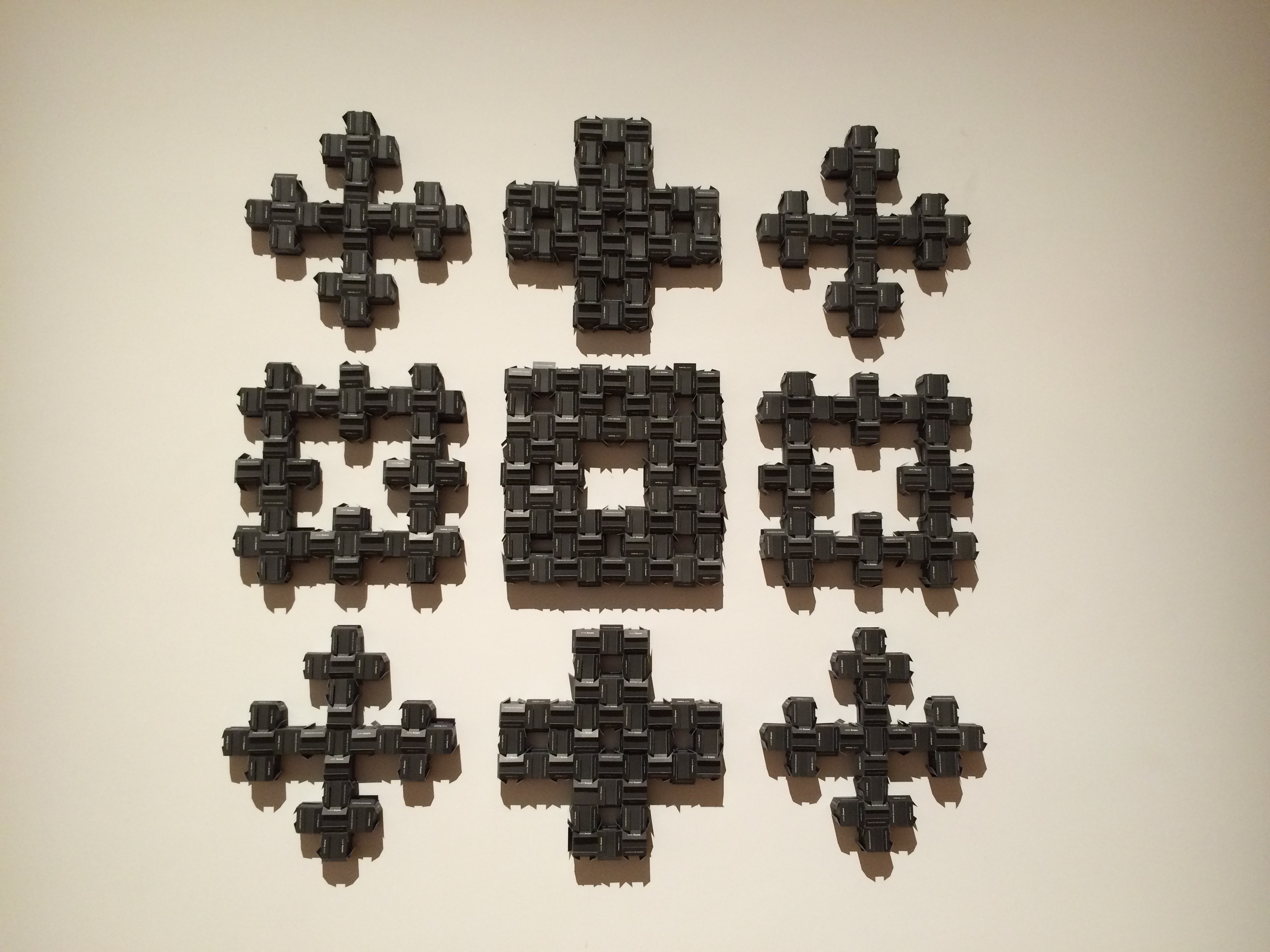
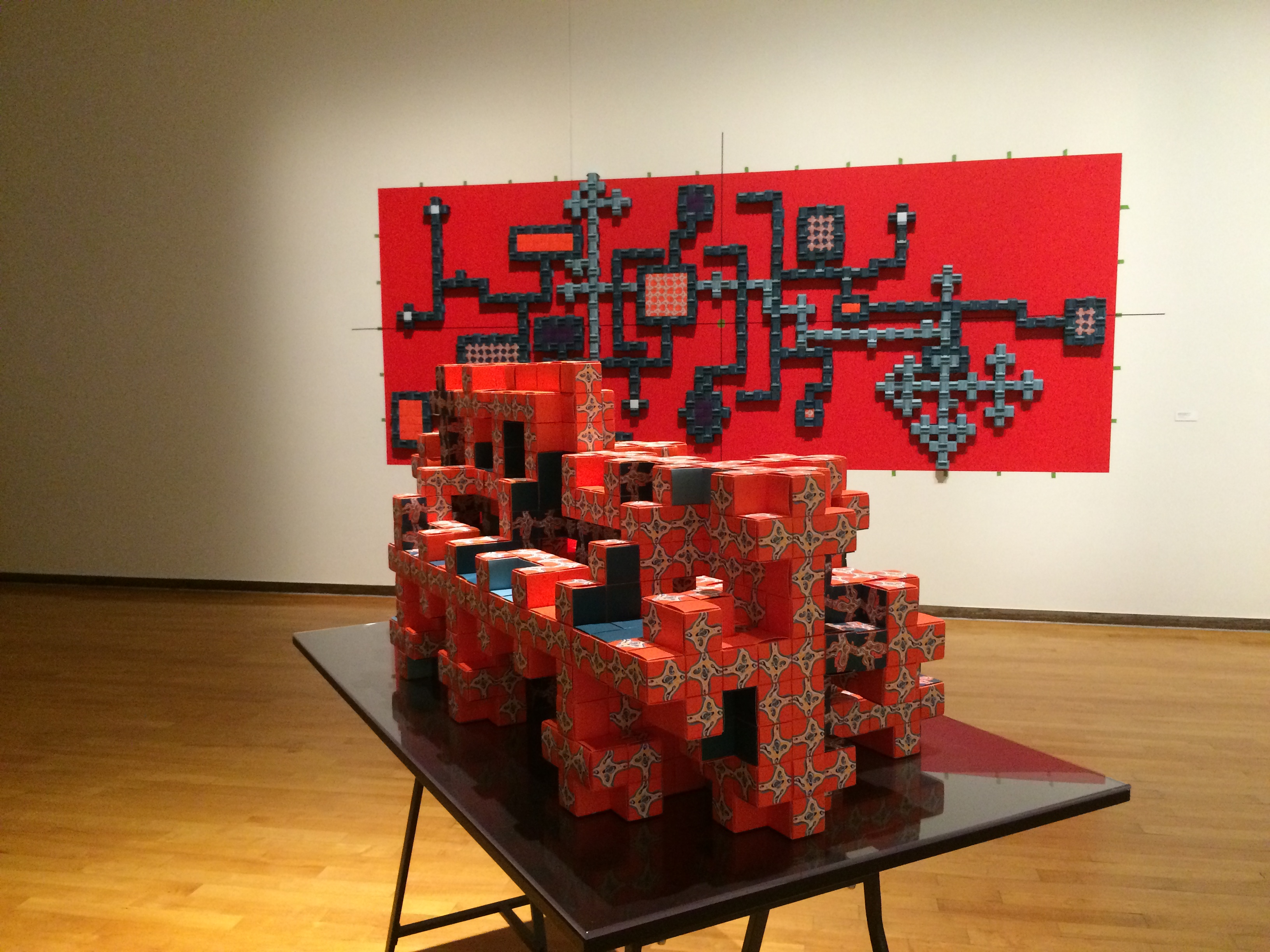
This exhibition is a reaction to our current, fast, information society. It challenges the viewer slow down and take in less information but experience it in a deeper way. The Institute for Figuring and Margaret Wertheim designed paper cards that can be folded to build fractal structures. They use the techniques of Dr Jeannine Mosely’s business card origami. The IFF is known for their work with Hyperbolic geometry and the crocheted coral projects. This work takes on new mathematically influences.

16-27-01

“Fractal Ruins”, 2016

This wall piece named “Fractal Ruins” illustrates some basic forms each with order-4 rotational symmetry, but their sculptures can take on much more complex fractals as well as experiments in randomness.

16-27-03

16-27-02

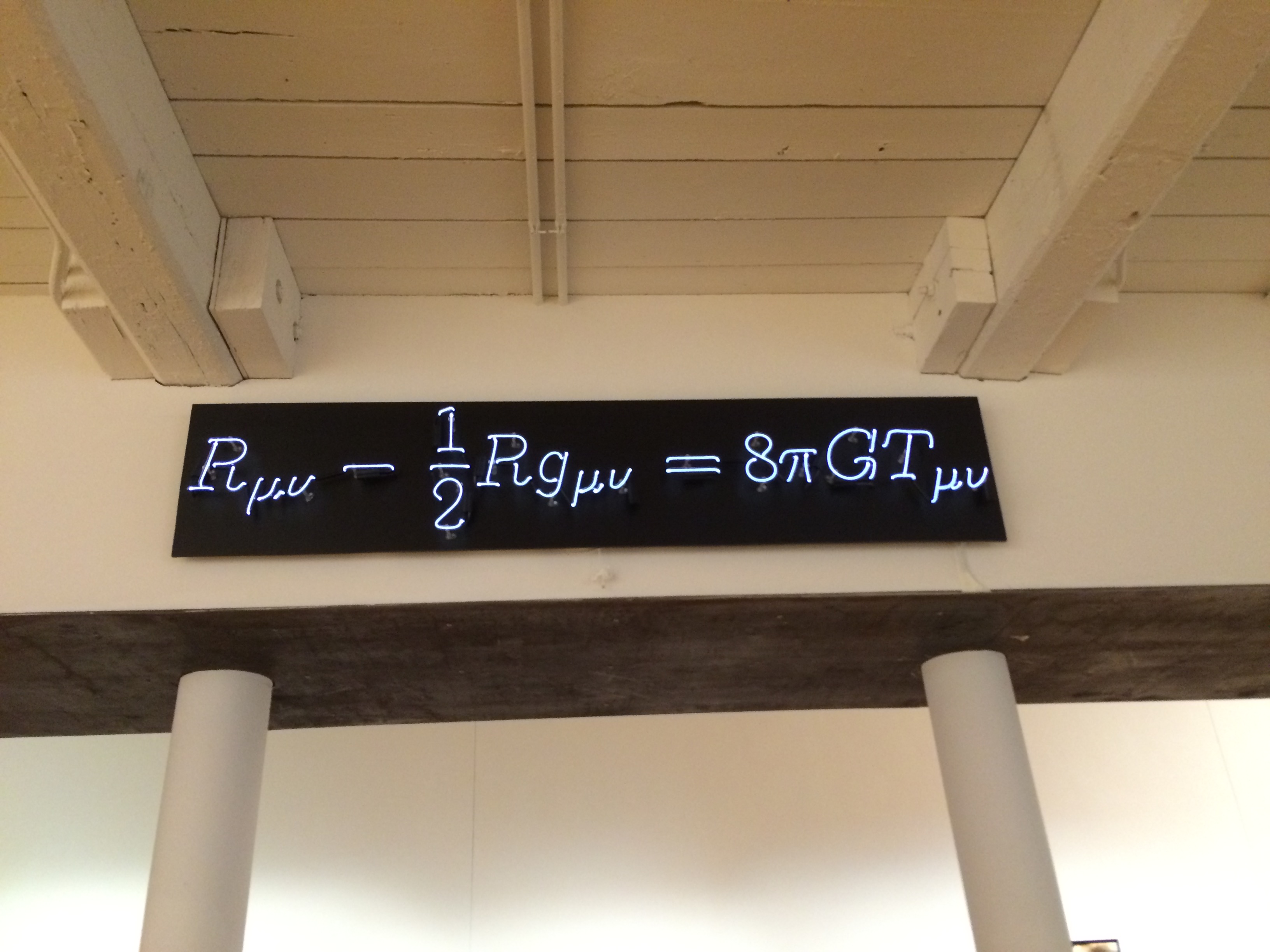
“Krypton Relativity”, 2015

Situated above one of the gallery entrances Rachel Sussman’s neon formula “Krypton Relativity” asks us to explore the aesthetic qualities of Mathematical and scientific formulae. The krypton gas gives a natural glow highlighting the purely visual elements of the work. The need to understand the information contained with in the symbols is not a requirement to appreciate its beauty. This sign acts as an invitation to explore the scientific subject matter and the means of communicating the data on a different level.

Susan Happersett

Beauty at the Cooper Hewitt

The fifth installation of “Beauty- Cooper Hewitt Design Triennial” is survey of aesthetics in contemporary design. On display are a number of objects with mathematical connections.

16-25-01

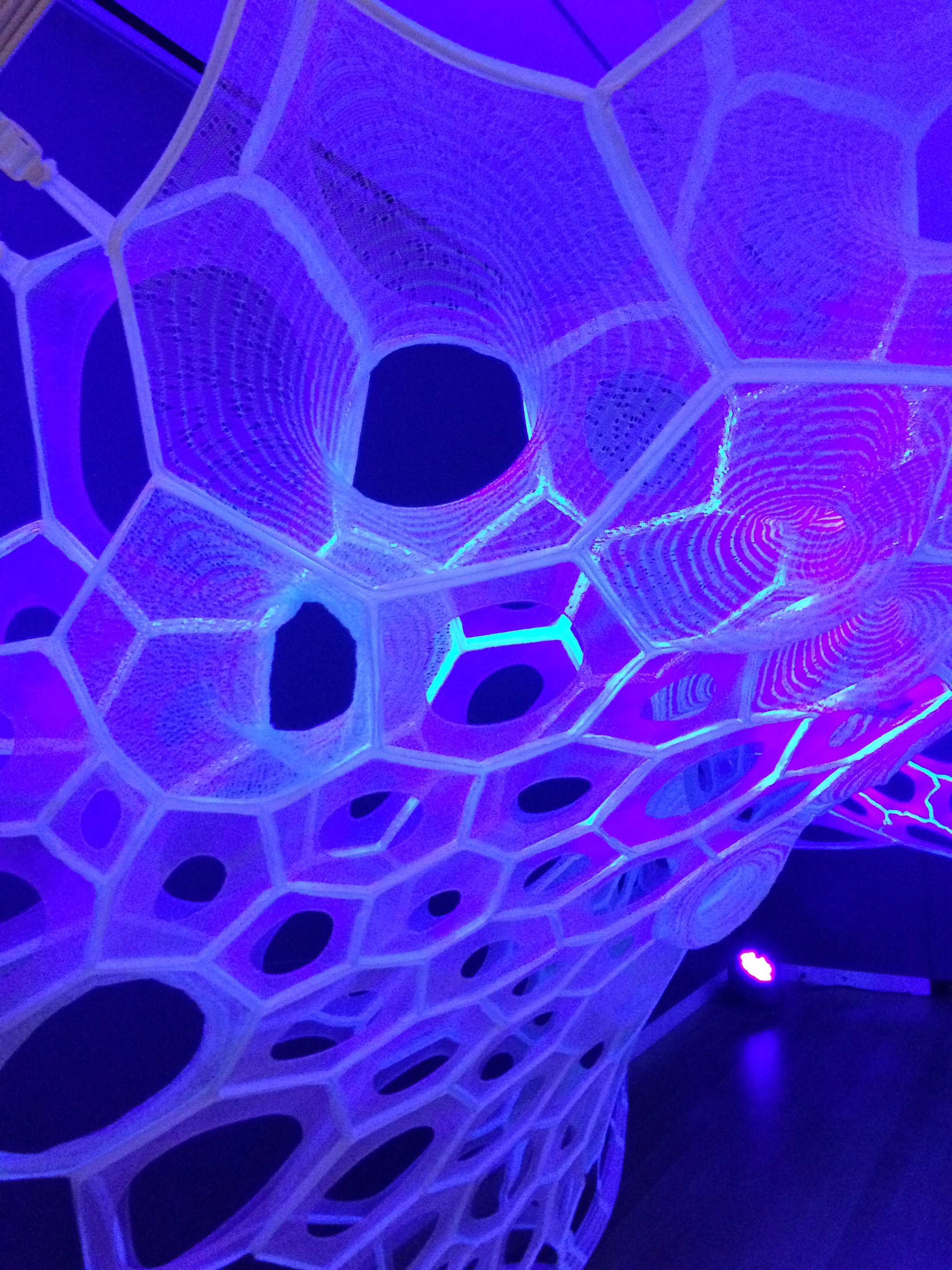
Jenny Sabin 2015-2016

Jenny Sabin’s knitted architectural is based on Mathematics in nature and was commissioned specifically for this show. It was digitally knit using photoluminescent and solar active yarns creating a glowing environment of geometric webs.

16-25-02

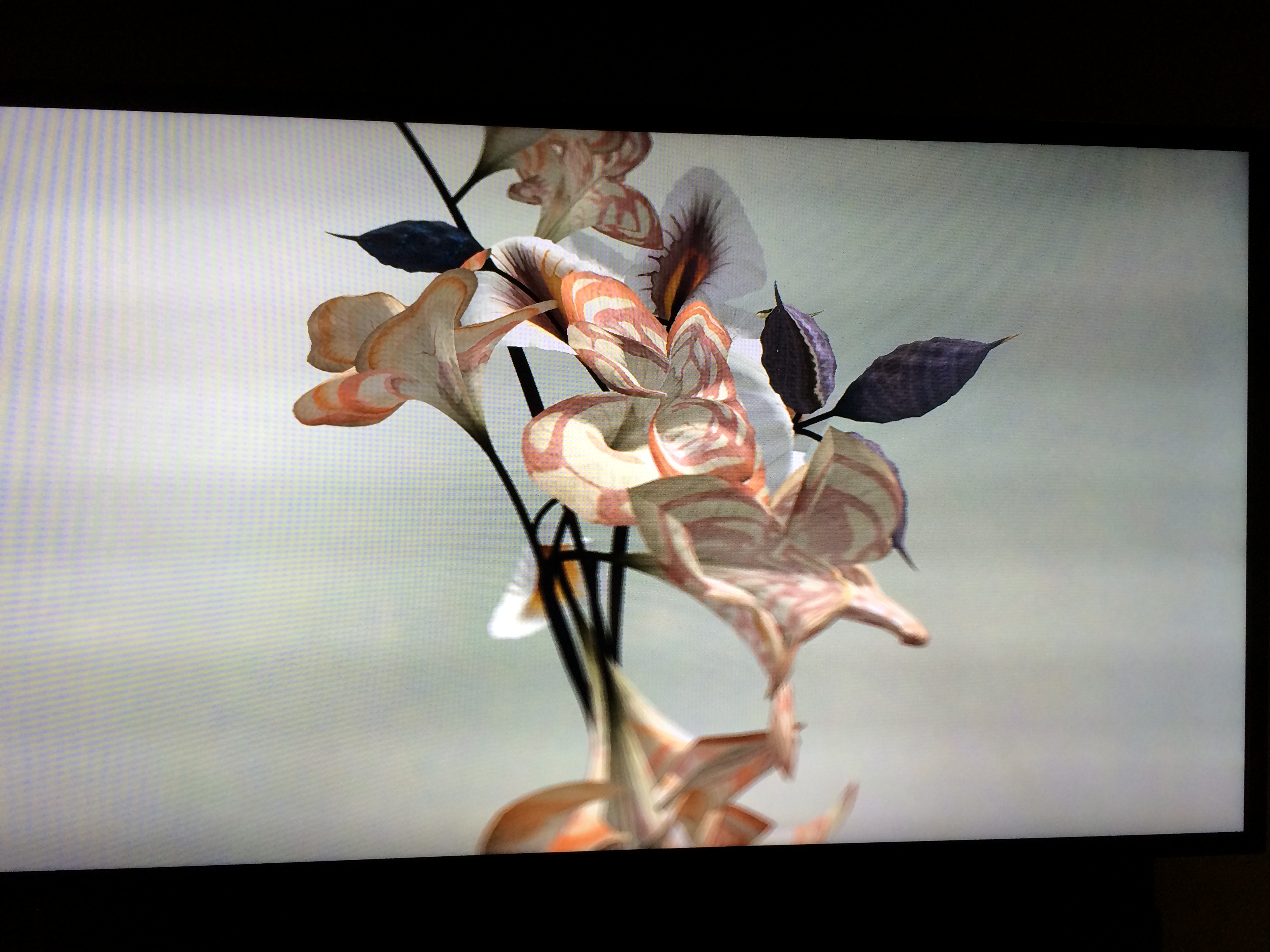
Daniel Brown -“On Growth and Form” 2- Video – 2013

Daniel Brown’s six minute video shows the formation of a series of mathematically generated flowers. These blossoms have been created through the process of coding algorithms to digitally render an idealized image of nature. The resulting video has an eery, overly perfect, super realistic quality, an aesthetic contrast from actual flowers.

16-25-03

16-25-04

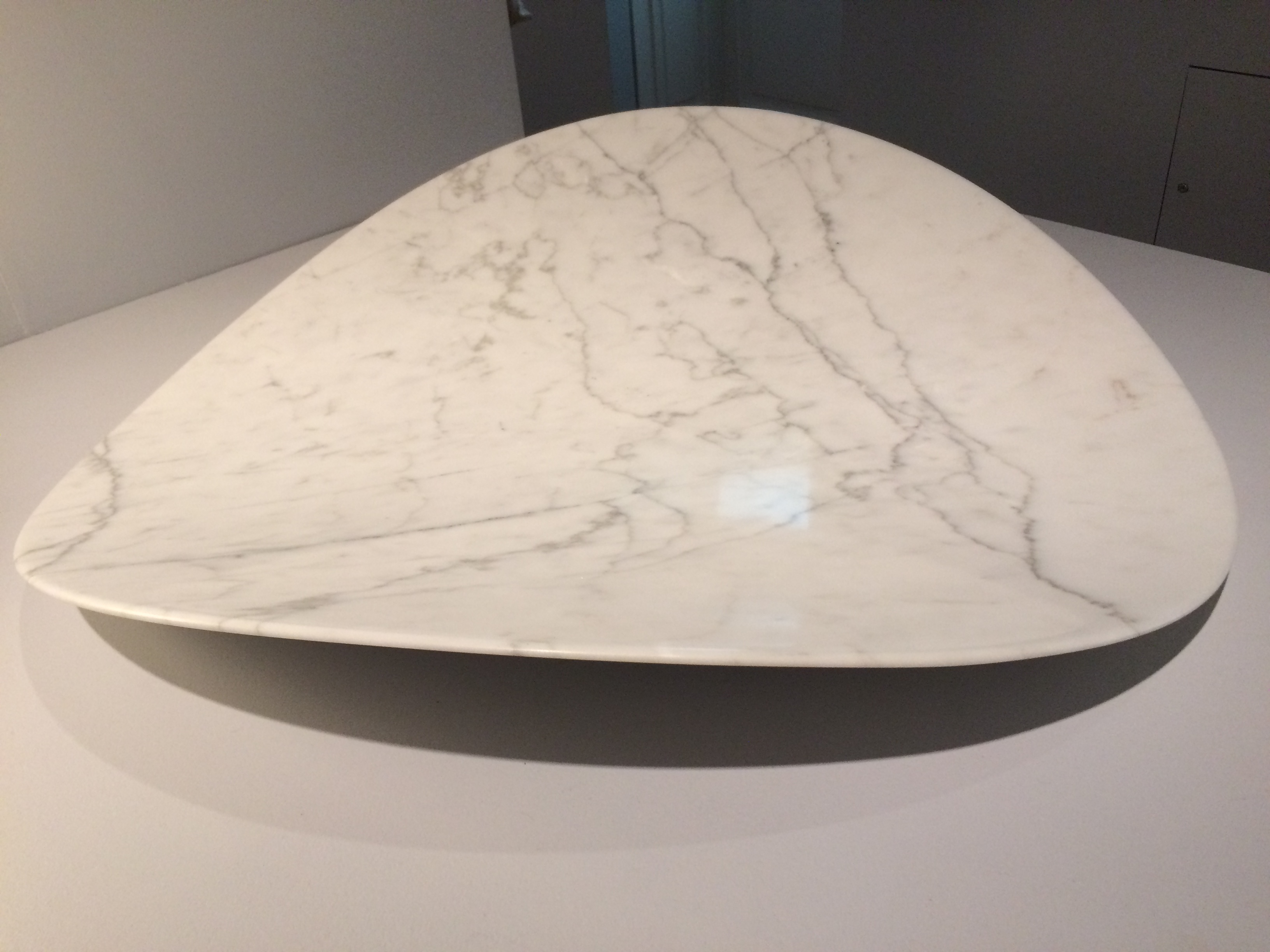
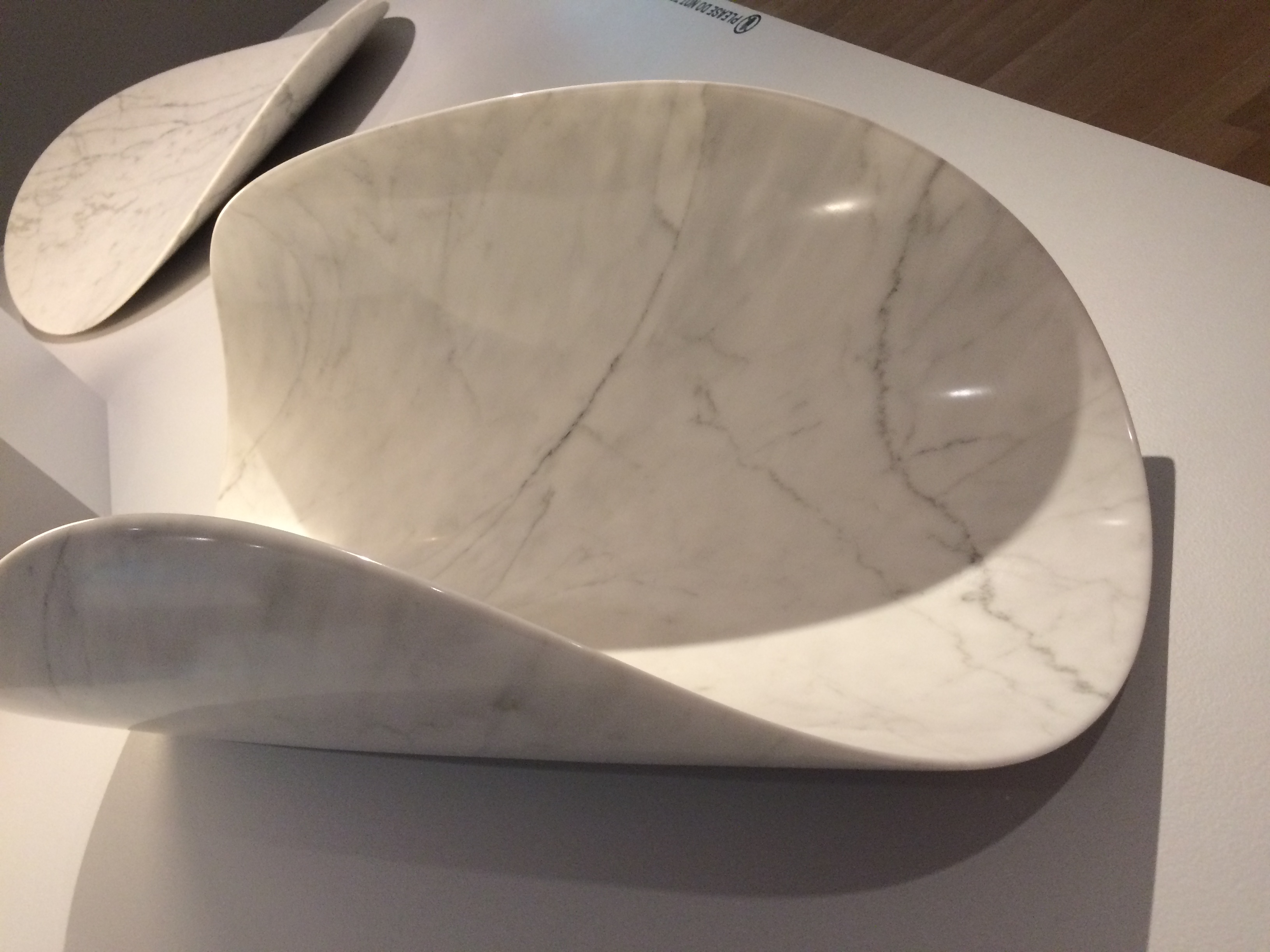
Michael Anastassiades – “Miracle Chips” – Marble – 2013


Michael Anastassiades’ white marble “Miracle Chips” are circular discs that seem to have been bent into concave surfaces. The sculpture presents a series of discs with increasing concavity. The smoothness of the curves leads the viewer to imagine it is possible to take  flat discs of marble and gently fold them into these elegant forms.

Mathematics was an important theme of the “Beauty” exhibition at the Copper Hewitt and the supporting text of the wall signage was clear in attributing the inspiration and use of mathematics by the artists and designers.

Susan Happersett

Gerard Mullin at Kristen Lorello

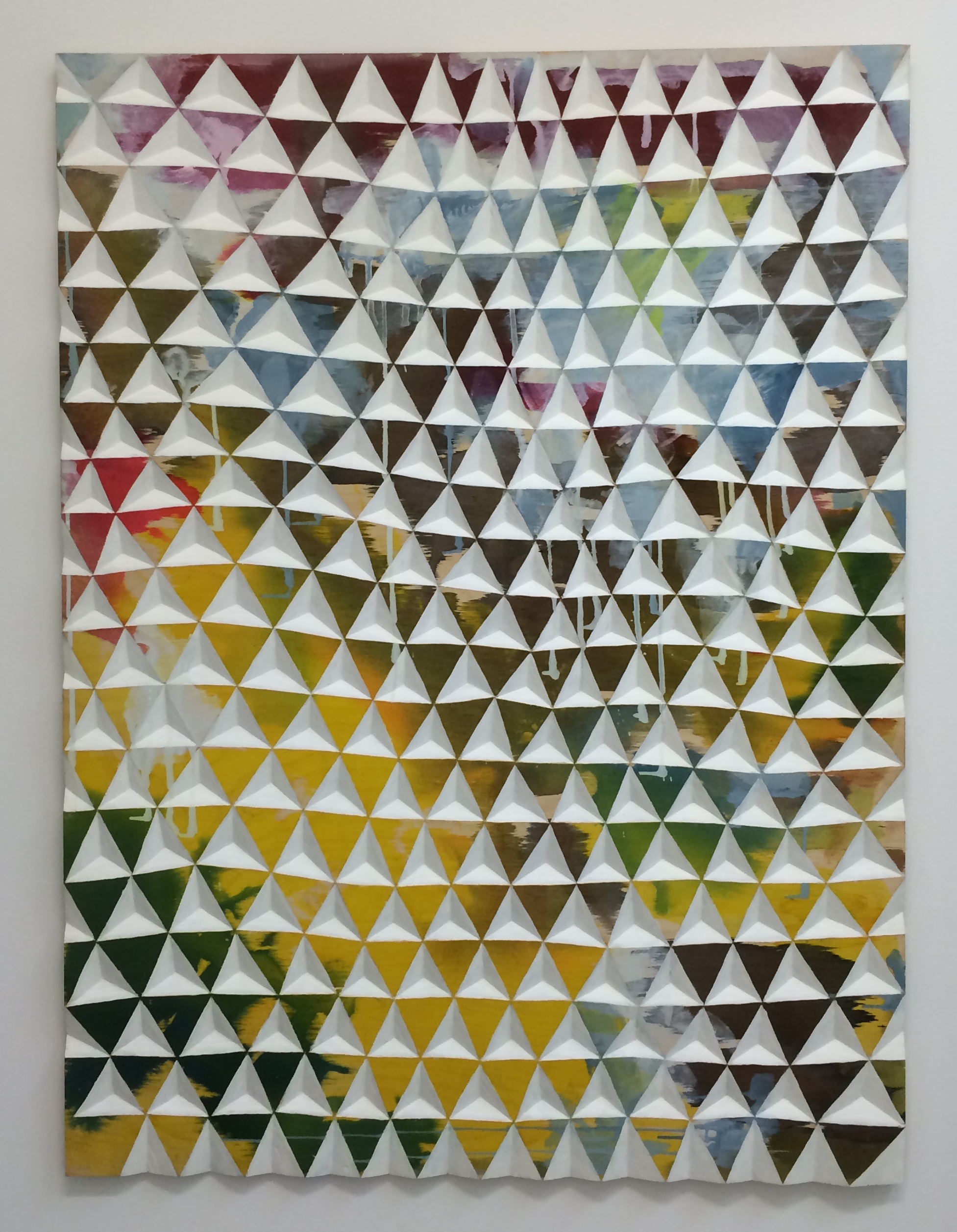
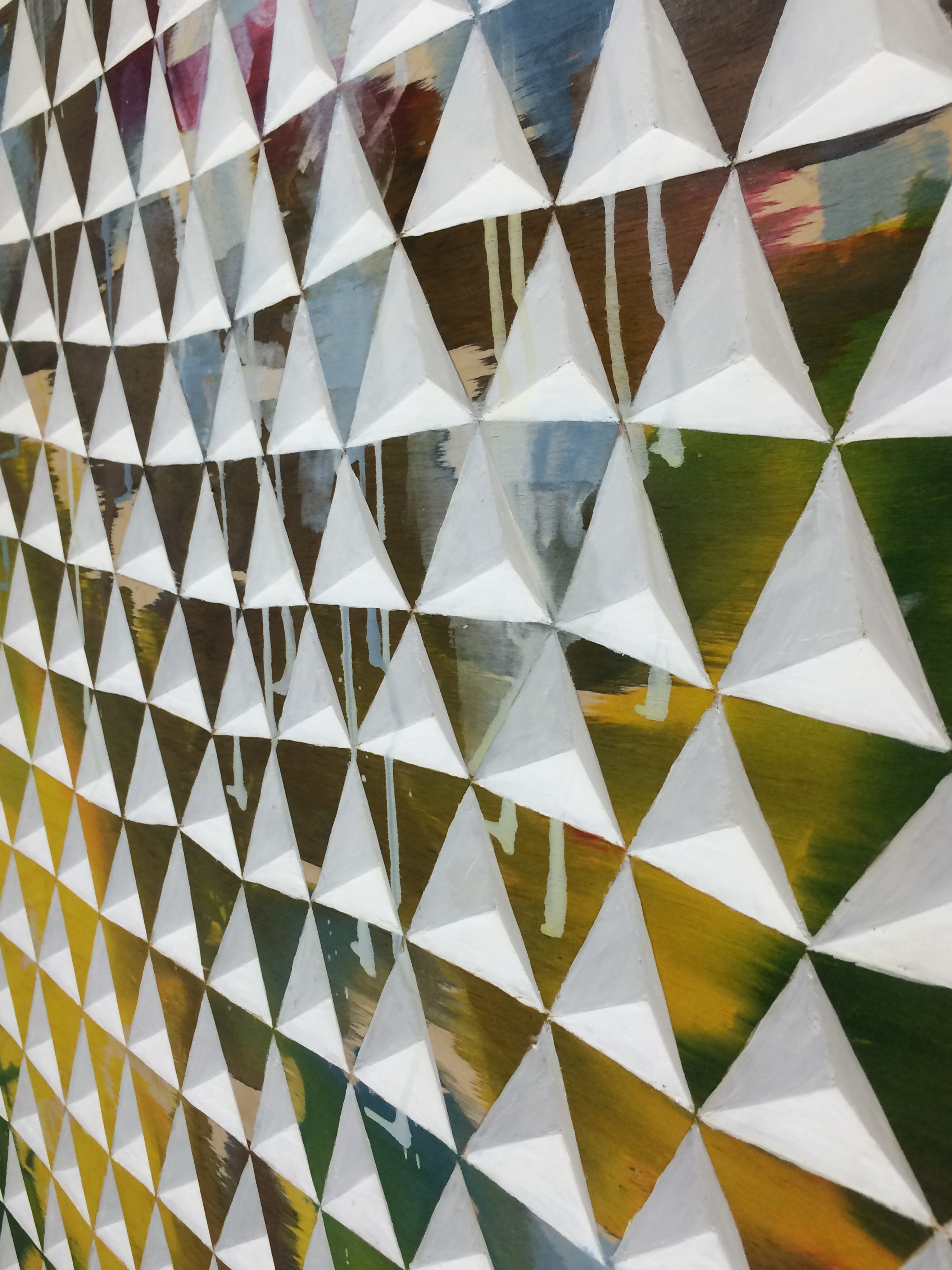
The Kristen Lorello Gallery in New York is currently presenting a solo exhibition of Gerard Mullin’s painted and carved wood reliefs. The artist begins by painting abstract images with watercolor, wood dye, and acrylic on sheets of plywood. Then starting at one edge he carves a row of a single type of geometric shape.

16-22-01

Gerard Mullin – Untitled – 2013
Picture courtesy of the gallery and the artist

In this first example the first carving is the bottom row of Isosceles triangles. Carving by hand – without a template – the rows of triangles fluctuate in size creating a sense of motion.

16-22-02

Gerard Mullin – Untitled – 2013 (detail)
Picture courtesy of the gallery and the artist

The carved sections of the work are then painted white. This accentuates the 3-D aspects of the work allowing a clean surface to display the shadows from the carving. The brightness of the white paint in the recesses of the work contrasting with darker surface painting creates an interesting switch in positive and negative space.

16-22-03

Gerard Mullin – Untitled – 2013
Picture courtesy of the gallery and the artist

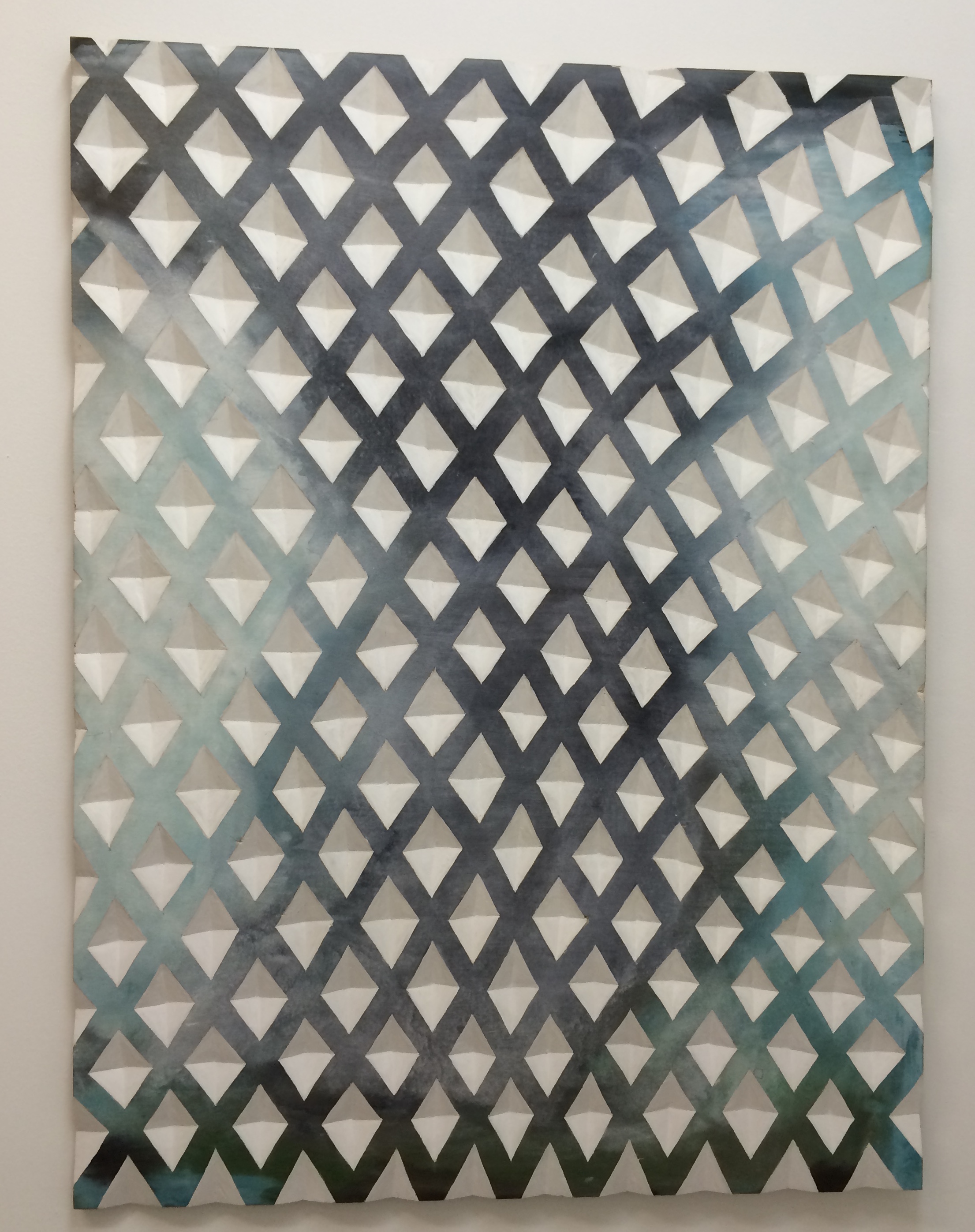
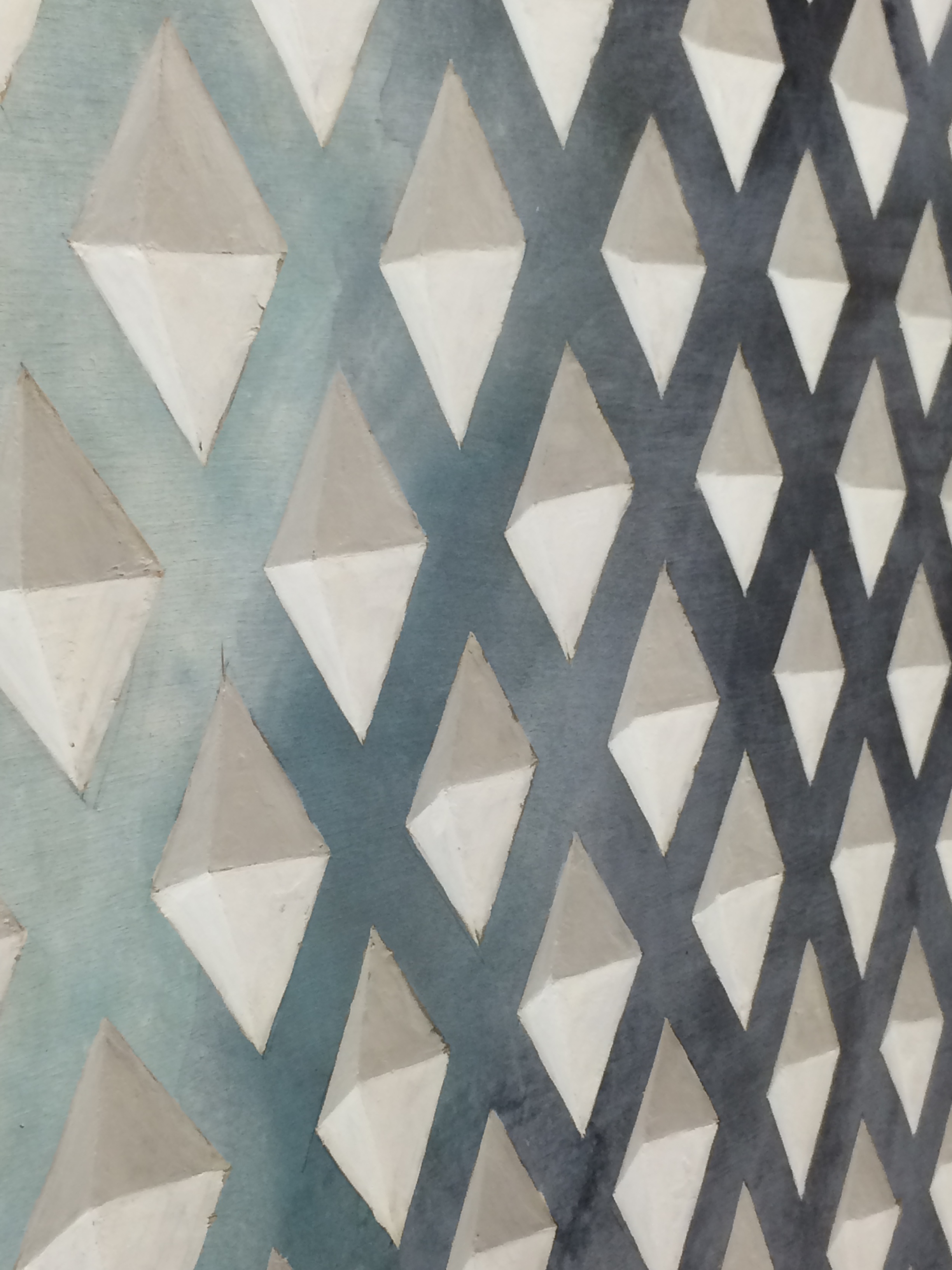
This second work work began with a row of  equilateral triangles across the bottom, but then developed into rows of double triangles positioned base to base to form a diamond pattern.

16-22-04

Gerard Mullin – Untitled – 2013 (detail)
Picture courtesy of the gallery and the artist

Looking at the work from a side angle, the diamonds are concave 4-sided pyramid indentations. The  nature of Mullin’s carving technique creates a type of off-kilter grid. This is an unexpected quality for the exploration of gridded geometric spaces. The initial abstract painting also adds a dimension to the work, taking it another direction from hard edge and minimalist interpretations of geometry. Mullin offers his viewers a chance to look at familiar shapes within a new, freer, and less formal structure.

Susan Happersett
Infinity at the MET Breuer

This Spring the Metropolitan Museum of Art expanded its exhibition space into what used to be the Whitney Museum on Madison Avenue and is now called the “MET Breuer”. “Unfinished, Thoughts Left Visible” is one of the two of the inaugural shows. “Unfinished” features art which was never fully completed either by determination of the artist or by chance. On the forth floor of the museum there is a gallery with more abstract work that deals with the concept of infinity. The nature of the infinite creates a continuum in the work, thus alluding completion.

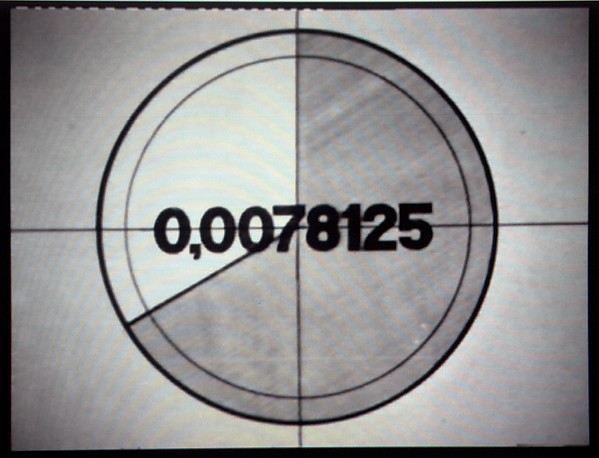
One of best visual interpretations that I have seen of Zeno’s Arrow Paradox is in the form animated video. “La Flecha de Zenon” by Jorge Macchi and David Oubina begins the way many movies begin, with a count down of numerals from ten to one, but, when you think some other action will start after one, the numbers are divided in two and expressed as a decimal. As the numbers get smaller and smaller the length of the decimal gets longer and longer until the digits get so small they seem to disappear. We are left to believe they go on forever and zero is unattainable.

16-21-02

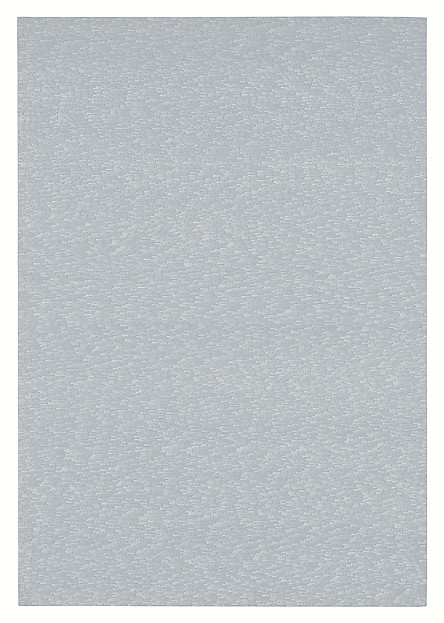
Another artist in the exhibition that has a relationship with infinity is Roman Opalka. Beginning in 1965, he began a series of paintings on which he started to paint the numbers up to infinity. Each set of digits is hand painted in white on a grey background. The artist completed 233 canvases but of course never completed the project.

16-21-03These examples highlight the way numbers can be used as a tool to express themes of time and infinity and their effects on the human condition.

Susan Happersett
 

Pictures courtesy of the Metropolitan Museum of Art.

Harmony Hammond at Alexander Gray Associates

Alexander Gray Associates gallery in Chelsea is currently exhibiting recent work of Harmony Hammond. In the 1970’s Hammond was an influential feminist artist. Her current work is abstract, but with an emphasis on process and physicality. The materiality of these almost monochrome works relate to earlier themes of the human body.

16-20-01

“Red Stack” – oil and mixed media – 2015

16-20-02

“Red Stack” – oil and mixed media – 2015 (detail)

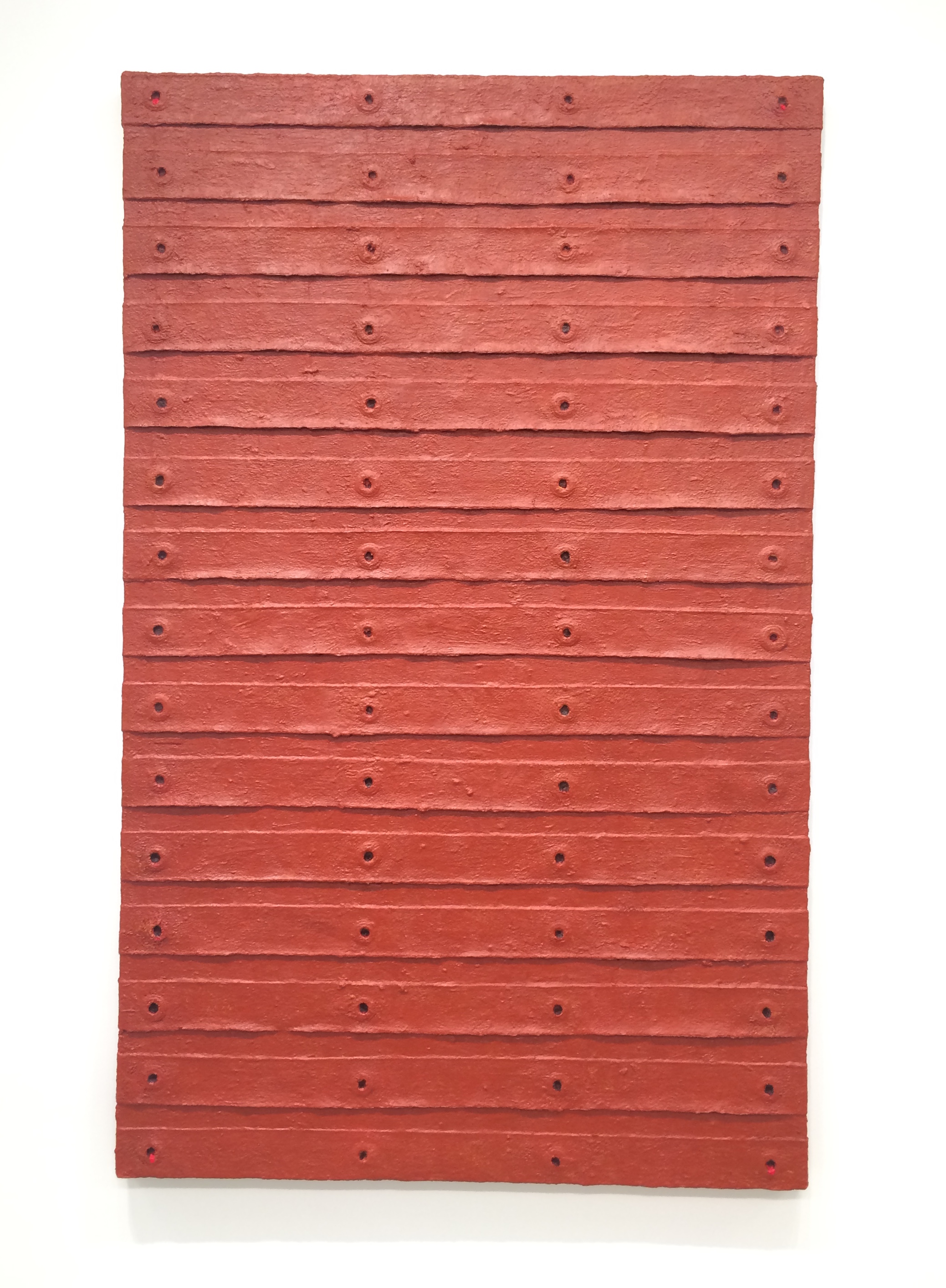
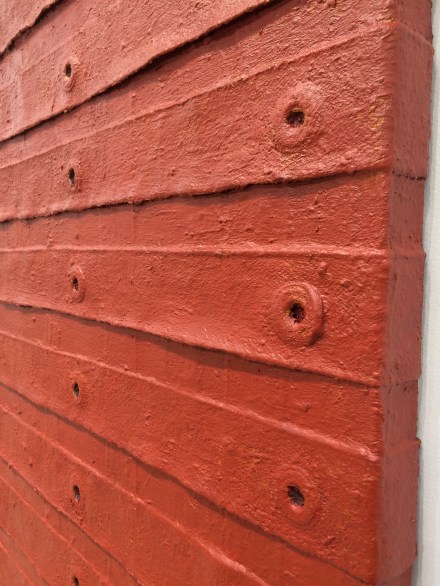
The painting “Red Stack” features a series of evenly placed horizontal straps, as well as a grid of metal grommets. The linearity of the rows of raised strips of fabric is interrupted by the circular grommets. This work has a very sculpture quality with a rough surface that keeps all of the lines and proportions from being hard edged and perfect.

16-20-03

“White Rims #1” – Monotype on paper with metal grommets – 2015

16-20-04

“White Rims #1” – Monotype on paper with metal grommets – 2015 (detail)

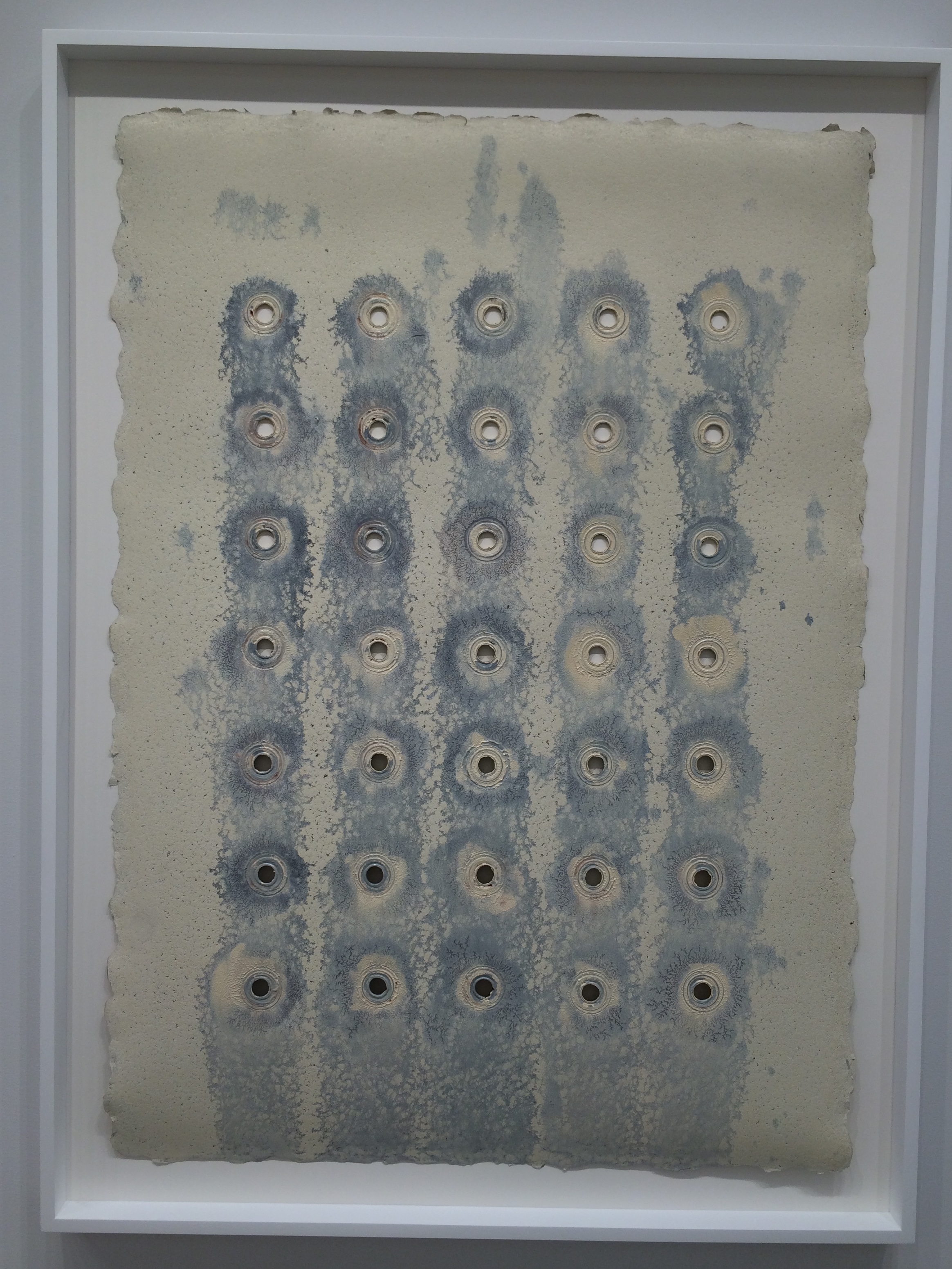
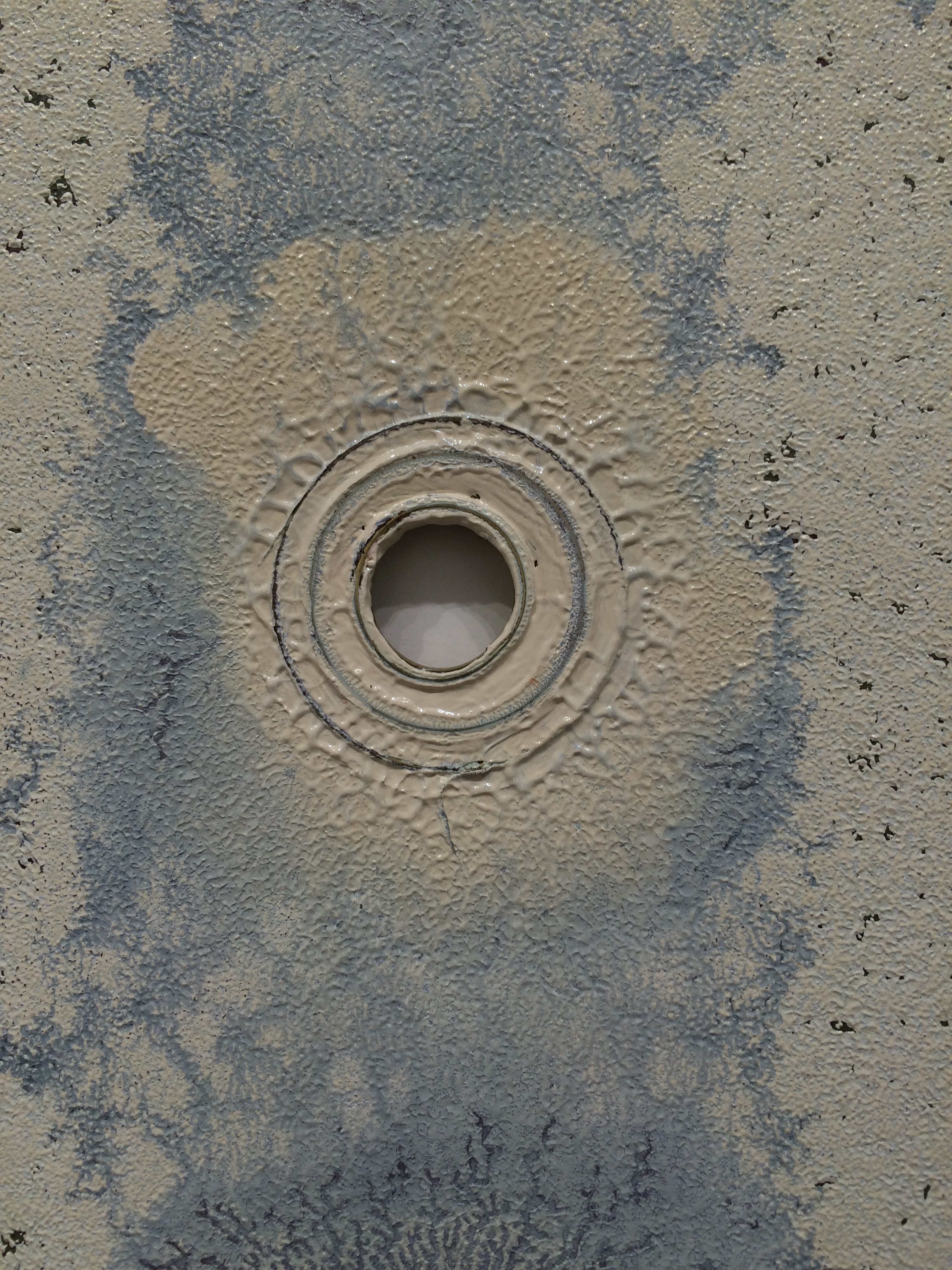
The monotype “White Rims #1” showcases the concentric circles created by the grommets. The  organized 5 x 7 grid of holes juxtaposes the more random pigmentation of the print. The ink flows and pools and plumes around the structures. The edges of the paper have a rough, almost torn, quality that is in contrast to the gridded repetition of the circles. There is a push and pull of chaos versus order, geometry versus the physicality of Hammond”s artistic process.

All Pictures courtesy of the artist and the gallery.

Susan

Huguette Caland at Natalie Karg

The exhibition “Silent Letters” is currently on view at the Natalie Karg gallery. This exhibition features paintings of Huguette Caland from the past 18 years. Originally from Lebanon, Caland is the daughter of the first post colonial president of that country. She worked in Paris before moving to Los Angeles. Her work has spanned numerous styles and subject matter.

16-19-01This series of square format paintings explore both proportion and geometry. In this work the canvas has a pair of adjacent squares placed horizontally. The center of the canvas that have sides that are one half the length of canvas. In each corner ,the artist has placed squares with sides one quarter the length of the canvas. Using the measurements of the canvas as a reference point Caland builds geometric relationships between the figures.

16-19-02

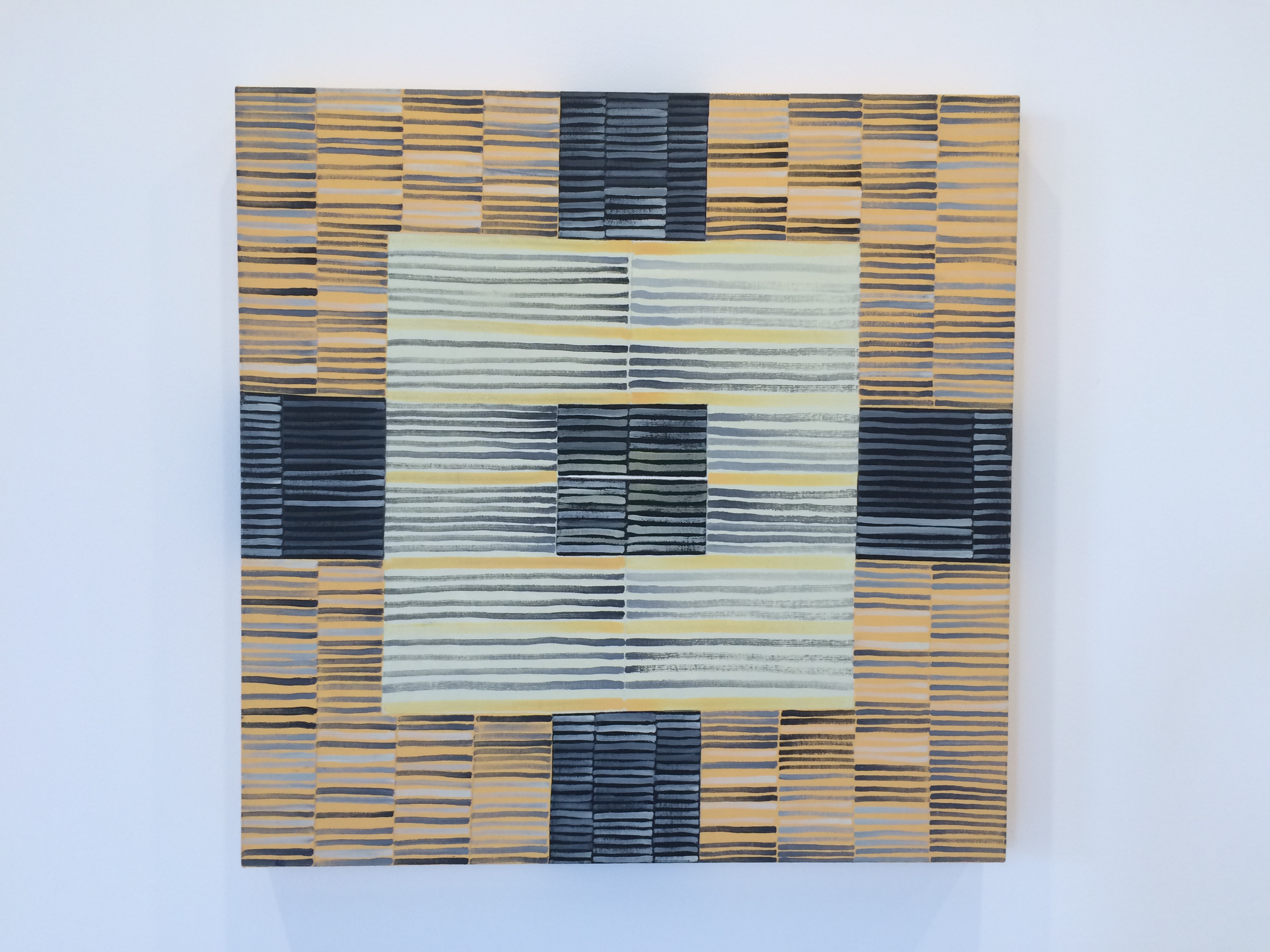
This second example features squares in more complex play of proportions. Each of the five small darker squares have sides with length one fifth that of the canvas and the large lighter center square has sides with length three fifths the measure of the canvas. Caland’s interest in grids is more visible in this work. Her use of vertical lines to fill in the spaces reminds me of the mark making of Agnes Martin.
The geometric themes of the paintings in “Silent Letters” are strong but it is Caland’s process of filling in the shapes that makes the work personal.

Susan Happersett