Art Fair Week NYC

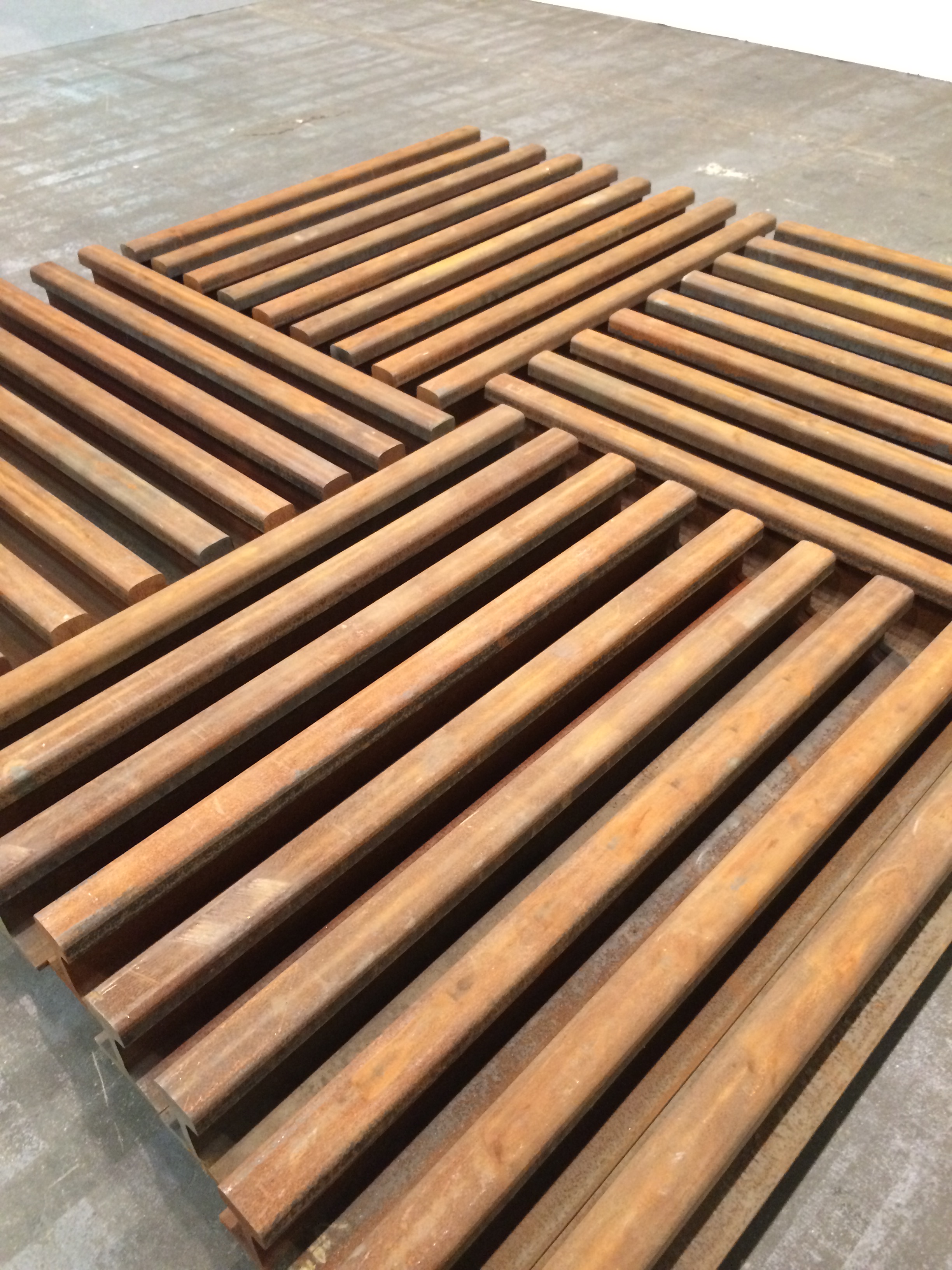
This past week there were nine different art fairs held in New York City. The largest was the Art Fair Week NYC that was held on a pier on the west side of town. The Contemporary Fine Arts Gallery from Berlin was there, featuring the work of Marianne Vitale. She made with this very interesting floor sculpture made of rusted steel rail road track.
16-10-01

Marianne Vitale – 2016 – Steel
Picture courtesy of the gallery and the artist

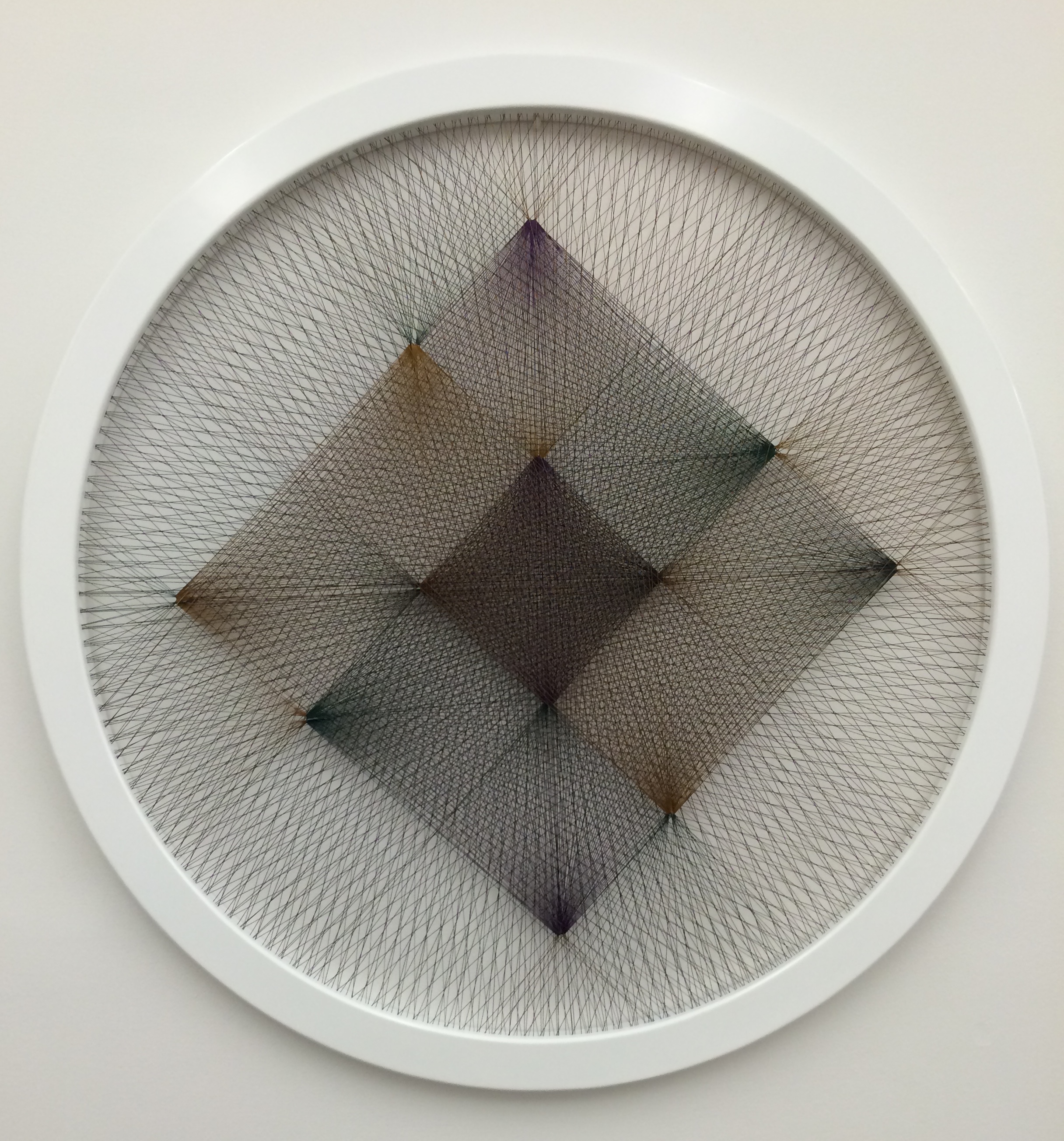
This piece is a square composed of four squares that are placed so the parallel lines of each square are perpendicular to the parallel line of the adjacent squares. This reminded me of the process of weaving with the perpendicular warp and weft.

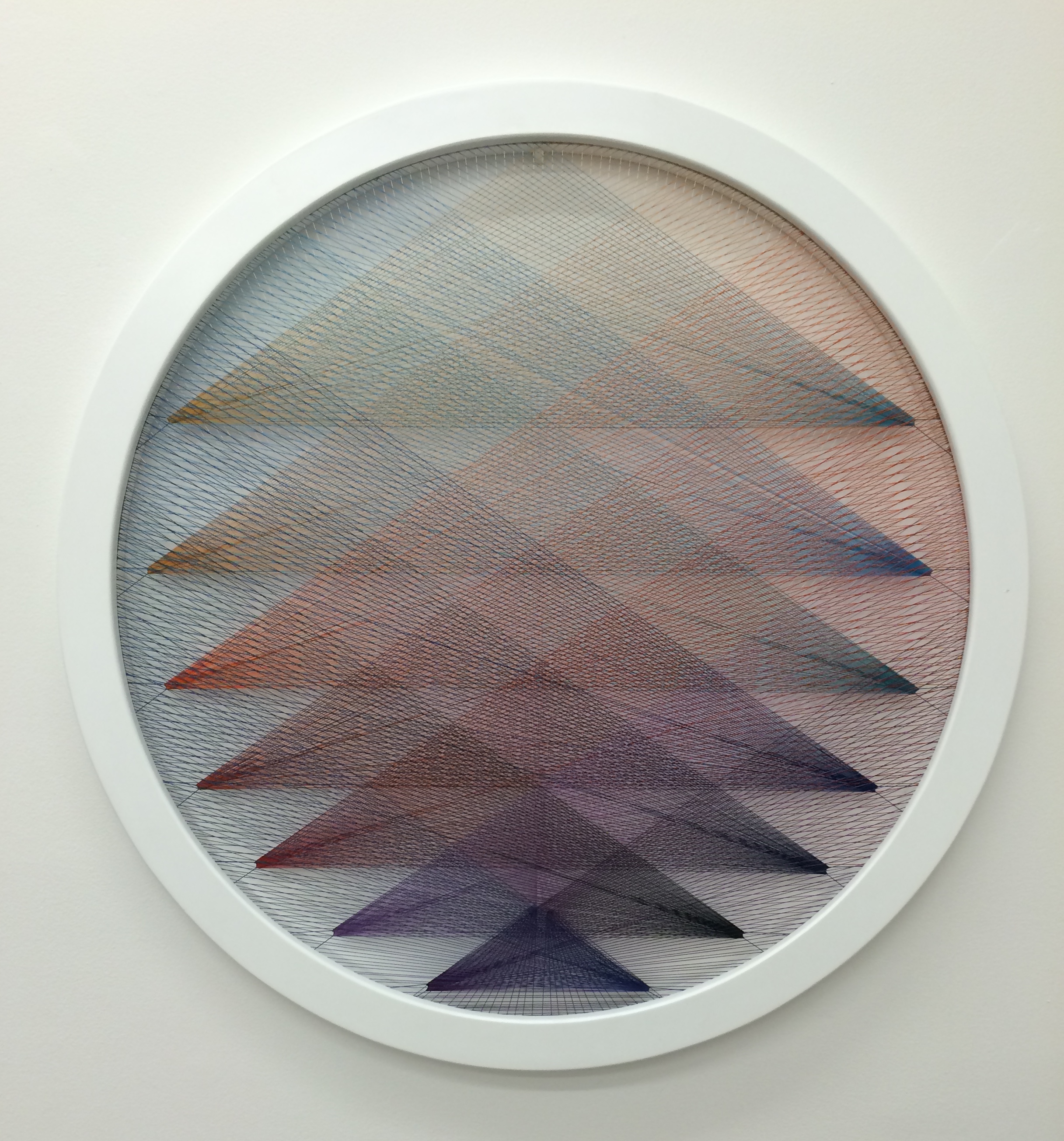
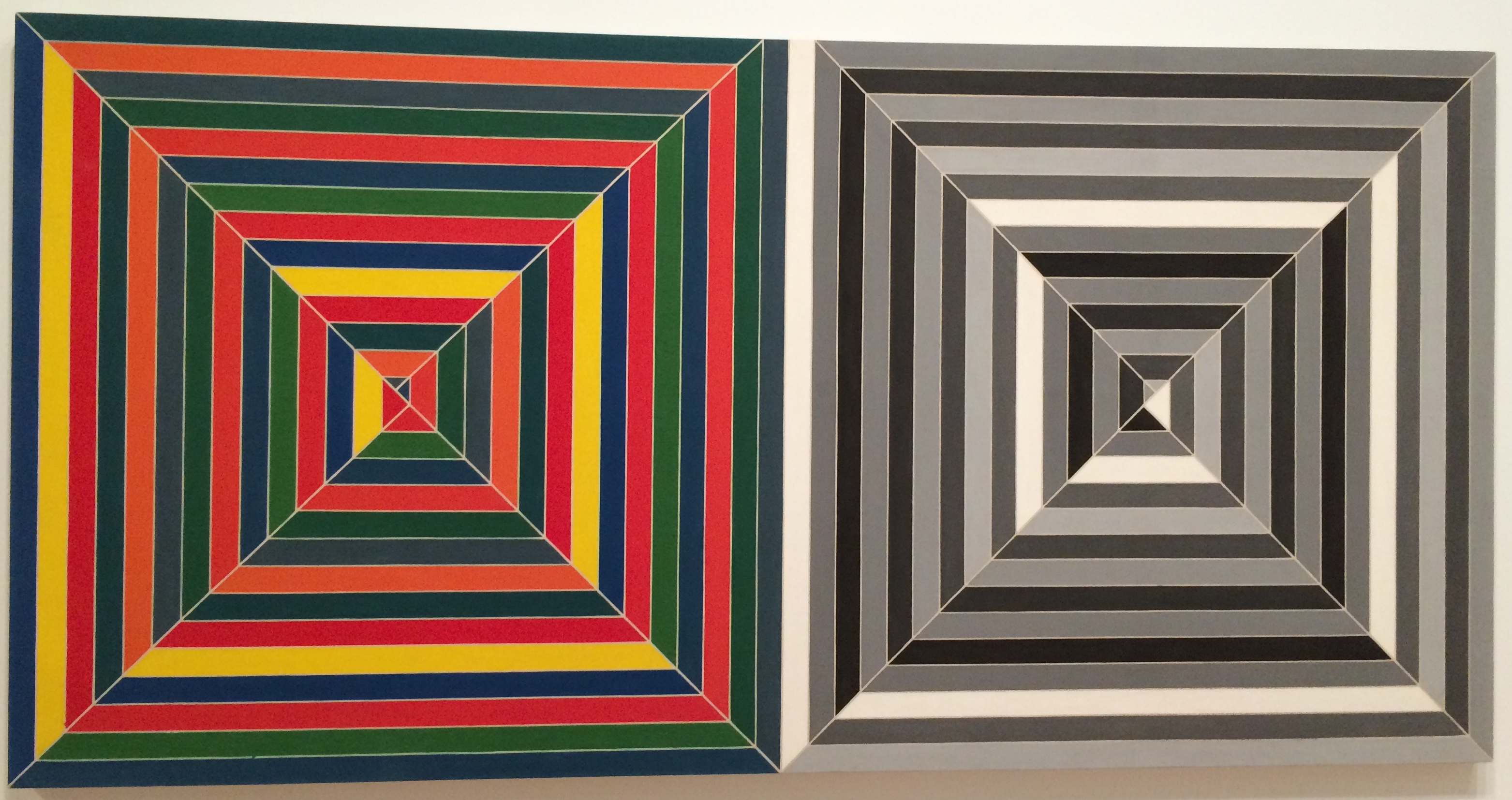
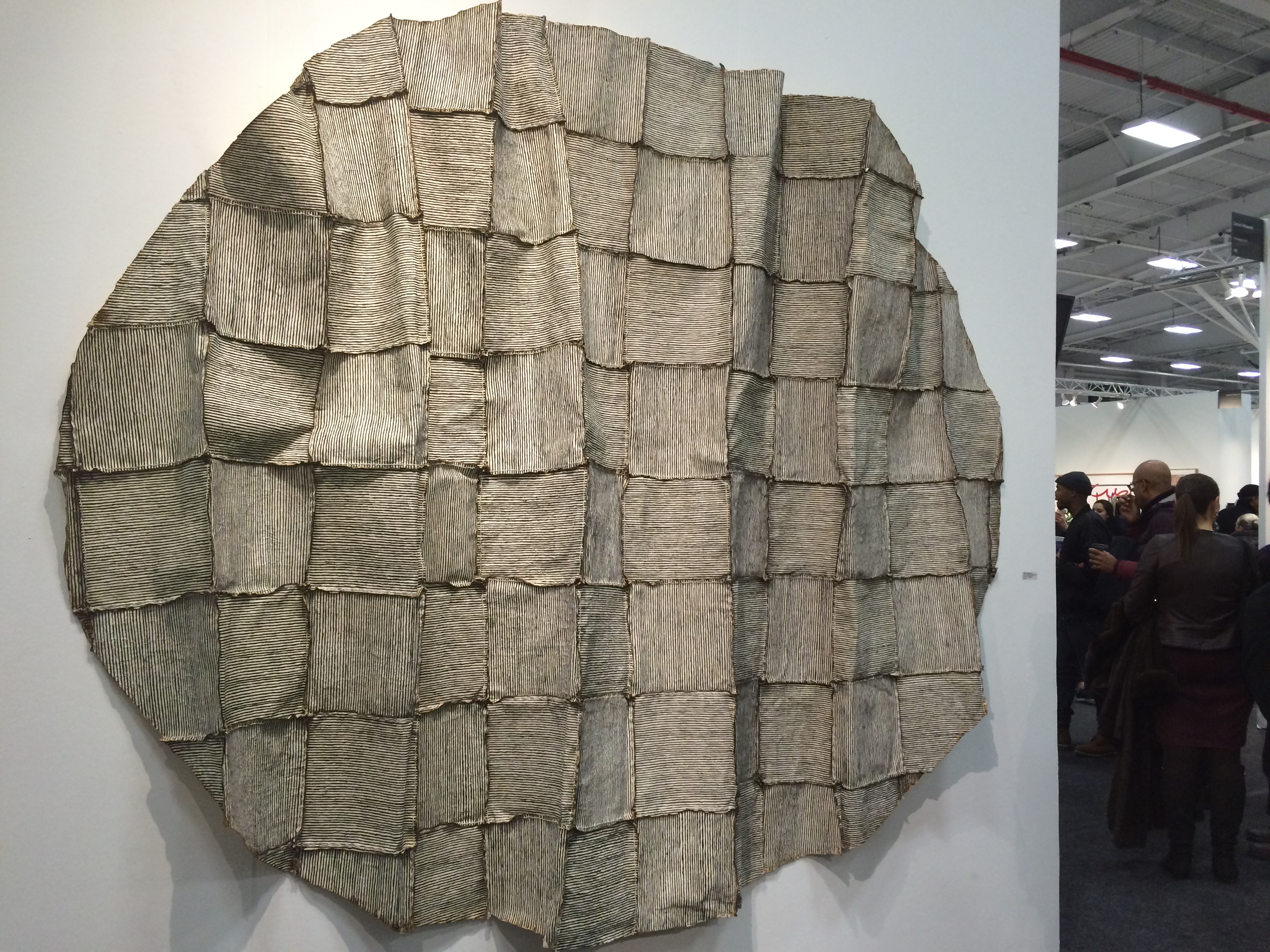
The next day I went to the Art on Paper Fair where I saw this wall hanging “16th Vanishing and Emerging Wall” by Hideho Tanaka at the browngrotta arts (Wilton, CT) booth.
16-10-02

Hideho Tanaka – “16th Vanishing and Emerging Wall” – 2009
Picture courtesy of the gallery and the artist

Although the outer edge of this work is an oval the piece is all about parallel and perpendicular.
16-10-03

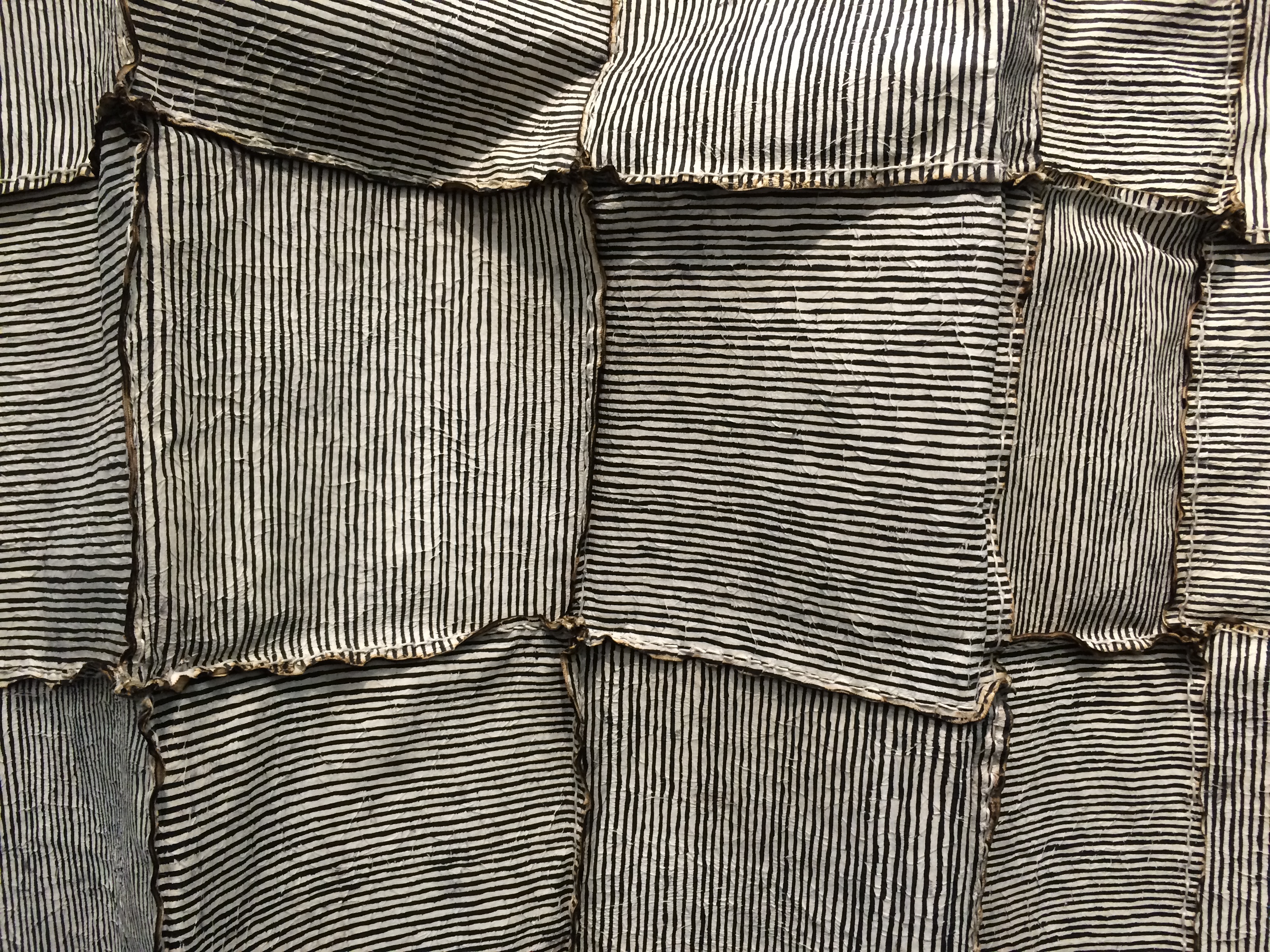
Hideho Tanaka – “16th Vanishing and Emerging Wall” (Detail) – 2009
Picture courtesy of the gallery and the artist

Each of the sections – most are square – are placed so that the parallel lines in each square are at a 90 degree angle with the parallel lines in the adjacent squares  in a similar fashion as the squares in Vitale’s floor sculpture.

Over the course of three days I saw a lot of art and navigated crowds of people. At some points it was bit overwhelming. It was gratifying to see two artists tackle the same geometric theme in two unique ways.

Susan Happersett
Hayal Pozanti at The Aldrich Contemporary Art Museum

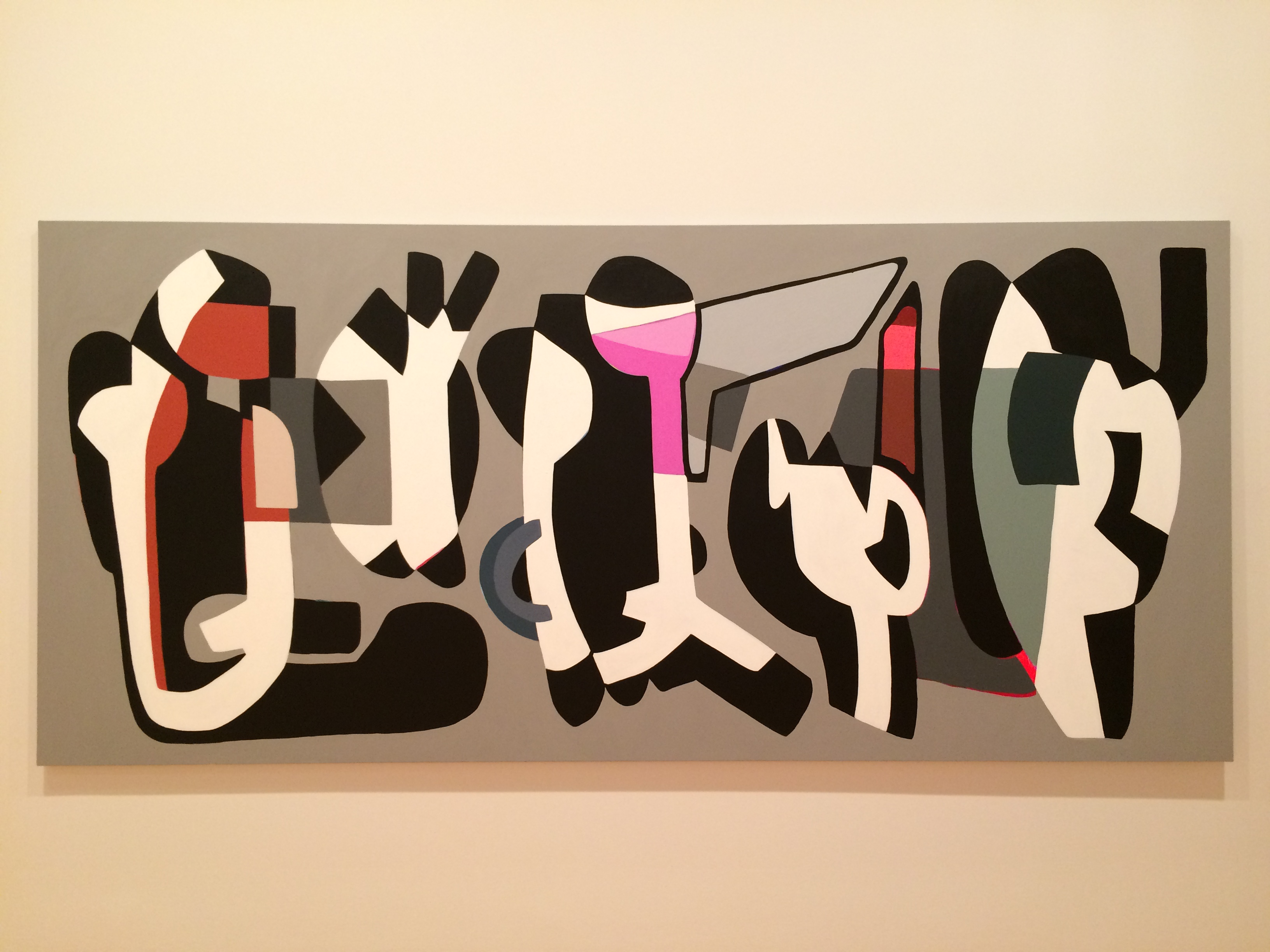
“Deep Learning”,  Hayal Pozanti’s solo show, currently on display at the Aldrich Contemporary Art Museum in Ridgefield Connecticut, features work related to technology and the human experience. Robert D. Hof’s article “Deep Learning” (MIT Technology Review, April 23,2013) is quoted in the catalog: Deep Learning in reference to “software [that] attempts to mimic the activity in layers of neurons in the neocortex”.

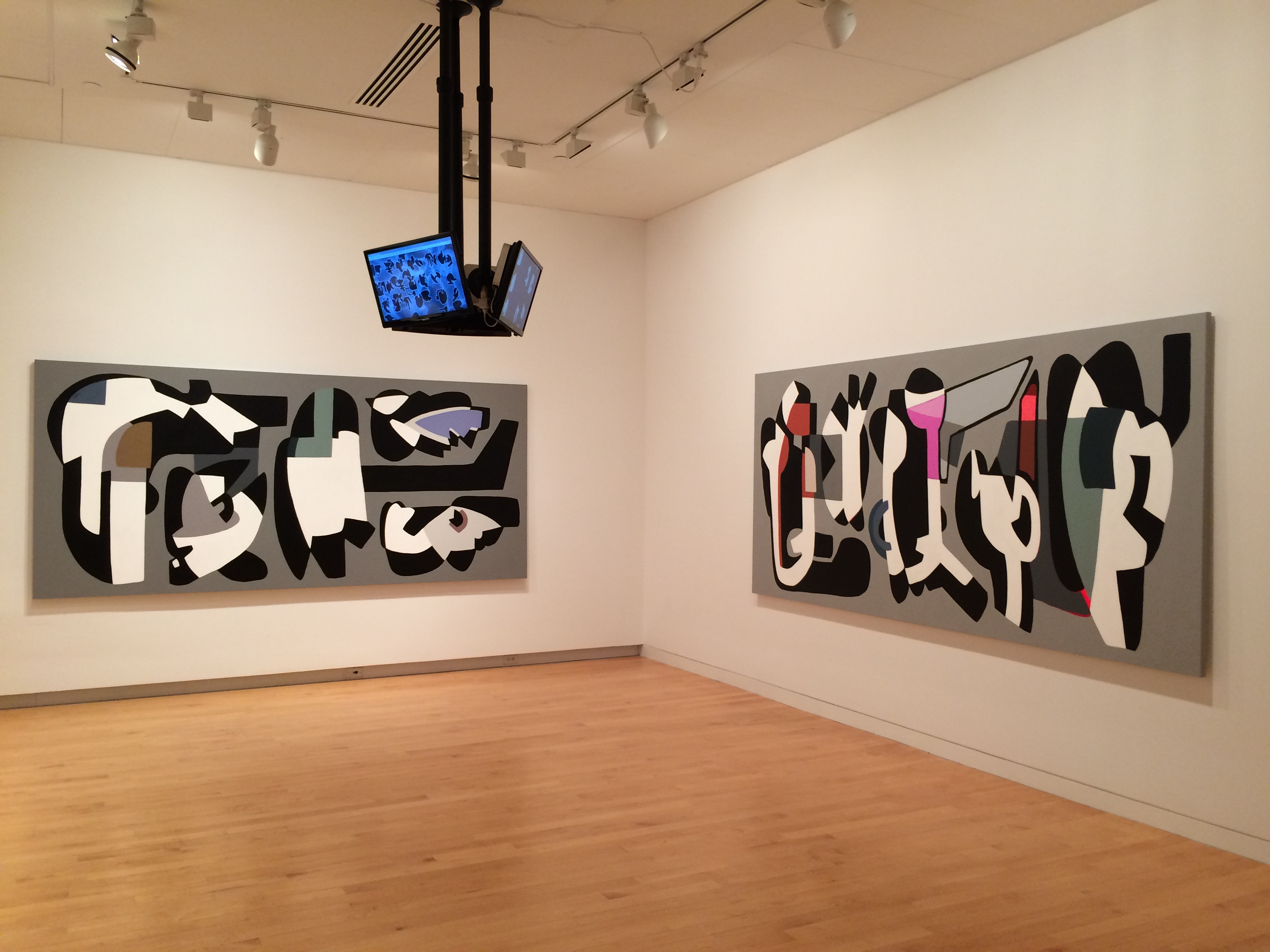
Pozanti employs her own alphabet of 31 shapes named “Instant Paradise” to create paintings and digital animations. Her new, large scale rectangular paintings are the same proportions of a smartphone screen but blown up to almost room sized canvases.

16-09-01

“Sixty Seven” – 2015
Courtesy the artist, Jessica Silverman Gallery San Fransisco and the Aldrich Museum

The paintings are all based on source data that is documented in the curatorial signage. “Sixty Seven” has “Source data: milliseconds it takes for the human brain to form a microexpression”.

Pozanti generates images through a process of selecting and overlapping shapes from her alphabet. The more the images are repeated over time the more recognizable they become. This is similar to the way Deep Learning software operates. All of these canvases were hand painted. Instead of using a computer to create these images, the artist is generating the work in reference to the software.

16-09-02

Gallery View

In the center of the gallery, video screens are suspended from the ceiling above eye level. Their placement and size are like an airport terminal or waiting room. Each screen is playing one of Pozanti’s digital videos featuring images generated from the “Instant Paradise” alphabet. The videos have a sound track of abstract poetry developed by assigning the shapes sounds.

Hayal Pozanti’s work relates to mathematics in two ways. The images have been created using algorithmic rules to explore the permutations of possibilities combining 31 distinct shapes. The paintings and videos are also an expression of computer’s ability to mimic human processes, as well as, how humans react to the technology that is now part of everyday life.

Susan Happersett

Geometric Cabinet at Kristen Lorello Gallery

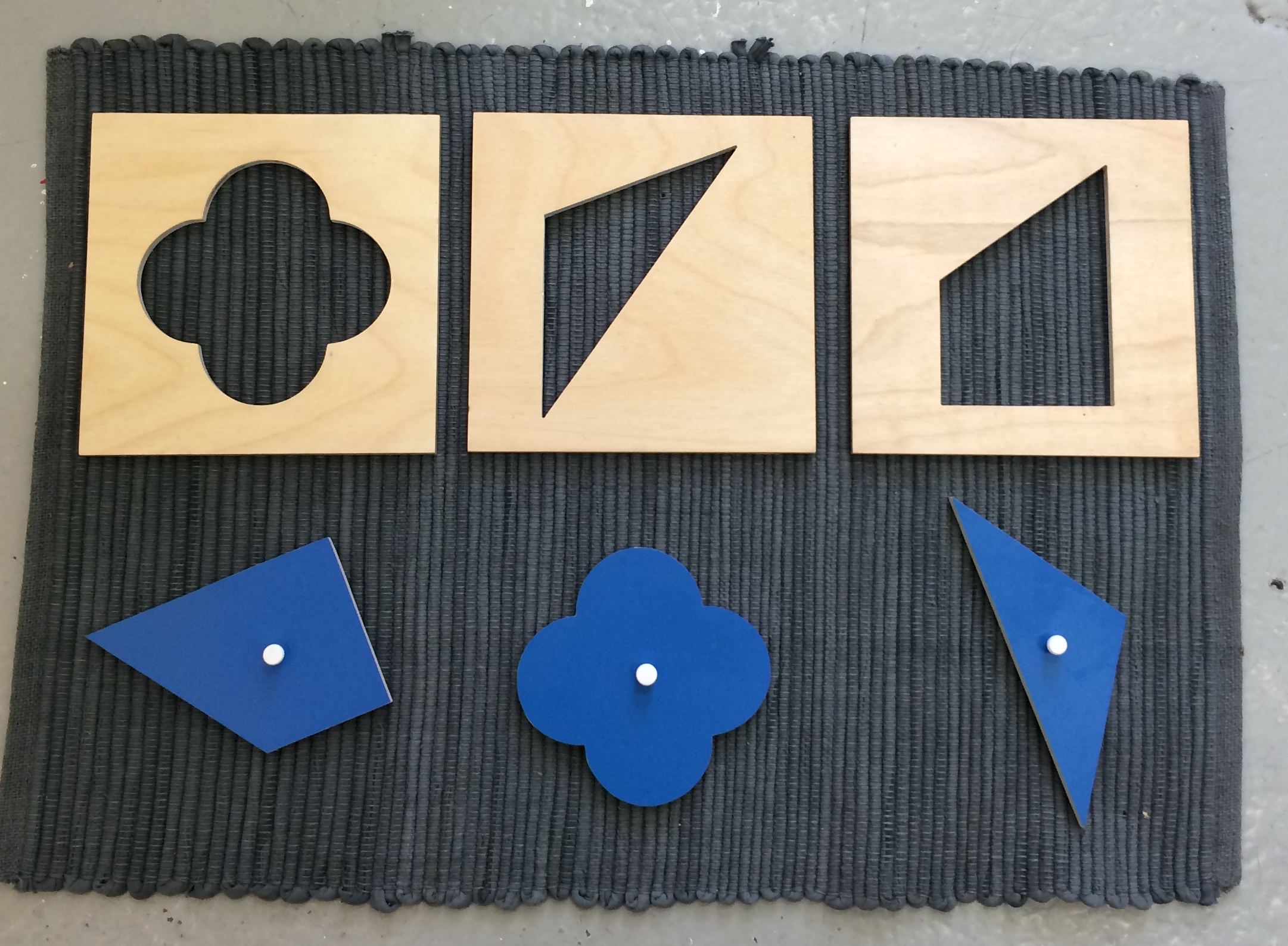
The “Geometric Cabinet” at Kristen Lorello Gallery  is an exhibition based on an instructional tool used in Montessori early childhood education to teach geometry. This tool consists of 6 puzzle-like drawers with removable trapezoids, triangles, quatrefoils, and other shapes. The children learn about the shapes by running their fingers along the edges of the shapes, as well as the process of fitting the shapes into the corresponding cutout frame. Two of these drawers are laid out on mats on the floor of the gallery. Kristen Lorello has curated this exhibition by selection work that relate to these geometric shapes and the prescribed educational activities.

16-07-1

Drawer from a Montessori “Geometric Cabinet”
Picture courtesy of Kristen Lorello

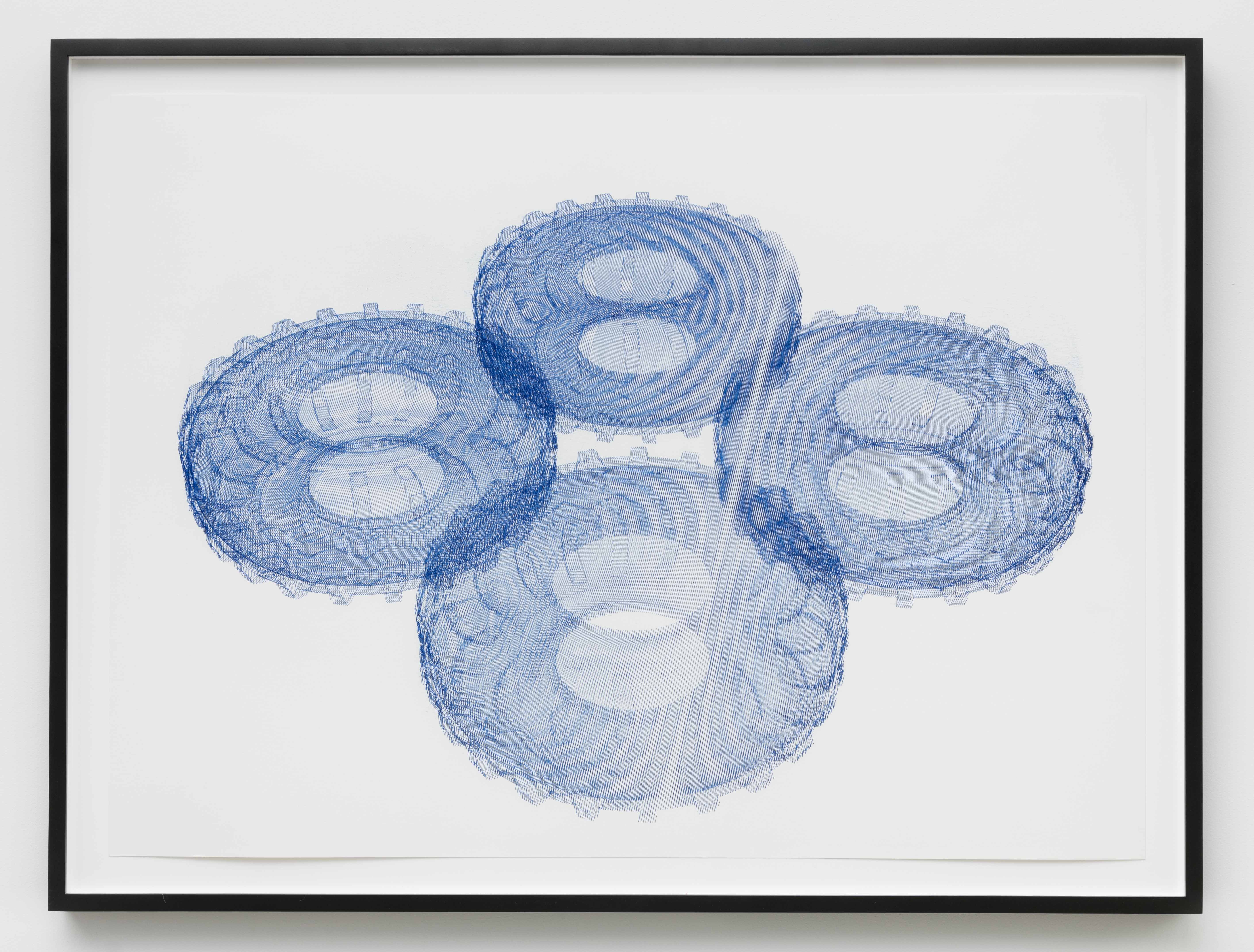
The work of eight artists has been included included in this show. There is a kinetic, rotating, circular stone-like wall sculpture by Rachel Higgins that reminds the viewer of the tactile experience of a young student running their fingers along the curved sides of the circular shape taken from the cabinet. Michael DeLucia has provided a direct response to the quatrefoil shaped piece with his drawing “Quatrefoil” .

16-07-02

Michael DeLucia, “Quatrefoil”, 2016, ink on paper
Picture courtesy of Gallery 11r

“Quatrefoil” features a 2-dimensional depiction of four tire-like tori. A torus is a 3-dimensional topological form that has genus one. This means it has only one hole, like a bagel. The tori have been drawn in perspective so that front single torus is larger and in the foreground. There is a pair of tori in the middle ground and the smallest torus in the background.

Through this work De Lucia has not only referenced the basic geometry of the flat cabinet shape but he elevated the quatrefoil to a complex form. The structure of each torus has been expressed by drawing a series of circles rotating in 3-dimensional space around a circular axis. Adding the tire tread element to the shapes gives the form a textural quality that take the drawing out of the realm of text book figures.

The exhibit Geometric Cabinet has one of the most interesting curatorial premises I have encountered. The history and principles of Mathematics education are a fertile ground for creative interpretation and Kristen Lorello has presented a thought provoking selection and installation to explore these ideas.

Susan Happersett

Drawing Then at Dominique Lévy Gallery.

There are a number of Upper East Side galleries that display museum caliber exhibitions of historically significant art. The current show at the Dominique Lévy gallery “Drawing Then, Innovation and Influence in American drawings of the Sixties” is an excellent example. It features work by some of my favorite artists like Eva Hesse, Agnes Martin, and Cy Twombly. The list goes on and on, there is even a Sol Lewitt wall drawing.

There are two works on display that relate the most directly to Mathematics. Mel Bochner’s “3” from 1966, is an homage to a Sierpinski Triangle. An equilateral triangular grid formation has been strategically filled in with hand written number 3’s and words that begin with letters “Tri”. The positive and negative shapes created delineate the fractal construction of a Sierpinski Triangle.

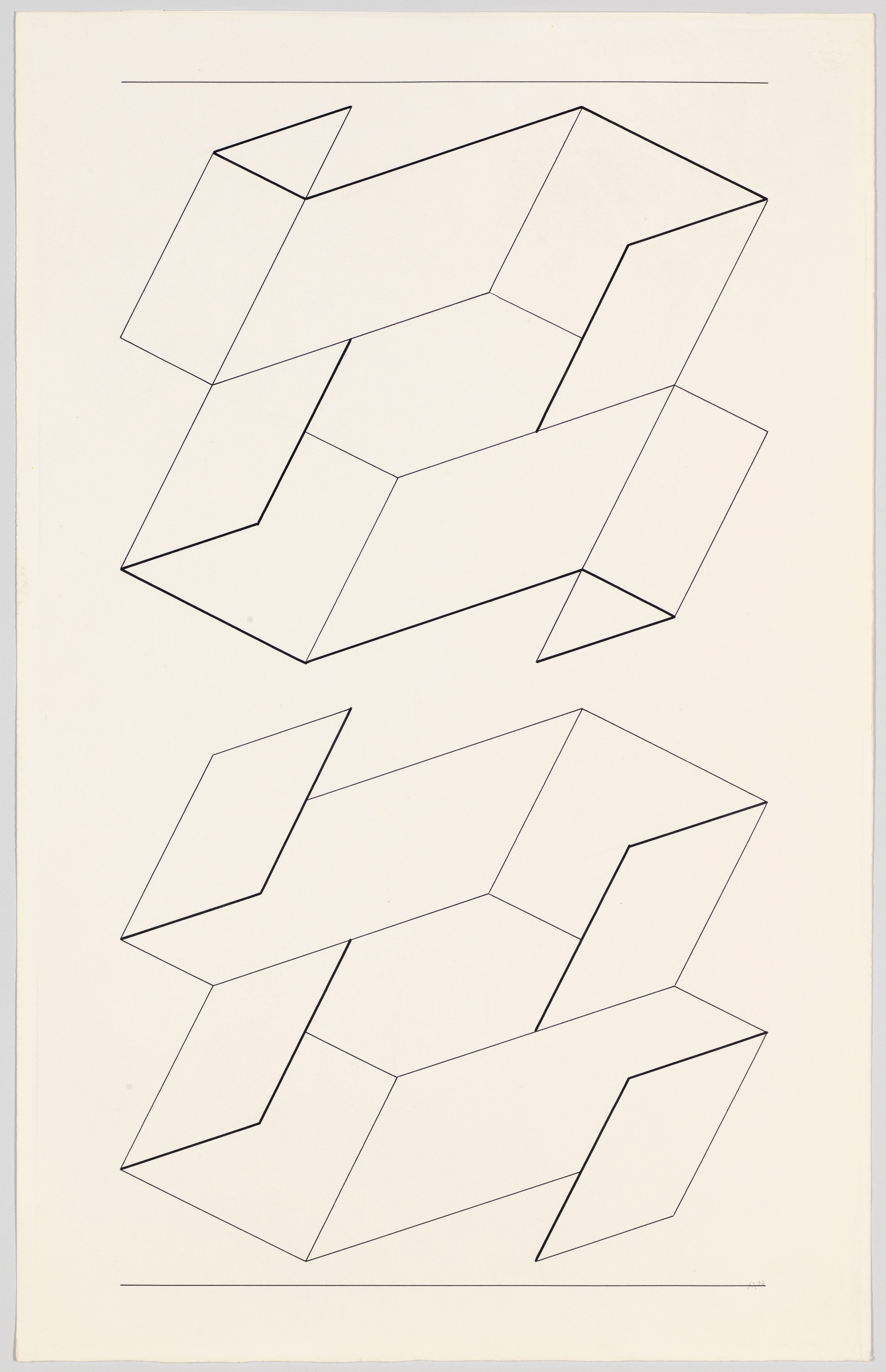
The second drawing is Josef Albers’ “Reverse + Obverse” from 1962. This line drawing  is a 2-D rendering of  3-D constructions.

16-06-01

Josef Albers -“Reverse+Obverse” – 1962
Picture courtesy of the gallery

Both the top and bottom pairs of the figures employ a 180 degree rotation, an order-2 rotational symmetry. This work is a geometric expression of a form turning through space.

This year is the 40th anniversary of the MOMA’s ground breaking 1976 exhibition, “Drawing Now”. The current show at Dominique Lévy gallery is true to this historical reference, focusing on work from the turbulent years from 1960-1969. There is a wide range of work on display from drawings with social commentary, to drawings exploring the aesthetics of minimalism and conceptual rule-based art.

Susan Happersett

Concrete Cuba at David Zwirner

The Group Show Concrete Cuba at the David Zwirner Gallery in Chelsea is an exhibition of historical importance and has been the subject of numerous reviews and editorials. So far I have not read a direct discussion of the Mathematical connections to the art, so here it goes… This exhibition displays  the work of a group of Cuban abstract artists who are referred to as Los Diez Pintores Concretos (Ten Concrete Painters). This group was active fro 1959 to 1961, but the show also includes earlier work to explore the development of Concretism, introducing the viewer to  art work created at a pivotal and complex time in recent Cuban history. Pure hard edge abstraction was counterintuitively a political statement by striving for a visual utopia instead of expressive political themes.

I have selected two works from the extensive exhibition with interesting mathematical subjects.

16-05-01

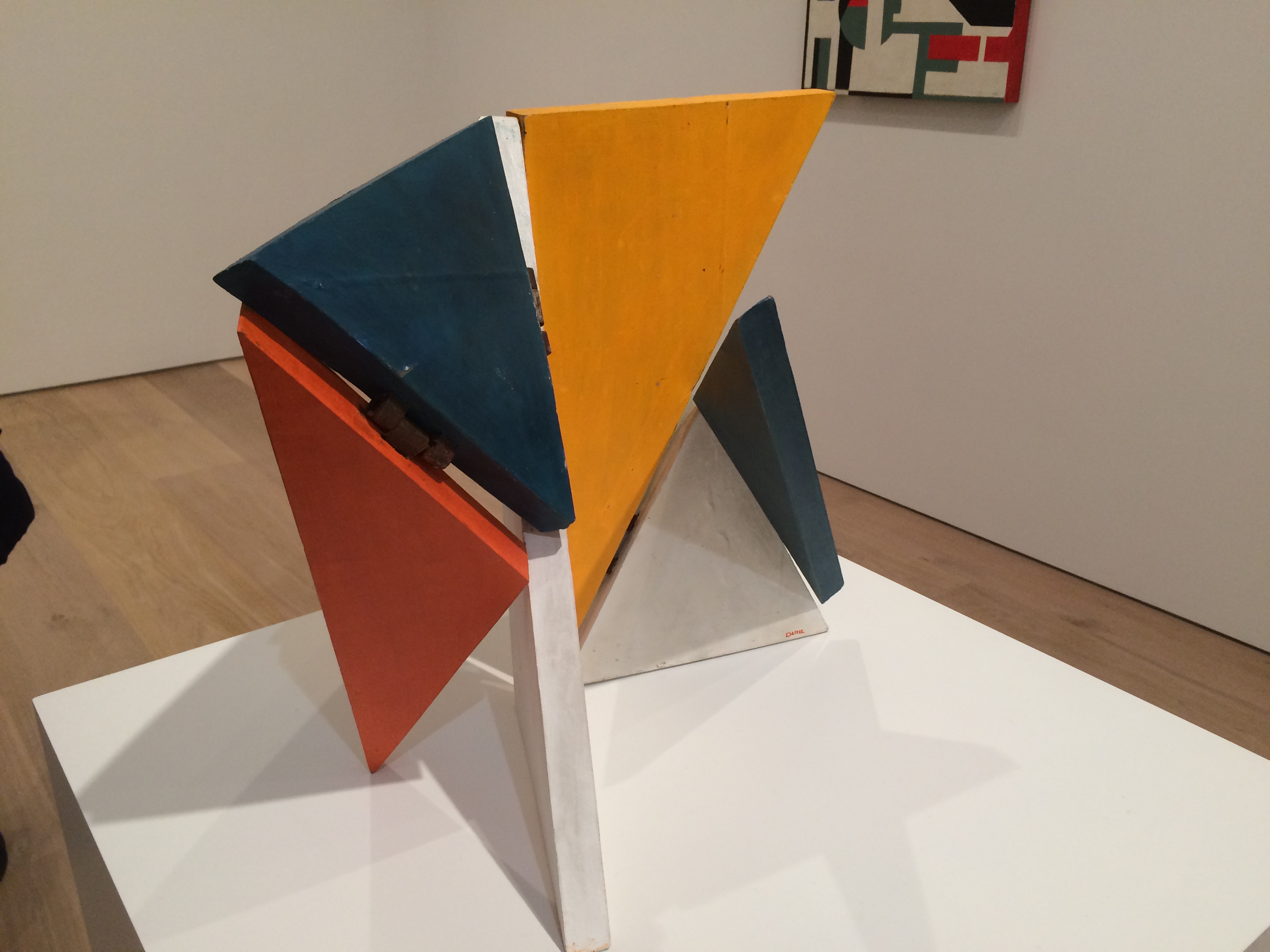
Sandú Darié – “Untitled, Transformable” – 1950 – oil on wood with hinges

This sculpture “Untitled, Transformable” by Sandú Darié consists of six hinged triangles. Depending on your vantage point in the gallery the structure takes on many different forms. Two hinged vertical rectangle have been split and hinged along parallel diagonals. Then, the two outer right triangles have been split and hinged to form equilateral and isosceles triangles. By using different colors for the elements in each half it is not obvious that each side is the same construction with a 180 degree rotation. The sculpture can take on a multitude of shapes through the use of hinges. The artist has used a fairly direct study of triangles to create a work with about how geometry can be visualized with the viewer moving through space.

IMG_2652

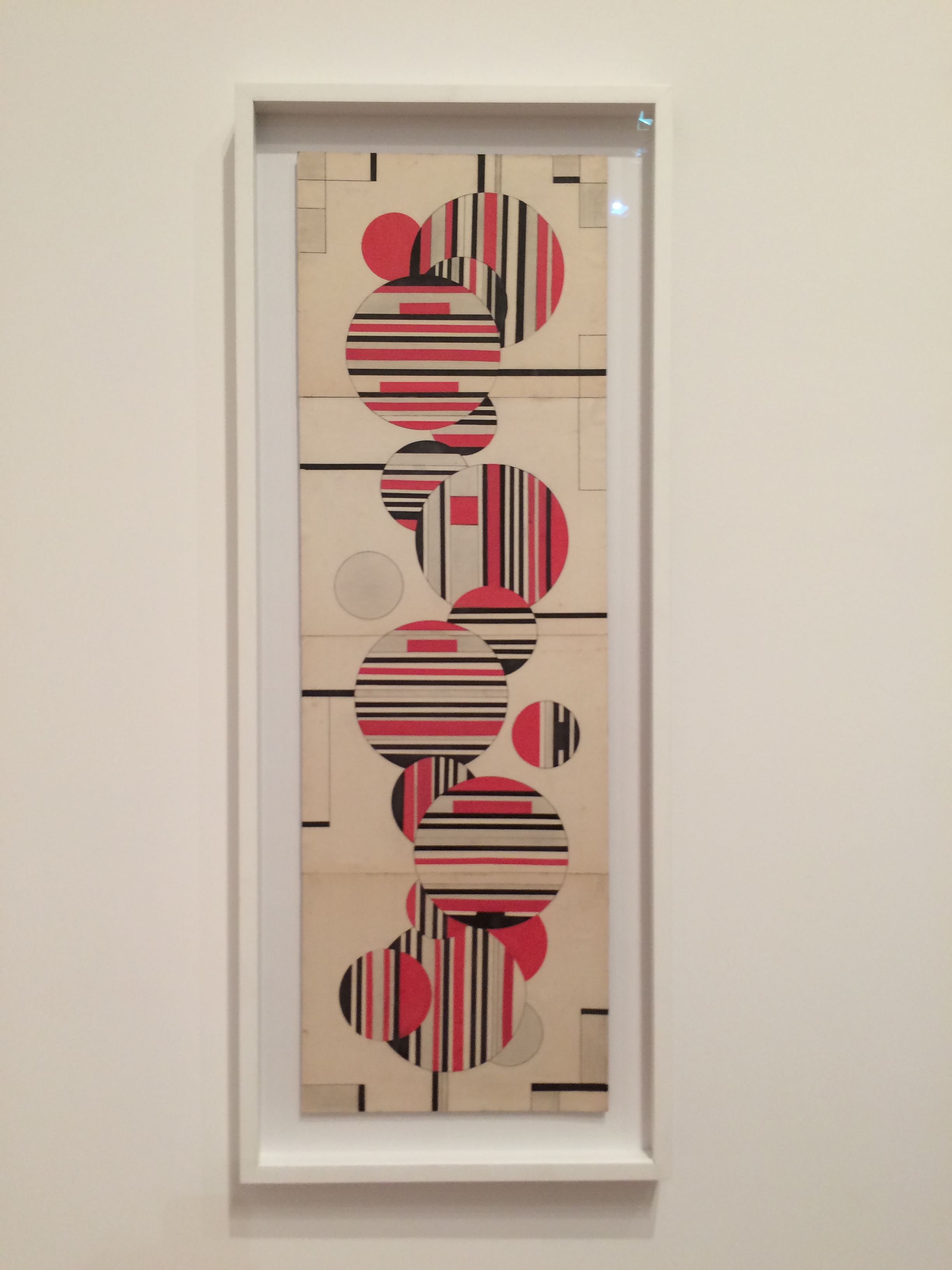
Sandú Darié – “Untitled ” – 1950 – collage on paper

The next example is also by Sandú Darié. It is a collage work on paper. This 1950 work is all about circles. It features a column of overlapping circles. Some of the circles have been divided into red, black and white parallel stripes using vertical chords and some horizontal chords. This makes the circles appear to be twisting 90 degrees back and forth as they tumble down the page. It is the juxtaposition of the linear qualities of the parallel bands of color and the circular cut outs that provide a sense of movement in this dynamic collage.

Much of the work on display at this memorable exhibition employed mathematical themes. These were just my favorite pieces.

Susan Happersett

Chelsea Hrynick Browne installation at Sprint Flatiron Prow Art Space

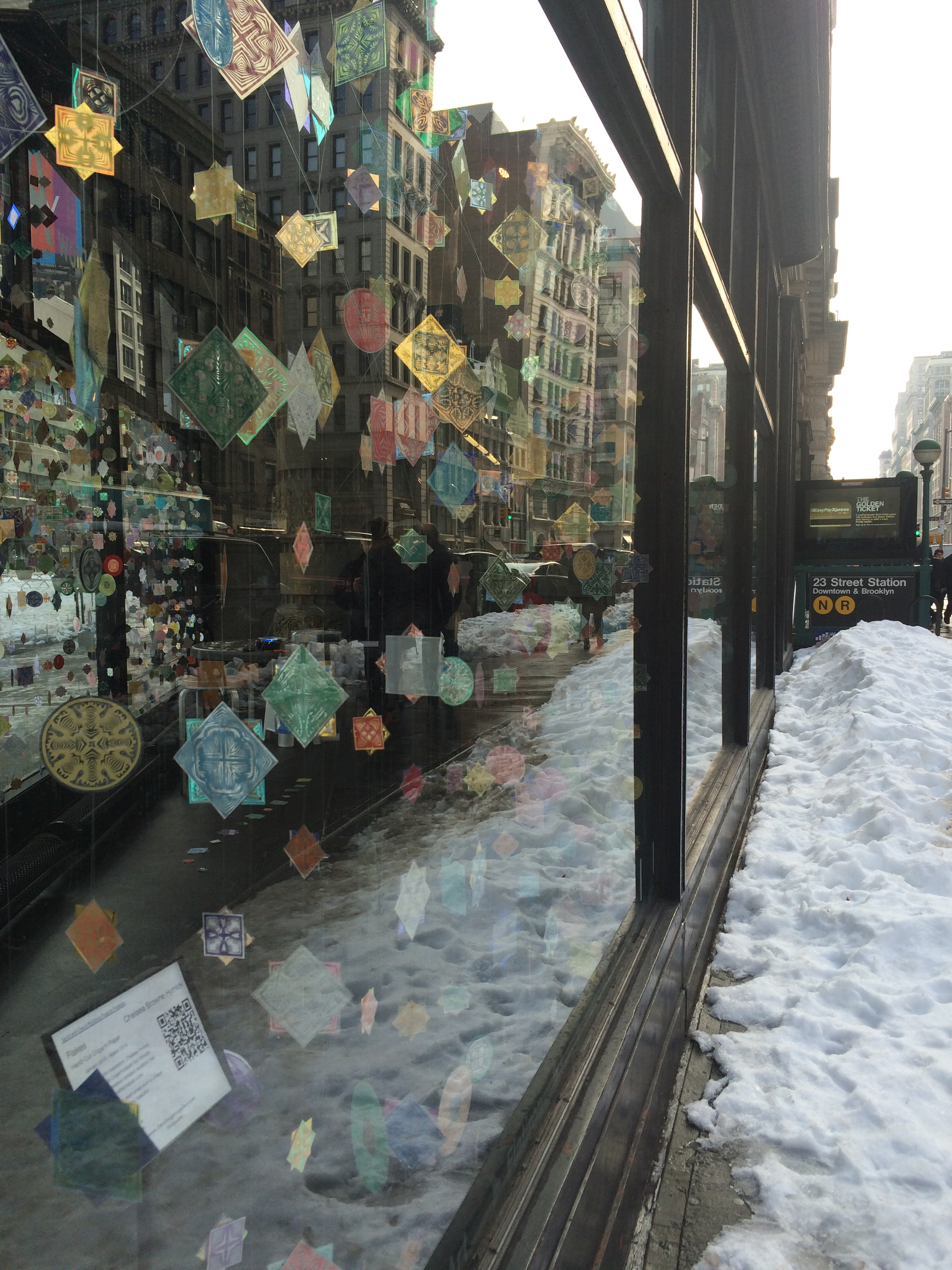
The iconic Flatiron building on 23rd street in Manhattan is home to the Sprint Flatiron Prow Art Space, a bright triangular room of windows, that can be viewed from the sidewalks of both Fifth avenue and Broadway. In coordination with Cheryl McGinnis Gallery, artists fill the space with interesting, temporary projects. This winter, Chelsea Hrynick Browne’s exhibition “Flakes” consists of vertical strings suspended with a multitude paper shapes.
16-05-01
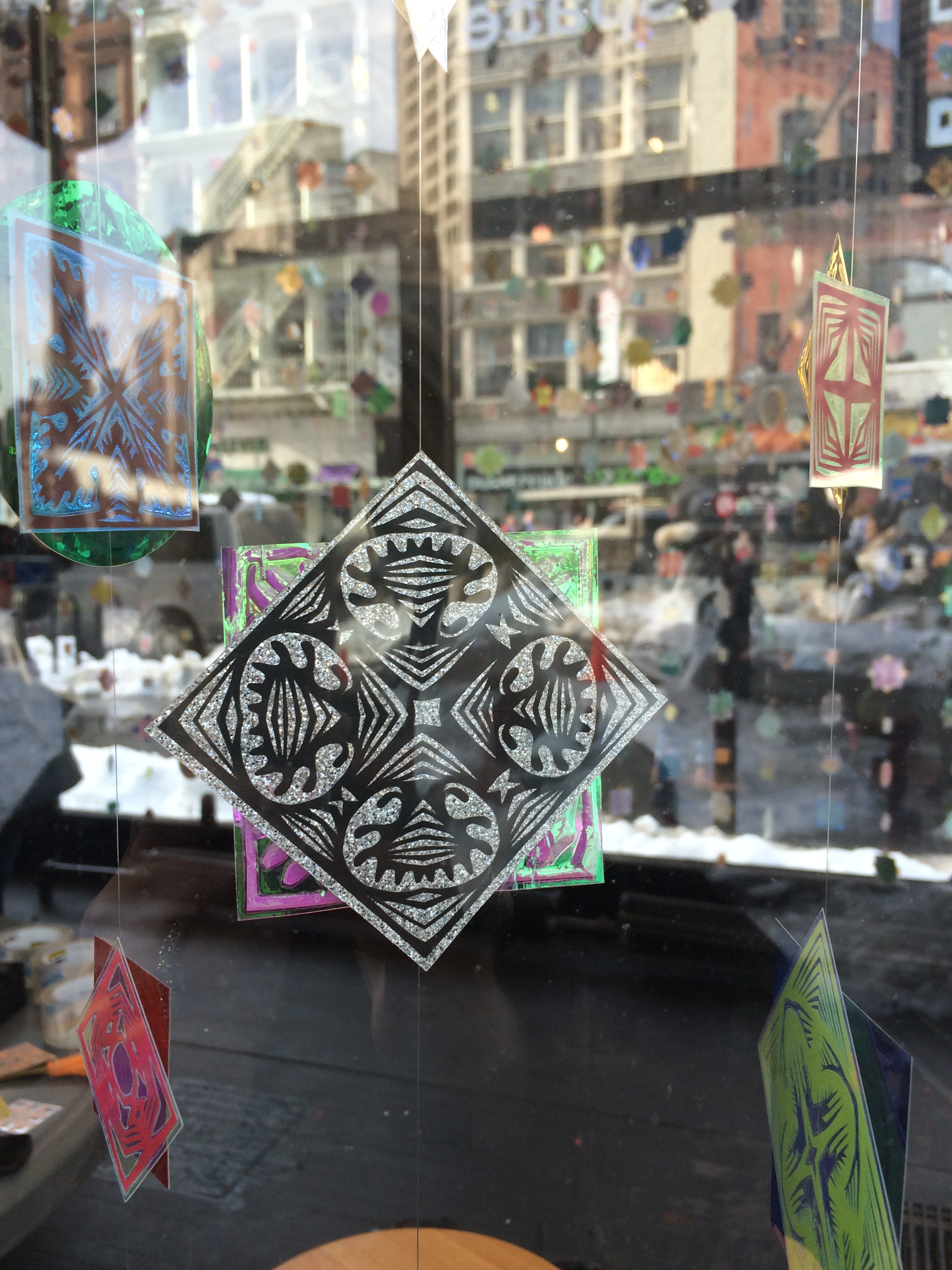
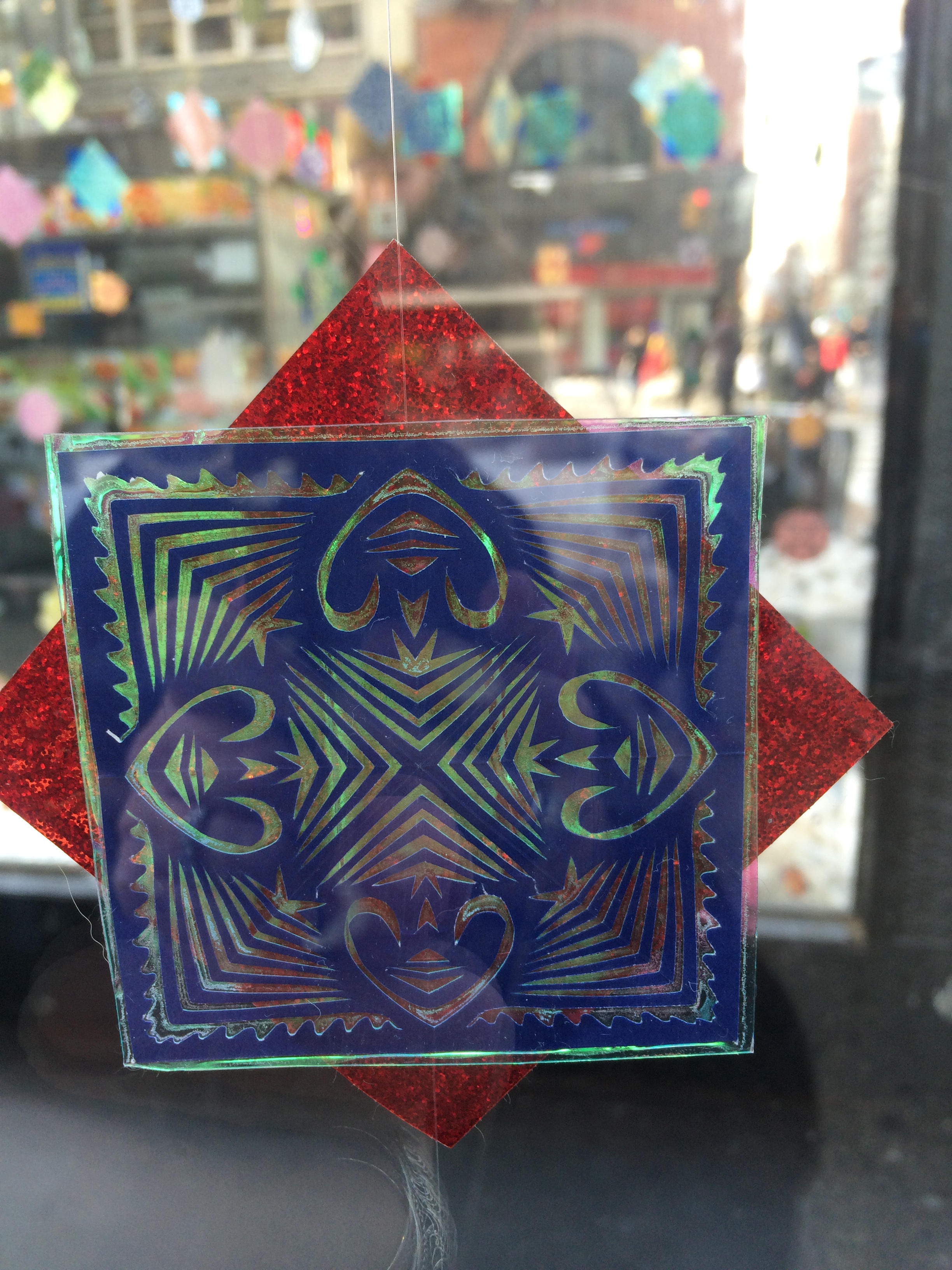
Each two-sided shape is created by cutting and layering pieces origami paper. Browne’s intricate paper cutting relies on Mathematics to create the symmetrical patterns.  These two examples each feature order-4 rotational symmetry. The use of contrasting colored papers affords an interesting expression of positive and negative space.

16-05-02
Each of the flakes is two-sided. Some flakes are circular and others are square, but my favorite flakes have 16 sides. These extra special flakes are formed by two back-to-back square paper cuts with a 45 degree rotation.

16-05-03

“Flakes” is a terrific installation for Winter in NYC. Each of the paper cut outs is different and they colorfully beckon to pedestrians navigating the snow and grey slush. I stumbled across this display and it made my whole day better. I am always amazed and happy to be able to find so many great examples of Mathematical art as I go about town.

Susan Happersett

Sjoerd Hofstra with Karen O’hearn at Rare

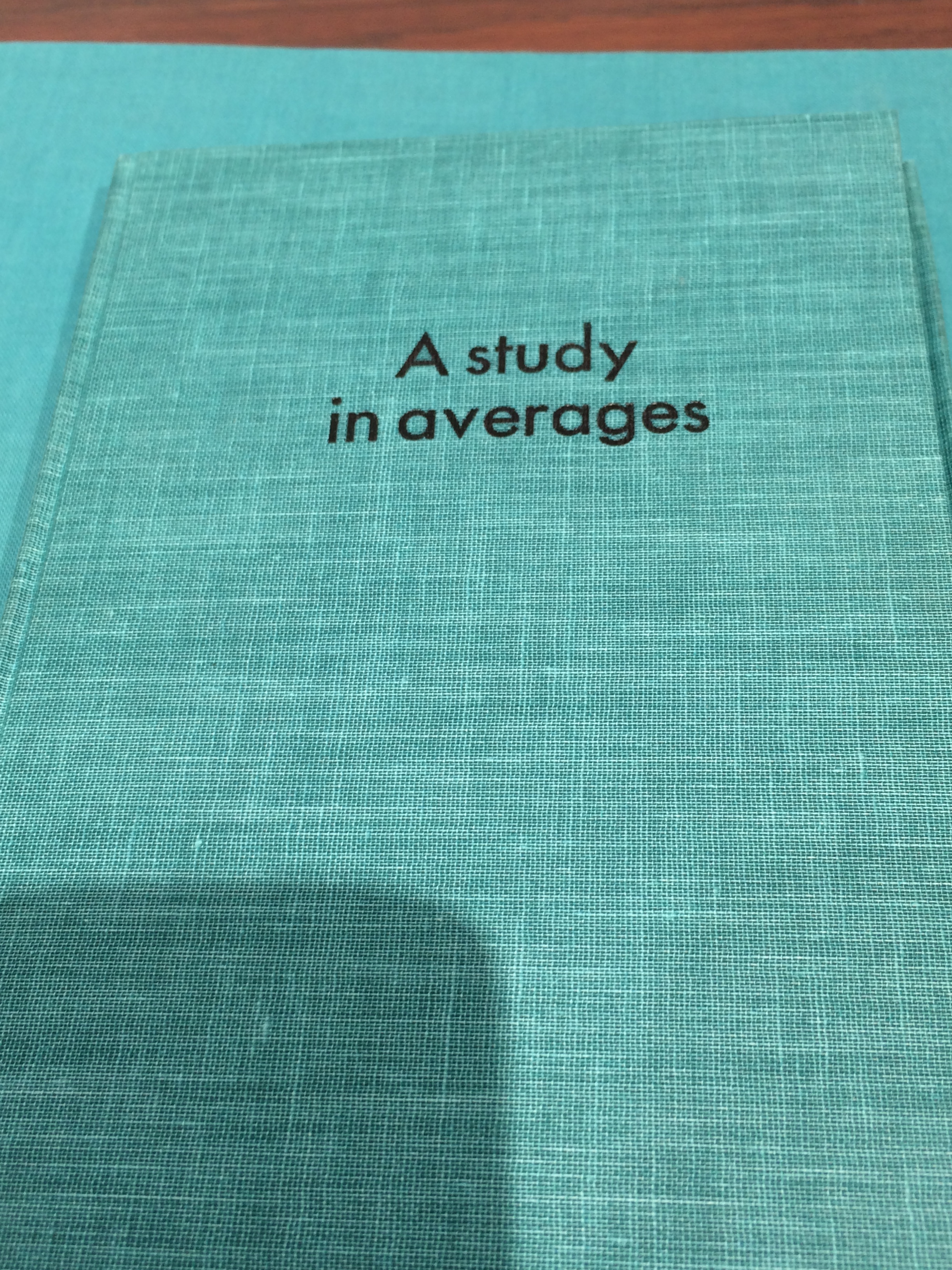
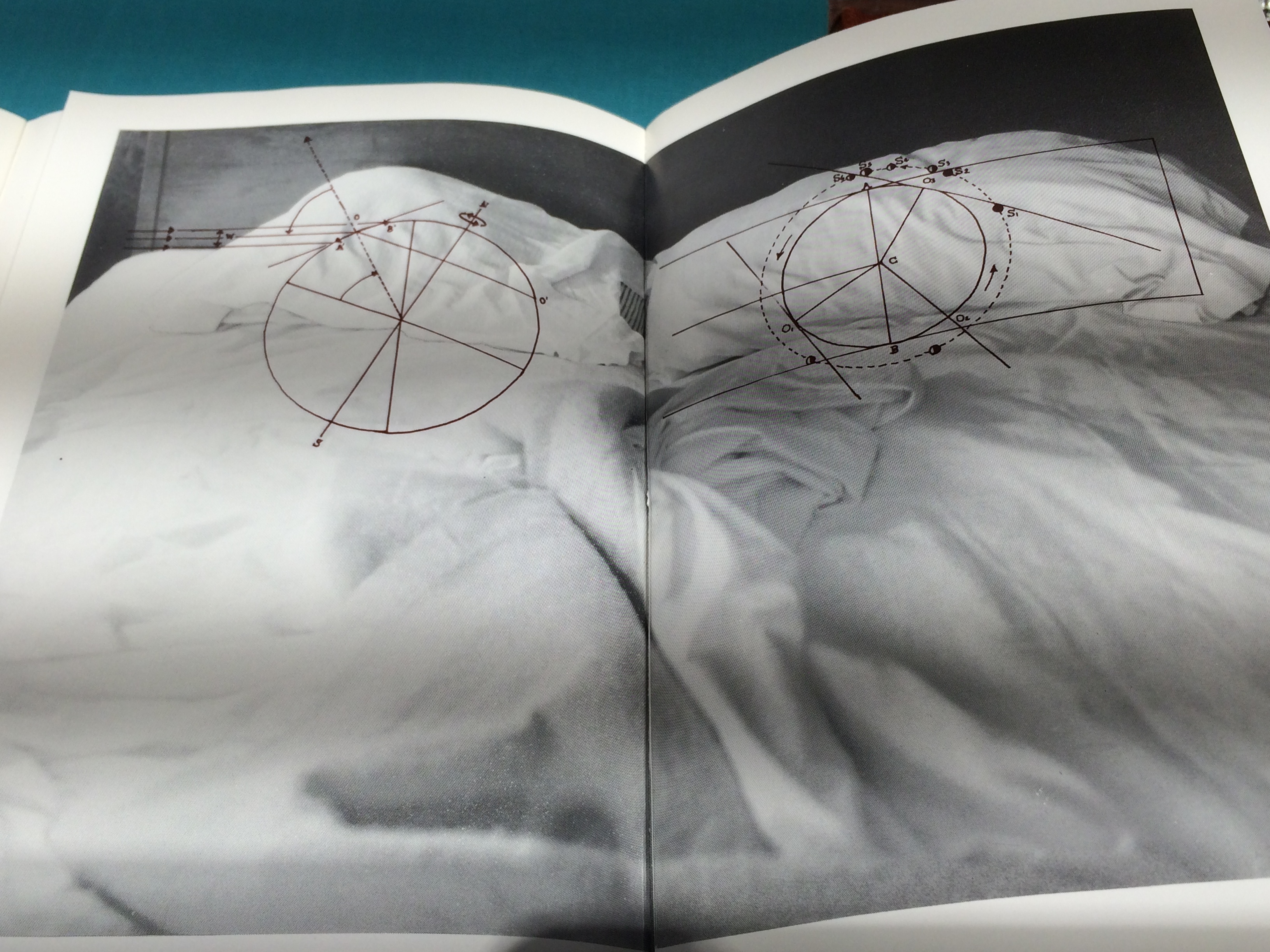
Glenn Horowitz Bookseller’s gallery Rare is currently showing the work of Sjoerd Hofstra with Karen O’hearn. On display are some of their artist’s books, featuring finely engineered kinetic elements. The subject matter of these books is directly mathematical. “A study in Averages” is a schematic treatise on the relationship between averages and society.

16-04-01

16-04-02

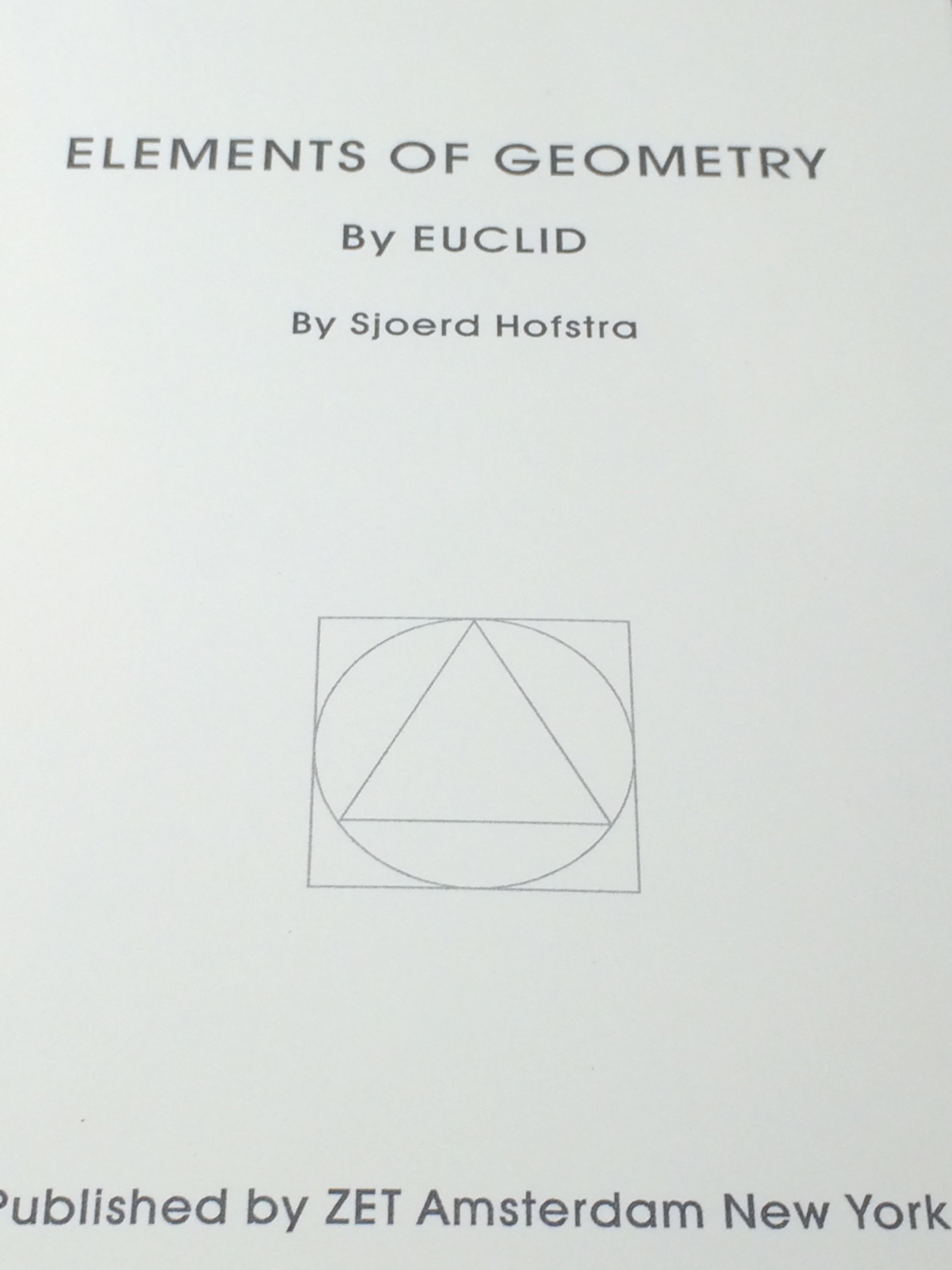
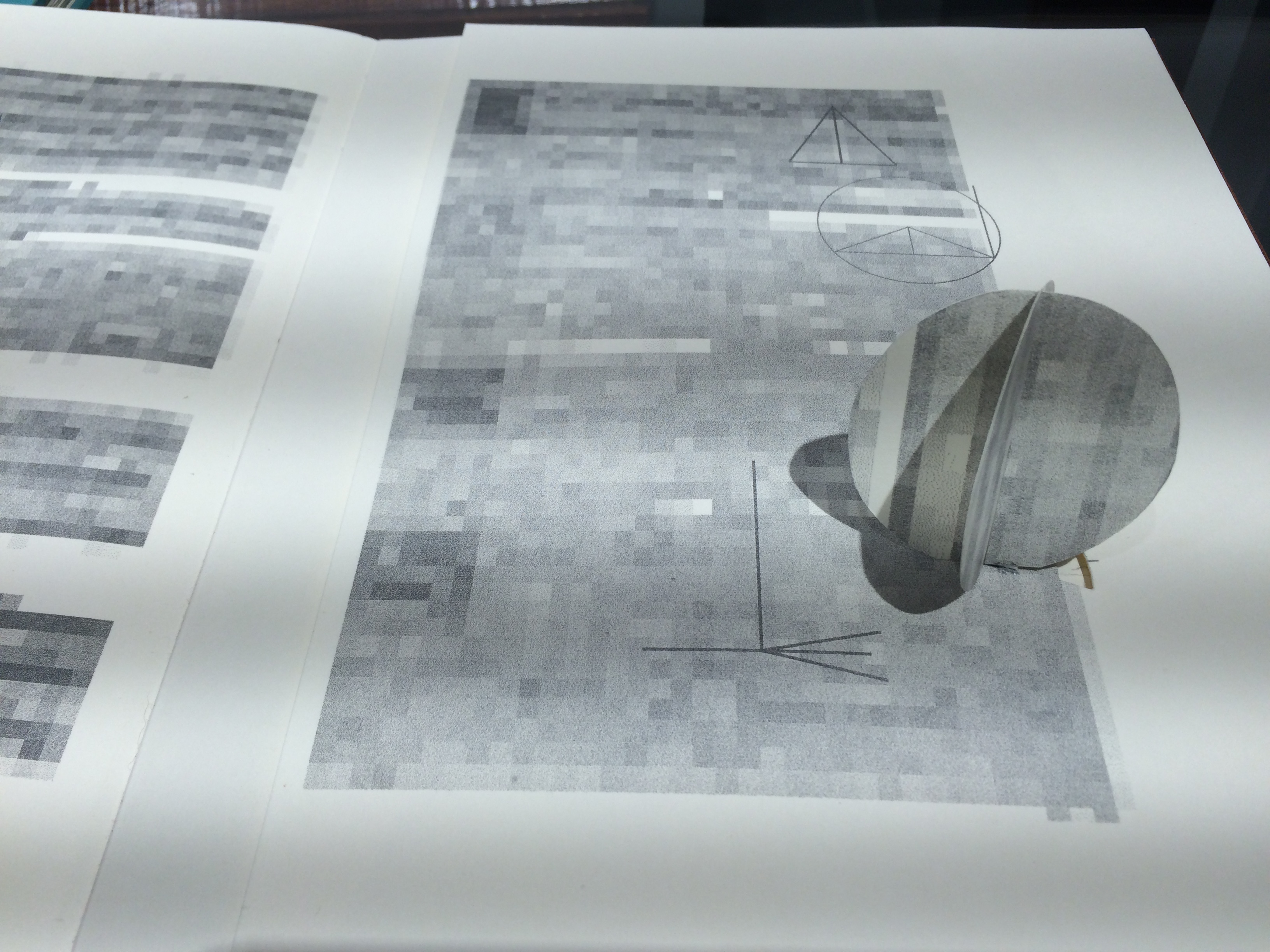
“Elements of Geometry by Euclid” includes pop-ups of the geometric solids. The mathematical texts have been blurred and instructional line drawings have been added.


16-04-04

16-04-03

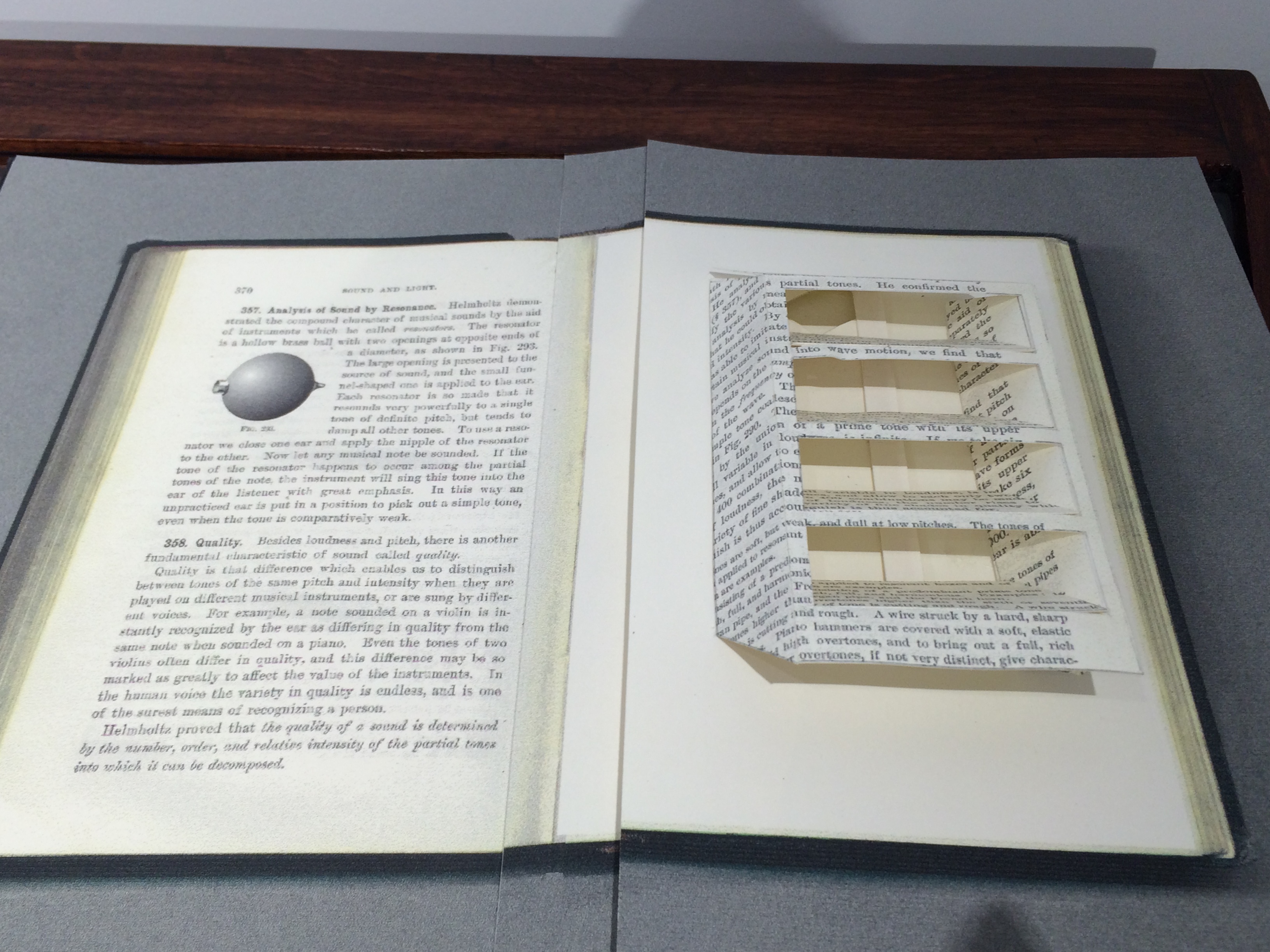
“6 Empty Bookcases” is more architectural, but each of the bookcases presents interesting geometric 3 dimensional properties as it folds off the page.

16-04-05

What I find refreshing about Hofstra’s and O’hearn’s books is the clear unabashed connection to the mathematics. Whether addressing the societal implications of the use of averages, or creating their own interpretation on the historical Euclidean text, or using sophisticated calculations to build their geometric bookcases, the artists embrace mathematics.

I realize how difficult it is to see the true interactive nature of these books through my inadequate photos. The artists have provided a video link so you can see their work in action.

Susan Happersett

Lori Ellison at McKenzie Fine Art

The use of repetitive geometric patterns is a prevalent theme in abstract art. Lori Ellison’s paintings and drawings celebrate the hand of the artist, featuring a lyrical, hand drawn quality. Through the use of basic geometric shapes Ellison created lively compositions that hum, buzz and pulsate. The current exhibition at the McKenzie Fine Art gallery include small scale paintings on wood panels and drawings on notebook paper. All of this ambitious work was completed the year or so before the artist’s death in 2015.

16-03-01
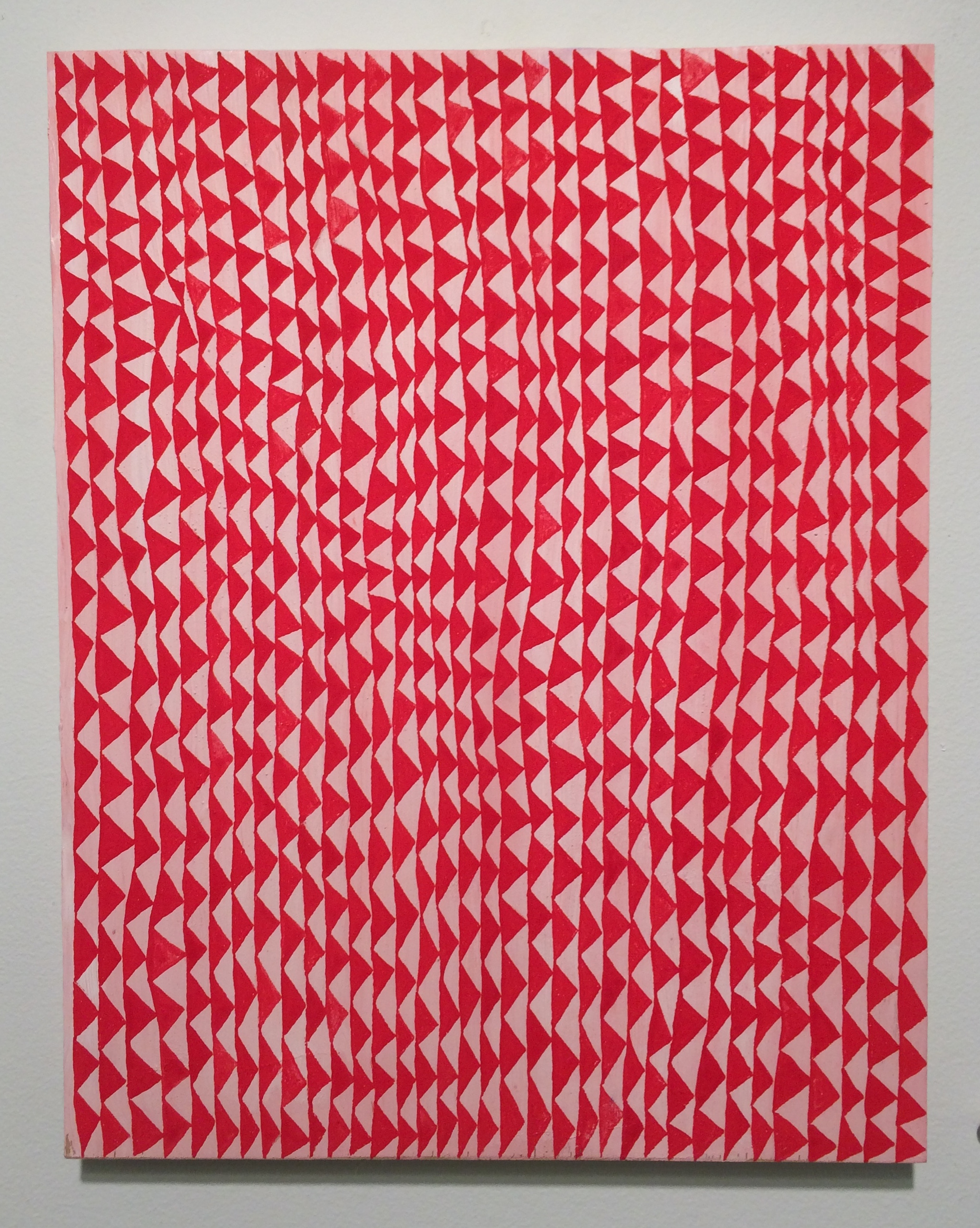
This gouache on wood panel from 2015 measures 14 x 11 inches. Its compact format holds a profusion of triangles. The almost parallel columns of almost isosceles triangles are packed tightly on the plane. Alternating the the red and pink shapes, all of the red triangles seem to point right and all pink ones point left. This forms an interesting dialogue between positive and negative space.

16-03-02
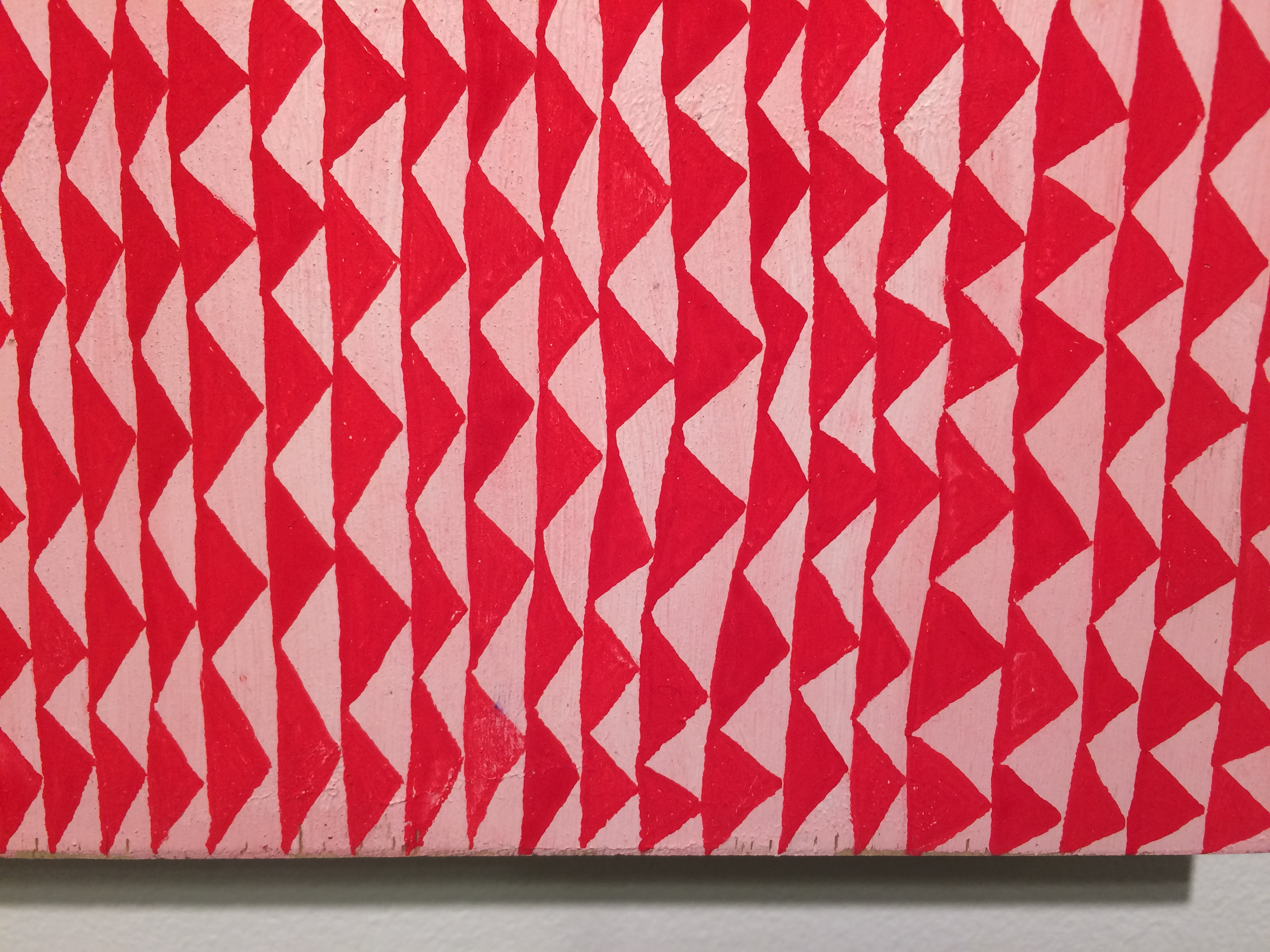
In this close up of the same panel we can see more clearly that this work is not about the accurate measurement of pure clean geometry. It is some ways more complicated, more human. This is definitely a painting about lines, triangles, positive and negative, but it is also about the artist. The personal scale makes the viewer stand close to the work and be drawn into the patterning. Art can be about mathematics with out having to use a ruler or striving for perfection.

Susan Happersett

Gao Rong at Klein Sun Gallery

The current exhibition in the North gallery room of the Klein Sun Gallery is called “The Simple Line”. The show features the work of Beijing artist Gao Rong. Each of Gao Rong’s installation pieces is based on a circular hoop framework. Threads are stretched across the circle from evenly placed locations around the circumference. Although the basis of her subject matter is circular, through careful placement of the threads Gao Rong is able to create geometric arrangements featuring straight lines and angles.

16-02-01a

This work contains a square grid of nine squares with the center square darkened with the overlapping of many lines of thread. this work at first appears to have two axis of reflection symmetry but this is only superficial. Upon closer inspection we see that some of the corners of the of the squares are much darker than others and taking that into consideration there is an order-2 rotational symmetry.

16-02-02

The next work is based on triangles. Starting at the bottom with single unit  isosceles triangle, then moving up the structure, this single unit is overlapped by a triangle with a base twice as long. The next overlapping triangle has a base three times the length of the initial triangle Each subsequent triangle gets larger but also lighter in color. The shape seems to fade into the top of the circular frame.

There are two sets of theoretical juxtapositions in Gao Rong’s work. First and most is obviously the fact that the work illustrates linear structures within a curvilinear environment. Second, there is also the social statement of the use of colored thread, traditionally seen in women’s decorative needle work, to create very structured geometric diagrams that are heavily influenced by Mathematics.

Susan Happersett

Frank Stella at the Whitney Museum

Happy New Year!
I decided to start 2016 with a big show and the Frank Stella exhibition at the Whitney Museum definitely qualifies as a really big exhibition. When the elevator door opens into the first gallery,the viewer is met by two very different canvases: a large, geometric, consecutive squares painting, and a huge abstract that is exuberant to the point of being Baroque. The dichotomy of these two works highlights the the range of styles and themes explored throughout the galleries. On display are the all black paintings from the late 1950’s, as well as the colorful geometric square-and-shape canvases from the 1960’s. Also included are the wall sculptures from the 1980’s and the more recent work created using 3-D printing.
For the purposes of this entry I decided to concentrate on Stella’s paintings from the 1960’s. These works are clearly about geometry. Some of the artist’s sketches and schematic diagrams are on display as a group. I highly recommend taking a close look at these plans, they really highlight the mathematical processes involved in the paintings.

16-01-01

Stella – “Jasper’s Dilemma” – 1962

The two canvases of  “Jasper’s Dilemma” each have the same  spiral geometric structure, but the left canvas features a system of the color spectrum, while the right canvas is composed of shades of gray. Stella has built these spirals within the squares by creating two sets of isosceles triangles. The set with vertical bases are slightly larger than the triangles with the horizontal bases. This results in only one diagonal line on each canvas and the four triangles do not all meet at the same point.

16-01-02

Stella – “Empress of India” -1965 – Metallic powder in polymer emulsion on canvas

“Empress of India” is a monumental shaped canvas featuring a series of four V-shaped sections, each featuring a line of reflection symmetry and a 60 degree angle at the point of the “V”. There is also an interesting line of order-2 rotational symmetry running diagonally through the center section of the work.

Both “Jasper’s Dilemma” and “Empress of India” spotlight Frank Stella’s dedication to developing complex geometric structures in his work during the 1960’s.

Keep posted for many more observations on Mathematics and Art in 2016

Susan Happersett