Author: Susan Happersett
This year the Bridges Math Art conference was held at the University of Waterloo in Ontario, Canada. To coordinate with the conference, the University Art Gallery (UWAG) presented the exhibit “Passage + Obstacle”, featuring work that addresses the mission of the Bridges organization, as well as metaphorical bridges that allow transport over obstacles.
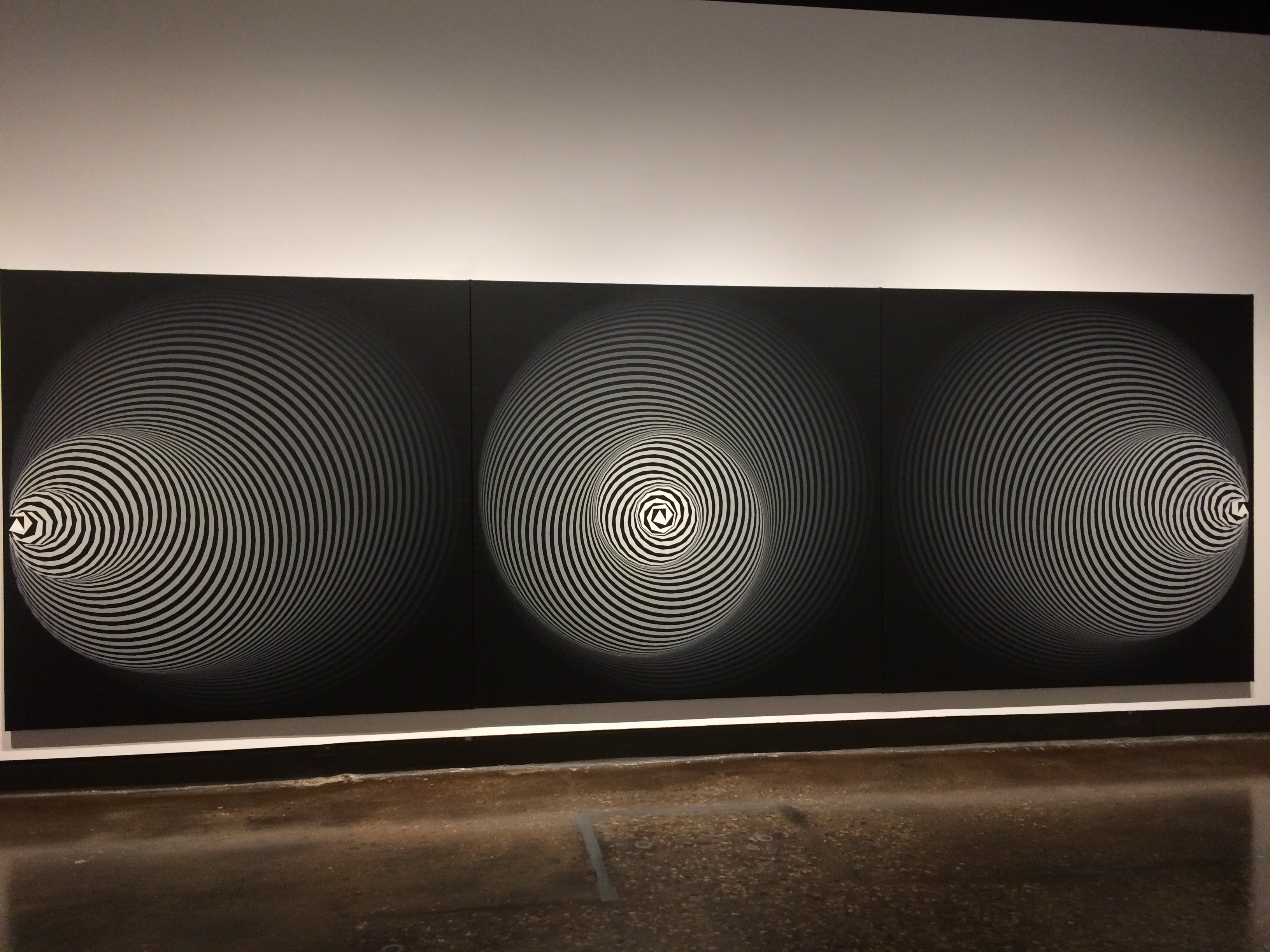
In Andrew James Smith’s triptych painting “Protogon Shift”, each of the three canvases begins with a triangle at its center. A series of 98 polygons are connected to form a spiral composed of all straight lines. Leading us from the most basic polygon (triangle ) to the most complex.
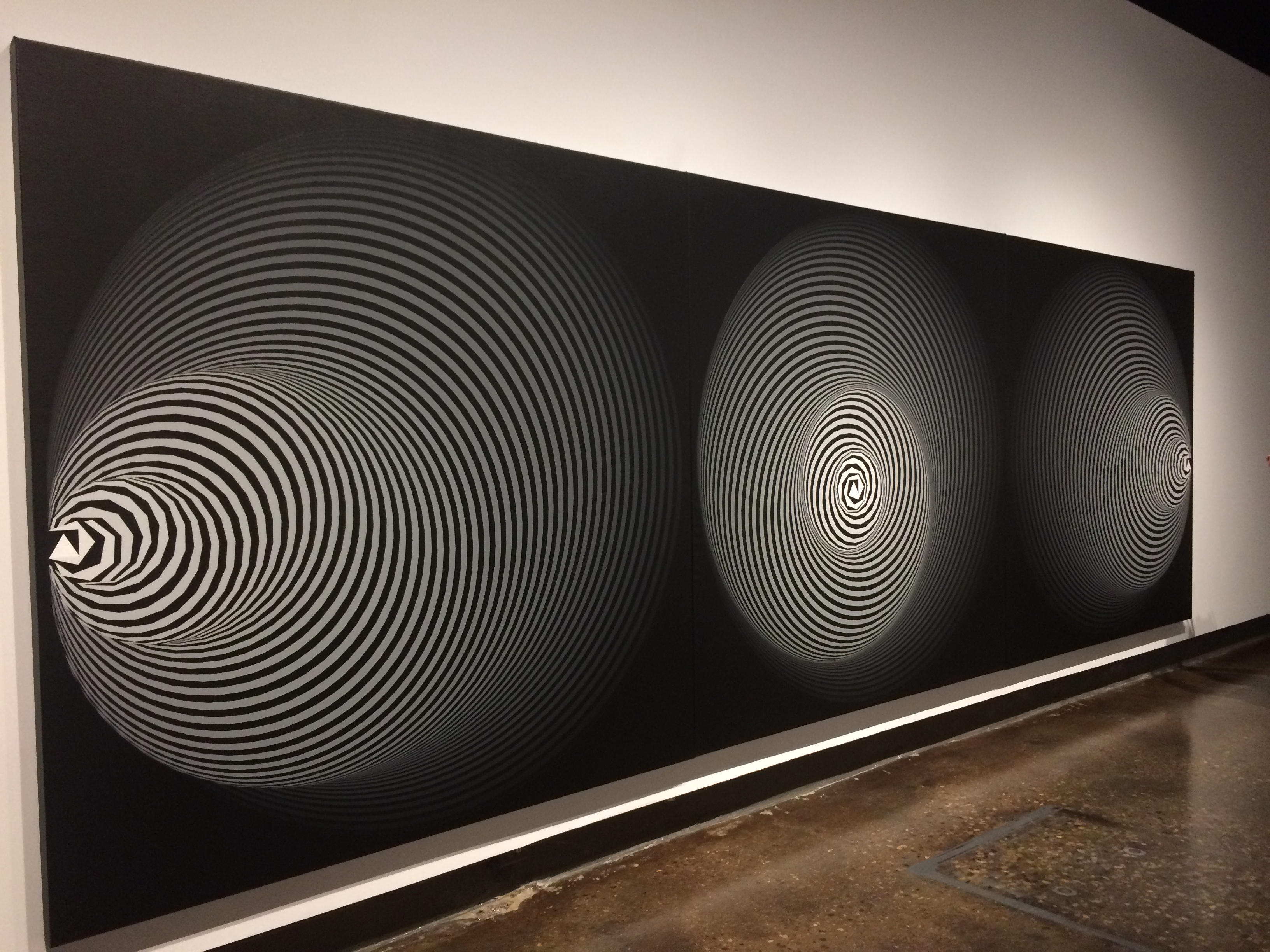
The images changes appearance depending on the viewer’s vantage point in the gallery.
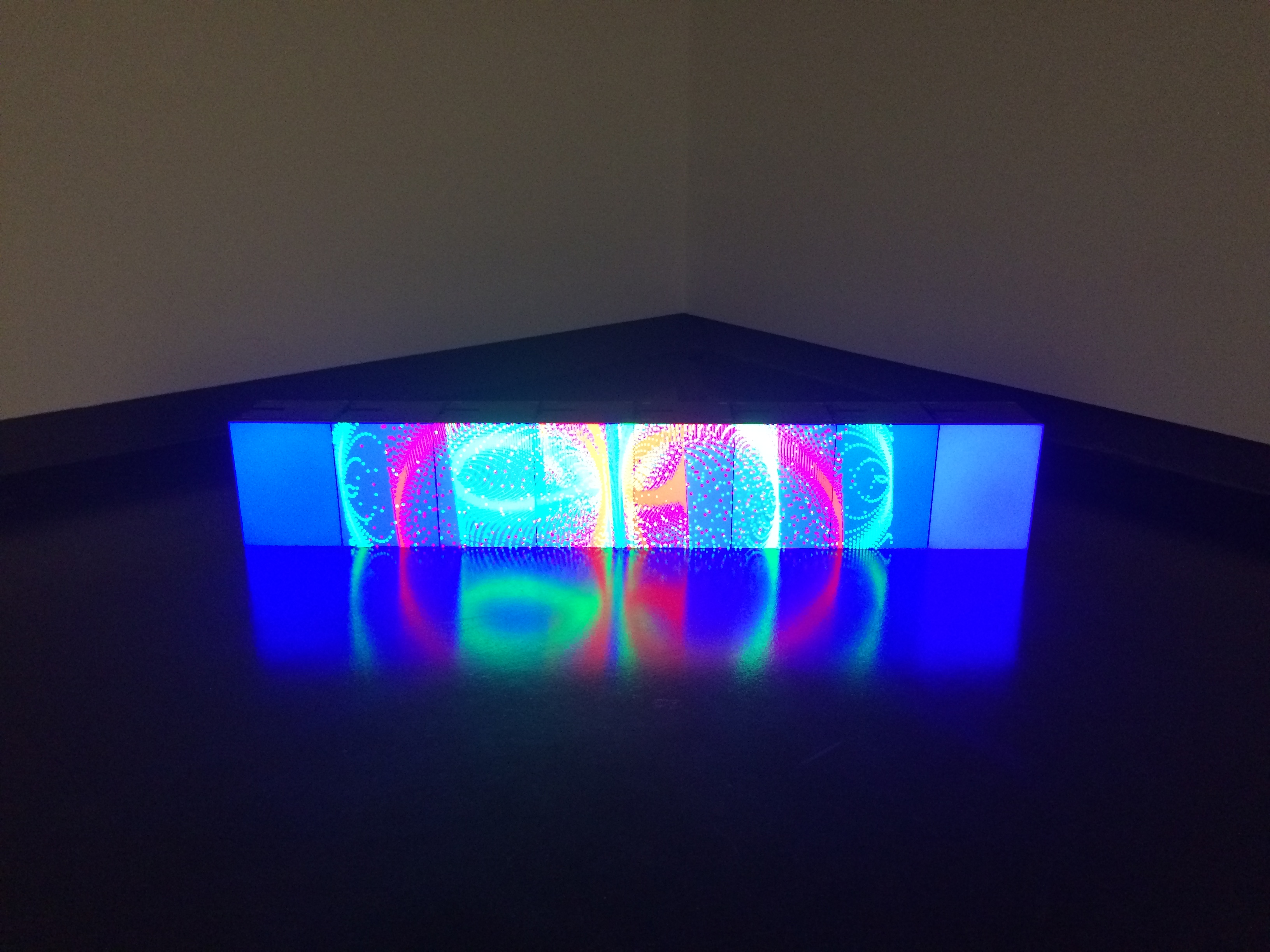
Laura De Deckers video “Composition in Red, Green, And Blue” was created using custom computer code written by the artist to create prints. Using just the three colors De Decker transforms computer language to abstract visual images. Here is just a short sample of the video.
The Bridges conference also sponsored its own art exhibition which I will write about in future blog posts.
Susan Happersett
“Making Space: Women Artists and Postwar Abstraction” at MOMA
The MOMA in NYC is presenting an exhibition of work from their permanent collection, featuring abstract work produced by women between 1945-1968. Although abstraction was an important genre of art during this time period, the work created by women has been underappreciated. There is a wide range of art on display from gestural expressive paintings and drawings to the more geometric and calculated.
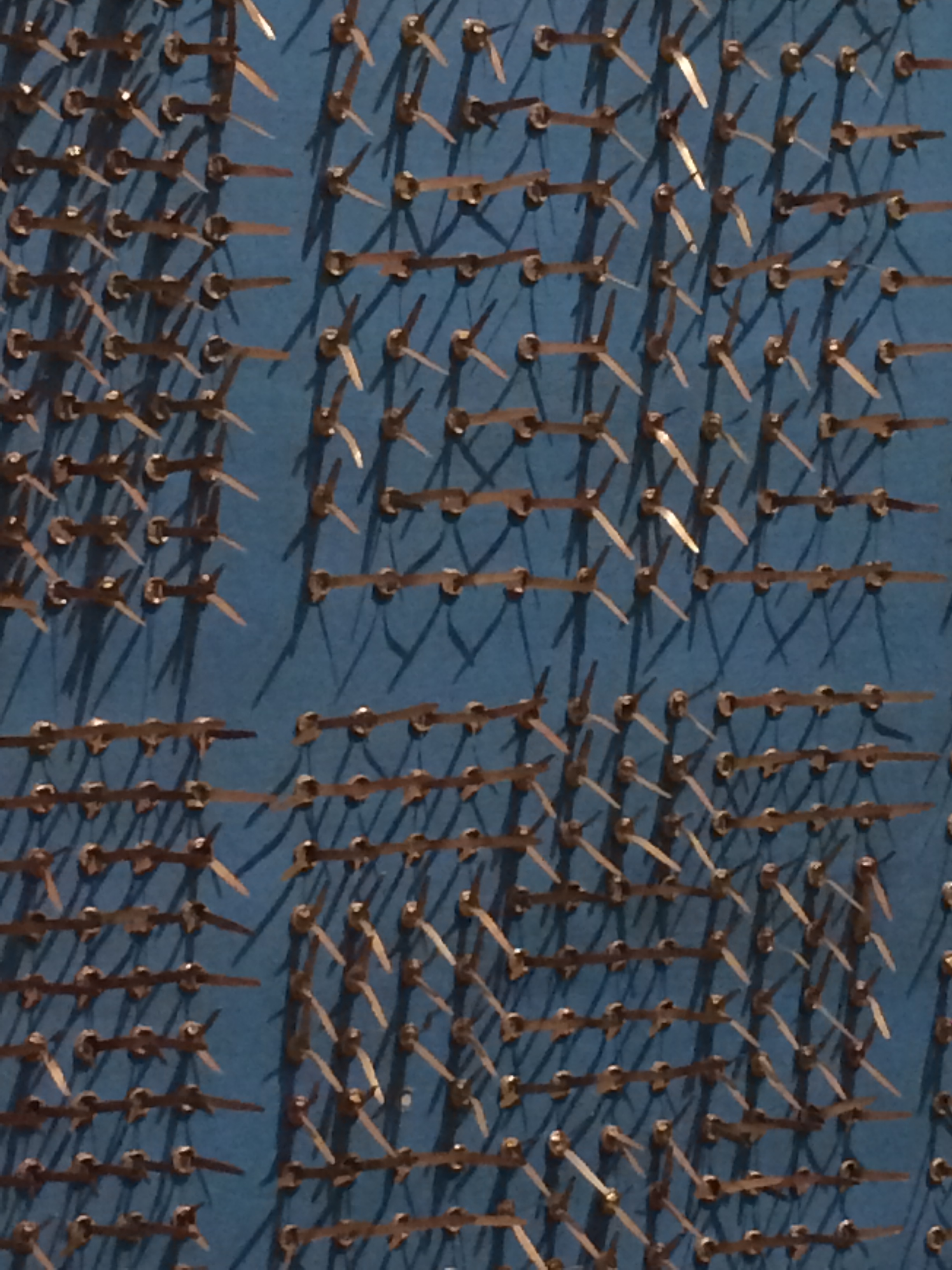
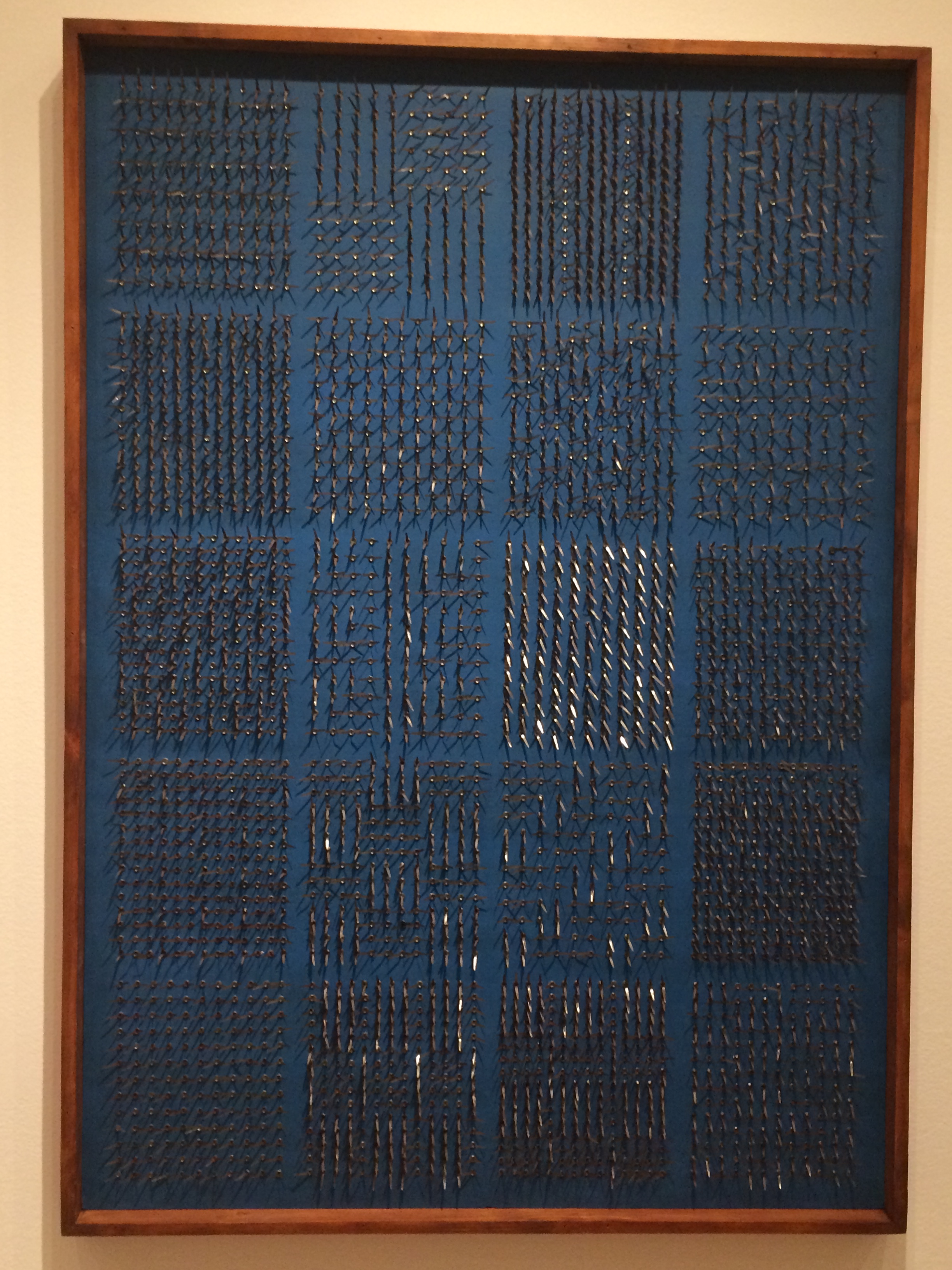
For this assemblage “Five by Four”, Běla Kolářová used metal paper fasteners to count out the grid patterns that make up each of the 20 rectangles. These rectangles are then arranged in 4 columns, 5 rectangles high. The use of the paper fasteners (something found in any home or office) as a mark making vehicle adds extra personal element to the work.
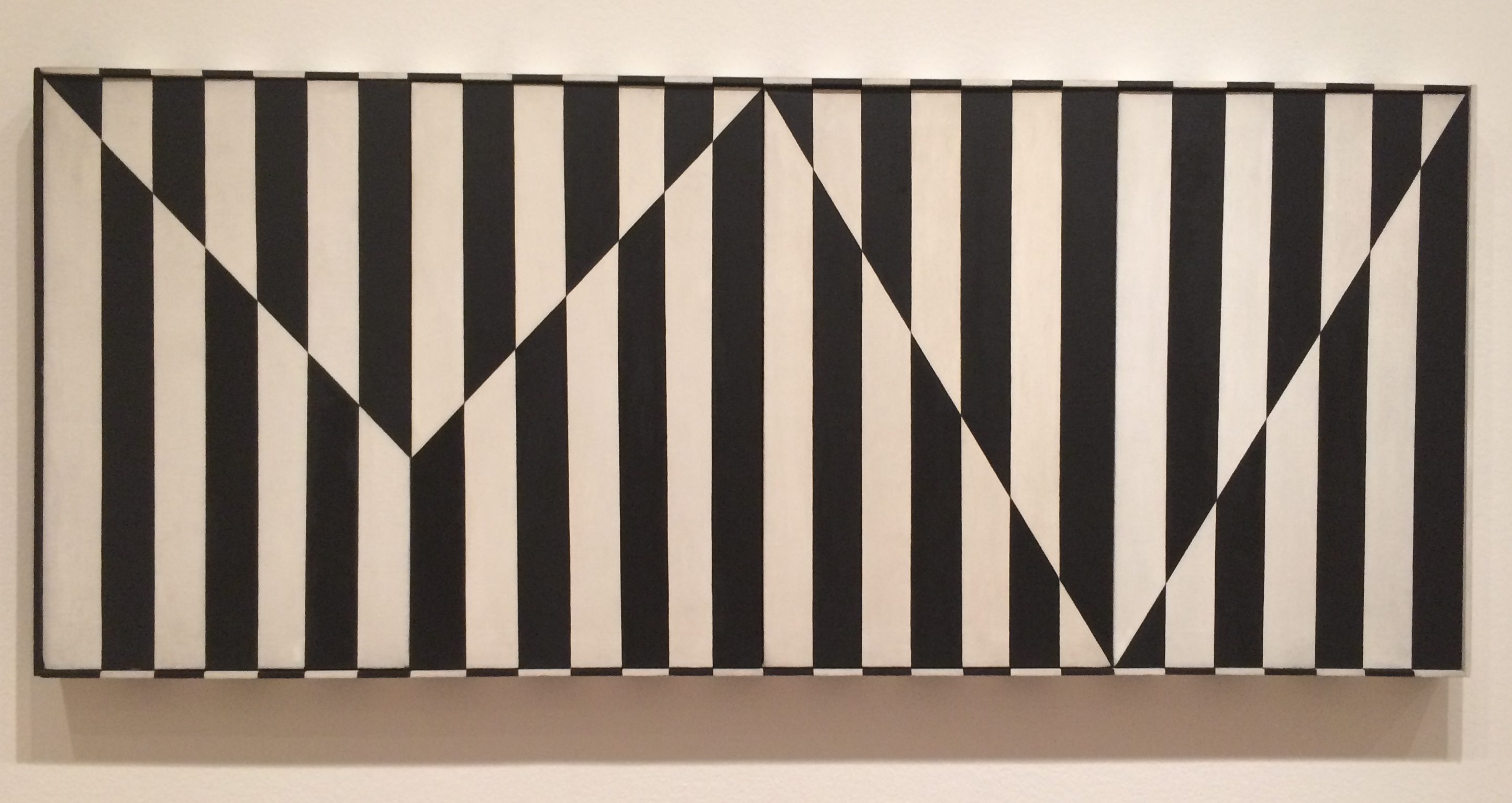
This large scale canvas by Carmen Herrera features two isosceles triangles with their bases along the top of the painting. Using the tension of black and white vertical parallel stripes, Herrera has defined the shapes by swapping the colors at the sides of the triangles. This technique has created an visual energy along these lines that allows the triangles to pulsate. The geometry of this painting is so strong, you feel like you are being pushed back to view from a distance.
Susan Happersett
Gary Hill at bitforms Gallery
Gary Hill’s ” Klein Bottle with Image of Its Own Making (after Robert Morris)” from 2014 is on display in bitforms Gallery’s Summer 2017 group show. The glass structure is a 3-D representation of the Mathematical form introduced by Felix Klein in 1882. Related to Moebius strips, Klein Bottles are a sort of vessel where both interior and exterior are all the same continuous surface. They are only truly possible using four dimensions. A video is projected inside the bottle showing the glass structure being formed. This conceptual aspect of the video connected the sculptural work with it’s production relates to Robert Morris’s “Box with the Sound of Its own Making” (1961).
This Summer exhibition at bitforms Gallery provides a sample of the work of artist who will have larger exhibitions next season. i am looking forward to seeing more of Gary Hill’s work.
Susan Happersett
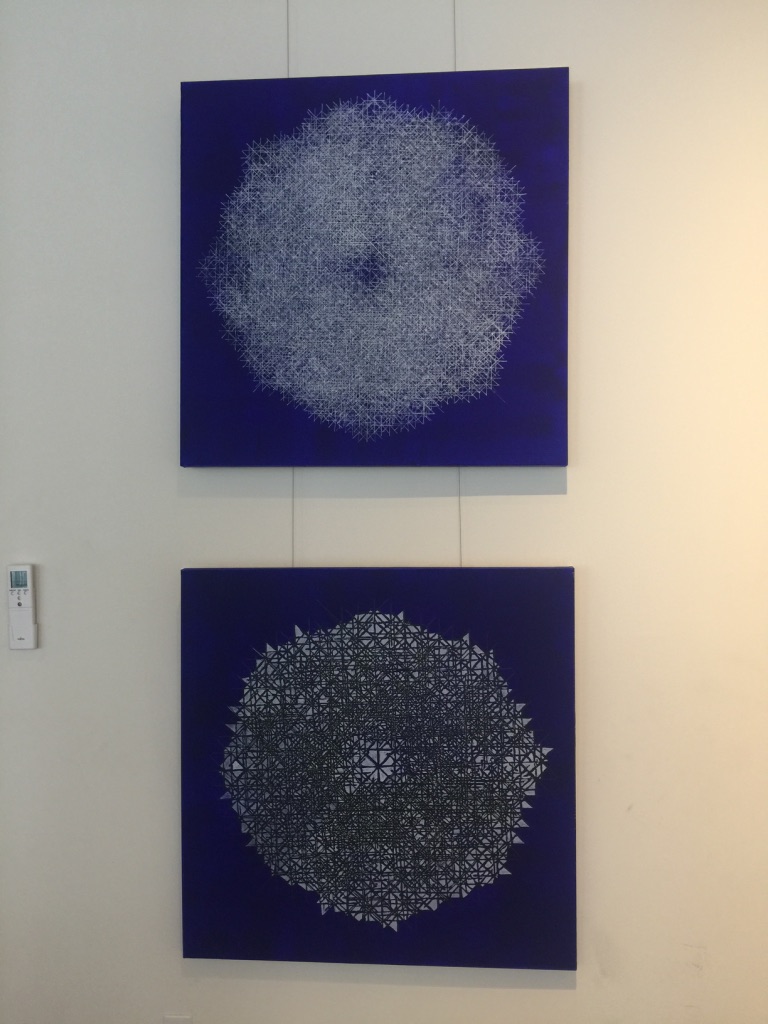
Hungarian Art of the 1960’s and 1970’s at Elizabeth Dee Gallery
The Elizabeth Dee gallery in Harlem, NY is currently presenting “With the eyes of others, Hungarian Artists of the Sixties and Seventies”. The exhibition is curated by András Szántó. The works in this show are not that well known in the United States, but are an important part of twentieth century (art) history. These artists worked under a repressive regime and had to find ways to express their opposition through subtle means. Making geometric abstract work was a way to show a connection to Western artist like Frank Stella and Al Held with out overt political connections.
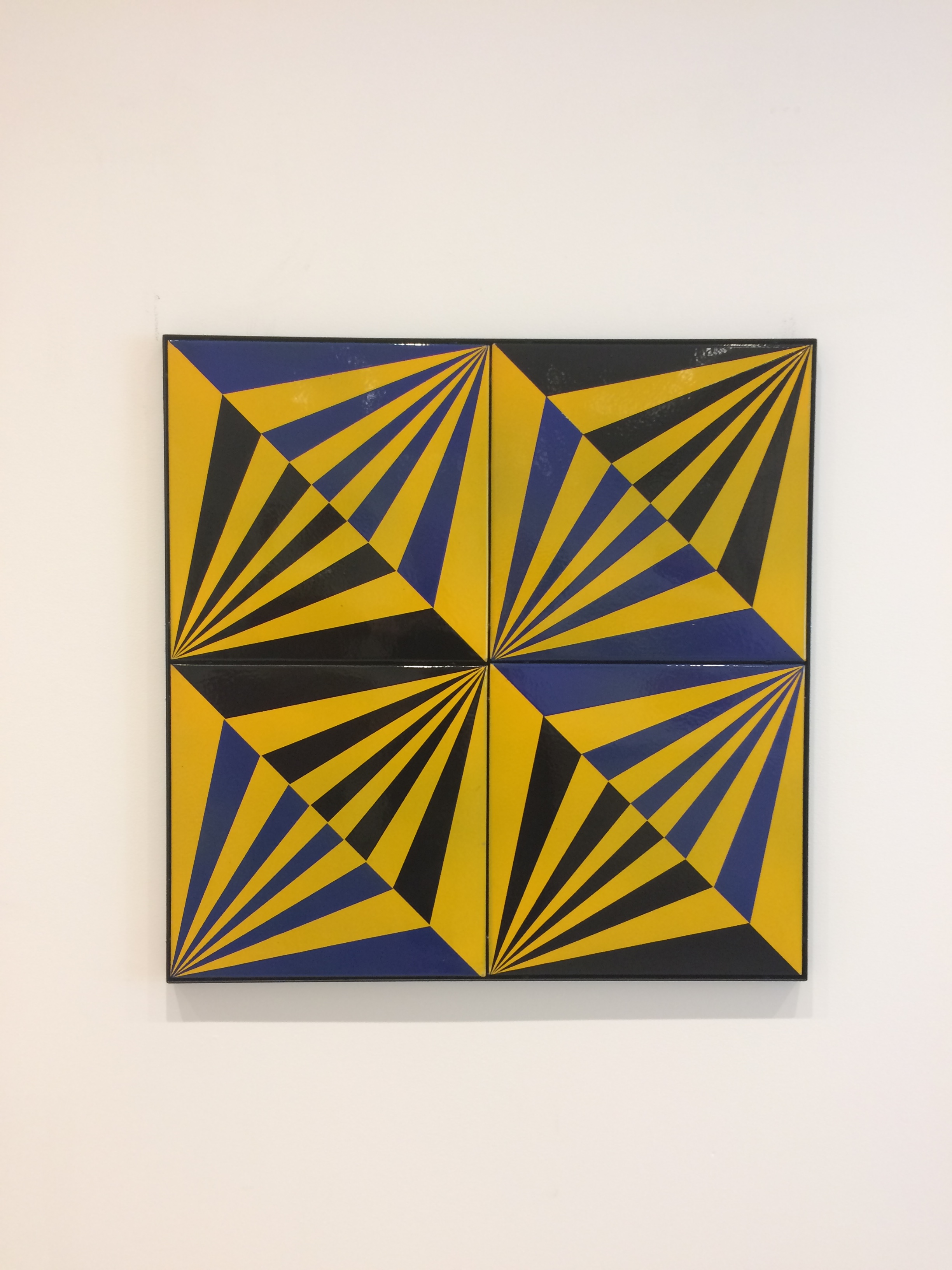
Károly Halász’ “Radial Enamel I-IV” consists of four square enameled iron plates. Using only bright yellow, dark blue and black to create tension between the narrow acute triangles, radiating from diagonal corners of the squares. The lines of symmetry in this work are a bit tricky. At first glance you think they would run from upper left corner to lower right corner, because of the lines created by the bases of the triangles along the diagonals. But, because of the alternating dark and bright colors, this is not the case. Instead, the lines of reflective symmetry are the four diagonals running from the upper right corner to the lower left corner of each individual square, as well as the same diagonal for the work in its entirety.
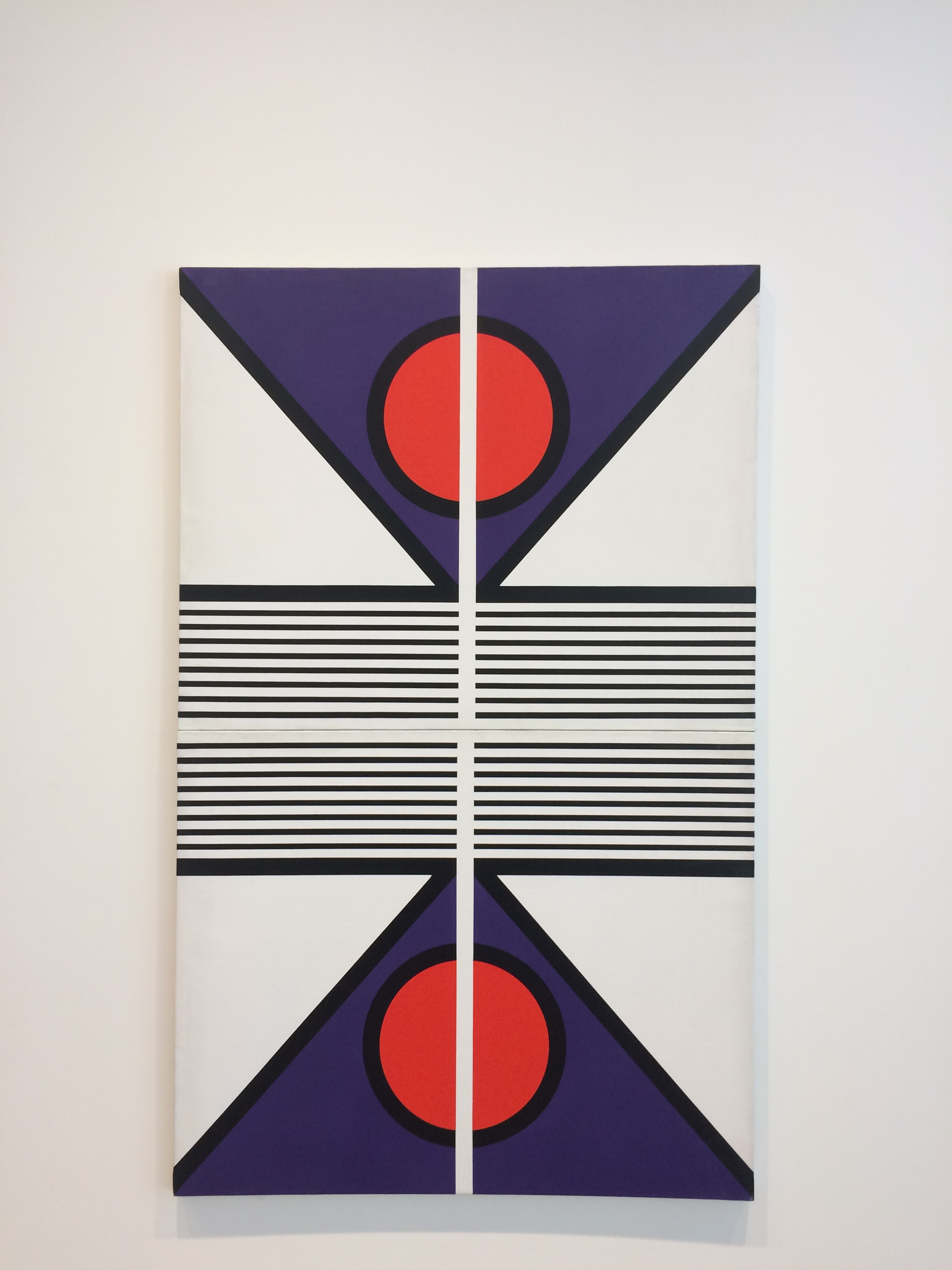
Imre Bak’s 1974 painting “Landscape Transformation” presents a mathematically stylized landscape. Featuring a series of parallel lines, right triangles, and half circles this work has both horizontal and vertical lines of reflection symmetry. Alluding to traditional landscape painting, but using the vocabulary of the geometric hard edge painters, Bak is signaling an allegiance to the Western European and American art communities.Susan Happersett
“Gamut: A Group Show About Color”at Cross Contemporary Art in Saugerties, NY
The Cross Contemporary Art Gallery’s current presentation features the work of four artists that all incorporate unique color usage. The Paintings of Jeanette Fintz also address the unfolding of 3-D geometric forms depicted on a 2-D plane.
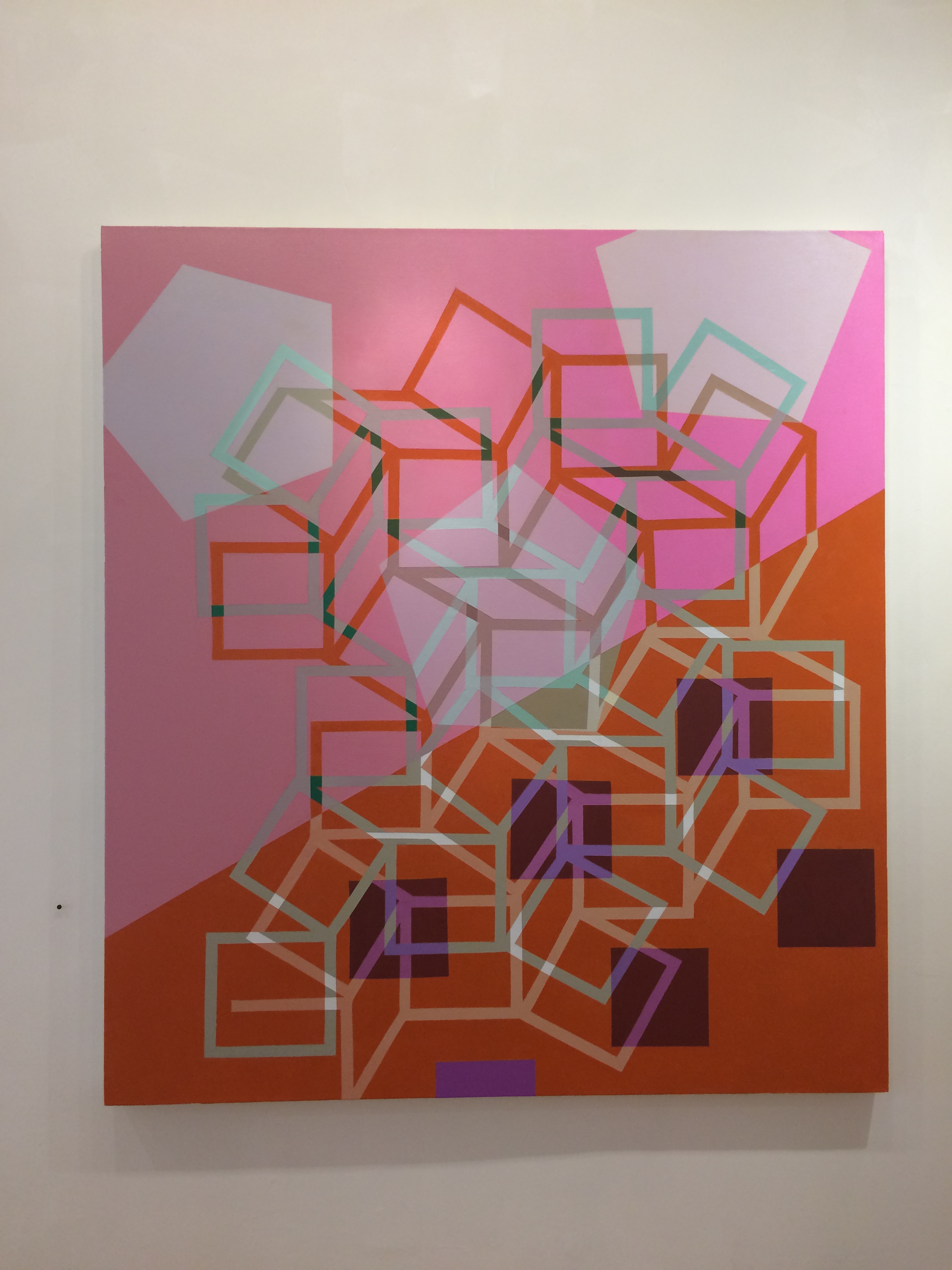
In Fintz’s large scale canvas “Matrix, The Cold Pink”, a construction of cubes is unfolding in front of a background of squares and pentagons.
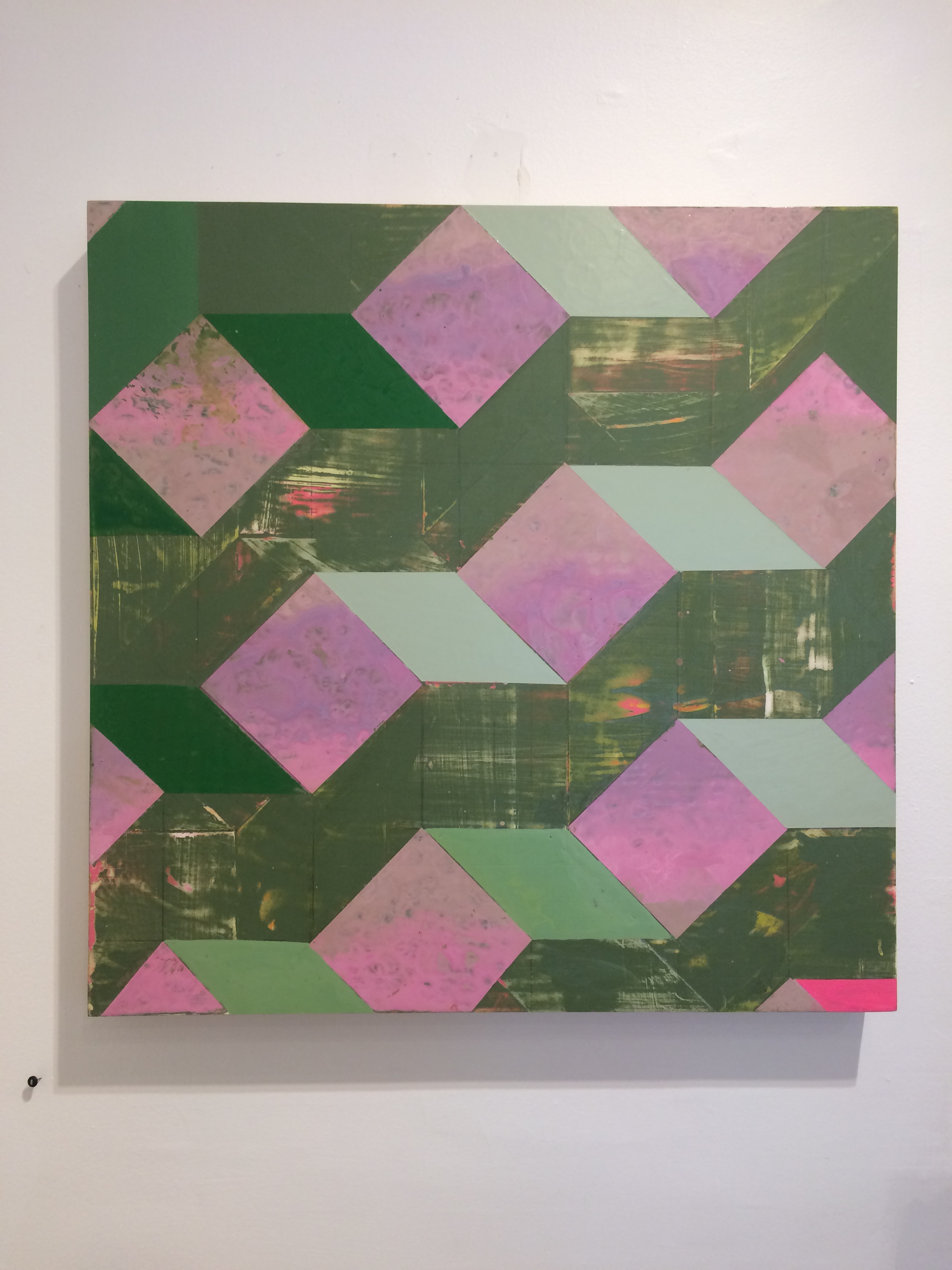
“Tumble 3”, a painting on wood panel, depicts accordion-folded strips. It is the artist’s selection of colors that gives the appearance of dimensionality. There is no use of shading. Each rhombus is painted in a solid color.
The geometry in Fintz’s paintings pops and hums off the plane. Combining carefully rendered hard-edge lines and shapes with powerful and unexpected colors this work produces a dynamic presence in the gallery.
Susan Happersett
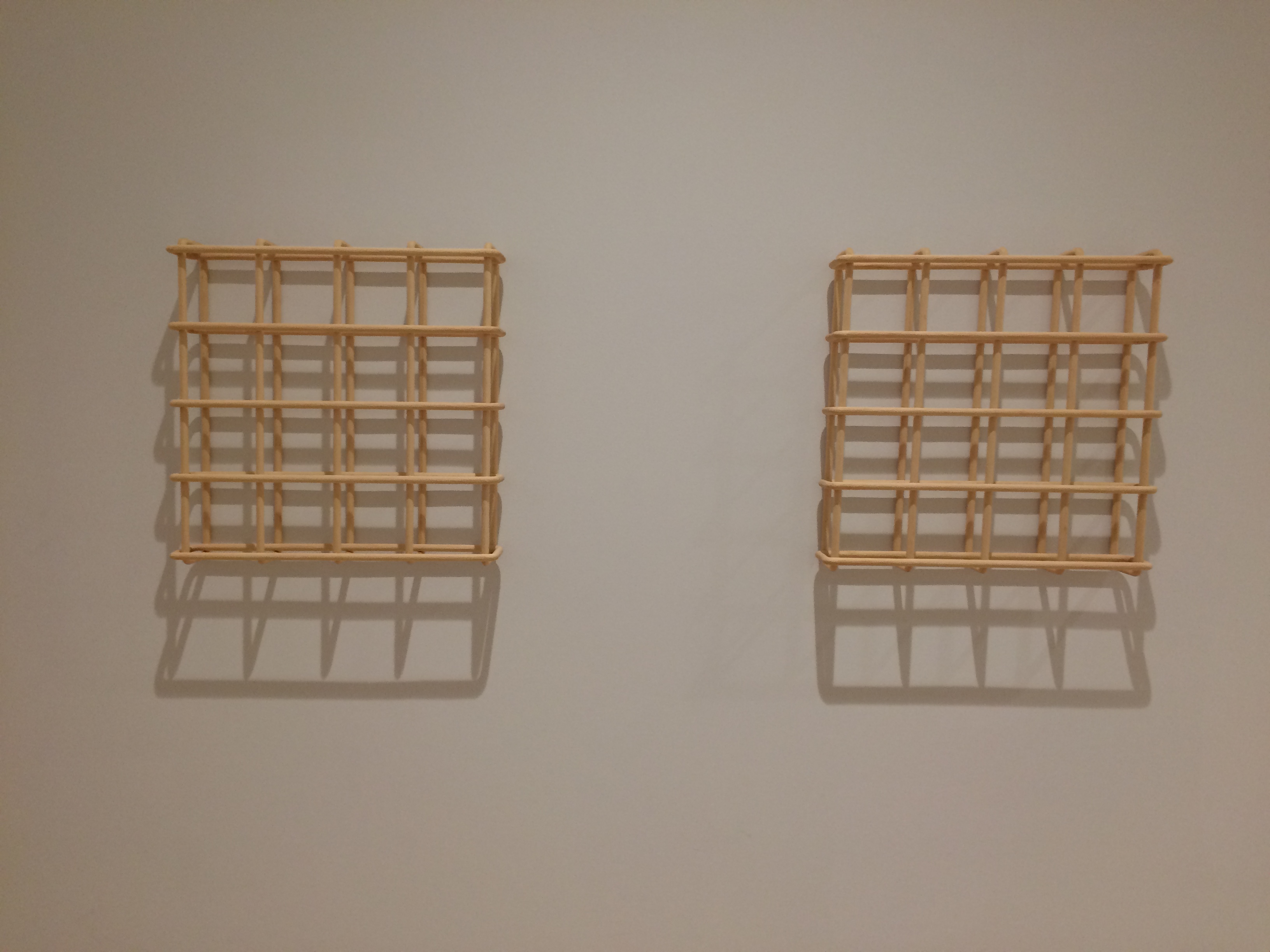
“The Ritual of Construction” at the Byrdcliffe Guild, Woodstock, New York
The Kleinart/James Center for the Arts at the Byrdcliffe Guild in Woodstock, NY is currently presenting the exhibition “The Ritual of Construction. Curated by Jeanette Fintz, the show features work that has a foundation in geometry. Basic mathematical structures like circles, squares, and other polygons have been elevated through ritualistic repetition.
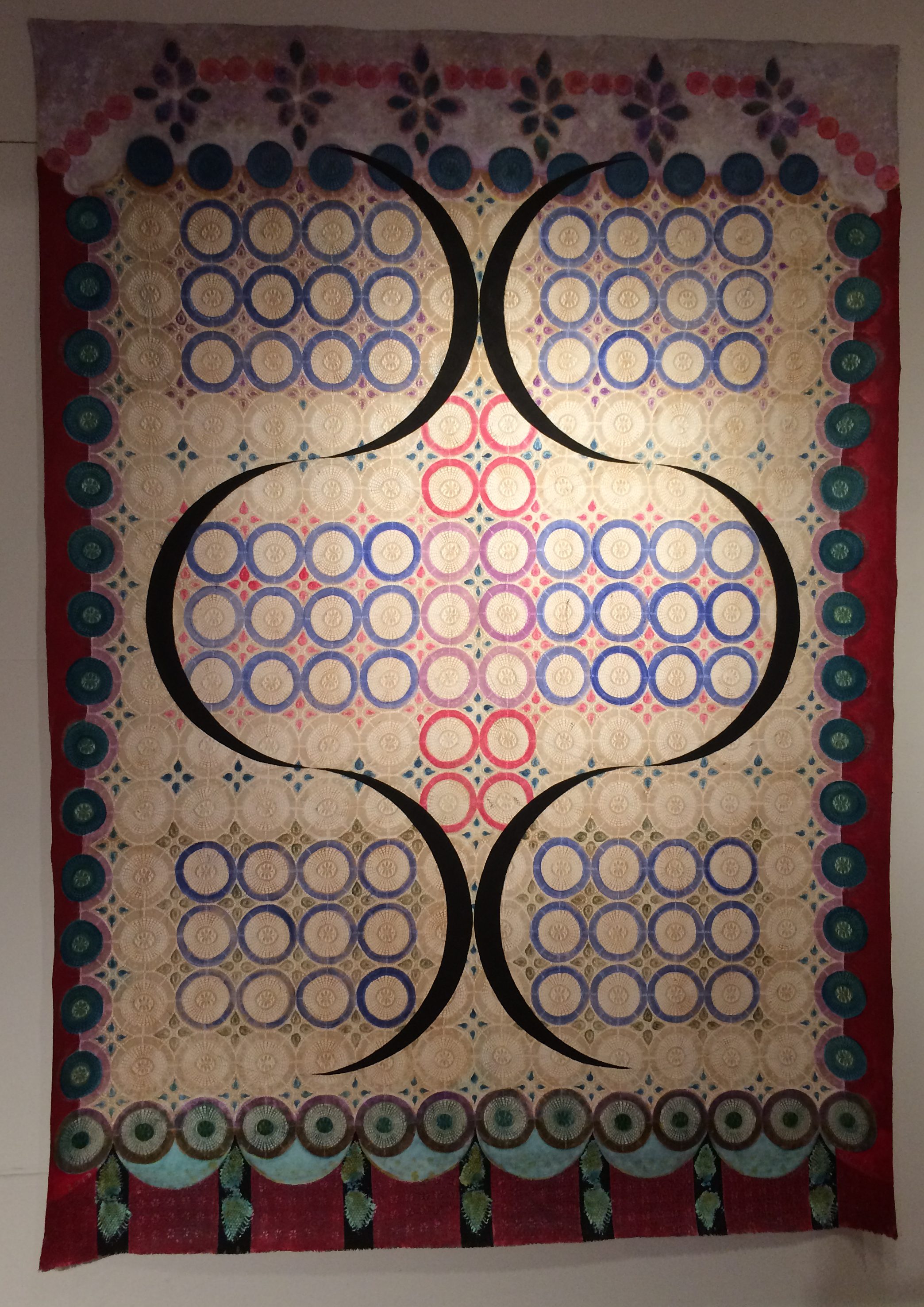
This large unstretched canvas by Benigna Chilla features a grid of circles segmented into squares and rectangles through the use of subtle coloration. An overlying pattern of six crescents incorporate a reflective symmetry. Chilla’s banner-like paintings have the spirit of devotional and meditative mandalas.
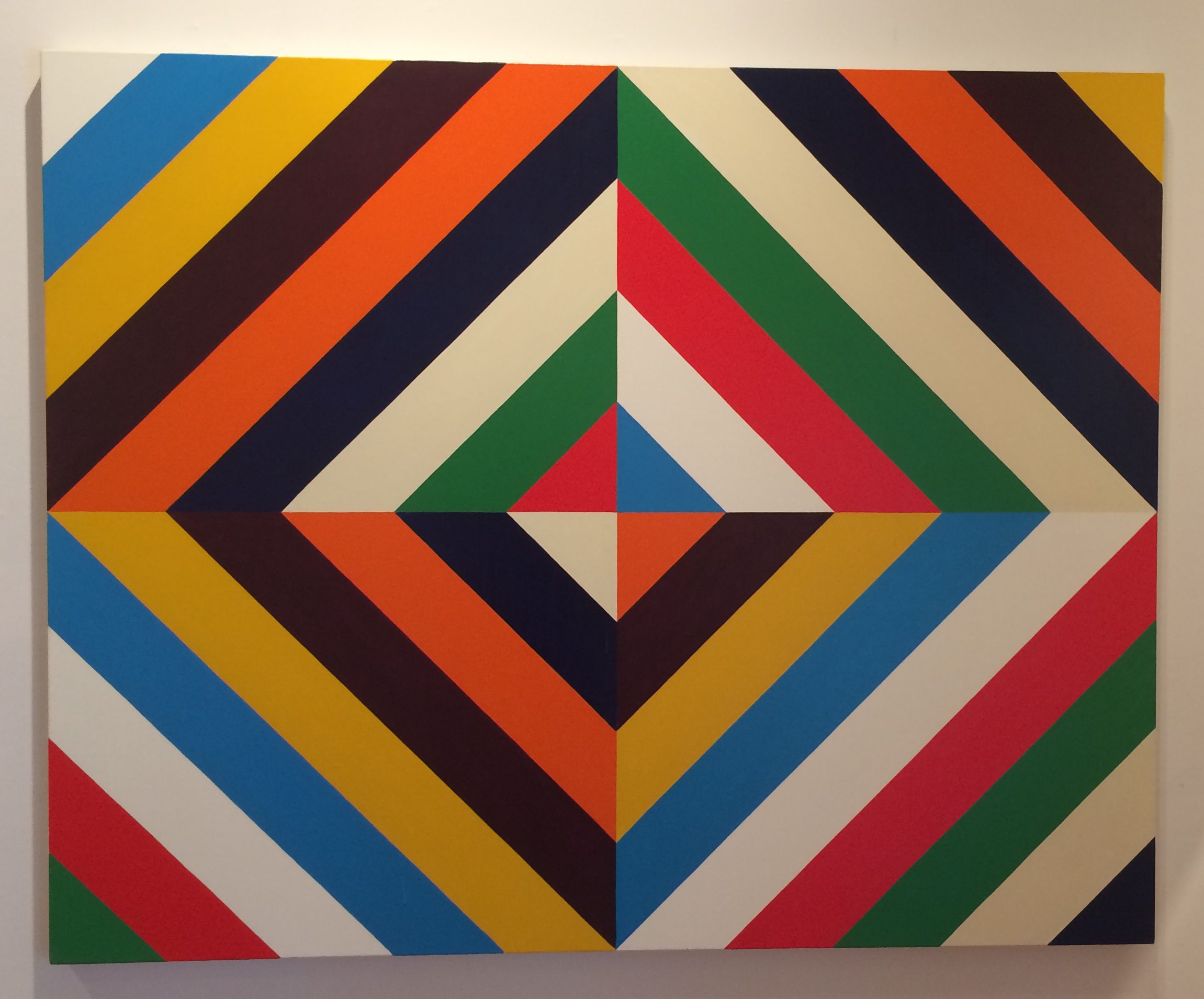
Stephen Westfall’s painting “Live for Tomorrow” is a colorful feast of reflective symmetry. The hard edge bands cutting diagonally across the four rectangles form a central square. Part of the interior section of the painting features order-4 rotational symmetry, but Westfall’s use of rectangles does not allow this to carry through the entire structure of the work, creating a kinetic pulse of color. I should probably mention that Stephen Westfall was my professor of Art Theory when I was in graduate school and I have always admired his work.
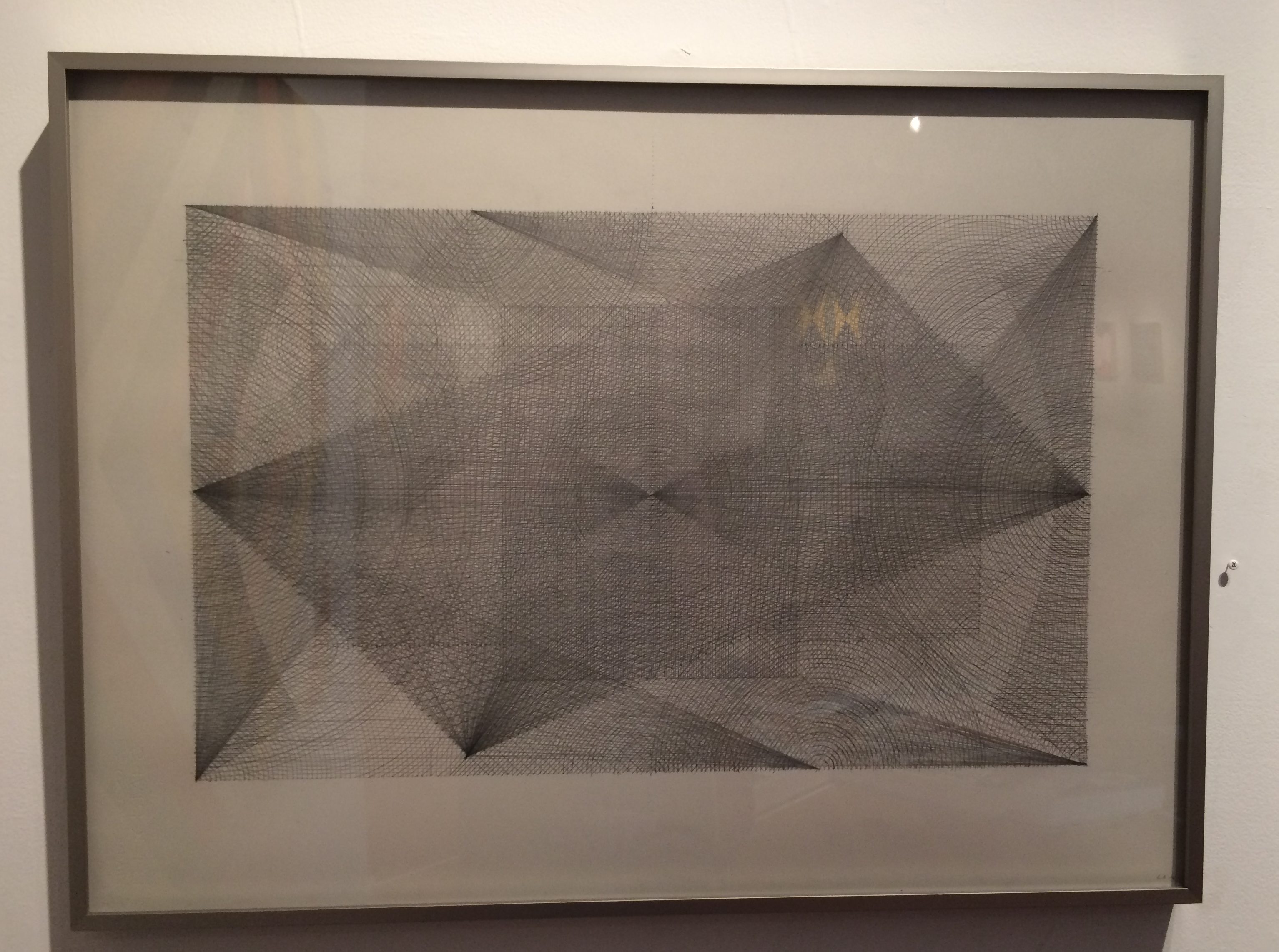
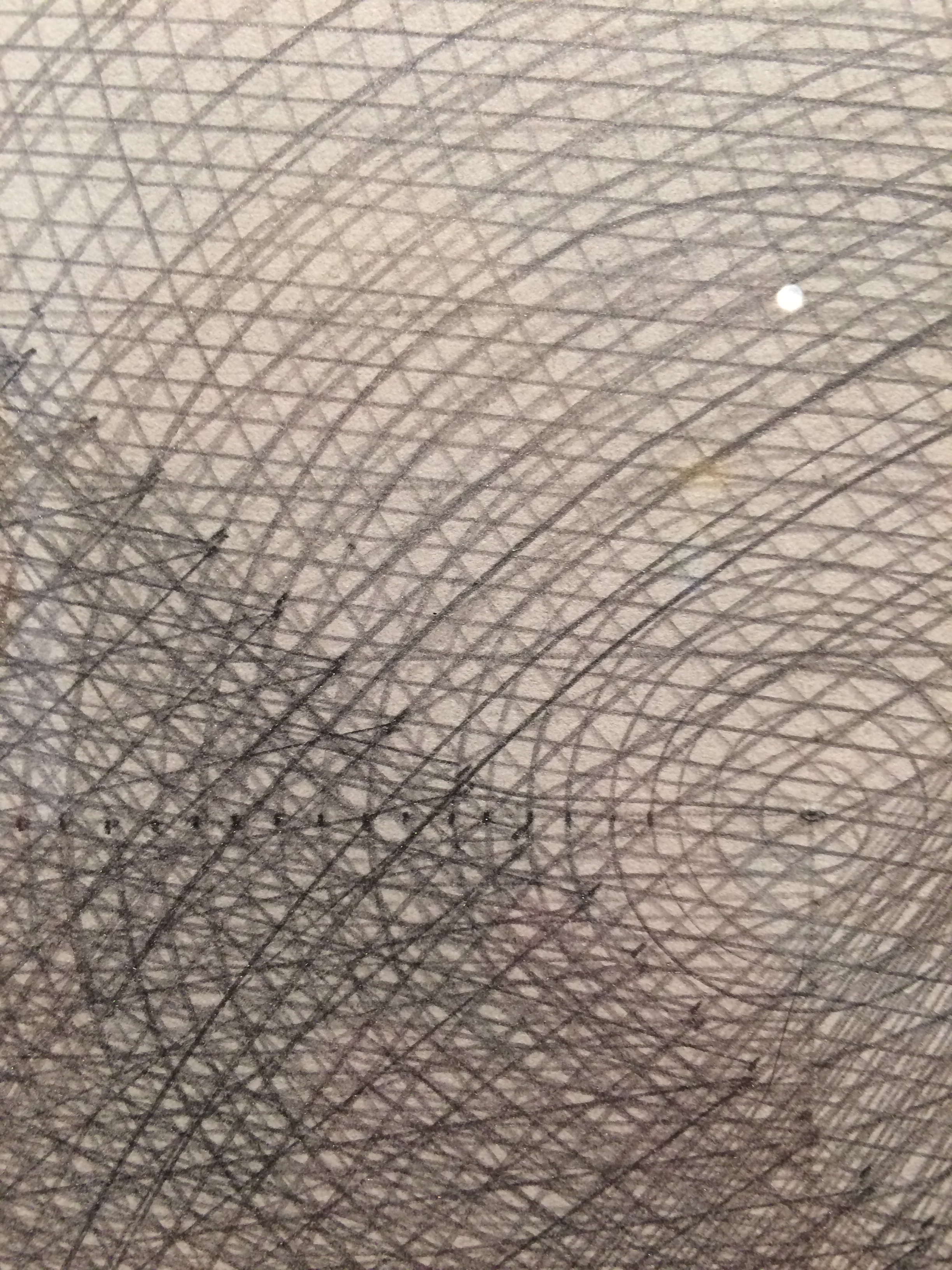
Through the use of an astonishingly detailed repetitive accumulation of straight lines and concentric circles, Laura Battle creates “Prism”. From a distance, the subject of the drawing appears to be the central parallelogram that strategically touches all four edges of the drawing. Upon closer inspection it becomes apparent the real theme is the relationship between the two types of lines straight and curvi-linear lines. The intense process necessary for creating such an intense drawing definitely highlights the ritual aspects of the entire exhibition,
I am always happy to see an art show with a geometric intention. This diverse presentation goes a step further and asks us to go beyond the mathematical logic and think about geometry as a spiritual experience.
Susan Happersett
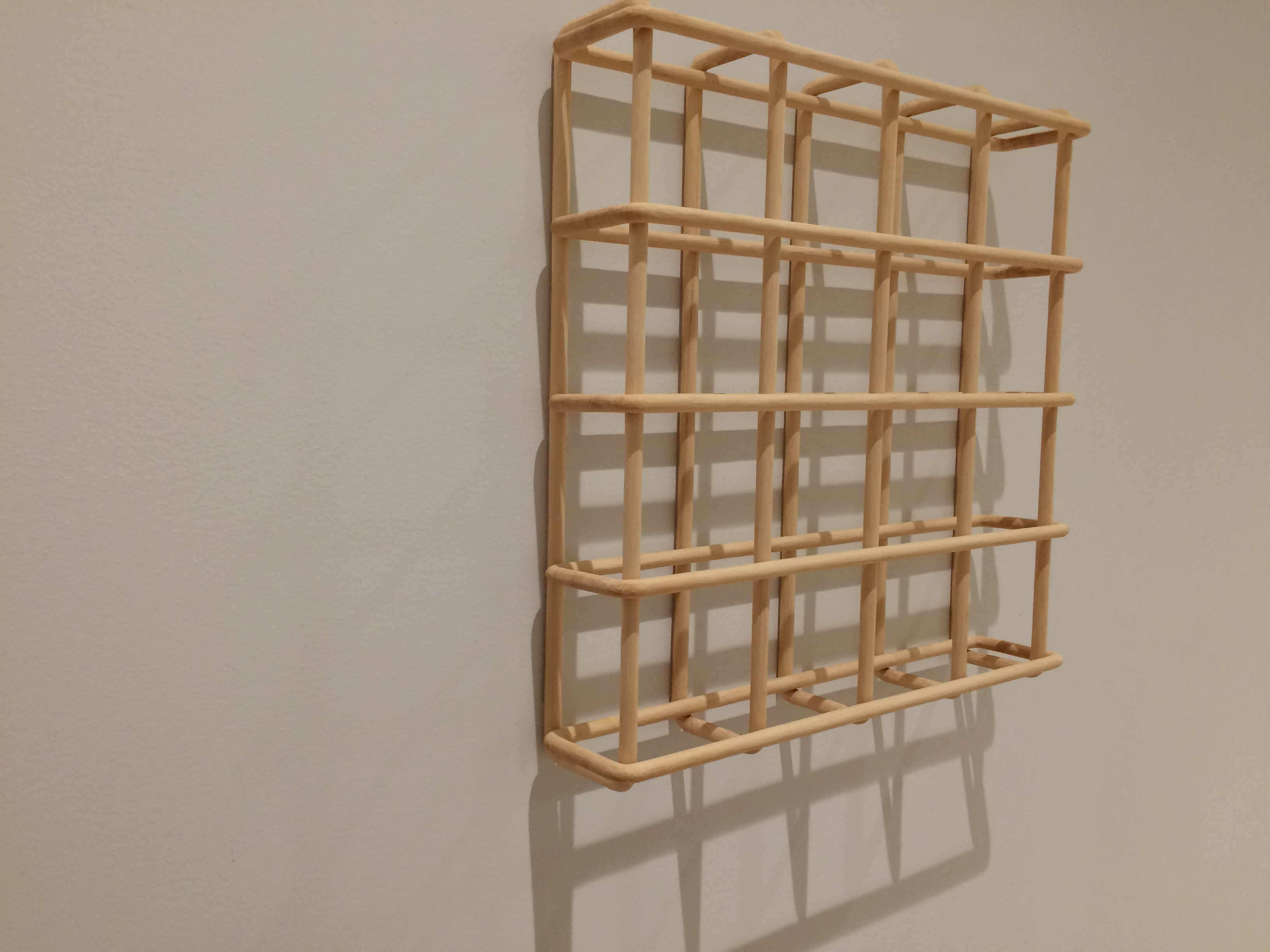
Kendall Shaw at The Ogden Museum of Southern Art – New Orleans
On the wall of the gallery next to Kendall Shaw’s painting “Sunship for John Coltrane” there is a quote from the artist: “How can I make a work so alive that one must react as if to a living creature overflowing with energy? I want to place life upon the wall.”
Surprisingly, to answer this aesthetic question Shaw enlisted the use of the most static of geometric forms, squares.
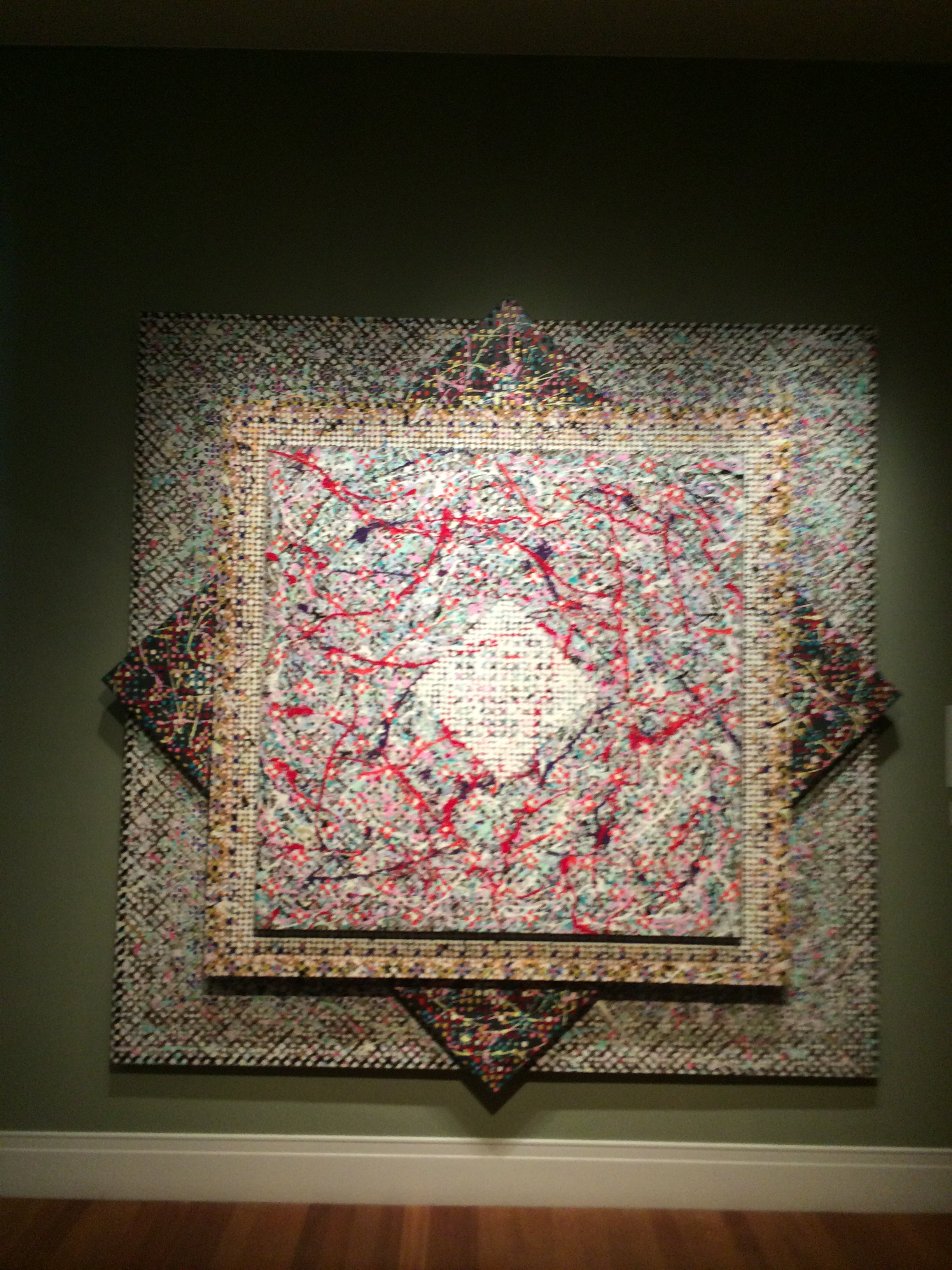
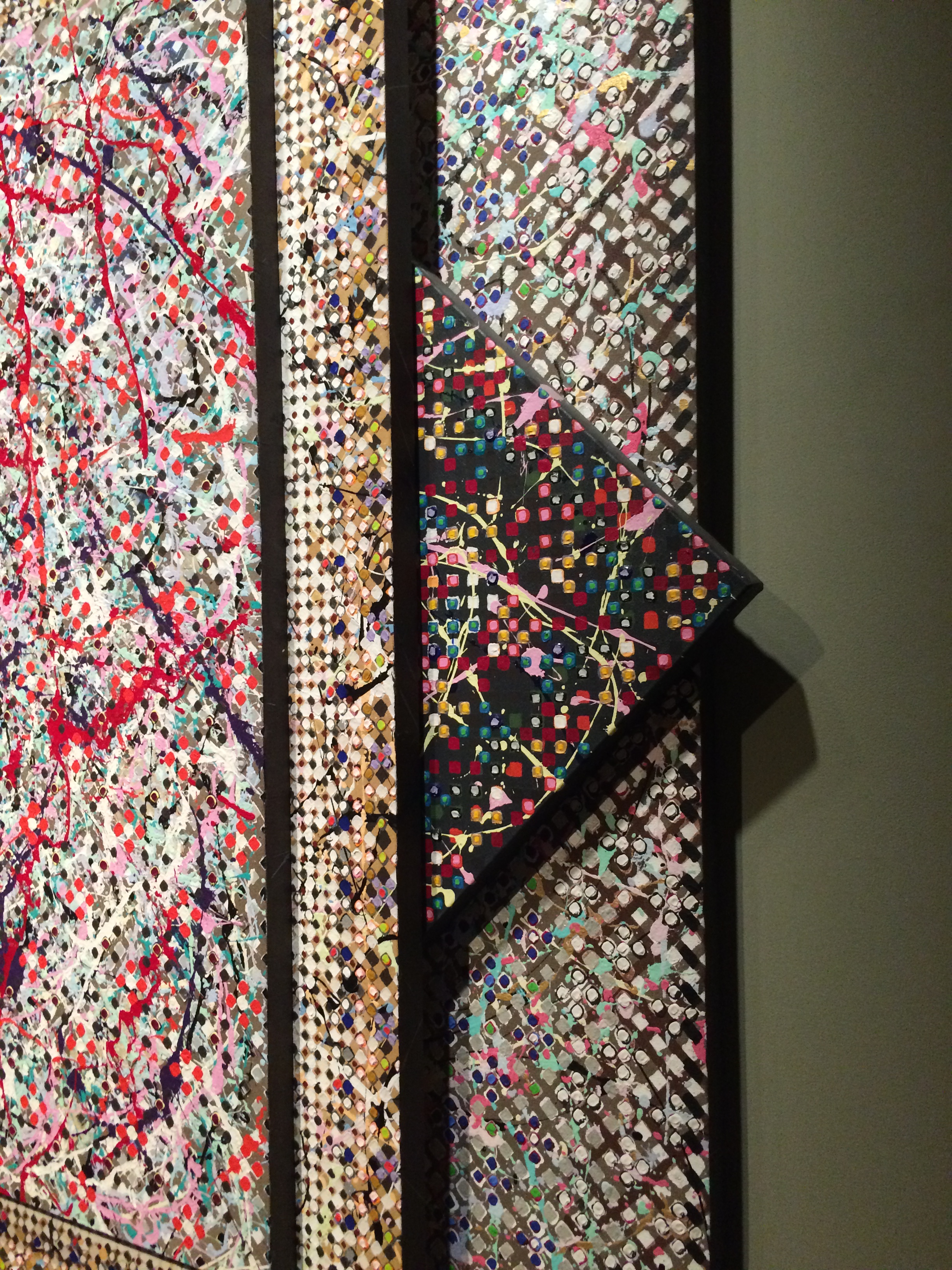
By stacking and four square canvases and rotating one 90 degrees the artists creates a sense of spinning movement.
Shaw’s painterly technique consists of both planned gridded makings, and gestural drips and splashes. This produces kinetic visual energy that seems to be anchored in space only by the smallest square grid painted in white at the center of the work.
Susan Happersett
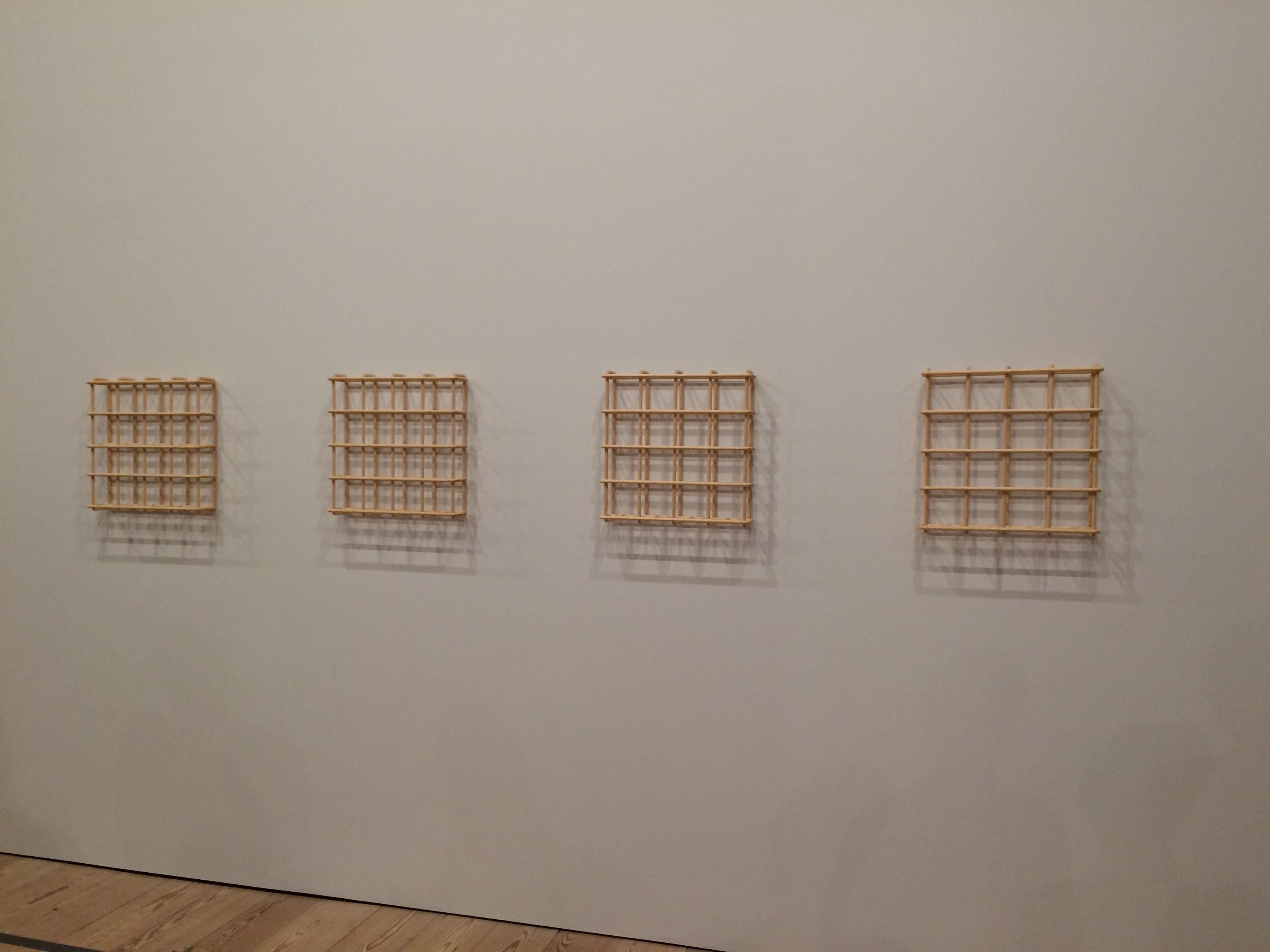
Lygia Pape at The MET Breuer
Lygia Pape “A Multitude of Forms” currently on display at the MET Breuer is the first US museum retrospective for the Brazilian artist. A member of both the Grupo Frente and the Neoconcrete movement, both with emphasis on abstraction and geometry during the 1950’s and 1960’s. She continued to work while under dictatorship (1964-1985) broadening her creative practice to include film, performance, poetry and installations.
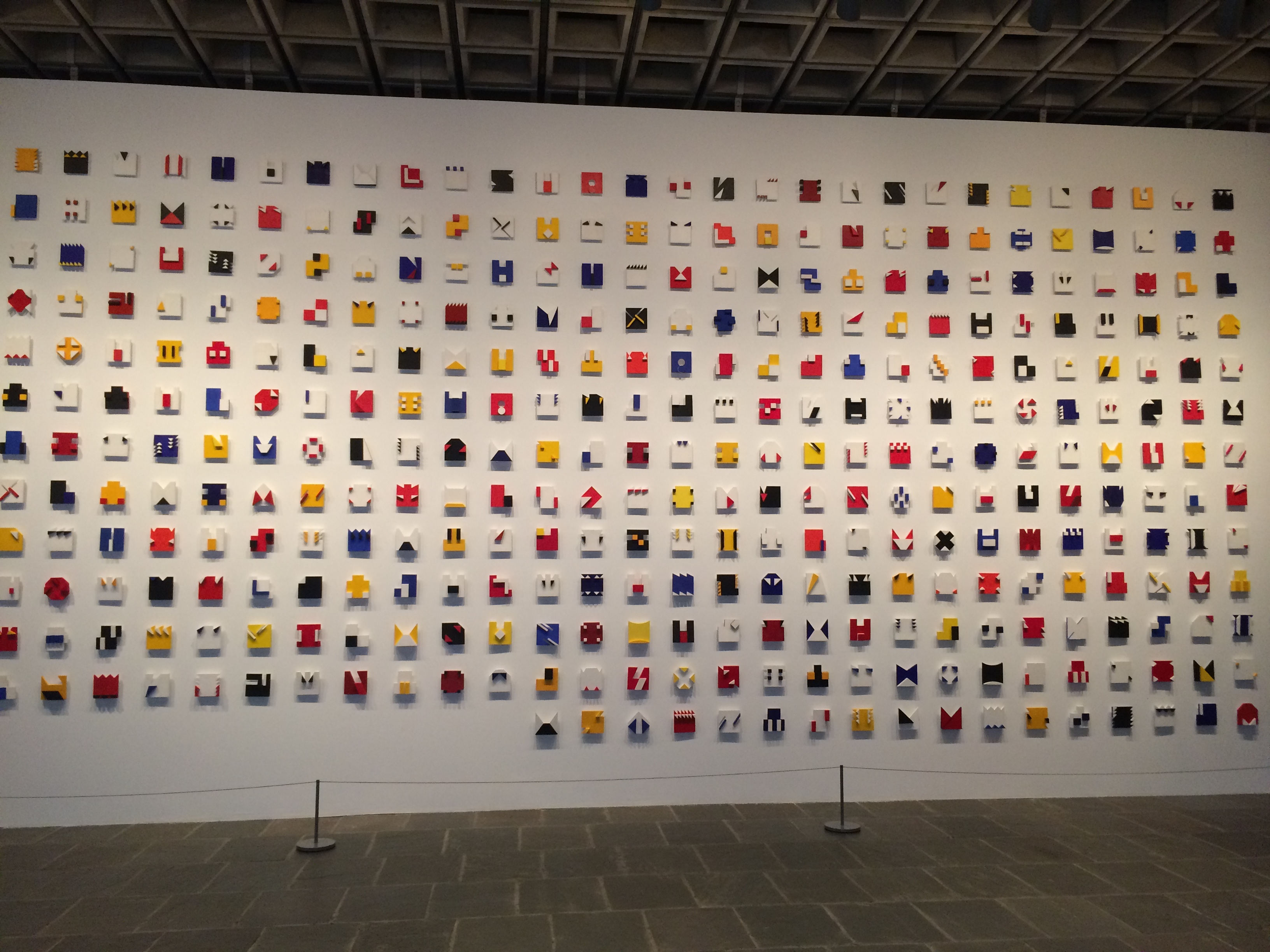
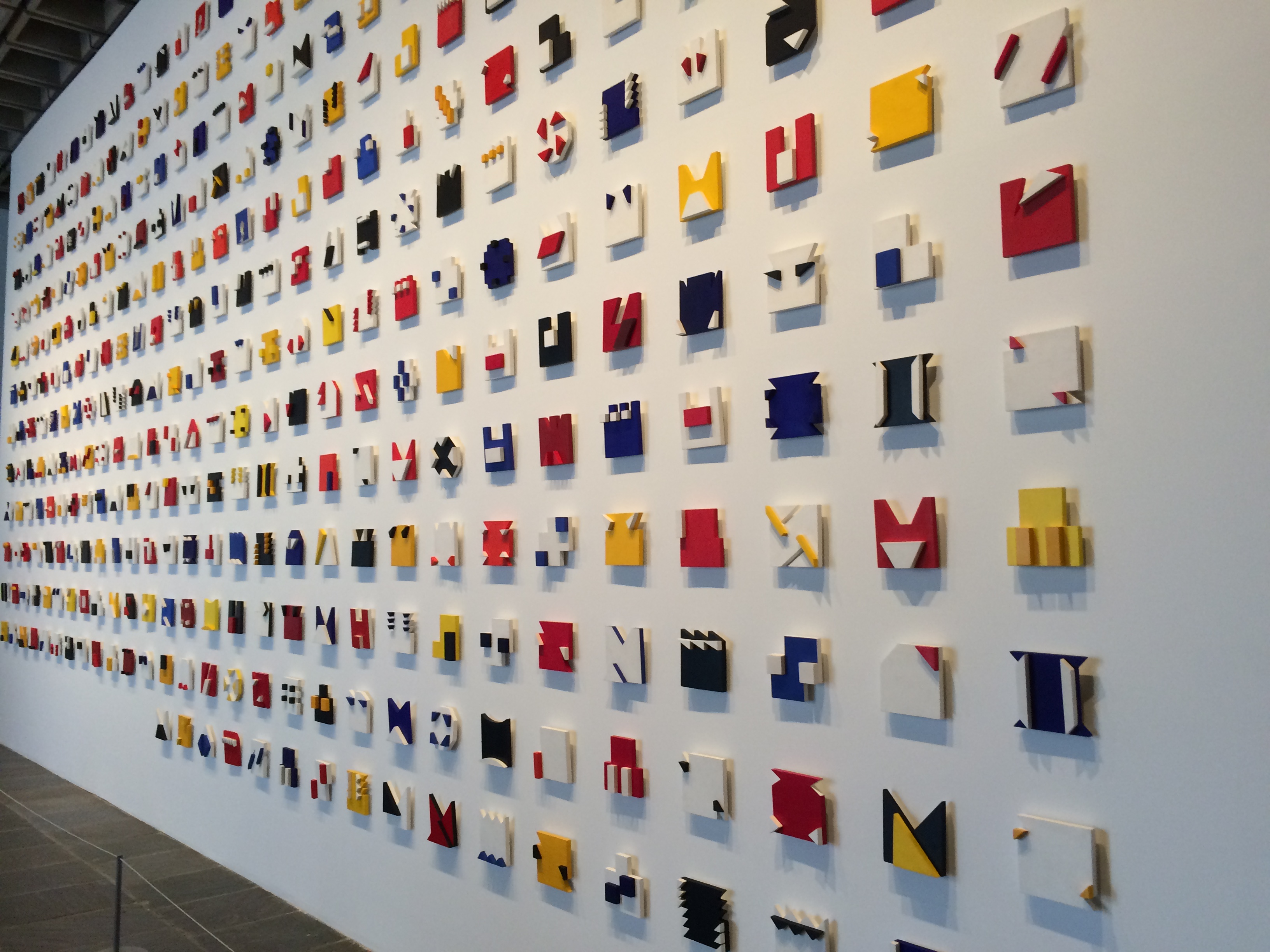
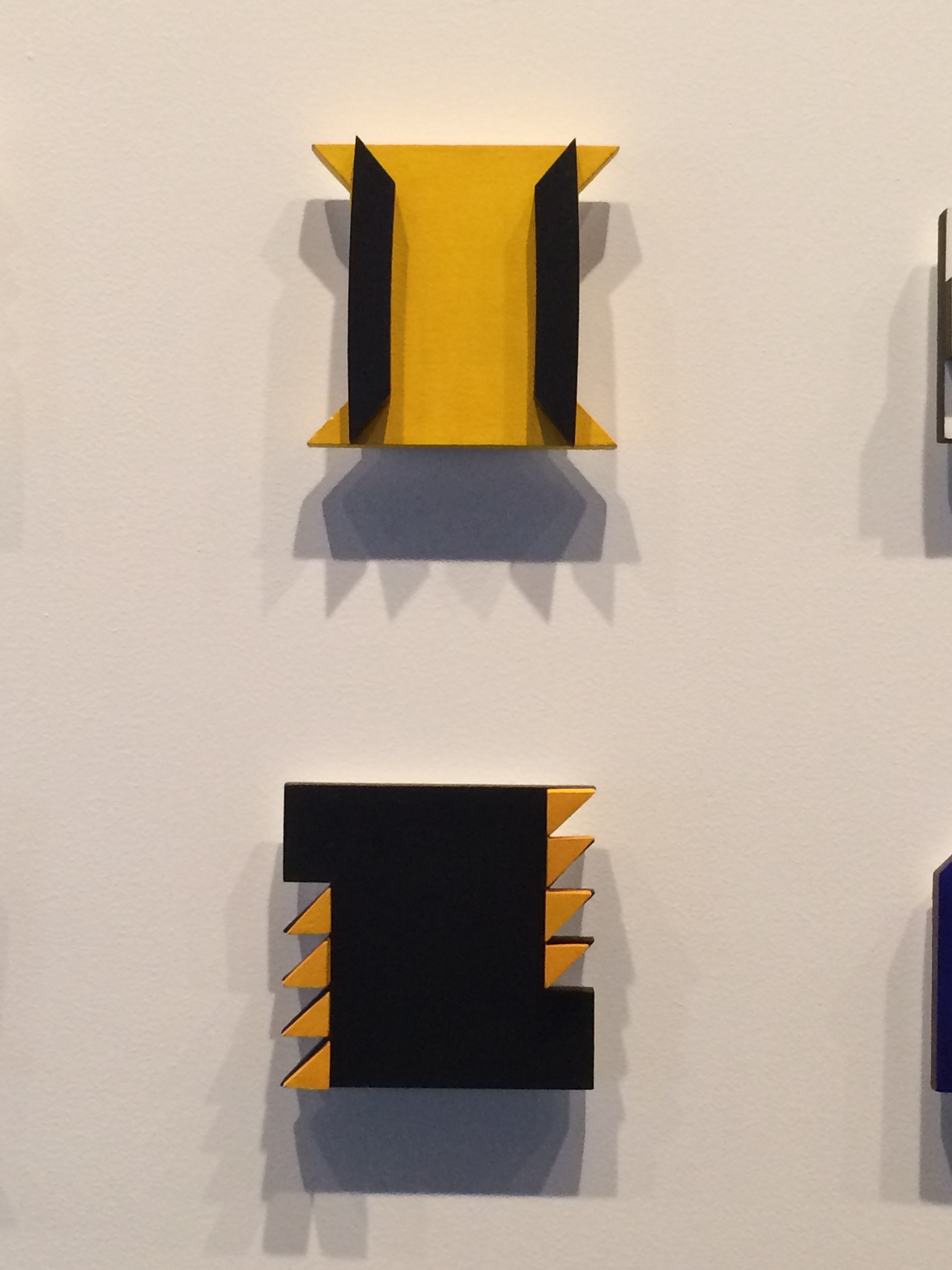
One of the most impressive works in the exhibition is “Livro du tempo” (“Book of Time’, 1961-1963) which consists of 365 wall sculptures, to represent 365 days in a year. Each of the forms is a variation on a square.
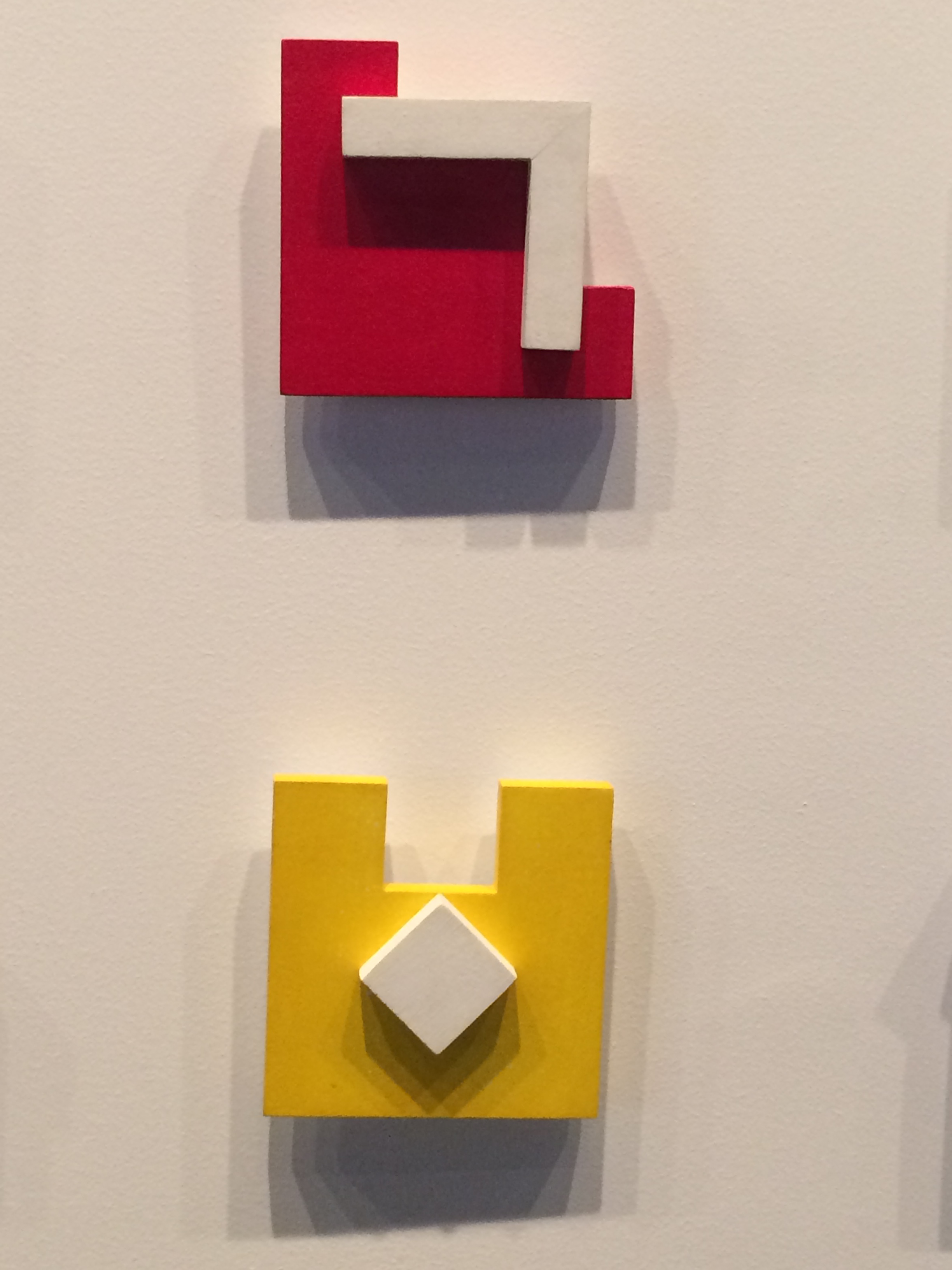
The squares have each had at least one section cut away, recolored and placed back on top of the square.
In the top example an L shaped corner has been cut away from the red square painted white then arranged so that the corner of the section meets the new corner of the red figure. In the bottom example the yellow square has had a smaller square (with sides 1/3 the length of the original) removed from the center of the top edge. Painted white and rotatated 45 degrees the new square is placed centered under the void.
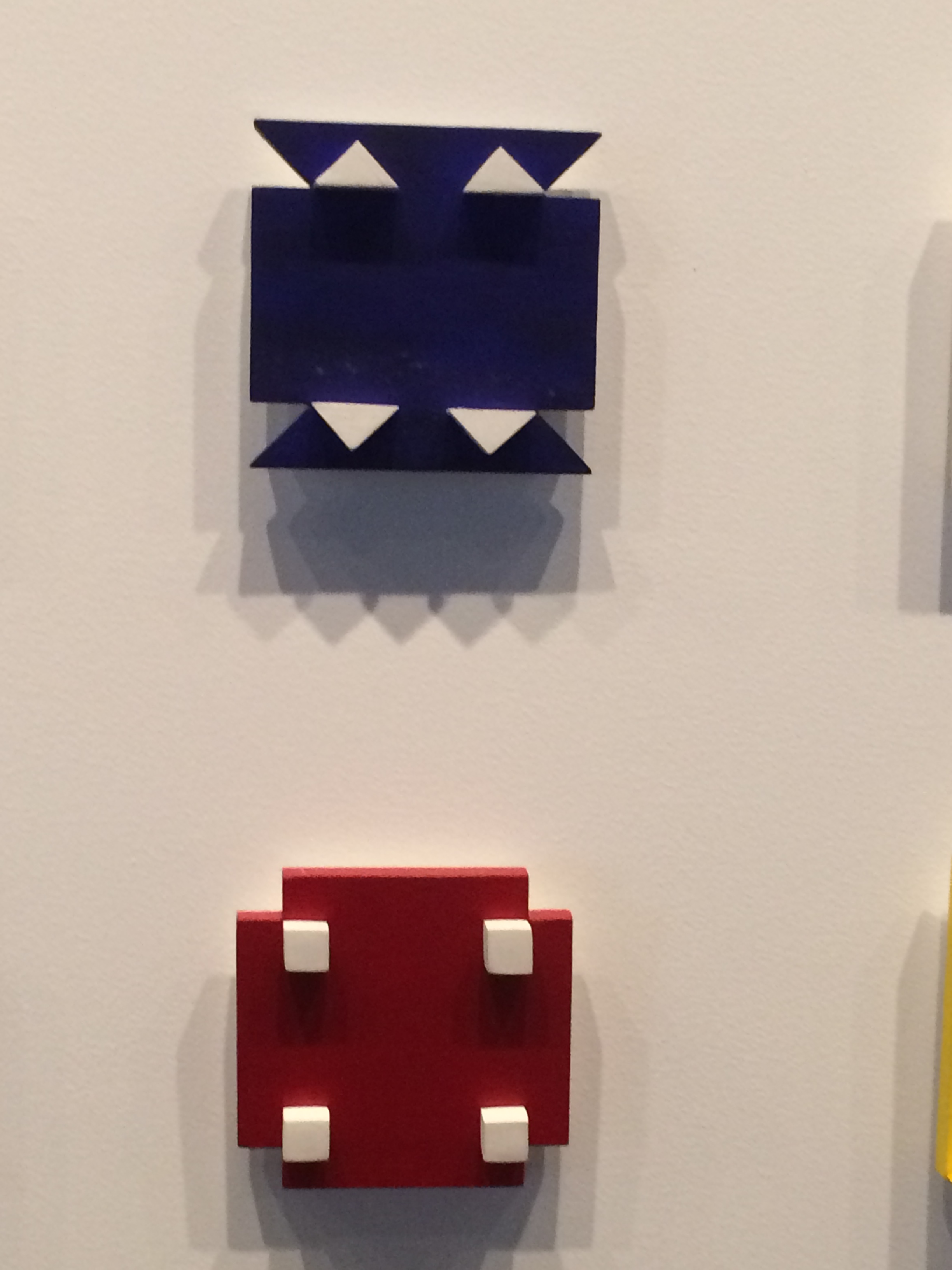
The individual sculptural elements can be more complex with multiple identical cut-aways. The myriad of possibilities explored by Pape is what makes this work monumental. Created during the time of the Concrete movement “Livro du tempo”, this work included an element of viewer interaction: viewers (back then) were allowed to touch the work. By including 365 elements the artist references the time it take for the earth’s rotation, tying the abstract geometry to the natural world.
The MET Breuer has presented a large comprehensive display of Pape’s art. I have only really talked about one work of art, there is so much more to discuss. Anyone in NYC this Spring should definitely plan to go to the museum.
Susan Happersett
Mathematical Meditations in Beacon, New York
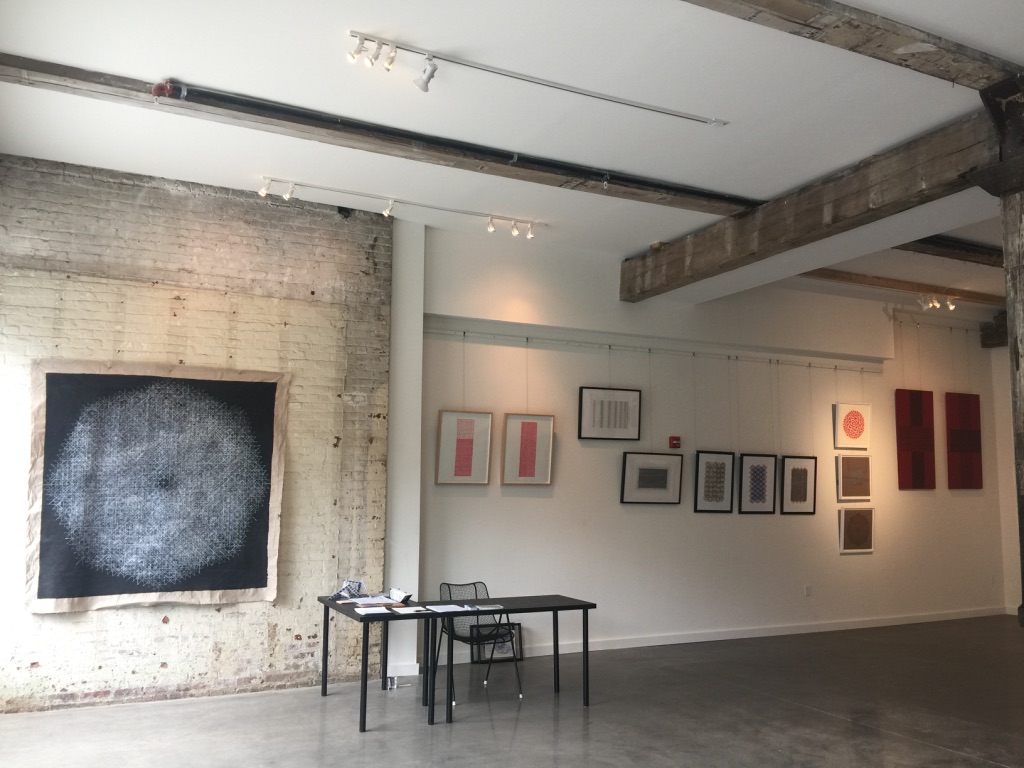
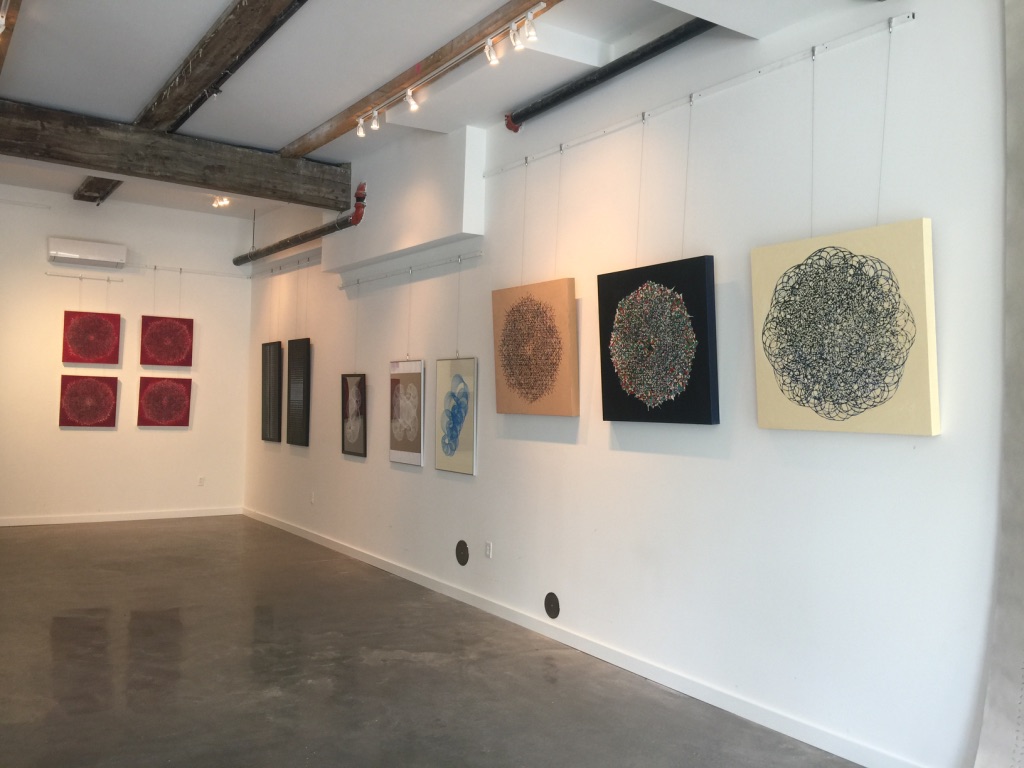
A survey of my Mathematically inspired paintings, drawings, videos and artist’s books is currently on view at the Roundhouse Gallery in Beacon, NY. Situated in a restored 19th century factory building, the gallery space provides ample room for a wide range of work I have completed over the past twenty years.
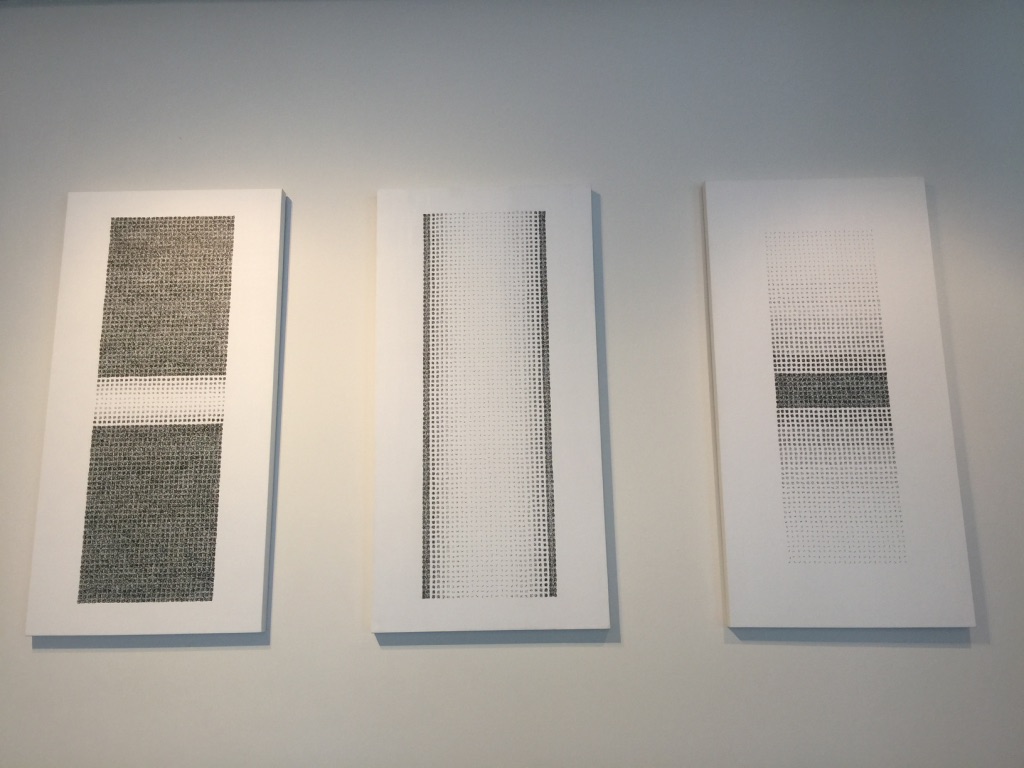
Included in the exhibit are my counted marking drawings. I started making these early in my career and I am still creating them with more complex algorithms.
There is also a range of work based the Chaos Theory.
A wew of my pieces from my recent “Cartesian Lace” series are also on display.
This wonderful opportunity has offered me a chance for the first time, to present an exploration of all of the various types of my Mathematical art all in one room.
The opening last weekend was wonderful. On May 21, Dikko Faust and Ester K. Smith of Purgatory pie Press will be at the gallery for a meet and greet. Over the past years I have collaborated with them on a number of limited edition letterpress projects, that are also on display. Meet Esther and Dikko from 2PM to 6PM.
Susan Happersett
The Whitney Biennial
This year the Whitney Museum of American Art presents its 78th Biennial survey. I knew from media reports that the art selected heavily represented political and social current events. There was a wide cross section of themes including an emphasis on figural work, but there were two artists whose work dealt directly with geometric figures.
Matt Brownings gridded wall sculptures were installed in small groupings through the two floors of exhibit. each grid of 26 cubes is hand carved from a single piece of wood forming an interlocking lattice work.
Brownings’ subject matter of the cubes relates to the perspective of minimalist geometric sculpture. His technique of painstakingly whittling the wood by hand takes the geometry to the unexpected realm of craft and folk art.
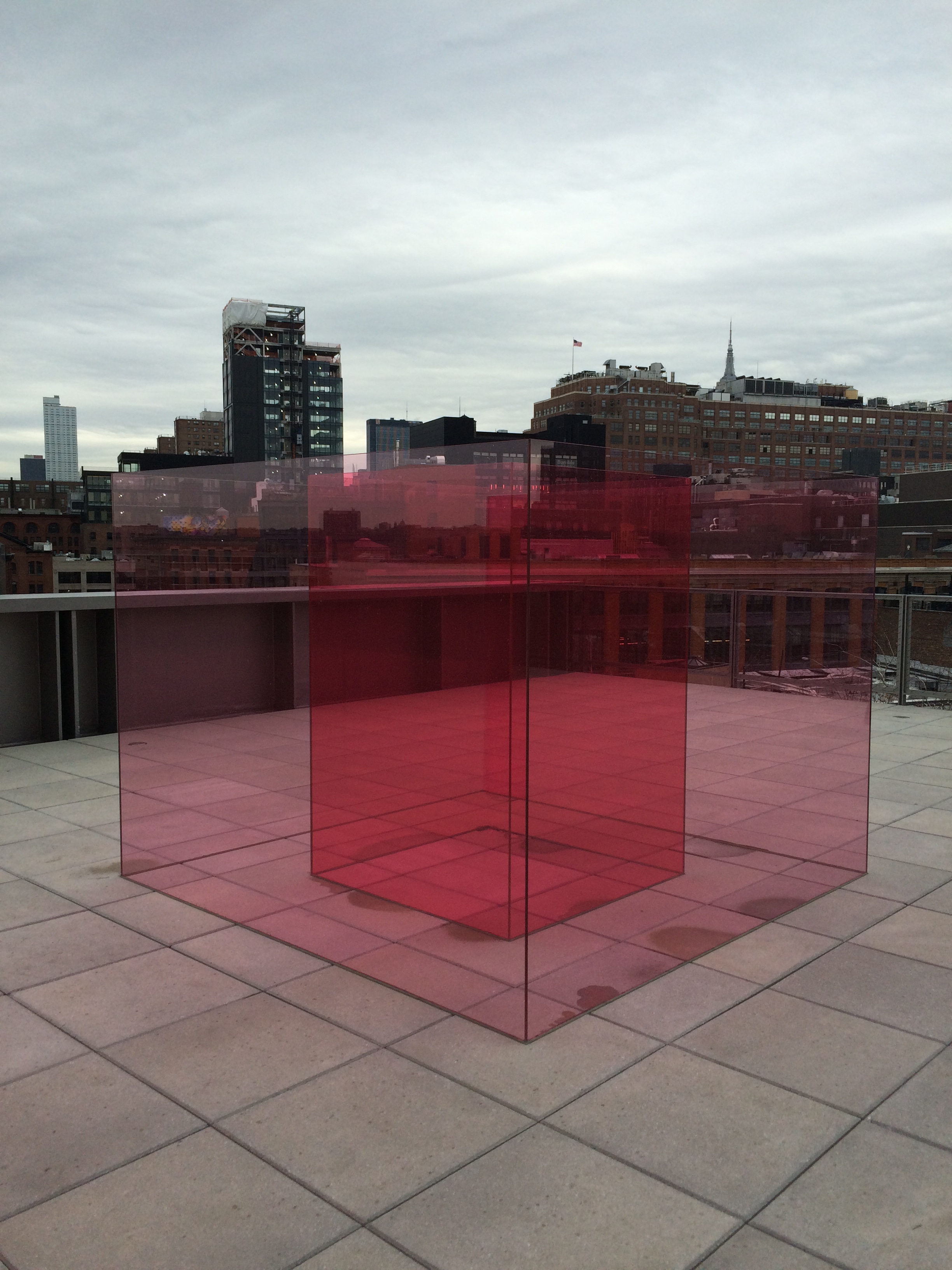
Larry Bell’s laminated glass sculptures are installed on a roof terrace. Consisting of 6 large prisms featuring six foot by eight foot walls each enclosing a smaller six foot by four foot prism. The transparent nature of the material allows for a comparison of the proportions of the two sized boxes. All twelve have the same height but the interior forms are half as wide. The volume of the larger boxes are 4 times that of the interior boxes. I particularly like the way the sculptures are situated so that the viewer can see the surrounding buildings through the colored glass. The abstract geometry becomes part of the city scape.
Susan Happersett