Sjoerd Hofstra with Karen O’hearn at Rare

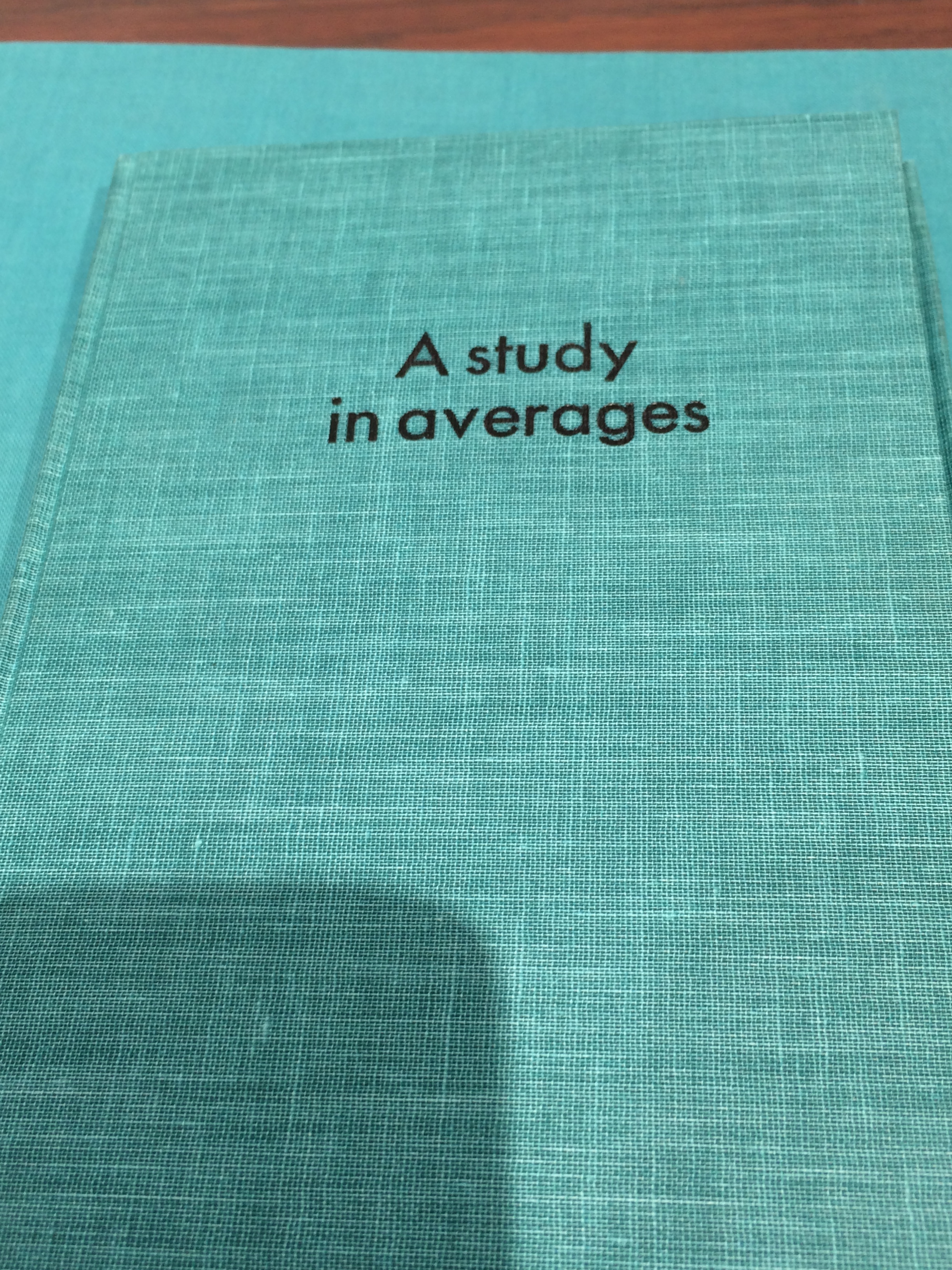
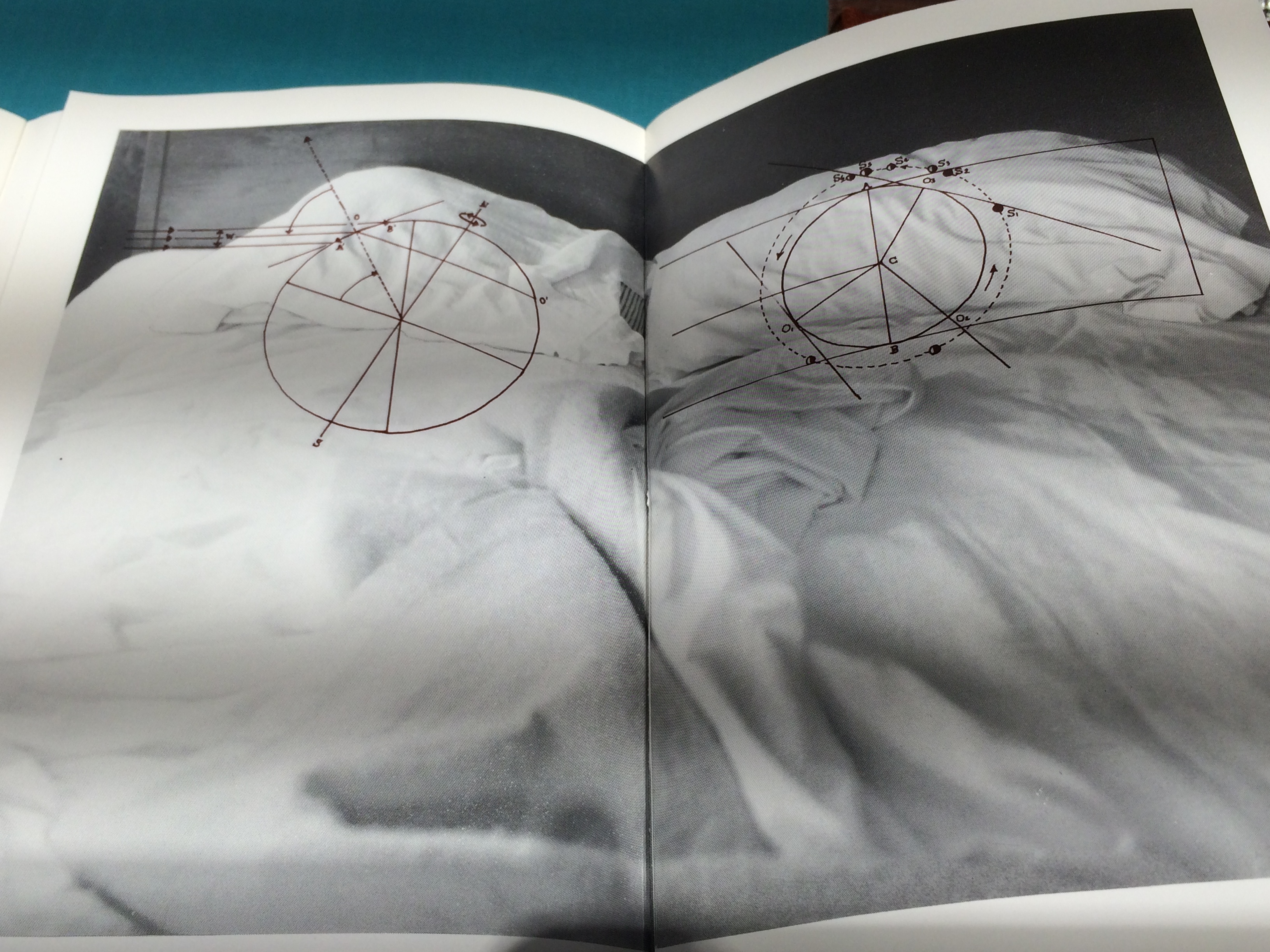
Glenn Horowitz Bookseller’s gallery Rare is currently showing the work of Sjoerd Hofstra with Karen O’hearn. On display are some of their artist’s books, featuring finely engineered kinetic elements. The subject matter of these books is directly mathematical. “A study in Averages” is a schematic treatise on the relationship between averages and society.
16-04-01

16-04-02

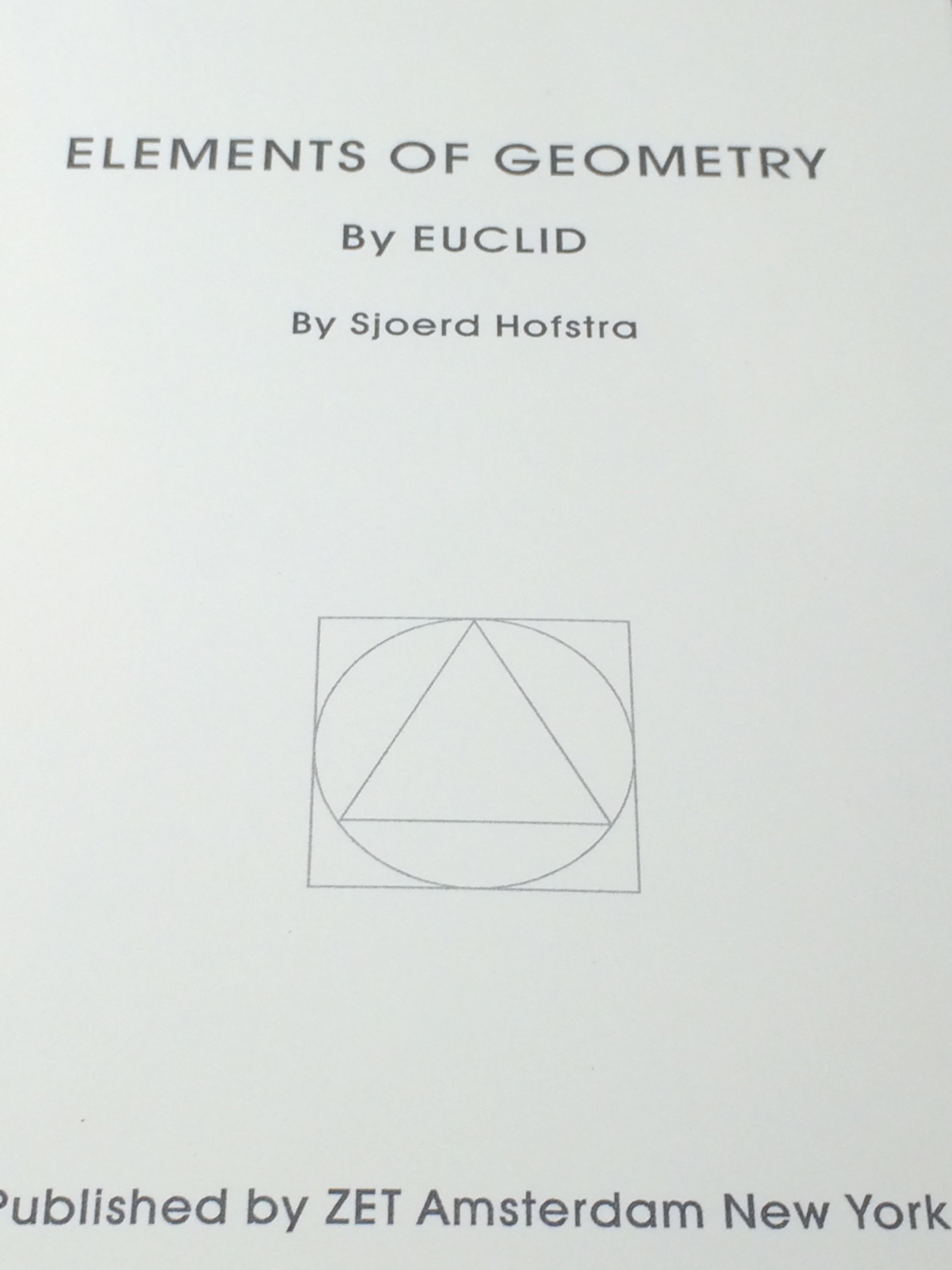
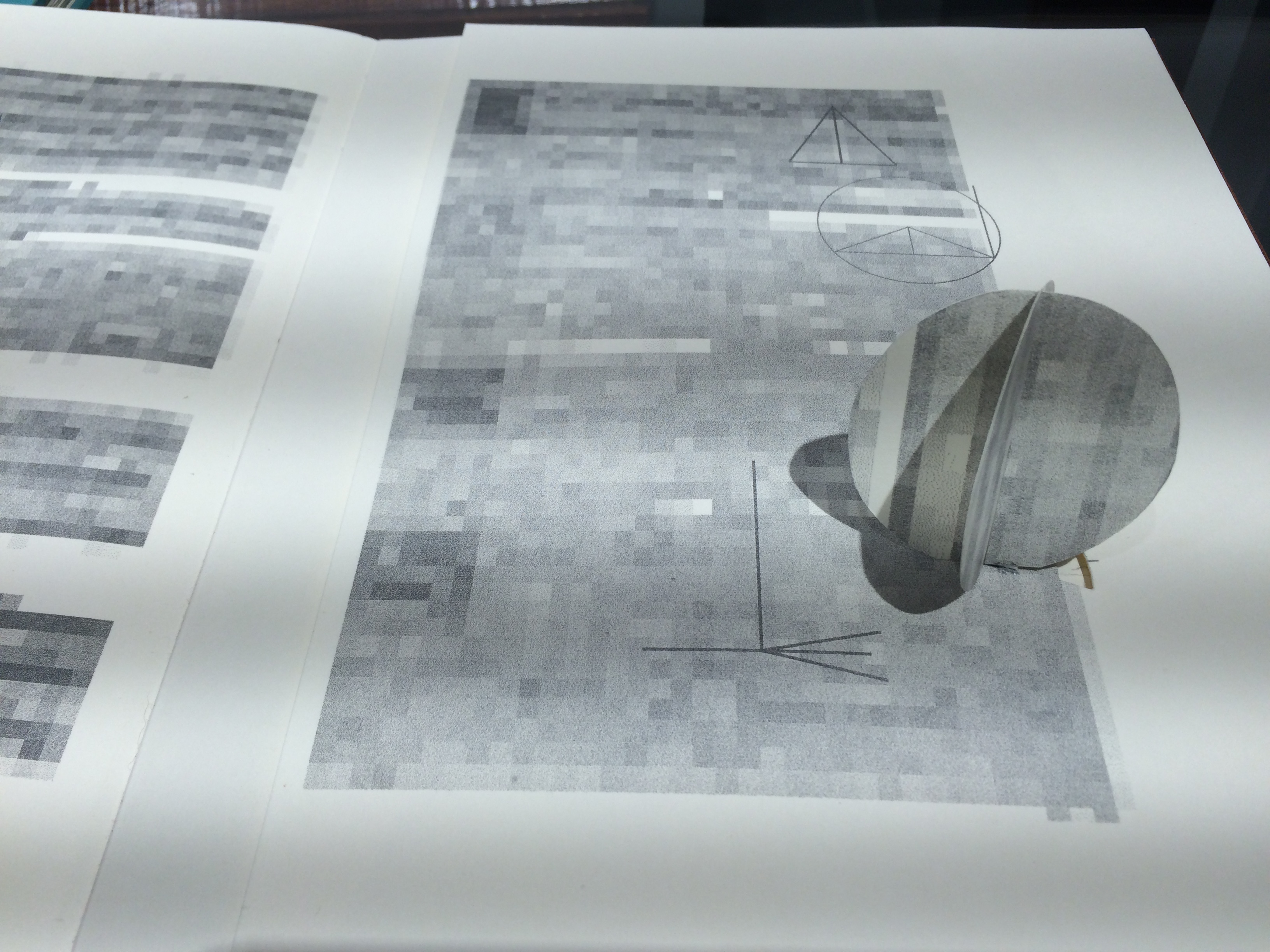
“Elements of Geometry by Euclid” includes pop-ups of the geometric solids. The mathematical texts have been blurred and instructional line drawings have been added.
 

16-04-04

16-04-03

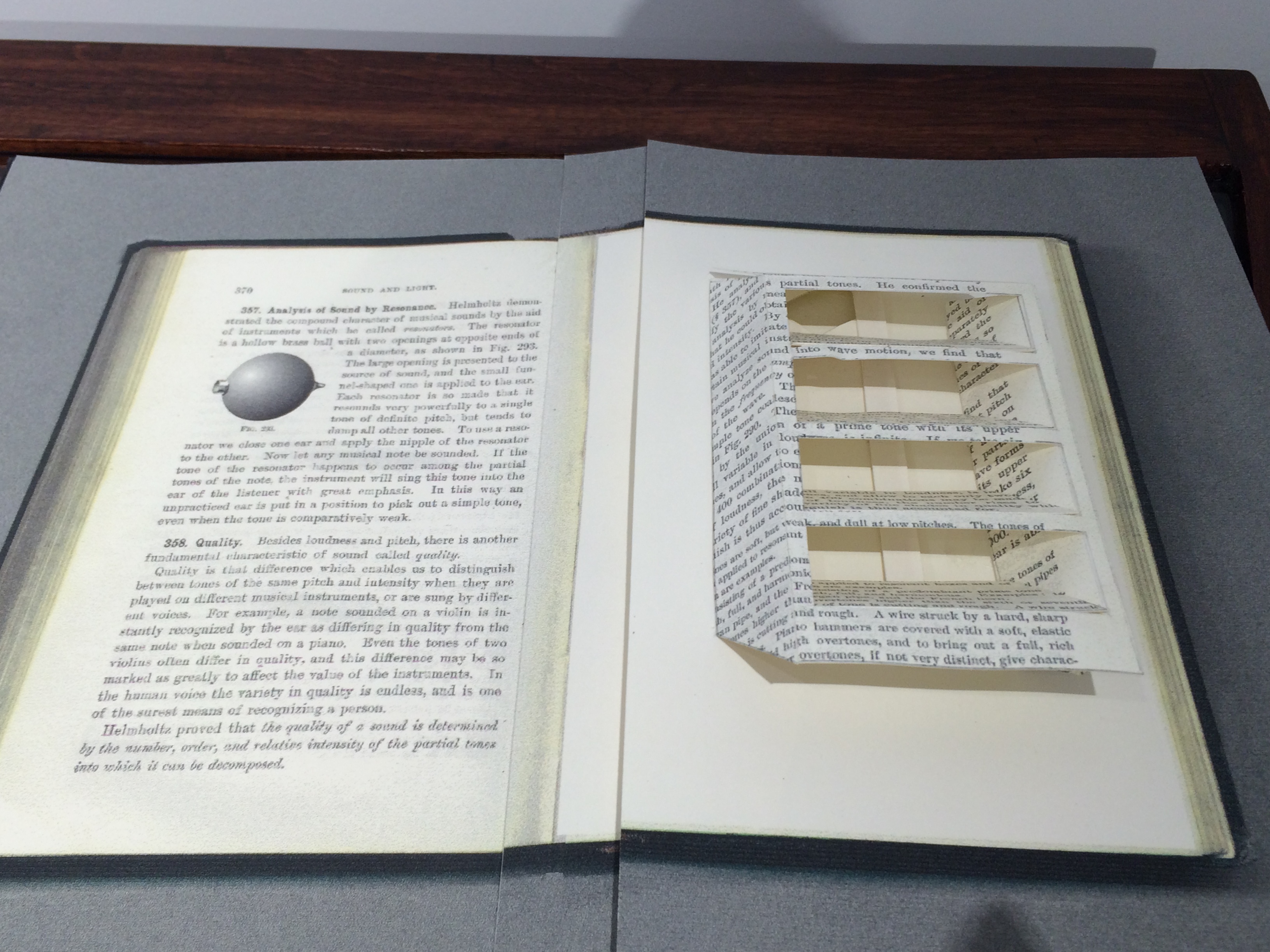
“6 Empty Bookcases” is more architectural, but each of the bookcases presents interesting geometric 3 dimensional properties as it folds off the page.
16-04-05

What I find refreshing about Hofstra’s and O’hearn’s books is the clear unabashed connection to the mathematics. Whether addressing the societal implications of the use of averages, or creating their own interpretation on the historical Euclidean text, or using sophisticated calculations to build their geometric bookcases, the artists embrace mathematics.

I realize how difficult it is to see the true interactive nature of these books through my inadequate photos. The artists have provided a video link so you can see their work in action.

Susan Happersett
Gao Rong at Klein Sun Gallery

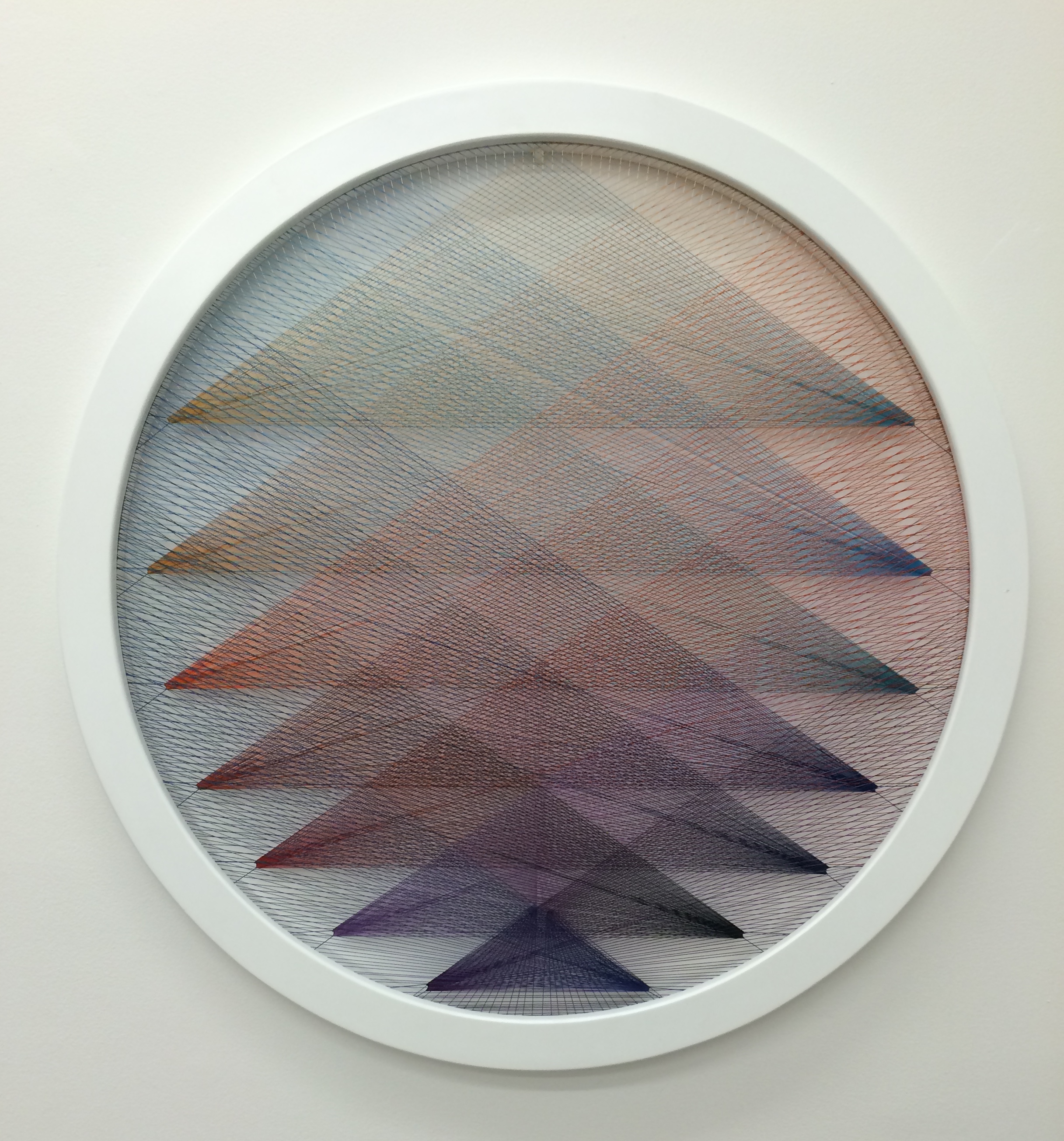
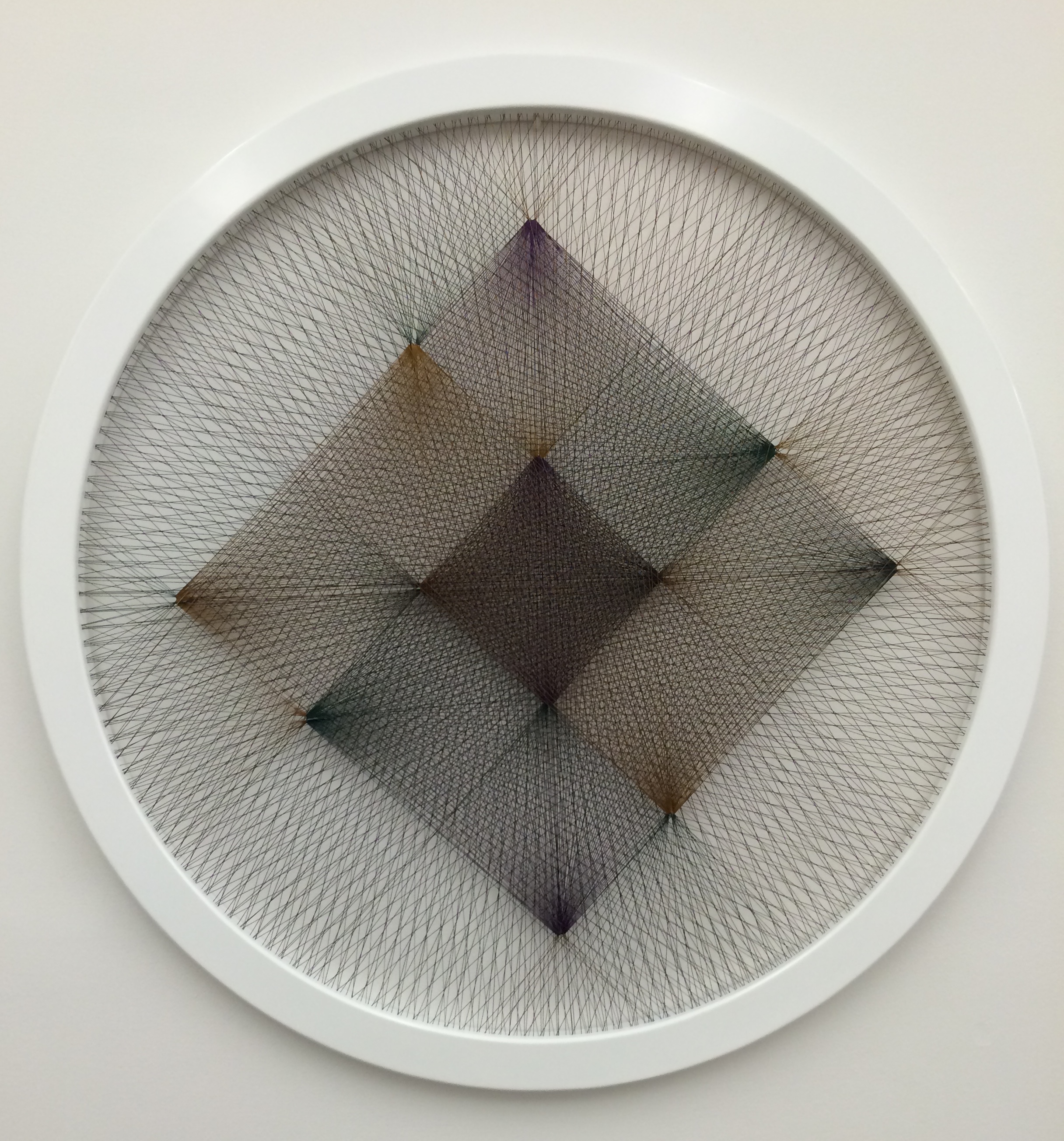
The current exhibition in the North gallery room of the Klein Sun Gallery is called “The Simple Line”. The show features the work of Beijing artist Gao Rong. Each of Gao Rong’s installation pieces is based on a circular hoop framework. Threads are stretched across the circle from evenly placed locations around the circumference. Although the basis of her subject matter is circular, through careful placement of the threads Gao Rong is able to create geometric arrangements featuring straight lines and angles.

16-02-01a

This work contains a square grid of nine squares with the center square darkened with the overlapping of many lines of thread. this work at first appears to have two axis of reflection symmetry but this is only superficial. Upon closer inspection we see that some of the corners of the of the squares are much darker than others and taking that into consideration there is an order-2 rotational symmetry.

16-02-02

The next work is based on triangles. Starting at the bottom with single unit  isosceles triangle, then moving up the structure, this single unit is overlapped by a triangle with a base twice as long. The next overlapping triangle has a base three times the length of the initial triangle Each subsequent triangle gets larger but also lighter in color. The shape seems to fade into the top of the circular frame.

There are two sets of theoretical juxtapositions in Gao Rong’s work. First and most is obviously the fact that the work illustrates linear structures within a curvilinear environment. Second, there is also the social statement of the use of colored thread, traditionally seen in women’s decorative needle work, to create very structured geometric diagrams that are heavily influenced by Mathematics.

Susan Happersett

Frank Stella at the Whitney Museum

Happy New Year!
I decided to start 2016 with a big show and the Frank Stella exhibition at the Whitney Museum definitely qualifies as a really big exhibition. When the elevator door opens into the first gallery,the viewer is met by two very different canvases: a large, geometric, consecutive squares painting, and a huge abstract that is exuberant to the point of being Baroque. The dichotomy of these two works highlights the the range of styles and themes explored throughout the galleries. On display are the all black paintings from the late 1950’s, as well as the colorful geometric square-and-shape canvases from the 1960’s. Also included are the wall sculptures from the 1980’s and the more recent work created using 3-D printing.
For the purposes of this entry I decided to concentrate on Stella’s paintings from the 1960’s. These works are clearly about geometry. Some of the artist’s sketches and schematic diagrams are on display as a group. I highly recommend taking a close look at these plans, they really highlight the mathematical processes involved in the paintings.

16-01-01

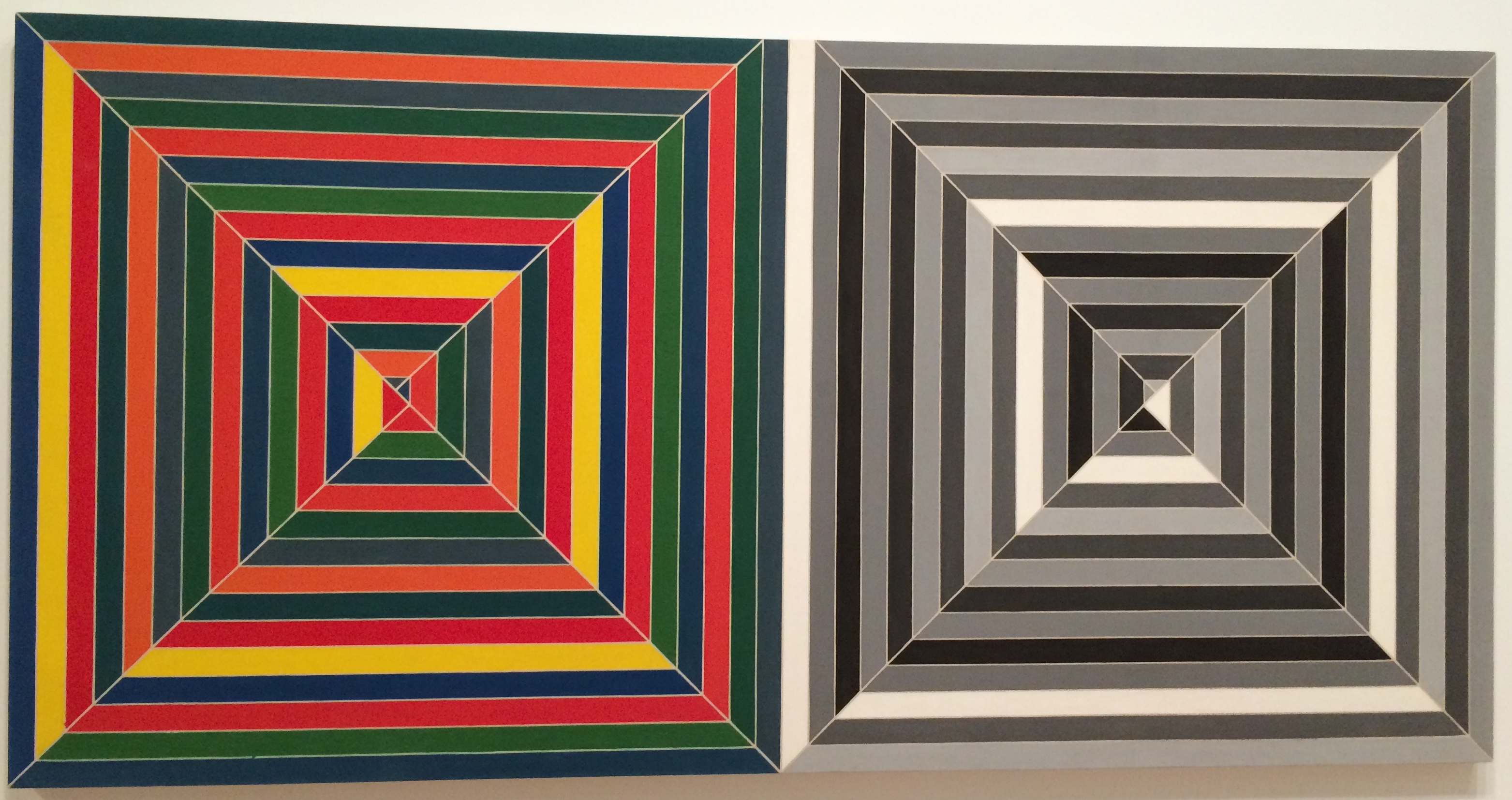
Stella – “Jasper’s Dilemma” – 1962

The two canvases of  “Jasper’s Dilemma” each have the same  spiral geometric structure, but the left canvas features a system of the color spectrum, while the right canvas is composed of shades of gray. Stella has built these spirals within the squares by creating two sets of isosceles triangles. The set with vertical bases are slightly larger than the triangles with the horizontal bases. This results in only one diagonal line on each canvas and the four triangles do not all meet at the same point.

16-01-02

Stella – “Empress of India” -1965 – Metallic powder in polymer emulsion on canvas

“Empress of India” is a monumental shaped canvas featuring a series of four V-shaped sections, each featuring a line of reflection symmetry and a 60 degree angle at the point of the “V”. There is also an interesting line of order-2 rotational symmetry running diagonally through the center section of the work.

Both “Jasper’s Dilemma” and “Empress of India” spotlight Frank Stella’s dedication to developing complex geometric structures in his work during the 1960’s.

Keep posted for many more observations on Mathematics and Art in 2016

Susan Happersett

Larry Zox at STUX + HALLER Gallery

The exhibition “LARRY ZOX: Master of Color and Form” is currently on display at the STUX + HALLER located at 57th street in Midtown Manhattan. This neighborhood has a number of blue chip galleries that show the work of established and often historically significant artists. Zox’s acrylic paintings from the late 1960’s are all about hard edge geometry on a flat plane.

15-49-1

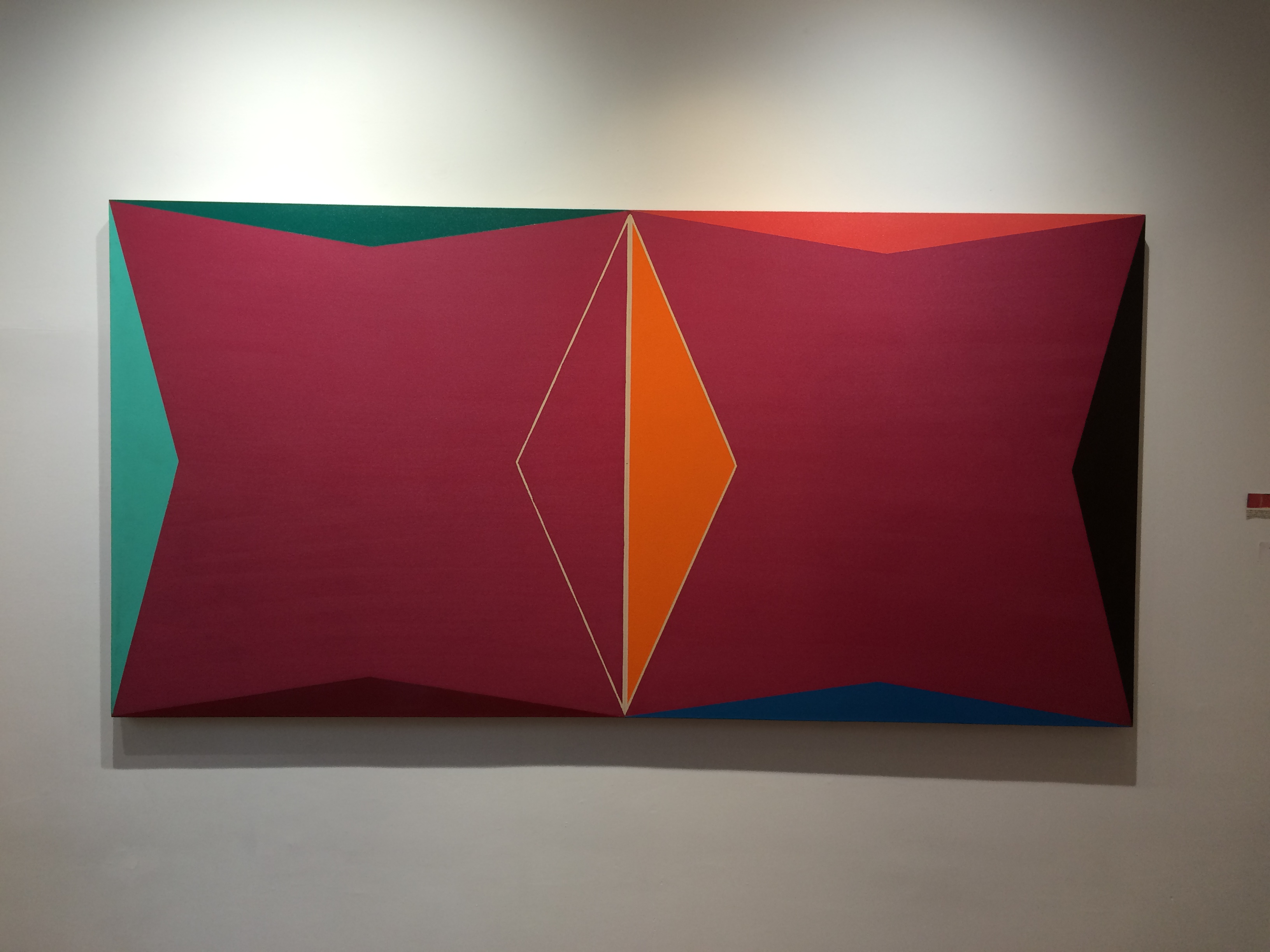
“Untitled” from the “Double Gemini Series”, 1969
Picture courtesy of the gallery

This large scale rectangular canvas has adjacent sides in a 2:1, ratio creating a format consisting of two equal squares. From each side of the squares an obtuse isosceles triangle has bee drawn. An obtuse isosceles triangle has two sides and two angles of equal measure, and the third  angle  measures over over 90 degrees. All Isosceles triangle have a line of reflection symmetry.  The triangles with vertical bases have a greater height than the triangles with horizontal bases. This gives the illusion of stretching the plan across the canvas. All but one of the triangles have been painted a different color than the central form. The left central vertical triangle is only defined by a white line outline. This painting is a very important piece, MOMA owns a similar work from this series. It is quite gratifying to be able to enjoy it in an intimate gallery setting.

Mary Heilmann at 303 Gallery

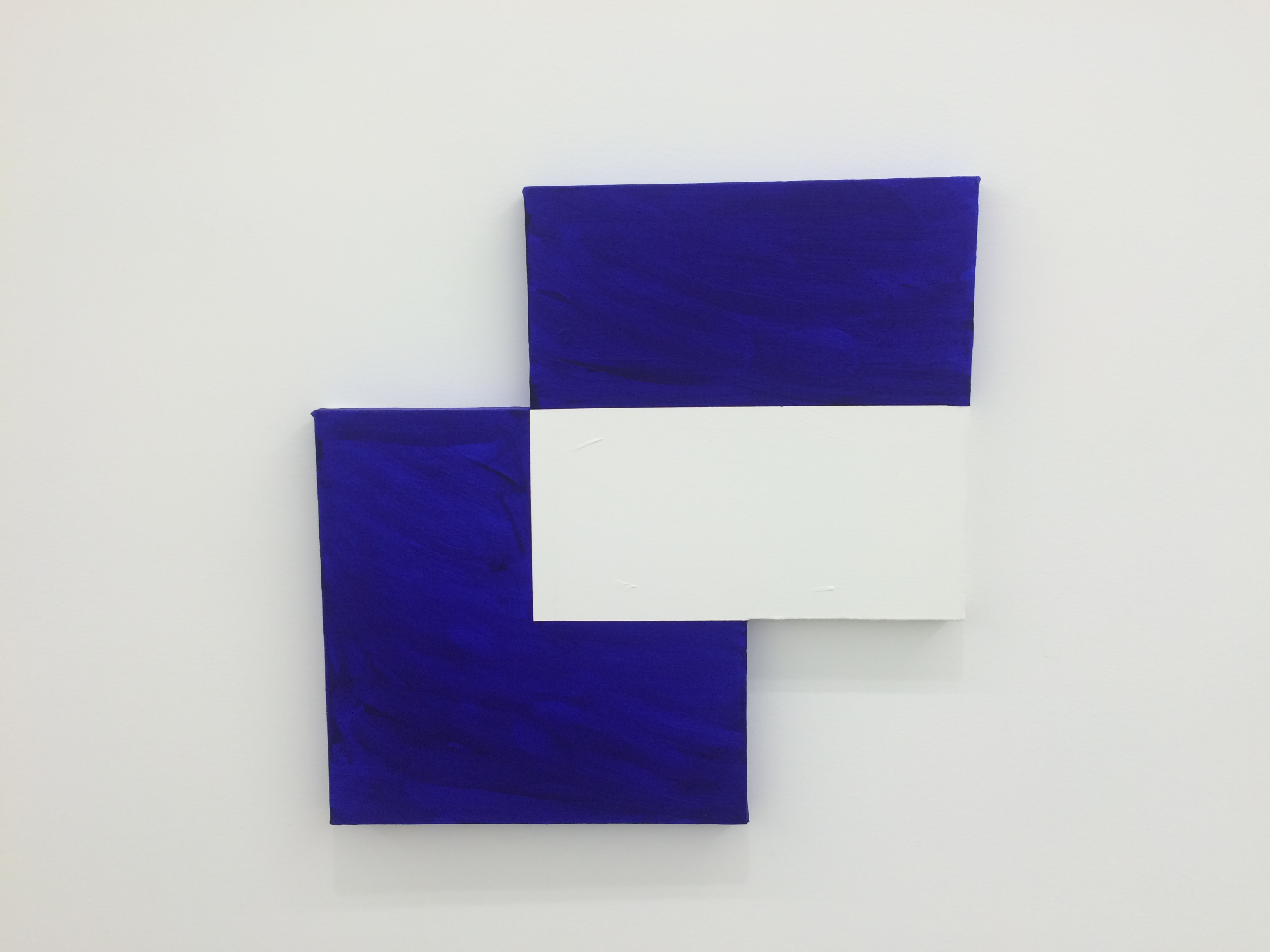
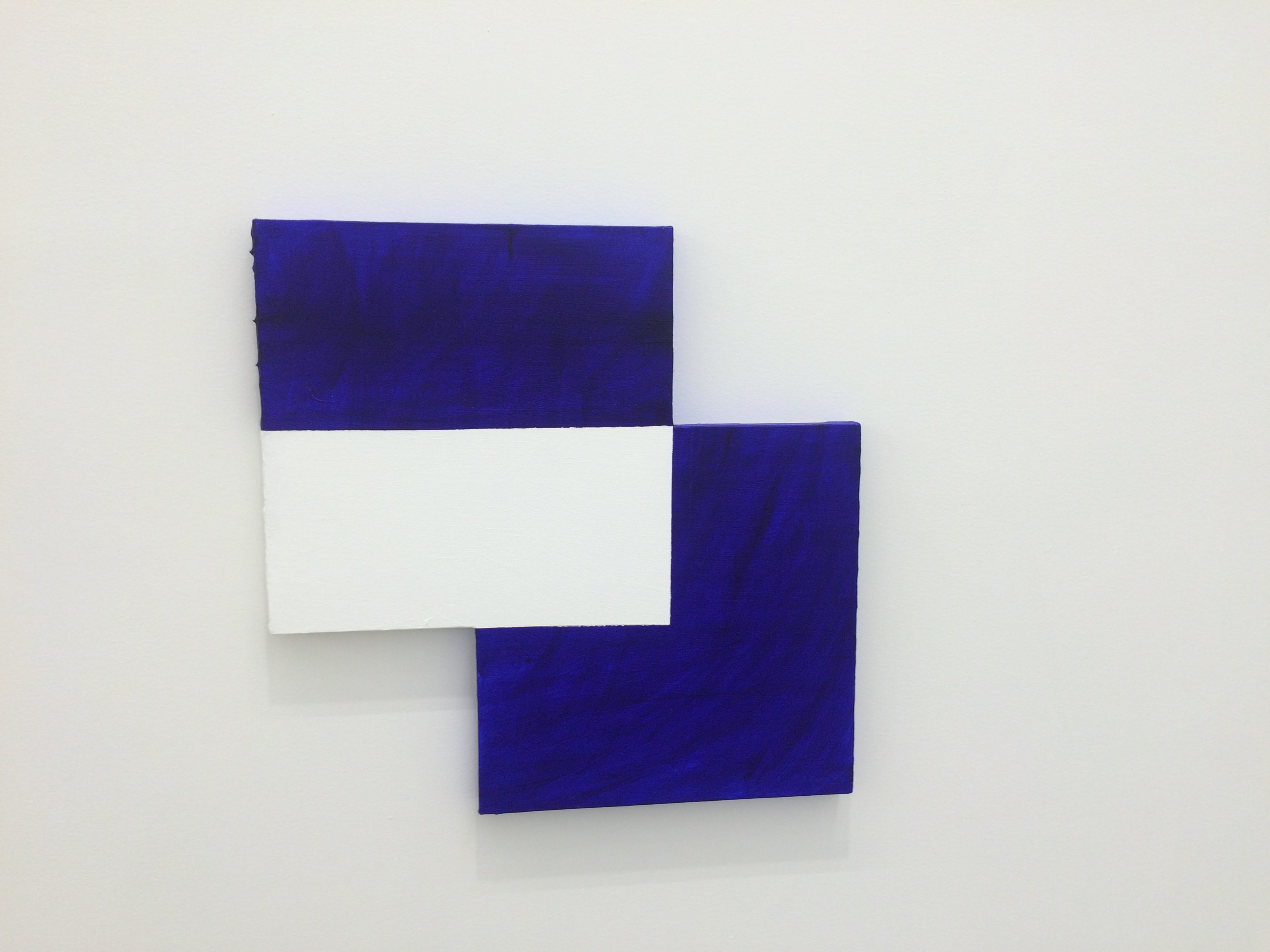
“Geometrics: Waves, Roads, Etc”, Mary Heilmann’s current solo show at 303 Gallery in Chelsea, features work with an emphasis, as the title suggests, Geometry. My favorite pieces were two shaped canvases, “Geometry Right’ and Geometry Left” both acrylic on canvas from 2015.

15-48-1
15-48-2
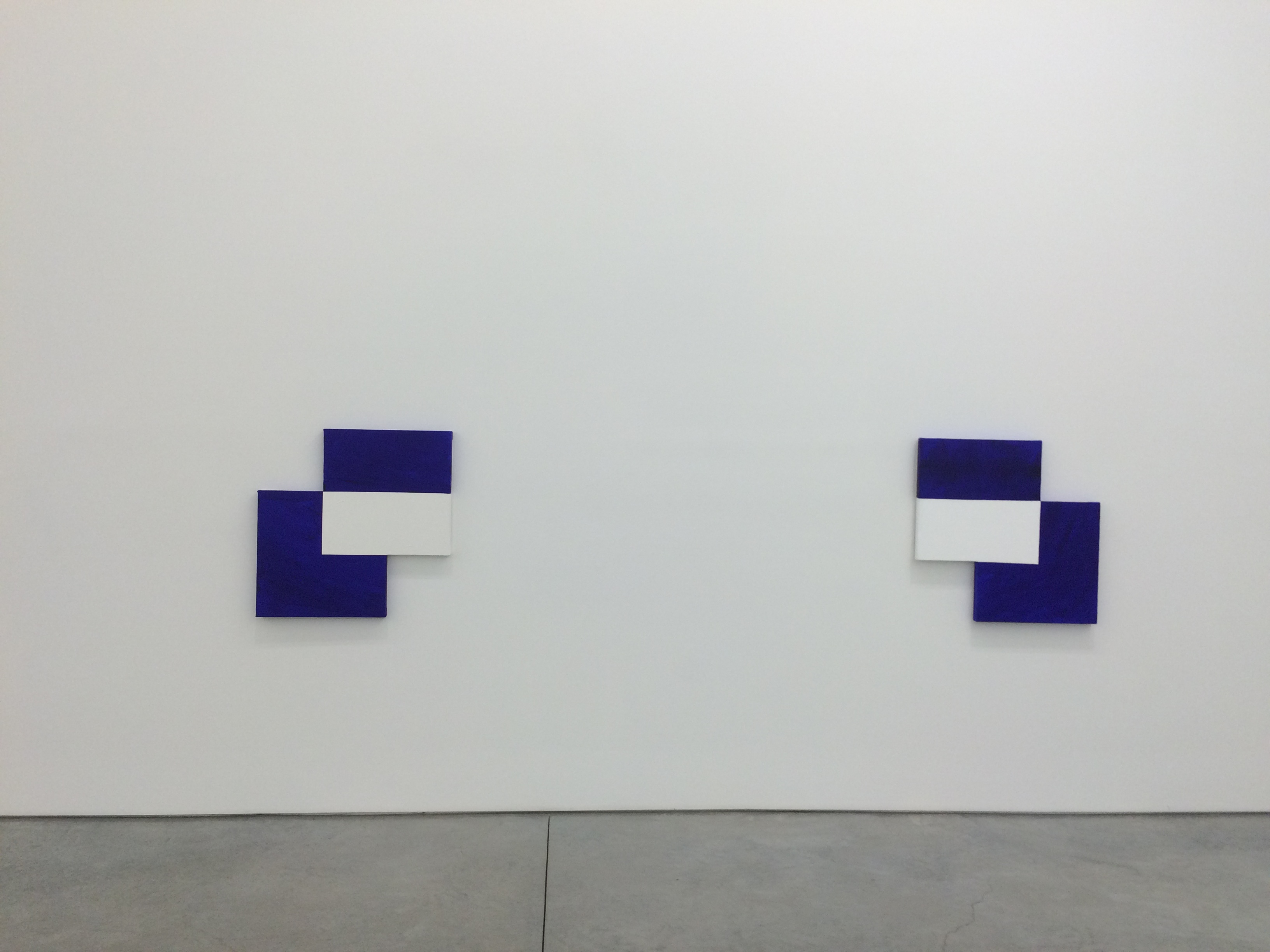
Each painting consists of two squares that overlap on a diagonal so that they share a corner quarter square. The top square of each pair is divided horizontally in half to create two congruent rectangles. The top rectangle is bright blue and the bottom rectangle is matte white. The two canvases are displayed in the gallery in a symmetrical fashion. The installation creates a reflection symmetry with the vertical axis of symmetry running midway between the works.

15-48-3

Although I was first drawn to these two canvases because of the geometry they represented. When I stood back to observe their placement in the gallery space, I realized the intriguing perspective of positive and negative space within the parameters of reflection symmetry.

Susan Happersett

On Kawara at MOMA

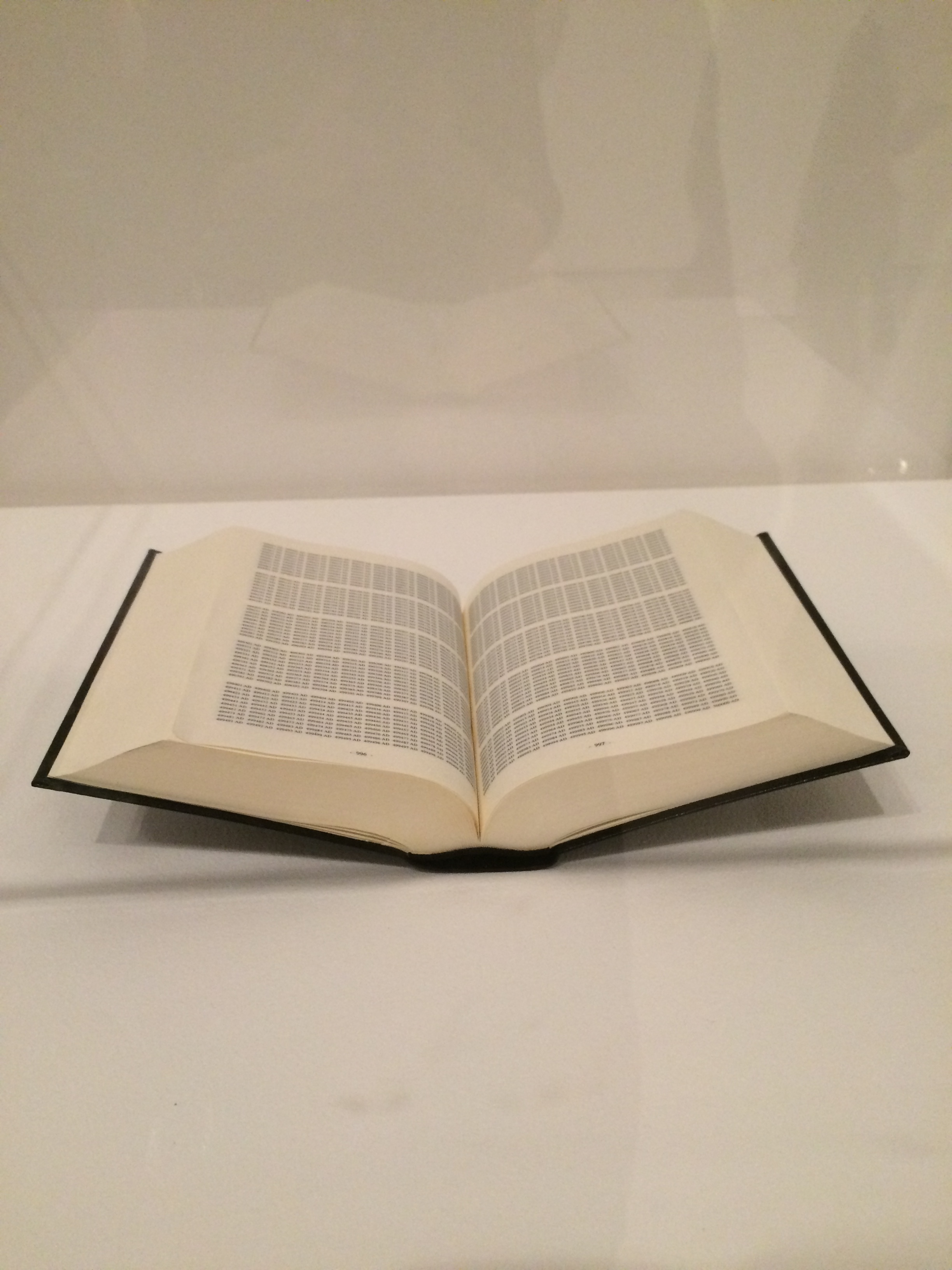
Currently on display Museum of Modern Art, “Scenes for a New Heritage” is a fresh reinstallation of the Museum’s collection of contemporary art. The first work you encounter as you enter the gallery is On Kawara’s “One Million Years (Past and Future)”. A limited edition Artist Book published in 1999 by Editions Micheline Szwajcer and Michele Didier, Brussels.  Situated on a white pedestal in a clear vitrine the book features rows and columns of numerical years in sequence from 998,031 BC to 1.001,992 AD.

15-45-1

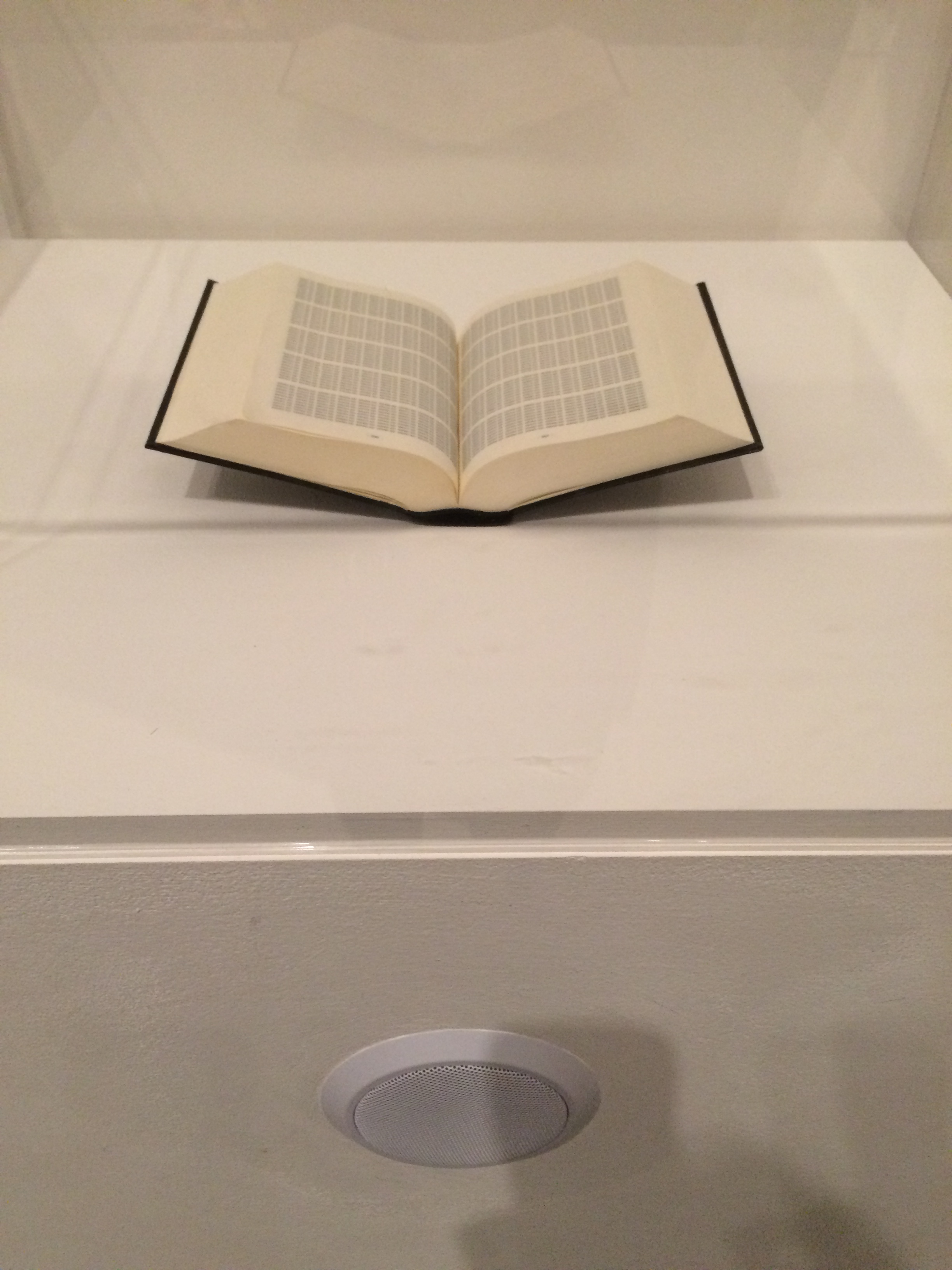
As you get close to the vitrine to study the book, a voice reads out the numbers of a year. There is a speaker in the front of the stand. If you stand close to the pedestal another year in consecutive order is read out. The voice on the recording alternates between male and female. The audio recording was produced by the David Zwirner Gallery NY in 2000. This installation at the MOMA is really two works of art, the visual component in the form of a book and a poetic component in the reading of the dates.

15-43-2

On Kawara is very famous for his paintings of single dates on canvas. I feel this installation reflects a deeper connection to Mathematics. The emphasis on the listing of numbers makes the viewer think about how we mark time using digits and order. The act of counting to this huge number of one million creates an extremely emotionally charged audio experience. The number are just as poignant as any other words in expressing the vastness and continuity of time.

Susan Happersett

Eleanor White at Matteawan Gallery

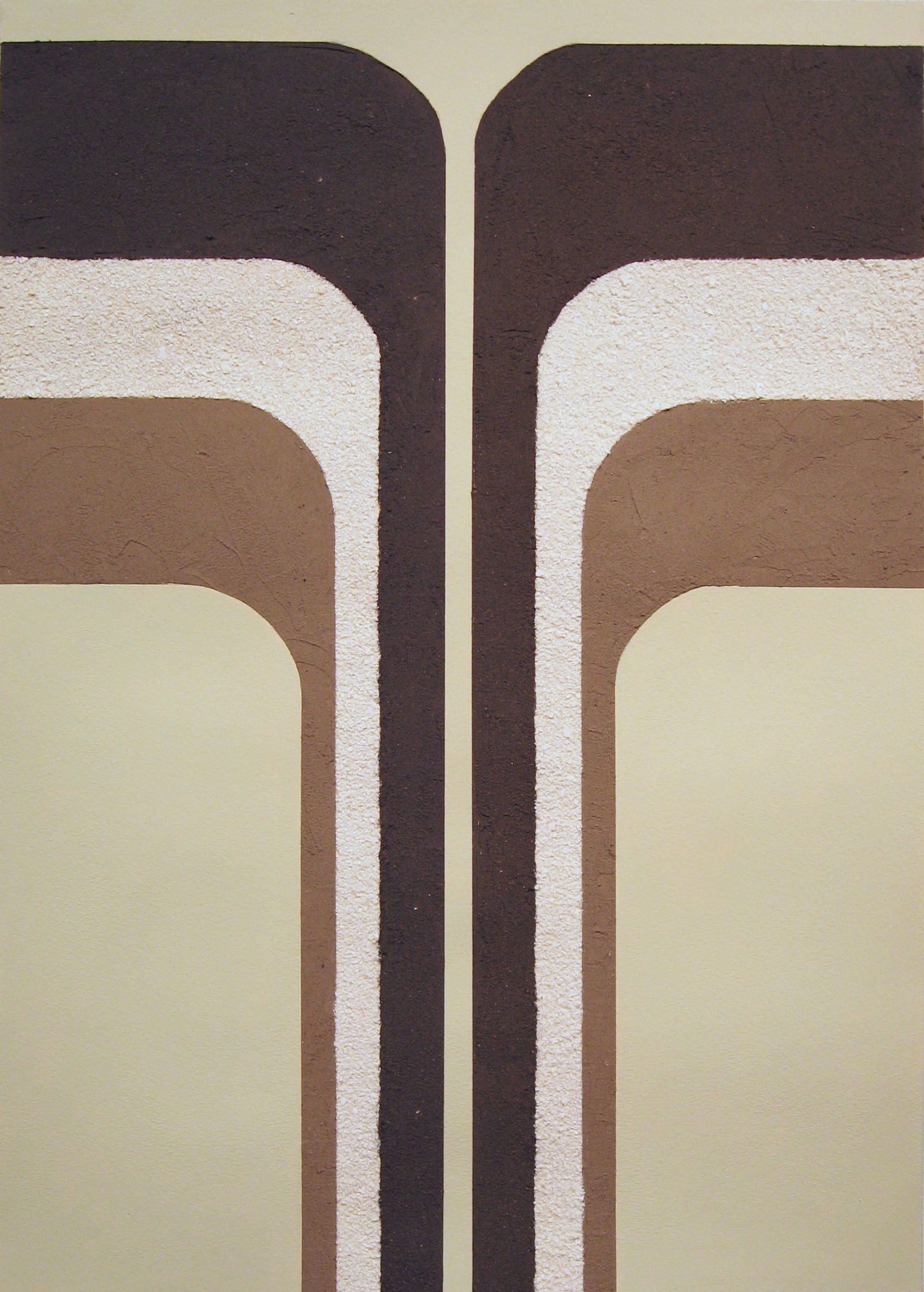
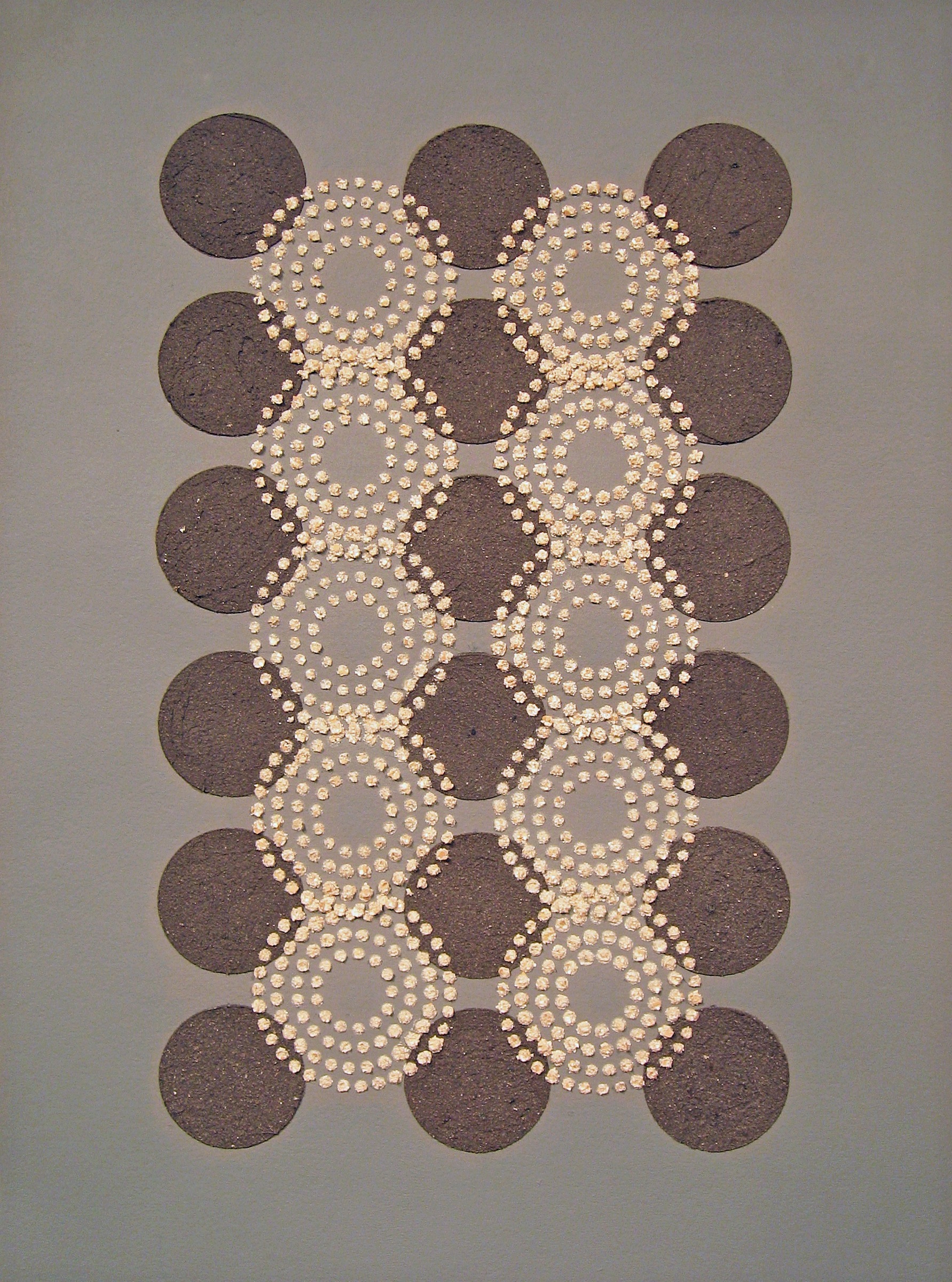
I have written about art in a variety of mediums,  but Eleanor White’s recent work on paper currently on display at the Matteawan Gallery in Beacon, NY is probably the most unique. White incorporates crushed egg shells and wood ash into paint resulting in a beautiful but gritty texture. Minimalism and 1960’s and 1970’s design are references for the artist and lead to the geometric qualities of the work.

eleanor stripes low res

“Untitled” 2015 eggshells, wood ash and paint on paper
Picture courtesy of the artist and the gallery

In this first drawing, “Untitled” from 2015, there is the obvious reflection symmetry with the line of symmetry running vertically through the center of the work. There is also the interesting visual effect of the thickness of the parallel bands of color. Narrow vertical section blend into thicker horizontal bands.

tan circles_black dots

“Untitled” 2015 Eggshells wood ash and paint on paper
Picture courtesy of the gallery and the artist

This next drawing is all about circles. It features a top layer of a 2 by 5 grid of slightly overlapping sets of 4 concentric circles. Each circle composed of dots of ground egg shells. The inner circles have 13 dots, then 20, 27 and finally 34 dots in the outer circle. The underlay of circles is a 3 by 6 grid of solid circle. The 2 by 5 grid packs elegantly on top of the 3 by 6 grid. It is an excellent illustration of how the proportions 3:6 relate to the proportions of 2:5.

White’s work has a lot of geometric and numerical mathematical elements. There is also a more subtle theme in the shapes of the tiny bits of crushed egg shells. The original oval 3D shape of the egg has been fractured and spread across the flat plane of the paper. But if you look closely you can still see tiny bits of the curved planes. These optical remnants of the original eggs give these drawings a complex surface that is inspired.

Susan Happersett

Richard Long at Sperone Westwater

Richard Long has along career of creating art about nature based on his walks through different landscapes. I saw more recent work last week at Sperone Westwater.

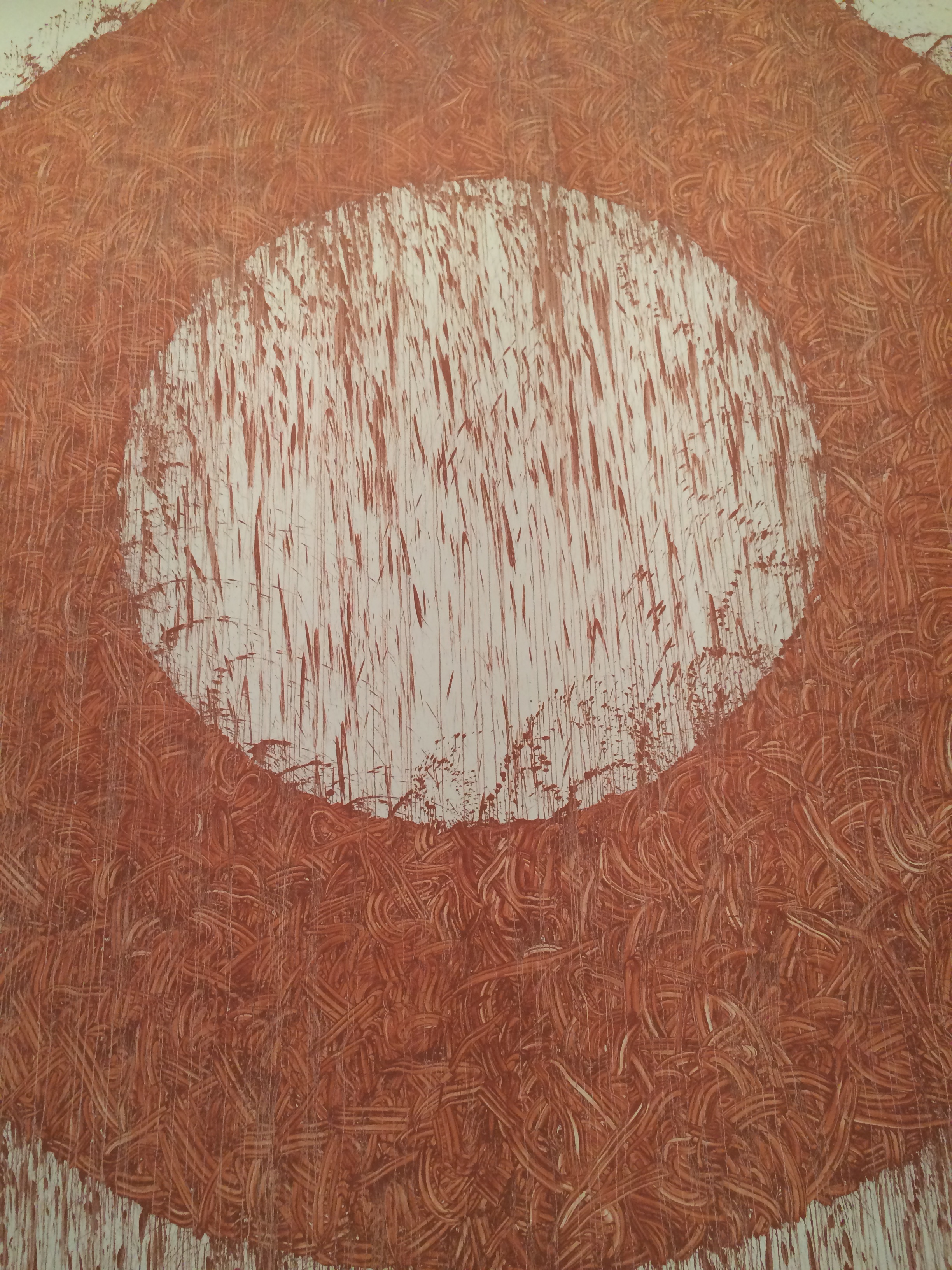
One double height wall in the gallery features a sight-specific giant circular drawing created by the artist by hand, by applying red mud directly to the wall.
15-41-1
This gallery room is taller than it is wide, so the viewer must look up to see the entire circle. This creates an interesting optical element. Although the circle has a consistent width it appears to be thicker at the bottom and thinner at the top. It is a perfect expression of how geometric appearance can change based on the location of the form and the viewer in space.
15-41-2
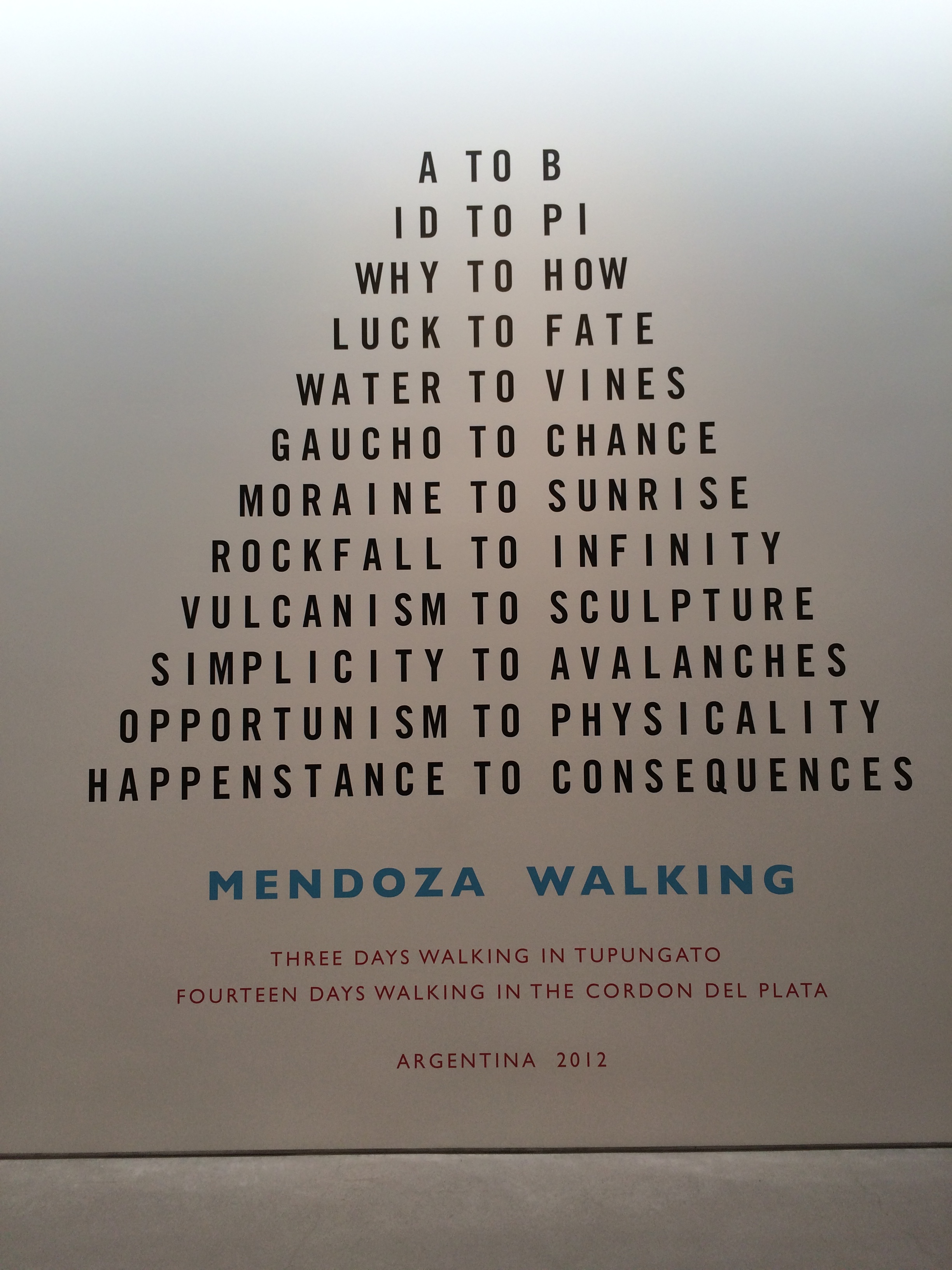
Richard Long’s artistic practice also includes text based work. The visual poem “Mendosa Walking”  incorporates an interesting use of counting and mirror symmetry. The 12-line text has a center column using the two letter word “TO” to join the a word on each side. the number of letters in these words increases by one letter going down the rows. From “A”  “TO” “B” at the top all the way down to “HAPPENSTANCE” “TO”  “CONSEQUENCES”.

Susan Happersett

Mark Barrow and Sarah Parke at Elizabeth Dee Gallery

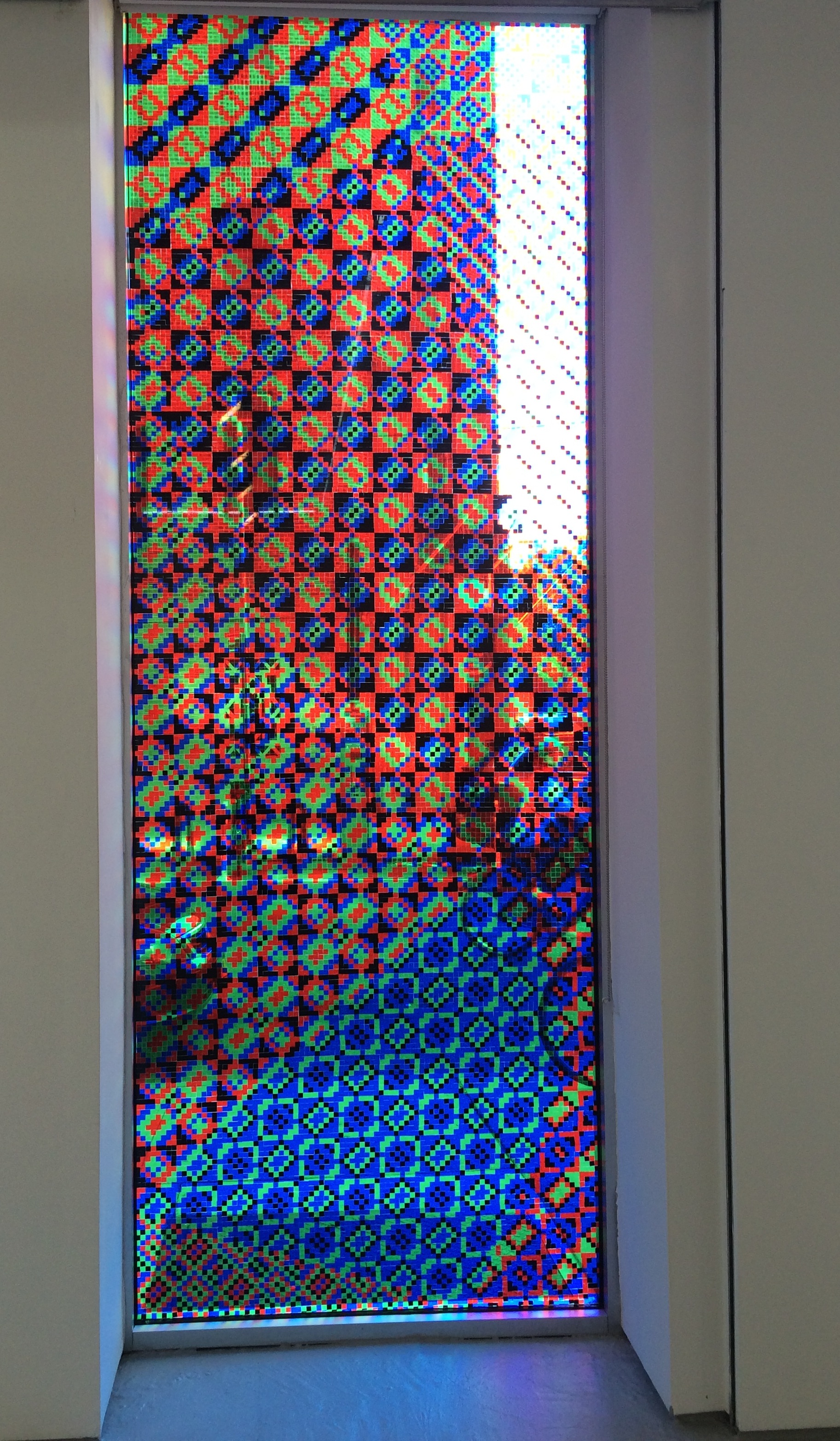
“wave, particle, string” is the title of the exhibition at the Elizabeth Dee gallery featuring the collaborative work of Sarah Parke and Mark Barrow.

15-38-1
I was walking across West 20th street when I spotted this great great mosaic in the front window of the gallery. Created by applying tiny squares of black, red, green, and blue vinyl directly to the glass, it forms a grid based on the Cartesian coordinate system. Inside the gallery there is a diverse selection of work consisting of woven textiles, painting and videos. I found the “Swipe paintings” particularly interesting.

15-38-2
Barrow and Parke are interested in the organization within systems of data. Taking small patterns of geometric information and repeating them through framework of the Cartesian grids, the results are both complex and ordered. In the “swipe” paintings the color changes are based on the finger swipes Barrow has made drawing on an iPad. This reinforces the link between the mathematical elements of the work and technology.

Susan Happersett


Terry Haggerty at Sikkema Jenkins & Co.

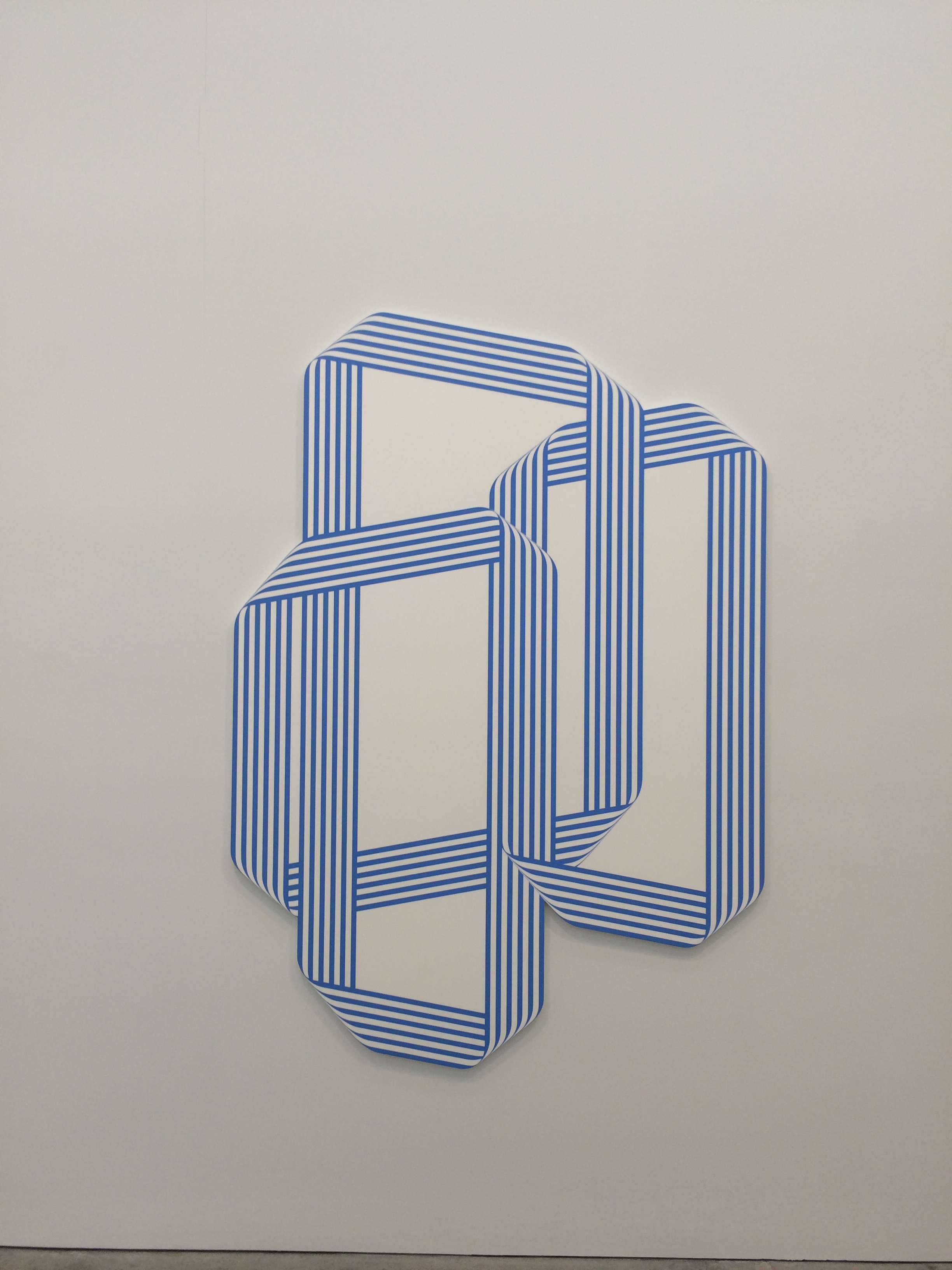
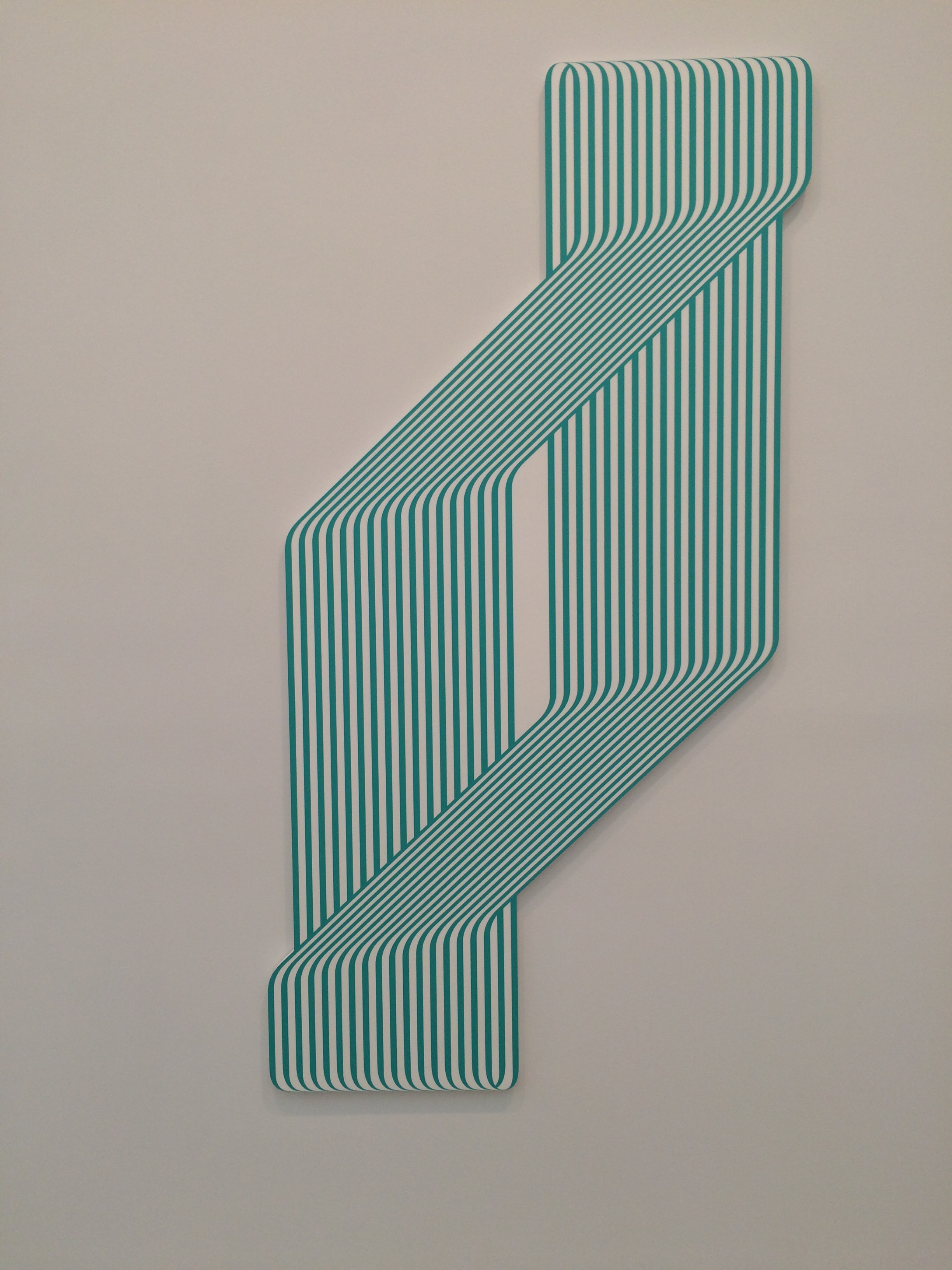
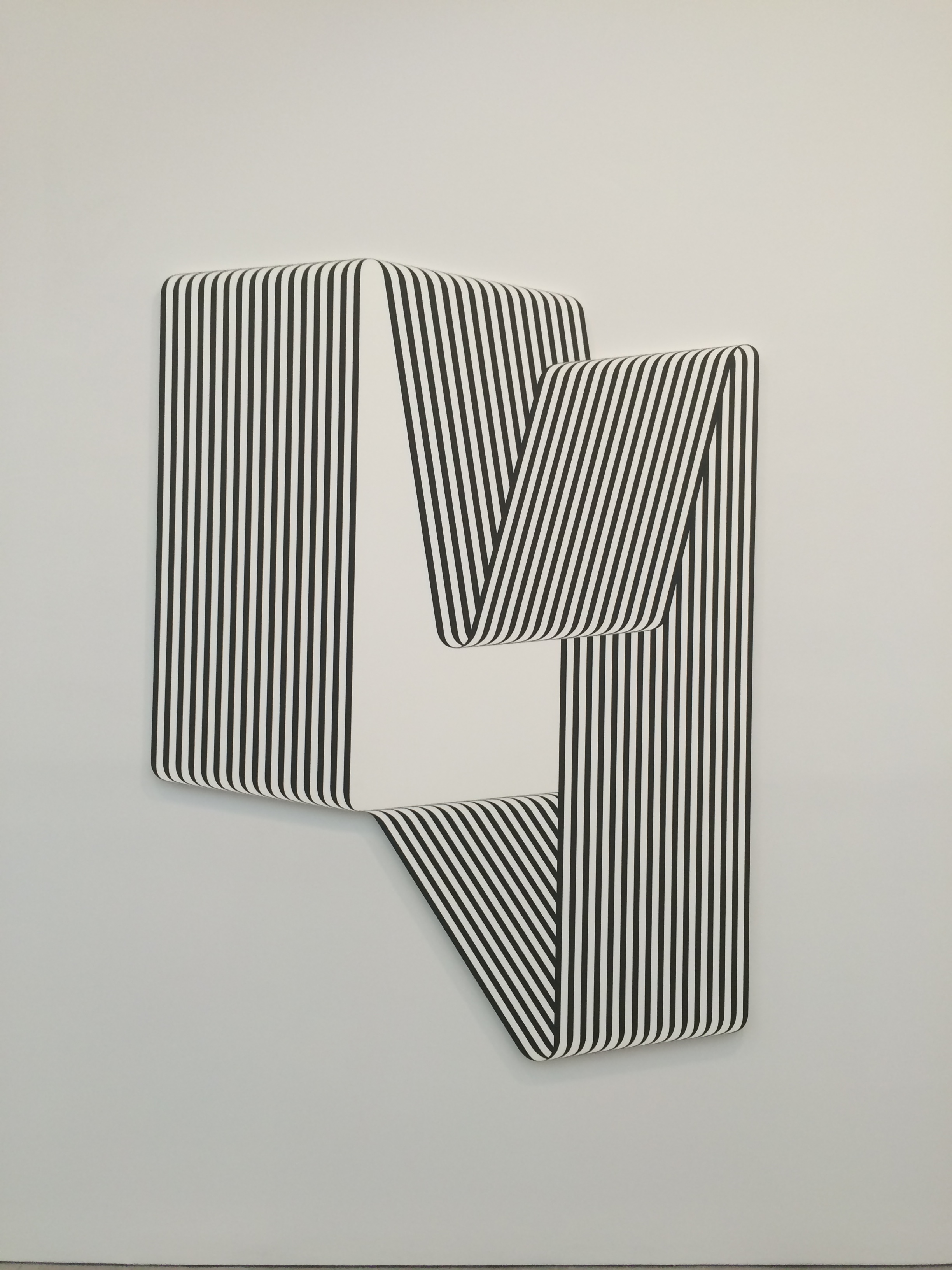
The Fall season is in full swing in the New York art world. All of the galleries have opened fresh shows and I am continuing my Math/Art treasure hunt. The Sikkema Jenkins & Co. gallery in Chelsea is exhibiting the brand new work of Terry Haggerty.  A virtuoso of parallel lines, Haggerty is able to create an illusion of depth without the use of shading.

15-38-3

“Detatched” – 2015 – Acrylic on wood panel

Although the paintings are on flat panels of wood, the ribbons of line seem to bend and fold. Haggerty’s technique of using hard edge lines creates an optical paradox as his forms seem to loop through space.

15-37-2

“Torque” – 2015 – Acrylic on wood

The painting “Torque” depicts a closed loop that appears to be twisting around itself.

15-37-1

“Easily Lost” – 2015- Acrylic on wood panel

Image 3 x.

“Easily Lost” is one of the most complex structure in the exhibition.The ribbon of parallel lines is thinner than in other paintings and the loop is arranged in a circuit three overlapping rings.

Haggerty uses the vocabulary of Hard Edge and Minimalist painters from years ago, but by incorporating parallel lines he has allowed his geometric forms to optically leave the 2-dimensional plane.

Susan Happersett